
“What it means is Eclipse now
gets to expand its footprint
beyond the
traditional computing environ
ment, and it gets to reach out
to the mobile device.
TWO KINDS OF MOBILITY:
•USER MOBILITY
•DEVICE MOBILITY
WHAT IS MOBILE COMPUTTING:
•DEFECTOR STANDARD BY
ITSELF
•MAJOR PART OF WIRELESS
COMMUNICATION TECHNOLOGY
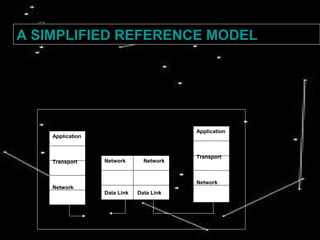
Application
Transport
Network
Data Link
Network Network
Data Link Data Link
Physical Physical
Application
Transport
Network
Data Link
Physical
A SIMPLIFIED REFERENCE MODEL
The wireless devices represent the
ultimate constrained computing device
with:
•Less powerful CPUs,
•Less memory (ROM and RAM)
•Restricted power consumption
•Smaller displays
•Different input devices (e.g., a phone
keypad, voice input, etc.)
On the network side, wireless networks
are constrained by
•Less bandwidth
•More latency
•Less connection stability
•Less predictable availability
Goals, assumptions, and
requirements:
The Internet is the network for global
data communication with hundreds of
millions of users. So why not simply
use a mobile computer in the
Internet?
Requirements:
•Compatibility
•Transparency
•Scalability and efficiency
•Security
APPLICATIONS:
1. Vehicles
2. Emergencies
3. Business
4. MOBILE AND WIRELESS DEVICES
5. Sensor:
6. Pager:
7. Mobile Phones:
8. Personal digital assistant:
9. Palmtop/pocket computer:
10.Notebook/Laptop:
CONCLUSION
Mobile Computing and Communications is
useful for wireless Networks. The study of
different versions will give differences
between Mobile Computing and
Communications, Access Control, Security
etc.,
QUERIES????
PRESENTED BY

Mobile computing