STRUCTURE OF PROFESSIONAL DEVELOPMENT-
        MODULE FOR NACOL’S STANDARD I :
           QUALITY ONLINE TEACHING:
 iNACOL Mission: Ensure all students have access to
  world-class education & quality online learning
  opportunities that prepare them for lifetime of success
     This PD will concentrate on Standard I Pg. 14
  The online teacher will demonstrate competency in
   using data from assessments and other data sources
     to modify content and to guide student learning.
 There are 6 principles in relationship to Standard I
  (pg. 14) that teachers will be held accountable and
  must demonstrate mastery in all skills-
DEVELOPMENT-MODULE FOR INACOL’S STANDARD I
       QUALITY ONLINE TEACHING: CONT.
    This professional development will focus on the six
     principles in relation to Standard I which include:
1) Effective management strategies,
2) Understands online course management tasks,
3) Knows & understands student readiness for course,
4) Knows & understands students success is an important
  measure of teaching & course content,
5) Knows & understands the importance of student self-
  assessment,
6) Knows & understands the role of student empowerment
  in online learning,
MODULE OBJECTIVES FOR
            STANDARD I:
Upon completion the learner will be able to:
1) Effectively incorporate time management skills
  into an online learning course
2)Use a variety of digital programs to assist in
management skills
3) Set up a survey to poll students for information
4) Design a WIKI page
5) Design a Self-Assessment and Reflection Form
6) Begin building on eLearning Toolkit
PRINCIPLE 1:THE ONLINE TEACHER KNOWS AND
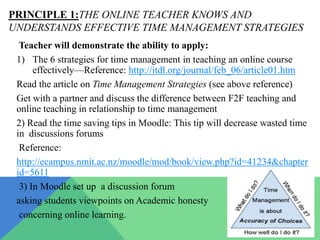
UNDERSTANDS EFFECTIVE TIME MANAGEMENT STRATEGIES
  Teacher will demonstrate the ability to apply:
 1) The 6 strategies for time management in teaching an online course
      effectively—Reference: http://itdl.org/journal/feb_06/article01.htm
 Read the article on Time Management Strategies (see above reference)
 Get with a partner and discuss the difference between F2F teaching and
 online teaching in relationship to time management
 2) Read the time saving tips in Moodle: This tip will decrease wasted time
 in discussions forums
  Reference:
 http://ecampus.nmit.ac.nz/moodle/mod/book/view.php?id=41234&chapter
 id=5611
  3) In Moodle set up a discussion forum
 asking students viewpoints on Academic honesty
  concerning online learning.
PRINCIPLE 2: THE ONLINE TEACHER KNOWS AND
UNDERSTANDS ONLINE COURSE MANAGEMENT TASKS.
    The learner will demonstrate the ability to:
   1) Put together an e-learning toolkit to assists in class
      assignments—Reference:
      http://blended.online.ucf.edu/blendkit-course-diy-
      project-tasks/ Complete Task: 01 & 02:
    Course Blueprint & Design for Interaction Learning
   2) Manage the Moodle course management system (CMS)
   to create online learning sites
   Reference: http://moodle.org/
   Principle 1 Activity 2 & 3 will assist with managing the
   Moodle site
PRINCIPLE 3: THE ONLINE TEACHER KNOWS AND
UNDERSTANDS WAYS FOR TEACHER AND STUDENTS TO
ACCESS STUDENT READINESS FOR COURSE CONTENT
AND METHOD OF DELIVERY
             The learner will demonstrate the ability to:
  1) Schedule events and poll students using Doodle Mydoodle
     Reference: http://www.doodle.com/
  2) Take the learning style inventory (LSI):
     Reference:
    http://people.usd.edu/~bwjames/tut/learning-
    style/stylest.html
   After taking the LSI get with a partner and discuss:
  What are the different types of learning styles?
  What are ways you can differentiate instruction for
   online learners?
PRINCIPLE 4: THE ONLINE TEACHER KNOWS AND UNDERSTANDS
THAT STUDENT SUCCESS (E.G., GRADE, LEVEL OF
PARTICIPATION, MASTERY OF CONTENT, COMPLETION PERCENTAGE
) IS AN IMPORTANT MEASURE OF TEACHING AND COURSE SUCCESS.


               The learner will demonstrate the ability to:
   1) Access student information to gather important data in
       determining student’s level of readiness
   2) Create various styles of evaluations to meet the needs of
       individual students
   (Example: Design a rubric for a project) Reference: Rubistar
   http://rubistar.4teachers.org/ (Create a rubric for a high achieving
   student and one for a low achieving student)

   Name types of assessments online teachers can utilize.
   How can teachers prevent cheating on assessments?
   With a partner design an Academic Honesty Policy
PRINCIPLE 5: THE ONLINE TEACHER KNOWS AND
UNDERSTANDS THE IMPORTANCE OF STUDENT SELF-
ASSESSMENT.
    The learner will demonstrate the ability to:
   1) Design a transition assessment tool for students
 The tool will be used to collect data on student
   interests, strengths, weaknesses
 For insight locate: Student Self-Assessment and
   Reflection Form: Website
   http://www.iidc.indiana.edu/styles/iidc/defiles/INS
   TRC/TuesTips/Student_Self_eval_benefits.pdf
PRINCIPLE 6: THE ONLINE TEACHER KNOWS AND
UNDERSTANDS THE ROLE OF STUDENT EMPOWERMENT
IN ONLINE LEARNING.

     The learner will demonstrate the ability to:
1) Design a WIKI page for students to interact and
   contribute to projects
2) Read the article: Online Learning design that fosters
   student support, self-regulation, and retention.
   Website:
   https://pantherfile.uwm.edu/simonec/public/Motivati
   on%20retention%20articles/Articles/Fisher_OnlineL
   earningDesign.pdf
3) After reading the article list instructional strategies
   teacher can utilize to build student ownership with
   online learning.
PROFESSIONAL DEVELOPMENT DOES NOT
    STOP-CONTINUE TO GROW & DEVELOP

 Upon completion of each activity under each principle
  the learner will advance a step closer to becoming a
  quality online instructor.
 Quality instructors seek to improve daily in their
  profession-Never accept the status quo & continue to
  grow and develop as an online instructor
 Set the bar high-your students will meet your
  expectations & sometime surprise you
 I have supplied an excellent source to begin your e-
  learning toolkit- Go ahead: eat your frog now!!
  http://www.elearning.ubc.ca/toolkit/academic-continuity-
  toolkit/
Thank you for your
participation, listening and
      learning skills!
REFERENCES
Doodle. (2012). Easy scheduling. Retrieved on June 29, 2012 from http://www.doodle.com/
Fisher, M., & Baird, D. (2005). Online learning design that fosters student support, self-
    regulation, and retention. Emerald Research Register, 22(2), 88-107.
iNACOL. (2011). National standards for quality online teaching. Retrieved on June 29, 2012 from
    http://www.inacol.org/research/nationalstandards/iNACOL_TeachingStandardsv2.pdf
Indiana Secondary Transition Resource Center. (n.d.) Student self-assessment & reflections.
     Retrieved on June 28, 2012 from
     http://www.iidc.indiana.edu/styles/iidc/defiles/INSTRC/TuesTips/Student_Self_eval_benefits.pdf
Instructor Magazine (2009). What’s your learning style? Retrieved on June 29, 2012 from
     http://people.usd.edu/~bwjames/tut/learning-style/stylest.html
Moodle. (2011). What is moodle? Retrieved on June 29, 2012 from http://moodle.org/about/
Nelson Marlborough Institute of Technology. (2012). Time saving tips in moodle. Retrieved on June
    29, 2012 from http://ecampus.nmit.ac.nz/moodle/mod/book/view.php?id=41234&chapterid=5611
Rubistar. (2008). Welcome to rubistar. Retrieved on June 29, 2012 from http://rubistar.4teachers.org/
Shi, M., Bonk, C., & Magjuka, R. (2006). Time management strategies for online teaching.
     International Journal of Instructional Technology & Distance Learning. Retrieved on June
     28, 2012 from http://itdl.org/journal/feb_06/article01.htm
University of Central Florida. (n.d.) Blendkit course: DIY project tasks. Retrieved on June 29, 2012
    from http://blended.online.ucf.edu/blendkit-course-diy-project-tasks/

Standard i pg 14

  • 2.
    STRUCTURE OF PROFESSIONALDEVELOPMENT- MODULE FOR NACOL’S STANDARD I : QUALITY ONLINE TEACHING:  iNACOL Mission: Ensure all students have access to world-class education & quality online learning opportunities that prepare them for lifetime of success This PD will concentrate on Standard I Pg. 14 The online teacher will demonstrate competency in using data from assessments and other data sources to modify content and to guide student learning.  There are 6 principles in relationship to Standard I (pg. 14) that teachers will be held accountable and must demonstrate mastery in all skills-
  • 3.
    DEVELOPMENT-MODULE FOR INACOL’SSTANDARD I QUALITY ONLINE TEACHING: CONT. This professional development will focus on the six principles in relation to Standard I which include: 1) Effective management strategies, 2) Understands online course management tasks, 3) Knows & understands student readiness for course, 4) Knows & understands students success is an important measure of teaching & course content, 5) Knows & understands the importance of student self- assessment, 6) Knows & understands the role of student empowerment in online learning,
  • 4.
    MODULE OBJECTIVES FOR STANDARD I: Upon completion the learner will be able to: 1) Effectively incorporate time management skills into an online learning course 2)Use a variety of digital programs to assist in management skills 3) Set up a survey to poll students for information 4) Design a WIKI page 5) Design a Self-Assessment and Reflection Form 6) Begin building on eLearning Toolkit
  • 5.
    PRINCIPLE 1:THE ONLINETEACHER KNOWS AND UNDERSTANDS EFFECTIVE TIME MANAGEMENT STRATEGIES Teacher will demonstrate the ability to apply: 1) The 6 strategies for time management in teaching an online course effectively—Reference: http://itdl.org/journal/feb_06/article01.htm Read the article on Time Management Strategies (see above reference) Get with a partner and discuss the difference between F2F teaching and online teaching in relationship to time management 2) Read the time saving tips in Moodle: This tip will decrease wasted time in discussions forums Reference: http://ecampus.nmit.ac.nz/moodle/mod/book/view.php?id=41234&chapter id=5611 3) In Moodle set up a discussion forum asking students viewpoints on Academic honesty concerning online learning.
  • 6.
    PRINCIPLE 2: THEONLINE TEACHER KNOWS AND UNDERSTANDS ONLINE COURSE MANAGEMENT TASKS. The learner will demonstrate the ability to: 1) Put together an e-learning toolkit to assists in class assignments—Reference: http://blended.online.ucf.edu/blendkit-course-diy- project-tasks/ Complete Task: 01 & 02:  Course Blueprint & Design for Interaction Learning 2) Manage the Moodle course management system (CMS) to create online learning sites Reference: http://moodle.org/ Principle 1 Activity 2 & 3 will assist with managing the Moodle site
  • 7.
    PRINCIPLE 3: THEONLINE TEACHER KNOWS AND UNDERSTANDS WAYS FOR TEACHER AND STUDENTS TO ACCESS STUDENT READINESS FOR COURSE CONTENT AND METHOD OF DELIVERY The learner will demonstrate the ability to: 1) Schedule events and poll students using Doodle Mydoodle Reference: http://www.doodle.com/ 2) Take the learning style inventory (LSI): Reference: http://people.usd.edu/~bwjames/tut/learning- style/stylest.html After taking the LSI get with a partner and discuss: What are the different types of learning styles? What are ways you can differentiate instruction for online learners?
  • 8.
    PRINCIPLE 4: THEONLINE TEACHER KNOWS AND UNDERSTANDS THAT STUDENT SUCCESS (E.G., GRADE, LEVEL OF PARTICIPATION, MASTERY OF CONTENT, COMPLETION PERCENTAGE ) IS AN IMPORTANT MEASURE OF TEACHING AND COURSE SUCCESS. The learner will demonstrate the ability to: 1) Access student information to gather important data in determining student’s level of readiness 2) Create various styles of evaluations to meet the needs of individual students (Example: Design a rubric for a project) Reference: Rubistar http://rubistar.4teachers.org/ (Create a rubric for a high achieving student and one for a low achieving student) Name types of assessments online teachers can utilize. How can teachers prevent cheating on assessments? With a partner design an Academic Honesty Policy
  • 9.
    PRINCIPLE 5: THEONLINE TEACHER KNOWS AND UNDERSTANDS THE IMPORTANCE OF STUDENT SELF- ASSESSMENT. The learner will demonstrate the ability to: 1) Design a transition assessment tool for students The tool will be used to collect data on student interests, strengths, weaknesses For insight locate: Student Self-Assessment and Reflection Form: Website http://www.iidc.indiana.edu/styles/iidc/defiles/INS TRC/TuesTips/Student_Self_eval_benefits.pdf
  • 10.
    PRINCIPLE 6: THEONLINE TEACHER KNOWS AND UNDERSTANDS THE ROLE OF STUDENT EMPOWERMENT IN ONLINE LEARNING. The learner will demonstrate the ability to: 1) Design a WIKI page for students to interact and contribute to projects 2) Read the article: Online Learning design that fosters student support, self-regulation, and retention. Website: https://pantherfile.uwm.edu/simonec/public/Motivati on%20retention%20articles/Articles/Fisher_OnlineL earningDesign.pdf 3) After reading the article list instructional strategies teacher can utilize to build student ownership with online learning.
  • 11.
    PROFESSIONAL DEVELOPMENT DOESNOT STOP-CONTINUE TO GROW & DEVELOP  Upon completion of each activity under each principle the learner will advance a step closer to becoming a quality online instructor.  Quality instructors seek to improve daily in their profession-Never accept the status quo & continue to grow and develop as an online instructor  Set the bar high-your students will meet your expectations & sometime surprise you  I have supplied an excellent source to begin your e- learning toolkit- Go ahead: eat your frog now!! http://www.elearning.ubc.ca/toolkit/academic-continuity- toolkit/
  • 12.
    Thank you foryour participation, listening and learning skills!
  • 13.
    REFERENCES Doodle. (2012). Easyscheduling. Retrieved on June 29, 2012 from http://www.doodle.com/ Fisher, M., & Baird, D. (2005). Online learning design that fosters student support, self- regulation, and retention. Emerald Research Register, 22(2), 88-107. iNACOL. (2011). National standards for quality online teaching. Retrieved on June 29, 2012 from http://www.inacol.org/research/nationalstandards/iNACOL_TeachingStandardsv2.pdf Indiana Secondary Transition Resource Center. (n.d.) Student self-assessment & reflections. Retrieved on June 28, 2012 from http://www.iidc.indiana.edu/styles/iidc/defiles/INSTRC/TuesTips/Student_Self_eval_benefits.pdf Instructor Magazine (2009). What’s your learning style? Retrieved on June 29, 2012 from http://people.usd.edu/~bwjames/tut/learning-style/stylest.html Moodle. (2011). What is moodle? Retrieved on June 29, 2012 from http://moodle.org/about/ Nelson Marlborough Institute of Technology. (2012). Time saving tips in moodle. Retrieved on June 29, 2012 from http://ecampus.nmit.ac.nz/moodle/mod/book/view.php?id=41234&chapterid=5611 Rubistar. (2008). Welcome to rubistar. Retrieved on June 29, 2012 from http://rubistar.4teachers.org/ Shi, M., Bonk, C., & Magjuka, R. (2006). Time management strategies for online teaching. International Journal of Instructional Technology & Distance Learning. Retrieved on June 28, 2012 from http://itdl.org/journal/feb_06/article01.htm University of Central Florida. (n.d.) Blendkit course: DIY project tasks. Retrieved on June 29, 2012 from http://blended.online.ucf.edu/blendkit-course-diy-project-tasks/