21.2 The Vascular System
KEY CONCEPT
The vascular system allows for the transport of
water, minerals, and sugars.
21.2 The Vascular System
Water and dissolved minerals move through xylem.
• Xylem contains specialized cells.
– vessel elements are short and wide
– tracheid cells are long and narrow
– xylem cells die at maturity
vessel
element
tracheid
21.2 The Vascular System
– Plants passively transport water through the xylem.
– Cohesion is the tendency of water molecules to bond
with each other.
• The cohesion-tension theory explains water movement.
– Adhesion is the
tendency of water
molecules to bond
with other
substances.
21.2 The Vascular System
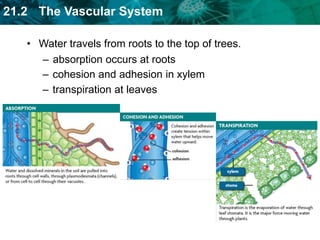
– absorption occurs at roots
• Water travels from roots to the top of trees.
– cohesion and adhesion in xylem
– transpiration at leaves
21.2 The Vascular System
– water vapor exits leaf stomata
– helps pull water to the top
branches
• Transpiration is the loss of water
vapor through leaves.
21.2 The Vascular System
Phloem carries sugars from photosynthesis throughout
the plant.
• Phloem contains specialized cells.
– sieve tube elements have
holes at ends
– companion cells help sieve
tube elements
– unlike xylem, phloem tissue is
alive
21.2 The Vascular System
– plants actively transport sugar from the source
– sugar flows to the sink due to pressure differences
sugars
phloem xylem
water
Sugars move from their
source, such as
photosynthesizing
leaves, into the phloem.
1
The sugars move into
the sink, such as root
or fruit, where the are
stored.
3
Water moves from
the xylem into the
phloem by osmosis,
due to the higher
concentration of the
sugars in the phloem.
The water flow helps
move sugars through
the phloem.
2
• The Pressure-flow model explains sugar movement.

21.2 Vascular System.ppt

  • 1.
    21.2 The VascularSystem KEY CONCEPT The vascular system allows for the transport of water, minerals, and sugars.
  • 2.
    21.2 The VascularSystem Water and dissolved minerals move through xylem. • Xylem contains specialized cells. – vessel elements are short and wide – tracheid cells are long and narrow – xylem cells die at maturity vessel element tracheid
  • 3.
    21.2 The VascularSystem – Plants passively transport water through the xylem. – Cohesion is the tendency of water molecules to bond with each other. • The cohesion-tension theory explains water movement. – Adhesion is the tendency of water molecules to bond with other substances.
  • 4.
    21.2 The VascularSystem – absorption occurs at roots • Water travels from roots to the top of trees. – cohesion and adhesion in xylem – transpiration at leaves
  • 5.
    21.2 The VascularSystem – water vapor exits leaf stomata – helps pull water to the top branches • Transpiration is the loss of water vapor through leaves.
  • 6.
    21.2 The VascularSystem Phloem carries sugars from photosynthesis throughout the plant. • Phloem contains specialized cells. – sieve tube elements have holes at ends – companion cells help sieve tube elements – unlike xylem, phloem tissue is alive
  • 7.
    21.2 The VascularSystem – plants actively transport sugar from the source – sugar flows to the sink due to pressure differences sugars phloem xylem water Sugars move from their source, such as photosynthesizing leaves, into the phloem. 1 The sugars move into the sink, such as root or fruit, where the are stored. 3 Water moves from the xylem into the phloem by osmosis, due to the higher concentration of the sugars in the phloem. The water flow helps move sugars through the phloem. 2 • The Pressure-flow model explains sugar movement.