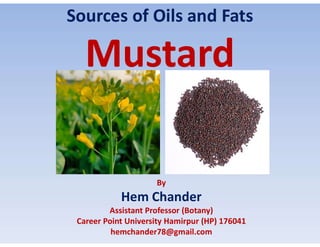
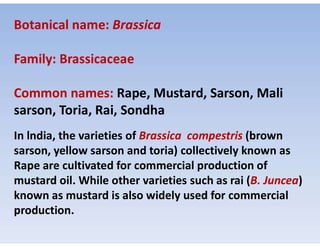
Sources of Oils and Fats
By
Hem Chander
Assistant Professor (Botany)
Career Point University Hamirpur (HP) 176041
hemchander78@gmail.com
Botanical name: Brassica
Family: Brassicaceae
Common names: Rape, Mustard, Sarson, Mali
sarson, Toria, Rai, Sondha
In lndia, the varieties of Brassica compestris (brown
sarson, yellow sarson and toria) collectively known as
Rape are cultivated for commercial production of
mustard oil. While other varieties such as rai (B. Juncea)
known as mustard is also widely used for commercial
production.
•The genus Brassica includes over 150 species and
several of them are the source of oil.
•Brassica seeds have a very long history and find several
references in the Bible and in the Greek and Roman
writings. Sanskrit records of 3000 BC refer to mustard
as an important spice.
•The plants are annual, biennial or rarely perennial
herbs. Brussica spp. are believed to have originated in
three different centres: Europe, Central and Southern
Asia, and China.
•In India, they are cultivated in Punjab, Haryana, Uttar
Pradesh, Bihar, Bengal and Assam.
•The cultivated Brassica species may be divided into
two distinct types: the vegetable types and oil seed
types.
•The vegetable types are cabbage, cauliflower, broccoli
and turnip.
•Those extensively cultivated for oil are: Brassica
napus and B. juncea in China and Japan; B. napus and
B. praecox in Europe and America; and B. juncea and
B. nupus in Russia and Mediterranean region.
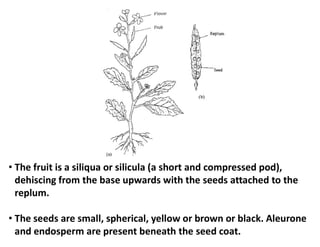
• The fruit is a siliqua or silicula (a short and compressed pod),
dehiscing from the base upwards with the seeds attached to the
replum.
• The seeds are small, spherical, yellow or brown or black. Aleurone
and endosperm are present beneath the seed coat.
•Oil is extracted from the seeds in bullock operated
ghanis (Colhu) or power driven rotary ghanis,
expellers and hydraulic press.
•The solvent extraction methods are also employed.
Extraction of oil
Chemical & Nutritional Composition
• The oil content of the seeds varies from 30 to 48 per cent
depending upon the variety and the climatic conditions under
which it is grown. The seeds contain about 20 per cent protein.
• All varieties are characterized by having high percentage of erucic
acid, i.e., 40-45 percent of total fatty acid. Oleic and linoleic acids
represent about 47 percent.
• The other saturated acids such as palmitic, stearic and lignoceric
acid are present in very small quaniities. The seeds contain a
glucoside called sinigrin and potassiurn myronate. On hydrolysis
by an enzyme myrosinrase it yields dextrose allyI-isothiocyanate
and hydrogen sulphate.
• The pungency in the oil is due to the essential oil allyl-
isothiocynate.
Uses
•The whole seed and its oil are used as a condiment in the
preparation of pickles and for flavouring curries and
vegetables.
• The oil extracted from mustard is used almost entirely
for edible purposes such as salads and cooking oils and in
margarine.
•It is also used as a lubricant, in the manufacture of
greases, lubricants and for the manufacture of soft
soaps.
•The oil cake is used as a cattle feed and manure.
21. Mustard.pdf

21. Mustard.pdf

  • 1.
    Sources of Oilsand Fats By Hem Chander Assistant Professor (Botany) Career Point University Hamirpur (HP) 176041 hemchander78@gmail.com
  • 2.
    Botanical name: Brassica Family:Brassicaceae Common names: Rape, Mustard, Sarson, Mali sarson, Toria, Rai, Sondha In lndia, the varieties of Brassica compestris (brown sarson, yellow sarson and toria) collectively known as Rape are cultivated for commercial production of mustard oil. While other varieties such as rai (B. Juncea) known as mustard is also widely used for commercial production.
  • 3.
    •The genus Brassicaincludes over 150 species and several of them are the source of oil. •Brassica seeds have a very long history and find several references in the Bible and in the Greek and Roman writings. Sanskrit records of 3000 BC refer to mustard as an important spice. •The plants are annual, biennial or rarely perennial herbs. Brussica spp. are believed to have originated in three different centres: Europe, Central and Southern Asia, and China. •In India, they are cultivated in Punjab, Haryana, Uttar Pradesh, Bihar, Bengal and Assam.
  • 4.
    •The cultivated Brassicaspecies may be divided into two distinct types: the vegetable types and oil seed types. •The vegetable types are cabbage, cauliflower, broccoli and turnip. •Those extensively cultivated for oil are: Brassica napus and B. juncea in China and Japan; B. napus and B. praecox in Europe and America; and B. juncea and B. nupus in Russia and Mediterranean region.
  • 5.
    • The fruitis a siliqua or silicula (a short and compressed pod), dehiscing from the base upwards with the seeds attached to the replum. • The seeds are small, spherical, yellow or brown or black. Aleurone and endosperm are present beneath the seed coat.
  • 6.
    •Oil is extractedfrom the seeds in bullock operated ghanis (Colhu) or power driven rotary ghanis, expellers and hydraulic press. •The solvent extraction methods are also employed. Extraction of oil
  • 7.
    Chemical & NutritionalComposition • The oil content of the seeds varies from 30 to 48 per cent depending upon the variety and the climatic conditions under which it is grown. The seeds contain about 20 per cent protein. • All varieties are characterized by having high percentage of erucic acid, i.e., 40-45 percent of total fatty acid. Oleic and linoleic acids represent about 47 percent. • The other saturated acids such as palmitic, stearic and lignoceric acid are present in very small quaniities. The seeds contain a glucoside called sinigrin and potassiurn myronate. On hydrolysis by an enzyme myrosinrase it yields dextrose allyI-isothiocyanate and hydrogen sulphate. • The pungency in the oil is due to the essential oil allyl- isothiocynate.
  • 8.
    Uses •The whole seedand its oil are used as a condiment in the preparation of pickles and for flavouring curries and vegetables. • The oil extracted from mustard is used almost entirely for edible purposes such as salads and cooking oils and in for edible purposes such as salads and cooking oils and in margarine. •It is also used as a lubricant, in the manufacture of greases, lubricants and for the manufacture of soft soaps. •The oil cake is used as a cattle feed and manure.