Sengamala Thayaar Educational Trust Women’s College
(Affiliated to Bharathidasan University)
(Accredited with ‘A’ Grade {3.45/4.00} By NAAC)
(An ISO 9001: 2015 Certified Institution)
Sundarakkottai, Mannargudi-614 016.
Thiruvarur (Dt.), Tamil Nadu, India.
HERBS AND DRUG ACTION
Mrs. T. TAMILVANI
ASSISTANT PROFESSOR
PG & RESEARCH DEPARTMENT OF MICROBIOLOGY
The term “medicinal plant” include
various types of plants used in
herbalism ("herbology" or "herbal
medicine").
The word “herb” has been derived
from the Latin word, “herba” and an
old French word “herbe”.
These medicinal plants are also used
as food, flavonoid, medicine or
perfume and also in certain spiritual
activities.
Medicinal Plants
• A considerable number of definitions
have been proposed for the term
'medicinal plant'. According to the
World Health Organization, "a
medicinal plant is any plant which,
in one or more of its organs/parts,
contains substances that can be used
for therapeutic purposes, or which
are precursors for chemo-
pharmaceutical semi synthesis".
Medicinal plants
• Medicinal plants have many characteristics
when used as a treatment, as follow:-
• Synergic medicine- The ingredients of plants
all interact simultaneously, so their uses can
complement or damage others or neutralize
their possible negative effects.
Characteristics of Medicinal Plants
• Support of official medicine-
• In the treatment of complex cases
like cancer diseases the components of
the plants proved to be very effective.
• Preventive medicine- It has been proven that the component of
the plants also characterize by their ability to prevent the
appearance of some diseases.
• This will help to reduce the
use of the chemical remedies which
will be used when the disease is
already present i.e., reduce the side
effect of synthetic treatment.
Cont..
• India is one of the few countries where almost all the
known medicinal plants can be cultivated in some
part of the country of the other. Among the various
plants is great demand in the country & abroad are
Opium poppy, tropane alkaloid bearing plants
saprogenic bearing Yam, Senna, psyllium husk &
seeds, cinchona & ipecac.
• The ancient India system of medicines (ISM) is
predominantly a plant based material medica
making use of most of our native plants
Important & scope of Medicinal Plants
in India
• ISM offers most appropriate or first line therapy
against many diseases likes Jaundice, bronchial
asthma rheumatoid arthritis diabetes etc.
 Document indigenous uses of medicinal
plants,
 Certify raw material for quality control,
 Develop and improve the agro- technology for
valuable medicinal plants,
 Officially recognize and protect the customary laws
of indigenous people,
Conti..
 Prepare a clear policy for granting permits for
cultivation within stipulated time,
 Conduct regular research and training on
better harvesting and processing techniques,
 Investigate various pathological agents
infecting medicinal plants,
 Setup a community-based
management of medicinal plants
farming and marketing,
Conti..
 Seeds: Production and marketing ofquality seeds
of high yielding varieties (seed companies).
 Plant parts (leaf, bark, root, seed etc.)- Enterprises such
as large scale cultivation as an agro-industry, marketing
of dried plant parts (crude drugs) in national and
international markets, establishing market net works
can be started.
 Grading of specific plant parts such as leaves of senna,
roots of ashwagandha/ safed musli/ long pepper etc.
This is the simplest but economically viable small
enterprise that can be established at farm level and can
add value to the harvested produce.
Use of Medicinal Plants
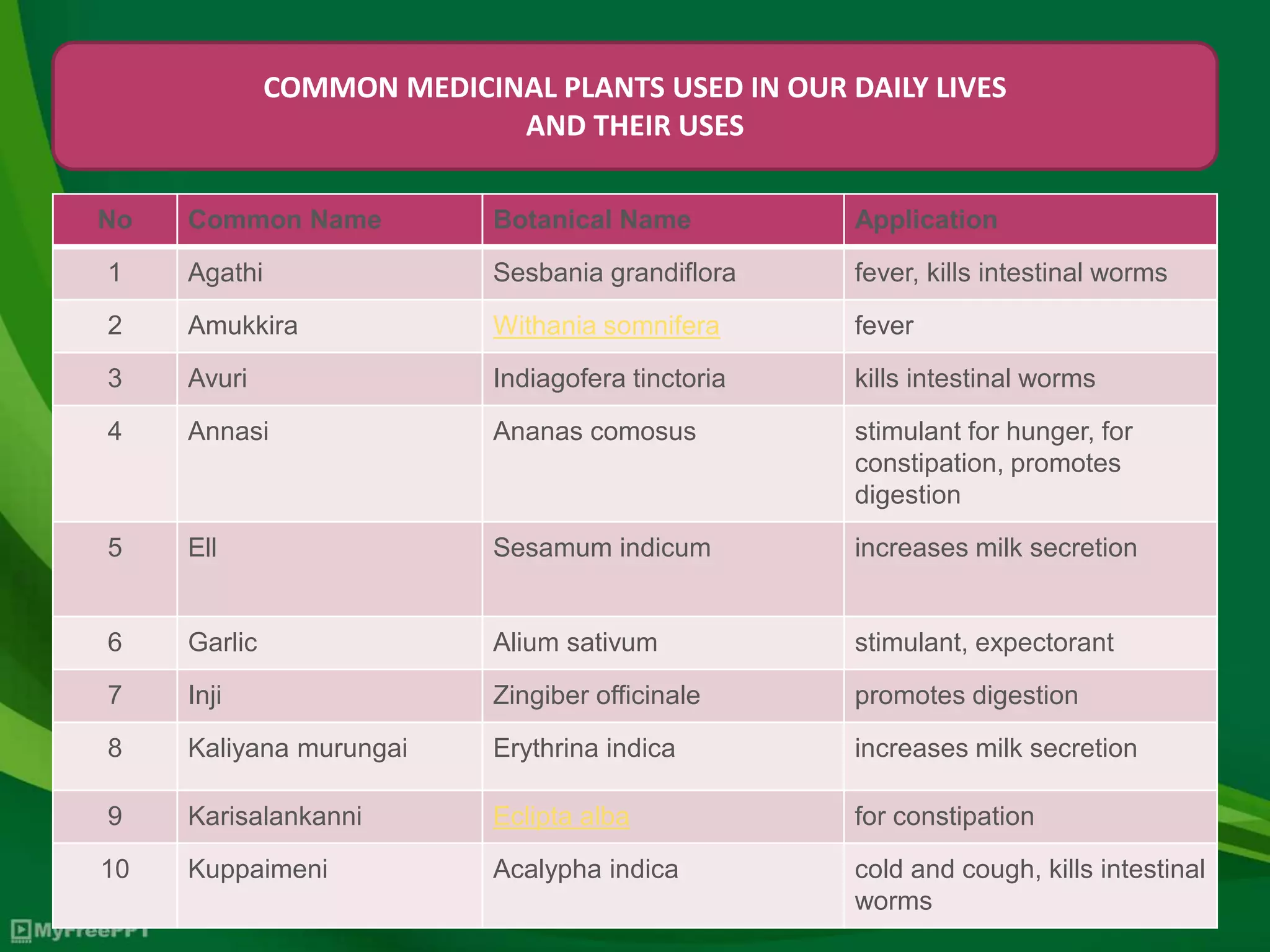
COMMON MEDICINAL PLANTS USED IN OUR DAILY LIVES
AND THEIR USES
No Common Name Botanical Name Application
1 Agathi Sesbania grandiflora fever, kills intestinal worms
2 Amukkira Withania somnifera fever
3 Avuri Indiagofera tinctoria kills intestinal worms
4 Annasi Ananas comosus stimulant for hunger, for
constipation, promotes
digestion
5 Ell Sesamum indicum increases milk secretion
6 Garlic Alium sativum stimulant, expectorant
7 Inji Zingiber officinale promotes digestion
8 Kaliyana murungai Erythrina indica increases milk secretion
9 Karisalankanni Eclipta alba for constipation
10 Kuppaimeni Acalypha indica cold and cough, kills intestinal
worms
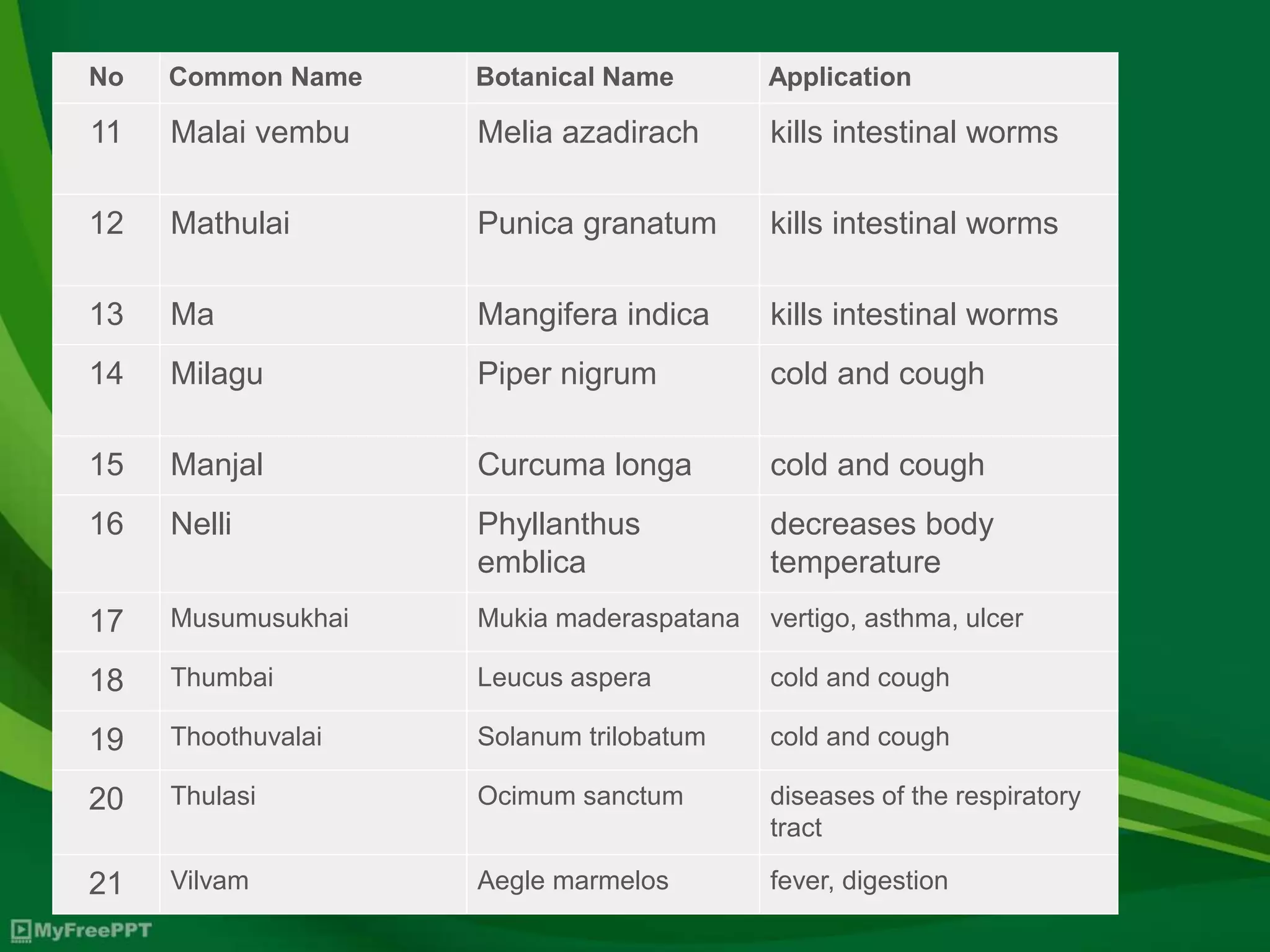
No Common Name Botanical Name Application
11 Malai vembu Melia azadirach kills intestinal worms
12 Mathulai Punica granatum kills intestinal worms
13 Ma Mangifera indica kills intestinal worms
14 Milagu Piper nigrum cold and cough
15 Manjal Curcuma longa cold and cough
16 Nelli Phyllanthus
emblica
decreases body
temperature
17 Musumusukhai Mukia maderaspatana vertigo, asthma, ulcer
18 Thumbai Leucus aspera cold and cough
19 Thoothuvalai Solanum trilobatum cold and cough
20 Thulasi Ocimum sanctum diseases of the respiratory
tract
21 Vilvam Aegle marmelos fever, digestion
Conclusion
These herbal products are today are the symbol of safety in
contrast to the synthetic drugs, that are regarded as unsafe to
human being and environment. Although herbs had been priced for
their medicinal, flavouring and aromatic qualities for centuries, the
synthetic products of the modern age surpassed their importance,
for a while. However, the blind dependence on synthetics is over
and people are returning to the naturals with hope of safety and
security. It’s time to promote them globally.
Medicinal plants and their importance

Medicinal plants and their importance

  • 1.
    Sengamala Thayaar EducationalTrust Women’s College (Affiliated to Bharathidasan University) (Accredited with ‘A’ Grade {3.45/4.00} By NAAC) (An ISO 9001: 2015 Certified Institution) Sundarakkottai, Mannargudi-614 016. Thiruvarur (Dt.), Tamil Nadu, India. HERBS AND DRUG ACTION Mrs. T. TAMILVANI ASSISTANT PROFESSOR PG & RESEARCH DEPARTMENT OF MICROBIOLOGY
  • 2.
    The term “medicinalplant” include various types of plants used in herbalism ("herbology" or "herbal medicine"). The word “herb” has been derived from the Latin word, “herba” and an old French word “herbe”. These medicinal plants are also used as food, flavonoid, medicine or perfume and also in certain spiritual activities. Medicinal Plants
  • 3.
    • A considerablenumber of definitions have been proposed for the term 'medicinal plant'. According to the World Health Organization, "a medicinal plant is any plant which, in one or more of its organs/parts, contains substances that can be used for therapeutic purposes, or which are precursors for chemo- pharmaceutical semi synthesis". Medicinal plants
  • 4.
    • Medicinal plantshave many characteristics when used as a treatment, as follow:- • Synergic medicine- The ingredients of plants all interact simultaneously, so their uses can complement or damage others or neutralize their possible negative effects. Characteristics of Medicinal Plants
  • 5.
    • Support ofofficial medicine- • In the treatment of complex cases like cancer diseases the components of the plants proved to be very effective. • Preventive medicine- It has been proven that the component of the plants also characterize by their ability to prevent the appearance of some diseases. • This will help to reduce the use of the chemical remedies which will be used when the disease is already present i.e., reduce the side effect of synthetic treatment. Cont..
  • 6.
    • India isone of the few countries where almost all the known medicinal plants can be cultivated in some part of the country of the other. Among the various plants is great demand in the country & abroad are Opium poppy, tropane alkaloid bearing plants saprogenic bearing Yam, Senna, psyllium husk & seeds, cinchona & ipecac. • The ancient India system of medicines (ISM) is predominantly a plant based material medica making use of most of our native plants Important & scope of Medicinal Plants in India
  • 7.
    • ISM offersmost appropriate or first line therapy against many diseases likes Jaundice, bronchial asthma rheumatoid arthritis diabetes etc.  Document indigenous uses of medicinal plants,  Certify raw material for quality control,  Develop and improve the agro- technology for valuable medicinal plants,  Officially recognize and protect the customary laws of indigenous people, Conti..
  • 8.
     Prepare aclear policy for granting permits for cultivation within stipulated time,  Conduct regular research and training on better harvesting and processing techniques,  Investigate various pathological agents infecting medicinal plants,  Setup a community-based management of medicinal plants farming and marketing, Conti..
  • 9.
     Seeds: Productionand marketing ofquality seeds of high yielding varieties (seed companies).  Plant parts (leaf, bark, root, seed etc.)- Enterprises such as large scale cultivation as an agro-industry, marketing of dried plant parts (crude drugs) in national and international markets, establishing market net works can be started.  Grading of specific plant parts such as leaves of senna, roots of ashwagandha/ safed musli/ long pepper etc. This is the simplest but economically viable small enterprise that can be established at farm level and can add value to the harvested produce. Use of Medicinal Plants
  • 10.
    COMMON MEDICINAL PLANTSUSED IN OUR DAILY LIVES AND THEIR USES No Common Name Botanical Name Application 1 Agathi Sesbania grandiflora fever, kills intestinal worms 2 Amukkira Withania somnifera fever 3 Avuri Indiagofera tinctoria kills intestinal worms 4 Annasi Ananas comosus stimulant for hunger, for constipation, promotes digestion 5 Ell Sesamum indicum increases milk secretion 6 Garlic Alium sativum stimulant, expectorant 7 Inji Zingiber officinale promotes digestion 8 Kaliyana murungai Erythrina indica increases milk secretion 9 Karisalankanni Eclipta alba for constipation 10 Kuppaimeni Acalypha indica cold and cough, kills intestinal worms
  • 11.
    No Common NameBotanical Name Application 11 Malai vembu Melia azadirach kills intestinal worms 12 Mathulai Punica granatum kills intestinal worms 13 Ma Mangifera indica kills intestinal worms 14 Milagu Piper nigrum cold and cough 15 Manjal Curcuma longa cold and cough 16 Nelli Phyllanthus emblica decreases body temperature 17 Musumusukhai Mukia maderaspatana vertigo, asthma, ulcer 18 Thumbai Leucus aspera cold and cough 19 Thoothuvalai Solanum trilobatum cold and cough 20 Thulasi Ocimum sanctum diseases of the respiratory tract 21 Vilvam Aegle marmelos fever, digestion
  • 12.
    Conclusion These herbal productsare today are the symbol of safety in contrast to the synthetic drugs, that are regarded as unsafe to human being and environment. Although herbs had been priced for their medicinal, flavouring and aromatic qualities for centuries, the synthetic products of the modern age surpassed their importance, for a while. However, the blind dependence on synthetics is over and people are returning to the naturals with hope of safety and security. It’s time to promote them globally.