Nicholas Socrates

                                                                             2008

Richard Meier

Richard Meier, born in Newark, New Jersey, USA, in 1934.
He graduated from the Cornell University in Ithica, New
York. Establishing his office ‘Richard Meier & Partners
Architects’, in New York’.
As well as MACBA, examples of his world famous buildings
are; The Getty Centre, in Los Angeles, California, conceived
from 1984 – 1997, and the Hague City Hall & Central
Library, in the Netherlands, from 1987 – 1995. Up to date
Richard Meier has had over 80 modernist buildings
created. All of which are pristine and white. In 1998 he was
awarded the prestigious Pritzker Architecture Prize.


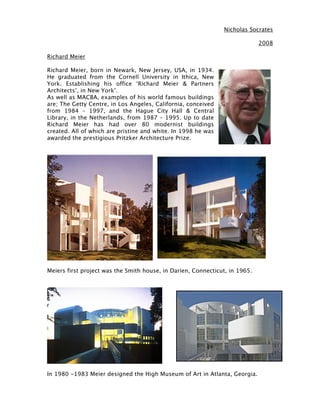
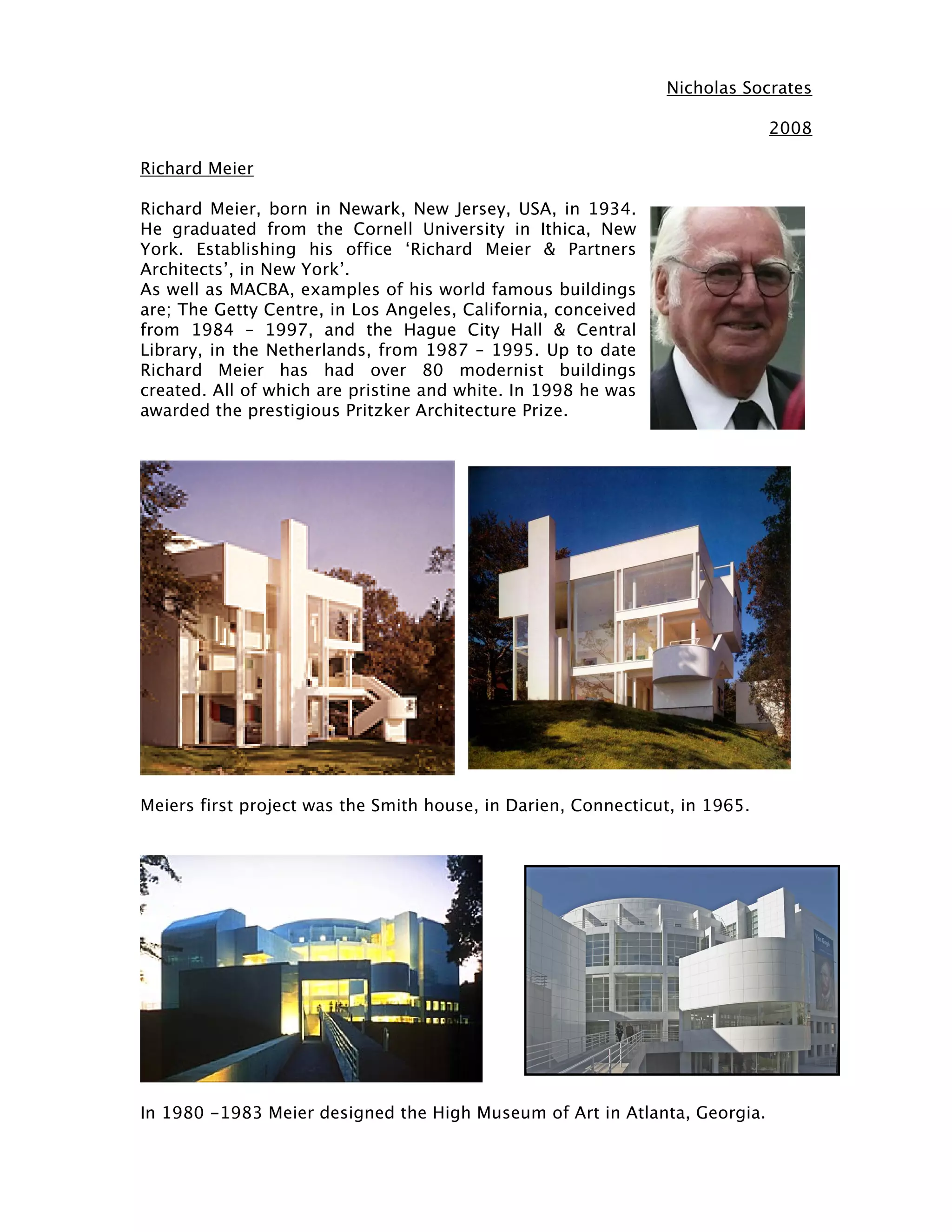
Meiers first project was the Smith house, in Darien, Connecticut, in 1965.


In 1980 -1983 Meier designed the High Museum of Art in Atlanta, Georgia.
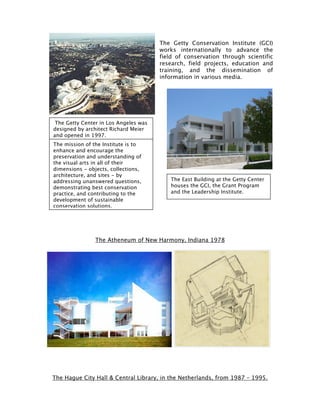
The Getty Conservation Institute (GCI)
                                       works internationally to advance the
                                       field of conservation through scientific
                                       research, field projects, education and
                                       training, and the dissemination of
                                       information in various media.


 The Getty Center in Los Angeles was
designed by architect Richard Meier
and opened in 1997.
The mission of the Institute is to
enhance and encourage the
preservation and understanding of
the visual arts in all of their
dimensions - objects, collections,
architecture, and sites - by
addressing unanswered questions,          The East Building at the Getty Center
demonstrating best conservation           houses the GCI, the Grant Program
practice, and contributing to the         and the Leadership Institute.
development of sustainable
conservation solutions.


                The Atheneum of New Harmony, Indiana 1978


The Hague City Hall & Central Library, in the Netherlands, from 1987 – 1995.
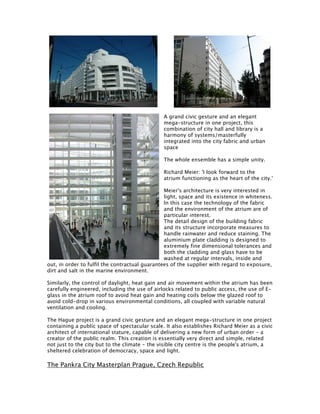
A grand civic gesture and an elegant
                                               mega-structure in one project, this
                                               combination of city hall and library is a
                                               harmony of systems/masterfully
                                               integrated into the city fabric and urban
                                               space

                                               The whole ensemble has a simple unity.

                                               Richard Meier: 'I look forward to the
                                               atrium functioning as the heart of the city.'

                                                Meier's architecture is very interested in
                                                light, space and its existence in whiteness.
                                                In this case the technology of the fabric
                                                and the environment of the atrium are of
                                                particular interest.
                                                The detail design of the building fabric
                                                and its structure incorporate measures to
                                                handle rainwater and reduce staining. The
                                                aluminium plate cladding is designed to
                                                extremely fine dimensional tolerances and
                                                both the cladding and glass have to be
                                                washed at regular intervals, inside and
out, in order to fulfil the contractual guarantees of the supplier with regard to exposure,
dirt and salt in the marine environment.

Similarly, the control of daylight, heat gain and air movement within the atrium has been
carefully engineered, including the use of airlocks related to public access, the use of E-
glass in the atrium roof to avoid heat gain and heating coils below the glazed roof to
avoid cold-drop in various environmental conditions, all coupled with variable natural
ventilation and cooling.

The Hague project is a grand civic gesture and an elegant mega-structure in one project
containing a public space of spectacular scale. It also establishes Richard Meier as a civic
architect of international stature, capable of delivering a new form of urban order - a
creator of the public realm. This creation is essentially very direct and simple, related
not just to the city but to the climate - the visible city centre is the people's atrium, a
sheltered celebration of democracy, space and light.

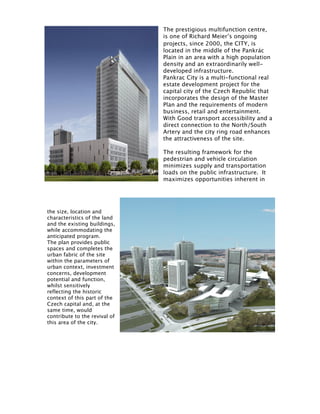
The Pankra City Masterplan Prague, Czech Republic
The prestigious multifunction centre,
                               is one of Richard Meier’s ongoing
                               projects, since 2000, the CITY, is
                               located in the middle of the Pankrác
                               Plain in an area with a high population
                               density and an extraordinarily well-
                               developed infrastructure.
                               Pankrac City is a multi-functional real
                               estate development project for the
                               capital city of the Czech Republic that
                               incorporates the design of the Master
                               Plan and the requirements of modern
                               business, retail and entertainment.
                               With Good transport accessibility and a
                               direct connection to the North/South
                               Artery and the city ring road enhances
                               the attractiveness of the site.

                               The resulting framework for the
                               pedestrian and vehicle circulation
                               minimizes supply and transportation
                               loads on the public infrastructure. It
                               maximizes opportunities inherent in


the size, location and
characteristics of the land
and the existing buildings,
while accommodating the
anticipated program.
The plan provides public
spaces and completes the
urban fabric of the site
within the parameters of
urban context, investment
concerns, development
potential and function,
whilst sensitively
reflecting the historic
context of this part of the
Czech capital and, at the
same time, would
contribute to the revival of
this area of the city.

Richard Meier - Architect Case Study

  • 1.
    Nicholas Socrates 2008 Richard Meier Richard Meier, born in Newark, New Jersey, USA, in 1934. He graduated from the Cornell University in Ithica, New York. Establishing his office ‘Richard Meier & Partners Architects’, in New York’. As well as MACBA, examples of his world famous buildings are; The Getty Centre, in Los Angeles, California, conceived from 1984 – 1997, and the Hague City Hall & Central Library, in the Netherlands, from 1987 – 1995. Up to date Richard Meier has had over 80 modernist buildings created. All of which are pristine and white. In 1998 he was awarded the prestigious Pritzker Architecture Prize. Meiers first project was the Smith house, in Darien, Connecticut, in 1965. In 1980 -1983 Meier designed the High Museum of Art in Atlanta, Georgia.
  • 2.
    The Getty ConservationInstitute (GCI) works internationally to advance the field of conservation through scientific research, field projects, education and training, and the dissemination of information in various media. The Getty Center in Los Angeles was designed by architect Richard Meier and opened in 1997. The mission of the Institute is to enhance and encourage the preservation and understanding of the visual arts in all of their dimensions - objects, collections, architecture, and sites - by addressing unanswered questions, The East Building at the Getty Center demonstrating best conservation houses the GCI, the Grant Program practice, and contributing to the and the Leadership Institute. development of sustainable conservation solutions. The Atheneum of New Harmony, Indiana 1978 The Hague City Hall & Central Library, in the Netherlands, from 1987 – 1995.
  • 3.
    A grand civicgesture and an elegant mega-structure in one project, this combination of city hall and library is a harmony of systems/masterfully integrated into the city fabric and urban space The whole ensemble has a simple unity. Richard Meier: 'I look forward to the atrium functioning as the heart of the city.' Meier's architecture is very interested in light, space and its existence in whiteness. In this case the technology of the fabric and the environment of the atrium are of particular interest. The detail design of the building fabric and its structure incorporate measures to handle rainwater and reduce staining. The aluminium plate cladding is designed to extremely fine dimensional tolerances and both the cladding and glass have to be washed at regular intervals, inside and out, in order to fulfil the contractual guarantees of the supplier with regard to exposure, dirt and salt in the marine environment. Similarly, the control of daylight, heat gain and air movement within the atrium has been carefully engineered, including the use of airlocks related to public access, the use of E- glass in the atrium roof to avoid heat gain and heating coils below the glazed roof to avoid cold-drop in various environmental conditions, all coupled with variable natural ventilation and cooling. The Hague project is a grand civic gesture and an elegant mega-structure in one project containing a public space of spectacular scale. It also establishes Richard Meier as a civic architect of international stature, capable of delivering a new form of urban order - a creator of the public realm. This creation is essentially very direct and simple, related not just to the city but to the climate - the visible city centre is the people's atrium, a sheltered celebration of democracy, space and light. The Pankra City Masterplan Prague, Czech Republic
  • 4.
    The prestigious multifunctioncentre, is one of Richard Meier’s ongoing projects, since 2000, the CITY, is located in the middle of the Pankrác Plain in an area with a high population density and an extraordinarily well- developed infrastructure. Pankrac City is a multi-functional real estate development project for the capital city of the Czech Republic that incorporates the design of the Master Plan and the requirements of modern business, retail and entertainment. With Good transport accessibility and a direct connection to the North/South Artery and the city ring road enhances the attractiveness of the site. The resulting framework for the pedestrian and vehicle circulation minimizes supply and transportation loads on the public infrastructure. It maximizes opportunities inherent in the size, location and characteristics of the land and the existing buildings, while accommodating the anticipated program. The plan provides public spaces and completes the urban fabric of the site within the parameters of urban context, investment concerns, development potential and function, whilst sensitively reflecting the historic context of this part of the Czech capital and, at the same time, would contribute to the revival of this area of the city.