42Crunch.com
Are Your APIs Rugged?
7 April 2022
Colin Domoney
@colindomoney
colin.domoney@42crunch.com
2 │ 42Crunch.com
Agenda
● Why be rugged?
● What are the threats?
● Rugged by design
● Rugged by implementation
● Rugged at runtime
● Learning more
3 │ 42Crunch.com
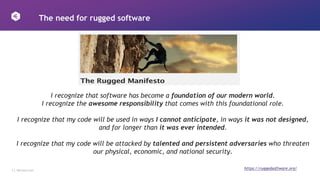
The need for rugged software
https://ruggedsoftware.org/
I recognize that software has become a foundation of our modern world.
I recognize the awesome responsibility that comes with this foundational role.
I recognize that my code will be used in ways I cannot anticipate, in ways it was not designed,
and for longer than it was ever intended.
I recognize that my code will be attacked by talented and persistent adversaries who threaten
our physical, economic, and national security.
4 │ 42Crunch.com
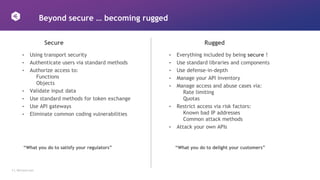
Beyond secure … becoming rugged
Secure Rugged
• Using transport security
• Authenticate users via standard methods
• Authorize access to:
Functions
Objects
• Validate input data
• Use standard methods for token exchange
• Use API gateways
• Eliminate common coding vulnerabilities
• Everything included by being secure !
• Use standard libraries and components
• Use defense-in-depth
• Manage your API inventory
• Manage access and abuse cases via:
Rate limiting
Quotas
• Restrict access via risk factors:
Known bad IP addresses
Common attack methods
• Attack your own APIs
“What you do to satisfy your regulators” “What you do to delight your customers”
5 │ 42Crunch.com
What are the threats?
6 │ 42Crunch.com
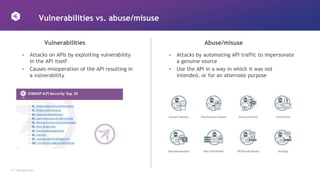
Vulnerabilities vs. abuse/misuse
Vulnerabilities Abuse/misuse
• Attacks on APIs by exploiting vulnerability
in the API itself
• Causes misoperation of the API resulting in
a vulnerability
• Attacks by automating API traffic to impersonate
a genuine source
• Use the API in a way in which it was not
intended, or for an alternate purpose
7 │ 42Crunch.com
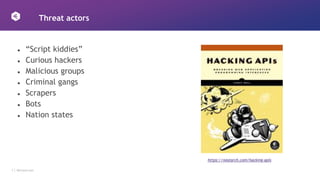
Threat actors
● “Script kiddies”
● Curious hackers
● Malicious groups
● Criminal gangs
● Scrapers
● Bots
● Nation states
https://nostarch.com/hacking-apis
8 │ 42Crunch.com
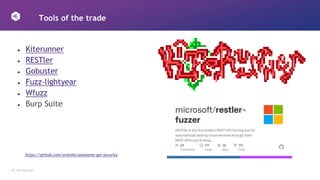
Tools of the trade
● Kiterunner
● RESTler
● Gobuster
● Fuzz-lightyear
● Wfuzz
● Burp Suite
https://github.com/arainho/awesome-api-security
9 │ 42Crunch.com
Rugged by design
10 │ 42Crunch.com
Threat modelling
● Establish your attack surface
● Understand the:
Use cases
Abuse cases
● Mitigations and compensating
controls
● Expose assumptions and
misunderstandings
● Put the Sec into DevOps !
11 │ 42Crunch.com
Think like an attacker
12 │ 42Crunch.com
Understand your data
● Privacy requirements
● What is your PII ?
● Handling privacy requests
● Data ownership
● Expose the bare minimum of data !
13 │ 42Crunch.com
Understand your environments
● Secret storage
● Token exchange
● Device integrity
● Channel integrity
● Assume your environment is hostile
14 │ 42Crunch.com
Rugged by implementation
15 │ 42Crunch.com
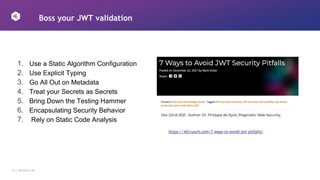
Boss your JWT validation
https://42crunch.com/7-ways-to-avoid-jwt-pitfalls/
1. Use a Static Algorithm Configuration
2. Use Explicit Typing
3. Go All Out on Metadata
4. Treat your Secrets as Secrets
5. Bring Down the Testing Hammer
6. Encapsulating Security Behavior
7. Rely on Static Code Analysis
16 │ 42Crunch.com
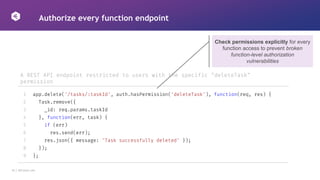
Authorize every function endpoint
A REST API endpoint restricted to users with the specific "deleteTask"
permission
1
2
3
4
5
6
7
8
9
app.delete('/tasks/:taskId', auth.hasPermission('deleteTask'), function(req, res) {
Task.remove({
_id: req.params.taskId
}, function(err, task) {
if (err)
res.send(err);
res.json({ message: 'Task successfully deleted' });
});
};
Check permissions explicitly for every
function access to prevent broken
function-level authorization
vulnerabilities
17 │ 42Crunch.com
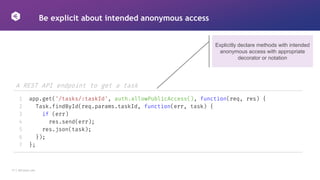
Be explicit about intended anonymous access
Explicitly declare methods with intended
anonymous access with appropriate
decorator or notation
A REST API endpoint to get a task
1
2
3
4
5
6
7
app.get('/tasks/:taskId', auth.allowPublicAccess(), function(req, res) {
Task.findById(req.params.taskId, function(err, task) {
if (err)
res.send(err);
res.json(task);
});
};
18 │ 42Crunch.com
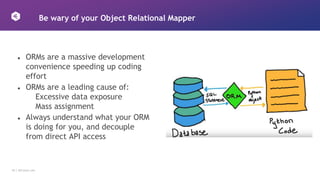
Be wary of your Object Relational Mapper
● ORMs are a massive development
convenience speeding up coding
effort
● ORMs are a leading cause of:
Excessive data exposure
Mass assignment
● Always understand what your ORM
is doing for you, and decouple
from direct API access
19 │ 42Crunch.com
Explicitly enable methods, prevent unused methods
Explicitly specify the methods to be
used, and prevent unused methods in
the framework used
A Python Flask API endpoint
1
2
3
4
5
@app.route('/', methods=['POST'])
def my_first_api_endpoint():
json_data = json.loads(request.data)
...
return "", 200
20 │ 42Crunch.com
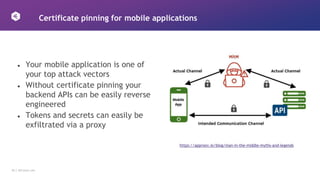
Certificate pinning for mobile applications
https://approov.io/blog/man-in-the-middle-myths-and-legends
● Your mobile application is one of
your top attack vectors
● Without certificate pinning your
backend APIs can be easily reverse
engineered
● Tokens and secrets can easily be
exfiltrated via a proxy
21 │ 42Crunch.com
Use standard libraries and components
● NEVER write your own cryptography
functions or methods
● Use standard libraries for common
functionality (and scan them for
vulnerabilities)
● Stand on the shoulder of giants (and
contribute fixes and improvements)
22 │ 42Crunch.com
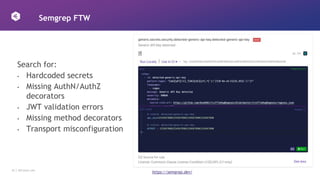
Semgrep FTW
https://semgrep.dev/
Search for:
• Hardcoded secrets
• Missing AuthN/AuthZ
decorators
• JWT validation errors
• Missing method decorators
• Transport misconfiguration
23 │ 42Crunch.com
Rugged at runtime
24 │ 42Crunch.com
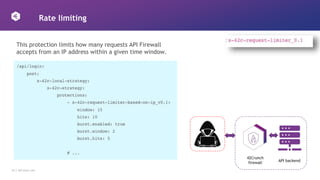
Rate limiting
API backend
42Crunch
firewall
This protection limits how many requests API Firewall
accepts from an IP address within a given time window.
25 │ 42Crunch.com
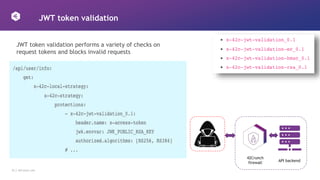
JWT token validation
API backend
42Crunch
firewall
JWT token validation performs a variety of checks on
request tokens and blocks invalid requests
26 │ 42Crunch.com
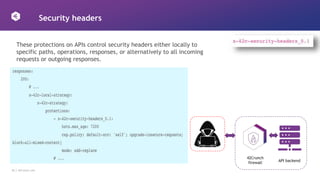
Security headers
API backend
42Crunch
firewall
These protections on APIs control security headers either locally to
specific paths, operations, responses, or alternatively to all incoming
requests or outgoing responses.
27 │ 42Crunch.com
API monitoring in your SIEM – Azure Sentinel
28 │ 42Crunch.com
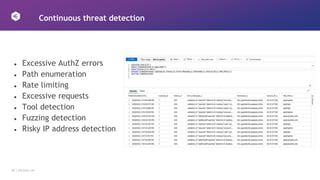
Continuous threat detection
● Excessive AuthZ errors
● Path enumeration
● Rate limiting
● Excessive requests
● Tool detection
● Fuzzing detection
● Risky IP address detection
29 │ 42Crunch.com
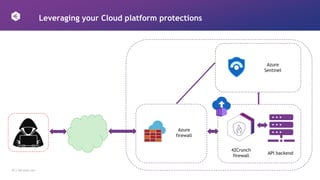
Leveraging your Cloud platform protections
API backend
42Crunch
firewall
Azure
Sentinel
Azure
firewall
30 │ 42Crunch.com
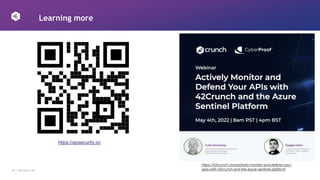
Learning more
https://42crunch.com/actively-monitor-and-defend-your-
apis-with-42crunch-and-the-azure-sentinel-platform/
https://apisecurity.io/

2022 APIsecure_Are your APIs Rugged Enough?

  • 1.
    42Crunch.com Are Your APIsRugged? 7 April 2022 Colin Domoney @colindomoney colin.domoney@42crunch.com
  • 2.
    2 │ 42Crunch.com Agenda ●Why be rugged? ● What are the threats? ● Rugged by design ● Rugged by implementation ● Rugged at runtime ● Learning more
  • 3.
    3 │ 42Crunch.com Theneed for rugged software https://ruggedsoftware.org/ I recognize that software has become a foundation of our modern world. I recognize the awesome responsibility that comes with this foundational role. I recognize that my code will be used in ways I cannot anticipate, in ways it was not designed, and for longer than it was ever intended. I recognize that my code will be attacked by talented and persistent adversaries who threaten our physical, economic, and national security.
  • 4.
    4 │ 42Crunch.com Beyondsecure … becoming rugged Secure Rugged • Using transport security • Authenticate users via standard methods • Authorize access to: Functions Objects • Validate input data • Use standard methods for token exchange • Use API gateways • Eliminate common coding vulnerabilities • Everything included by being secure ! • Use standard libraries and components • Use defense-in-depth • Manage your API inventory • Manage access and abuse cases via: Rate limiting Quotas • Restrict access via risk factors: Known bad IP addresses Common attack methods • Attack your own APIs “What you do to satisfy your regulators” “What you do to delight your customers”
  • 5.
    5 │ 42Crunch.com Whatare the threats?
  • 6.
    6 │ 42Crunch.com Vulnerabilitiesvs. abuse/misuse Vulnerabilities Abuse/misuse • Attacks on APIs by exploiting vulnerability in the API itself • Causes misoperation of the API resulting in a vulnerability • Attacks by automating API traffic to impersonate a genuine source • Use the API in a way in which it was not intended, or for an alternate purpose
  • 7.
    7 │ 42Crunch.com Threatactors ● “Script kiddies” ● Curious hackers ● Malicious groups ● Criminal gangs ● Scrapers ● Bots ● Nation states https://nostarch.com/hacking-apis
  • 8.
    8 │ 42Crunch.com Toolsof the trade ● Kiterunner ● RESTler ● Gobuster ● Fuzz-lightyear ● Wfuzz ● Burp Suite https://github.com/arainho/awesome-api-security
  • 9.
  • 10.
    10 │ 42Crunch.com Threatmodelling ● Establish your attack surface ● Understand the: Use cases Abuse cases ● Mitigations and compensating controls ● Expose assumptions and misunderstandings ● Put the Sec into DevOps !
  • 11.
    11 │ 42Crunch.com Thinklike an attacker
  • 12.
    12 │ 42Crunch.com Understandyour data ● Privacy requirements ● What is your PII ? ● Handling privacy requests ● Data ownership ● Expose the bare minimum of data !
  • 13.
    13 │ 42Crunch.com Understandyour environments ● Secret storage ● Token exchange ● Device integrity ● Channel integrity ● Assume your environment is hostile
  • 14.
    14 │ 42Crunch.com Ruggedby implementation
  • 15.
    15 │ 42Crunch.com Bossyour JWT validation https://42crunch.com/7-ways-to-avoid-jwt-pitfalls/ 1. Use a Static Algorithm Configuration 2. Use Explicit Typing 3. Go All Out on Metadata 4. Treat your Secrets as Secrets 5. Bring Down the Testing Hammer 6. Encapsulating Security Behavior 7. Rely on Static Code Analysis
  • 16.
    16 │ 42Crunch.com Authorizeevery function endpoint A REST API endpoint restricted to users with the specific "deleteTask" permission 1 2 3 4 5 6 7 8 9 app.delete('/tasks/:taskId', auth.hasPermission('deleteTask'), function(req, res) { Task.remove({ _id: req.params.taskId }, function(err, task) { if (err) res.send(err); res.json({ message: 'Task successfully deleted' }); }); }; Check permissions explicitly for every function access to prevent broken function-level authorization vulnerabilities
  • 17.
    17 │ 42Crunch.com Beexplicit about intended anonymous access Explicitly declare methods with intended anonymous access with appropriate decorator or notation A REST API endpoint to get a task 1 2 3 4 5 6 7 app.get('/tasks/:taskId', auth.allowPublicAccess(), function(req, res) { Task.findById(req.params.taskId, function(err, task) { if (err) res.send(err); res.json(task); }); };
  • 18.
    18 │ 42Crunch.com Bewary of your Object Relational Mapper ● ORMs are a massive development convenience speeding up coding effort ● ORMs are a leading cause of: Excessive data exposure Mass assignment ● Always understand what your ORM is doing for you, and decouple from direct API access
  • 19.
    19 │ 42Crunch.com Explicitlyenable methods, prevent unused methods Explicitly specify the methods to be used, and prevent unused methods in the framework used A Python Flask API endpoint 1 2 3 4 5 @app.route('/', methods=['POST']) def my_first_api_endpoint(): json_data = json.loads(request.data) ... return "", 200
  • 20.
    20 │ 42Crunch.com Certificatepinning for mobile applications https://approov.io/blog/man-in-the-middle-myths-and-legends ● Your mobile application is one of your top attack vectors ● Without certificate pinning your backend APIs can be easily reverse engineered ● Tokens and secrets can easily be exfiltrated via a proxy
  • 21.
    21 │ 42Crunch.com Usestandard libraries and components ● NEVER write your own cryptography functions or methods ● Use standard libraries for common functionality (and scan them for vulnerabilities) ● Stand on the shoulder of giants (and contribute fixes and improvements)
  • 22.
    22 │ 42Crunch.com SemgrepFTW https://semgrep.dev/ Search for: • Hardcoded secrets • Missing AuthN/AuthZ decorators • JWT validation errors • Missing method decorators • Transport misconfiguration
  • 23.
  • 24.
    24 │ 42Crunch.com Ratelimiting API backend 42Crunch firewall This protection limits how many requests API Firewall accepts from an IP address within a given time window.
  • 25.
    25 │ 42Crunch.com JWTtoken validation API backend 42Crunch firewall JWT token validation performs a variety of checks on request tokens and blocks invalid requests
  • 26.
    26 │ 42Crunch.com Securityheaders API backend 42Crunch firewall These protections on APIs control security headers either locally to specific paths, operations, responses, or alternatively to all incoming requests or outgoing responses.
  • 27.
    27 │ 42Crunch.com APImonitoring in your SIEM – Azure Sentinel
  • 28.
    28 │ 42Crunch.com Continuousthreat detection ● Excessive AuthZ errors ● Path enumeration ● Rate limiting ● Excessive requests ● Tool detection ● Fuzzing detection ● Risky IP address detection
  • 29.
    29 │ 42Crunch.com Leveragingyour Cloud platform protections API backend 42Crunch firewall Azure Sentinel Azure firewall
  • 30.
    30 │ 42Crunch.com Learningmore https://42crunch.com/actively-monitor-and-defend-your- apis-with-42crunch-and-the-azure-sentinel-platform/ https://apisecurity.io/