Environmental Impact
Assessment
ENGI 9626
Environmental Management
System
ENGI 9626
Environmental Management System
1
Environmental Impact Assessment (EIA)
Environmental impact assessment (EIA) can be defined
as the systematic identification and evaluation of the
potential impacts (effects) of proposed projects, plans,
programs, or legislative actions, relative to the physical–
chemical, biological, cultural, and socioeconomic
components of the environment.
ENGI 9626
Environmental Management System
2
(Canter, 1999)
EIA and EMS
ENGI 9626
Environmental Management System
3
https://www.iaia.org/iaia10/documents/reviewed_posters/The%20Integration%20of%20EIA%20and%20EMS%20-
%20Experiences%20from%20the%20UK.pdf?AspxAutoDetectCookieSupport=1
EIA and EMS are environmental protection tools with
complementary purposes.
•  The goal of EIA is to anticipate and mitigate the
environmental impacts of proposed new projects at the
planning and design stages,
•  An EMS can help organisations to effectively manage
the day-to-day environmental impacts arising during the
construction, operation and decommissioning of such
projects.
EIA and EMS
ENGI 9626
Environmental Management System
4
https://www.iaia.org/iaia10/documents/reviewed_posters/The%20Integration%20of%20EIA%20and%20EMS%20-
%20Experiences%20from%20the%20UK.pdf?AspxAutoDetectCookieSupport=1
The integration of EIA and EMS
•  At a basic level, these two tools could be linked if an EIA
recommended that an EMS be implemented during
project construction or operation and this commitment
was fulfilled by the site developer or operator(s)
•  However, this link would be strengthened further if the
EIA findings directly informed the EMS
ENGI 9626
Environmental Management System
5
https://www.iaia.org/iaia10/documents/
reviewed_posters/
The%20Integration%20of%20EIA%20and%20EMS%
20-%20Experiences%20from%20the%20UK.pdf?
AspxAutoDetectCookieSupport=1
EIA and EMS
EIA Background and
Overview
ENGI 9626
Environmental Management System
6
Origins
The National
Environmental Policy Act
(NEPA) of 1969 (PL91–
190).
NEPA requires that all
agencies of the federal
government issue "a
detailed statement" on "the
environmental impact" of
"proposals for legislation
and other major federal
actions significantly
affecting the quality of the
human environment.”
ENGI 9626
Environmental Management System
7http://www.epw.senate.gov/nepa69.pdf
(Canter, 1999)
Origins
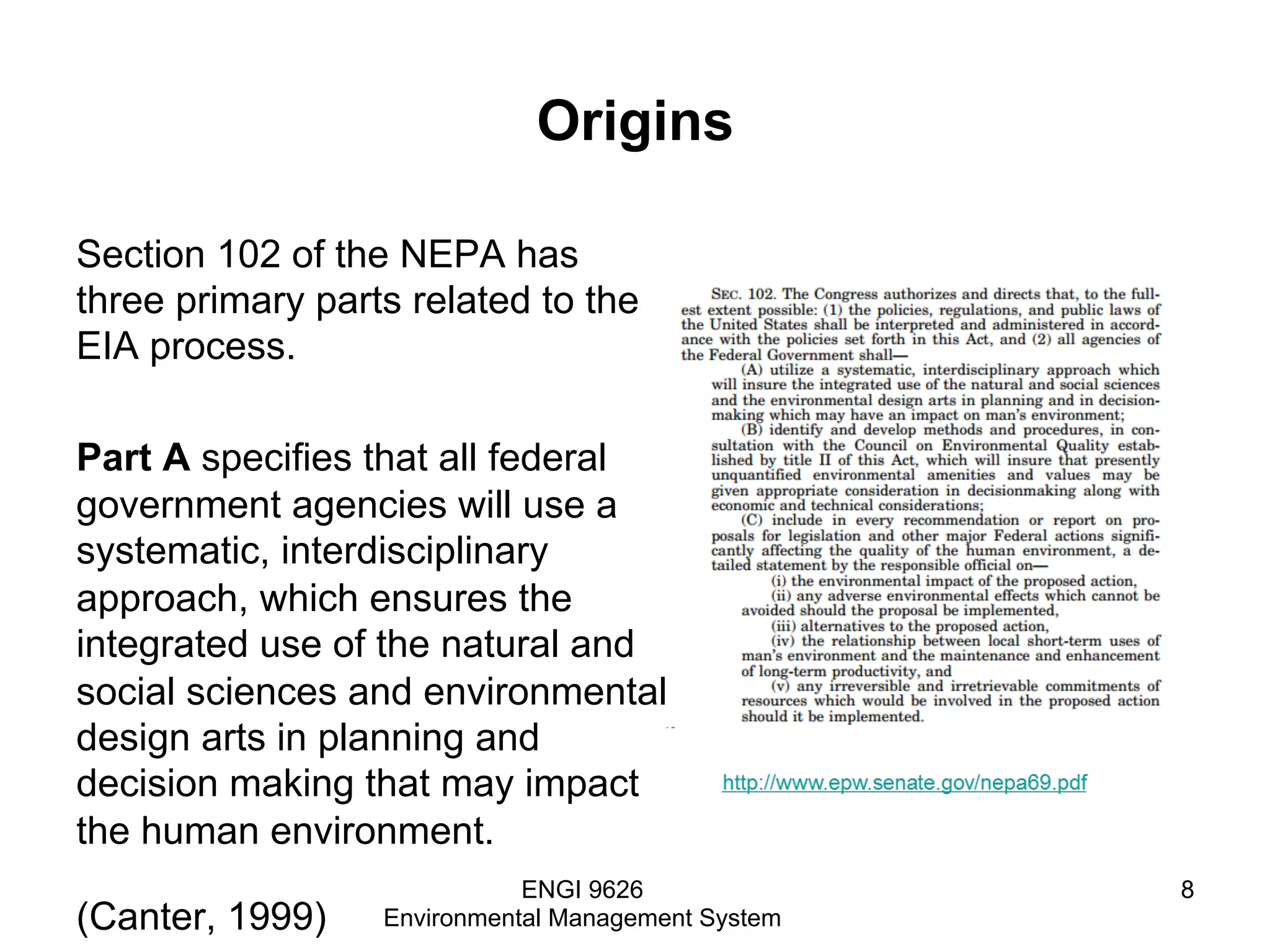
Section 102 of the NEPA has
three primary parts related to the
EIA process.
Part A specifies that all federal
government agencies will use a
systematic, interdisciplinary
approach, which ensures the
integrated use of the natural and
social sciences and environmental
design arts in planning and
decision making that may impact
the human environment.
(Canter, 1999)
ENGI 9626
Environmental Management System
8
Origins
Part B requires agencies to
identify and develop methods
and procedures to ensure that
presently unquantified
environmental amenities and
values are considered in
decision making along with
economic and technical
considerations. This part has
provided impetus for the
development of environmental
assessment methods.
ENGI 9626
Environmental Management System
9
(Canter, 1999)
Origins
Part C states the necessity
for preparing environmental
statements (called
environmental impact
statements or EISs) and
identifies basic items to be
included.
ENGI 9626
Environmental Management System
10
(Canter, 1999)
Origins
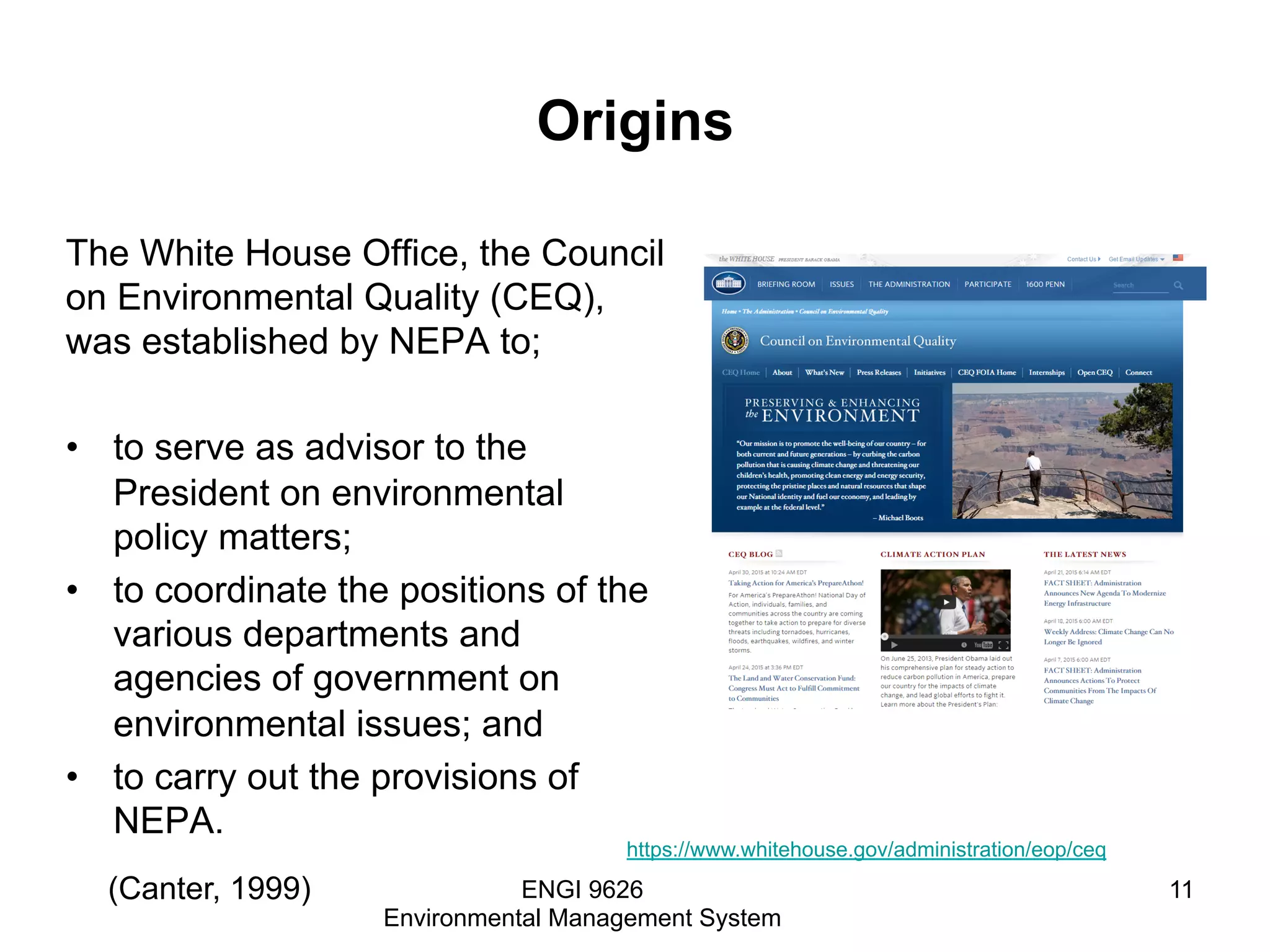
The White House Office, the Council
on Environmental Quality (CEQ),
was established by NEPA to;
•  to serve as advisor to the
President on environmental
policy matters;
•  to coordinate the positions of the
various departments and
agencies of government on
environmental issues; and
•  to carry out the provisions of
NEPA.
ENGI 9626
Environmental Management System
11(Canter, 1999)
https://www.whitehouse.gov/administration/eop/ceq
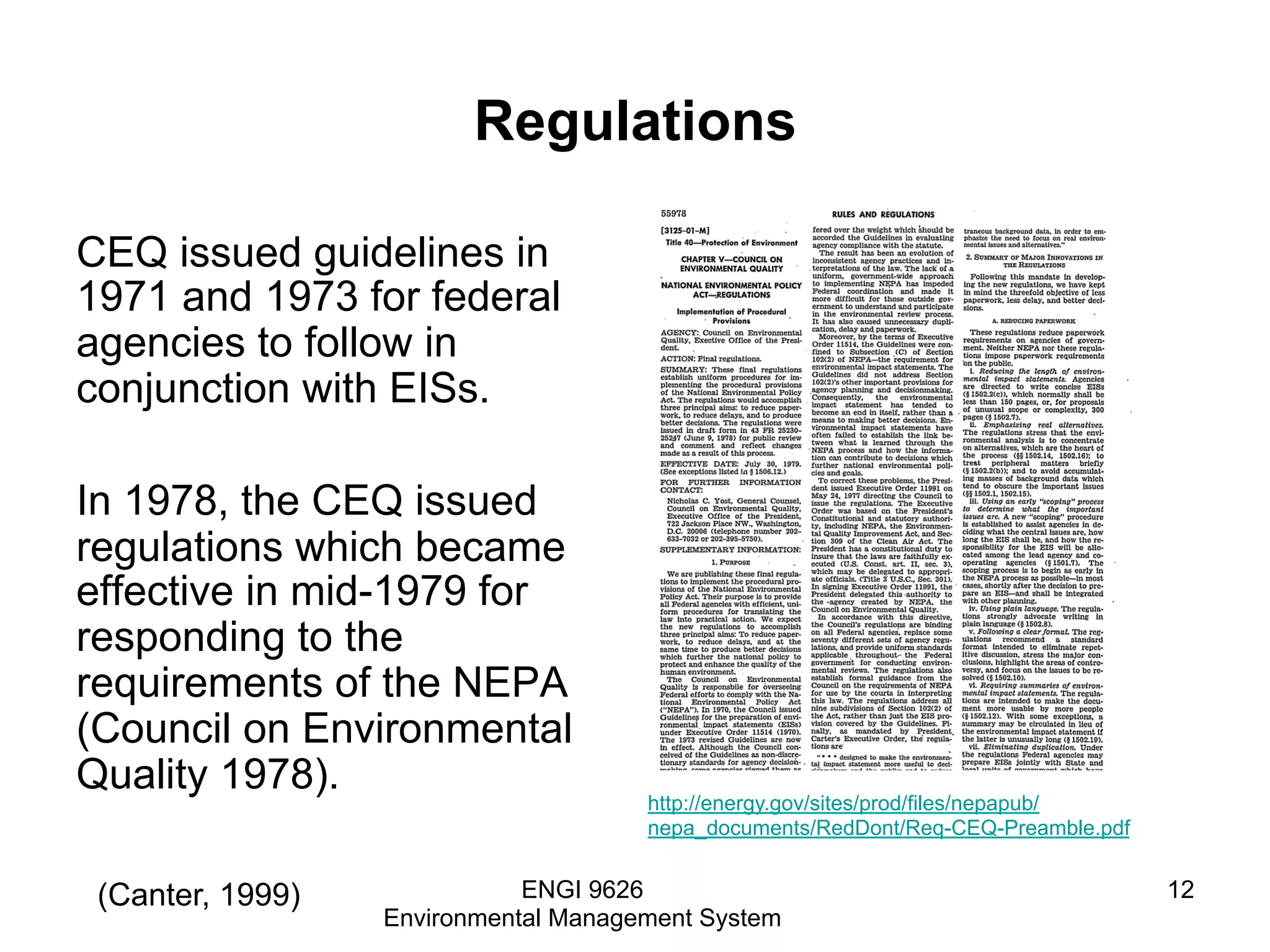
Regulations
CEQ issued guidelines in
1971 and 1973 for federal
agencies to follow in
conjunction with EISs.
In 1978, the CEQ issued
regulations which became
effective in mid-1979 for
responding to the
requirements of the NEPA
(Council on Environmental
Quality 1978).
ENGI 9626
Environmental Management System
12(Canter, 1999)
http://energy.gov/sites/prod/files/nepapub/
nepa_documents/RedDont/Req-CEQ-Preamble.pdf
Tiered Approach
ENGI 9626
Environmental Management System
13
Tiered Approach
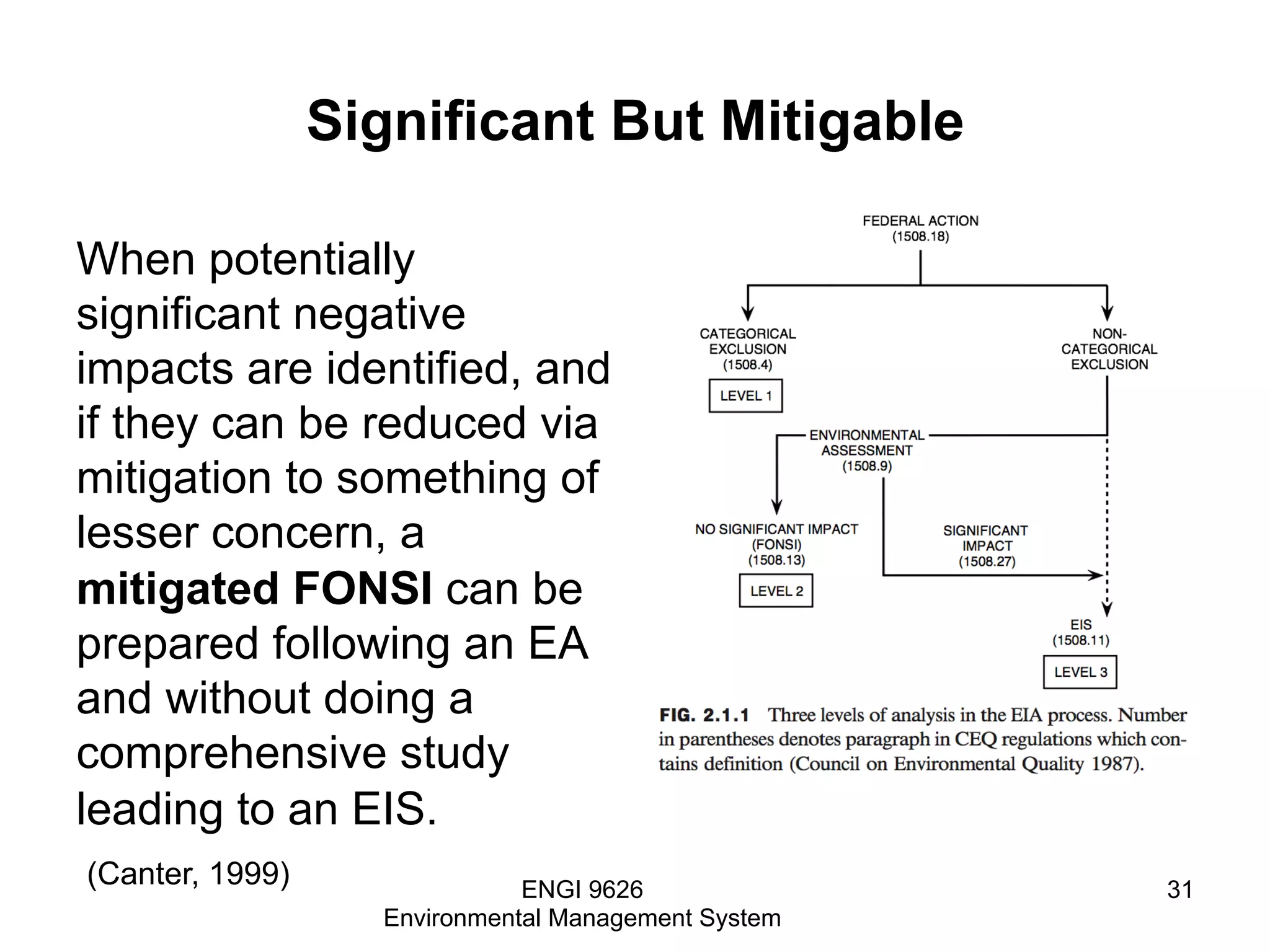
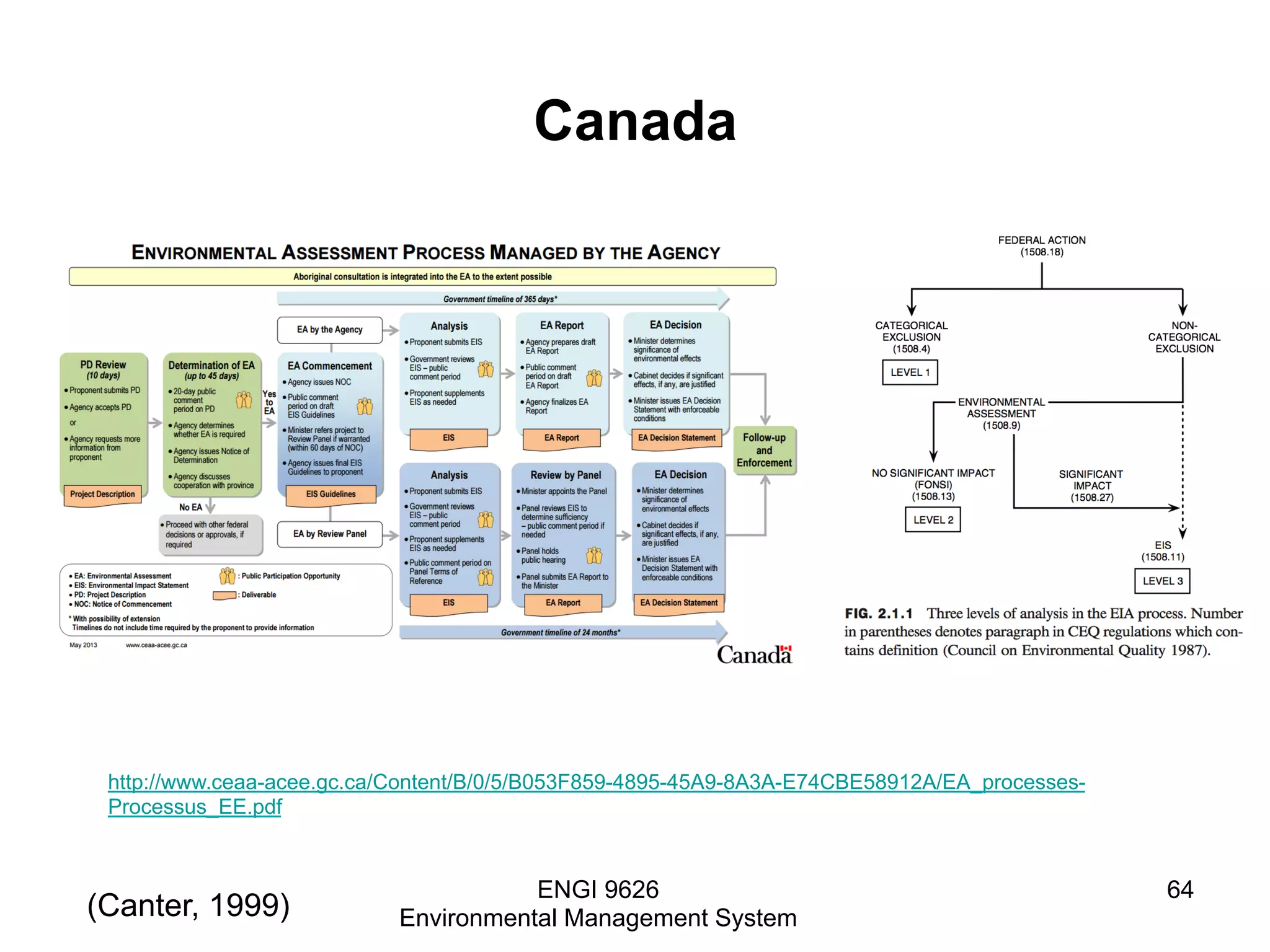
A key feature is the concept of three
levels of analysis;
•  Level 1 relates to a categorical
exclusion determination,
•  Level 2 to the preparation of an
environmental assessment (EA)
and finding of no significant
impact, and
•  Level 3 to the preparation of an
EIS
ENGI 9626
Environmental Management System
14
(Canter, 1999)
Tiered Approach
A categorical exclusion refers to
a category of actions which do not
individually or cumulatively have a
significant effect on the human
environment and have no such
effect in procedures adopted by a
federal agency in implementation
of the CEQ regulations.
Neither an EA nor an EIS is
required for categorical
exclusions.
ENGI 9626
Environmental Management System
15
(Canter, 1999)
Tiered Approach
An EA is a concise public document
that serves to provide sufficient
evidence and analysis for;
•  determining whether to prepare
an EIS or a finding of no
significant impact (FONSI),
•  aid an agency’s compliance with
the NEPA when no EIS is
necessary, or
•  facilitate preparation of an EIS
when one is necessary.
ENGI 9626
Environmental Management System
16
(Canter, 1999)
Tiered Approach
A FONSI is a document written by a
federal agency briefly presenting
the reasons why an action, not
otherwise excluded, will not have a
significant effect on the human
environment and for which an EIS
will not be prepared.
A mitigated FONSI refers to a
proposed action that has
incorporated mitigation measures to
reduce any significant negative
effects to insignificant ones.
ENGI 9626
Environmental Management System
17
(Canter, 1999)
Tiered Approach
The key definition in the EIA process is significant impact
since a proposed action which significantly affects the human
environment requires an EIS.
Significantly as used in the NEPA requires considerations
of both context and intensity.
•  Context means that significance must be analyzed
relative to society as a whole (human, national), the
affected region, the affected interests, the locality, and
whether the effects are short- or long- term.
•  Intensity refers to the severity of impact.
ENGI 9626
Environmental Management System
18
(Canter, 1999)
Tiered Approach
An EIS is a detailed written statement that serves as an action-forcing
device to ensure that the policies and goals defined in the NEPA are
infused into the ongoing pro- grams and actions of the federal
government.
It provides a full and fair discussion of significant environmental impacts
and informs decision makers and the public of the reasonable
alternatives which would avoid or minimize adverse impacts or enhance
the quality of the human environment.
An EIS is more than a disclosure document; it is used by federal officials
in conjunction with other relevant material to plan actions and make
decisions.
ENGI 9626
Environmental Management System
19
(Canter, 1999)
Public Participation
ENGI 9626
Environmental Management System
20
Public Participation
Public participation can be achieved in the EIA process in
three ways:
1.  Via an early scoping process to determine the scope
of issues to be addressed and to identify the
significant issues related to a proposed action
2.  Via a public participation program during the EIA
study
3.  Via the review process for draft EISs
ENGI 9626
Environmental Management System
21
(Canter, 1999)
Strategic Environmental
Assessment (SEA)
ENGI 9626
Environmental Management System
22
Strategic Environmental Assessment (SEA)
Strategic environmental assessment (SEA) refers to the
EIA process applied to policies, plans, or programs (Lee
and Walsh 1992).
While the NEPA includes the concept of applying the EIA
process to policies, plans, and programs, the majority of
EISs prepared in the first twenty-five years have been on
projects.
ENGI 9626
Environmental Management System
23
(Canter, 1999)
Programmatic EIS
A programmatic EIS is analogous to an SEA.
Programmatic EISs (PEISs) can be used in the United
States to address the environmental implications of the
policies and programs of federal agencies.
PEISs can be used to address the impacts of actions
that are similar in nature or broad in scope, including
cumulative impacts (Sigal and Webb 1989).
Site-specific or local-action EAs and EISs can be
tiered from the PEIS.
ENGI 9626
Environmental Management System
24
(Canter, 1999)
Impact
ENGI 9626
Environmental Management System
25
Impact Categories
Environmental impact assessment (EIA) can be defined as
the systematic identification and evaluation of the
potential impacts (effects) of proposed projects, plans,
programs, or legislative actions, relative to the physical–
chemical, biological, cultural, and socioeconomic
components of the environment.
Effects (or impacts): These terms can be considered as
synonymous.
ENGI 9626
Environmental Management System
26
(Canter, 1999)
Impact Categories
Impacts resulting from proposed actions can be considered in one or more of
the following categories:
•  Beneficial or detrimental
•  Naturally reversible or irreversible
•  Reparable via management practices or irreparable
•  Short term or long term
•  Temporary or continuous
•  Construction or operational phase
•  Local, regional, national, or global
•  Accidental or planned (recognized beforehand)
•  Direct or primary, or indirect or secondary
•  Cumulative or single
ENGI 9626
Environmental Management System
27
(Canter, 1999)
Impact Categories
Direct effects are caused by the action and occur at the same time
and place.
Indirect effects are caused by the action and occur later or farther
removed in distance, but are still reasonably foreseeable.
Cumulative impact:
The impact on the environment which results from the incremental
impact of the action when added to other past, present, and
reasonably foreseeable future actions regardless of what agency
(federal or nonfederal) or person undertakes such other actions.
Cumulative impacts can result from individually minor, but collectively
significant, actions taking place over a period of time.
ENGI 9626
Environmental Management System
28
(Canter, 1999)
Negative Impacts
Negative impacts fall into three categories:
1.  insignificant,
2.  significant but mitigable, or
3.  significant but not mitigable
ENGI 9626
Environmental Management System
29
(Canter, 1999)
Negative Impacts
Mitigation includes
(Council on Environmental Quality 1987):
1.  Avoiding the impact altogether by not taking a certain action or
parts of an action
2.  Minimizing impacts by limiting the degree or magnitude of the
action and its implementation
3.  Rectifying the impact by repairing, rehabilitating, or restoring the
affected environment
4.  Reducing or eliminating the impact over time by preservation and
maintenance operations during the life of the action
5.  Compensating for the impact by replacing or providing substitute
resources or environments
ENGI 9626
Environmental Management System
30
(Canter, 1999)
Significant But Mitigable
When potentially
significant negative
impacts are identified, and
if they can be reduced via
mitigation to something of
lesser concern, a
mitigated FONSI can be
prepared following an EA
and without doing a
comprehensive study
leading to an EIS.
ENGI 9626
Environmental Management System
31
(Canter, 1999)
EIA METHODS
ENGI 9626
Environmental Management System
32
ENGI 9626
Environmental Management System
33
(Lee1988).
Impact Prediction
ENGI 9626
Environmental Management System
34
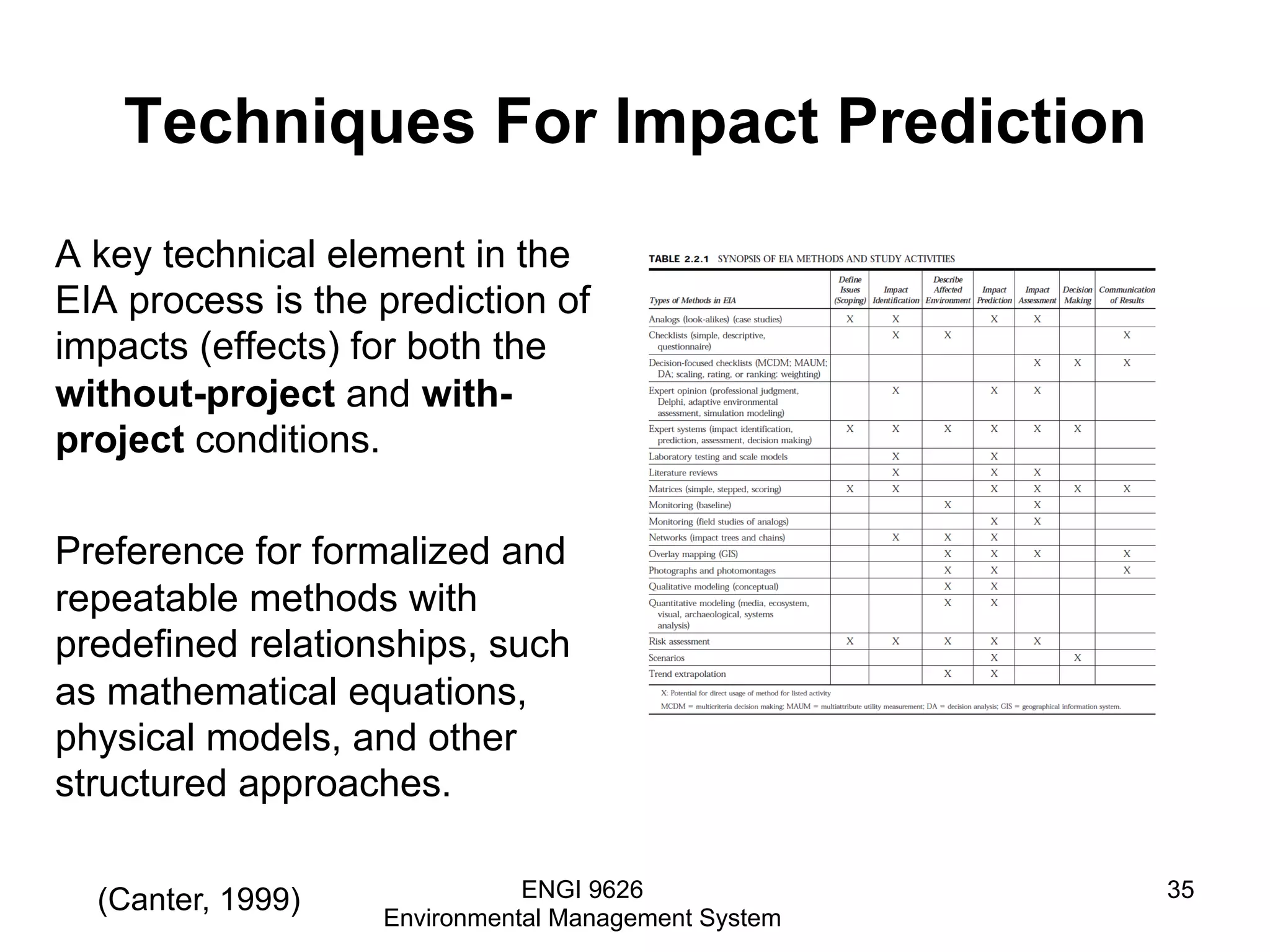
Techniques For Impact Prediction
A key technical element in the
EIA process is the prediction of
impacts (effects) for both the
without-project and with-
project conditions.
Preference for formalized and
repeatable methods with
predefined relationships, such
as mathematical equations,
physical models, and other
structured approaches.
ENGI 9626
Environmental Management System
35(Canter, 1999)
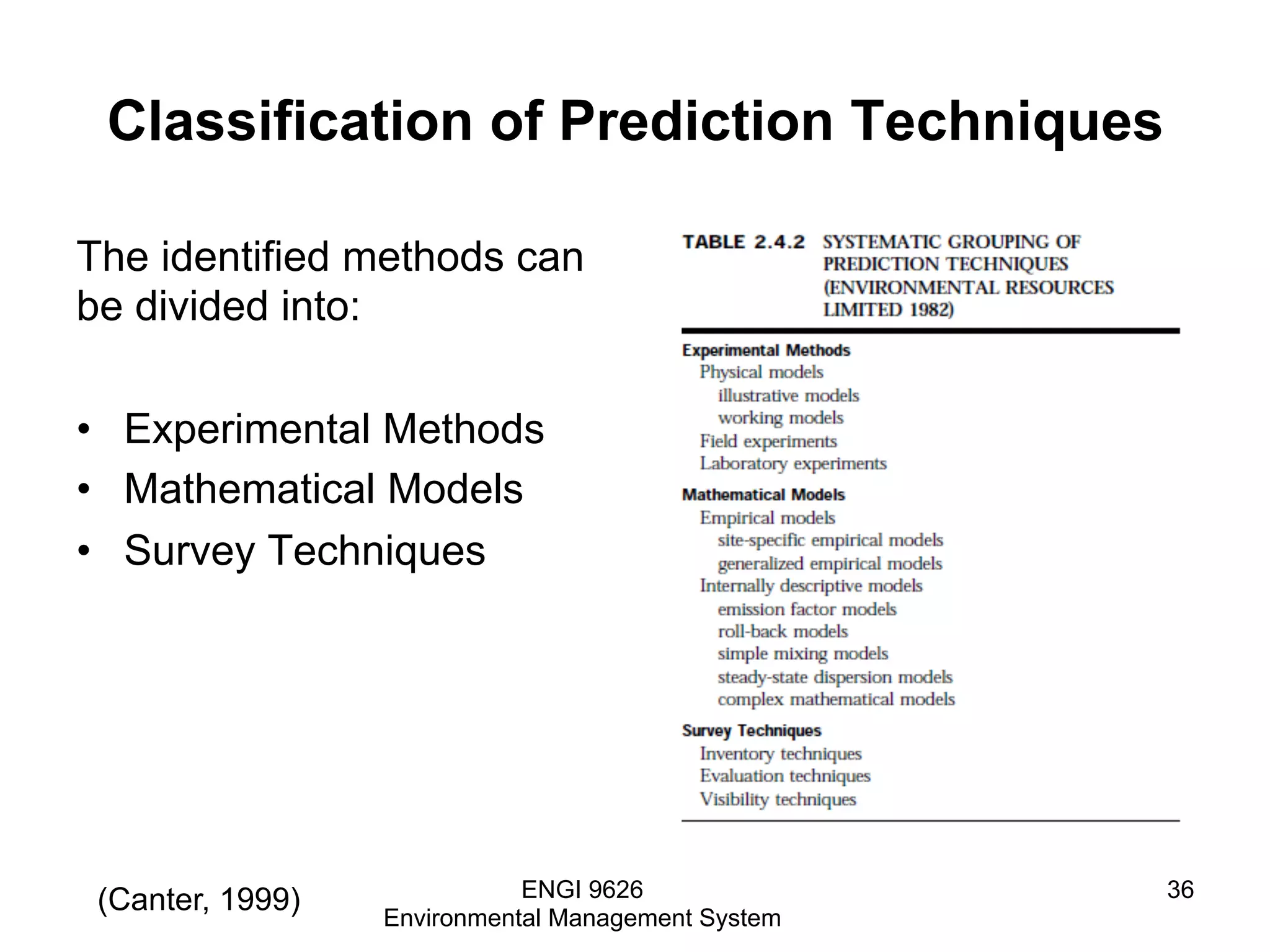
Classification of Prediction Techniques
The identified methods can
be divided into:
•  Experimental Methods
•  Mathematical Models
•  Survey Techniques
ENGI 9626
Environmental Management System
36(Canter, 1999)
Classification of Prediction Techniques
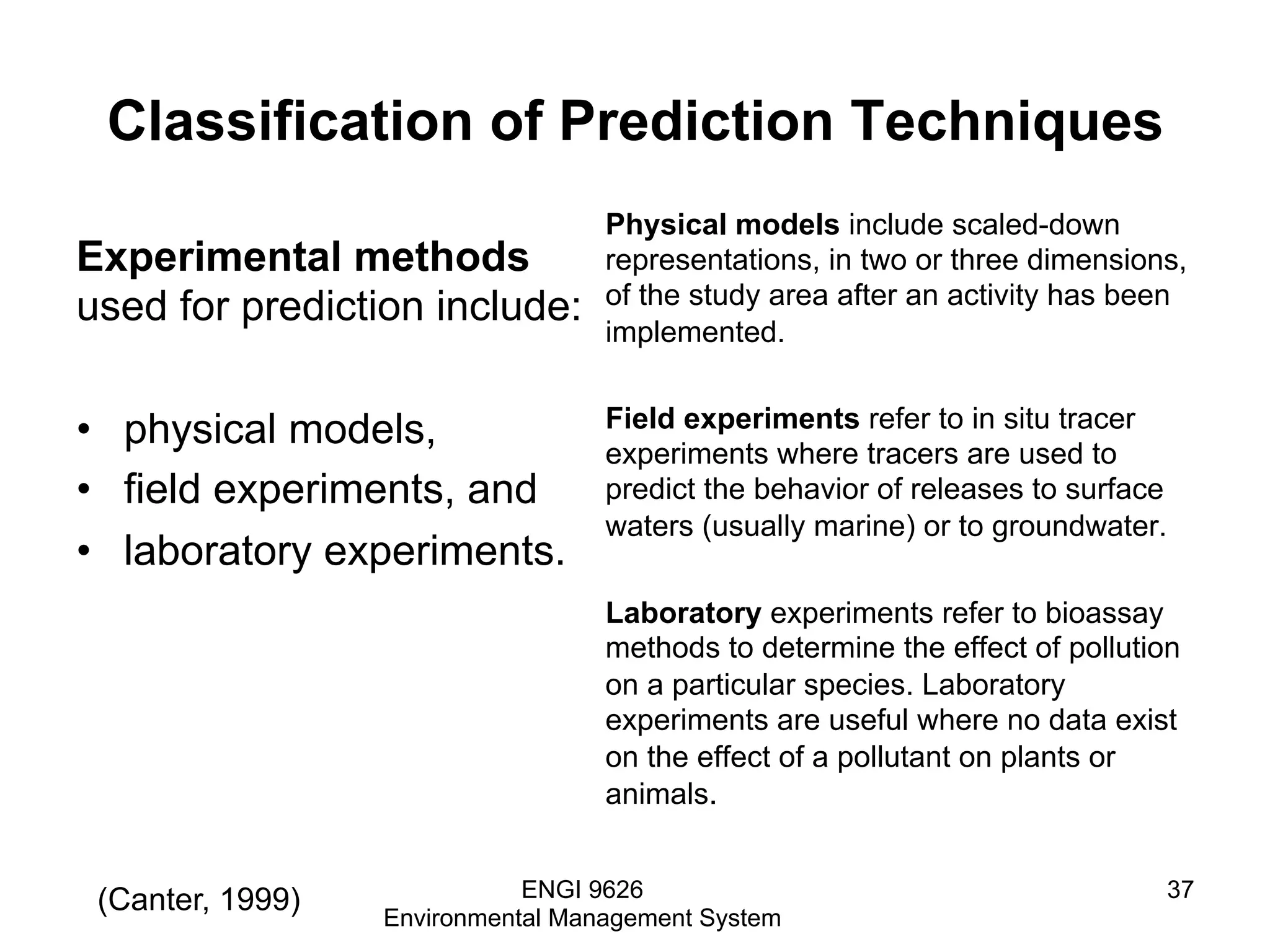
Experimental methods
used for prediction include:
•  physical models,
•  field experiments, and
•  laboratory experiments.
Physical models include scaled-down
representations, in two or three dimensions,
of the study area after an activity has been
implemented.
Field experiments refer to in situ tracer
experiments where tracers are used to
predict the behavior of releases to surface
waters (usually marine) or to groundwater.
Laboratory experiments refer to bioassay
methods to determine the effect of pollution
on a particular species. Laboratory
experiments are useful where no data exist
on the effect of a pollutant on plants or
animals.
ENGI 9626
Environmental Management System
37(Canter, 1999)
Classification of Prediction Techniques
Mathematical models refer to
predictive techniques which use
mathematical relationships between
system variables to describe the way an
environmental system reacts to an
external influence.
•  The most sophisticated approach for
impact prediction involves the use of
mathematical models.
•  Numerous types of mathematical
models account for pollutant
transport and fate within the
environmental setting.
•  Other models describe
environmental features and the
functioning of ecosystems.
Mathematical models can be divided
into
•  those models which are empirical or
“blackbox” models, where the
relationships between inputs and
outputs are established from analysis
of observations in the environment;
and
•  those models which are internally
descriptive, that is, where the
mathematical relationships within the
model are based on some
understanding of the mechanisms of
the processes occurring in the
environment.
ENGI 9626
Environmental Management System
38(Canter, 1999)
Classification of Prediction Techniques
Survey techniques are based on the
identification and quantification of
existing or future aspects of the
environment that might be affected, in
terms of their sensitivity to change or
of the importance of their loss or
disturbance.
The three main groups of survey
techniques include
•  inventory techniques,
•  evaluation techniques, and
•  visibility techniques.
Inventory techniques involve determining
the distribution of things which may be
affected by an activity (receptors) usually
because of their proximity to an activity.
Evaluation techniques refer to surveys to
determine the value of the environmental
aspect that will be lost or disturbed as the
result of an activity, and where possible its
change in value after the activity is
undertaken.
Visibility techniques form a group which
cannot easily be categorized in either of
the other types. These techniques are
used in landscape assessment for
determining the zone from which an
activity will be visible.
ENGI 9626
Environmental Management System
39(Canter, 1999)
Evaluating Alternatives
ENGI 9626
Environmental Management System
40
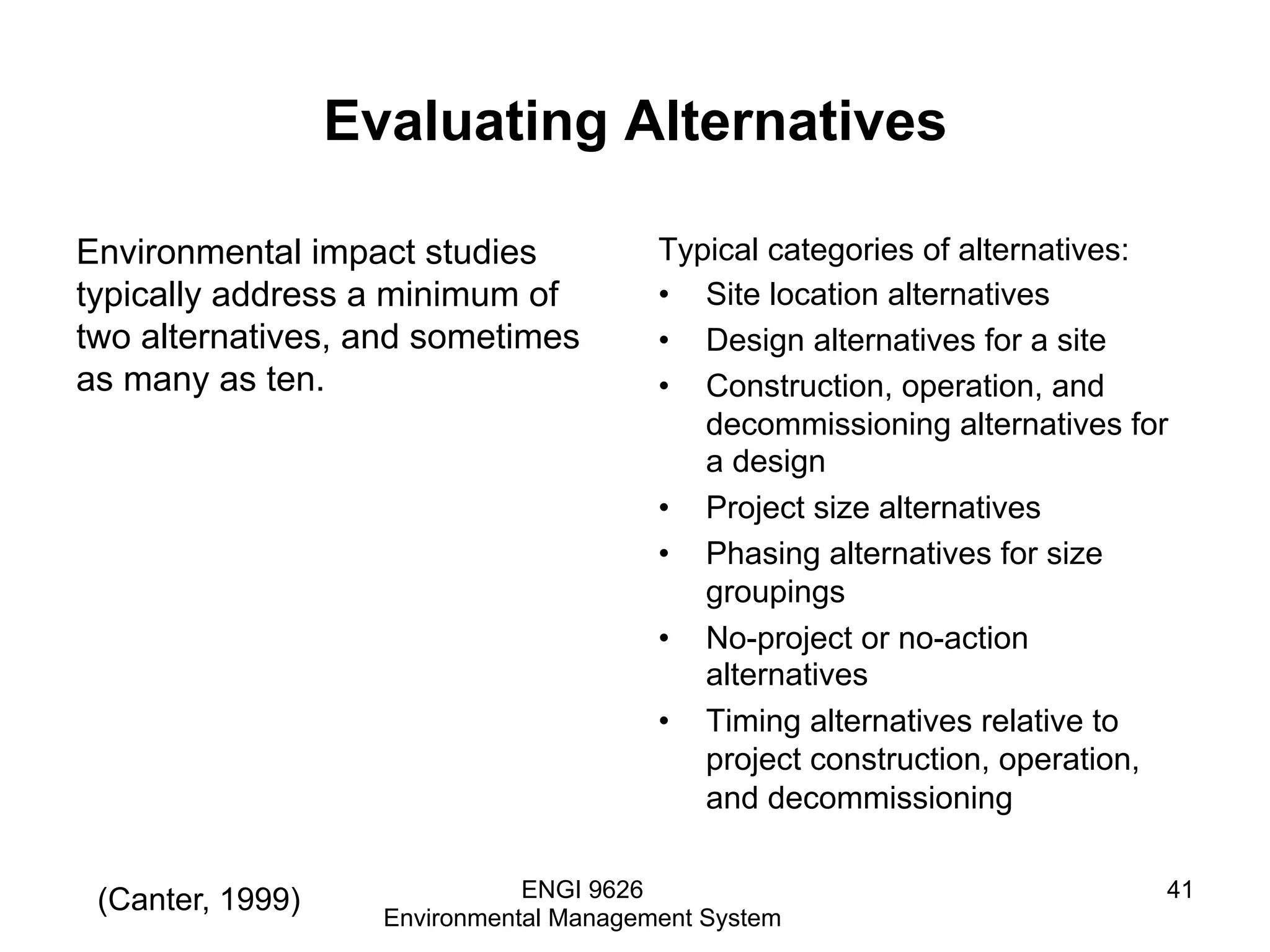
Evaluating Alternatives
Environmental impact studies
typically address a minimum of
two alternatives, and sometimes
as many as ten.
Typical categories of alternatives:
•  Site location alternatives
•  Design alternatives for a site
•  Construction, operation, and
decommissioning alternatives for
a design
•  Project size alternatives
•  Phasing alternatives for size
groupings
•  No-project or no-action
alternatives
•  Timing alternatives relative to
project construction, operation,
and decommissioning
ENGI 9626
Environmental Management System
41(Canter, 1999)
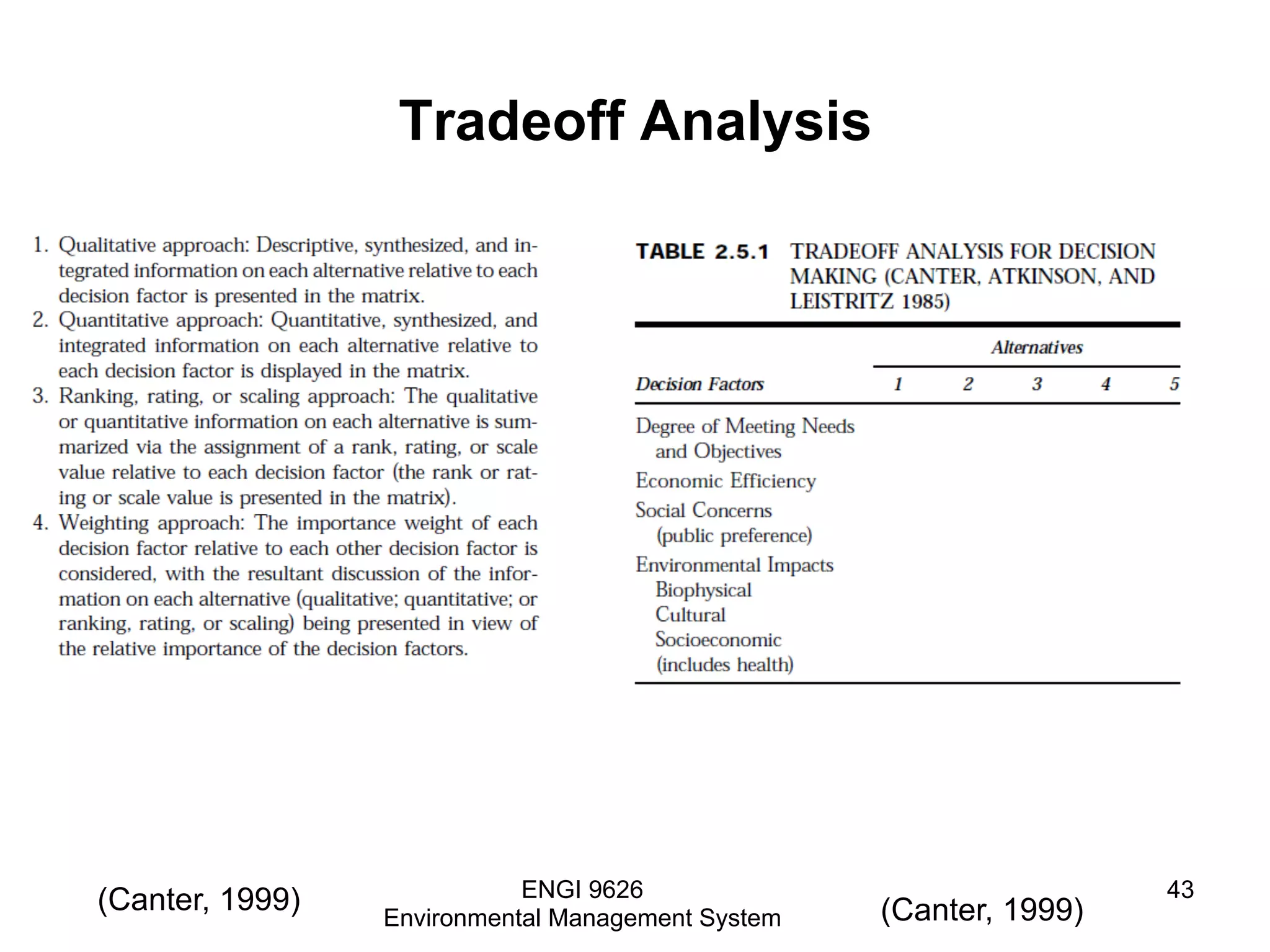
Evaluating Alternatives
Tradeoff Analysis
To achieve systematic
decision making among
alternatives, tradeoff
analysis should be used.
Tradeoff analysis involves
the comparison of a set of
alternatives relative to a
series of decision factors.
ENGI 9626
Environmental Management System
42(Canter, 1999)
Tradeoff Analysis
ENGI 9626
Environmental Management System
43
(Canter, 1999)(Canter, 1999)
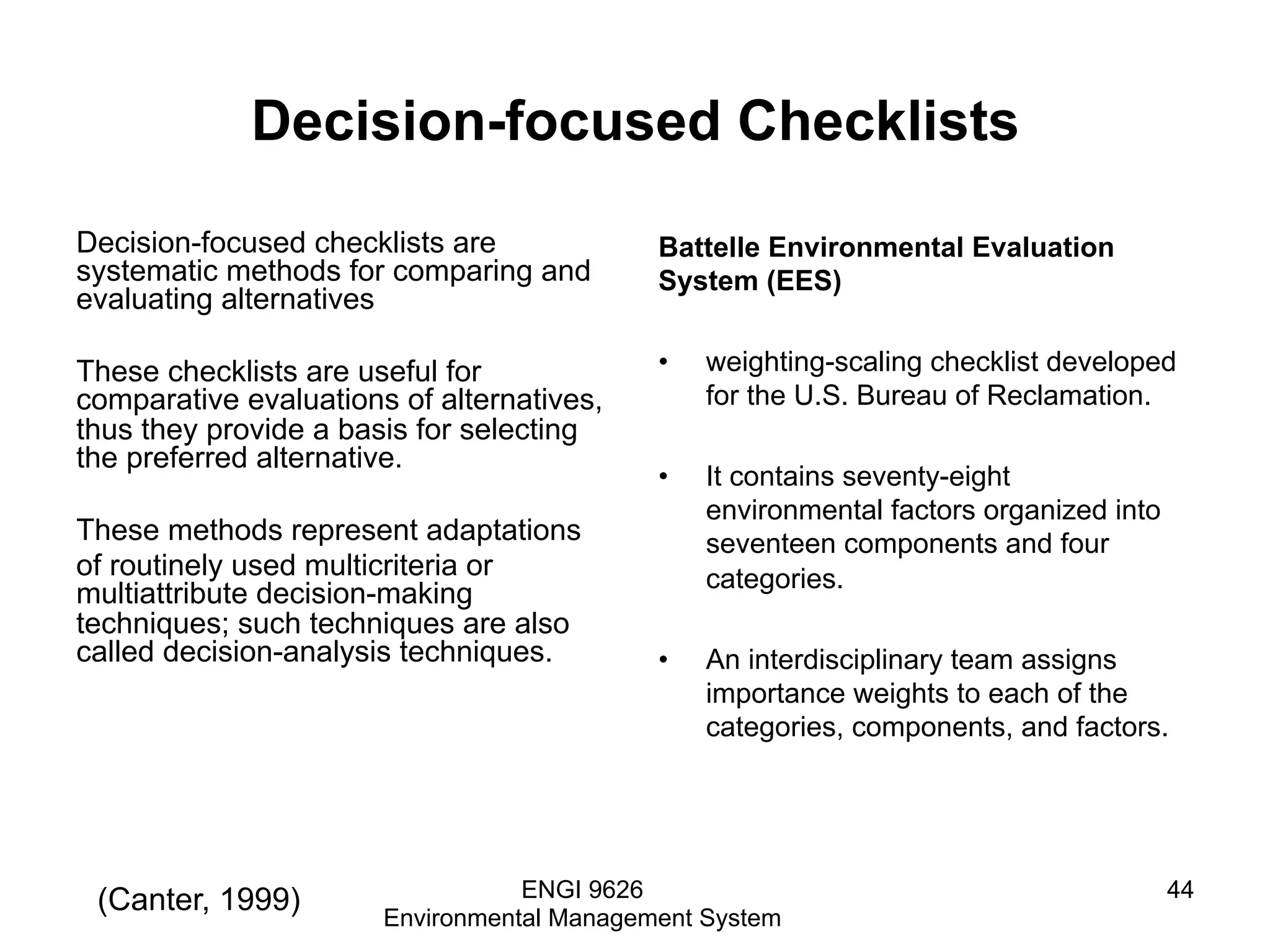
Decision-focused Checklists
Decision-focused checklists are
systematic methods for comparing and
evaluating alternatives
These checklists are useful for
comparative evaluations of alternatives,
thus they provide a basis for selecting
the preferred alternative.
These methods represent adaptations
of routinely used multicriteria or
multiattribute decision-making
techniques; such techniques are also
called decision-analysis techniques.
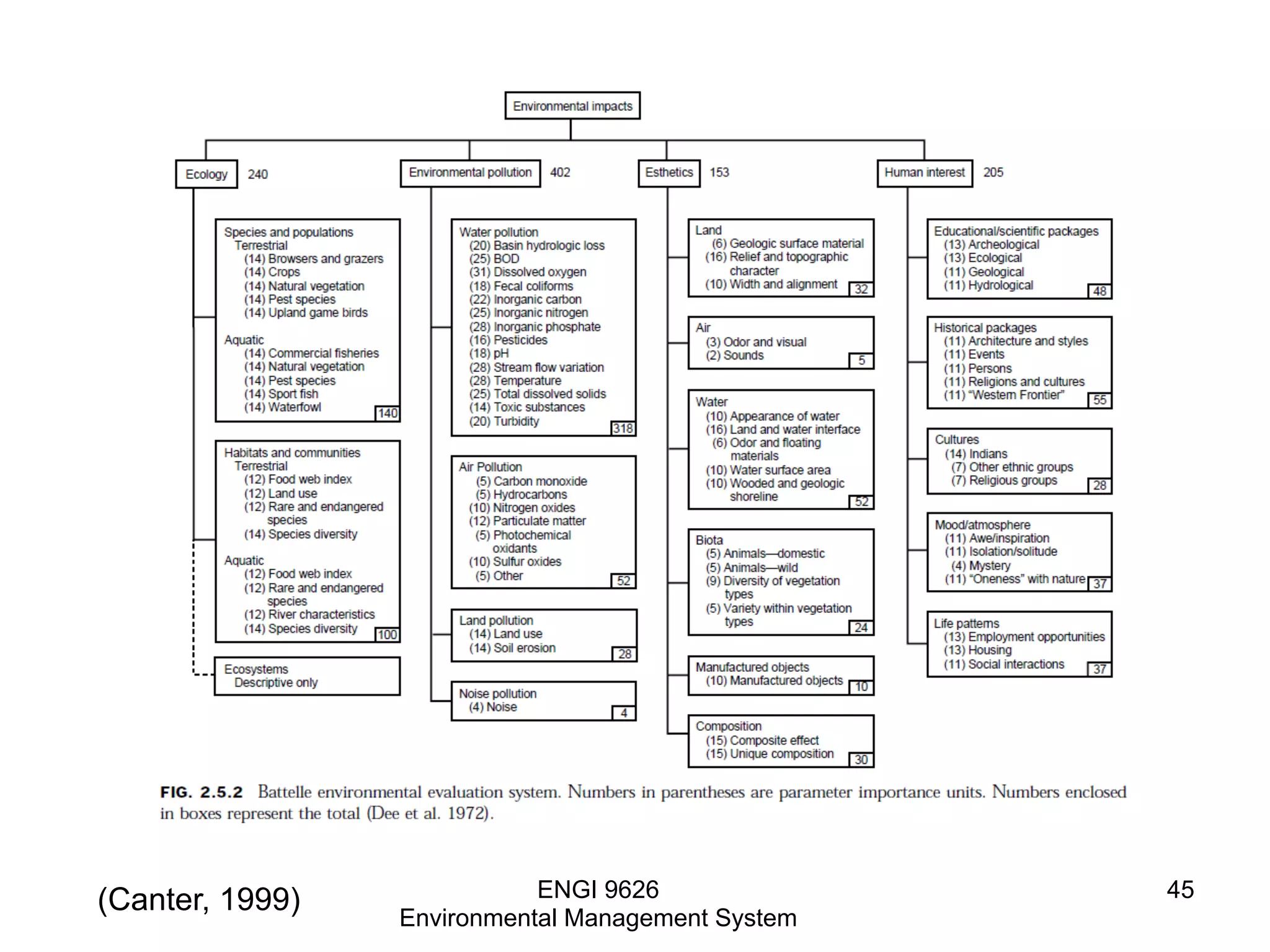
Battelle Environmental Evaluation
System (EES)
•  weighting-scaling checklist developed
for the U.S. Bureau of Reclamation.
•  It contains seventy-eight
environmental factors organized into
seventeen components and four
categories.
•  An interdisciplinary team assigns
importance weights to each of the
categories, components, and factors.
ENGI 9626
Environmental Management System
44(Canter, 1999)
ENGI 9626
Environmental Management System
45(Canter, 1999)
Written Documentation
ENGI 9626
Environmental Management System
46
Written Documentation
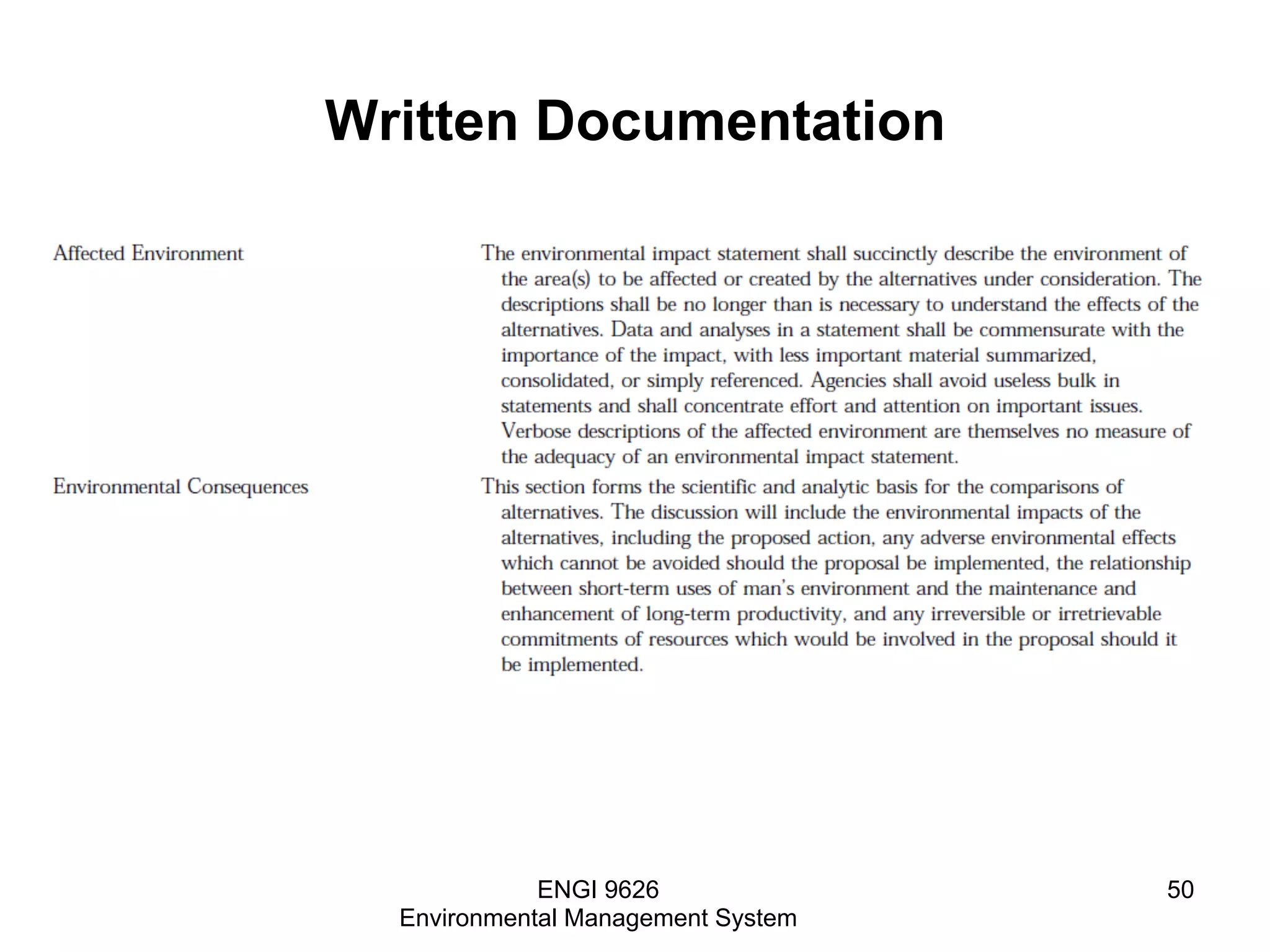
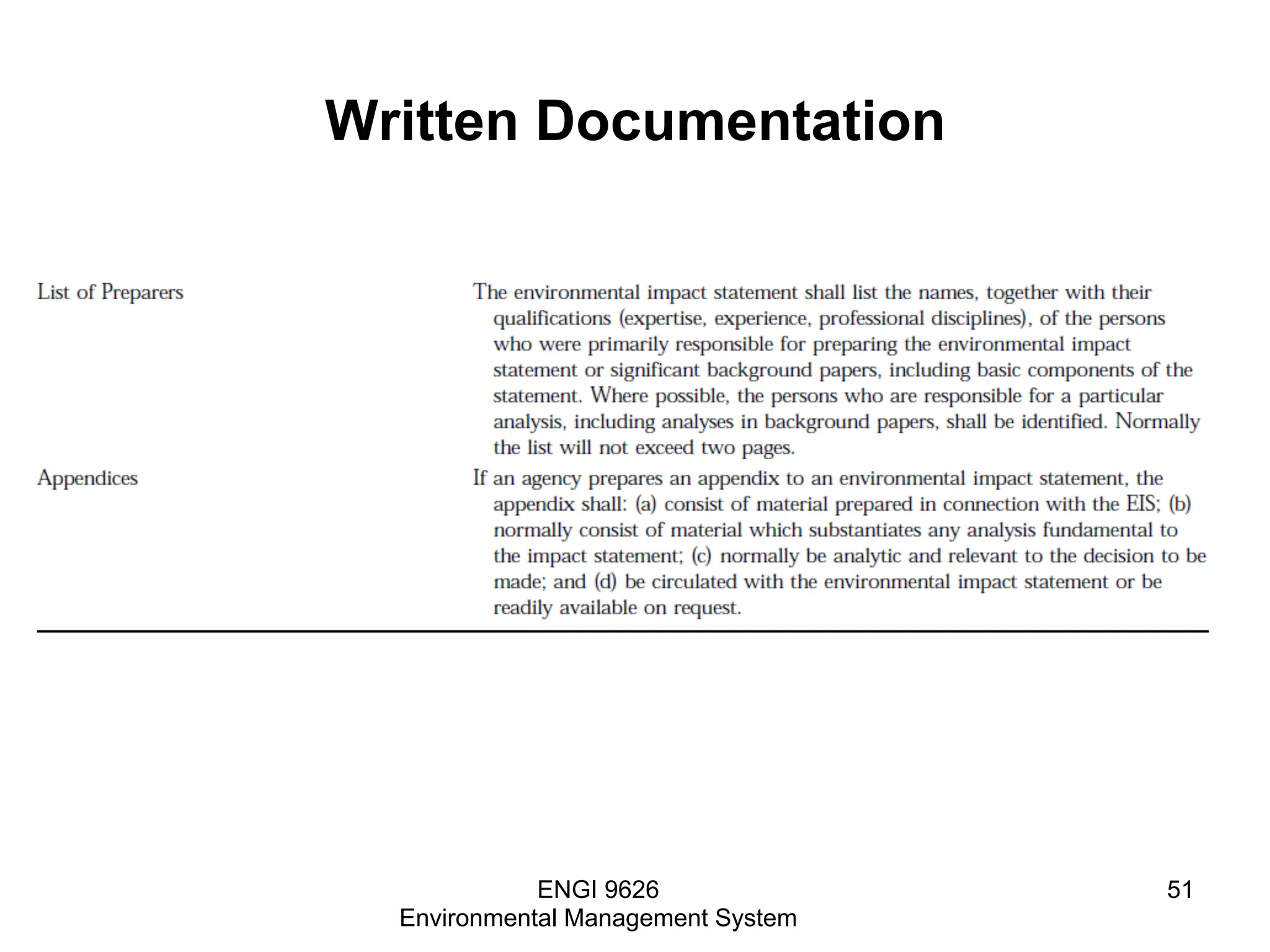
Perhaps the most important
activity in the EIA process is
preparing written reports
which document the impact
study findings.
The resultant document or
documents include EAs,
EISs, environmental impact
reports, environmental
impact declarations, and
FONSIs.
ENGI 9626
Environmental Management System
47(Canter, 1999)
Written Documentation
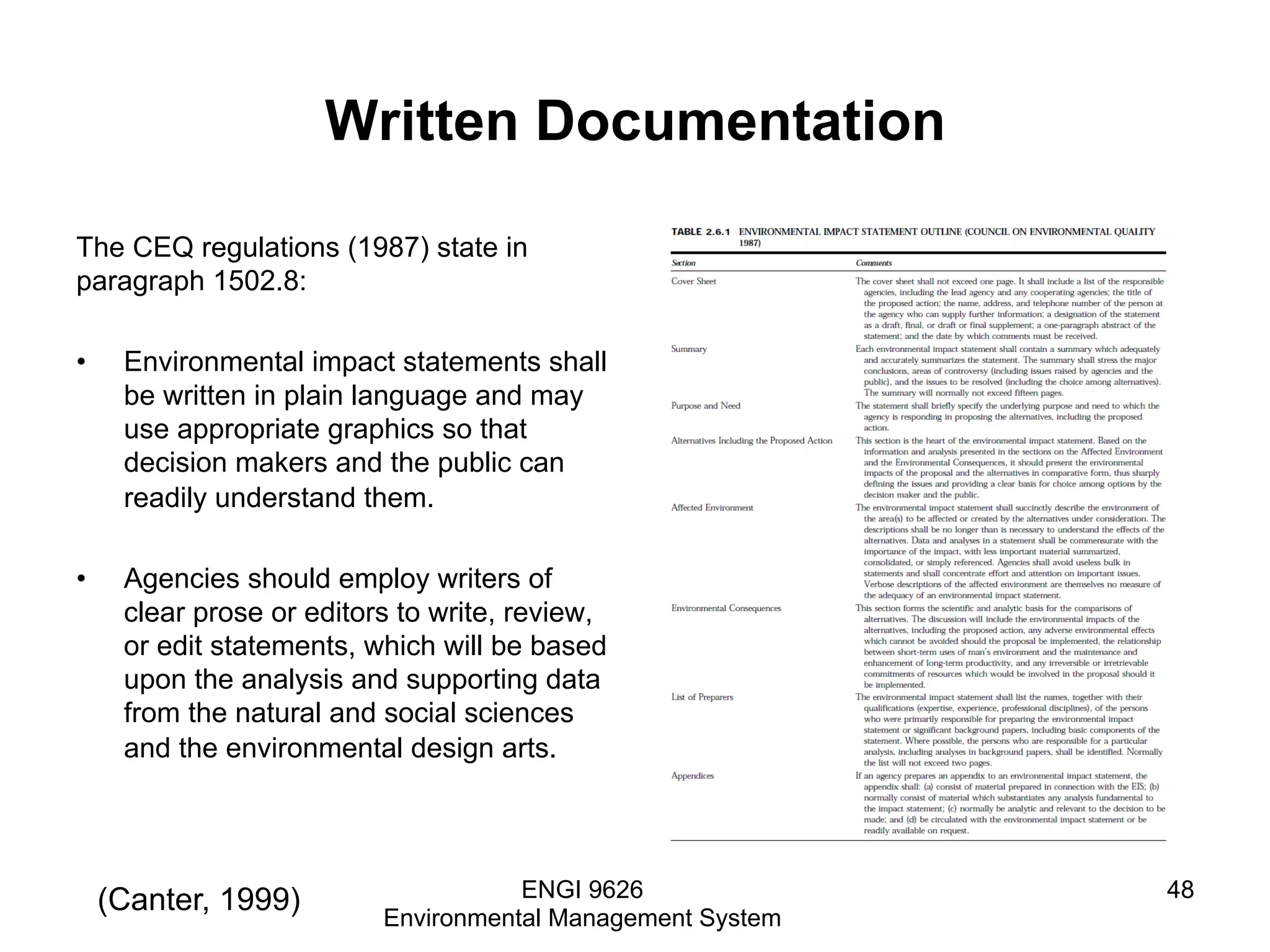
The CEQ regulations (1987) state in
paragraph 1502.8:
•  Environmental impact statements shall
be written in plain language and may
use appropriate graphics so that
decision makers and the public can
readily understand them.
•  Agencies should employ writers of
clear prose or editors to write, review,
or edit statements, which will be based
upon the analysis and supporting data
from the natural and social sciences
and the environmental design arts.
ENGI 9626
Environmental Management System
48(Canter, 1999)
Written Documentation
ENGI 9626
Environmental Management System
49
Written Documentation
ENGI 9626
Environmental Management System
50
Written Documentation
ENGI 9626
Environmental Management System
51
Environmental Monitoring
ENGI 9626
Environmental Management System
52
Environmental Monitoring
The CEQ regulations (1987)
enunciate the principle of
post-EIS environmental
monitoring in sections
1505.3 and 1505.2(c).
The CEQ regulations focus
on monitoring in conjunction
with implementing mitigation
measures.
Monitoring can also be used
to determine the
effectiveness of each of the
types of mitigation
measures.
ENGI 9626
Environmental Management System
53(Canter, 1999)
Environmental Monitoring
Three types of
environmental monitoring
associated with the life cycle
of a project, plan, or
program;
•  Baseline Monitoring
•  Effects Or Impact
Monitoring
•  Compliance Monitoring
ENGI 9626
Environmental Management System
54(Canter, 1999)
Environmental Monitoring
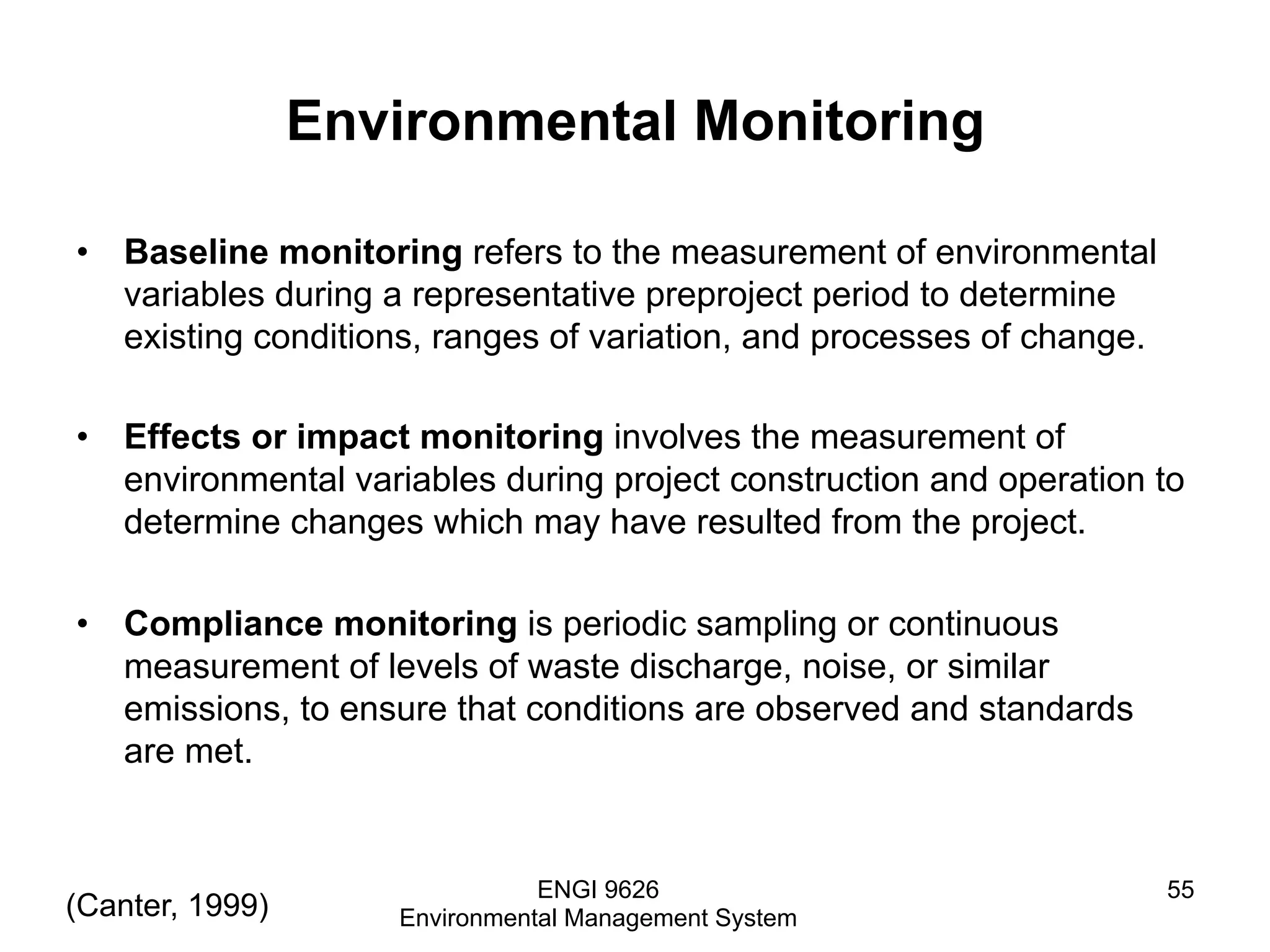
•  Baseline monitoring refers to the measurement of environmental
variables during a representative preproject period to determine
existing conditions, ranges of variation, and processes of change.
•  Effects or impact monitoring involves the measurement of
environmental variables during project construction and operation to
determine changes which may have resulted from the project.
•  Compliance monitoring is periodic sampling or continuous
measurement of levels of waste discharge, noise, or similar
emissions, to ensure that conditions are observed and standards
are met.
ENGI 9626
Environmental Management System
55
(Canter, 1999)
Uses For Post EIS Monitoring
1.  Provides information for documentation of the impacts
that result from a proposed federal action, with this
information enabling more accurate prediction of
impacts associated with similar federal actions.
2.  Warns agencies of unanticipated adverse impacts or
sudden changes in impact trends
3.  Provides an immediate warning whenever a preselected
impact indicator approaches a pre-selected critical level.
ENGI 9626
Environmental Management System
56(Canter, 1999)
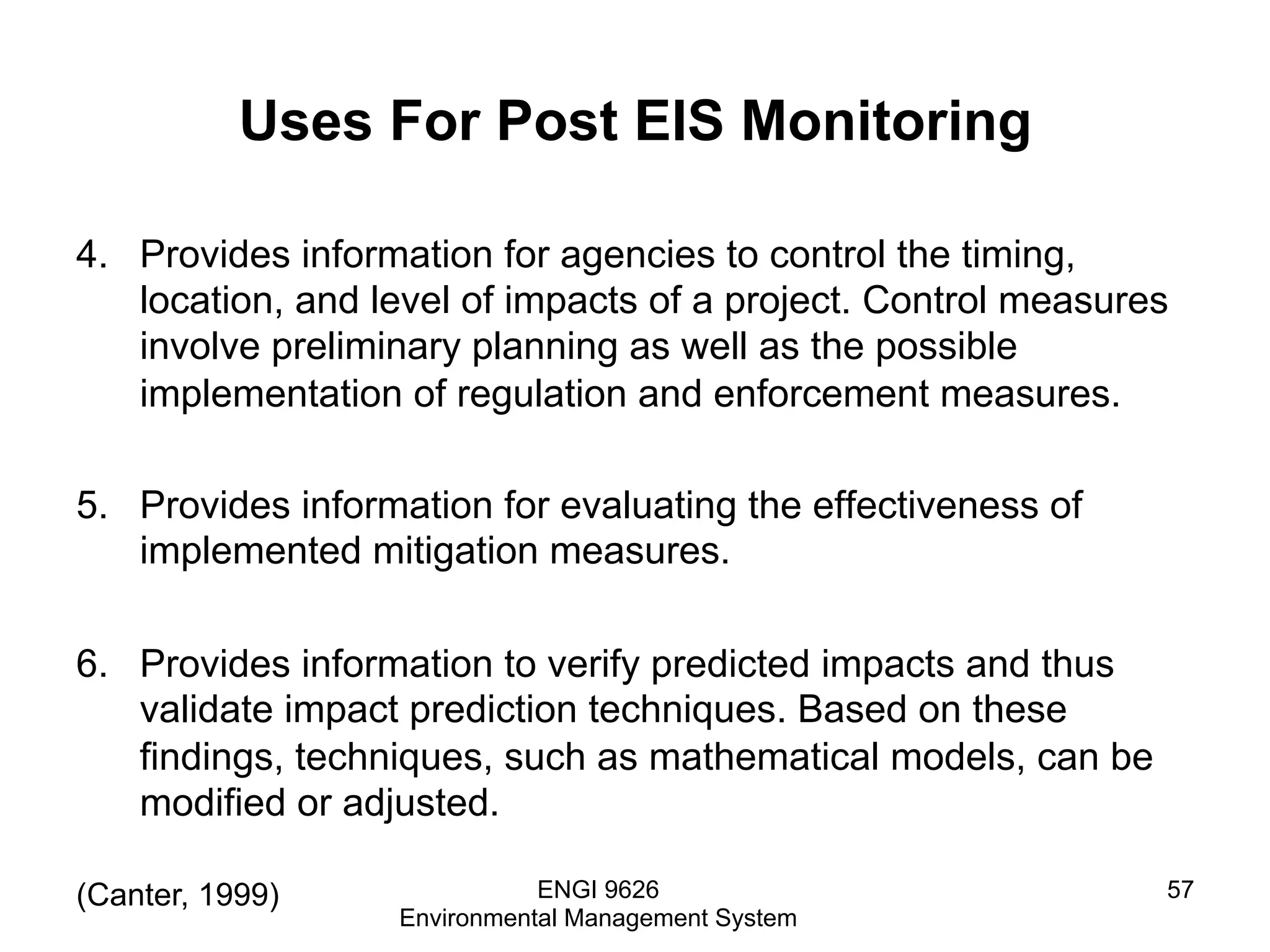
Uses For Post EIS Monitoring
4.  Provides information for agencies to control the timing,
location, and level of impacts of a project. Control measures
involve preliminary planning as well as the possible
implementation of regulation and enforcement measures.
5.  Provides information for evaluating the effectiveness of
implemented mitigation measures.
6.  Provides information to verify predicted impacts and thus
validate impact prediction techniques. Based on these
findings, techniques, such as mathematical models, can be
modified or adjusted.
ENGI 9626
Environmental Management System
57(Canter, 1999)
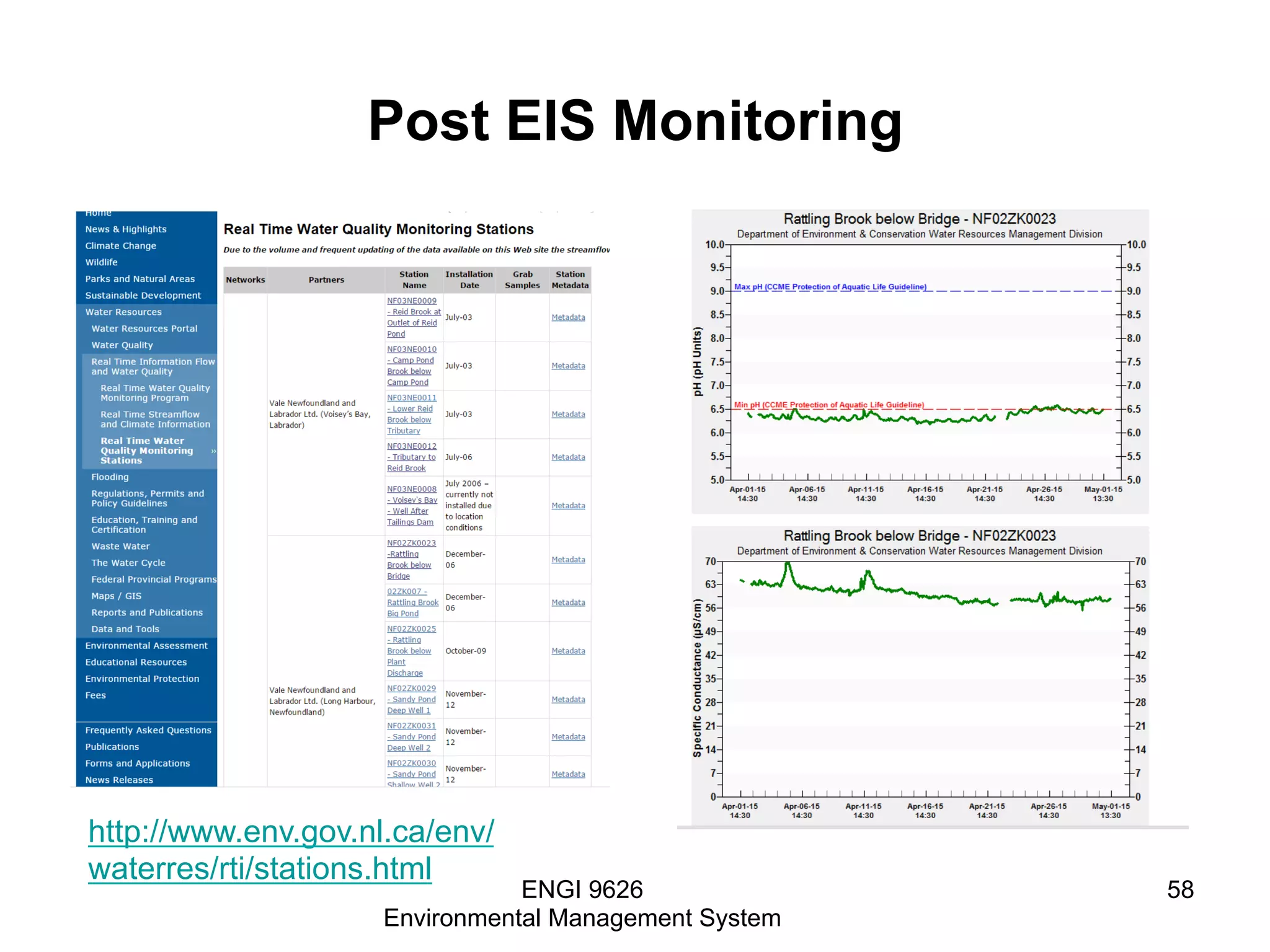
Post EIS Monitoring
ENGI 9626
Environmental Management System
58
http://www.env.gov.nl.ca/env/
waterres/rti/stations.html
Post EIS Monitoring
ENGI 9626
Environmental Management System
59
International Activities In EIA
ENGI 9626
Environmental Management System
60
International Activities In EIA
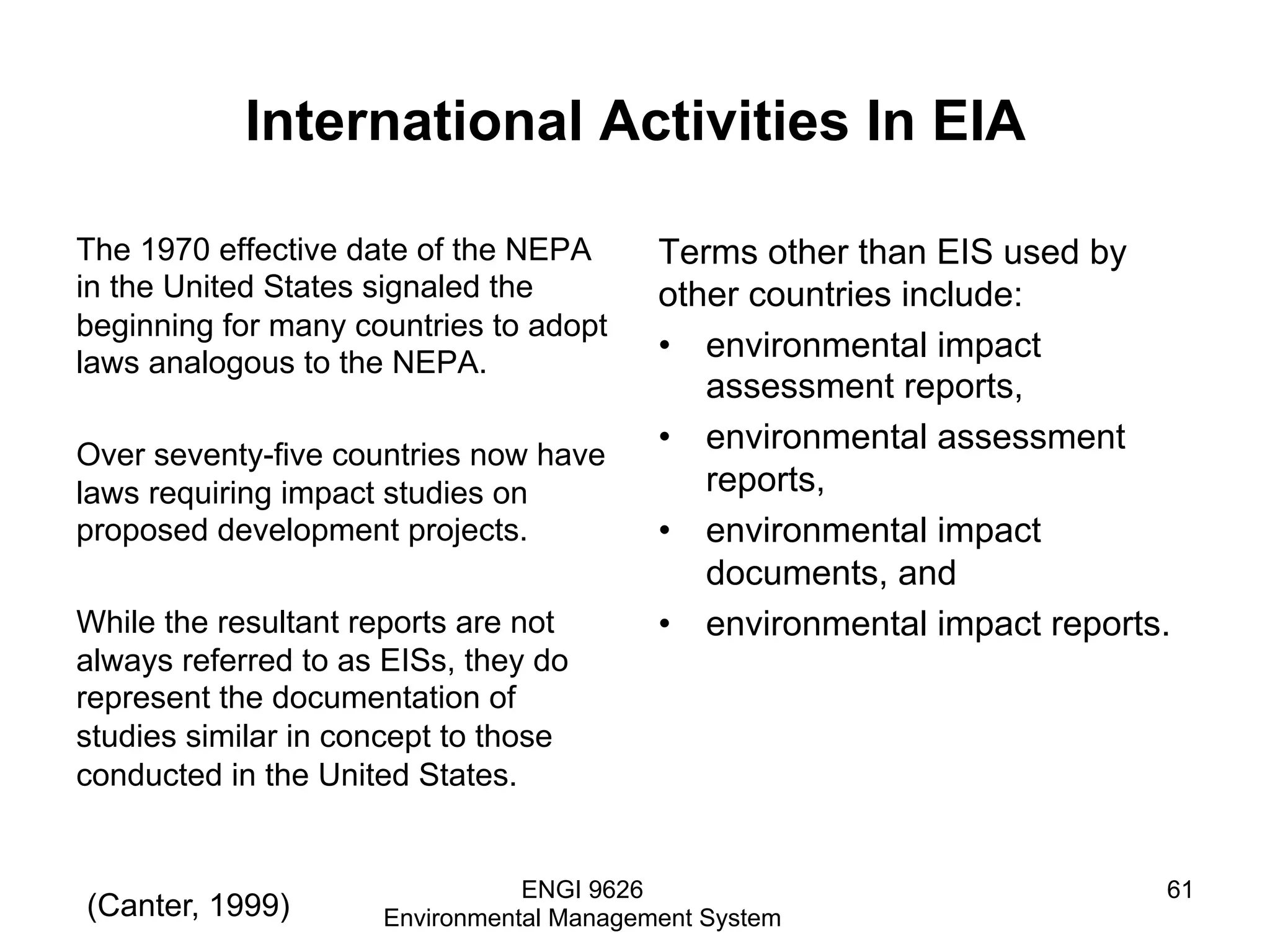
The 1970 effective date of the NEPA
in the United States signaled the
beginning for many countries to adopt
laws analogous to the NEPA.
Over seventy-five countries now have
laws requiring impact studies on
proposed development projects.
While the resultant reports are not
always referred to as EISs, they do
represent the documentation of
studies similar in concept to those
conducted in the United States.
Terms other than EIS used by
other countries include:
•  environmental impact
assessment reports,
•  environmental assessment
reports,
•  environmental impact
documents, and
•  environmental impact reports.
ENGI 9626
Environmental Management System
61
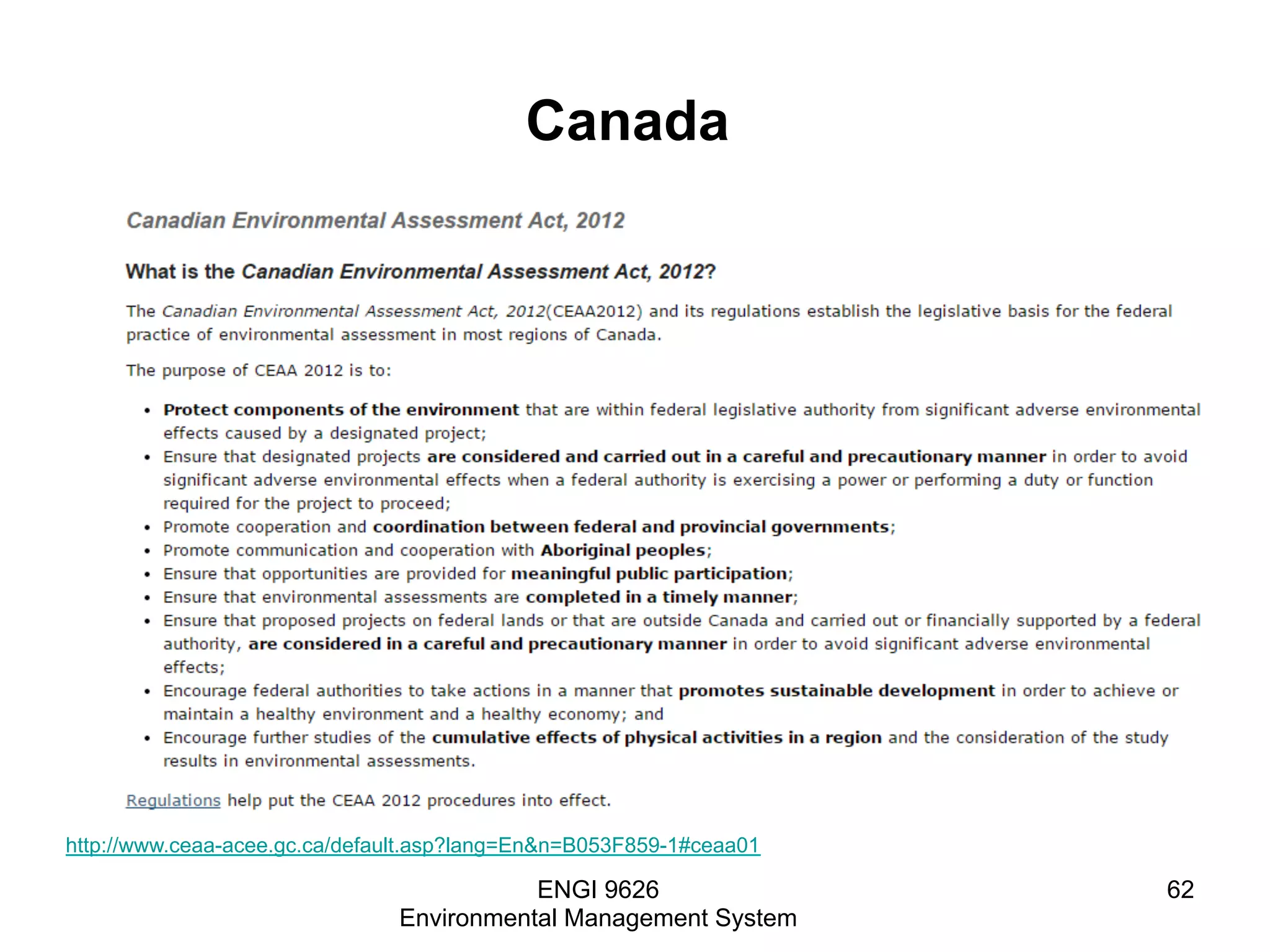
(Canter, 1999)
Canada
ENGI 9626
Environmental Management System
62
http://www.ceaa-acee.gc.ca/default.asp?lang=En&n=B053F859-1#ceaa01
Canada
ENGI 9626
Environmental Management System
63
(Canter, 1999)
http://www.ceaa-acee.gc.ca/Content/B/0/5/B053F859-4895-45A9-8A3A-
E74CBE58912A/EA_processes-Processus_EE.pdf
Canada
ENGI 9626
Environmental Management System
64
(Canter, 1999)
http://www.ceaa-acee.gc.ca/Content/B/0/5/B053F859-4895-45A9-8A3A-E74CBE58912A/EA_processes-
Processus_EE.pdf
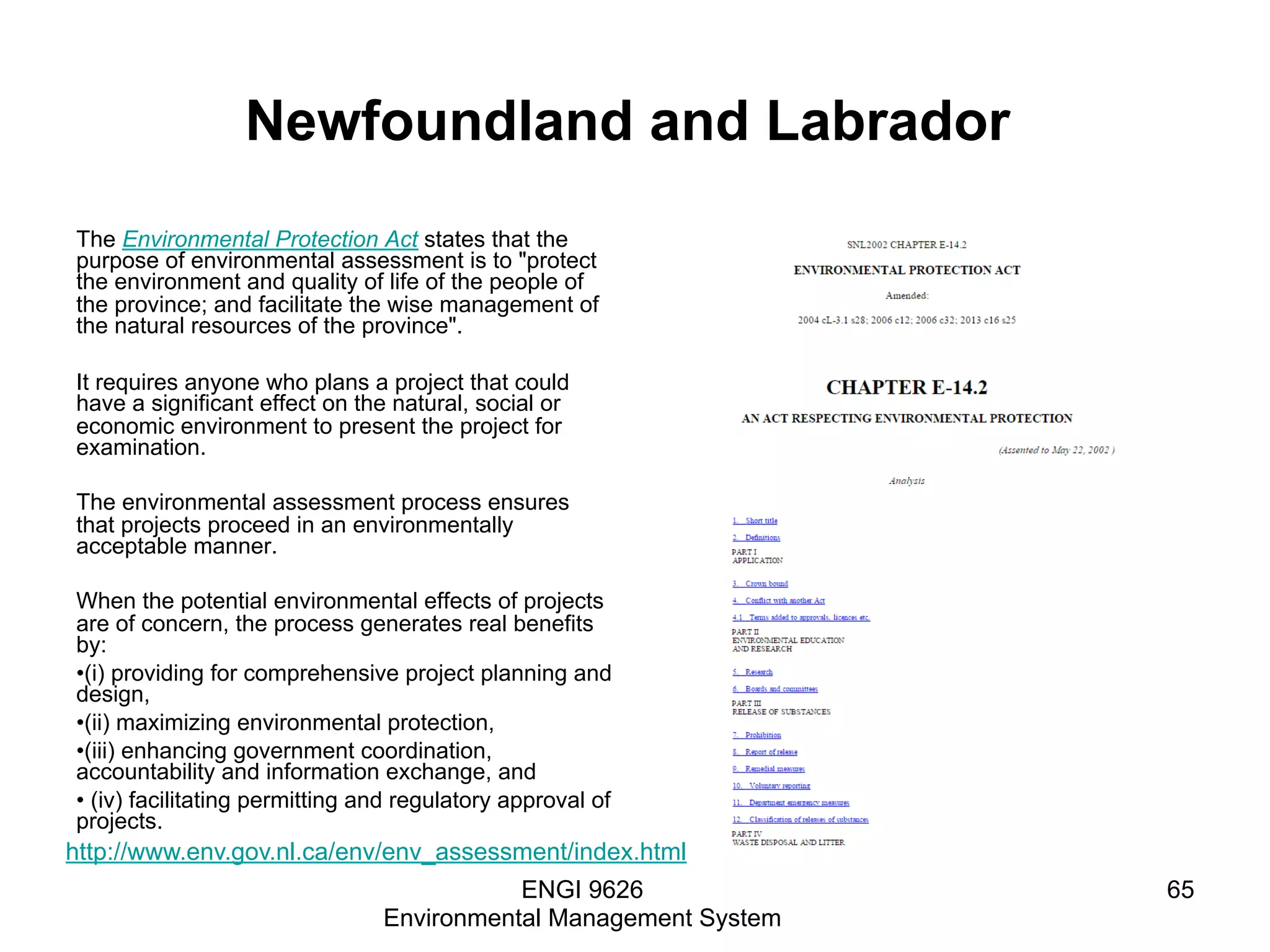
Newfoundland and Labrador
The Environmental Protection Act states that the
purpose of environmental assessment is to "protect
the environment and quality of life of the people of
the province; and facilitate the wise management of
the natural resources of the province".
It requires anyone who plans a project that could
have a significant effect on the natural, social or
economic environment to present the project for
examination.
The environmental assessment process ensures
that projects proceed in an environmentally
acceptable manner.
When the potential environmental effects of projects
are of concern, the process generates real benefits
by:
• (i) providing for comprehensive project planning and
design,
• (ii) maximizing environmental protection,
• (iii) enhancing government coordination,
accountability and information exchange, and
• (iv) facilitating permitting and regulatory approval of
projects.
ENGI 9626
Environmental Management System
65
http://www.env.gov.nl.ca/env/env_assessment/index.html
Newfoundland and Labrador
ENGI 9626
Environmental Management System
66
http://www.env.gov.nl.ca/env/env_assessment/
ea_guide.pdf
Emerging Issues In The EIA
Process
ENGI 9626
Environmental Management System
67
Emerging Issues In The EIA Process
Cumulative Impact
considerations in the EIA
process are becoming
increasingly important as
projects are recognized as
not being constructed and
operated in isolation, but in
the context of existing and
other planned projects in the
environs.
ENGI 9626
Environmental Management System
68
(Canter, 1999)
Emerging Issues In The EIA Process
Risk Assessment Integration
into the EIA Process is
increasing. Risk assessment is
a tool developed in the 1970s
primarily for evaluating
environmental regulatory
strategies.
Risk assessment provides not
only a focus on human health
concerns, but can also be
applied in ecological analyses.
ENGI 9626
Environmental Management System
69
(Canter, 1999)
Emerging Issues In The EIA Process
Regional EIA process for
larger scale projects. EIA
process is being applied in a
more focused manner to
environmental permits and
specific environmental
remediation projects.
In contrast, interest is
increasing in considering
regional and broader issues
in the EIA process.
ENGI 9626
Environmental Management System
70
(Canter, 1999)
Emerging Issues In The EIA Process
One example is the
delineated need for
addressing the impacts of
projects on biodiversity
(Council on Environmental
Quality 1993).
The implications for some
large-scale projects, in
terms of transboundary
impacts, acid rain as well as
global warming, may have
to be considered.
ENGI 9626
Environmental Management System
71
(Canter, 1999)
References
•  Larry W . Canter “Environmental
Impact Assessment” Ch 2 in
Environmental Engineers' Handbook,
CRC Press 1999
•  http://www.epw.senate.gov/nepa69.pdf
• 
https://www.whitehouse.gov/
administration/eop/ceq
•  http://www.env.gov.nl.ca/env/
env_assessment/index.html
• 
http://www.ceaa-acee.gc.ca/
default.asp?
lang=En&n=B053F859-1#ceaa01
ENGI 9626
Environmental Management System
72
EIA Assignment 1
1.  Summarize the EA process in NL in a flow chart.
Please show/cite all relevant legislation and regulations
(1 page).
2.  Systematically describe the flow chart and thereby the
EA process in NL. (1-2 pages).
3.  Compare the EA process in NL with the EIS process of
NEPA, highlight what is similar between the two and
what is different(1 page).
ENGI 9626
Environmental Management System
73
EIA Assignment 1
•  The assignment is due a week after the Guest
Presentation on the NL EA process.
ENGI 9626
Environmental Management System
74
EIA Assignment 2
1.  Please review and prepare a one
page summary of the paper on “
Multi-jurisdictional environmental
impact assessment: Canadian
experiences”
2.  Please review and prepare a one
page summary of the paper on
“Risk assessment for improved
treatment of health considerations
in EIA”
3.  Please review and prepare a one
page summary of the paper on
“Cumulative Impacts Are Not
Properly Addressed In
Environmental Assessments”
ENGI 9626
Environmental Management System
75
EIA Assignment 2
•  The assignment is due in two weeks.
ENGI 9626
Environmental Management System
76

2018 eia

  • 1.
    Environmental Impact Assessment ENGI 9626 EnvironmentalManagement System ENGI 9626 Environmental Management System 1
  • 2.
    Environmental Impact Assessment(EIA) Environmental impact assessment (EIA) can be defined as the systematic identification and evaluation of the potential impacts (effects) of proposed projects, plans, programs, or legislative actions, relative to the physical– chemical, biological, cultural, and socioeconomic components of the environment. ENGI 9626 Environmental Management System 2 (Canter, 1999)
  • 3.
    EIA and EMS ENGI9626 Environmental Management System 3 https://www.iaia.org/iaia10/documents/reviewed_posters/The%20Integration%20of%20EIA%20and%20EMS%20- %20Experiences%20from%20the%20UK.pdf?AspxAutoDetectCookieSupport=1 EIA and EMS are environmental protection tools with complementary purposes. •  The goal of EIA is to anticipate and mitigate the environmental impacts of proposed new projects at the planning and design stages, •  An EMS can help organisations to effectively manage the day-to-day environmental impacts arising during the construction, operation and decommissioning of such projects.
  • 4.
    EIA and EMS ENGI9626 Environmental Management System 4 https://www.iaia.org/iaia10/documents/reviewed_posters/The%20Integration%20of%20EIA%20and%20EMS%20- %20Experiences%20from%20the%20UK.pdf?AspxAutoDetectCookieSupport=1 The integration of EIA and EMS •  At a basic level, these two tools could be linked if an EIA recommended that an EMS be implemented during project construction or operation and this commitment was fulfilled by the site developer or operator(s) •  However, this link would be strengthened further if the EIA findings directly informed the EMS
  • 5.
    ENGI 9626 Environmental ManagementSystem 5 https://www.iaia.org/iaia10/documents/ reviewed_posters/ The%20Integration%20of%20EIA%20and%20EMS% 20-%20Experiences%20from%20the%20UK.pdf? AspxAutoDetectCookieSupport=1 EIA and EMS
  • 6.
    EIA Background and Overview ENGI9626 Environmental Management System 6
  • 7.
    Origins The National Environmental PolicyAct (NEPA) of 1969 (PL91– 190). NEPA requires that all agencies of the federal government issue "a detailed statement" on "the environmental impact" of "proposals for legislation and other major federal actions significantly affecting the quality of the human environment.” ENGI 9626 Environmental Management System 7http://www.epw.senate.gov/nepa69.pdf (Canter, 1999)
  • 8.
    Origins Section 102 ofthe NEPA has three primary parts related to the EIA process. Part A specifies that all federal government agencies will use a systematic, interdisciplinary approach, which ensures the integrated use of the natural and social sciences and environmental design arts in planning and decision making that may impact the human environment. (Canter, 1999) ENGI 9626 Environmental Management System 8
  • 9.
    Origins Part B requiresagencies to identify and develop methods and procedures to ensure that presently unquantified environmental amenities and values are considered in decision making along with economic and technical considerations. This part has provided impetus for the development of environmental assessment methods. ENGI 9626 Environmental Management System 9 (Canter, 1999)
  • 10.
    Origins Part C statesthe necessity for preparing environmental statements (called environmental impact statements or EISs) and identifies basic items to be included. ENGI 9626 Environmental Management System 10 (Canter, 1999)
  • 11.
    Origins The White HouseOffice, the Council on Environmental Quality (CEQ), was established by NEPA to; •  to serve as advisor to the President on environmental policy matters; •  to coordinate the positions of the various departments and agencies of government on environmental issues; and •  to carry out the provisions of NEPA. ENGI 9626 Environmental Management System 11(Canter, 1999) https://www.whitehouse.gov/administration/eop/ceq
  • 12.
    Regulations CEQ issued guidelinesin 1971 and 1973 for federal agencies to follow in conjunction with EISs. In 1978, the CEQ issued regulations which became effective in mid-1979 for responding to the requirements of the NEPA (Council on Environmental Quality 1978). ENGI 9626 Environmental Management System 12(Canter, 1999) http://energy.gov/sites/prod/files/nepapub/ nepa_documents/RedDont/Req-CEQ-Preamble.pdf
  • 13.
  • 14.
    Tiered Approach A keyfeature is the concept of three levels of analysis; •  Level 1 relates to a categorical exclusion determination, •  Level 2 to the preparation of an environmental assessment (EA) and finding of no significant impact, and •  Level 3 to the preparation of an EIS ENGI 9626 Environmental Management System 14 (Canter, 1999)
  • 15.
    Tiered Approach A categoricalexclusion refers to a category of actions which do not individually or cumulatively have a significant effect on the human environment and have no such effect in procedures adopted by a federal agency in implementation of the CEQ regulations. Neither an EA nor an EIS is required for categorical exclusions. ENGI 9626 Environmental Management System 15 (Canter, 1999)
  • 16.
    Tiered Approach An EAis a concise public document that serves to provide sufficient evidence and analysis for; •  determining whether to prepare an EIS or a finding of no significant impact (FONSI), •  aid an agency’s compliance with the NEPA when no EIS is necessary, or •  facilitate preparation of an EIS when one is necessary. ENGI 9626 Environmental Management System 16 (Canter, 1999)
  • 17.
    Tiered Approach A FONSIis a document written by a federal agency briefly presenting the reasons why an action, not otherwise excluded, will not have a significant effect on the human environment and for which an EIS will not be prepared. A mitigated FONSI refers to a proposed action that has incorporated mitigation measures to reduce any significant negative effects to insignificant ones. ENGI 9626 Environmental Management System 17 (Canter, 1999)
  • 18.
    Tiered Approach The keydefinition in the EIA process is significant impact since a proposed action which significantly affects the human environment requires an EIS. Significantly as used in the NEPA requires considerations of both context and intensity. •  Context means that significance must be analyzed relative to society as a whole (human, national), the affected region, the affected interests, the locality, and whether the effects are short- or long- term. •  Intensity refers to the severity of impact. ENGI 9626 Environmental Management System 18 (Canter, 1999)
  • 19.
    Tiered Approach An EISis a detailed written statement that serves as an action-forcing device to ensure that the policies and goals defined in the NEPA are infused into the ongoing pro- grams and actions of the federal government. It provides a full and fair discussion of significant environmental impacts and informs decision makers and the public of the reasonable alternatives which would avoid or minimize adverse impacts or enhance the quality of the human environment. An EIS is more than a disclosure document; it is used by federal officials in conjunction with other relevant material to plan actions and make decisions. ENGI 9626 Environmental Management System 19 (Canter, 1999)
  • 20.
  • 21.
    Public Participation Public participationcan be achieved in the EIA process in three ways: 1.  Via an early scoping process to determine the scope of issues to be addressed and to identify the significant issues related to a proposed action 2.  Via a public participation program during the EIA study 3.  Via the review process for draft EISs ENGI 9626 Environmental Management System 21 (Canter, 1999)
  • 22.
    Strategic Environmental Assessment (SEA) ENGI9626 Environmental Management System 22
  • 23.
    Strategic Environmental Assessment(SEA) Strategic environmental assessment (SEA) refers to the EIA process applied to policies, plans, or programs (Lee and Walsh 1992). While the NEPA includes the concept of applying the EIA process to policies, plans, and programs, the majority of EISs prepared in the first twenty-five years have been on projects. ENGI 9626 Environmental Management System 23 (Canter, 1999)
  • 24.
    Programmatic EIS A programmaticEIS is analogous to an SEA. Programmatic EISs (PEISs) can be used in the United States to address the environmental implications of the policies and programs of federal agencies. PEISs can be used to address the impacts of actions that are similar in nature or broad in scope, including cumulative impacts (Sigal and Webb 1989). Site-specific or local-action EAs and EISs can be tiered from the PEIS. ENGI 9626 Environmental Management System 24 (Canter, 1999)
  • 25.
  • 26.
    Impact Categories Environmental impactassessment (EIA) can be defined as the systematic identification and evaluation of the potential impacts (effects) of proposed projects, plans, programs, or legislative actions, relative to the physical– chemical, biological, cultural, and socioeconomic components of the environment. Effects (or impacts): These terms can be considered as synonymous. ENGI 9626 Environmental Management System 26 (Canter, 1999)
  • 27.
    Impact Categories Impacts resultingfrom proposed actions can be considered in one or more of the following categories: •  Beneficial or detrimental •  Naturally reversible or irreversible •  Reparable via management practices or irreparable •  Short term or long term •  Temporary or continuous •  Construction or operational phase •  Local, regional, national, or global •  Accidental or planned (recognized beforehand) •  Direct or primary, or indirect or secondary •  Cumulative or single ENGI 9626 Environmental Management System 27 (Canter, 1999)
  • 28.
    Impact Categories Direct effectsare caused by the action and occur at the same time and place. Indirect effects are caused by the action and occur later or farther removed in distance, but are still reasonably foreseeable. Cumulative impact: The impact on the environment which results from the incremental impact of the action when added to other past, present, and reasonably foreseeable future actions regardless of what agency (federal or nonfederal) or person undertakes such other actions. Cumulative impacts can result from individually minor, but collectively significant, actions taking place over a period of time. ENGI 9626 Environmental Management System 28 (Canter, 1999)
  • 29.
    Negative Impacts Negative impactsfall into three categories: 1.  insignificant, 2.  significant but mitigable, or 3.  significant but not mitigable ENGI 9626 Environmental Management System 29 (Canter, 1999)
  • 30.
    Negative Impacts Mitigation includes (Councilon Environmental Quality 1987): 1.  Avoiding the impact altogether by not taking a certain action or parts of an action 2.  Minimizing impacts by limiting the degree or magnitude of the action and its implementation 3.  Rectifying the impact by repairing, rehabilitating, or restoring the affected environment 4.  Reducing or eliminating the impact over time by preservation and maintenance operations during the life of the action 5.  Compensating for the impact by replacing or providing substitute resources or environments ENGI 9626 Environmental Management System 30 (Canter, 1999)
  • 31.
    Significant But Mitigable Whenpotentially significant negative impacts are identified, and if they can be reduced via mitigation to something of lesser concern, a mitigated FONSI can be prepared following an EA and without doing a comprehensive study leading to an EIS. ENGI 9626 Environmental Management System 31 (Canter, 1999)
  • 32.
  • 33.
  • 34.
  • 35.
    Techniques For ImpactPrediction A key technical element in the EIA process is the prediction of impacts (effects) for both the without-project and with- project conditions. Preference for formalized and repeatable methods with predefined relationships, such as mathematical equations, physical models, and other structured approaches. ENGI 9626 Environmental Management System 35(Canter, 1999)
  • 36.
    Classification of PredictionTechniques The identified methods can be divided into: •  Experimental Methods •  Mathematical Models •  Survey Techniques ENGI 9626 Environmental Management System 36(Canter, 1999)
  • 37.
    Classification of PredictionTechniques Experimental methods used for prediction include: •  physical models, •  field experiments, and •  laboratory experiments. Physical models include scaled-down representations, in two or three dimensions, of the study area after an activity has been implemented. Field experiments refer to in situ tracer experiments where tracers are used to predict the behavior of releases to surface waters (usually marine) or to groundwater. Laboratory experiments refer to bioassay methods to determine the effect of pollution on a particular species. Laboratory experiments are useful where no data exist on the effect of a pollutant on plants or animals. ENGI 9626 Environmental Management System 37(Canter, 1999)
  • 38.
    Classification of PredictionTechniques Mathematical models refer to predictive techniques which use mathematical relationships between system variables to describe the way an environmental system reacts to an external influence. •  The most sophisticated approach for impact prediction involves the use of mathematical models. •  Numerous types of mathematical models account for pollutant transport and fate within the environmental setting. •  Other models describe environmental features and the functioning of ecosystems. Mathematical models can be divided into •  those models which are empirical or “blackbox” models, where the relationships between inputs and outputs are established from analysis of observations in the environment; and •  those models which are internally descriptive, that is, where the mathematical relationships within the model are based on some understanding of the mechanisms of the processes occurring in the environment. ENGI 9626 Environmental Management System 38(Canter, 1999)
  • 39.
    Classification of PredictionTechniques Survey techniques are based on the identification and quantification of existing or future aspects of the environment that might be affected, in terms of their sensitivity to change or of the importance of their loss or disturbance. The three main groups of survey techniques include •  inventory techniques, •  evaluation techniques, and •  visibility techniques. Inventory techniques involve determining the distribution of things which may be affected by an activity (receptors) usually because of their proximity to an activity. Evaluation techniques refer to surveys to determine the value of the environmental aspect that will be lost or disturbed as the result of an activity, and where possible its change in value after the activity is undertaken. Visibility techniques form a group which cannot easily be categorized in either of the other types. These techniques are used in landscape assessment for determining the zone from which an activity will be visible. ENGI 9626 Environmental Management System 39(Canter, 1999)
  • 40.
  • 41.
    Evaluating Alternatives Environmental impactstudies typically address a minimum of two alternatives, and sometimes as many as ten. Typical categories of alternatives: •  Site location alternatives •  Design alternatives for a site •  Construction, operation, and decommissioning alternatives for a design •  Project size alternatives •  Phasing alternatives for size groupings •  No-project or no-action alternatives •  Timing alternatives relative to project construction, operation, and decommissioning ENGI 9626 Environmental Management System 41(Canter, 1999)
  • 42.
    Evaluating Alternatives Tradeoff Analysis Toachieve systematic decision making among alternatives, tradeoff analysis should be used. Tradeoff analysis involves the comparison of a set of alternatives relative to a series of decision factors. ENGI 9626 Environmental Management System 42(Canter, 1999)
  • 43.
    Tradeoff Analysis ENGI 9626 EnvironmentalManagement System 43 (Canter, 1999)(Canter, 1999)
  • 44.
    Decision-focused Checklists Decision-focused checklistsare systematic methods for comparing and evaluating alternatives These checklists are useful for comparative evaluations of alternatives, thus they provide a basis for selecting the preferred alternative. These methods represent adaptations of routinely used multicriteria or multiattribute decision-making techniques; such techniques are also called decision-analysis techniques. Battelle Environmental Evaluation System (EES) •  weighting-scaling checklist developed for the U.S. Bureau of Reclamation. •  It contains seventy-eight environmental factors organized into seventeen components and four categories. •  An interdisciplinary team assigns importance weights to each of the categories, components, and factors. ENGI 9626 Environmental Management System 44(Canter, 1999)
  • 45.
    ENGI 9626 Environmental ManagementSystem 45(Canter, 1999)
  • 46.
  • 47.
    Written Documentation Perhaps themost important activity in the EIA process is preparing written reports which document the impact study findings. The resultant document or documents include EAs, EISs, environmental impact reports, environmental impact declarations, and FONSIs. ENGI 9626 Environmental Management System 47(Canter, 1999)
  • 48.
    Written Documentation The CEQregulations (1987) state in paragraph 1502.8: •  Environmental impact statements shall be written in plain language and may use appropriate graphics so that decision makers and the public can readily understand them. •  Agencies should employ writers of clear prose or editors to write, review, or edit statements, which will be based upon the analysis and supporting data from the natural and social sciences and the environmental design arts. ENGI 9626 Environmental Management System 48(Canter, 1999)
  • 49.
  • 50.
  • 51.
  • 52.
  • 53.
    Environmental Monitoring The CEQregulations (1987) enunciate the principle of post-EIS environmental monitoring in sections 1505.3 and 1505.2(c). The CEQ regulations focus on monitoring in conjunction with implementing mitigation measures. Monitoring can also be used to determine the effectiveness of each of the types of mitigation measures. ENGI 9626 Environmental Management System 53(Canter, 1999)
  • 54.
    Environmental Monitoring Three typesof environmental monitoring associated with the life cycle of a project, plan, or program; •  Baseline Monitoring •  Effects Or Impact Monitoring •  Compliance Monitoring ENGI 9626 Environmental Management System 54(Canter, 1999)
  • 55.
    Environmental Monitoring •  Baselinemonitoring refers to the measurement of environmental variables during a representative preproject period to determine existing conditions, ranges of variation, and processes of change. •  Effects or impact monitoring involves the measurement of environmental variables during project construction and operation to determine changes which may have resulted from the project. •  Compliance monitoring is periodic sampling or continuous measurement of levels of waste discharge, noise, or similar emissions, to ensure that conditions are observed and standards are met. ENGI 9626 Environmental Management System 55 (Canter, 1999)
  • 56.
    Uses For PostEIS Monitoring 1.  Provides information for documentation of the impacts that result from a proposed federal action, with this information enabling more accurate prediction of impacts associated with similar federal actions. 2.  Warns agencies of unanticipated adverse impacts or sudden changes in impact trends 3.  Provides an immediate warning whenever a preselected impact indicator approaches a pre-selected critical level. ENGI 9626 Environmental Management System 56(Canter, 1999)
  • 57.
    Uses For PostEIS Monitoring 4.  Provides information for agencies to control the timing, location, and level of impacts of a project. Control measures involve preliminary planning as well as the possible implementation of regulation and enforcement measures. 5.  Provides information for evaluating the effectiveness of implemented mitigation measures. 6.  Provides information to verify predicted impacts and thus validate impact prediction techniques. Based on these findings, techniques, such as mathematical models, can be modified or adjusted. ENGI 9626 Environmental Management System 57(Canter, 1999)
  • 58.
    Post EIS Monitoring ENGI9626 Environmental Management System 58 http://www.env.gov.nl.ca/env/ waterres/rti/stations.html
  • 59.
    Post EIS Monitoring ENGI9626 Environmental Management System 59
  • 60.
    International Activities InEIA ENGI 9626 Environmental Management System 60
  • 61.
    International Activities InEIA The 1970 effective date of the NEPA in the United States signaled the beginning for many countries to adopt laws analogous to the NEPA. Over seventy-five countries now have laws requiring impact studies on proposed development projects. While the resultant reports are not always referred to as EISs, they do represent the documentation of studies similar in concept to those conducted in the United States. Terms other than EIS used by other countries include: •  environmental impact assessment reports, •  environmental assessment reports, •  environmental impact documents, and •  environmental impact reports. ENGI 9626 Environmental Management System 61 (Canter, 1999)
  • 62.
    Canada ENGI 9626 Environmental ManagementSystem 62 http://www.ceaa-acee.gc.ca/default.asp?lang=En&n=B053F859-1#ceaa01
  • 63.
    Canada ENGI 9626 Environmental ManagementSystem 63 (Canter, 1999) http://www.ceaa-acee.gc.ca/Content/B/0/5/B053F859-4895-45A9-8A3A- E74CBE58912A/EA_processes-Processus_EE.pdf
  • 64.
    Canada ENGI 9626 Environmental ManagementSystem 64 (Canter, 1999) http://www.ceaa-acee.gc.ca/Content/B/0/5/B053F859-4895-45A9-8A3A-E74CBE58912A/EA_processes- Processus_EE.pdf
  • 65.
    Newfoundland and Labrador TheEnvironmental Protection Act states that the purpose of environmental assessment is to "protect the environment and quality of life of the people of the province; and facilitate the wise management of the natural resources of the province". It requires anyone who plans a project that could have a significant effect on the natural, social or economic environment to present the project for examination. The environmental assessment process ensures that projects proceed in an environmentally acceptable manner. When the potential environmental effects of projects are of concern, the process generates real benefits by: • (i) providing for comprehensive project planning and design, • (ii) maximizing environmental protection, • (iii) enhancing government coordination, accountability and information exchange, and • (iv) facilitating permitting and regulatory approval of projects. ENGI 9626 Environmental Management System 65 http://www.env.gov.nl.ca/env/env_assessment/index.html
  • 66.
    Newfoundland and Labrador ENGI9626 Environmental Management System 66 http://www.env.gov.nl.ca/env/env_assessment/ ea_guide.pdf
  • 67.
    Emerging Issues InThe EIA Process ENGI 9626 Environmental Management System 67
  • 68.
    Emerging Issues InThe EIA Process Cumulative Impact considerations in the EIA process are becoming increasingly important as projects are recognized as not being constructed and operated in isolation, but in the context of existing and other planned projects in the environs. ENGI 9626 Environmental Management System 68 (Canter, 1999)
  • 69.
    Emerging Issues InThe EIA Process Risk Assessment Integration into the EIA Process is increasing. Risk assessment is a tool developed in the 1970s primarily for evaluating environmental regulatory strategies. Risk assessment provides not only a focus on human health concerns, but can also be applied in ecological analyses. ENGI 9626 Environmental Management System 69 (Canter, 1999)
  • 70.
    Emerging Issues InThe EIA Process Regional EIA process for larger scale projects. EIA process is being applied in a more focused manner to environmental permits and specific environmental remediation projects. In contrast, interest is increasing in considering regional and broader issues in the EIA process. ENGI 9626 Environmental Management System 70 (Canter, 1999)
  • 71.
    Emerging Issues InThe EIA Process One example is the delineated need for addressing the impacts of projects on biodiversity (Council on Environmental Quality 1993). The implications for some large-scale projects, in terms of transboundary impacts, acid rain as well as global warming, may have to be considered. ENGI 9626 Environmental Management System 71 (Canter, 1999)
  • 72.
    References •  Larry W. Canter “Environmental Impact Assessment” Ch 2 in Environmental Engineers' Handbook, CRC Press 1999 •  http://www.epw.senate.gov/nepa69.pdf •  https://www.whitehouse.gov/ administration/eop/ceq •  http://www.env.gov.nl.ca/env/ env_assessment/index.html •  http://www.ceaa-acee.gc.ca/ default.asp? lang=En&n=B053F859-1#ceaa01 ENGI 9626 Environmental Management System 72
  • 73.
    EIA Assignment 1 1. Summarize the EA process in NL in a flow chart. Please show/cite all relevant legislation and regulations (1 page). 2.  Systematically describe the flow chart and thereby the EA process in NL. (1-2 pages). 3.  Compare the EA process in NL with the EIS process of NEPA, highlight what is similar between the two and what is different(1 page). ENGI 9626 Environmental Management System 73
  • 74.
    EIA Assignment 1 • The assignment is due a week after the Guest Presentation on the NL EA process. ENGI 9626 Environmental Management System 74
  • 75.
    EIA Assignment 2 1. Please review and prepare a one page summary of the paper on “ Multi-jurisdictional environmental impact assessment: Canadian experiences” 2.  Please review and prepare a one page summary of the paper on “Risk assessment for improved treatment of health considerations in EIA” 3.  Please review and prepare a one page summary of the paper on “Cumulative Impacts Are Not Properly Addressed In Environmental Assessments” ENGI 9626 Environmental Management System 75
  • 76.
    EIA Assignment 2 • The assignment is due in two weeks. ENGI 9626 Environmental Management System 76