Simple, Effective
Ways to Innovate
in Your Y
An Interactive How-To
2017 Illinois State Alliance Fall Rally
Bloomington-Normal, IL
FOR YOUTH DEVELOPMENT
FOR HEALTHY LIVING
FOR SOCIAL RESPONSIBILITY
Welcome
• Introduction
• Overview
Distinctions
• Creativity is thinking of something new
• Innovation is the implementation of
something new
Innovation Defined
“Staying relevant”
4
“The future delivered”
“Turning an idea into a solution that
adds value from a customer’s
perspective”
Innovation Defined
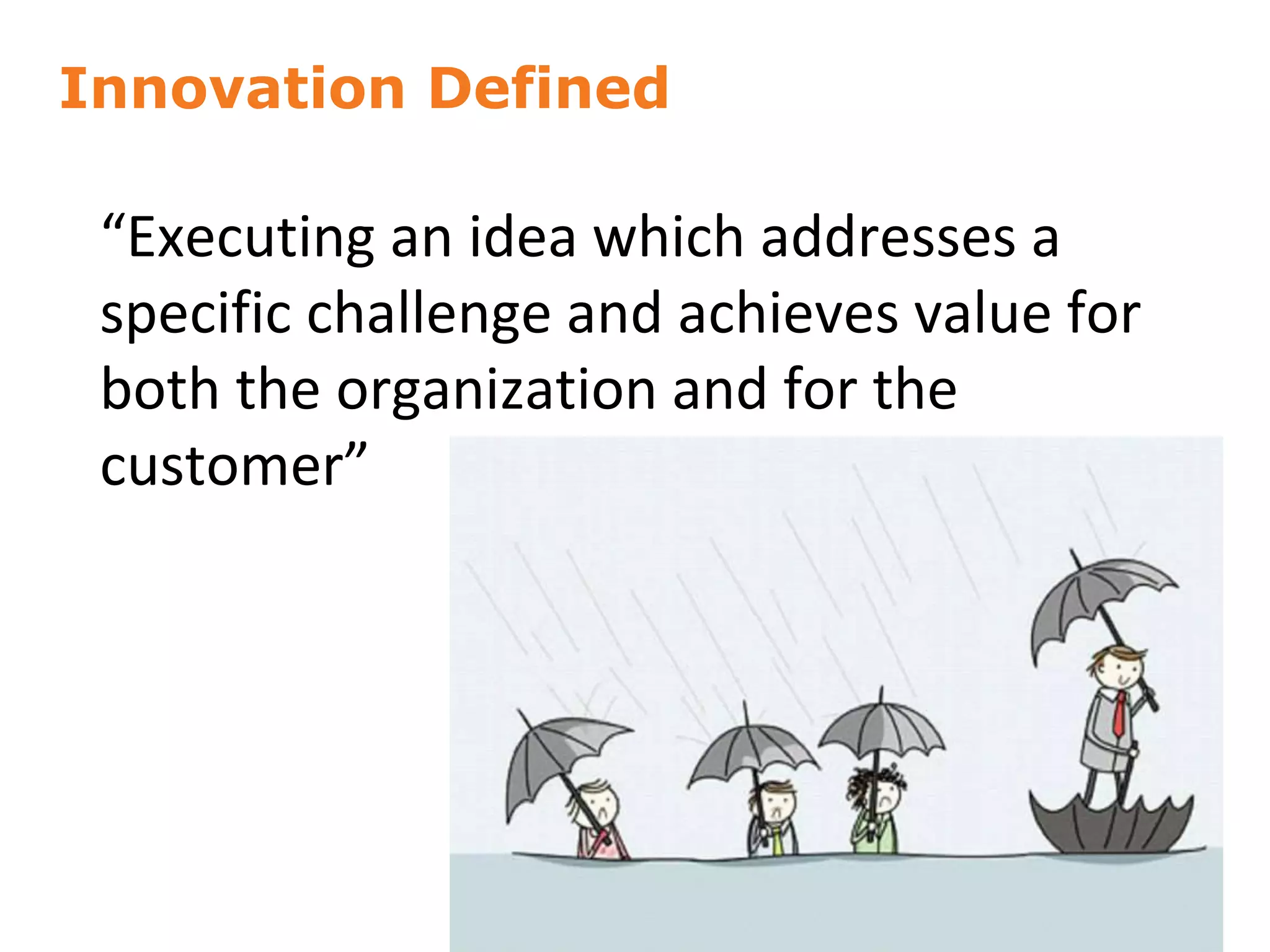
“Executing an idea which addresses a
specific challenge and achieves value for
both the organization and for the
customer”
5
Prerequisite: Personal Preparation
• Too often the focus is on the process
itself
• Need to prepare yourself mentally
and physically
6
Prerequisite: Personal Preparation
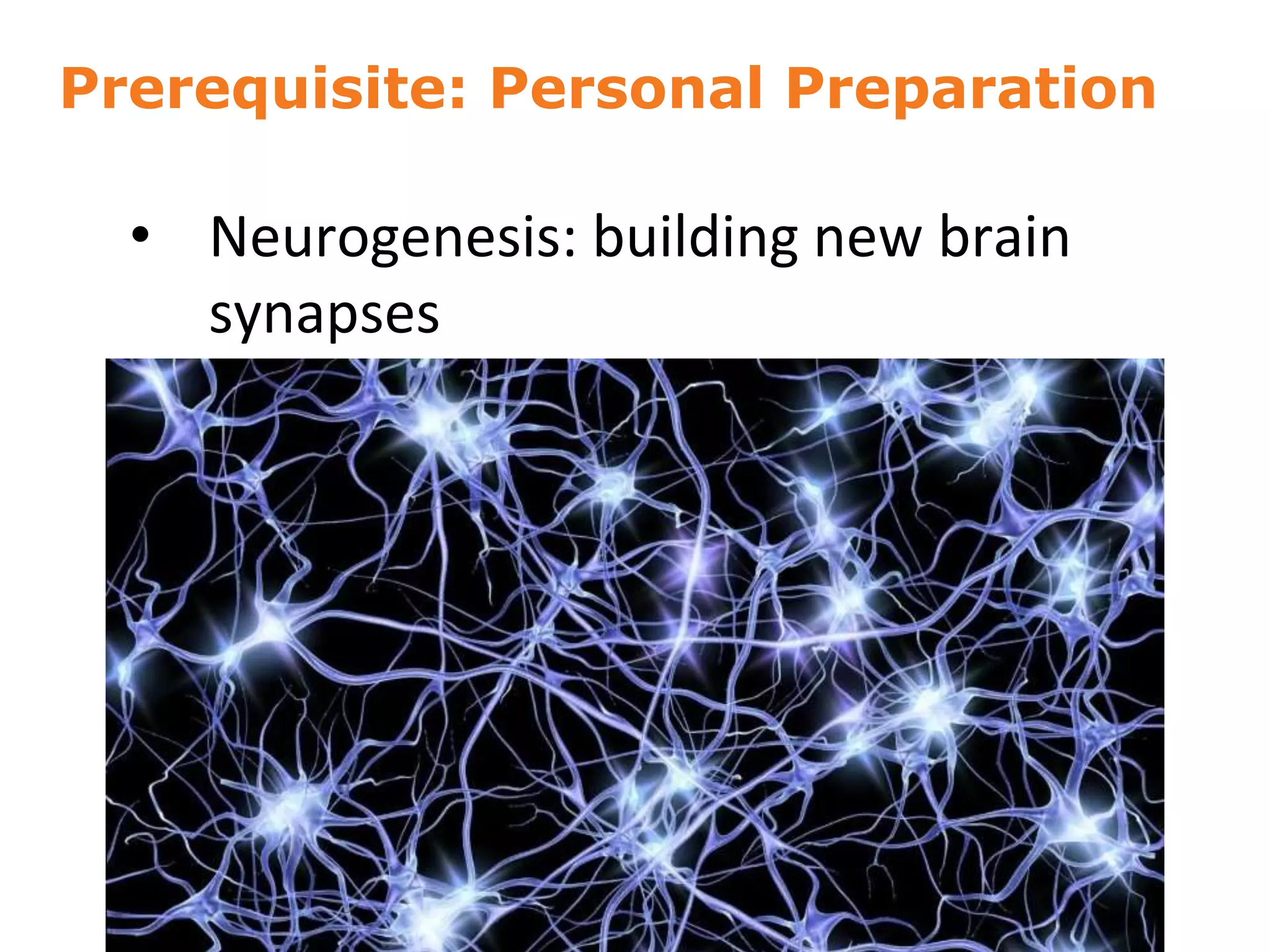
• Neurogenesis: building new brain
synapses
7
Prerequisite: Personal Preparation
• Stay mentally “fit”
• Crossword puzzles, Sudoku
• Learning a new language
• Learning to play a musical instrument
8
Prerequisite: Personal Preparation
• Stay physically fit
• Exercise = increased blood flow to
the brain which provides more
oxygen and glucose
• Helps grow new brain cells as well as
new connections between cells
9
Prerequisite: Personal Preparation
• Eat a healthy, balanced diet
• Vegetables such as broccoli, spinach,
tomatoes, some berries, and omega-
3 oils appear to improve memory and
overall brain function
• Green teas and protein in general do
the same thing
10
Prerequisite: Personal Preparation
• Protein, which we find in meat, eggs
and beans, contain high levels of
amino acids
• Amino acids cause neurons to
produce neurotransmitters
norepinephrine and dopamine, which
are associated with mental alertness
11
The Status Quo
Defined as the current or existing state
of affairs
To maintain the status quo is to keep
things the way they are
12
The Status Quo
Excuses for why we settle for the status
quo?
14
• There’s no budget for that
• Management won’t agree
• We’ve never done it that way
• We’re too small for that
The Status Quo
Excuses for why we settle for the status
quo?
15
• Since when are you the expert?
• Maybe someday …
• We don’t have time
• Let’s be realistic
The Status Quo
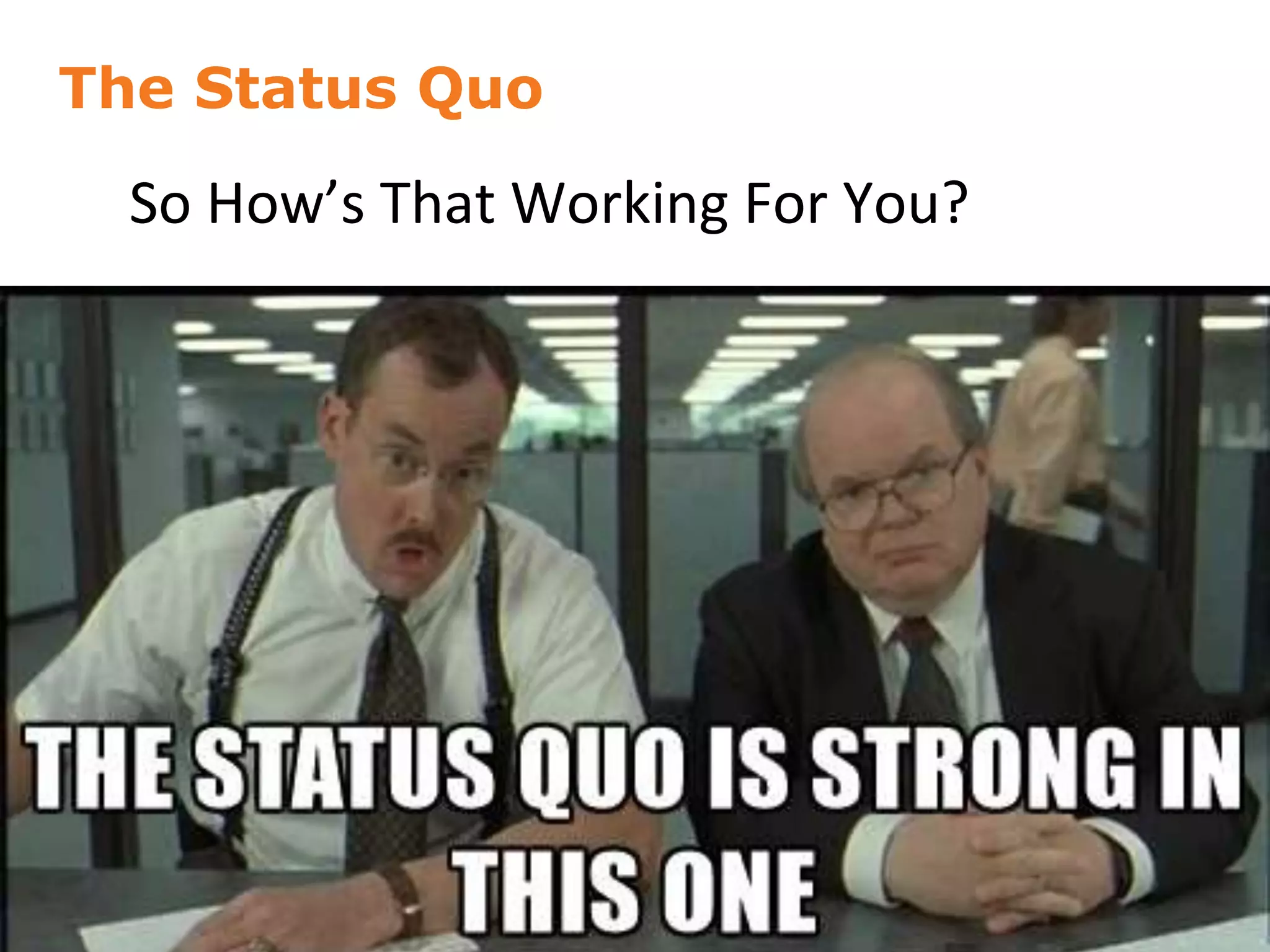
So How’s That Working For You?
16
The Status Quo
17
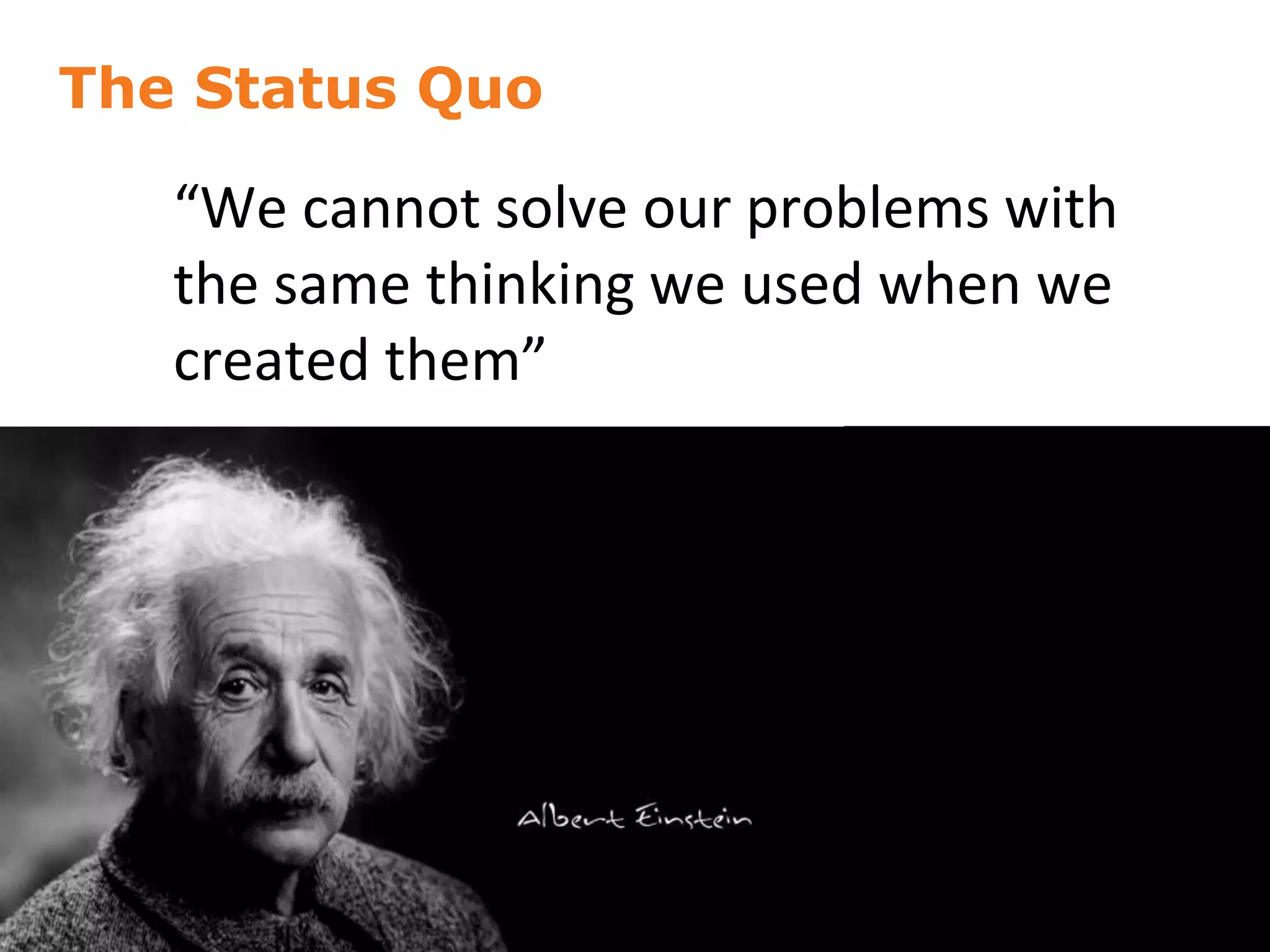
“We cannot solve our problems with
the same thinking we used when we
created them”
The Status Quo
18
Often “experts” will hold on to old ways
of thinking and doing that used to work
But times change, and we need to be
willing to do things in new, creative and
unexpected ways in order to continue to
live out our cause to strengthen
communities
Wreck The Status Quo
19
Wreck The Status Quo
20
1997 Apple Computer
Wreck The Status Quo
22
“The people who are crazy enough to
think they can change the world, are the
ones who do”
Don’t shy away from being one of the
“crazy” ones
Wreck The Status Quo
23
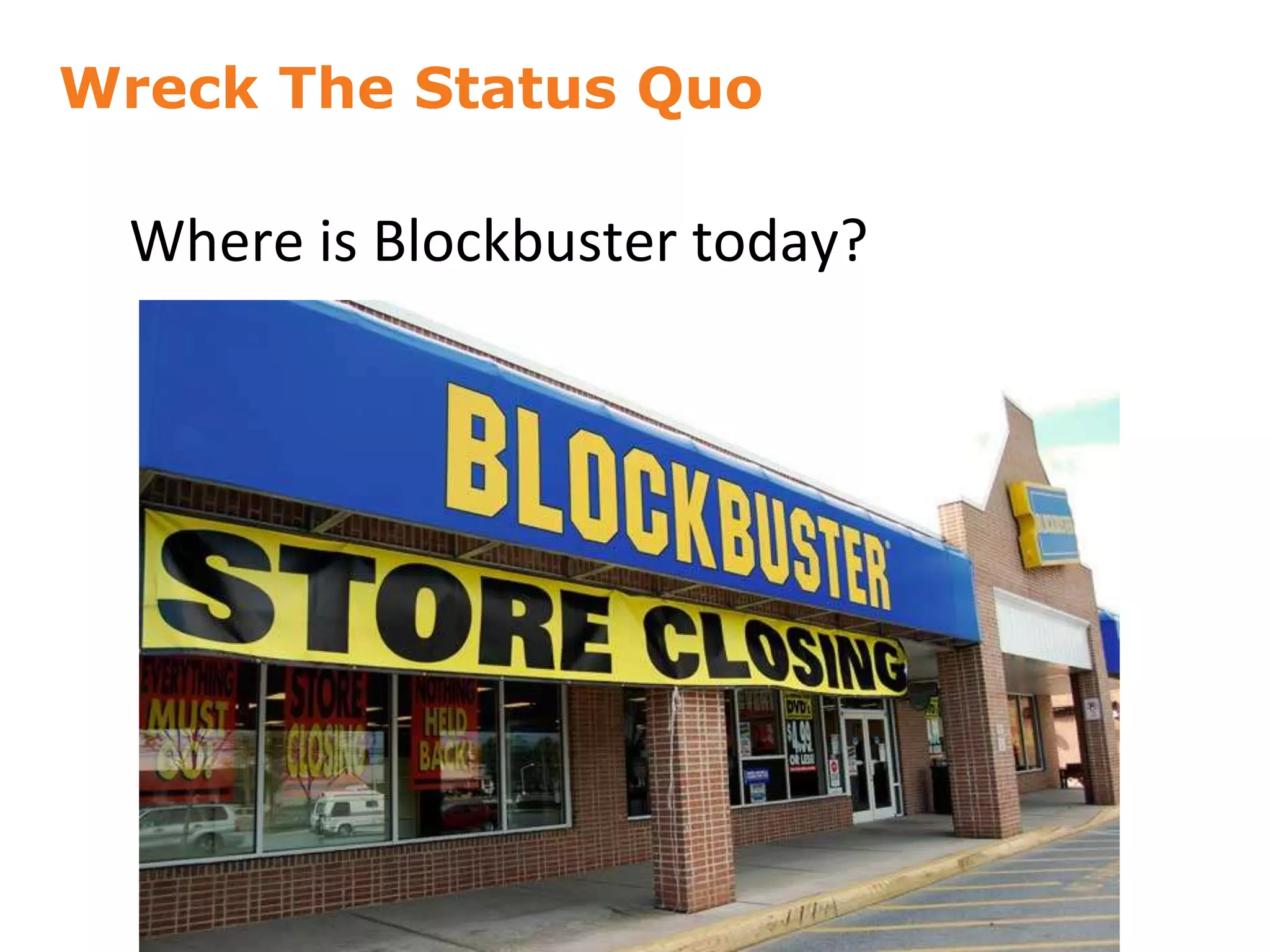
Think of Blockbuster Video
Wreck The Status Quo
24
They described the initial success of
Netflix as “crazy”. Why?
Wreck The Status Quo
25
They described the initial success of
Netflix as “crazy”. Why?
The approach Netflix took:
• Didn’t follow the rules
• Didn’t make sense
• Didn’t look like everyone else
Wreck The Status Quo
26
Where is Blockbuster today?
Be Brave and Innovate
27
Innovation is a process that requires us to:
1. Be willing to take risks and fail
2. Wreck the status quo
3. Make the world a better place
Simple, Effective Approaches
28
First Step: Create the proper context
• Location: best option is offsite
• Unplug: put phones on vibrate
(better yet, put them in a basket),
don’t check email
• Set aside a chunk of uninterrupted
time
Simple, Effective Approaches
29
First Step: Create the proper context
• Get creative juices flowing
• Google “recent innovations” and
review some of the amazing things
happening with innovation to
encourage and inspire your team
Simple, Effective Approaches
30
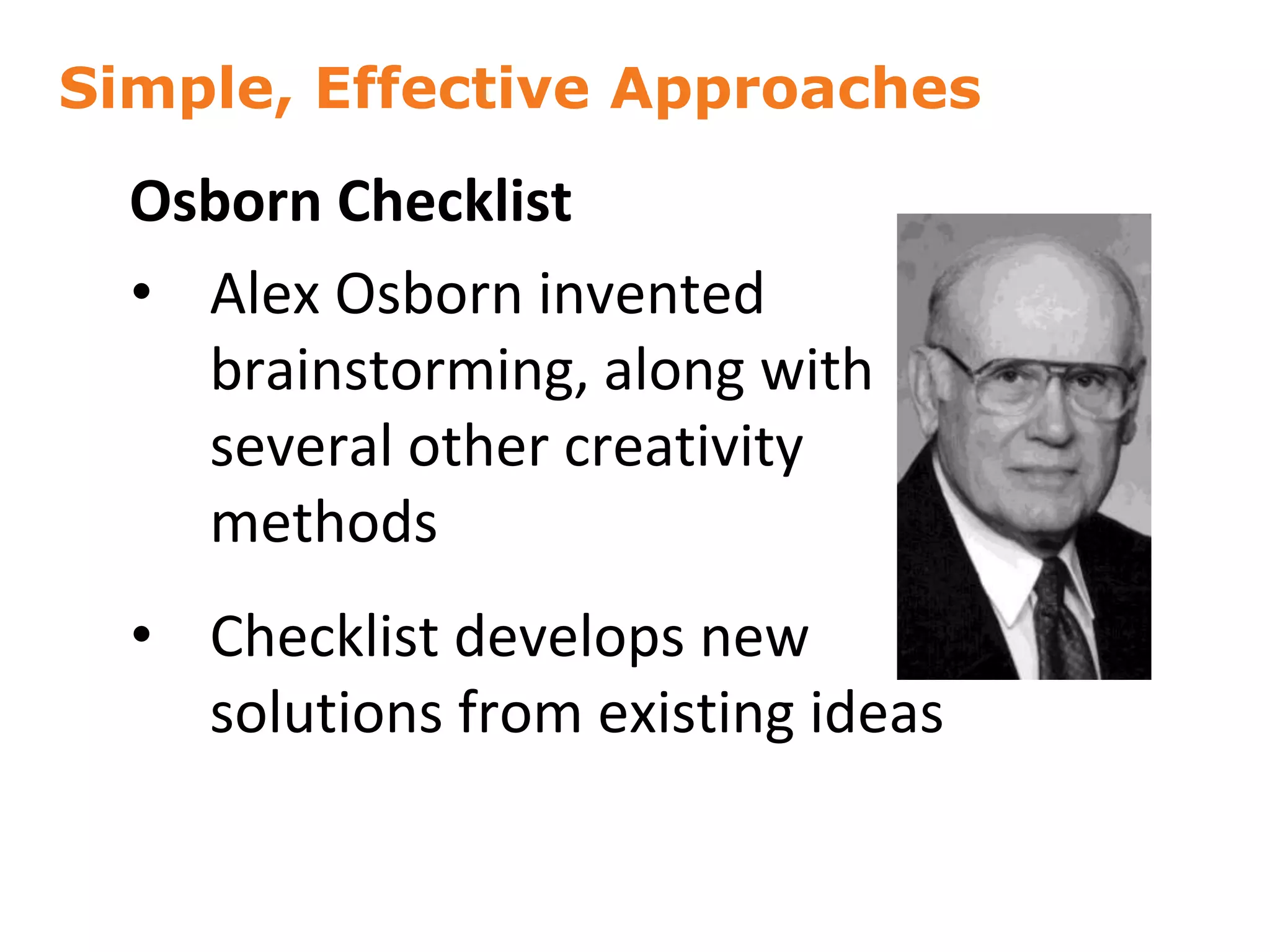
Osborn Checklist
• Alex Osborn invented
brainstorming, along with
several other creativity
methods
• Checklist develops new
solutions from existing ideas
Simple, Effective Approaches
31
Approach 1: Osborn Checklist
Develop at least one idea for each of these areas
Adapt What's similar, what are
parallels, what can you
imitate?
Modify Can you change color,
moving, size, shape, tone,
smell, etc.?
Substitute Different process, positions,
music, elements from other
countries, etc.?
Simple, Effective Approaches
32
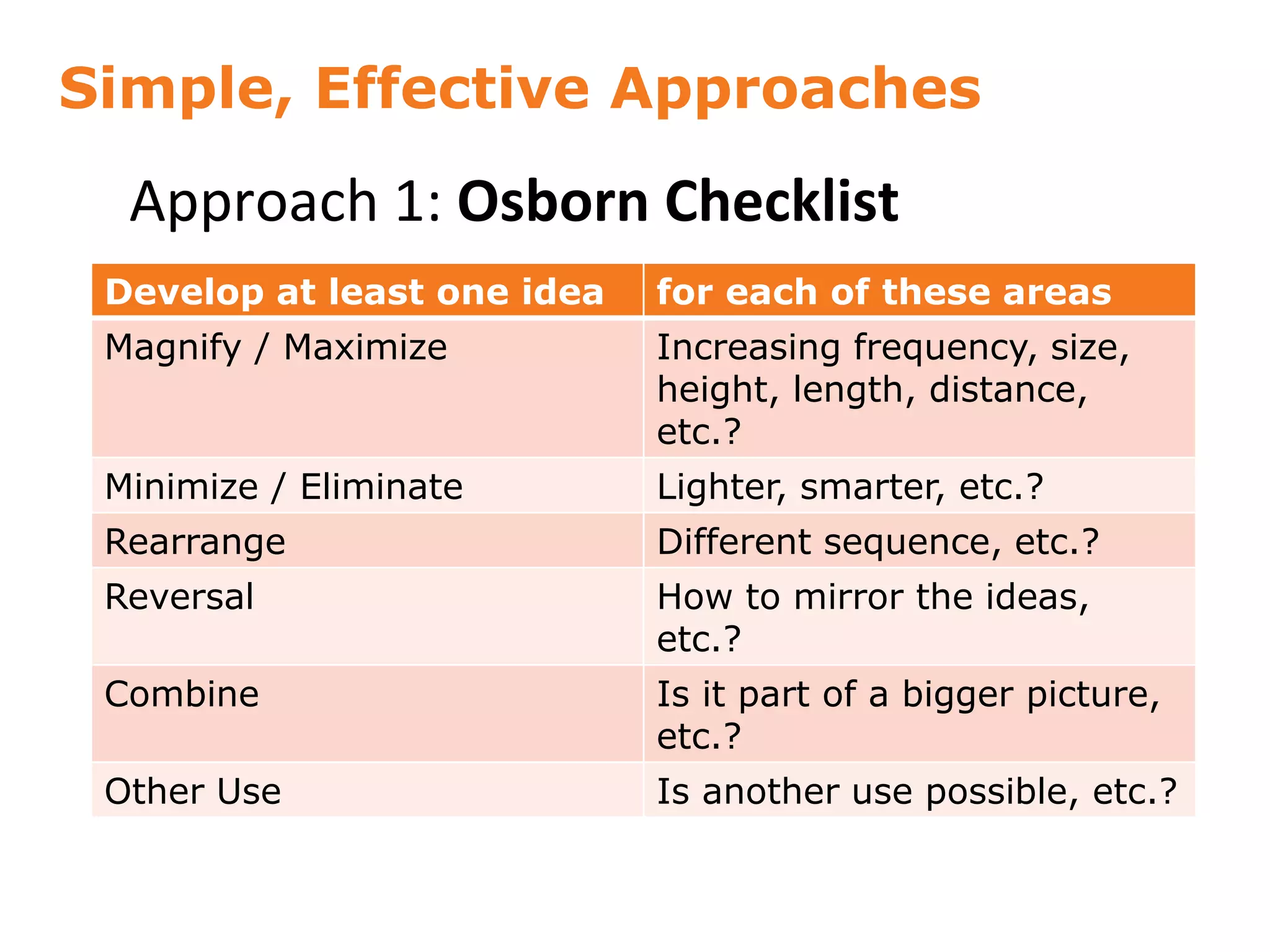
Approach 1: Osborn Checklist
Develop at least one idea for each of these areas
Magnify / Maximize Increasing frequency, size,
height, length, distance,
etc.?
Minimize / Eliminate Lighter, smarter, etc.?
Rearrange Different sequence, etc.?
Reversal How to mirror the ideas,
etc.?
Combine Is it part of a bigger picture,
etc.?
Other Use Is another use possible, etc.?
Simple, Effective Approaches
33
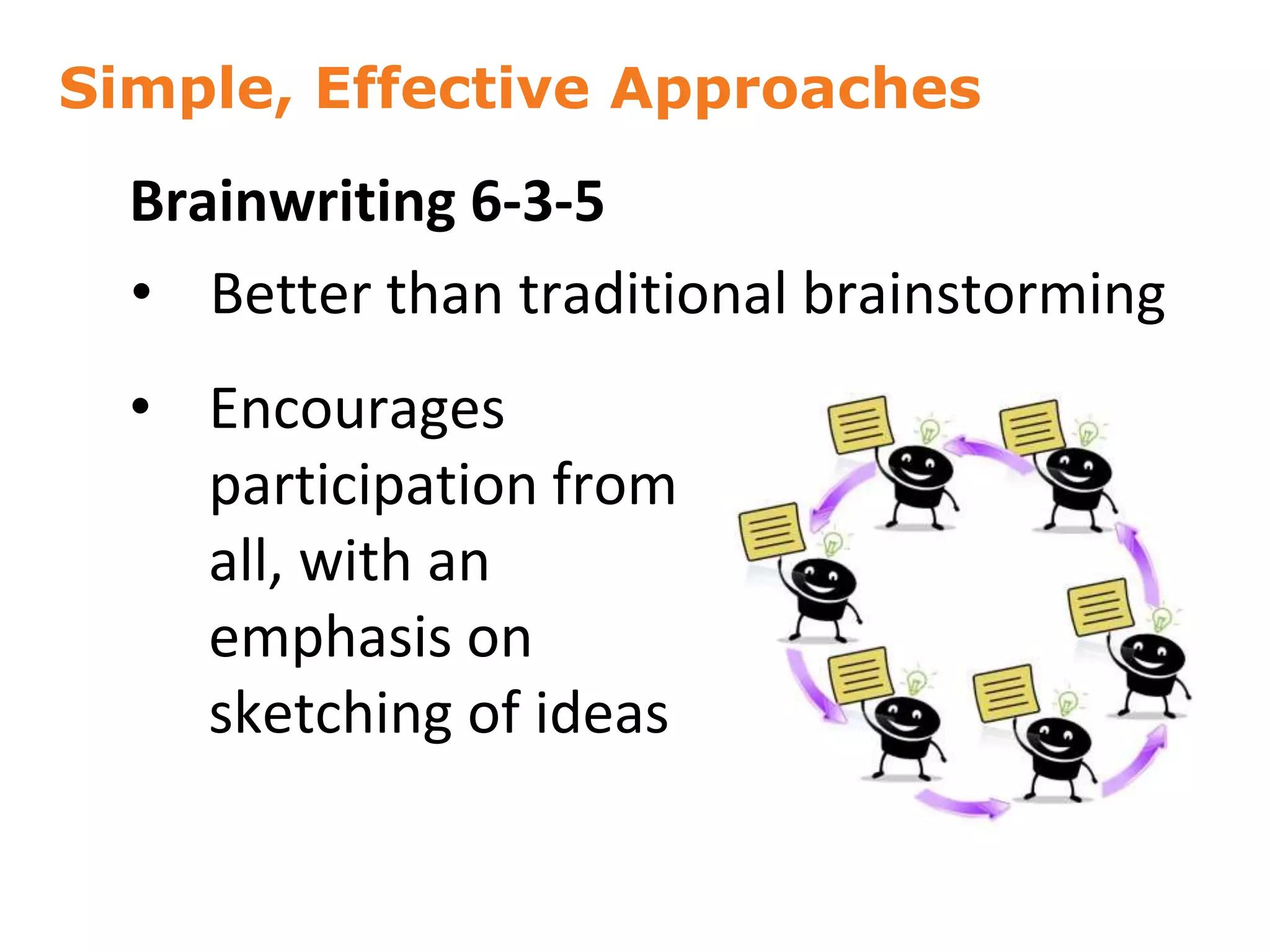
Brainwriting 6-3-5
• Better than traditional brainstorming
• Encourages
participation from
all, with an
emphasis on
sketching of ideas
Simple, Effective Approaches
34
Brainwriting 6-3-5
• Form a team of 3-8 people, 6 is best
• Set a clear focus – what is the issue?
• Each member writes, sketches and
annotates 3 ideas, each on a single
sheet of paper.
Simple, Effective Approaches
35
Brainwriting 6-3-5
• Pass your 3 ideas to the person on
your right.
• Take 5 minutes for them to add to,
modify or extend each idea.
• Pass the ideas to the next person,
and repeat until all ideas have gone
around the table.
Simple, Effective Approaches
36
Brainwriting 6-3-5: Lightning Round
• Focus: Ways to engage 10-12 year
olds in our Y
• Sketch & describe 3 ideas (5 mins)
• Pass to your right, refine it (2 mins)
• Keep passing to the right until
everyone has had a chance to modify
all the ideas (2 mins each)
Simple, Effective Approaches
37
Brainwriting 6-3-5: Lightning Round
• What happened?
• What did you learn?
• What value did the group add?
Simple, Effective Approaches
38
Excursion Technique
An excursion has three
basic steps. They are:
• Temporarily put the problem out of
mind.
• Generate irrelevant material.
• Improvise a novel idea.
Simple, Effective Approaches
39
Excursion Technique
• This technique generates new
thought patterns via analogies
• Step 1: Facilitator asks group to take
imaginary excursion to a physical
location (a museum, a jungle, a city,
another planet, etc.) which has
nothing to do with the real problem.
Simple, Effective Approaches
40
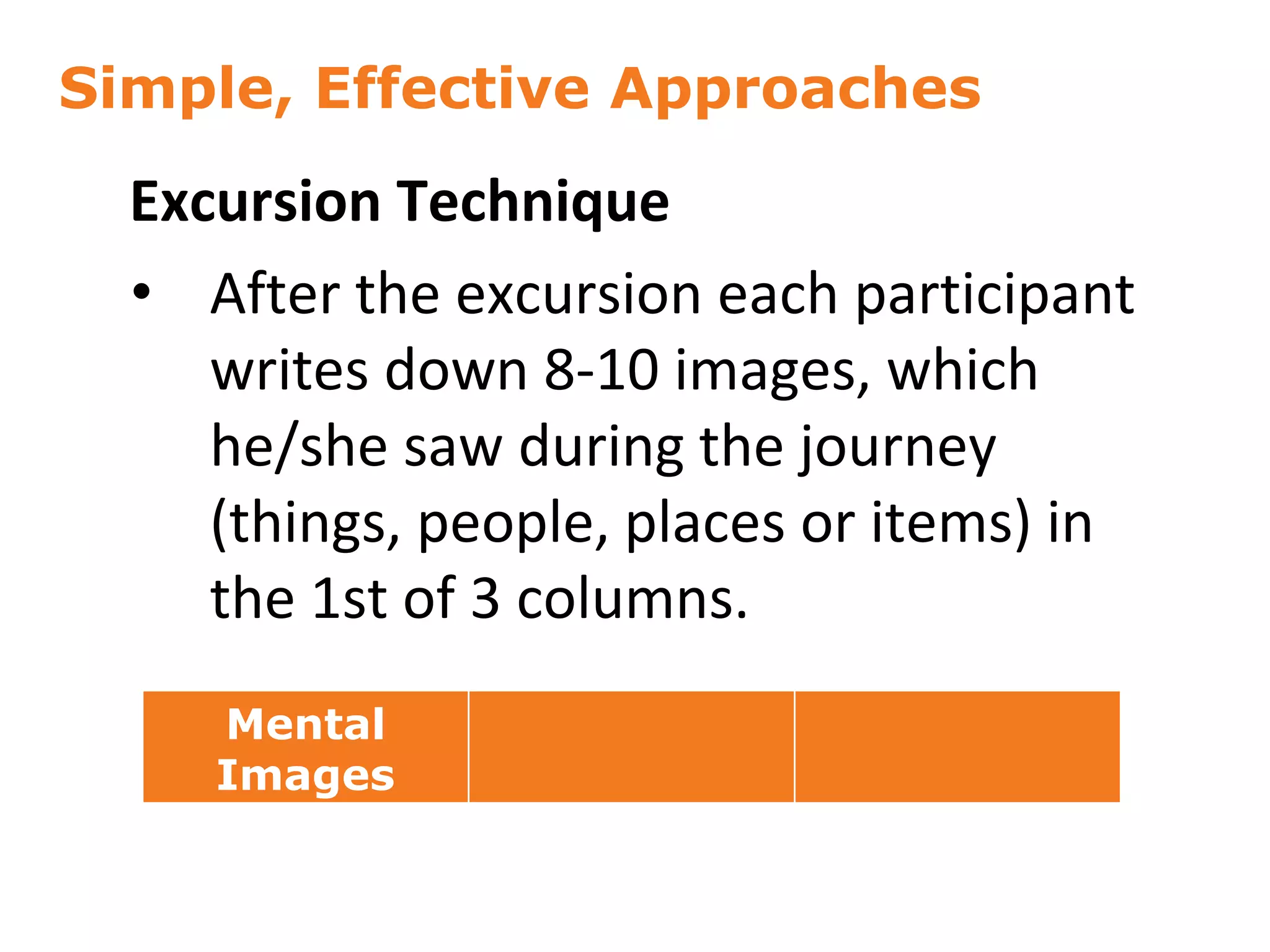
Excursion Technique
• After the excursion each participant
writes down 8-10 images, which
he/she saw during the journey
(things, people, places or items) in
the 1st of 3 columns.
Mental
Images
Simple, Effective Approaches
41
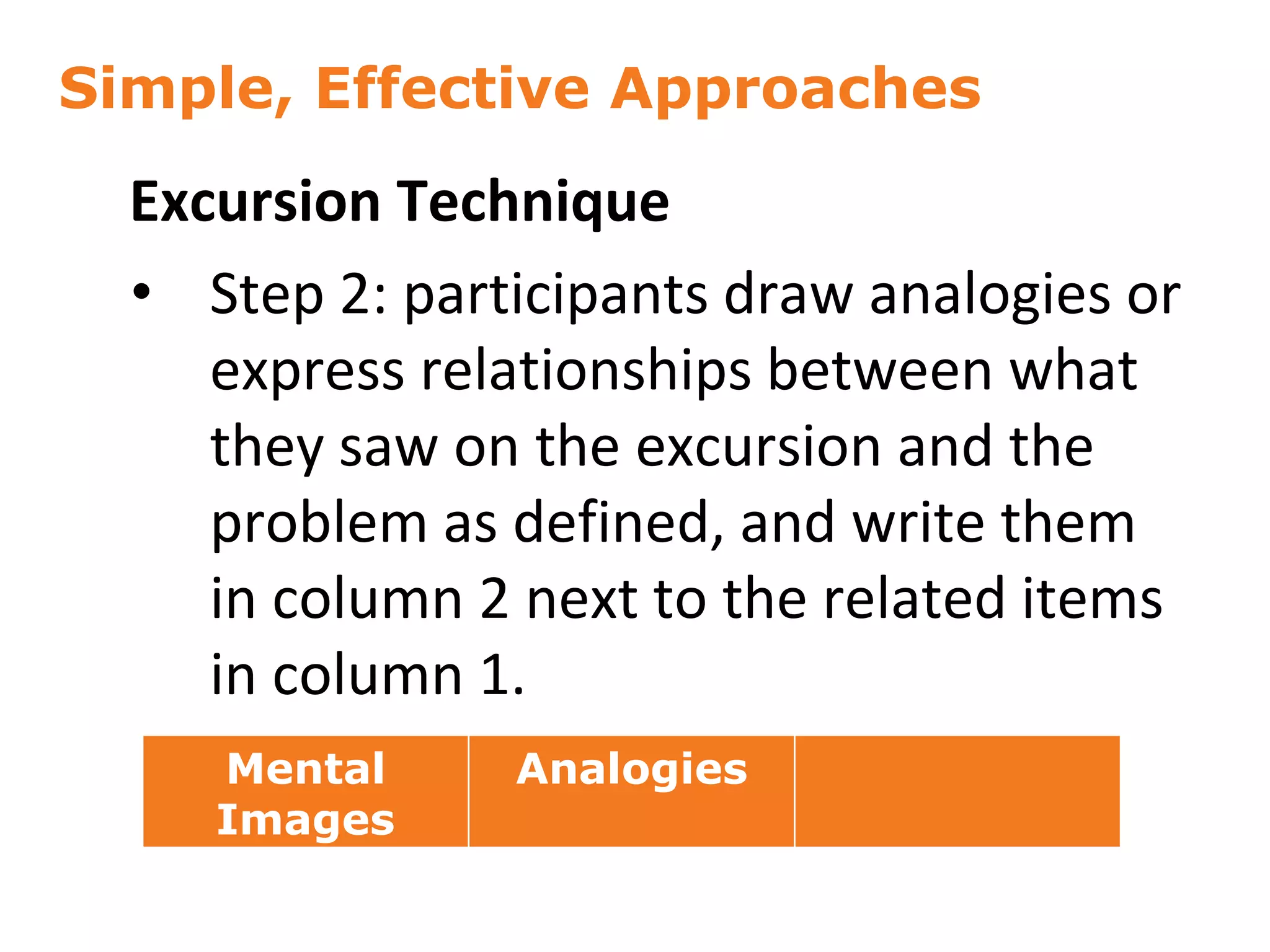
Excursion Technique
• Step 2: participants draw analogies or
express relationships between what
they saw on the excursion and the
problem as defined, and write them
in column 2 next to the related items
in column 1.
Mental
Images
Analogies
Simple, Effective Approaches
42
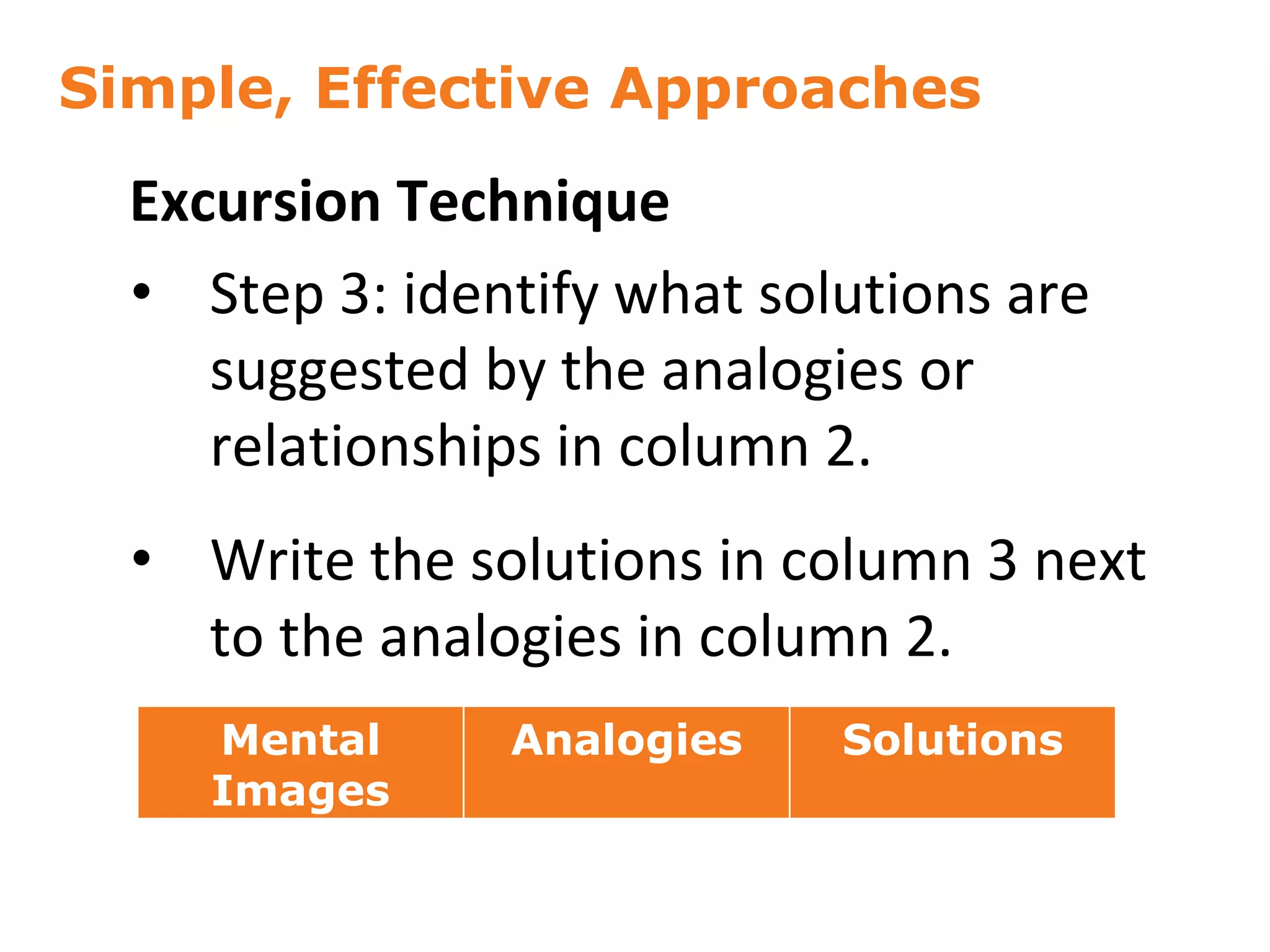
Excursion Technique
• Step 3: identify what solutions are
suggested by the analogies or
relationships in column 2.
• Write the solutions in column 3 next
to the analogies in column 2.
Mental
Images
Analogies Solutions
Simple, Effective Approaches
43
Excursion Technique
• Step 4: each participant shares what
they saw, their analogies and
solutions.
• Step 5: The group discusses the ideas.
The facilitator helps the group arrive
at common solutions that could work
for the problem.
Simple, Effective Approaches
44
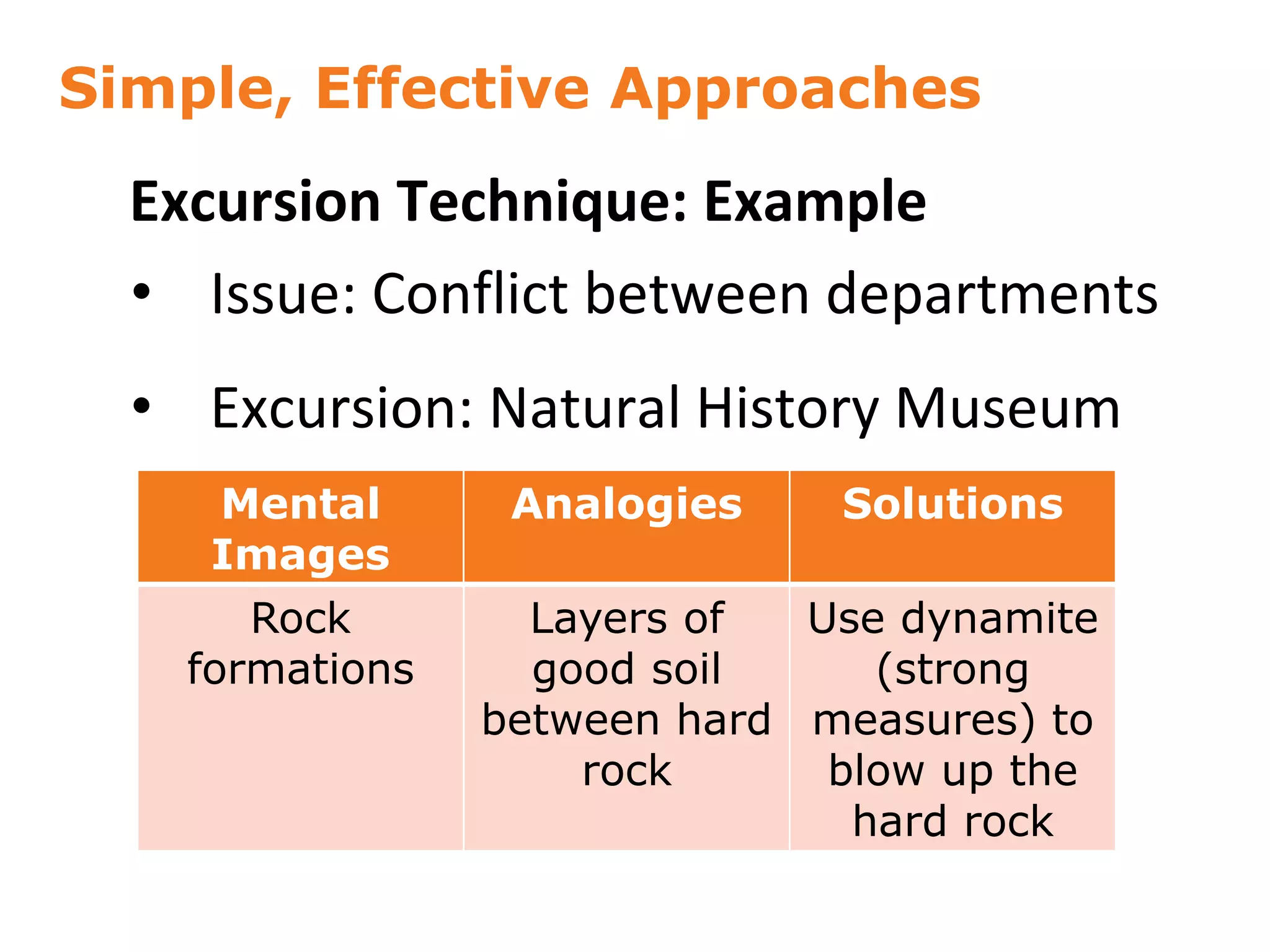
Excursion Technique: Example
• Issue: Conflict between departments
• Excursion: Natural History Museum
Simple, Effective Approaches
45
Excursion Technique: Example
• Issue: Conflict between departments
• Excursion: Natural History Museum
Mental
Images
Analogies Solutions
Rock
formations
Layers of
good soil
between hard
rock
Use dynamite
(strong
measures) to
blow up the
hard rock
Simple, Effective Approaches
46
Excursion Technique: Example
• Issue: Conflict between departments
• Excursion: Natural History Museum
Mental
Images
Analogies Solutions
War between
native tribes
“War”
between
departments
Bring in a
mediator to
forge a truce
Simple, Effective Approaches
47
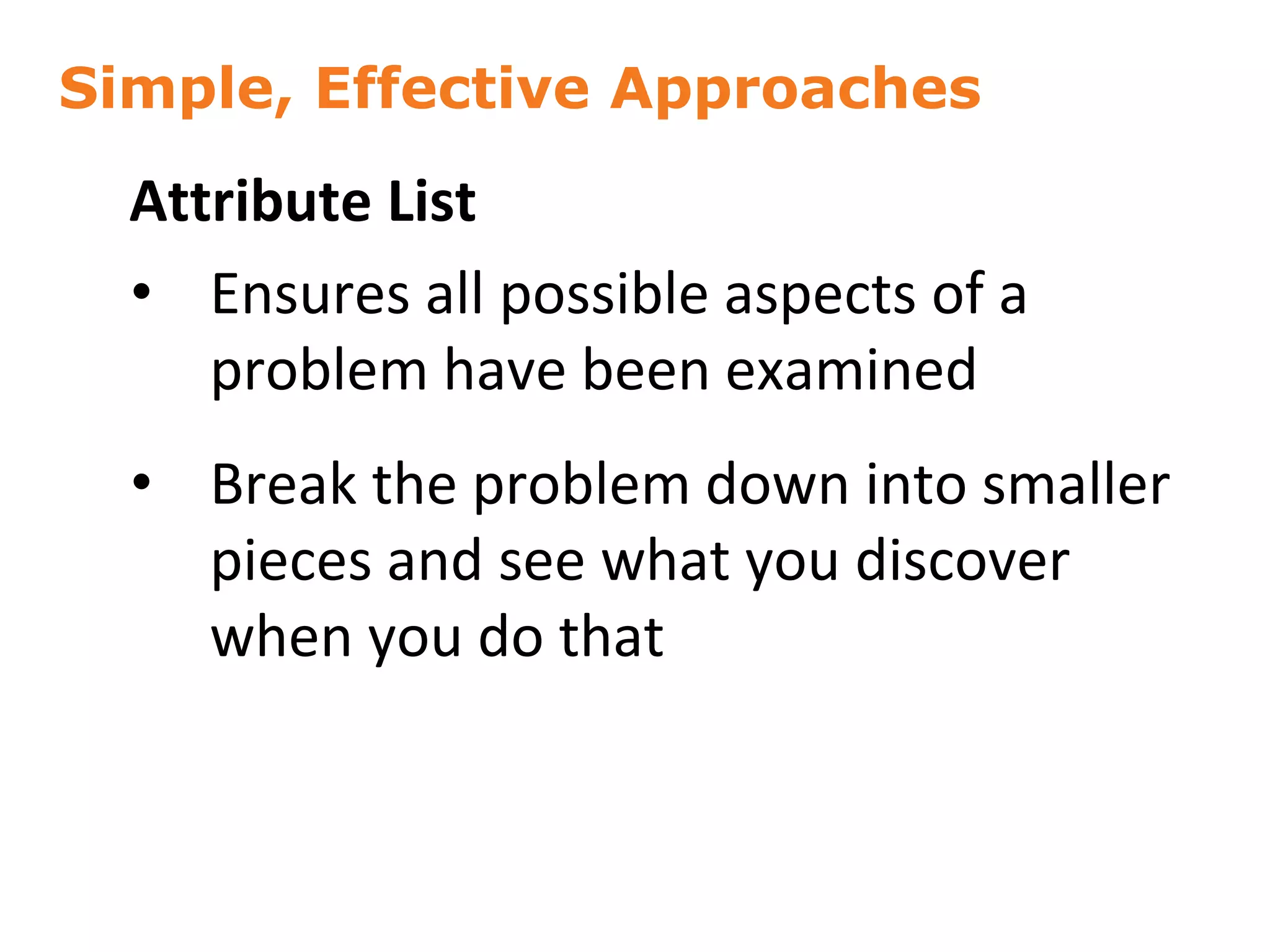
Attribute List
• Ensures all possible aspects of a
problem have been examined
• Break the problem down into smaller
pieces and see what you discover
when you do that
Simple, Effective Approaches
48
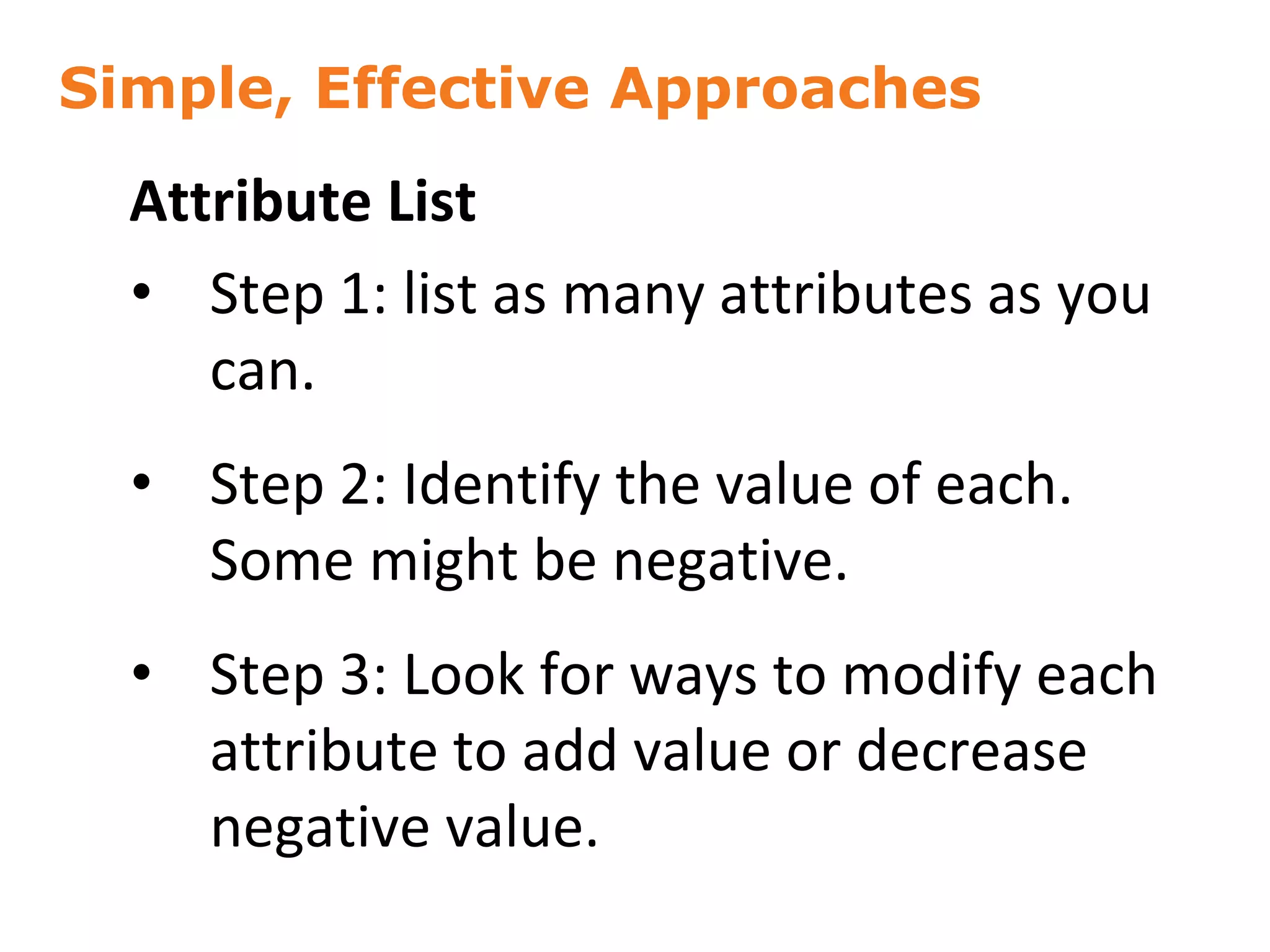
Attribute List
• Step 1: list as many attributes as you
can.
• Step 2: Identify the value of each.
Some might be negative.
• Step 3: Look for ways to modify each
attribute to add value or decrease
negative value.
Simple, Effective Approaches
49
Attribute List: Customer Service Desk
Step 1: list as many attributes as you
can:
• Opening hours
• Friendliness of service
• Availability of printed information
Simple, Effective Approaches
50
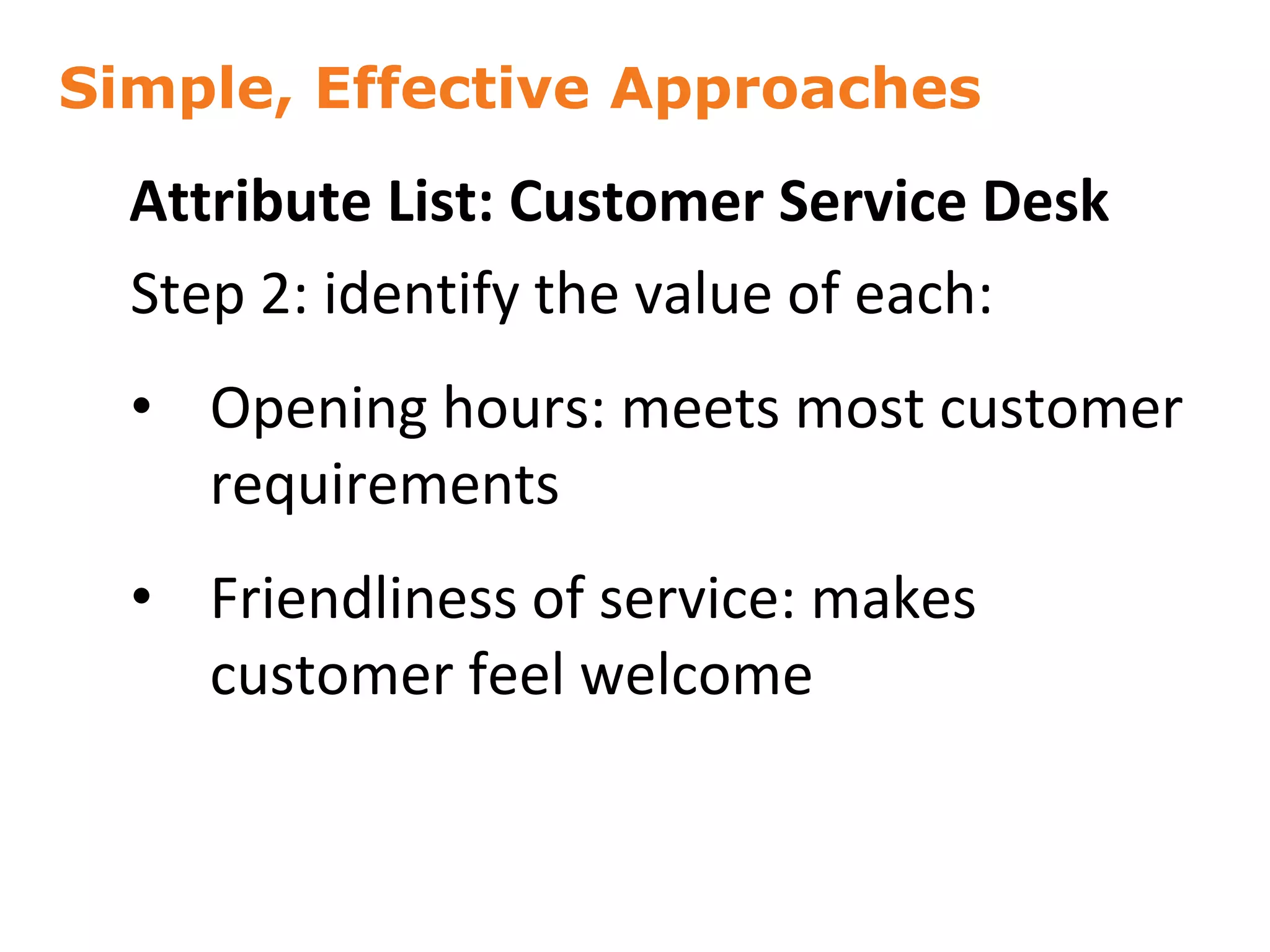
Attribute List: Customer Service Desk
Step 2: identify the value of each:
• Opening hours: meets most customer
requirements
• Friendliness of service: makes
customer feel welcome
Simple, Effective Approaches
51
Attribute List: Customer Service Desk
Step 2: identify the value of each:
• Availability of printed information:
resource for customers to take with
them
Simple, Effective Approaches
52
Attribute List: Customer Service Desk
Step 3: modify to add value to decrease
negative value:
• Opening hours: need to open earlier
on the weekend
• Friendliness of service: greet the
customer by name
Simple, Effective Approaches
53
Attribute List: Customer Service Desk
Step 3: modify to add value to decrease
negative value:
• Availability of printed information:
customers prefer electronic
information, send via email or mobile
app.
Review
54
• Innovation involves coming up with
new ideas and implementing them.
• Innovation adds value for both the
organization and the customer.
• Prepare yourself mentally and
physically.
• Prepare your context.
Review
55
• The status quo is doing things the
way we have always done them.
• Wrecking the status quo requires
ignoring our usual excuses.
• We need new ways of thinking to
solve old problems.
Review
56
Innovation requires that we:
• Be willing to take risks and fail.
• Wreck the status quo.
• Make the world a better place.
Teachbacks
57
Personal takeaways
Innovate!
58
“The people who are crazy enough to
think they can change the world, are the
ones who do”

2017 YMCA Fall Rally - Innovation

  • 1.
    Simple, Effective Ways toInnovate in Your Y An Interactive How-To 2017 Illinois State Alliance Fall Rally Bloomington-Normal, IL FOR YOUTH DEVELOPMENT FOR HEALTHY LIVING FOR SOCIAL RESPONSIBILITY
  • 2.
  • 3.
    Distinctions • Creativity isthinking of something new • Innovation is the implementation of something new
  • 4.
    Innovation Defined “Staying relevant” 4 “Thefuture delivered” “Turning an idea into a solution that adds value from a customer’s perspective”
  • 5.
    Innovation Defined “Executing anidea which addresses a specific challenge and achieves value for both the organization and for the customer” 5
  • 6.
    Prerequisite: Personal Preparation •Too often the focus is on the process itself • Need to prepare yourself mentally and physically 6
  • 7.
    Prerequisite: Personal Preparation •Neurogenesis: building new brain synapses 7
  • 8.
    Prerequisite: Personal Preparation •Stay mentally “fit” • Crossword puzzles, Sudoku • Learning a new language • Learning to play a musical instrument 8
  • 9.
    Prerequisite: Personal Preparation •Stay physically fit • Exercise = increased blood flow to the brain which provides more oxygen and glucose • Helps grow new brain cells as well as new connections between cells 9
  • 10.
    Prerequisite: Personal Preparation •Eat a healthy, balanced diet • Vegetables such as broccoli, spinach, tomatoes, some berries, and omega- 3 oils appear to improve memory and overall brain function • Green teas and protein in general do the same thing 10
  • 11.
    Prerequisite: Personal Preparation •Protein, which we find in meat, eggs and beans, contain high levels of amino acids • Amino acids cause neurons to produce neurotransmitters norepinephrine and dopamine, which are associated with mental alertness 11
  • 12.
    The Status Quo Definedas the current or existing state of affairs To maintain the status quo is to keep things the way they are 12
  • 14.
    The Status Quo Excusesfor why we settle for the status quo? 14 • There’s no budget for that • Management won’t agree • We’ve never done it that way • We’re too small for that
  • 15.
    The Status Quo Excusesfor why we settle for the status quo? 15 • Since when are you the expert? • Maybe someday … • We don’t have time • Let’s be realistic
  • 16.
    The Status Quo SoHow’s That Working For You? 16
  • 17.
    The Status Quo 17 “Wecannot solve our problems with the same thinking we used when we created them”
  • 18.
    The Status Quo 18 Often“experts” will hold on to old ways of thinking and doing that used to work But times change, and we need to be willing to do things in new, creative and unexpected ways in order to continue to live out our cause to strengthen communities
  • 19.
  • 20.
    Wreck The StatusQuo 20 1997 Apple Computer
  • 22.
    Wreck The StatusQuo 22 “The people who are crazy enough to think they can change the world, are the ones who do” Don’t shy away from being one of the “crazy” ones
  • 23.
    Wreck The StatusQuo 23 Think of Blockbuster Video
  • 24.
    Wreck The StatusQuo 24 They described the initial success of Netflix as “crazy”. Why?
  • 25.
    Wreck The StatusQuo 25 They described the initial success of Netflix as “crazy”. Why? The approach Netflix took: • Didn’t follow the rules • Didn’t make sense • Didn’t look like everyone else
  • 26.
    Wreck The StatusQuo 26 Where is Blockbuster today?
  • 27.
    Be Brave andInnovate 27 Innovation is a process that requires us to: 1. Be willing to take risks and fail 2. Wreck the status quo 3. Make the world a better place
  • 28.
    Simple, Effective Approaches 28 FirstStep: Create the proper context • Location: best option is offsite • Unplug: put phones on vibrate (better yet, put them in a basket), don’t check email • Set aside a chunk of uninterrupted time
  • 29.
    Simple, Effective Approaches 29 FirstStep: Create the proper context • Get creative juices flowing • Google “recent innovations” and review some of the amazing things happening with innovation to encourage and inspire your team
  • 30.
    Simple, Effective Approaches 30 OsbornChecklist • Alex Osborn invented brainstorming, along with several other creativity methods • Checklist develops new solutions from existing ideas
  • 31.
    Simple, Effective Approaches 31 Approach1: Osborn Checklist Develop at least one idea for each of these areas Adapt What's similar, what are parallels, what can you imitate? Modify Can you change color, moving, size, shape, tone, smell, etc.? Substitute Different process, positions, music, elements from other countries, etc.?
  • 32.
    Simple, Effective Approaches 32 Approach1: Osborn Checklist Develop at least one idea for each of these areas Magnify / Maximize Increasing frequency, size, height, length, distance, etc.? Minimize / Eliminate Lighter, smarter, etc.? Rearrange Different sequence, etc.? Reversal How to mirror the ideas, etc.? Combine Is it part of a bigger picture, etc.? Other Use Is another use possible, etc.?
  • 33.
    Simple, Effective Approaches 33 Brainwriting6-3-5 • Better than traditional brainstorming • Encourages participation from all, with an emphasis on sketching of ideas
  • 34.
    Simple, Effective Approaches 34 Brainwriting6-3-5 • Form a team of 3-8 people, 6 is best • Set a clear focus – what is the issue? • Each member writes, sketches and annotates 3 ideas, each on a single sheet of paper.
  • 35.
    Simple, Effective Approaches 35 Brainwriting6-3-5 • Pass your 3 ideas to the person on your right. • Take 5 minutes for them to add to, modify or extend each idea. • Pass the ideas to the next person, and repeat until all ideas have gone around the table.
  • 36.
    Simple, Effective Approaches 36 Brainwriting6-3-5: Lightning Round • Focus: Ways to engage 10-12 year olds in our Y • Sketch & describe 3 ideas (5 mins) • Pass to your right, refine it (2 mins) • Keep passing to the right until everyone has had a chance to modify all the ideas (2 mins each)
  • 37.
    Simple, Effective Approaches 37 Brainwriting6-3-5: Lightning Round • What happened? • What did you learn? • What value did the group add?
  • 38.
    Simple, Effective Approaches 38 ExcursionTechnique An excursion has three basic steps. They are: • Temporarily put the problem out of mind. • Generate irrelevant material. • Improvise a novel idea.
  • 39.
    Simple, Effective Approaches 39 ExcursionTechnique • This technique generates new thought patterns via analogies • Step 1: Facilitator asks group to take imaginary excursion to a physical location (a museum, a jungle, a city, another planet, etc.) which has nothing to do with the real problem.
  • 40.
    Simple, Effective Approaches 40 ExcursionTechnique • After the excursion each participant writes down 8-10 images, which he/she saw during the journey (things, people, places or items) in the 1st of 3 columns. Mental Images
  • 41.
    Simple, Effective Approaches 41 ExcursionTechnique • Step 2: participants draw analogies or express relationships between what they saw on the excursion and the problem as defined, and write them in column 2 next to the related items in column 1. Mental Images Analogies
  • 42.
    Simple, Effective Approaches 42 ExcursionTechnique • Step 3: identify what solutions are suggested by the analogies or relationships in column 2. • Write the solutions in column 3 next to the analogies in column 2. Mental Images Analogies Solutions
  • 43.
    Simple, Effective Approaches 43 ExcursionTechnique • Step 4: each participant shares what they saw, their analogies and solutions. • Step 5: The group discusses the ideas. The facilitator helps the group arrive at common solutions that could work for the problem.
  • 44.
    Simple, Effective Approaches 44 ExcursionTechnique: Example • Issue: Conflict between departments • Excursion: Natural History Museum
  • 45.
    Simple, Effective Approaches 45 ExcursionTechnique: Example • Issue: Conflict between departments • Excursion: Natural History Museum Mental Images Analogies Solutions Rock formations Layers of good soil between hard rock Use dynamite (strong measures) to blow up the hard rock
  • 46.
    Simple, Effective Approaches 46 ExcursionTechnique: Example • Issue: Conflict between departments • Excursion: Natural History Museum Mental Images Analogies Solutions War between native tribes “War” between departments Bring in a mediator to forge a truce
  • 47.
    Simple, Effective Approaches 47 AttributeList • Ensures all possible aspects of a problem have been examined • Break the problem down into smaller pieces and see what you discover when you do that
  • 48.
    Simple, Effective Approaches 48 AttributeList • Step 1: list as many attributes as you can. • Step 2: Identify the value of each. Some might be negative. • Step 3: Look for ways to modify each attribute to add value or decrease negative value.
  • 49.
    Simple, Effective Approaches 49 AttributeList: Customer Service Desk Step 1: list as many attributes as you can: • Opening hours • Friendliness of service • Availability of printed information
  • 50.
    Simple, Effective Approaches 50 AttributeList: Customer Service Desk Step 2: identify the value of each: • Opening hours: meets most customer requirements • Friendliness of service: makes customer feel welcome
  • 51.
    Simple, Effective Approaches 51 AttributeList: Customer Service Desk Step 2: identify the value of each: • Availability of printed information: resource for customers to take with them
  • 52.
    Simple, Effective Approaches 52 AttributeList: Customer Service Desk Step 3: modify to add value to decrease negative value: • Opening hours: need to open earlier on the weekend • Friendliness of service: greet the customer by name
  • 53.
    Simple, Effective Approaches 53 AttributeList: Customer Service Desk Step 3: modify to add value to decrease negative value: • Availability of printed information: customers prefer electronic information, send via email or mobile app.
  • 54.
    Review 54 • Innovation involvescoming up with new ideas and implementing them. • Innovation adds value for both the organization and the customer. • Prepare yourself mentally and physically. • Prepare your context.
  • 55.
    Review 55 • The statusquo is doing things the way we have always done them. • Wrecking the status quo requires ignoring our usual excuses. • We need new ways of thinking to solve old problems.
  • 56.
    Review 56 Innovation requires thatwe: • Be willing to take risks and fail. • Wreck the status quo. • Make the world a better place.
  • 57.
  • 58.
    Innovate! 58 “The people whoare crazy enough to think they can change the world, are the ones who do”

Editor's Notes

  • #4 We will be looking at the process of both creativity and innovation for this workshop, and simply refer to that process as “innovation”
  • #5 Relevancy and the future of the org depend on innovation Usual thinking is that innovation is only about adding value for the customer
  • #6 A more comprehensive definition that shows value added for both the org and the customer
  • #8 Recent research has shown that this is possible
  • #9 Mental activity helps with neurogenesis Actually learning a new language and learning to play musical instrument have also been shown to increase IQ
  • #10 Physical exercise also helps with neurogenesis and growing new brain cells
  • #12 That’s enough science for now
  • #31 May not be “brand new” ideas, but good ideas do come from this process. See http://members.optusnet.com.au/~charles57/Creative/Techniques/osb_quest.htm
  • #34 See https://www.mycoted.com/Brainwriting
  • #39 See http://www.innovationmanagement.se/imtool-articles/how-to-take-a-creative-excursion/
  • #48 See https://www.mycoted.com/Attribute_Listing