

1
|
MTL: The Professional Development Programme
Creative Thinking
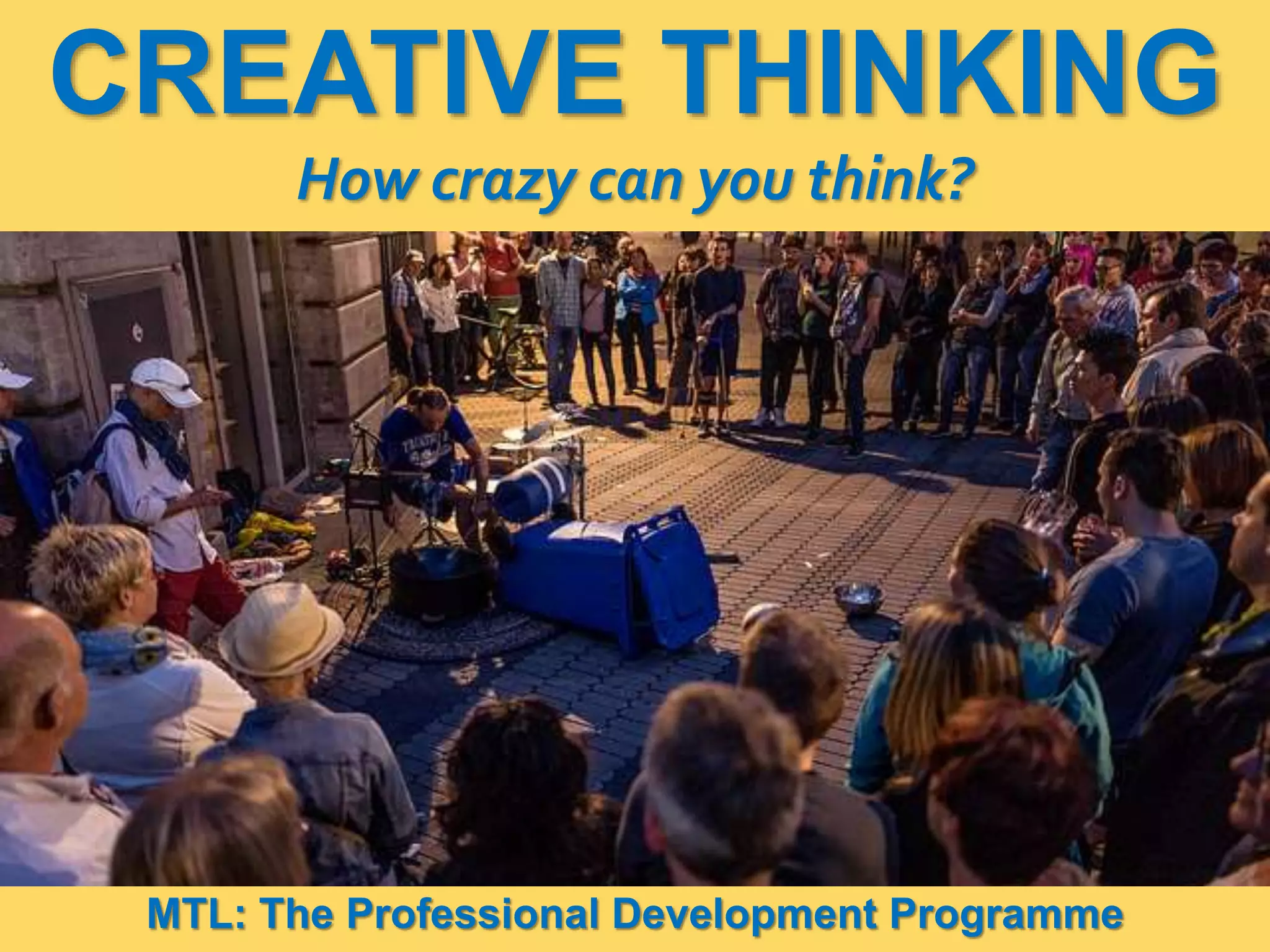
CREATIVE THINKING
How crazy can you think?
MTL: The Professional Development Programme
2
|
MTL: The Professional Development Programme
Creative Thinking
Attribution: All images are from sources where a Creative Commons license exists for commercial use. All icons are on subscription
from thenounproject. All clipart is from free sources. The MTL Professional Development Programme is copyright of Manage Train
Learn.
Creative
Thinking
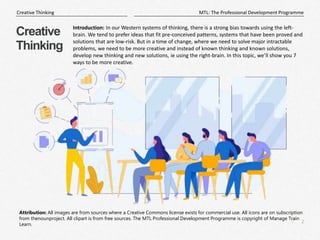
Introduction: In our Western systems of thinking, there is a strong bias towards using the left-
brain. We tend to prefer ideas that fit pre-conceived patterns, systems that have been proved and
solutions that are low-risk. But in a time of change, where we need to solve major intractable
problems, we need to be more creative and instead of known thinking and known solutions,
develop new thinking and new solutions, ie using the right-brain. In this topic, we’ll show you 7
ways to be more creative.
3
|
MTL: The Professional Development Programme
Creative Thinking
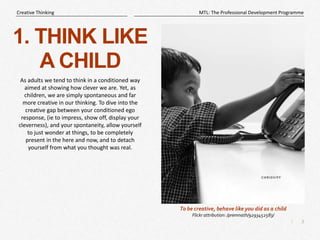
1. THINK LIKE
A CHILD
As adults we tend to think in a conditioned way
aimed at showing how clever we are. Yet, as
children, we are simply spontaneous and far
more creative in our thinking. To dive into the
creative gap between your conditioned ego
response, (ie to impress, show off, display your
cleverness), and your spontaneity, allow yourself
to just wonder at things, to be completely
present in the here and now, and to detach
yourself from what you thought was real.
To be creative, behave like you did as a child
Flickr attribution: /premnath/9293452583/
4
|
MTL: The Professional Development Programme
Creative Thinking
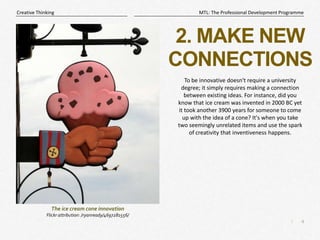
2. MAKE NEW
CONNECTIONS
To be innovative doesn't require a university
degree; it simply requires making a connection
between existing ideas. For instance, did you
know that ice cream was invented in 2000 BC yet
it took another 3900 years for someone to come
up with the idea of a cone? It's when you take
two seemingly unrelated items and use the spark
of creativity that inventiveness happens.
The ice cream cone innovation
Flickr attribution: /ryanready/4697281556/
5
|
MTL: The Professional Development Programme
Creative Thinking
3. BE A LITTLE
ILLOGICAL
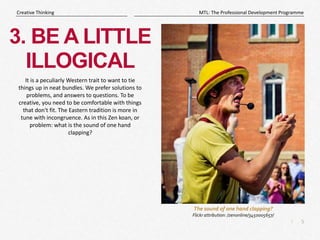
It is a peculiarly Western trait to want to tie
things up in neat bundles. We prefer solutions to
problems, and answers to questions. To be
creative, you need to be comfortable with things
that don't fit. The Eastern tradition is more in
tune with incongruence. As in this Zen koan, or
problem: what is the sound of one hand
clapping?
The sound of one hand clapping?
Flickr attribution: /zenonline/3450005657/
6
|
MTL: The Professional Development Programme
Creative Thinking
4. LAUGH
MORE
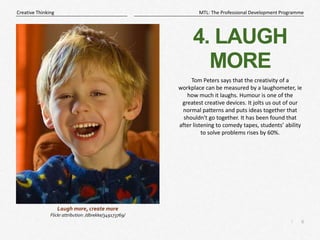
Tom Peters says that the creativity of a
workplace can be measured by a laughometer, ie
how much it laughs. Humour is one of the
greatest creative devices. It jolts us out of our
normal patterns and puts ideas together that
shouldn't go together. It has been found that
after listening to comedy tapes, students’ ability
to solve problems rises by 60%.
Laugh more, create more
Flickr attribution: /dbrekke/349173769/
7
|
MTL: The Professional Development Programme
Creative Thinking
5. THINK
OUTSIDE
YOUR LIMITS
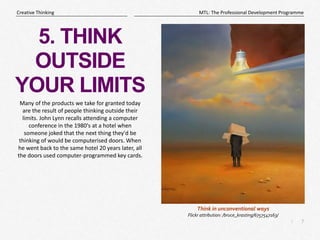
Many of the products we take for granted today
are the result of people thinking outside their
limits. John Lynn recalls attending a computer
conference in the 1980's at a hotel when
someone joked that the next thing they'd be
thinking of would be computerised doors. When
he went back to the same hotel 20 years later, all
the doors used computer-programmed key cards.
Think in unconventional ways
Flickr attribution: /bruce_krasting/6757547163/
8
|
MTL: The Professional Development Programme
Creative Thinking
Thinking OutsideYour Limits
Thinking outside your limits is also known as lateral thinking, out-
of-the-box thinking and creative thinking. It means looking at
familiar things in unfamiliar ways.
You can practise this kind of thinking with these pointers:
let go of old ways of seeing, thinking and doing
question what you see, remembering that we distort what we
see with our perceptions
have a clear understanding of what outcome you desire but
divorce the outcome from the method
be aware that thinking in familiar patterns can limit your
options of what is possible
free yourself from judging your own ideas
find a stream of creative ideas by thinking more like a child
take risks and dare to do things differently
be absolutely sure that you will succeed.
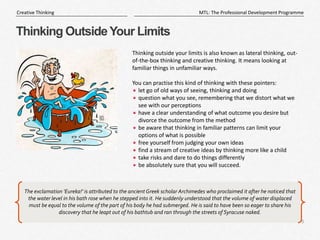
The exclamation 'Eureka!' is attributed to the ancient Greek scholar Archimedes who proclaimed it after he noticed that
the water level in his bath rose when he stepped into it. He suddenly understood that the volume of water displaced
must be equal to the volume of the part of his body he had submerged. He is said to have been so eager to share his
discovery that he leapt out of his bathtub and ran through the streets of Syracuse naked.
9
|
MTL: The Professional Development Programme
Creative Thinking
6. ADOPT AND
ADAPT
To be creative doesn't require blue-sky thinking.
You can still be creative by adapting what works
elsewhere. An American airline that wanted
quicker turnarounds on their flights adopted the
techniques of Formula One pit crews. Another
source of ideas is nature. Georges de Mestral
adapted the way certain seeds stick to clothing
and invented Velcro.
How burrs inspired a revolution in clothing
Flickr attribution: /garyhebding/21271515552/
10
|
MTL: The Professional Development Programme
Creative Thinking
7. WORK ON
YOUR
DREAMS
Dreaming and day-dreaming can create a rich
seam of ideas, because that's when we relax and
let the subconscious mind work by itself. The
Roffey Park Management Institute calls this
"washing-up creativity" because most flashes of
inspiration come when we are walking the dog,
sitting Archimedes-like in the bath, or doing the
washing up.
Your best ideas come when you’re not consciously thinking
Flickr attribution: /7622989@N04/16301732691/
11
|
MTL: The Professional Development Programme
Creative Thinking
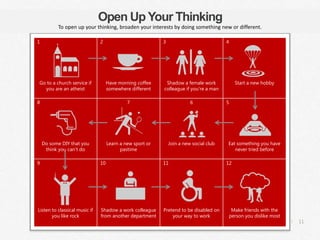
Open Up Your Thinking
1
Go to a church service if
you are an atheist
2
Have morning coffee
somewhere different
3
Shadow a female work
colleague if you're a man
4
Start a new hobby
8
Do some DIY that you
think you can’t do
7
Learn a new sport or
pastime
6
Join a new social club
5
Eat something you have
never tried before
9
Listen to classical music if
you like rock
10
Shadow a work colleague
from another department
11
Pretend to be disabled on
your way to work
12
Make friends with the
person you dislike most
To open up your thinking, broaden your interests by doing something new or different.
12
|
MTL: The Professional Development Programme
Creative Thinking
This has been a Slide Topic from Manage Train Learn
AFinal
Word
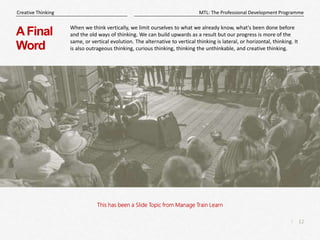
When we think vertically, we limit ourselves to what we already know, what's been done before
and the old ways of thinking. We can build upwards as a result but our progress is more of the
same, or vertical evolution. The alternative to vertical thinking is lateral, or horizontal, thinking. It
is also outrageous thinking, curious thinking, thinking the unthinkable, and creative thinking.

Creative Thinking

  • 1.
    1 | MTL: The ProfessionalDevelopment Programme Creative Thinking CREATIVE THINKING How crazy can you think? MTL: The Professional Development Programme
  • 2.
    2 | MTL: The ProfessionalDevelopment Programme Creative Thinking Attribution: All images are from sources where a Creative Commons license exists for commercial use. All icons are on subscription from thenounproject. All clipart is from free sources. The MTL Professional Development Programme is copyright of Manage Train Learn. Creative Thinking Introduction: In our Western systems of thinking, there is a strong bias towards using the left- brain. We tend to prefer ideas that fit pre-conceived patterns, systems that have been proved and solutions that are low-risk. But in a time of change, where we need to solve major intractable problems, we need to be more creative and instead of known thinking and known solutions, develop new thinking and new solutions, ie using the right-brain. In this topic, we’ll show you 7 ways to be more creative.
  • 3.
    3 | MTL: The ProfessionalDevelopment Programme Creative Thinking 1. THINK LIKE A CHILD As adults we tend to think in a conditioned way aimed at showing how clever we are. Yet, as children, we are simply spontaneous and far more creative in our thinking. To dive into the creative gap between your conditioned ego response, (ie to impress, show off, display your cleverness), and your spontaneity, allow yourself to just wonder at things, to be completely present in the here and now, and to detach yourself from what you thought was real. To be creative, behave like you did as a child Flickr attribution: /premnath/9293452583/
  • 4.
    4 | MTL: The ProfessionalDevelopment Programme Creative Thinking 2. MAKE NEW CONNECTIONS To be innovative doesn't require a university degree; it simply requires making a connection between existing ideas. For instance, did you know that ice cream was invented in 2000 BC yet it took another 3900 years for someone to come up with the idea of a cone? It's when you take two seemingly unrelated items and use the spark of creativity that inventiveness happens. The ice cream cone innovation Flickr attribution: /ryanready/4697281556/
  • 5.
    5 | MTL: The ProfessionalDevelopment Programme Creative Thinking 3. BE A LITTLE ILLOGICAL It is a peculiarly Western trait to want to tie things up in neat bundles. We prefer solutions to problems, and answers to questions. To be creative, you need to be comfortable with things that don't fit. The Eastern tradition is more in tune with incongruence. As in this Zen koan, or problem: what is the sound of one hand clapping? The sound of one hand clapping? Flickr attribution: /zenonline/3450005657/
  • 6.
    6 | MTL: The ProfessionalDevelopment Programme Creative Thinking 4. LAUGH MORE Tom Peters says that the creativity of a workplace can be measured by a laughometer, ie how much it laughs. Humour is one of the greatest creative devices. It jolts us out of our normal patterns and puts ideas together that shouldn't go together. It has been found that after listening to comedy tapes, students’ ability to solve problems rises by 60%. Laugh more, create more Flickr attribution: /dbrekke/349173769/
  • 7.
    7 | MTL: The ProfessionalDevelopment Programme Creative Thinking 5. THINK OUTSIDE YOUR LIMITS Many of the products we take for granted today are the result of people thinking outside their limits. John Lynn recalls attending a computer conference in the 1980's at a hotel when someone joked that the next thing they'd be thinking of would be computerised doors. When he went back to the same hotel 20 years later, all the doors used computer-programmed key cards. Think in unconventional ways Flickr attribution: /bruce_krasting/6757547163/
  • 8.
    8 | MTL: The ProfessionalDevelopment Programme Creative Thinking Thinking OutsideYour Limits Thinking outside your limits is also known as lateral thinking, out- of-the-box thinking and creative thinking. It means looking at familiar things in unfamiliar ways. You can practise this kind of thinking with these pointers: let go of old ways of seeing, thinking and doing question what you see, remembering that we distort what we see with our perceptions have a clear understanding of what outcome you desire but divorce the outcome from the method be aware that thinking in familiar patterns can limit your options of what is possible free yourself from judging your own ideas find a stream of creative ideas by thinking more like a child take risks and dare to do things differently be absolutely sure that you will succeed. The exclamation 'Eureka!' is attributed to the ancient Greek scholar Archimedes who proclaimed it after he noticed that the water level in his bath rose when he stepped into it. He suddenly understood that the volume of water displaced must be equal to the volume of the part of his body he had submerged. He is said to have been so eager to share his discovery that he leapt out of his bathtub and ran through the streets of Syracuse naked.
  • 9.
    9 | MTL: The ProfessionalDevelopment Programme Creative Thinking 6. ADOPT AND ADAPT To be creative doesn't require blue-sky thinking. You can still be creative by adapting what works elsewhere. An American airline that wanted quicker turnarounds on their flights adopted the techniques of Formula One pit crews. Another source of ideas is nature. Georges de Mestral adapted the way certain seeds stick to clothing and invented Velcro. How burrs inspired a revolution in clothing Flickr attribution: /garyhebding/21271515552/
  • 10.
    10 | MTL: The ProfessionalDevelopment Programme Creative Thinking 7. WORK ON YOUR DREAMS Dreaming and day-dreaming can create a rich seam of ideas, because that's when we relax and let the subconscious mind work by itself. The Roffey Park Management Institute calls this "washing-up creativity" because most flashes of inspiration come when we are walking the dog, sitting Archimedes-like in the bath, or doing the washing up. Your best ideas come when you’re not consciously thinking Flickr attribution: /7622989@N04/16301732691/
  • 11.
    11 | MTL: The ProfessionalDevelopment Programme Creative Thinking Open Up Your Thinking 1 Go to a church service if you are an atheist 2 Have morning coffee somewhere different 3 Shadow a female work colleague if you're a man 4 Start a new hobby 8 Do some DIY that you think you can’t do 7 Learn a new sport or pastime 6 Join a new social club 5 Eat something you have never tried before 9 Listen to classical music if you like rock 10 Shadow a work colleague from another department 11 Pretend to be disabled on your way to work 12 Make friends with the person you dislike most To open up your thinking, broaden your interests by doing something new or different.
  • 12.
    12 | MTL: The ProfessionalDevelopment Programme Creative Thinking This has been a Slide Topic from Manage Train Learn AFinal Word When we think vertically, we limit ourselves to what we already know, what's been done before and the old ways of thinking. We can build upwards as a result but our progress is more of the same, or vertical evolution. The alternative to vertical thinking is lateral, or horizontal, thinking. It is also outrageous thinking, curious thinking, thinking the unthinkable, and creative thinking.