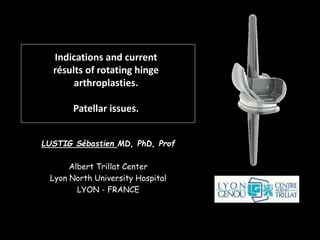
Indications and current
résults of rotating hinge
arthroplasties.
Patellar issues.
LUSTIG Sébastien MD, PhD, Prof
Albert Trillat Center
Lyon North University Hospital
LYON - FRANCE
AIM
• CURRENT INDICATIONS OF ROTATING HINGE
ARTHROPLASTY
• SPECIFIC ASSESSMENT OF PATELLAR
COMPLICATIONS
Principles
« … »L’implant
fémoral et l’implant
tibial sont liés entre
eux par un moyen
d’union de type
charnière palliant la
déficience des
formations
ligamentaires du
patient.
Cette charnière est
fixe ou rotatoire.
« … »
Problems :
• Increase bony stress
•Long stem is needed
More constraints…
indications ?
Avec défaillance ligamentaire
Arthroplastie tricompartimentale
Sans perte de substance osseuse
Indications?
Arthroplastie tricompartimentale
Avec perte de substance osseuse
Avec défaillance ligamentaire Avec défaillance ligamentaire
CHU Lyon Croix Rousse
Total UKA TKA RTKA R Hinge
2013 410 19 359 32 12
2014 523 38 444 41 15
2015 633 50 513 70 29
2016 651 54 495 102 43
TOTAL 2217 161 1811 245 96
4% indications
Indications
• Primary TKA:
– Valgus (LCM)
– Varus (severe +++) / eldearly patient
– Desarthrodesis TKA
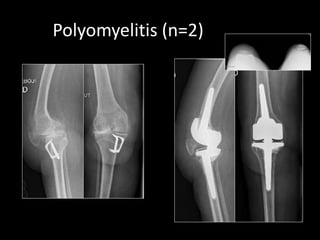
– Polyomyelitis …
• Revision :
– Bone loss (ligaments ?)
– Patella Baja
– FT instability
– Stiffness ++
Valgus
- Seems stable in EXT.
- Laxity in flexion (#20-30°)
Valgus
Varus ?
?
?
Varus
« Desarthrodesis » TKA
Polyomyelitis (n=2)
Indications
• Primary TKA:
– Valgus (LCM)
– Varus (ssevere +++) / eldearly patient
– Desarthrodesis TKA
– Polyomyelitis …
• Revision :
– Bone loss (ligaments ?)
– Patella Baja
– FT instability
– Stiffness ++
Revision for instability ++
Postoperative Xrays
Patella Baja
infections
1-Stage / 2-stage
Results
Patella ?
CHU Lyon Croix Rousse
Total UKA TKA RTKA R Hinge
2013 410 19 359 32 12
2014 523 38 444 41 15
2015 633 50 513 70 29
2016 651 54 495 102 43
TOTAL 2217 161 1811 245 96
4% indications
Type of R Hinge TKA
Simple
• Rotax (Groupe Lepine ®)
Reconstruction
• Noyles (Depuy®)
• RHK OSS (Biomet®)
n=43 N=29
n = 72
Patellar analysis
• X ray: pattelar view at 30° flexion
• 4 groups:
– Centered
– Tilted
– Subdislocated
– Dislocated
Type of R Hinge TKA
Simple
• Rotax (Groupe Lepine ®)
Reconstruction
• Noyles (Depuy®)
• RHK OSS (Biomet®)
65% 59%
28,1%
6,9%4,6 %
2,3 % 2,3 %
31,8 %
Type of R Hinge TKA
Simple
• Rotax (Groupe Lepine ®)
Reconstruction
• Noyles (Depuy®)
• RHK OSS (Biomet®)
65% 59%
28,1%
6,9%4,6 %
2,3 % 2,3 %
31,8 %
93,1% 90,8%
Type of R Hinge TKA
Simple
• Rotax (Groupe Lepine ®)
Reconstruction
• Noyles (Depuy®)
• RHK OSS (Biomet®)
65% 59%
28,1%
6,9%4,6 %
2,3 % 2,3 %
31,8 %
ATT medialisation+ MPFL
n = 2
Conclusion
• 25% of our current indications for
Revision TKA,
• Satisfactory functional results
(flexion),
• 65% optimal Patellar positioning,
• 5% secondary MPFL + ATT
medialisation.

2017-031

  • 1.
    Indications and current résultsof rotating hinge arthroplasties. Patellar issues. LUSTIG Sébastien MD, PhD, Prof Albert Trillat Center Lyon North University Hospital LYON - FRANCE
  • 2.
    AIM • CURRENT INDICATIONSOF ROTATING HINGE ARTHROPLASTY • SPECIFIC ASSESSMENT OF PATELLAR COMPLICATIONS
  • 3.
    Principles « … »L’implant fémoralet l’implant tibial sont liés entre eux par un moyen d’union de type charnière palliant la déficience des formations ligamentaires du patient. Cette charnière est fixe ou rotatoire. « … »
  • 4.
    Problems : • Increasebony stress •Long stem is needed More constraints…
  • 5.
    indications ? Avec défaillanceligamentaire Arthroplastie tricompartimentale Sans perte de substance osseuse
  • 6.
    Indications? Arthroplastie tricompartimentale Avec pertede substance osseuse Avec défaillance ligamentaire Avec défaillance ligamentaire
  • 7.
    CHU Lyon CroixRousse Total UKA TKA RTKA R Hinge 2013 410 19 359 32 12 2014 523 38 444 41 15 2015 633 50 513 70 29 2016 651 54 495 102 43 TOTAL 2217 161 1811 245 96 4% indications
  • 8.
    Indications • Primary TKA: –Valgus (LCM) – Varus (severe +++) / eldearly patient – Desarthrodesis TKA – Polyomyelitis … • Revision : – Bone loss (ligaments ?) – Patella Baja – FT instability – Stiffness ++
  • 9.
  • 10.
    - Seems stablein EXT. - Laxity in flexion (#20-30°) Valgus
  • 13.
  • 14.
  • 15.
  • 17.
  • 18.
    Indications • Primary TKA: –Valgus (LCM) – Varus (ssevere +++) / eldearly patient – Desarthrodesis TKA – Polyomyelitis … • Revision : – Bone loss (ligaments ?) – Patella Baja – FT instability – Stiffness ++
  • 19.
  • 21.
  • 22.
  • 23.
  • 24.
  • 25.
  • 26.
  • 27.
    CHU Lyon CroixRousse Total UKA TKA RTKA R Hinge 2013 410 19 359 32 12 2014 523 38 444 41 15 2015 633 50 513 70 29 2016 651 54 495 102 43 TOTAL 2217 161 1811 245 96 4% indications
  • 28.
    Type of RHinge TKA Simple • Rotax (Groupe Lepine ®) Reconstruction • Noyles (Depuy®) • RHK OSS (Biomet®) n=43 N=29 n = 72
  • 29.
    Patellar analysis • Xray: pattelar view at 30° flexion • 4 groups: – Centered – Tilted – Subdislocated – Dislocated
  • 30.
    Type of RHinge TKA Simple • Rotax (Groupe Lepine ®) Reconstruction • Noyles (Depuy®) • RHK OSS (Biomet®) 65% 59% 28,1% 6,9%4,6 % 2,3 % 2,3 % 31,8 %
  • 31.
    Type of RHinge TKA Simple • Rotax (Groupe Lepine ®) Reconstruction • Noyles (Depuy®) • RHK OSS (Biomet®) 65% 59% 28,1% 6,9%4,6 % 2,3 % 2,3 % 31,8 % 93,1% 90,8%
  • 32.
    Type of RHinge TKA Simple • Rotax (Groupe Lepine ®) Reconstruction • Noyles (Depuy®) • RHK OSS (Biomet®) 65% 59% 28,1% 6,9%4,6 % 2,3 % 2,3 % 31,8 %
  • 33.
  • 34.
    Conclusion • 25% ofour current indications for Revision TKA, • Satisfactory functional results (flexion), • 65% optimal Patellar positioning, • 5% secondary MPFL + ATT medialisation.