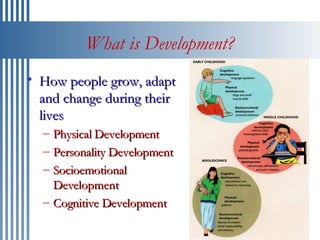
What is Development? How people grow, adapt and change during their lives  Physical Development Personality Development Socioemotional Development Cognitive Development
History of Development Hall was First President of APA Contents of Children’s Minds (1883) Ontogeny recapitulates phylogeny Ontogeny is the growth (size change) and development (shape change) of an individual organism; phylogeny is the evolutionary history of a species   Children develop in regular stages Deterministic  Cultural Epochs Curriculum Epochs of human history provide scope and sequence of the curriculum Differentiated curriculum Prepare boys for the world of work Prepare girls for marriage and motherhood G. Stanley Hall
Contemporary Principles of Development Development is Orderly Development is Gradual Nature - Nurture Learning changes the physical structure of the brain Different parts of the brain are ready to learn at different times
Piagetian Development Maturation Activity Social Experience Equilibration Blog
Piagetian Terminology Schemes Adaptation Assimilation Accommodation Equilibration Constructivism
Assimilation/Accommodation
Stages of Cognitive Development Sensorimotor Pre-operational Concrete operations Formal operations
Sensorimotor Stage: Ages 0-2 Learning through 5 senses Object permanence Trial & Error Reflexes
Preoperational Stage: 2-7 Egocentrism One-way logic Conservation Language Development Focus on states, not processes
Preoperational Researcher - Are Dreams true? Child - No, they are pictures we see. Researcher - Are your eyes open or shut when you dream? Child - Shut. Researcher - Could I see your dream? Child - No, you would be too far away. Researcher - Could your mother see it? Child - Yes, but she turns on the light.
Preoperational Researcher - If you stuck a pin in this stone, would it feel it?  Child - No  Researcher - Why not?  Child - Because it is hard.  Researcher - If you put it in the fire, would it feel that?  Child - Yes, because it would get burnt  Researcher -Is the sun alive?  Child - Yes, because it gives light.  Researcher - Is a candle alive?  Child - No- Well, I guess it is when it is giving light.  Researcher - Is a bicycle alive?  Child - No, when it doesn’t go it isn’t alive!
Conservation The child agrees that each container holds the same amount of liquid The child believes the tall container holds more.
Conservation of Liquid Preschoolers ignore the pouring process and focus only on the beginning state and the end state Blog
Concrete Operational Stage: 7-11 Hands-on Thinking Two way logic Transivity Classification Seriation Blog
Formal Operational Stage: 11-15 Hypothetico-deductive reasoning Systematic reasoning Adolescent egocentrism Monitored reasoning Blog
Applications of Piaget Awareness of student thinking Individuals “construct” knowledge Match teaching to cognitive stage presentation strategies illustrations & examples assignments Use disequilibrium to motivate
Limitations of Piaget Stage theory inconsistencies Under estimation of children’s abilities It overlooks cultural and social influences (Development depends upon task and prior experiences)
Vygotsky: A sociocultural Perspective Role of language & private speech Social transmission self-talk & learning Scaffolding & assisted learning Zone of Proximal Development Importance of conversations
Implementing Vygotsky’s Theory Imitiative Learning Instructed Learning Assisted Learning Cooperative Learning Alternative Assessments
Teaching Model Based Upon Vygotsky
Limitations of Vygotsky Learning may be effected by: knowledge base existing thinking skills Environmental influences transmission model of most American schools authoritarian environments and unwillingness to allow socially transmitted learning

Development2008

  • 1.
    What is Development?How people grow, adapt and change during their lives Physical Development Personality Development Socioemotional Development Cognitive Development
  • 2.
    History of DevelopmentHall was First President of APA Contents of Children’s Minds (1883) Ontogeny recapitulates phylogeny Ontogeny is the growth (size change) and development (shape change) of an individual organism; phylogeny is the evolutionary history of a species Children develop in regular stages Deterministic Cultural Epochs Curriculum Epochs of human history provide scope and sequence of the curriculum Differentiated curriculum Prepare boys for the world of work Prepare girls for marriage and motherhood G. Stanley Hall
  • 3.
    Contemporary Principles ofDevelopment Development is Orderly Development is Gradual Nature - Nurture Learning changes the physical structure of the brain Different parts of the brain are ready to learn at different times
  • 4.
    Piagetian Development MaturationActivity Social Experience Equilibration Blog
  • 5.
    Piagetian Terminology SchemesAdaptation Assimilation Accommodation Equilibration Constructivism
  • 6.
  • 7.
    Stages of CognitiveDevelopment Sensorimotor Pre-operational Concrete operations Formal operations
  • 8.
    Sensorimotor Stage: Ages0-2 Learning through 5 senses Object permanence Trial & Error Reflexes
  • 9.
    Preoperational Stage: 2-7Egocentrism One-way logic Conservation Language Development Focus on states, not processes
  • 10.
    Preoperational Researcher -Are Dreams true? Child - No, they are pictures we see. Researcher - Are your eyes open or shut when you dream? Child - Shut. Researcher - Could I see your dream? Child - No, you would be too far away. Researcher - Could your mother see it? Child - Yes, but she turns on the light.
  • 11.
    Preoperational Researcher -If you stuck a pin in this stone, would it feel it? Child - No Researcher - Why not? Child - Because it is hard. Researcher - If you put it in the fire, would it feel that? Child - Yes, because it would get burnt Researcher -Is the sun alive? Child - Yes, because it gives light. Researcher - Is a candle alive? Child - No- Well, I guess it is when it is giving light. Researcher - Is a bicycle alive? Child - No, when it doesn’t go it isn’t alive!
  • 12.
    Conservation The childagrees that each container holds the same amount of liquid The child believes the tall container holds more.
  • 13.
    Conservation of LiquidPreschoolers ignore the pouring process and focus only on the beginning state and the end state Blog
  • 14.
    Concrete Operational Stage:7-11 Hands-on Thinking Two way logic Transivity Classification Seriation Blog
  • 15.
    Formal Operational Stage:11-15 Hypothetico-deductive reasoning Systematic reasoning Adolescent egocentrism Monitored reasoning Blog
  • 16.
    Applications of PiagetAwareness of student thinking Individuals “construct” knowledge Match teaching to cognitive stage presentation strategies illustrations & examples assignments Use disequilibrium to motivate
  • 17.
    Limitations of PiagetStage theory inconsistencies Under estimation of children’s abilities It overlooks cultural and social influences (Development depends upon task and prior experiences)
  • 18.
    Vygotsky: A socioculturalPerspective Role of language & private speech Social transmission self-talk & learning Scaffolding & assisted learning Zone of Proximal Development Importance of conversations
  • 19.
    Implementing Vygotsky’s TheoryImitiative Learning Instructed Learning Assisted Learning Cooperative Learning Alternative Assessments
  • 20.
    Teaching Model BasedUpon Vygotsky
  • 21.
    Limitations of VygotskyLearning may be effected by: knowledge base existing thinking skills Environmental influences transmission model of most American schools authoritarian environments and unwillingness to allow socially transmitted learning