



The Cholesterol Conundrum
What does the Latest Science Say?
Ivor Cummins BE (Chem)
March 21st 2014
2013 Ivor Cummins BE(Chem) MIEI
Why are we in this room today
- How does this come about?
Academic /
Educational History
Problem Solving
Experience / Aptitude
2013 Ivor Cummins BE(Chem) MIEI
Quick Update from my last Seminar
At last, The unbiased experts
are stepping up to the plate:
• Six teaspoons max in 24 hours?
• That’s less than a single can of
your favorite sugary beverage, and
assumes NO other sugar for the
rest of the day?
• Looks like the Emperor’s suit is
getting frayed…..
• Gloves off lads, better pour some
money into the lobbying chest, and
shut this thing down quick
2013 Ivor Cummins BE(Chem) MIEI
1. The Key Molecules
2. The Key Particles
3. Our Common Enemy
4. The Risk Factors
5. How the Cholesterol Processing
System Works – High Level
6. The $1M Question – What Drives up
the Risk Factors?
The Conundrum Content:
2013 Ivor Cummins BE(Chem) MIEI
1. The Key Molecules
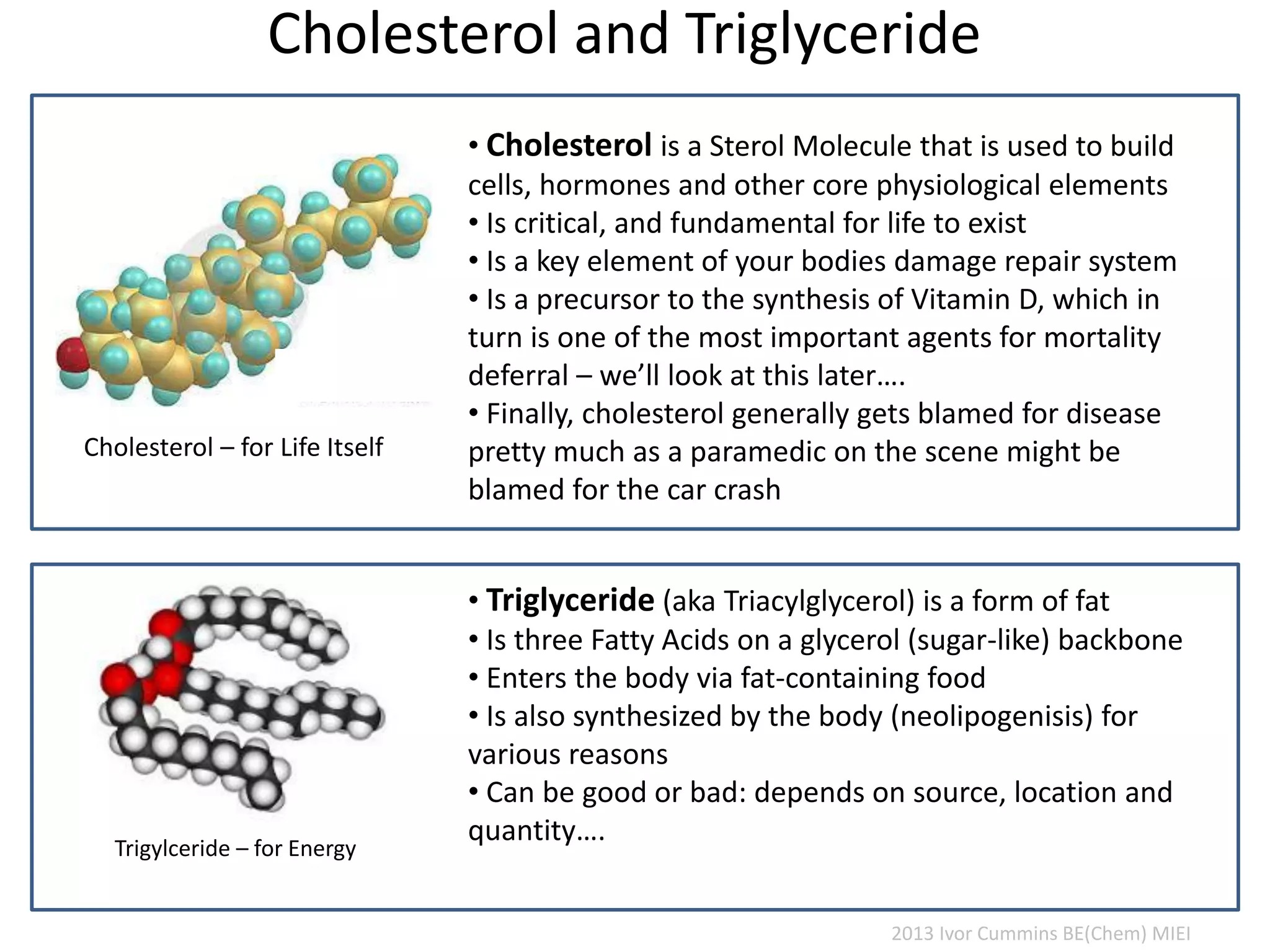
Cholesterol and Triglyceride
• Cholesterol is a Sterol Molecule that is used to build
cells, hormones and other core physiological elements
• Is critical, and fundamental for life to exist
• Is a key element of your bodies damage repair system
• Is a precursor to the synthesis of Vitamin D, which in
turn is one of the most important agents for mortality
deferral – we’ll look at this later….
• Finally, cholesterol generally gets blamed for disease
pretty much as a paramedic on the scene might be
blamed for the car crash
Cholesterol – for Life Itself
• Triglyceride (aka Triacylglycerol) is a form of fat
• Is three Fatty Acids on a glycerol (sugar-like) backbone
• Enters the body via fat-containing food
• Is also synthesized by the body (neolipogenisis) for
various reasons
• Can be good or bad: depends on source, location and
quantity….
Trigylceride – for Energy
2013 Ivor Cummins BE(Chem) MIEI
2. The Key Particles
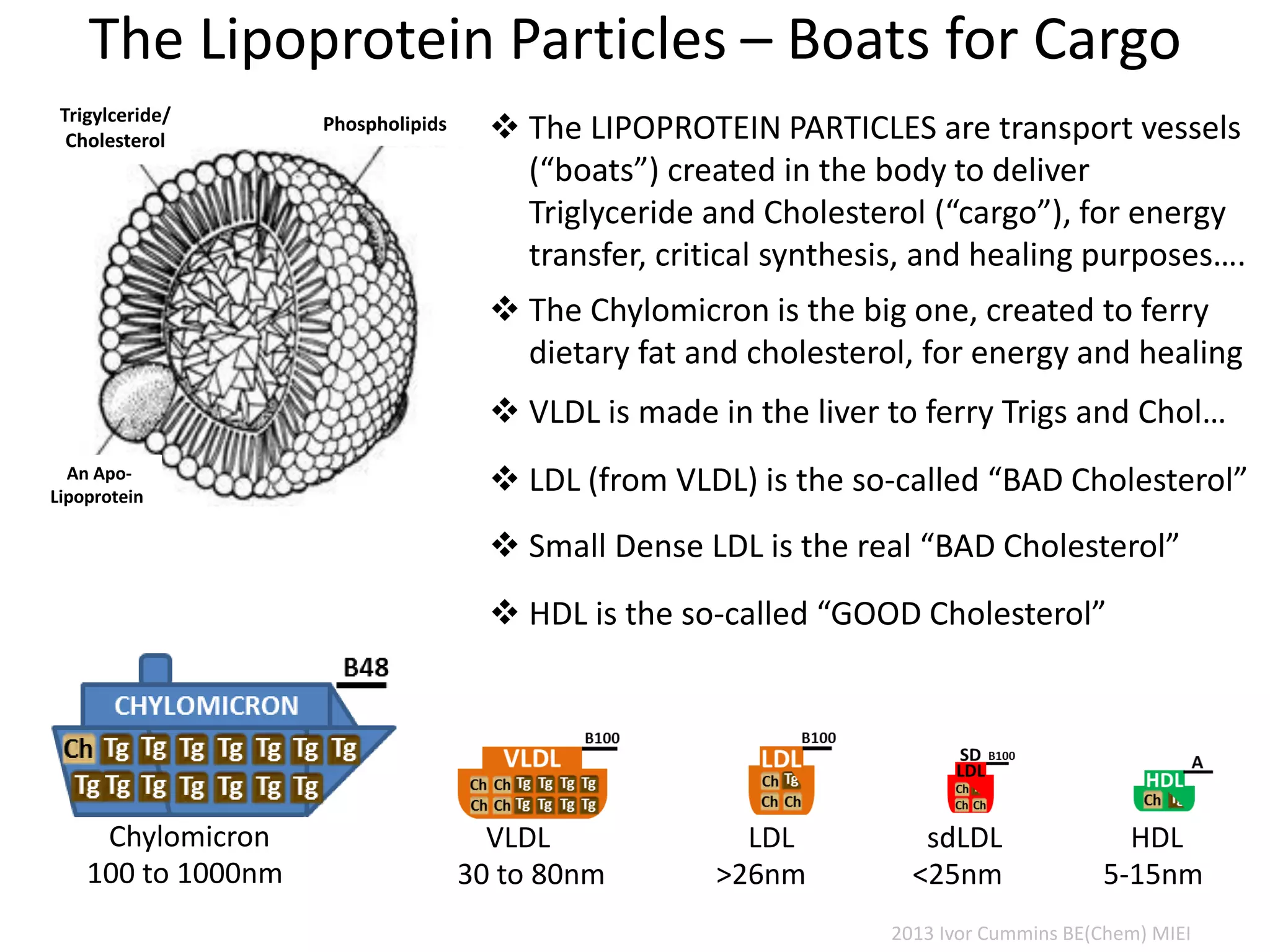
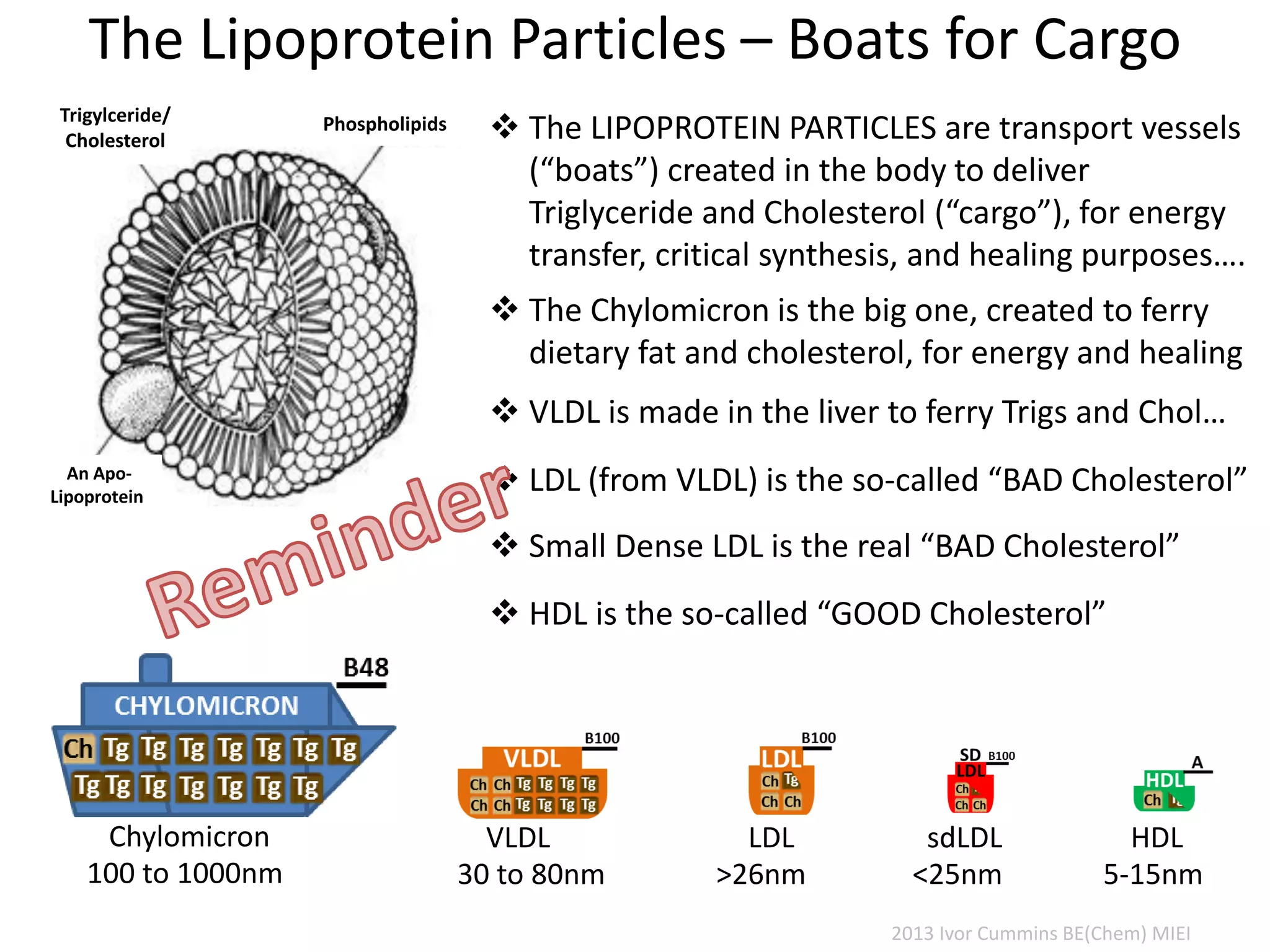
The Lipoprotein Particles – Boats for Cargo
Trigylceride/
Cholesterol
An Apo-
Lipoprotein
Phospholipids  The LIPOPROTEIN PARTICLES are transport vessels
(“boats”) created in the body to deliver
Triglyceride and Cholesterol (“cargo”), for energy
transfer, critical synthesis, and healing purposes….
 HDL is the so-called “GOOD Cholesterol”
 LDL (from VLDL) is the so-called “BAD Cholesterol”
 The Chylomicron is the big one, created to ferry
dietary fat and cholesterol, for energy and healing
Chylomicron
100 to 1000nm
sdLDL
<25nm
 VLDL is made in the liver to ferry Trigs and Chol…
 Small Dense LDL is the real “BAD Cholesterol”
HDL
5-15nm
LDL
>26nm
VLDL
30 to 80nm
2013 Ivor Cummins BE(Chem) MIEI
And now, a word from
our Sponsor…..
2013 Ivor Cummins BE(Chem) MIEI
3. Our Common Enemy
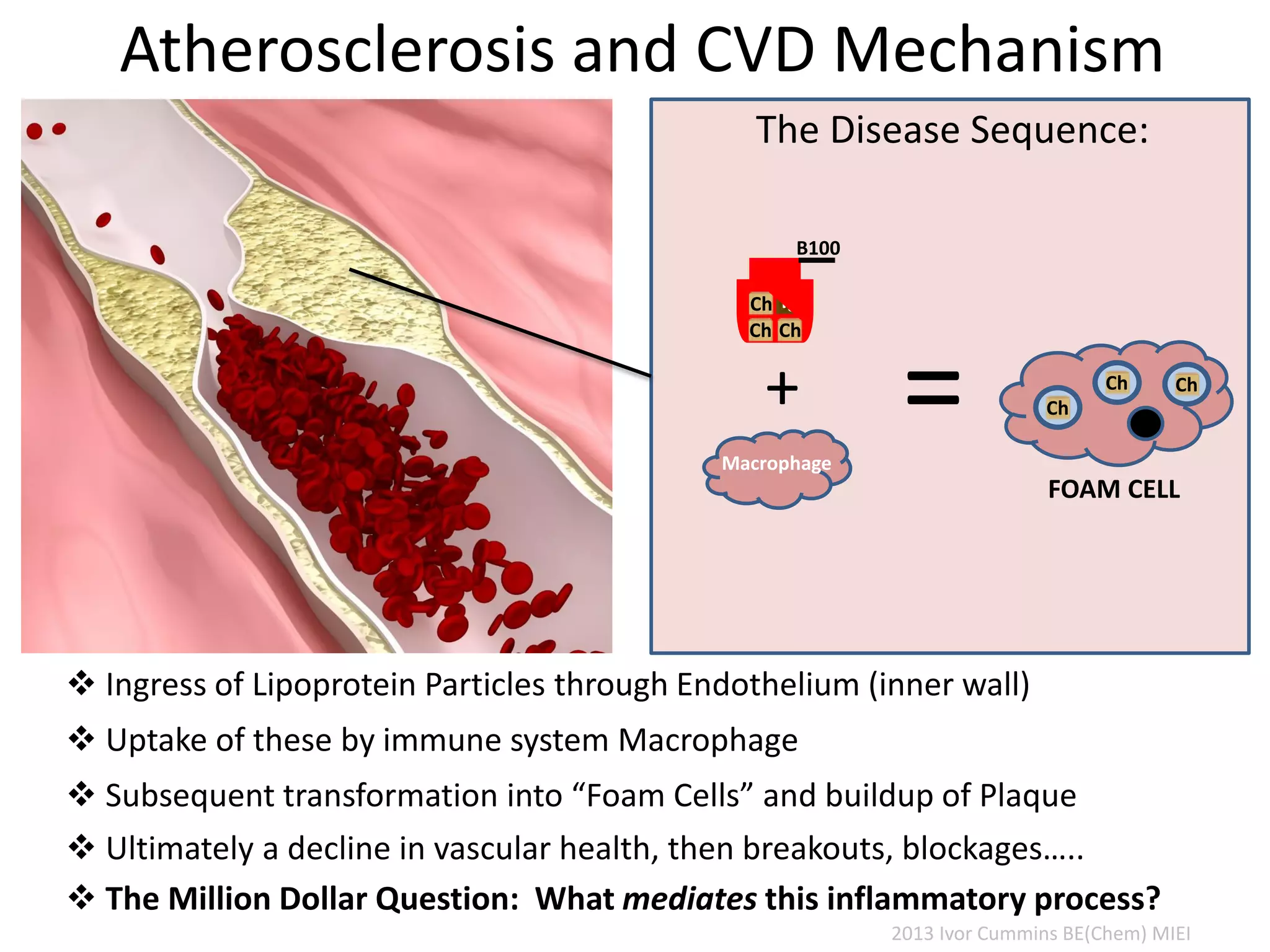
Atherosclerosis and CVD Mechanism
 Ingress of Lipoprotein Particles through Endothelium (inner wall)
 Uptake of these by immune system Macrophage
 Subsequent transformation into “Foam Cells” and buildup of Plaque
 Ultimately a decline in vascular health, then breakouts, blockages…..
The Disease Sequence:
+ Ch
Ch Ch
Macrophage
=
FOAM CELL
 The Million Dollar Question: What mediates this inflammatory process?
TgCh
ChCh
B100
2013 Ivor Cummins BE(Chem) MIEI
4. The Risk Factors
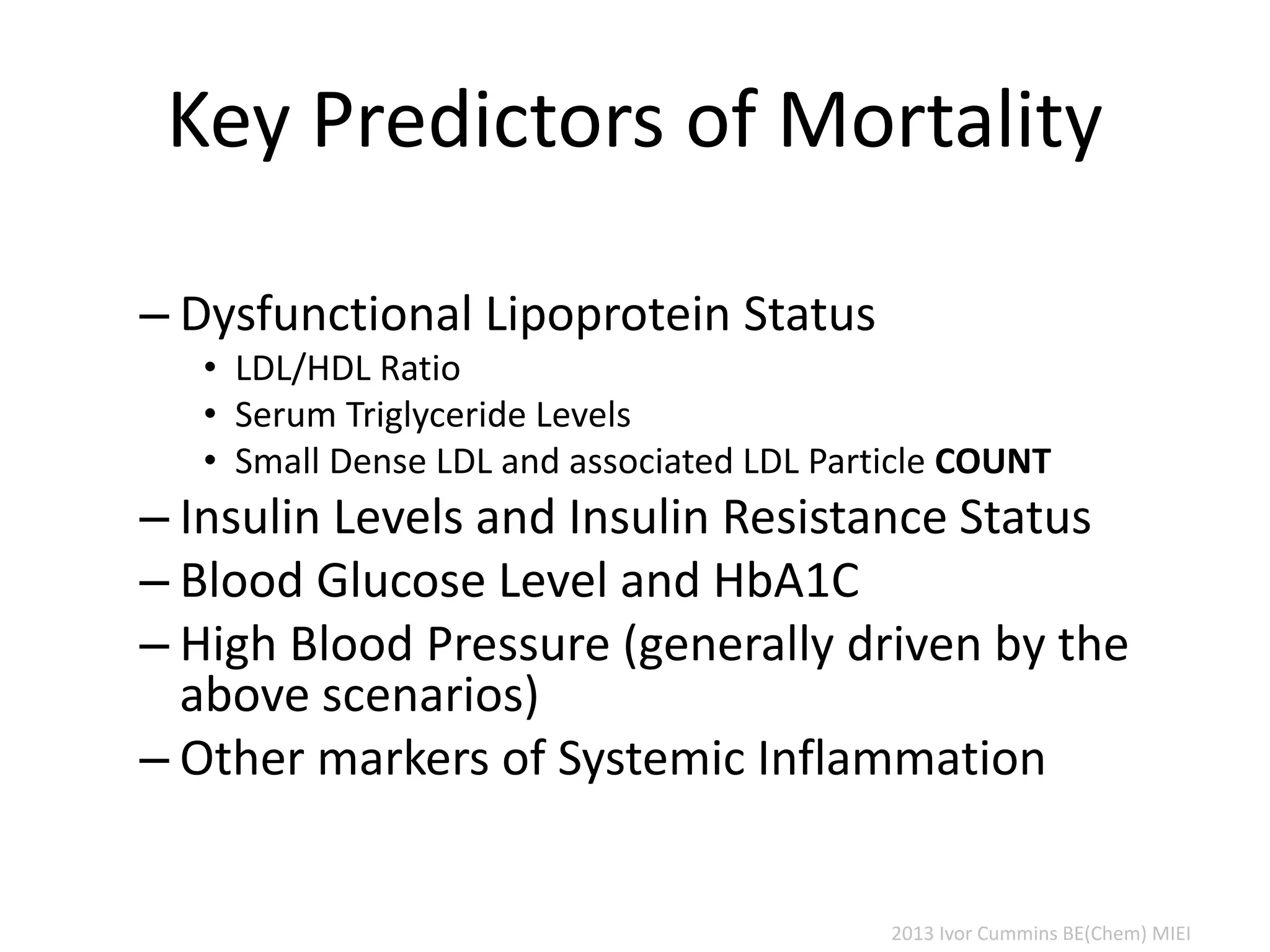
Key Predictors of Mortality
– Dysfunctional Lipoprotein Status
• LDL/HDL Ratio
• Serum Triglyceride Levels
• Small Dense LDL and associated LDL Particle COUNT
– Insulin Levels and Insulin Resistance Status
– Blood Glucose Level and HbA1C
– High Blood Pressure (generally driven by the
above scenarios)
– Other markers of Systemic Inflammation
2013 Ivor Cummins BE(Chem) MIEI
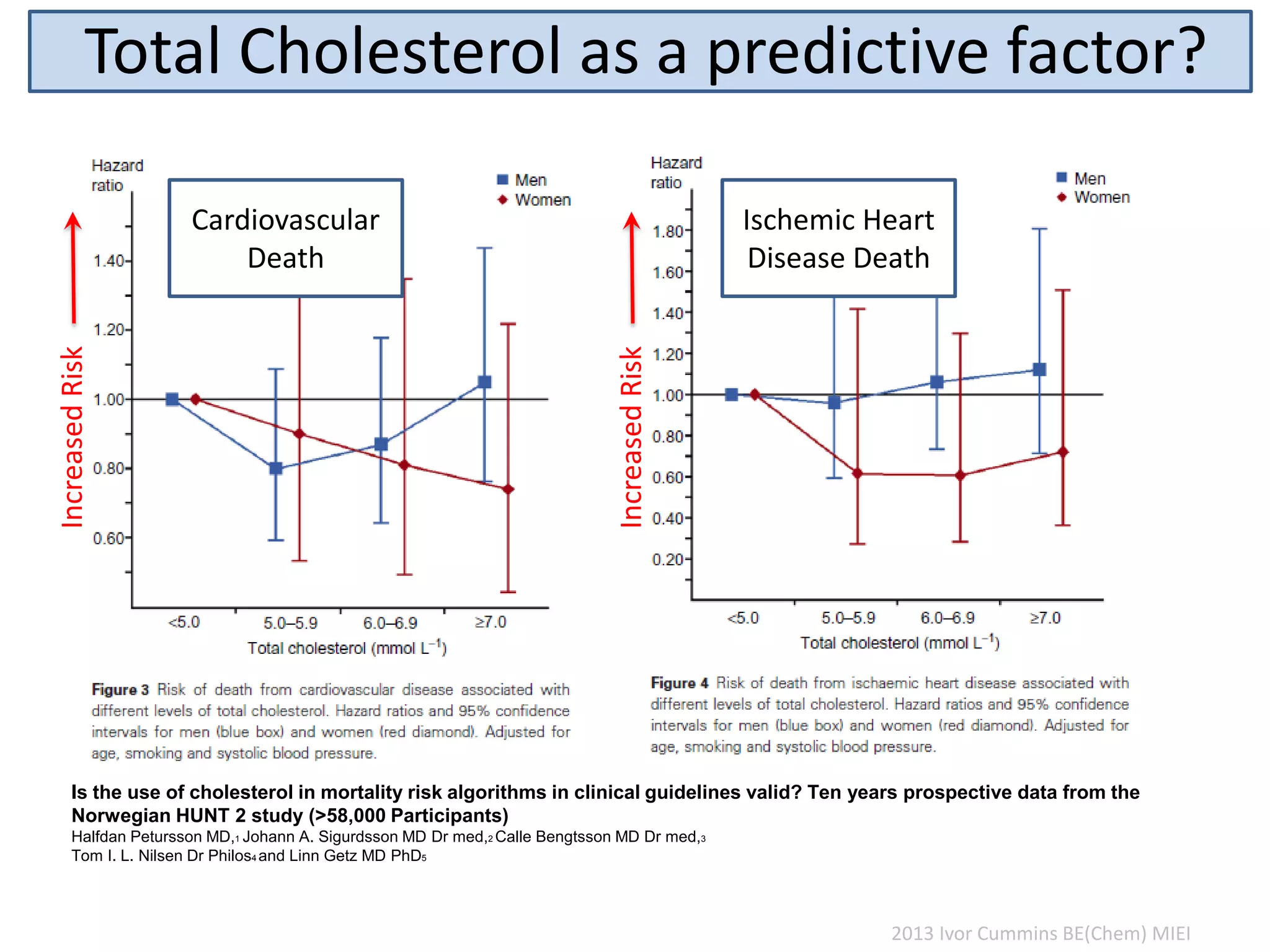
Total Cholesterol as a predictive factor?
Is the use of cholesterol in mortality risk algorithms in clinical guidelines valid? Ten years prospective data from the
Norwegian HUNT 2 study (>58,000 Participants)
Halfdan Petursson MD,1 Johann A. Sigurdsson MD Dr med,2 Calle Bengtsson MD Dr med,3
Tom I. L. Nilsen Dr Philos4 and Linn Getz MD PhD5
Cardiovascular
Death
IncreasedRisk
IncreasedRisk
Ischemic Heart
Disease Death
2013 Ivor Cummins BE(Chem) MIEI
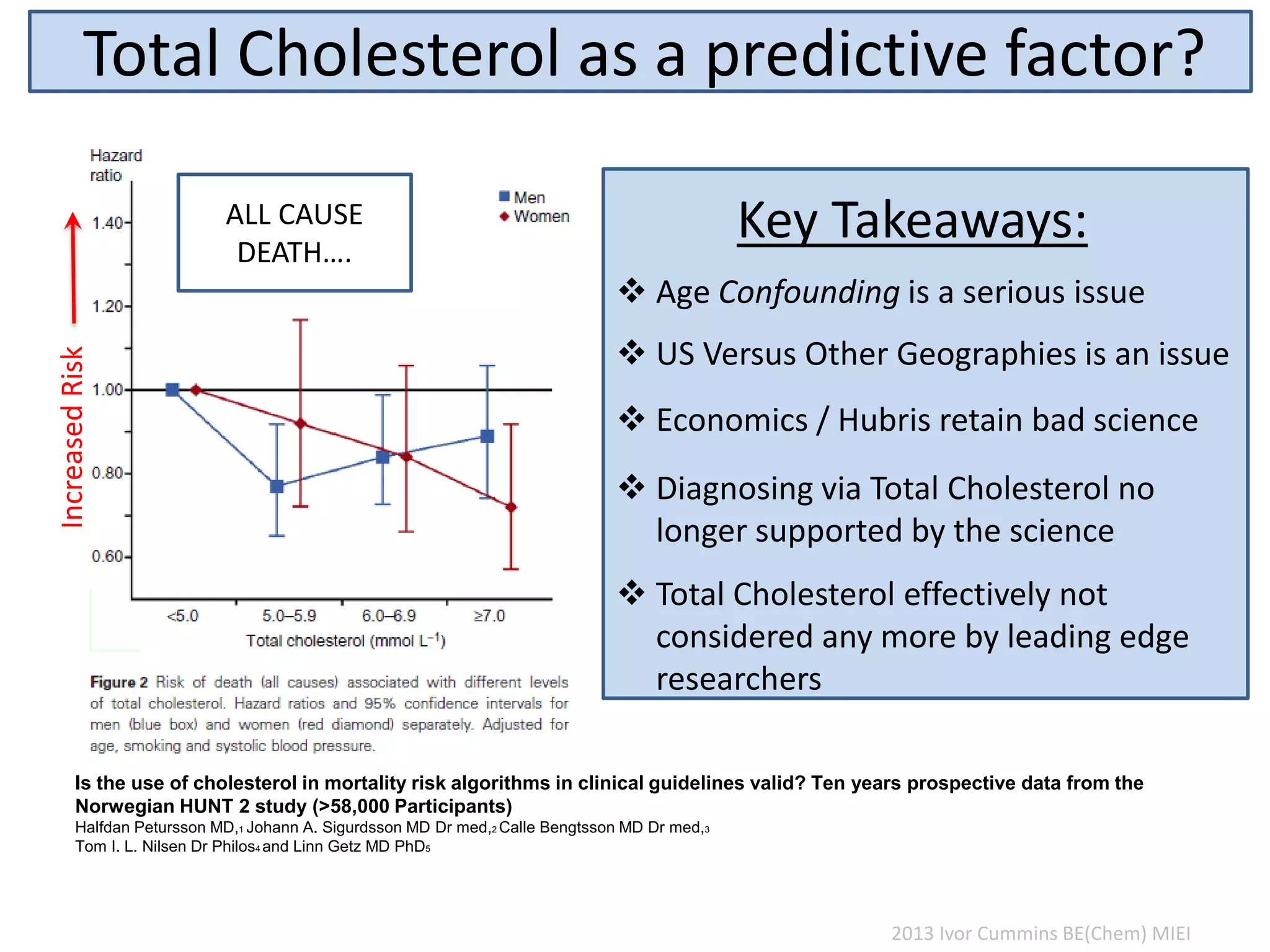
Total Cholesterol as a predictive factor?
Is the use of cholesterol in mortality risk algorithms in clinical guidelines valid? Ten years prospective data from the
Norwegian HUNT 2 study (>58,000 Participants)
Halfdan Petursson MD,1 Johann A. Sigurdsson MD Dr med,2 Calle Bengtsson MD Dr med,3
Tom I. L. Nilsen Dr Philos4 and Linn Getz MD PhD5
 Age Confounding is a serious issue
 US Versus Other Geographies is an issue
 Diagnosing via Total Cholesterol no
longer supported by the science
ALL CAUSE
DEATH….
IncreasedRisk
Key Takeaways:
 Total Cholesterol effectively not
considered any more by leading edge
researchers
 Economics / Hubris retain bad science
2013 Ivor Cummins BE(Chem) MIEI
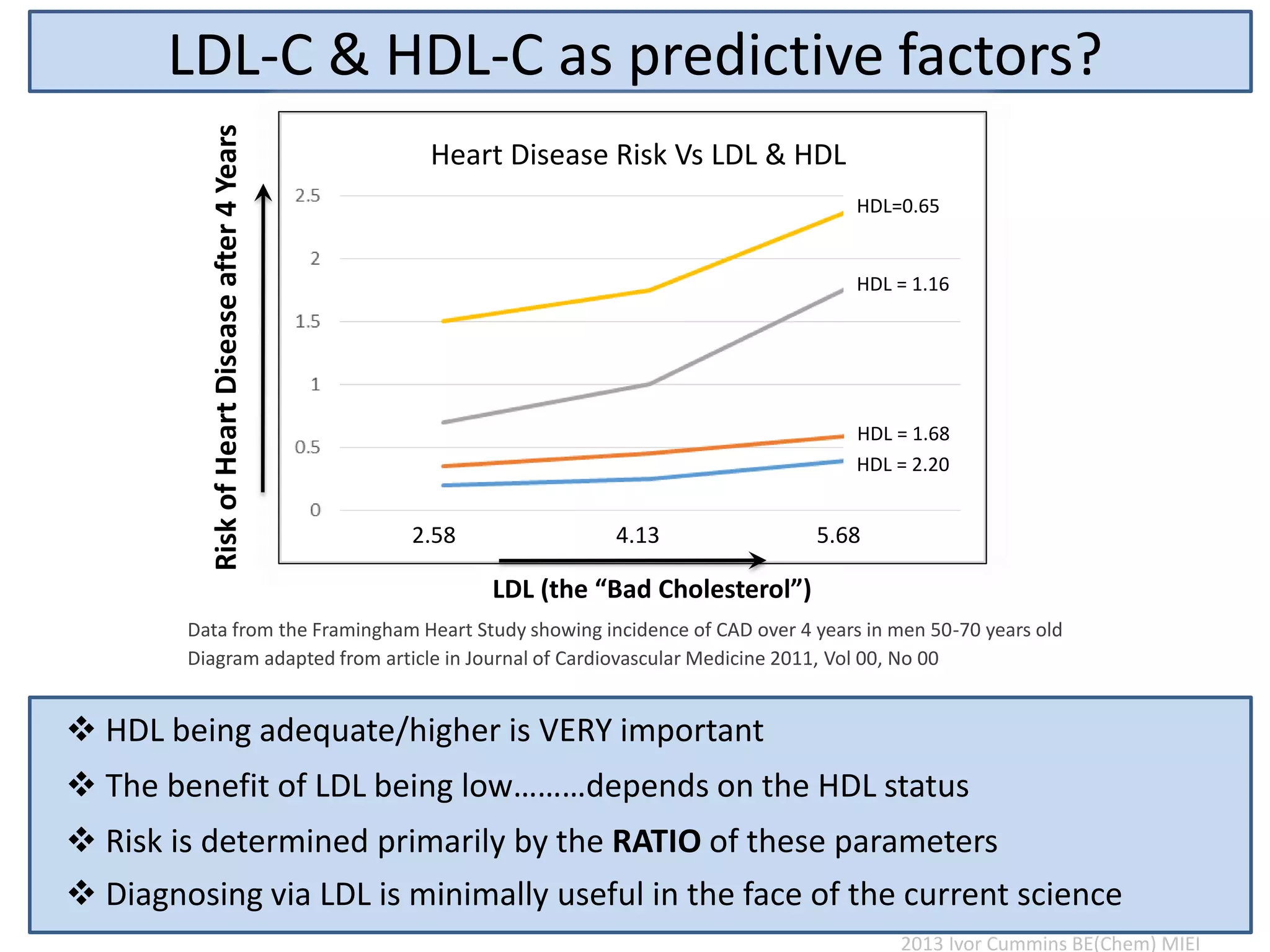
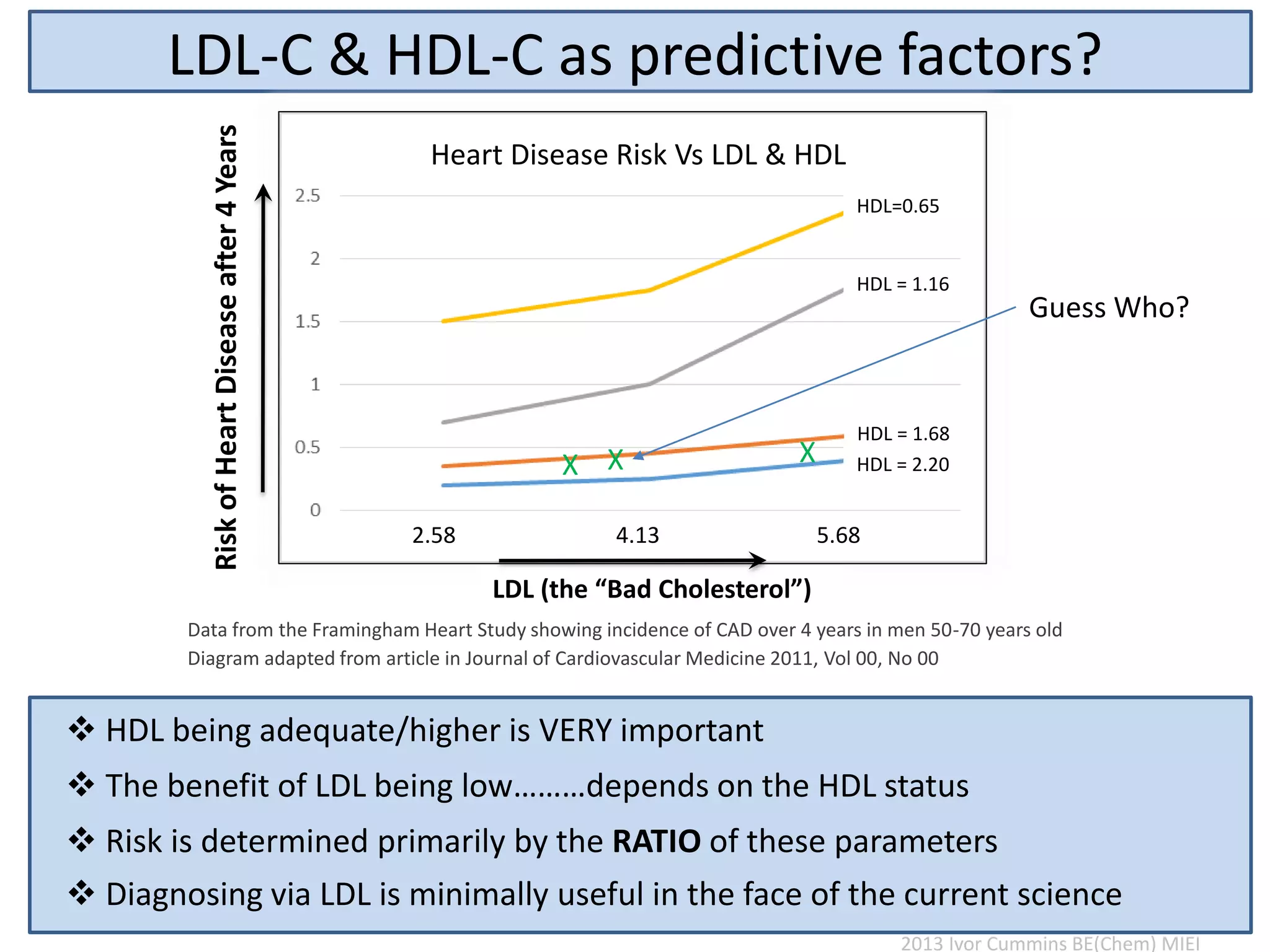
LDL-C & HDL-C as predictive factors?
Diagram adapted from article in Journal of Cardiovascular Medicine 2011, Vol 00, No 00
2.58 4.13 5.68
HDL=0.65
HDL = 1.16
HDL = 1.68
HDL = 2.20
RiskofHeartDiseaseafter4Years
LDL (the “Bad Cholesterol”)
 HDL being adequate/higher is VERY important
 The benefit of LDL being low………depends on the HDL status
 Risk is determined primarily by the RATIO of these parameters
 Diagnosing via LDL is minimally useful in the face of the current science
Heart Disease Risk Vs LDL & HDL
Data from the Framingham Heart Study showing incidence of CAD over 4 years in men 50-70 years old
2013 Ivor Cummins BE(Chem) MIEI
LDL-C & HDL-C as predictive factors?
Diagram adapted from article in Journal of Cardiovascular Medicine 2011, Vol 00, No 00
2.58 4.13 5.68
HDL=0.65
HDL = 1.16
HDL = 1.68
HDL = 2.20
RiskofHeartDiseaseafter4Years
LDL (the “Bad Cholesterol”)
 HDL being adequate/higher is VERY important
 The benefit of LDL being low………depends on the HDL status
 Risk is determined primarily by the RATIO of these parameters
 Diagnosing via LDL is minimally useful in the face of the current science
Heart Disease Risk Vs LDL & HDL
Data from the Framingham Heart Study showing incidence of CAD over 4 years in men 50-70 years old
XXX
2013 Ivor Cummins BE(Chem) MIEI
Guess Who?
SERUM TRIGLYCERIDE as a Predictive Factor
Assmann G, Schulte H. Am J Cardiol. 1992;70:733–737.
Data from the PROCAM Munster Study
 Blood Triglyceride Levels are an important Risk Factor for Coronary Disease
 However, they should not be judged alone – vital to balance with other factors
 Again we see the importance of LDL/HDL Ratios and interactions with Trigs
Key Takeaways:
2013 Ivor Cummins BE(Chem) MIEI
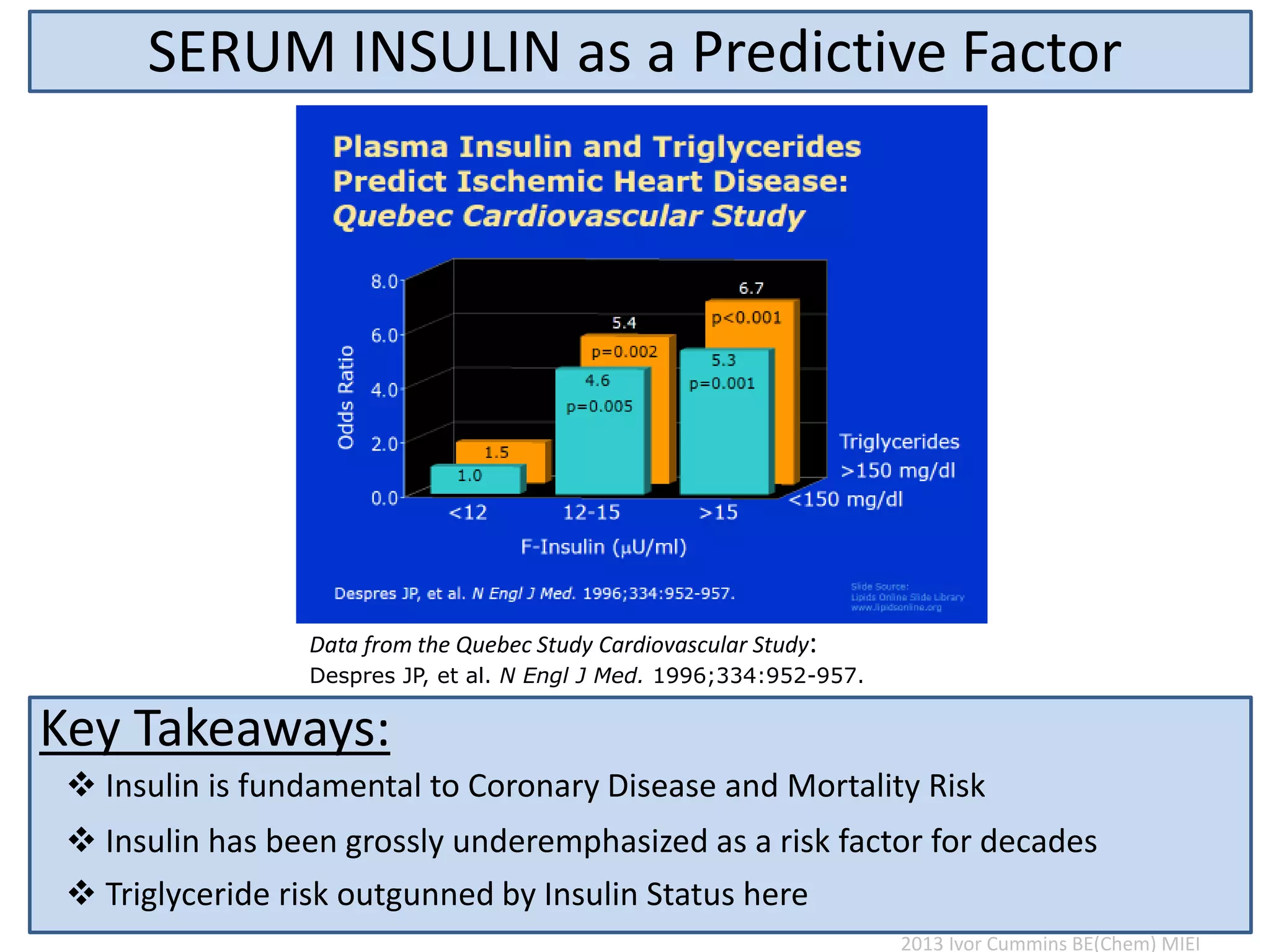
SERUM INSULIN as a Predictive Factor
Assmann G, Schulte H. Am J Cardiol. 1992;70:733–737.
Data from the PROCAM Munster Study (from "Interesting slideset around…):
 Insulin is fundamental to Coronary Disease and Mortality Risk
 Insulin has been grossly underemphasized as a risk factor for decades
 Triglyceride risk outgunned by Insulin Status here
Key Takeaways:
2013 Ivor Cummins BE(Chem) MIEI
Data from the Quebec Study Cardiovascular Study:
Despres JP, et al. N Engl J Med. 1996;334:952-957.
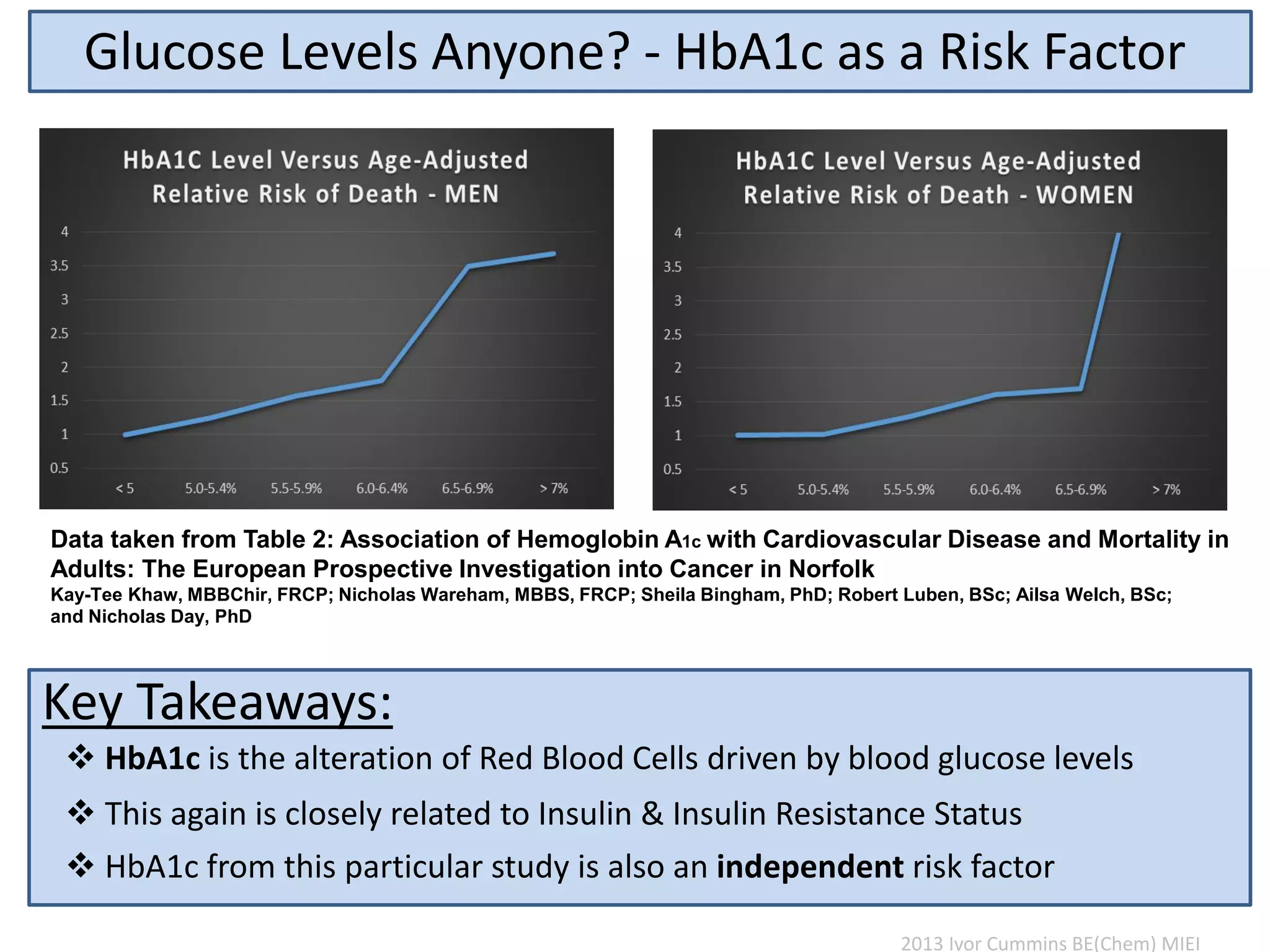
Data taken from Table 2: Association of Hemoglobin A1c with Cardiovascular Disease and Mortality in
Adults: The European Prospective Investigation into Cancer in Norfolk
Kay-Tee Khaw, MBBChir, FRCP; Nicholas Wareham, MBBS, FRCP; Sheila Bingham, PhD; Robert Luben, BSc; Ailsa Welch, BSc;
and Nicholas Day, PhD
Glucose Levels Anyone? - HbA1c as a Risk Factor
Assmann G, Schulte H. Am J Cardiol. 1992;70:733–737.
 HbA1c is the alteration of Red Blood Cells driven by blood glucose levels
 This again is closely related to Insulin & Insulin Resistance Status
 HbA1c from this particular study is also an independent risk factor
Key Takeaways:
2013 Ivor Cummins BE(Chem) MIEI
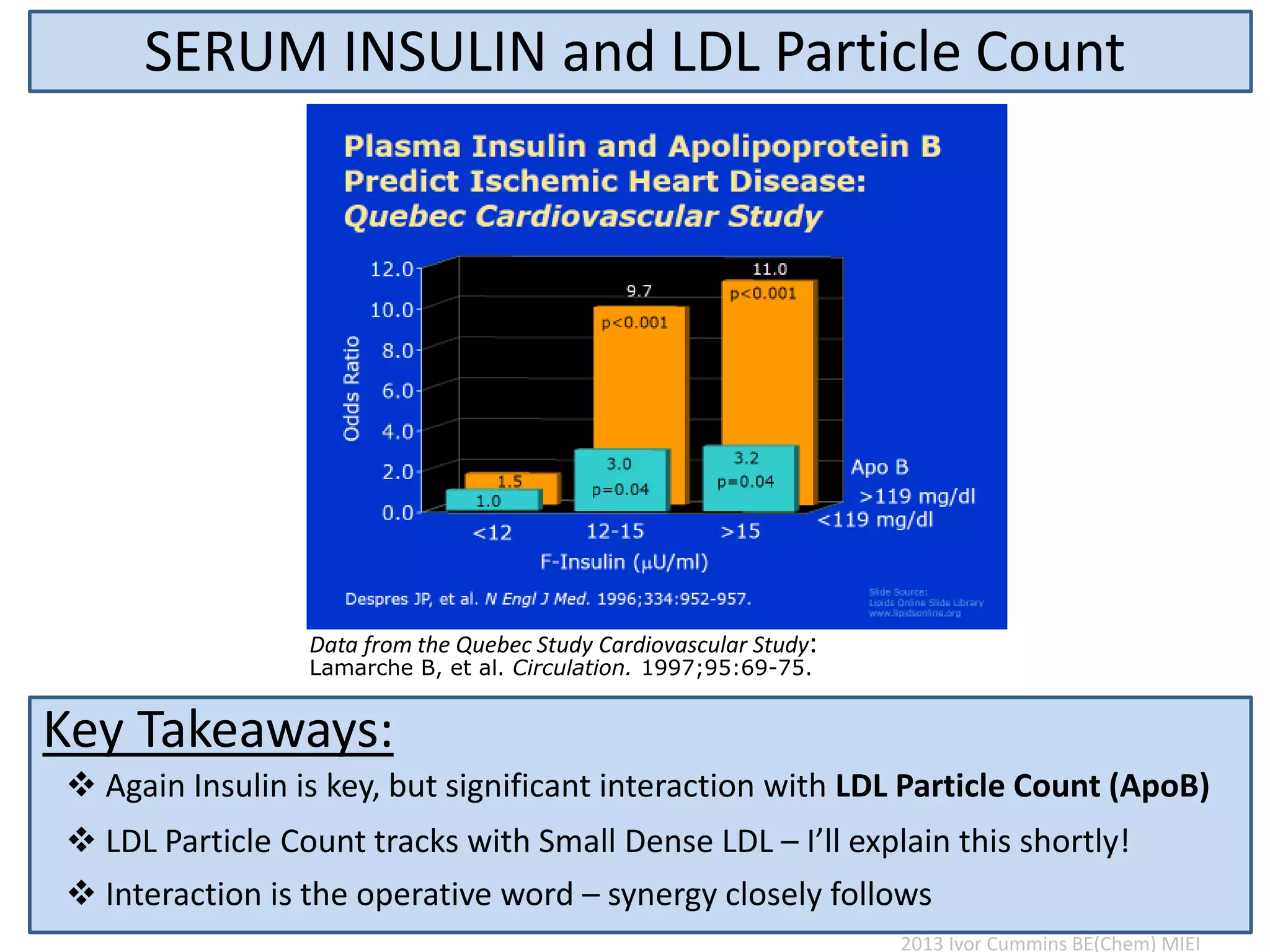
SERUM INSULIN and LDL Particle Count
Data from the Quebec Study Cardiovascular Study:
Assmann G, Schulte H. Am J Cardiol. 1992;70:733–737.
 Again Insulin is key, but significant interaction with LDL Particle Count (ApoB)
 LDL Particle Count tracks with Small Dense LDL – I’ll explain this shortly!
 Interaction is the operative word – synergy closely follows
Key Takeaways:
2013 Ivor Cummins BE(Chem) MIEI
Lamarche B, et al. Circulation. 1997;95:69-75.
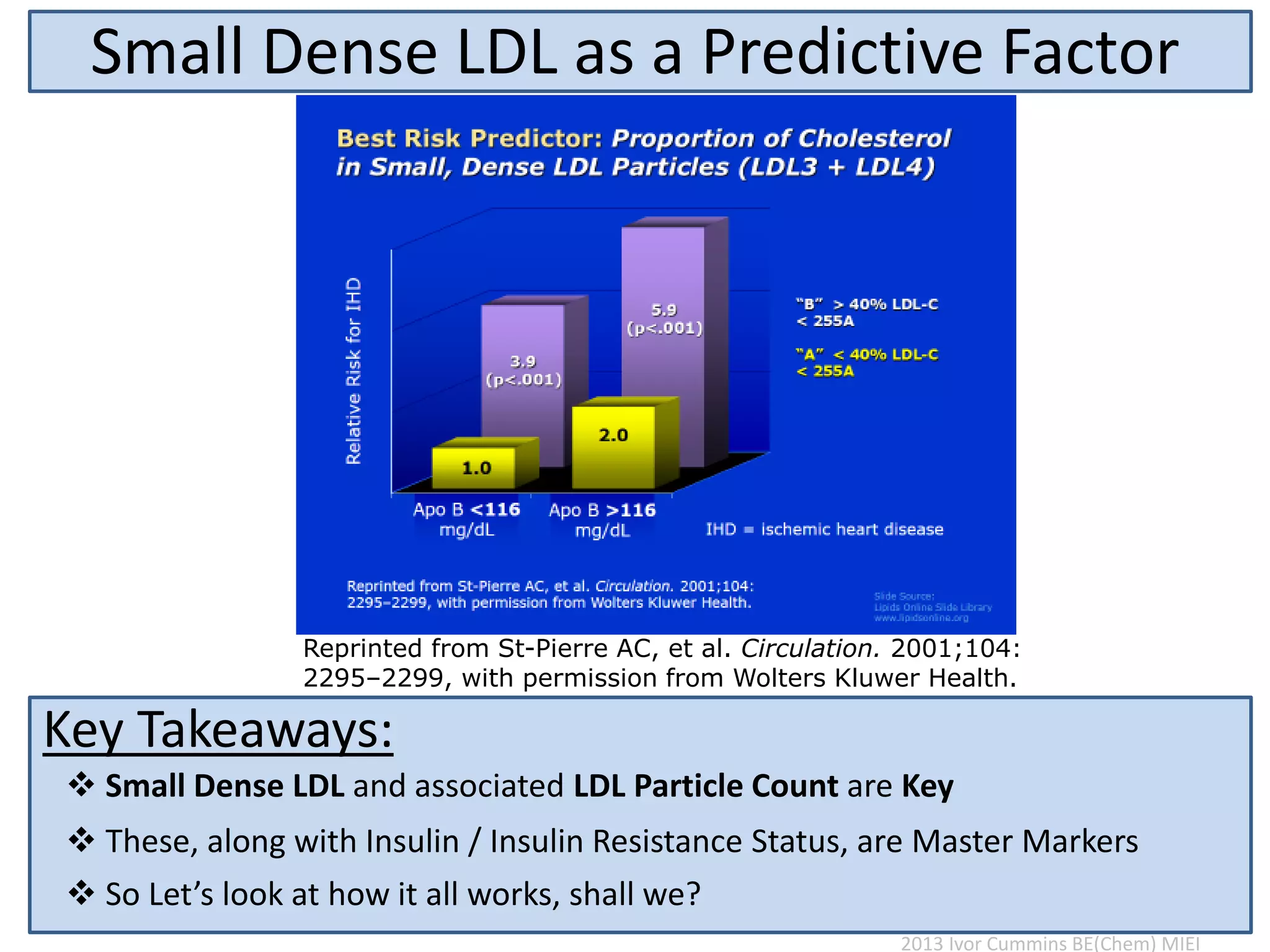
Small Dense LDL as a Predictive Factor
Assmann G, Schulte H. Am J Cardiol. 1992;70:733–737.
 Small Dense LDL and associated LDL Particle Count are Key
 These, along with Insulin / Insulin Resistance Status, are Master Markers
 So Let’s look at how it all works, shall we?
Key Takeaways:
2013 Ivor Cummins BE(Chem) MIEI
Reprinted from St-Pierre AC, et al. Circulation. 2001;104:
2295–2299, with permission from Wolters Kluwer Health.
2013 Ivor Cummins BE(Chem) MIEI
4. How the Cholesterol
Processing System
Works - High Level
(Hope appreciate the artwork here,
it took me a while!)
The Lipoprotein Particles – Boats for Cargo
Trigylceride/
Cholesterol
An Apo-
Lipoprotein
Phospholipids  The LIPOPROTEIN PARTICLES are transport vessels
(“boats”) created in the body to deliver
Triglyceride and Cholesterol (“cargo”), for energy
transfer, critical synthesis, and healing purposes….
 HDL is the so-called “GOOD Cholesterol”
 LDL (from VLDL) is the so-called “BAD Cholesterol”
 The Chylomicron is the big one, created to ferry
dietary fat and cholesterol, for energy and healing
Chylomicron
100 to 1000nm
sdLDL
<25nm
 VLDL is made in the liver to ferry Trigs and Chol…
 Small Dense LDL is the real “BAD Cholesterol”
HDL
5-15nm
LDL
>26nm
VLDL
30 to 80nm
2013 Ivor Cummins BE(Chem) MIEI
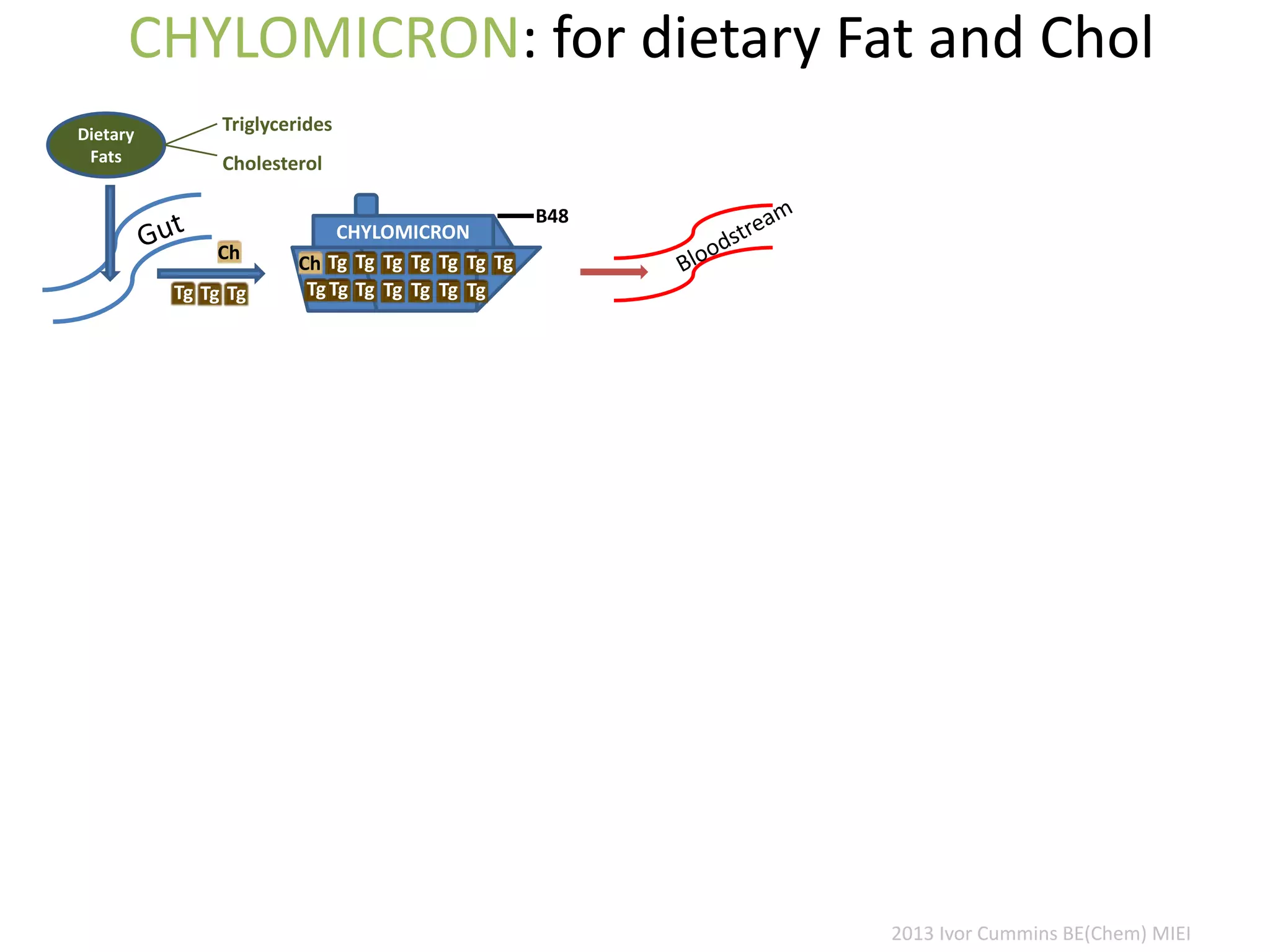
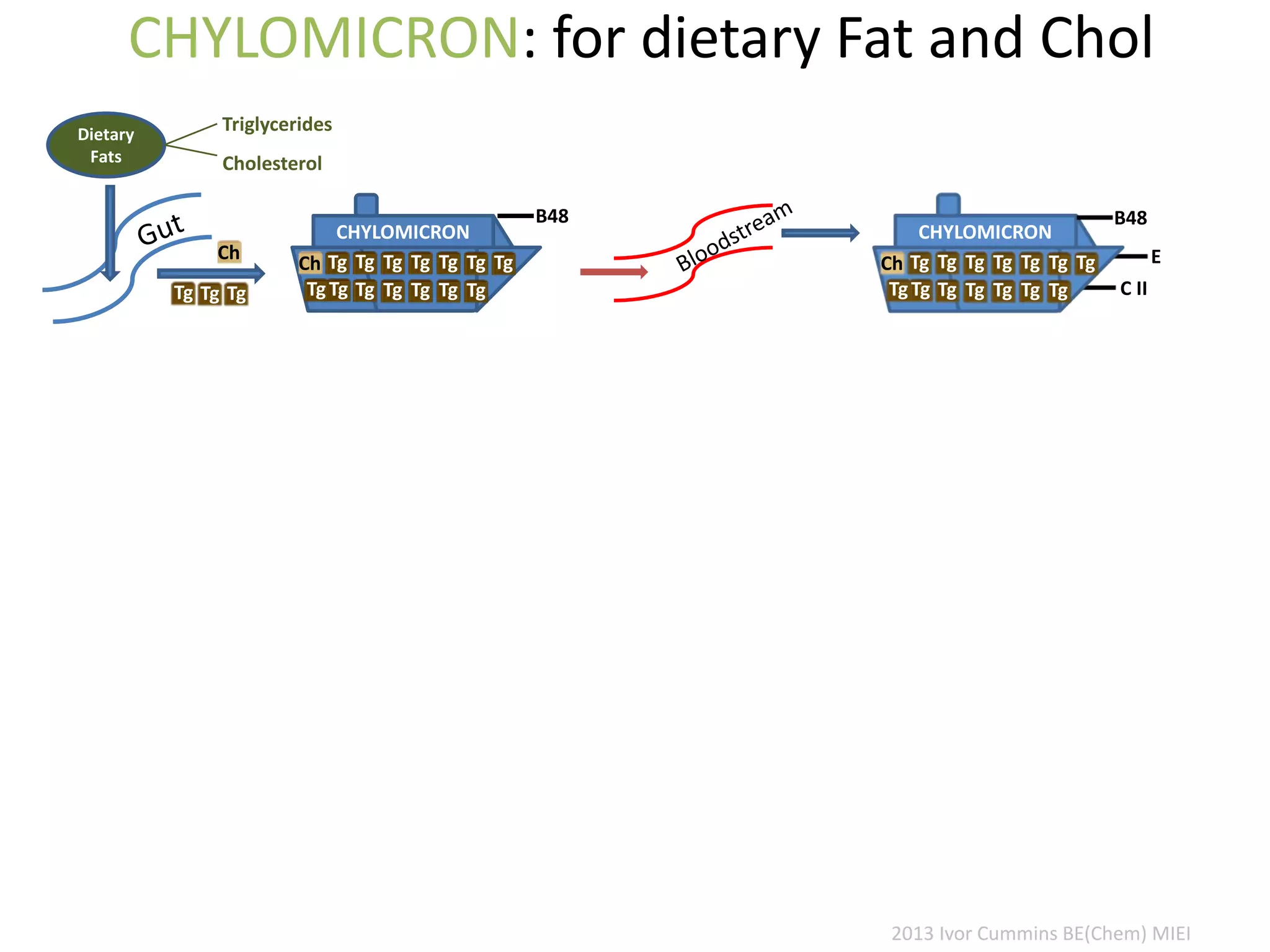
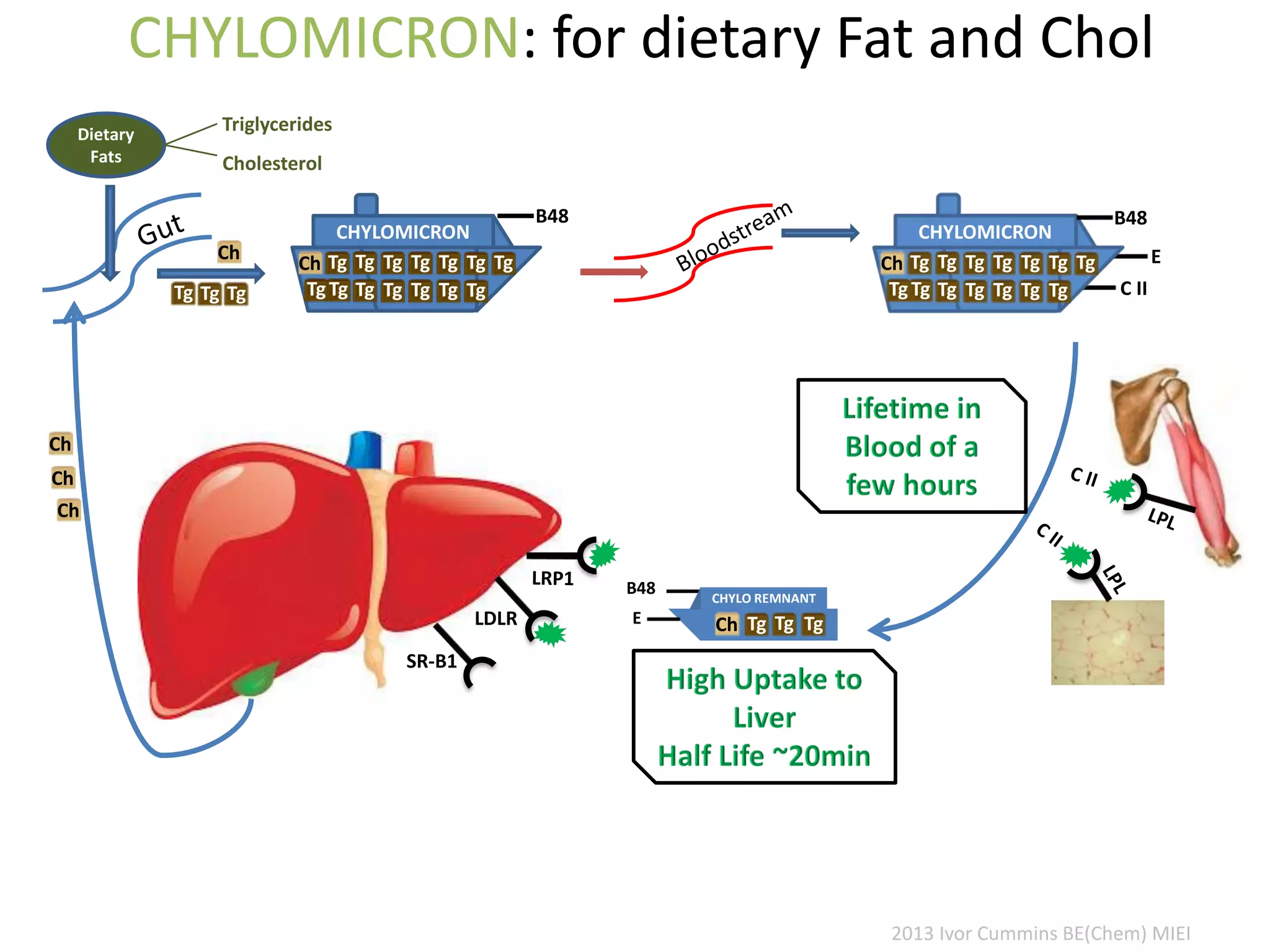
CHYLOMICRON: for dietary Fat and Chol
Dietary
Fats
Triglycerides
Cholesterol
CHYLOMICRON
B48
TgTgCh
TgTgTg
Tg
Tg
Tg
Tg
Tg
Tg
Tg
Tg
TgCh
Tg Tg Tg
2013 Ivor Cummins BE(Chem) MIEI
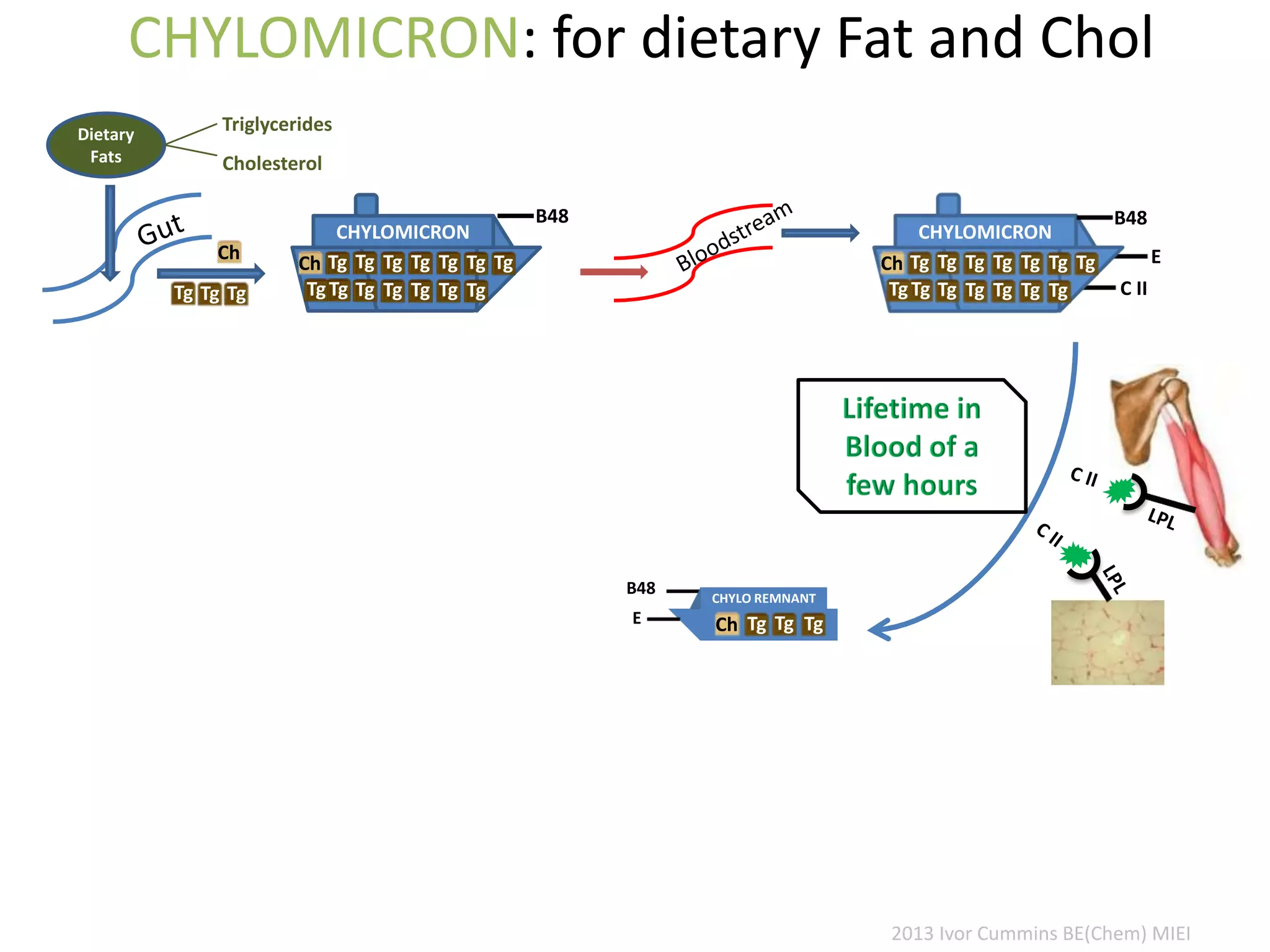
CHYLOMICRON: for dietary Fat and Chol
Dietary
Fats
Triglycerides
Cholesterol
E
C II
CHYLOMICRON
B48
TgTgCh
TgTgTg
Tg
Tg
Tg
Tg
Tg
Tg
Tg
Tg
Tg
CHYLOMICRON
B48
TgTgCh
TgTgTg
Tg
Tg
Tg
Tg
Tg
Tg
Tg
Tg
TgCh
Tg Tg Tg
2013 Ivor Cummins BE(Chem) MIEI
CHYLOMICRON: for dietary Fat and Chol
Dietary
Fats
Triglycerides
Cholesterol
E
C II
CHYLOMICRON
B48
TgTgCh
TgTgTg
Tg
Tg
Tg
Tg
Tg
Tg
Tg
Tg
Tg
CHYLOMICRON
B48
TgTgCh
TgTgTg
Tg
Tg
Tg
Tg
Tg
Tg
Tg
Tg
TgCh
Tg Tg Tg
2013 Ivor Cummins BE(Chem) MIEI
CHYLOMICRON: for dietary Fat and Chol
Dietary
Fats
Triglycerides
Cholesterol
E
C II
CHYLOMICRON
B48
TgTgCh
TgTgTg
Tg
Tg
Tg
Tg
Tg
Tg
Tg
Tg
Tg
CHYLOMICRON
B48
TgTgCh
TgTgTg
Tg
Tg
Tg
Tg
Tg
Tg
Tg
Tg
Tg
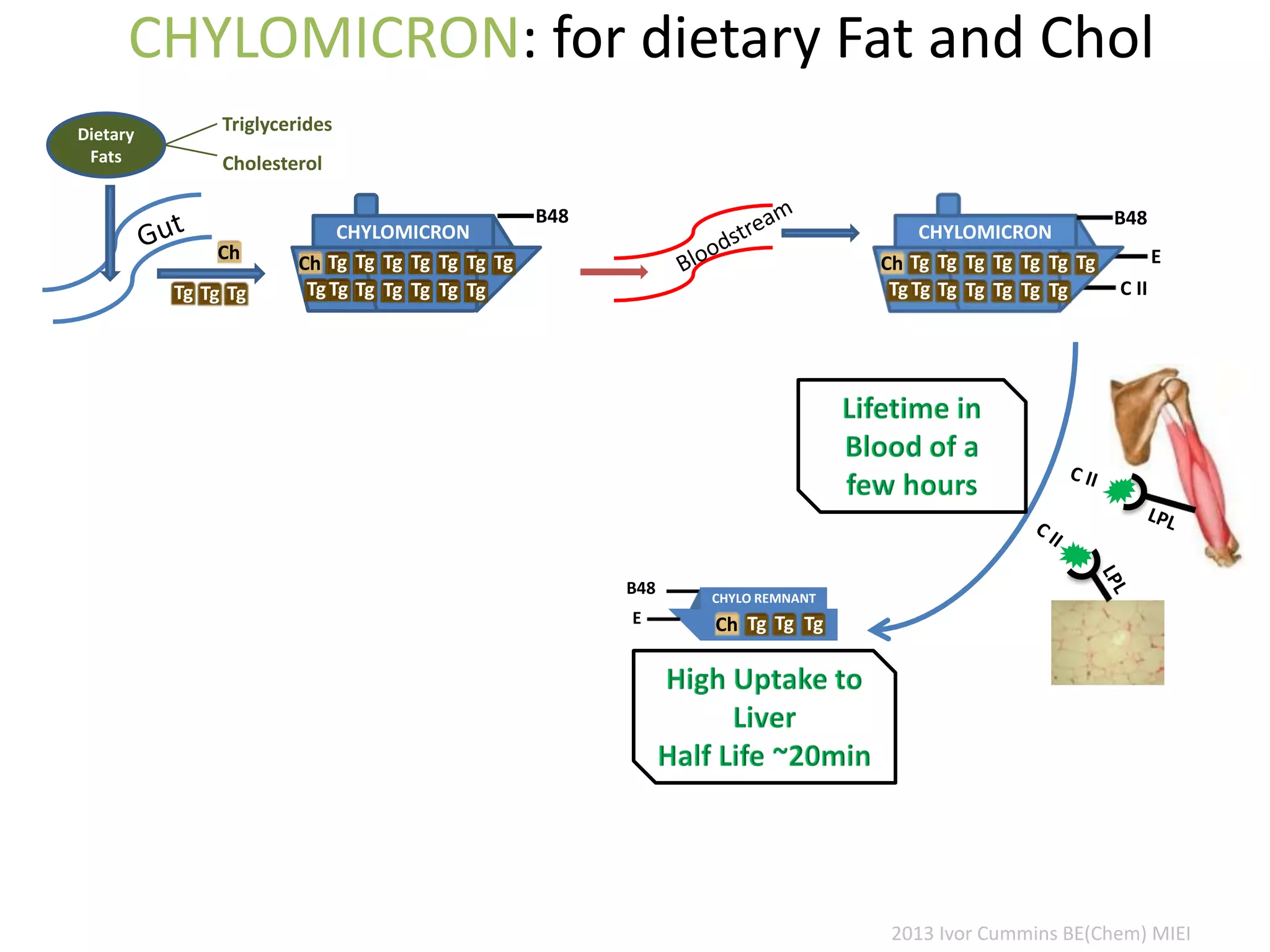
B48 CHYLO REMNANT
Ch TgTg TgE
Ch
Tg Tg Tg
2013 Ivor Cummins BE(Chem) MIEI
CHYLOMICRON: for dietary Fat and Chol
Dietary
Fats
Triglycerides
Cholesterol
E
C II
CHYLOMICRON
B48
TgTgCh
TgTgTg
Tg
Tg
Tg
Tg
Tg
Tg
Tg
Tg
Tg
CHYLOMICRON
B48
TgTgCh
TgTgTg
Tg
Tg
Tg
Tg
Tg
Tg
Tg
Tg
Tg
B48 CHYLO REMNANT
Ch TgTg TgE
Ch
Tg Tg Tg
2013 Ivor Cummins BE(Chem) MIEI
CHYLOMICRON: for dietary Fat and Chol
Dietary
Fats
Triglycerides
Cholesterol
E
C II
CHYLOMICRON
B48
TgTgCh
TgTgTg
Tg
Tg
Tg
Tg
Tg
Tg
Tg
Tg
Tg
CHYLOMICRON
B48
TgTgCh
TgTgTg
Tg
Tg
Tg
Tg
Tg
Tg
Tg
Tg
Tg
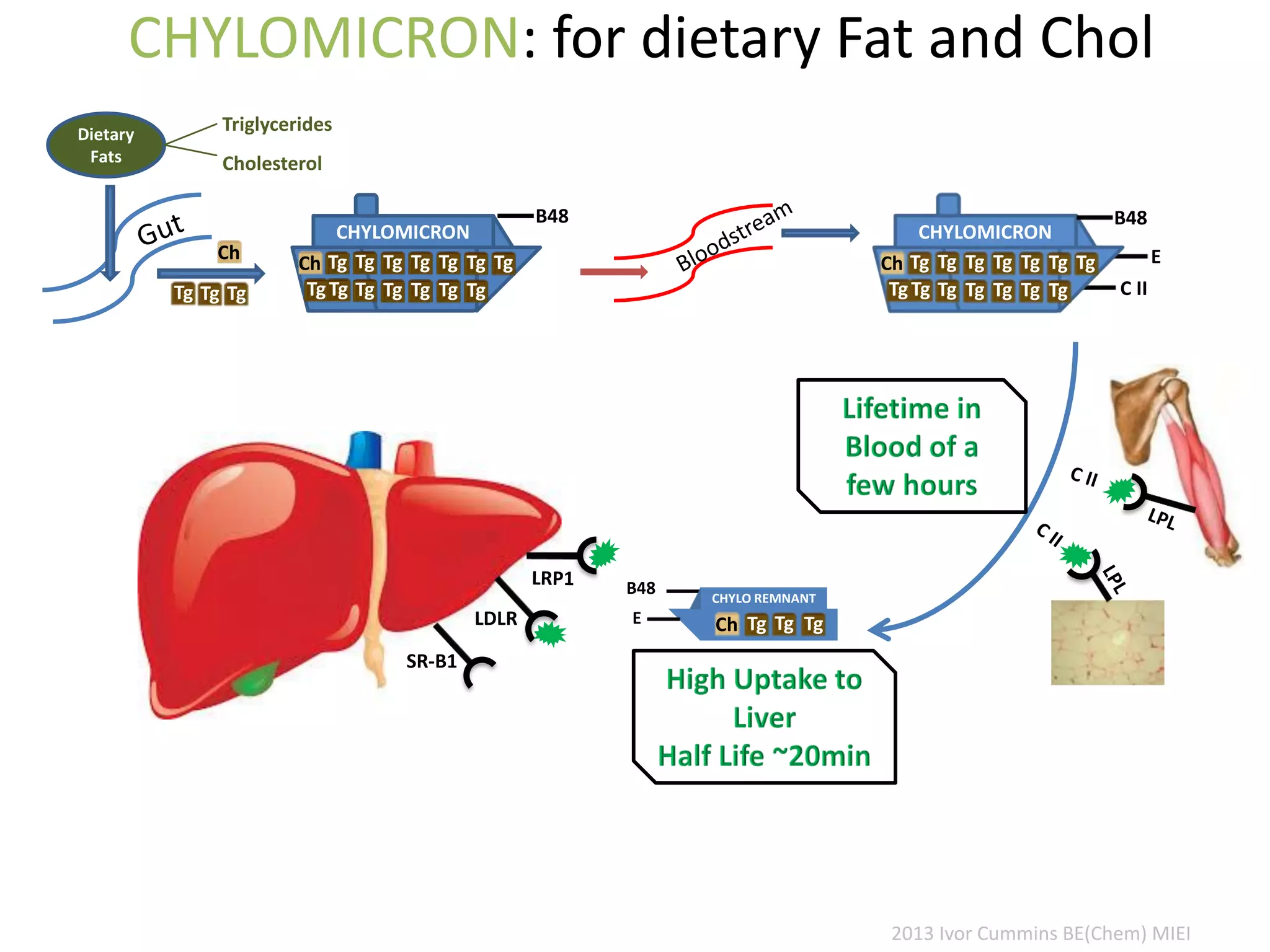
B48 CHYLO REMNANT
Ch TgTg TgELDLR
SR-B1
Ch
Tg Tg Tg
2013 Ivor Cummins BE(Chem) MIEI
CHYLOMICRON: for dietary Fat and Chol
Dietary
Fats
Triglycerides
Cholesterol
E
C II
CHYLOMICRON
B48
TgTgCh
TgTgTg
Tg
Tg
Tg
Tg
Tg
Tg
Tg
Tg
Tg
CHYLOMICRON
B48
TgTgCh
TgTgTg
Tg
Tg
Tg
Tg
Tg
Tg
Tg
Tg
Tg
B48 CHYLO REMNANT
Ch TgTg TgE
Ch
Ch
Ch
LDLR
SR-B1
Ch
Tg Tg Tg
2013 Ivor Cummins BE(Chem) MIEI
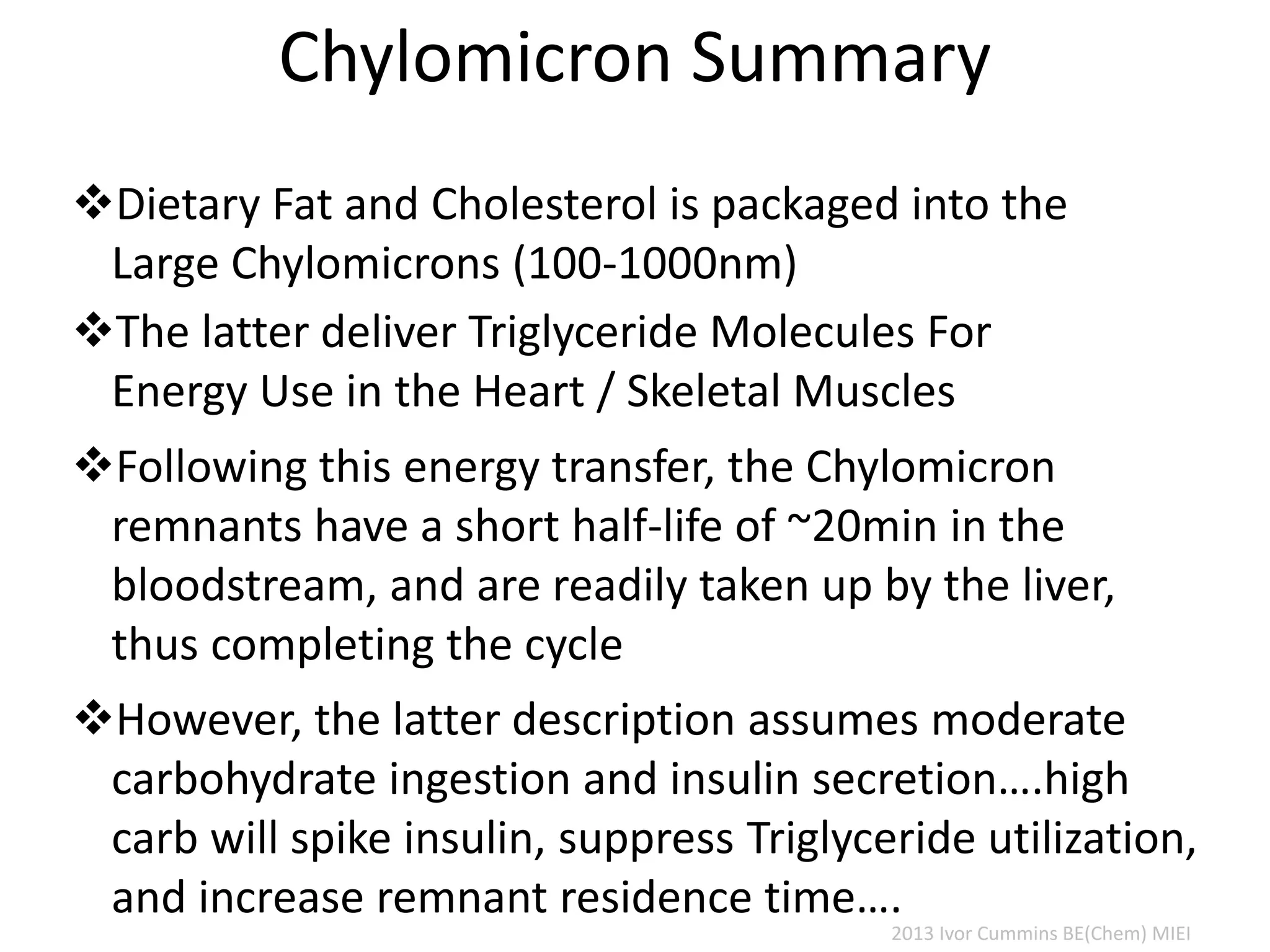
Chylomicron Summary
Dietary Fat and Cholesterol is packaged into the
Large Chylomicrons (100-1000nm)
The latter deliver Triglyceride Molecules For
Energy Use in the Heart / Skeletal Muscles
Following this energy transfer, the Chylomicron
remnants have a short half-life of ~20min in the
bloodstream, and are readily taken up by the liver,
thus completing the cycle
However, the latter description assumes moderate
carbohydrate ingestion and insulin secretion….high
carb will spike insulin, suppress Triglyceride utilization,
and increase remnant residence time….
2013 Ivor Cummins BE(Chem) MIEI
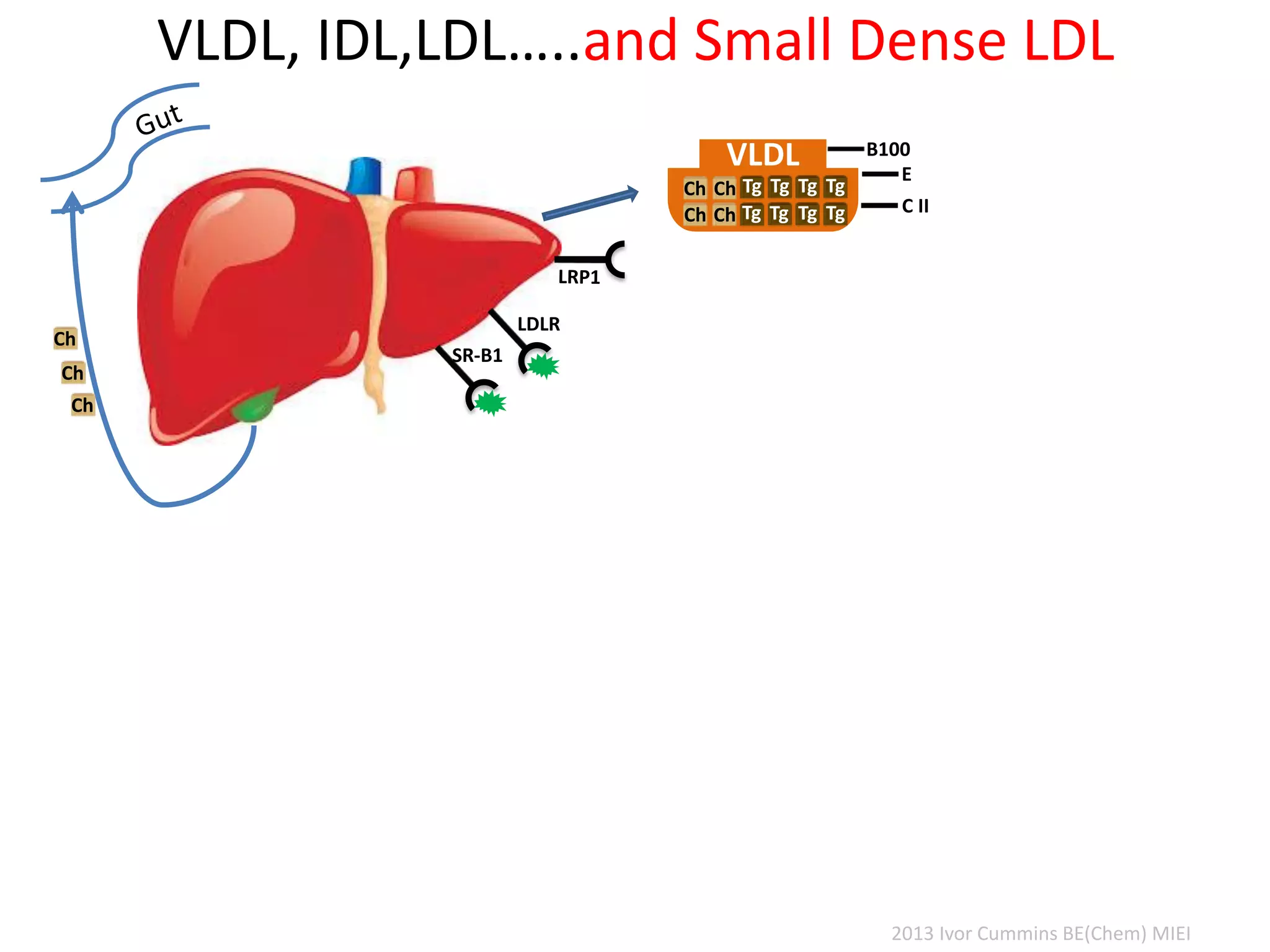
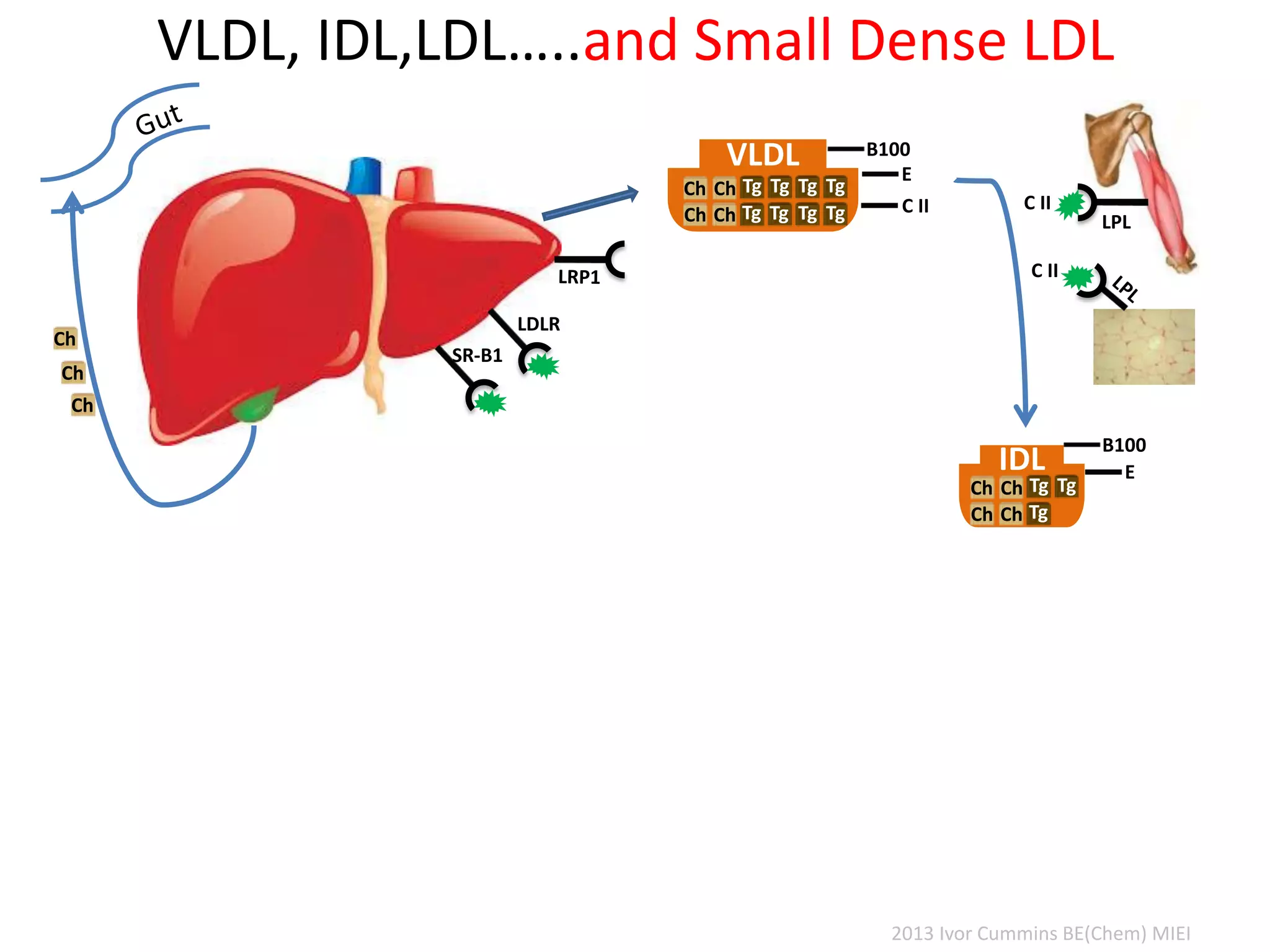
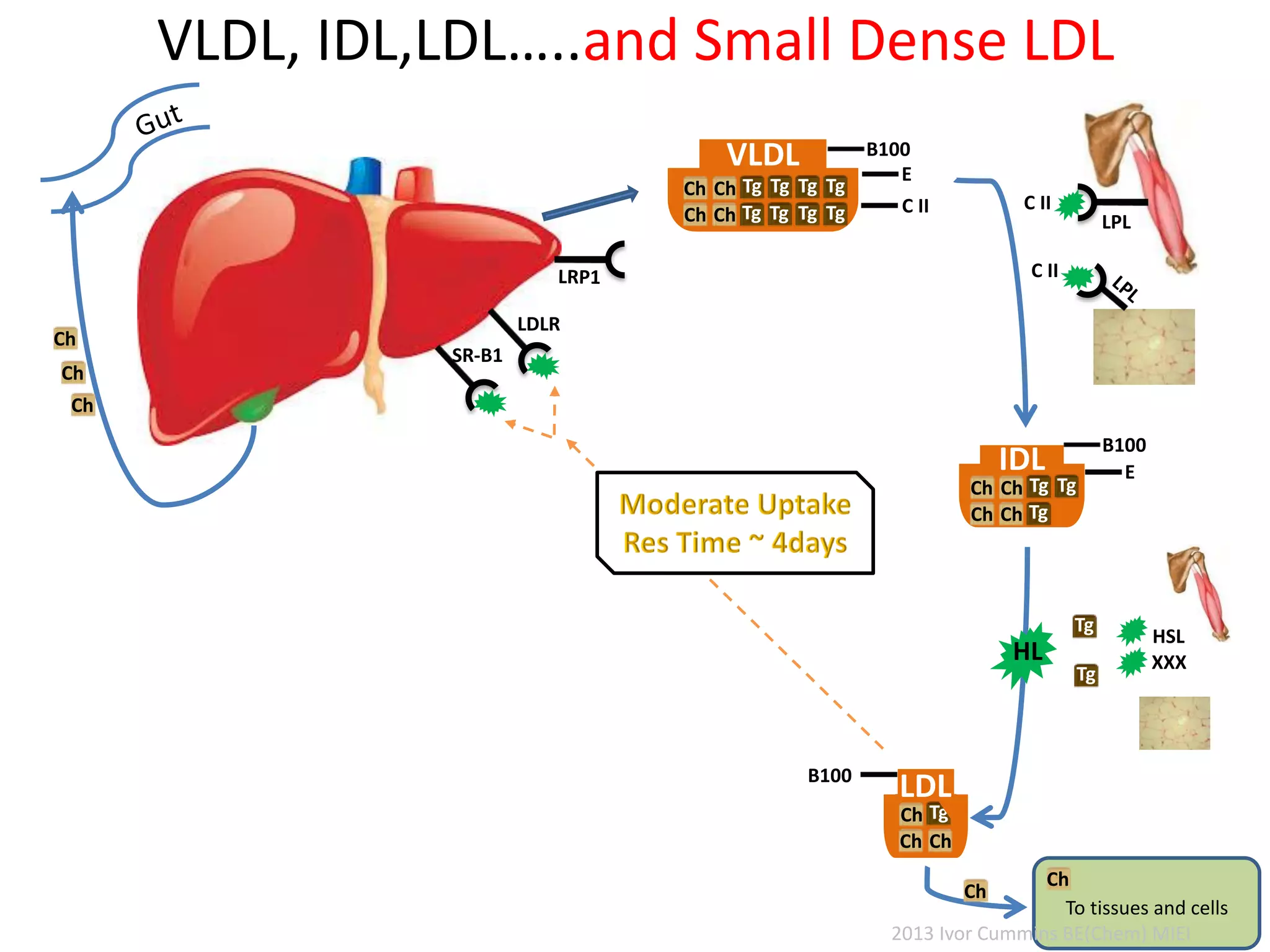
VLDL, IDL,LDL…..and Small Dense LDL
LDLR
VLDL
Tg
Tg
Tg
Tg
Tg
Tg
Tg
Tg
Ch
Ch
Ch
Ch
E
C II
B100
SR-B1
Ch
Ch
Ch
2013 Ivor Cummins BE(Chem) MIEI
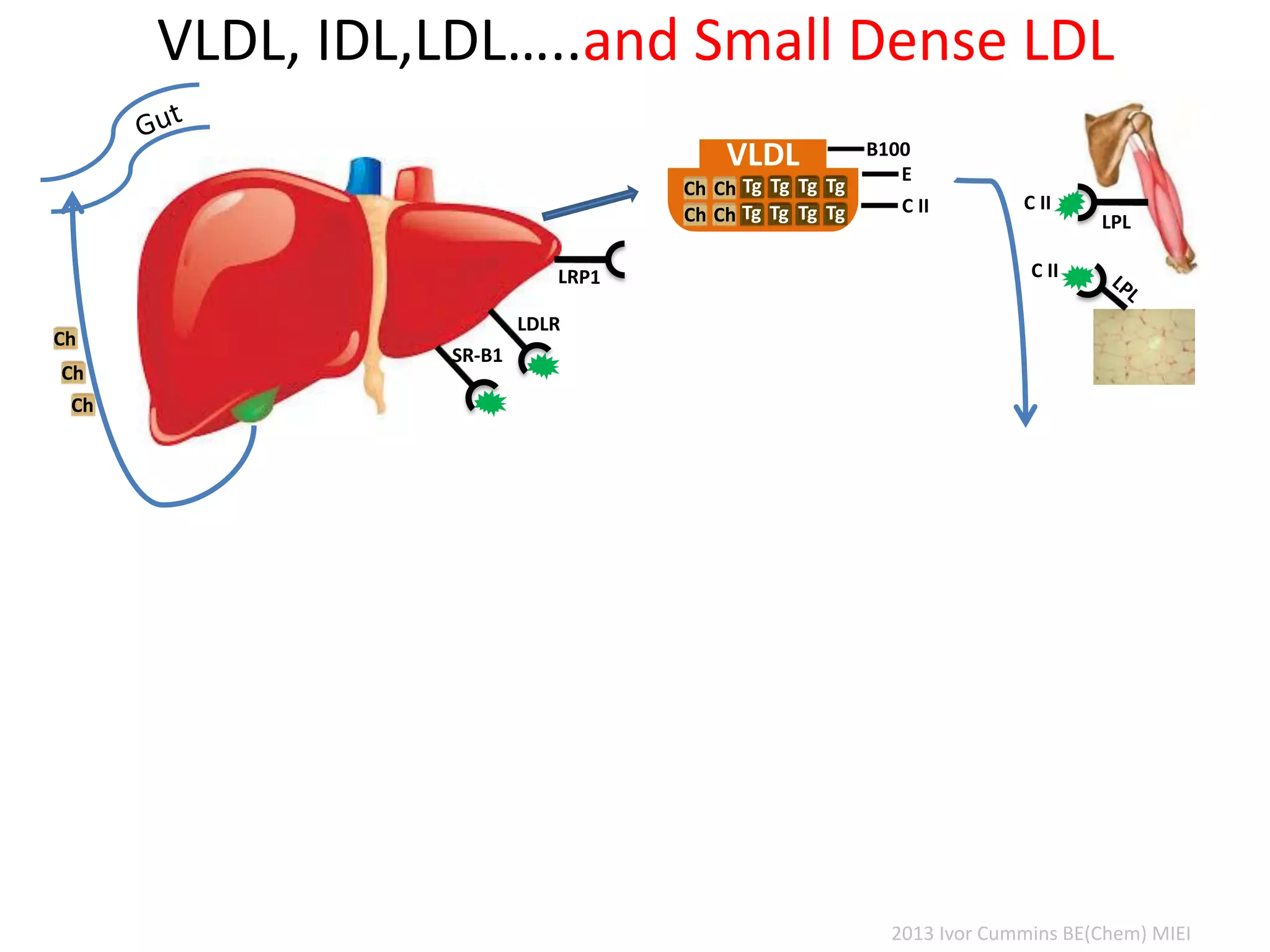
VLDL, IDL,LDL…..and Small Dense LDL
C II
LDLR
C II
LPL
VLDL
Tg
Tg
Tg
Tg
Tg
Tg
Tg
Tg
Ch
Ch
Ch
Ch
E
C II
B100
SR-B1
Ch
Ch
Ch
2013 Ivor Cummins BE(Chem) MIEI
VLDL, IDL,LDL…..and Small Dense LDL
C II
LDLR
C II
LPL
VLDL
Tg
Tg
Tg
Tg
Tg
Tg
Tg
Tg
Ch
Ch
Ch
Ch
E
C II
B100
IDL
TgTg
Tg
Ch
Ch
Ch
Ch
E
B100
SR-B1
Ch
Ch
Ch
2013 Ivor Cummins BE(Chem) MIEI
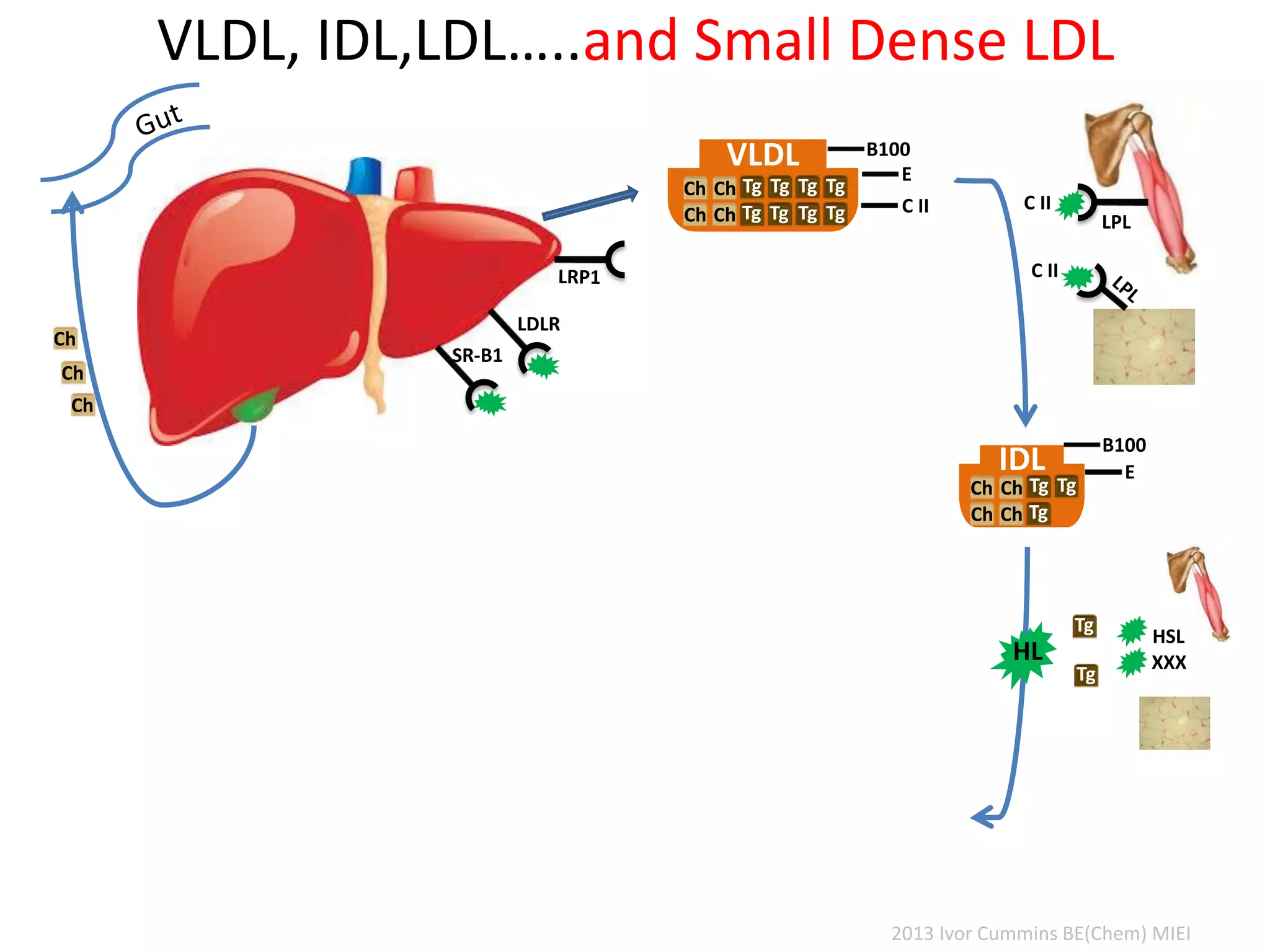
VLDL, IDL,LDL…..and Small Dense LDL
C II
LDLR
C II
LPL
VLDL
Tg
Tg
Tg
Tg
Tg
Tg
Tg
Tg
Ch
Ch
Ch
Ch
E
C II
B100
IDL
TgTg
Tg
Ch
Ch
Ch
Ch
E
B100
SR-B1
HL
Ch
Ch
Ch
HSL
XXX
Tg
Tg
2013 Ivor Cummins BE(Chem) MIEI
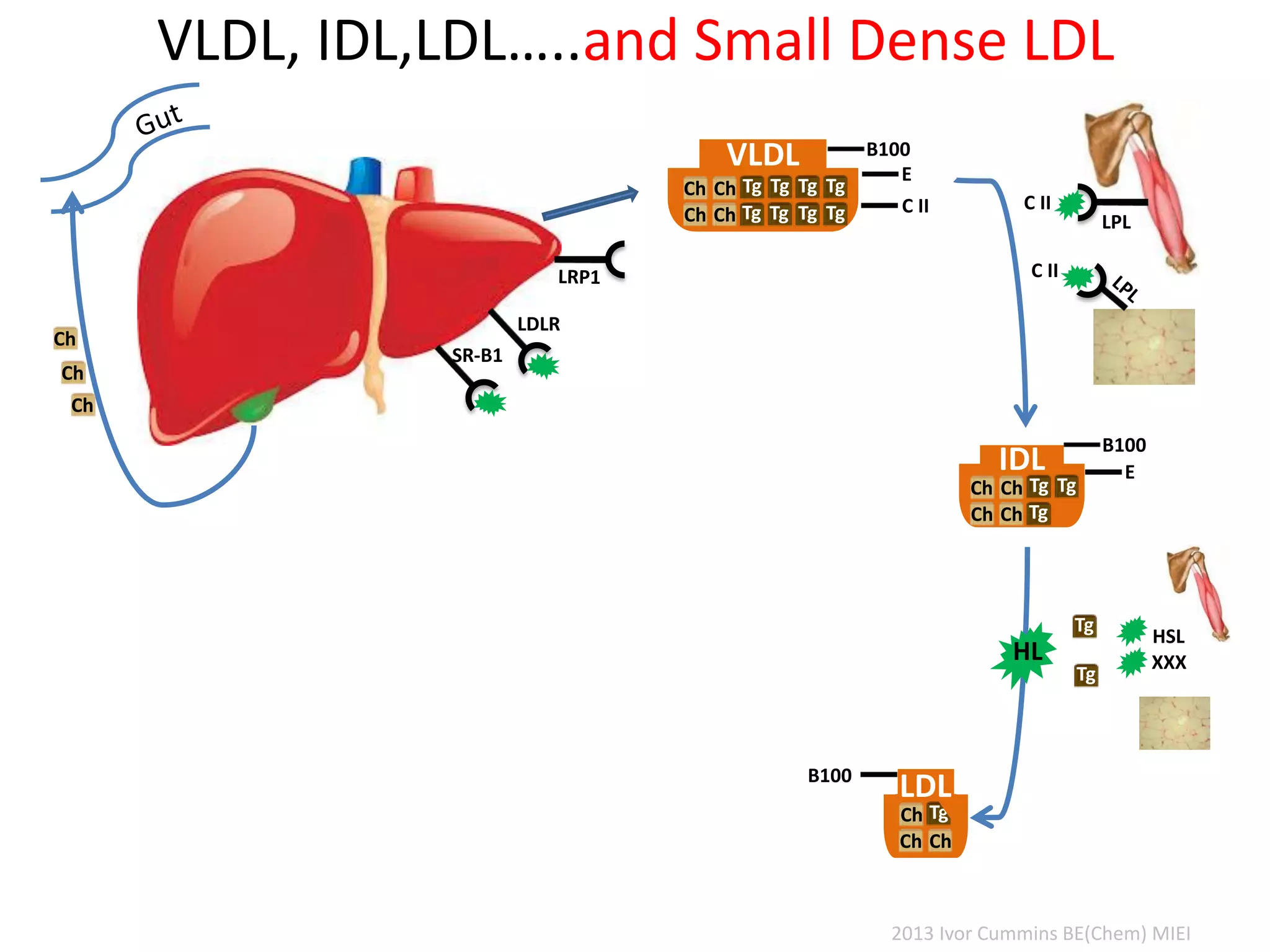
VLDL, IDL,LDL…..and Small Dense LDL
C II
LDLR
C II
LPL
VLDL
Tg
Tg
Tg
Tg
Tg
Tg
Tg
Tg
Ch
Ch
Ch
Ch
E
C II
B100
IDL
TgTg
Tg
Ch
Ch
Ch
Ch
E
B100
TgCh
ChCh
B100
LDL
SR-B1
HL
Ch
Ch
Ch
HSL
XXX
Tg
Tg
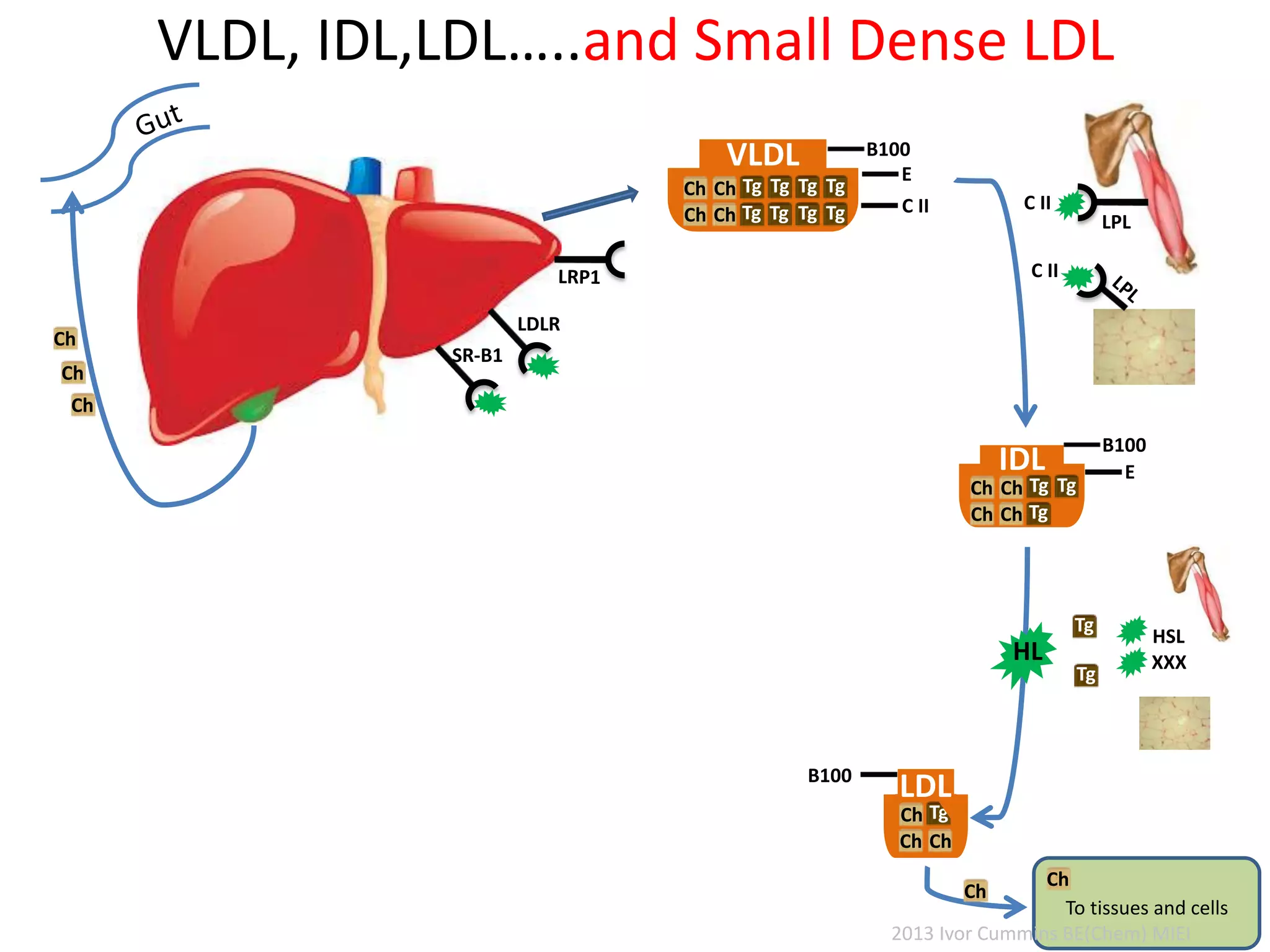
2013 Ivor Cummins BE(Chem) MIEI
VLDL, IDL,LDL…..and Small Dense LDL
C II
LDLR
C II
LPL
VLDL
Tg
Tg
Tg
Tg
Tg
Tg
Tg
Tg
Ch
Ch
Ch
Ch
E
C II
B100
IDL
TgTg
Tg
Ch
Ch
Ch
Ch
E
B100
TgCh
ChCh
B100
LDL
SR-B1
HL
Ch
Ch
Ch
HSL
XXX
Ch
Tg
Tg
Ch
To tissues and cells
2013 Ivor Cummins BE(Chem) MIEI
VLDL, IDL,LDL…..and Small Dense LDL
C II
LDLR
C II
LPL
VLDL
Tg
Tg
Tg
Tg
Tg
Tg
Tg
Tg
Ch
Ch
Ch
Ch
E
C II
B100
IDL
TgTg
Tg
Ch
Ch
Ch
Ch
E
B100
TgCh
ChCh
B100
LDL
SR-B1
HL
Ch
Ch
Ch
HSL
XXX
Ch
To tissues and cells
Tg
Tg
Ch
2013 Ivor Cummins BE(Chem) MIEI
VLDL, IDL,LDL…..and Small Dense LDL
C II
LDLR
C II
LPL
VLDL
Tg
Tg
Tg
Tg
Tg
Tg
Tg
Tg
Ch
Ch
Ch
Ch
E
C II
B100
IDL
TgTg
Tg
Ch
Ch
Ch
Ch
E
B100
TgCh
ChCh
B100
LDL
SR-B1
TgCh
ChCh
B100
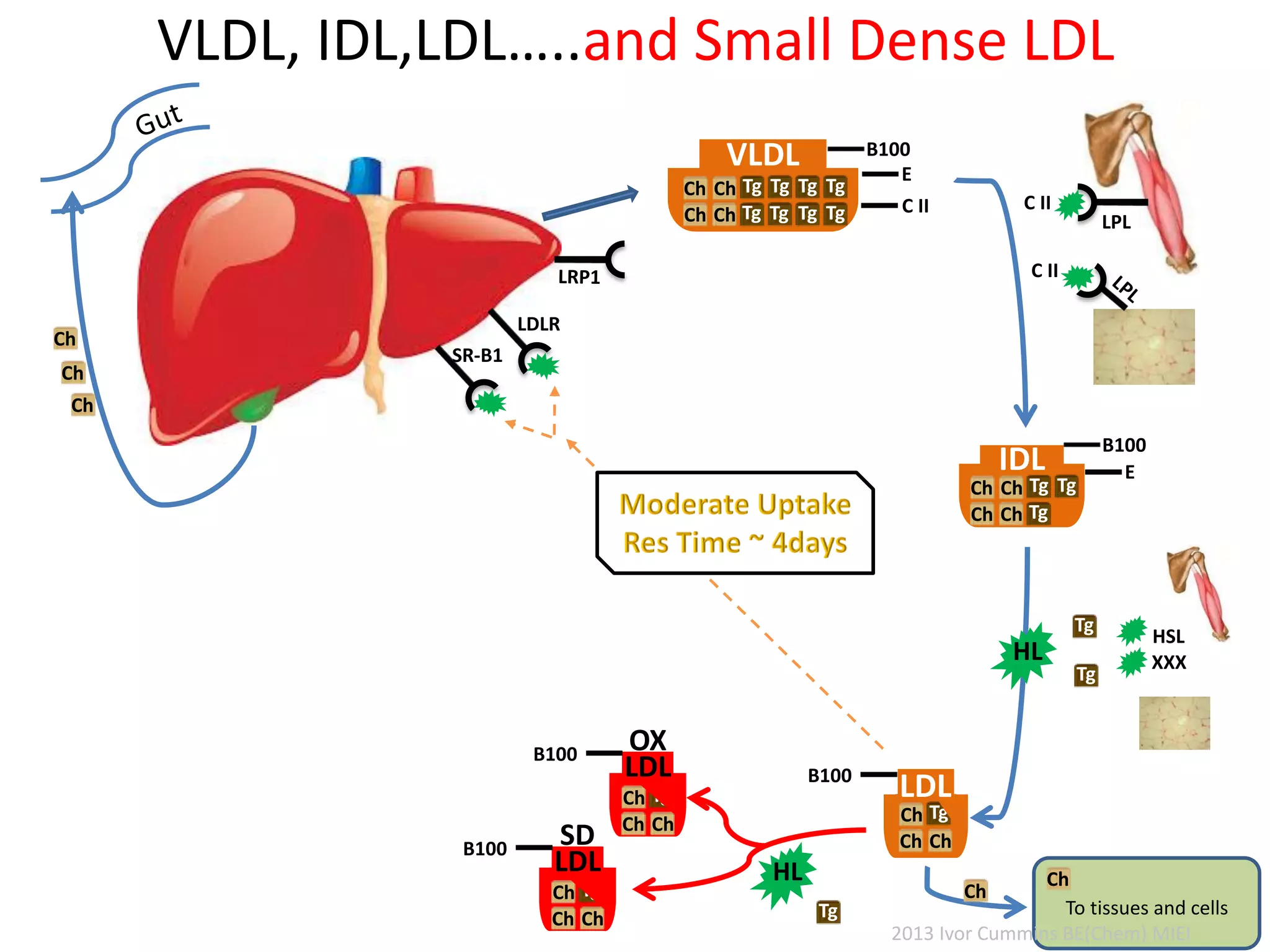
LDL
SD
HL
HL
Ch
Ch
Ch
HSL
XXX
Ch
Tg
Tg
Tg
Ch
TgCh
ChCh
B100
LDL
OX
To tissues and cells
2013 Ivor Cummins BE(Chem) MIEI
VLDL, IDL,LDL…..and Small Dense LDL
C II
LDLR
C II
LPL
VLDL
Tg
Tg
Tg
Tg
Tg
Tg
Tg
Tg
Ch
Ch
Ch
Ch
E
C II
B100
IDL
TgTg
Tg
Ch
Ch
Ch
Ch
E
B100
TgCh
ChCh
B100
LDL
SR-B1
TgCh
ChCh
B100
LDL
SD
HL
HL
Ch
Ch
Ch
HSL
XXX
Ch
Tg
Tg
Tg
Ch
TgCh
ChCh
B100
LDL
OX
To tissues and cells
2013 Ivor Cummins BE(Chem) MIEI
VLDL, IDL,LDL…..and Small Dense LDL
C II
LDLR
C II
LPL
VLDL
Tg
Tg
Tg
Tg
Tg
Tg
Tg
Tg
Ch
Ch
Ch
Ch
E
C II
B100
IDL
TgTg
Tg
Ch
Ch
Ch
Ch
E
B100
TgCh
ChCh
B100
LDL
SR-B1
TgCh
ChCh
B100
LDL
SD
HL
HL
Ch
Ch
Ch
Ch
Ch Ch
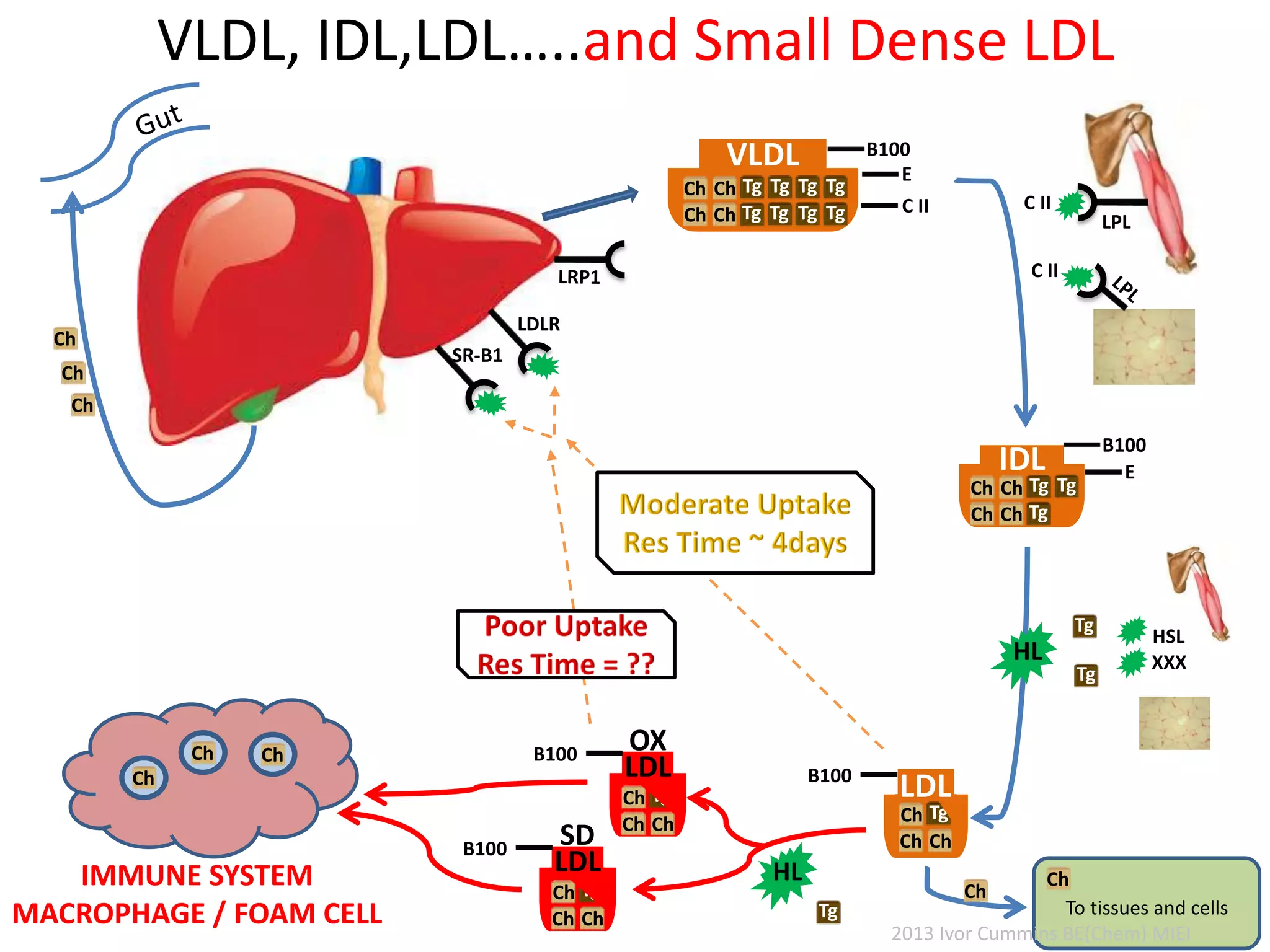
IMMUNE SYSTEM
MACROPHAGE / FOAM CELL
HSL
XXX
Ch
Tg
Tg
Tg
Ch
TgCh
ChCh
B100
LDL
OX
To tissues and cells
2013 Ivor Cummins BE(Chem) MIEI
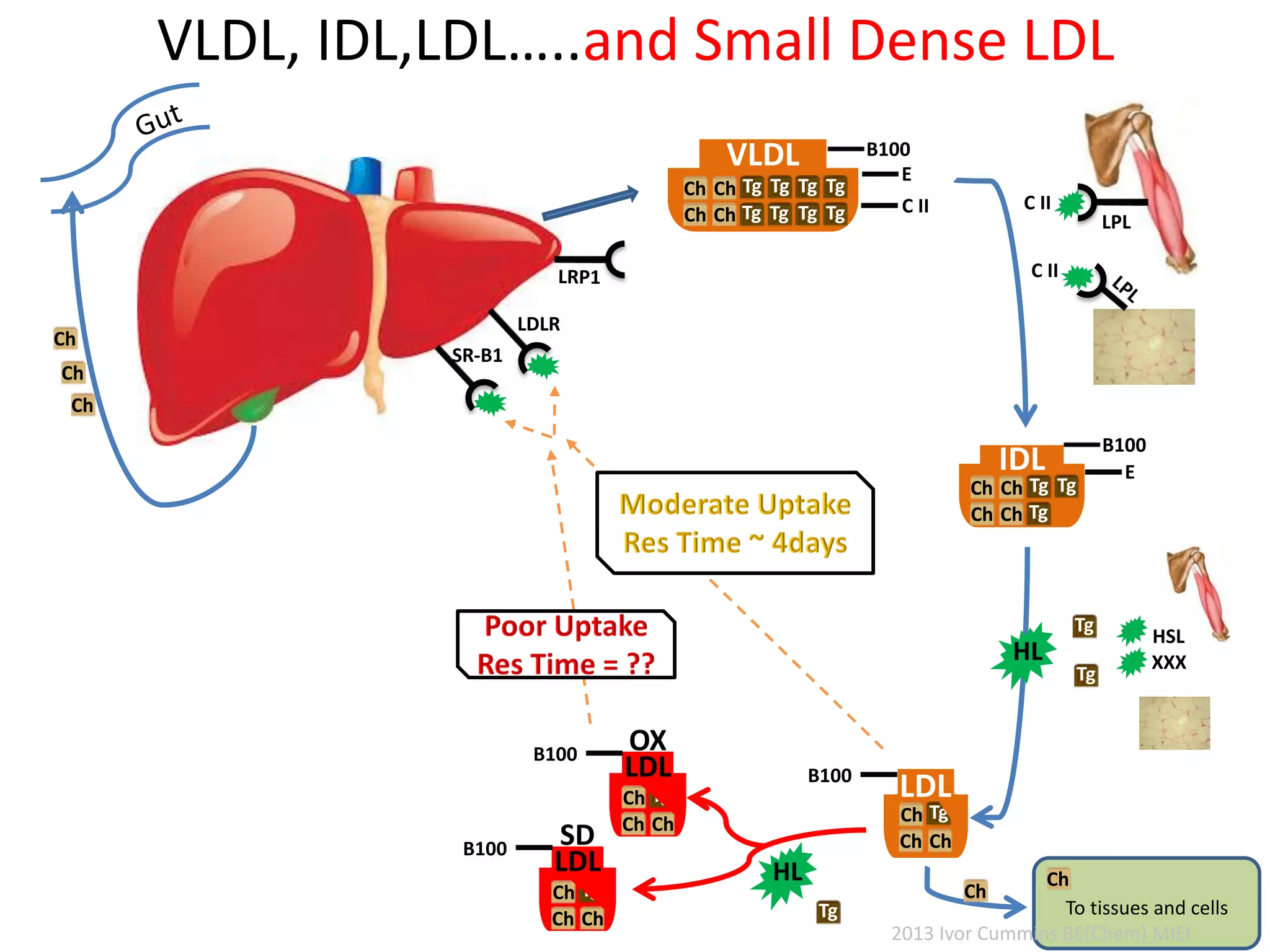
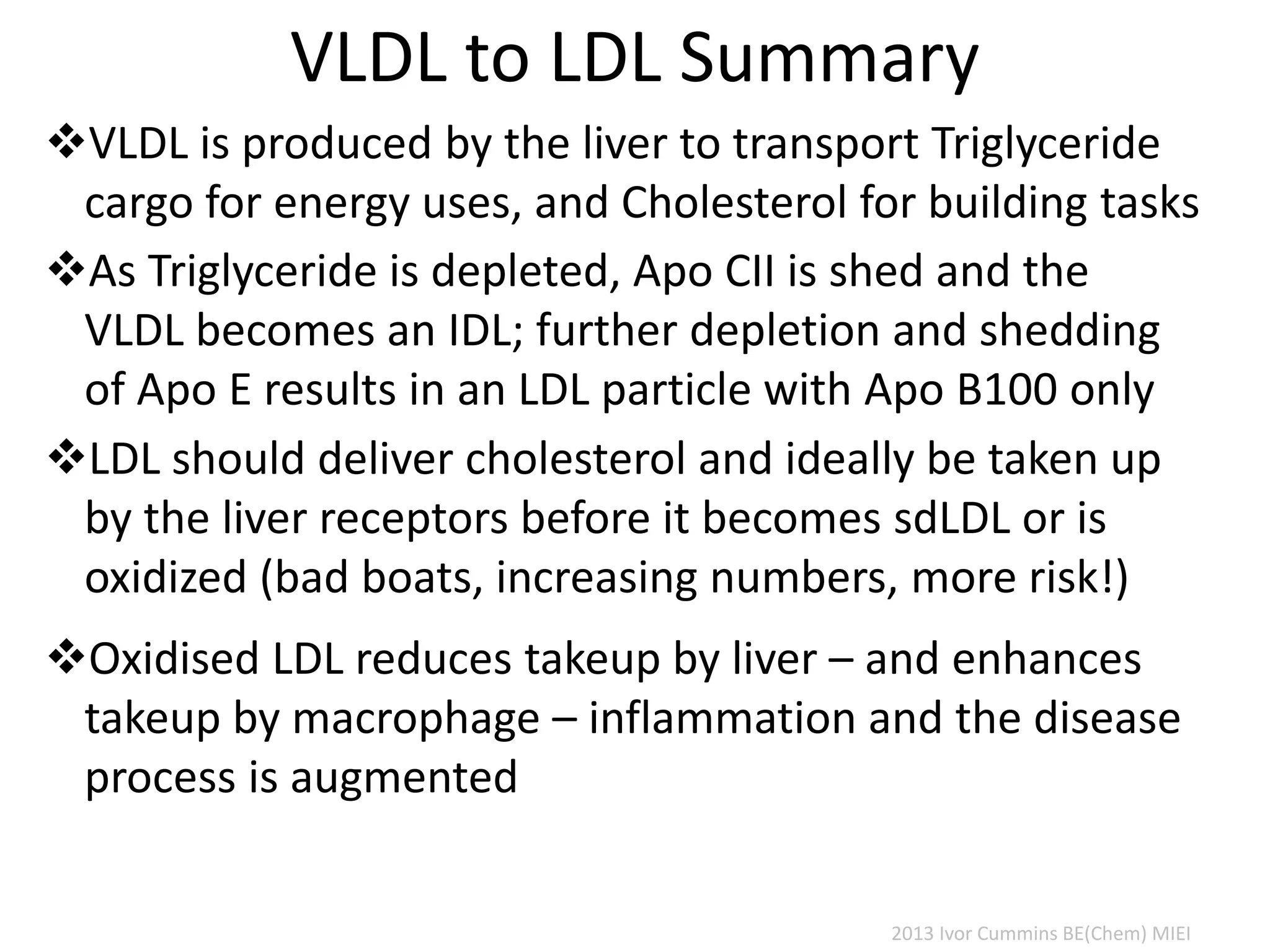
VLDL to LDL Summary
VLDL is produced by the liver to transport Triglyceride
cargo for energy uses, and Cholesterol for building tasks
As Triglyceride is depleted, Apo CII is shed and the
VLDL becomes an IDL; further depletion and shedding
of Apo E results in an LDL particle with Apo B100 only
LDL should deliver cholesterol and ideally be taken up
by the liver receptors before it becomes sdLDL or is
oxidized (bad boats, increasing numbers, more risk!)
Oxidised LDL reduces takeup by liver – and enhances
takeup by macrophage – inflammation and the disease
process is augmented
2013 Ivor Cummins BE(Chem) MIEI
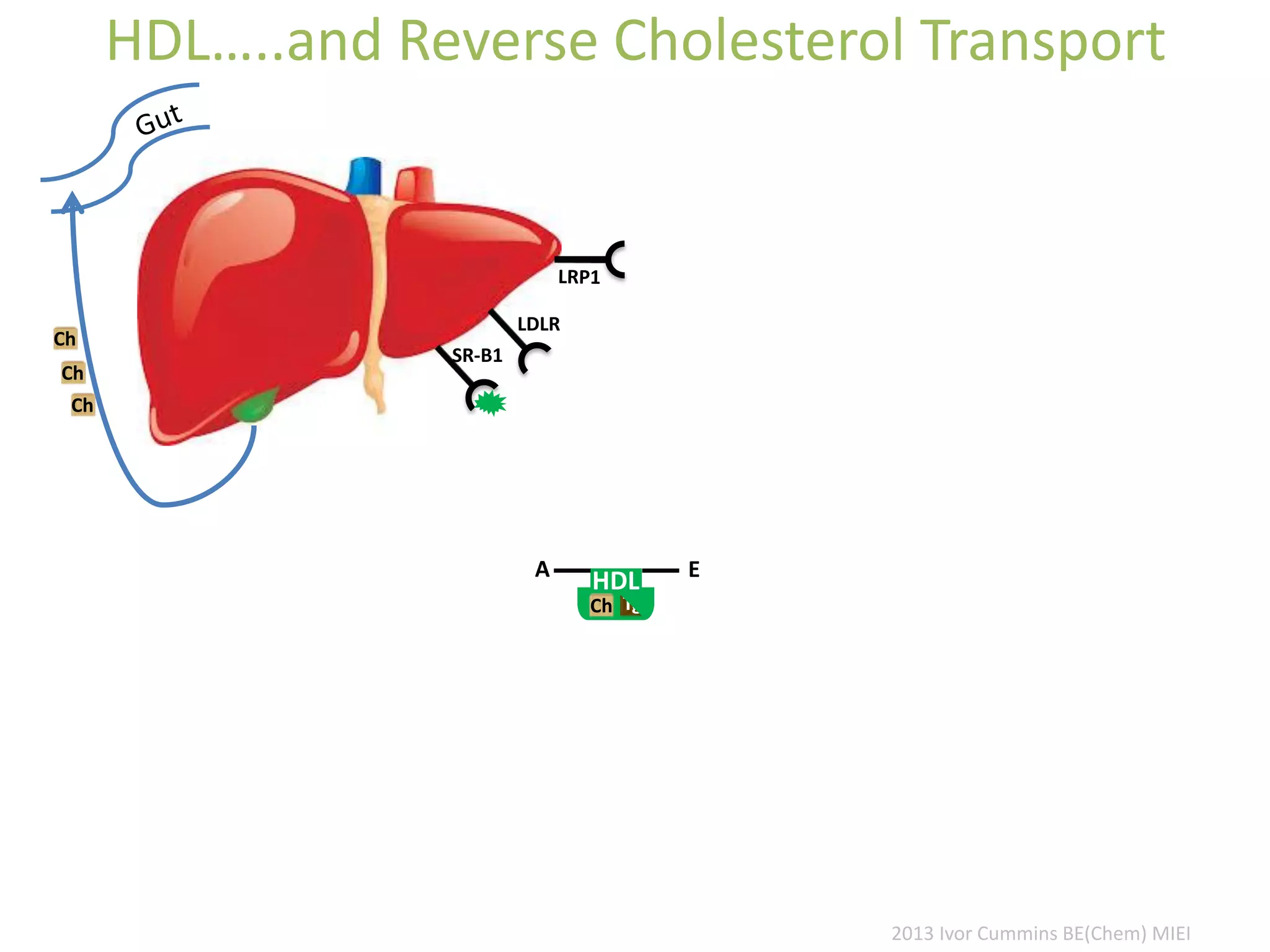
HDL…..and Reverse Cholesterol Transport
LDLR
SR-B1
Ch
Ch
Ch
Ch
A
HDL
Tg
E
2013 Ivor Cummins BE(Chem) MIEI
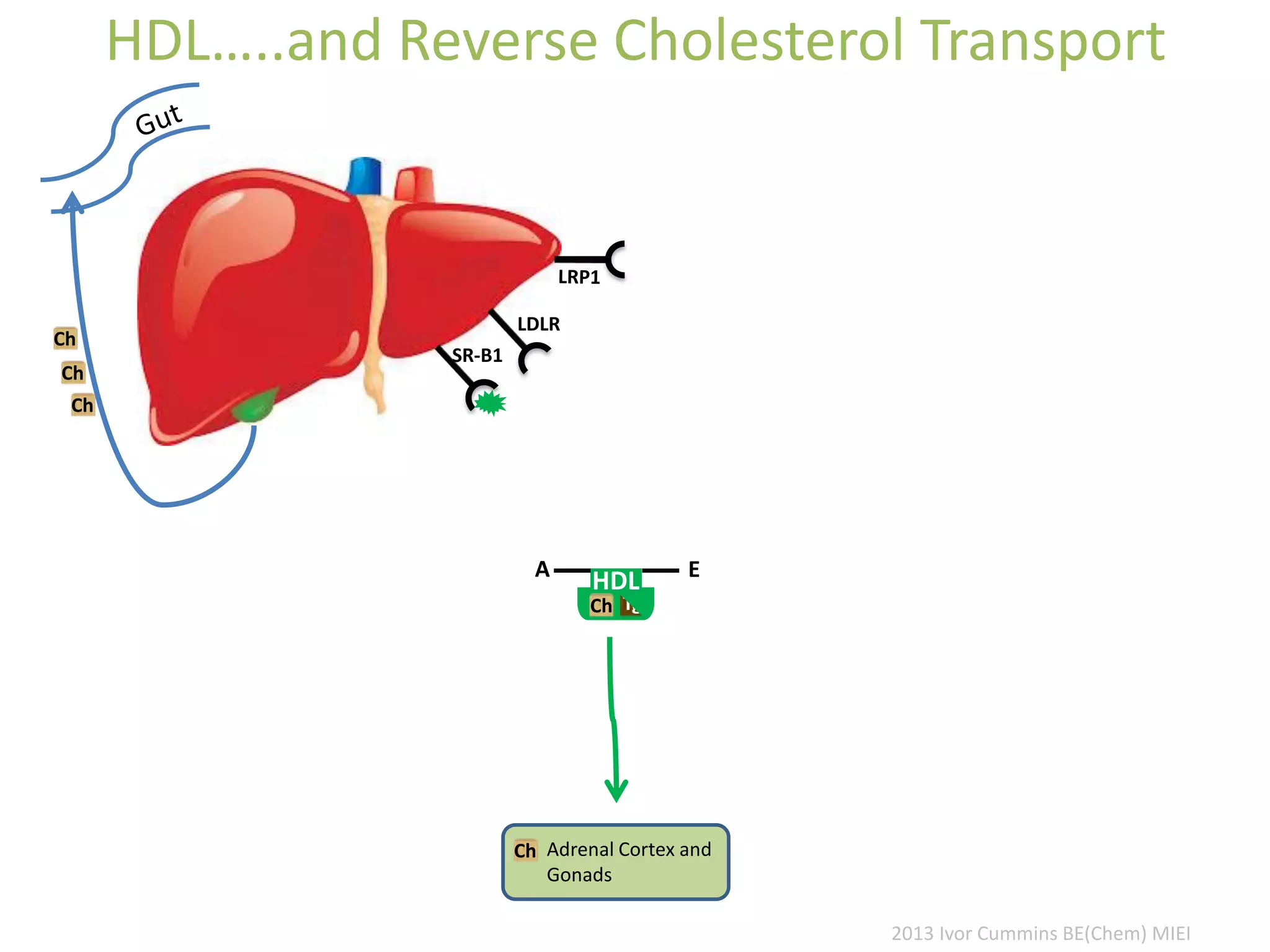
HDL…..and Reverse Cholesterol Transport
LDLR
SR-B1
Ch
Ch
Ch
Ch
A
HDL
Tg
E
Ch Adrenal Cortex and
Gonads
2013 Ivor Cummins BE(Chem) MIEI
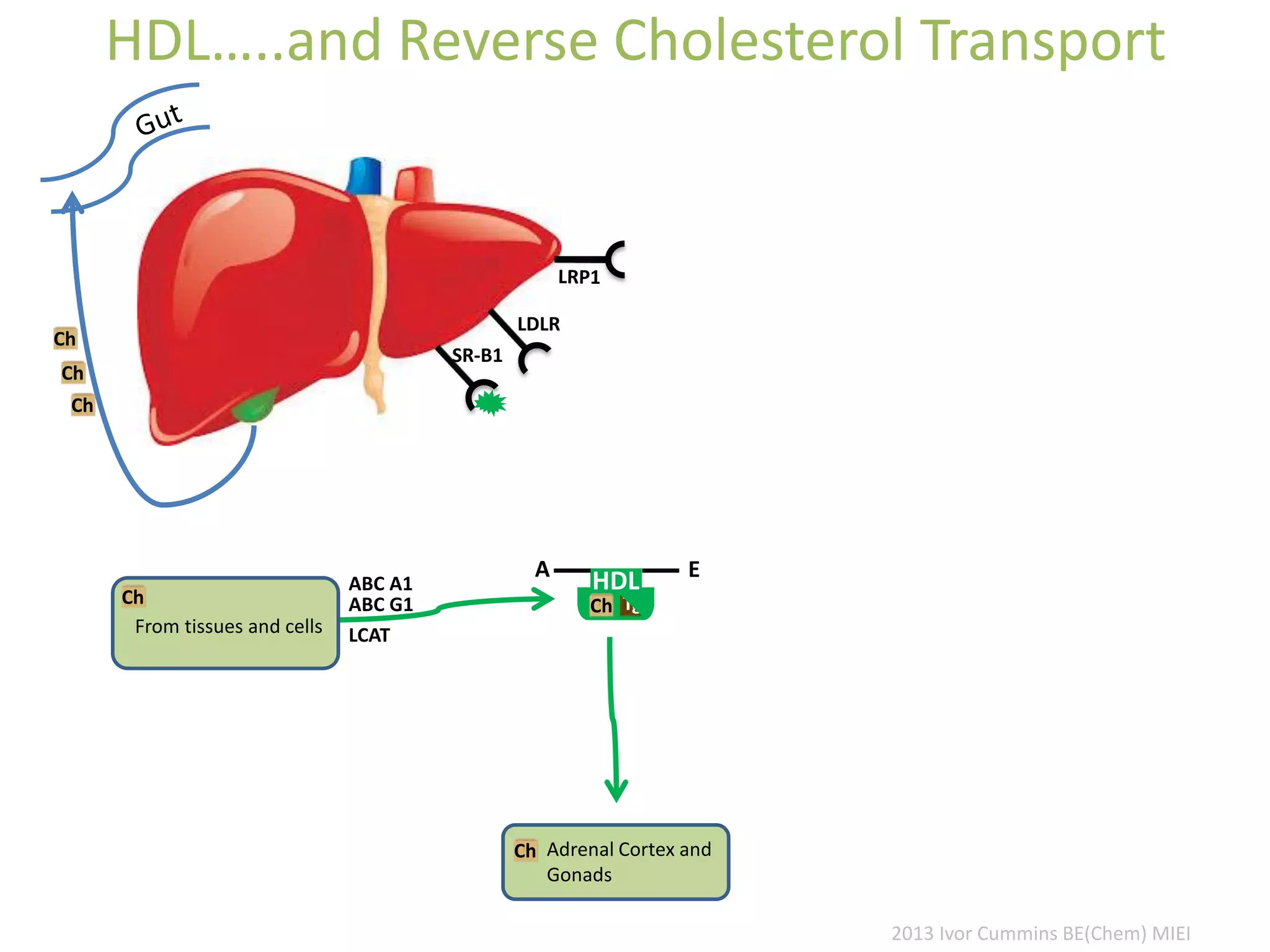
HDL…..and Reverse Cholesterol Transport
LDLR
SR-B1
Ch
Ch
Ch
Ch
A
HDL
Tg
E
Ch Adrenal Cortex and
Gonads
Ch
From tissues and cells
ABC A1
ABC G1
LCAT
2013 Ivor Cummins BE(Chem) MIEI
HDL…..and Reverse Cholesterol Transport
LDLR
SR-B1
Ch
Ch
Ch
Ch
A
HDL
Tg
E
Ch Adrenal Cortex and
Gonads
Ch
ABC A1
ABC G1
LCAT
Ch
Ch Ch
IMMUNE SYSTEM
MACROPHAGE / FOAM CELL
ABC A1
ABC G1
From tissues and cells
2013 Ivor Cummins BE(Chem) MIEI
HDL…..and Reverse Cholesterol Transport
LDLR
SR-B1
Ch
Ch
Ch
Ch
A
HDL
Tg
E
Ch Adrenal Cortex and
Gonads
Ch
ABC A1
ABC G1
LCAT
Ch
Ch Ch
IMMUNE SYSTEM
MACROPHAGE / FOAM CELL
ABC A1
ABC G1
From tissues and cells
2013 Ivor Cummins BE(Chem) MIEI
HDL…..and Reverse Cholesterol Transport
LDLR
SR-B1
Ch
Ch
Ch
Ch
Ch Ch
IMMUNE SYSTEM
MACROPHAGE / FOAM CELL
Ch
A
HDL
Tg
E
Ch
ABC A1
ABC G1
LCAT
LCAT
ABC A1
ABC G1
Ch Adrenal Cortex and
Gonads
From tissues and cells
2013 Ivor Cummins BE(Chem) MIEI
+ Antioxidant
Agents….!
HDL…..and Reverse Cholesterol Transport
LDLR
VLDL
Tg
Tg
Tg
Tg
Tg
Tg
Tg
Tg
Ch
Ch
Ch
Ch
E
C II
B100
TgCh
ChCh
B100
LDL
SR-B1
Ch
Ch
Ch
Ch
Ch Ch
IMMUNE SYSTEM
MACROPHAGE / FOAM CELL
Ch
A
HDL
Tg
E
Ch
ABC A1
ABC G1
LCAT
LCAT
Ch
Ch
Tg
Tg
ABC A1
ABC G1
Ch Adrenal Cortex and
Gonads
From tissues and cells
2013 Ivor Cummins BE(Chem) MIEI
+ Antioxidant
Agents….!
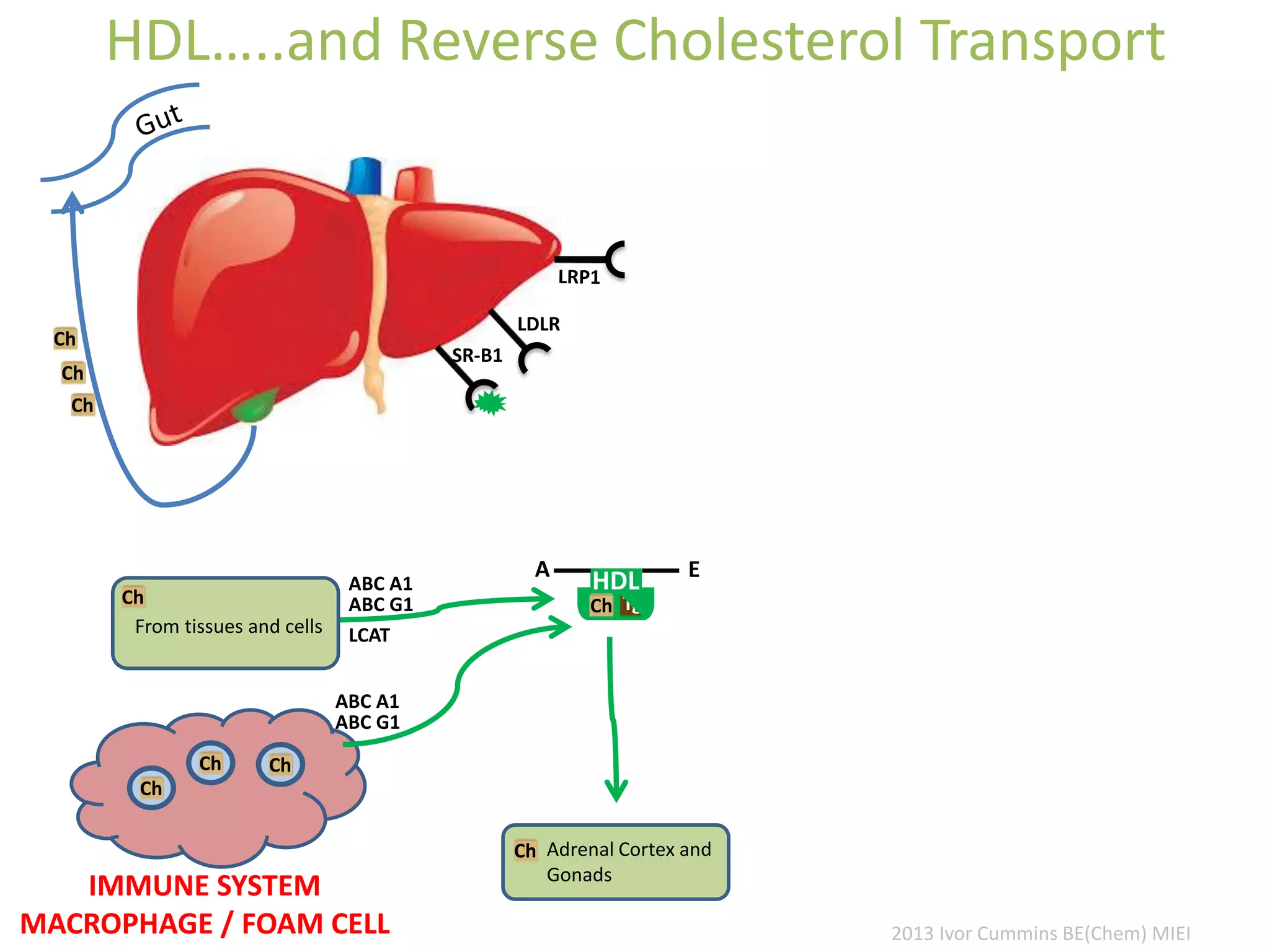
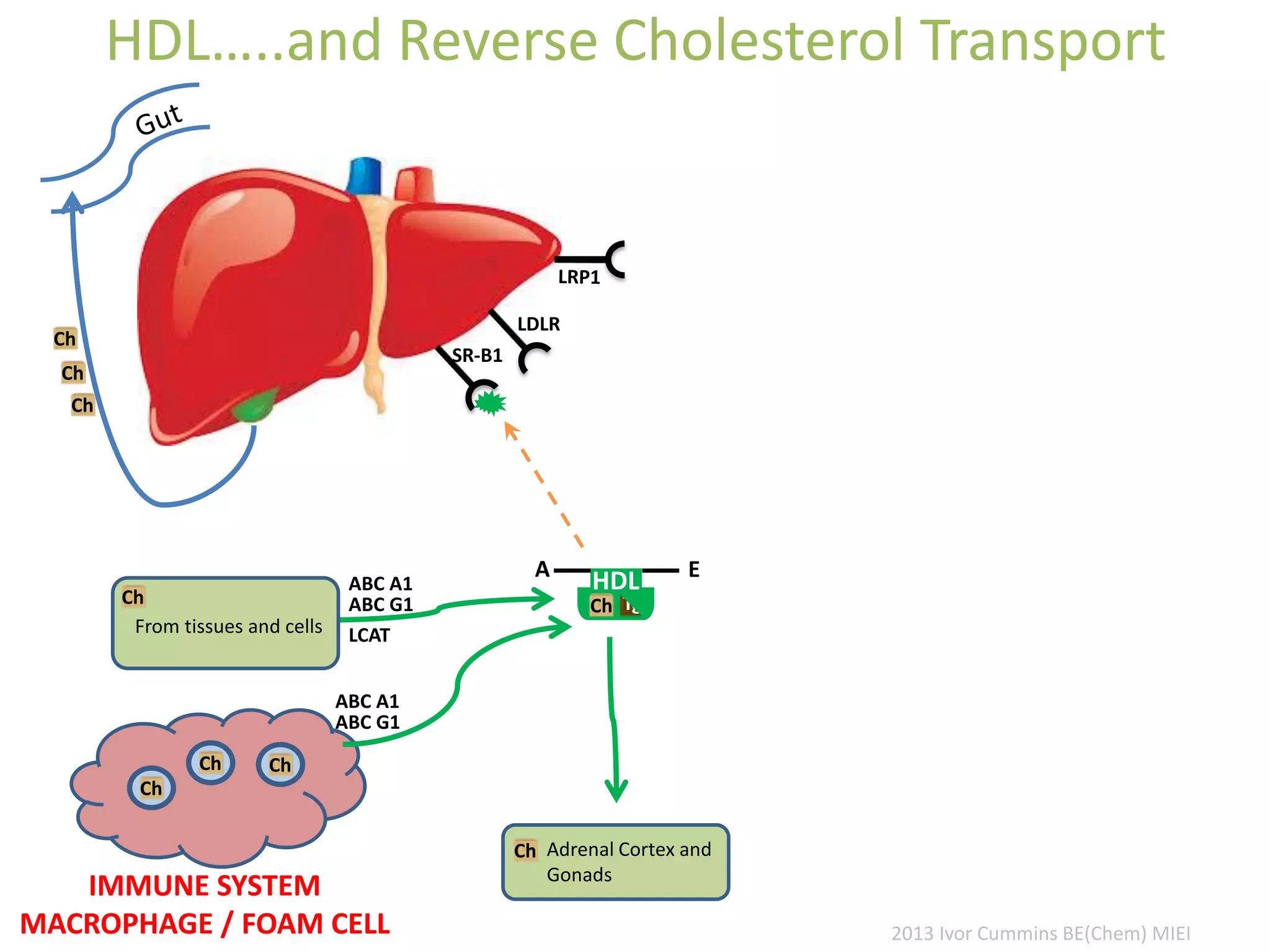
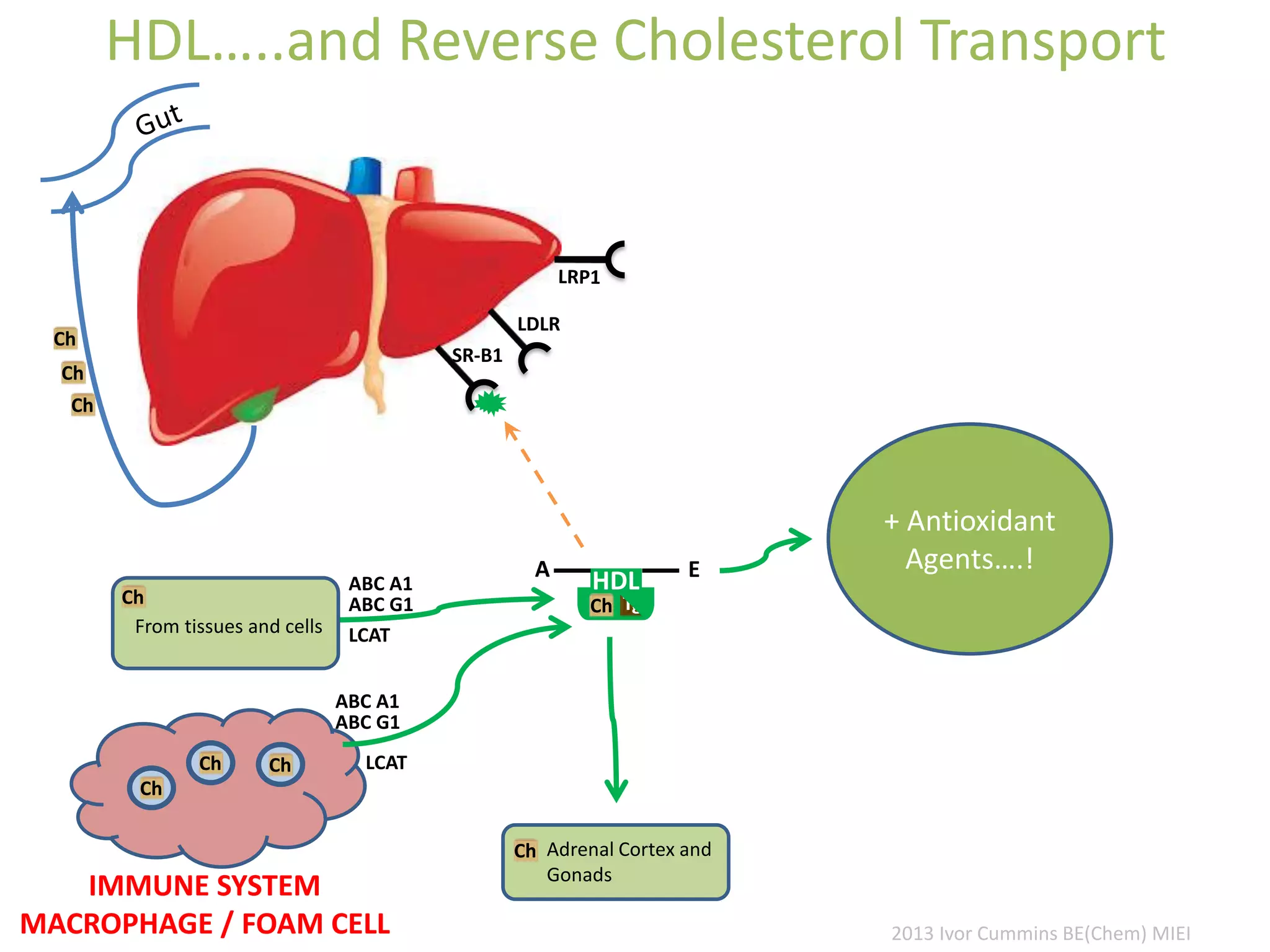
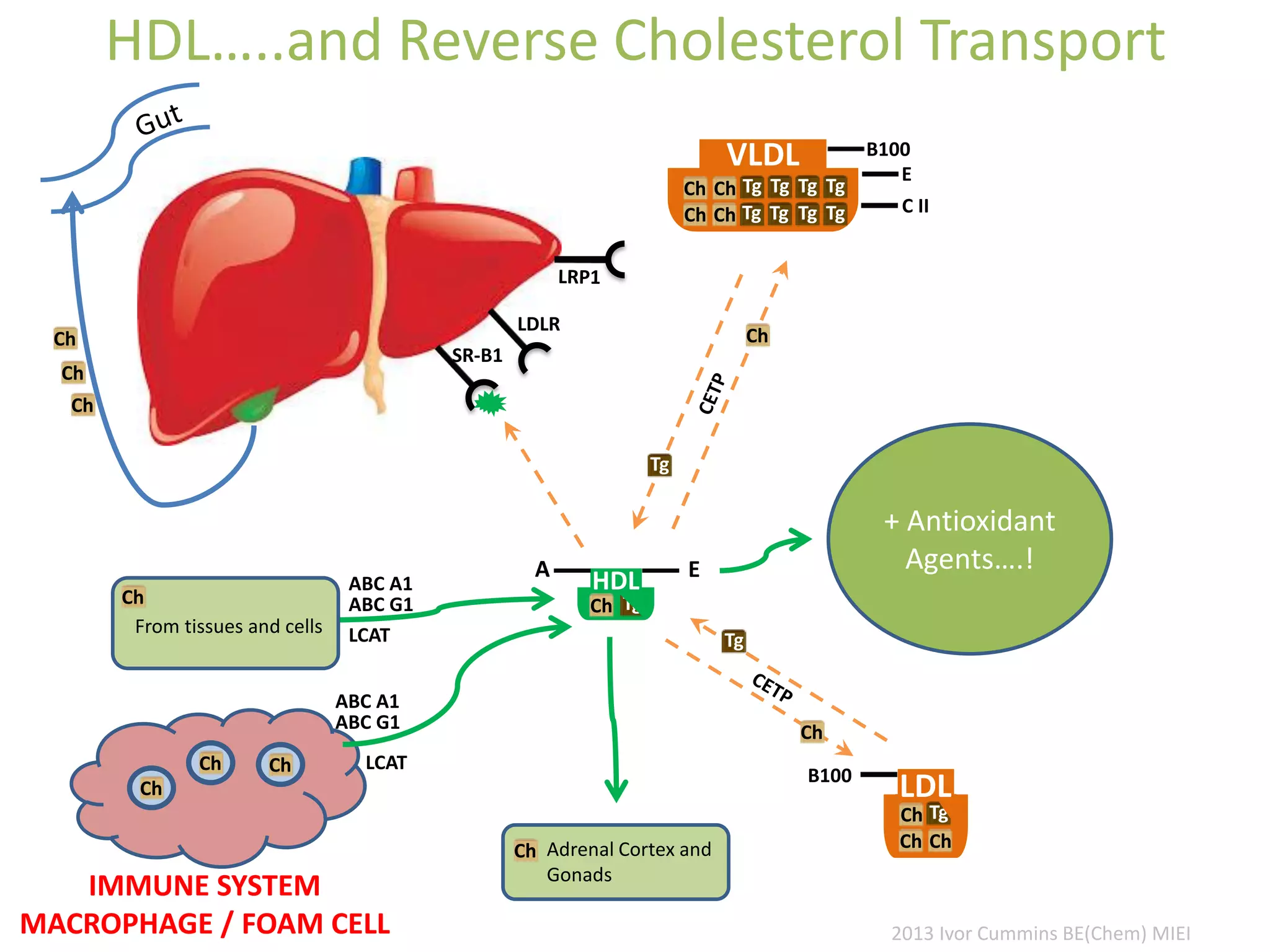
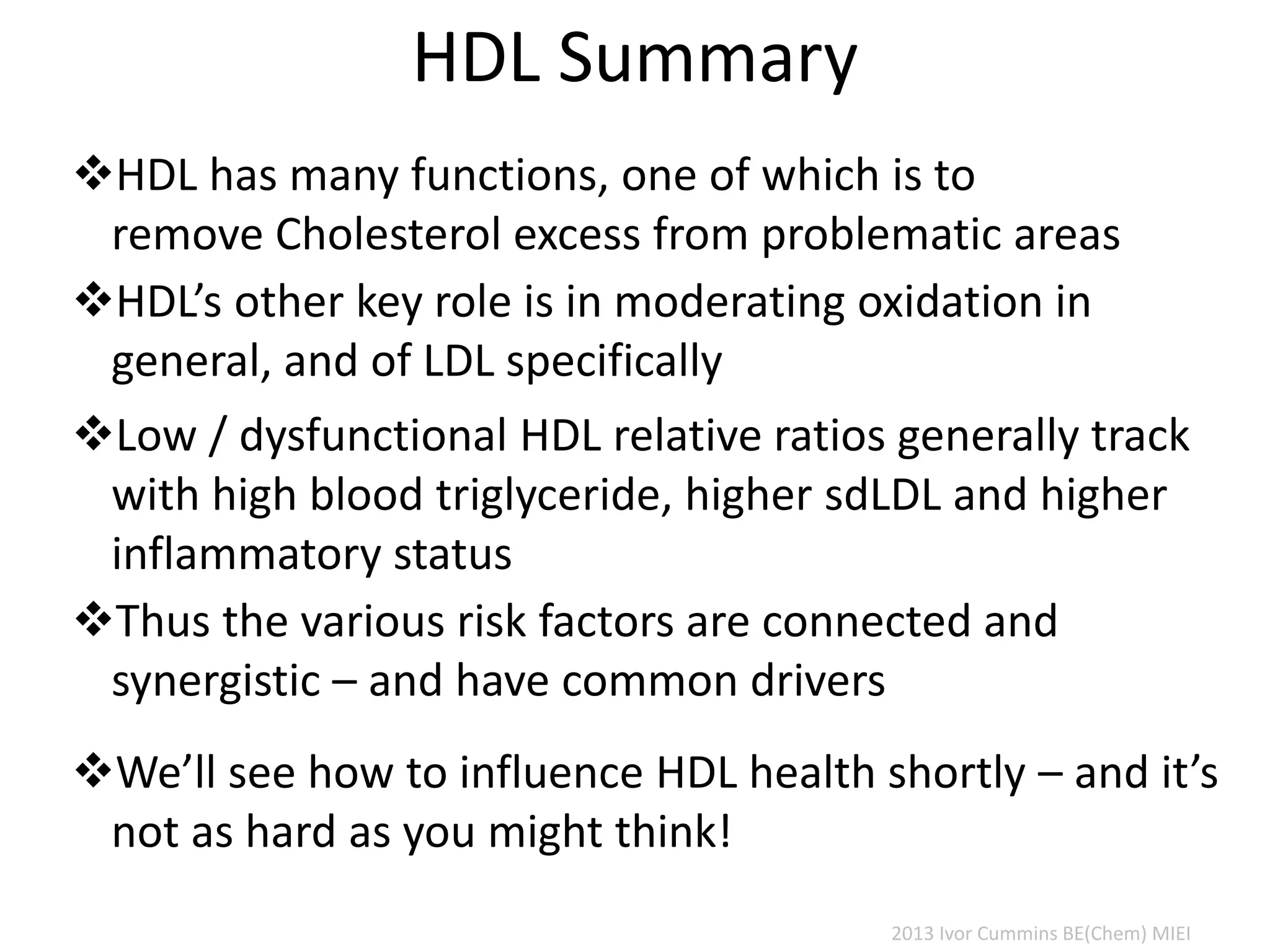
HDL Summary
HDL has many functions, one of which is to
remove Cholesterol excess from problematic areas
Low / dysfunctional HDL relative ratios generally track
with high blood triglyceride, higher sdLDL and higher
inflammatory status
Thus the various risk factors are connected and
synergistic – and have common drivers
We’ll see how to influence HDL health shortly – and it’s
not as hard as you might think!
2013 Ivor Cummins BE(Chem) MIEI
HDL’s other key role is in moderating oxidation in
general, and of LDL specifically
2013 Ivor Cummins BE(Chem) MIEI
6. The $1M Question –
What Primarily
Drives up the Risk
Factors???
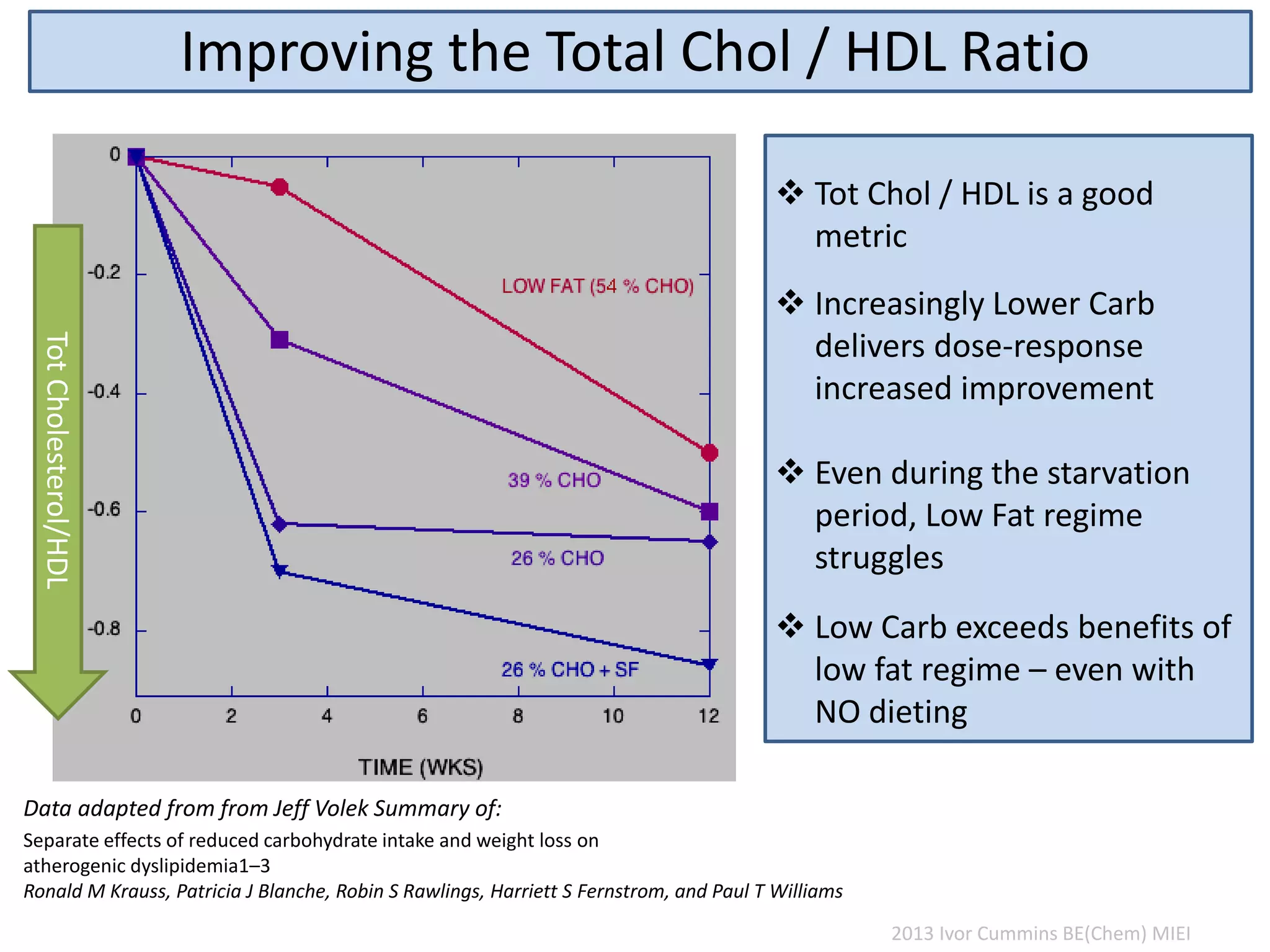
Improving the Total Chol / HDL RatioTotCholesterol/HDL
2013 Ivor Cummins BE(Chem) MIEI
 Tot Chol / HDL is a good
metric
 Increasingly Lower Carb
delivers dose-response
increased improvement
 Low Carb exceeds benefits of
low fat regime – even with
NO dieting
 Even during the starvation
period, Low Fat regime
struggles
Separate effects of reduced carbohydrate intake and weight loss on
atherogenic dyslipidemia1–3
Ronald M Krauss, Patricia J Blanche, Robin S Rawlings, Harriett S Fernstrom, and Paul T Williams
Data adapted from from Jeff Volek Summary of:
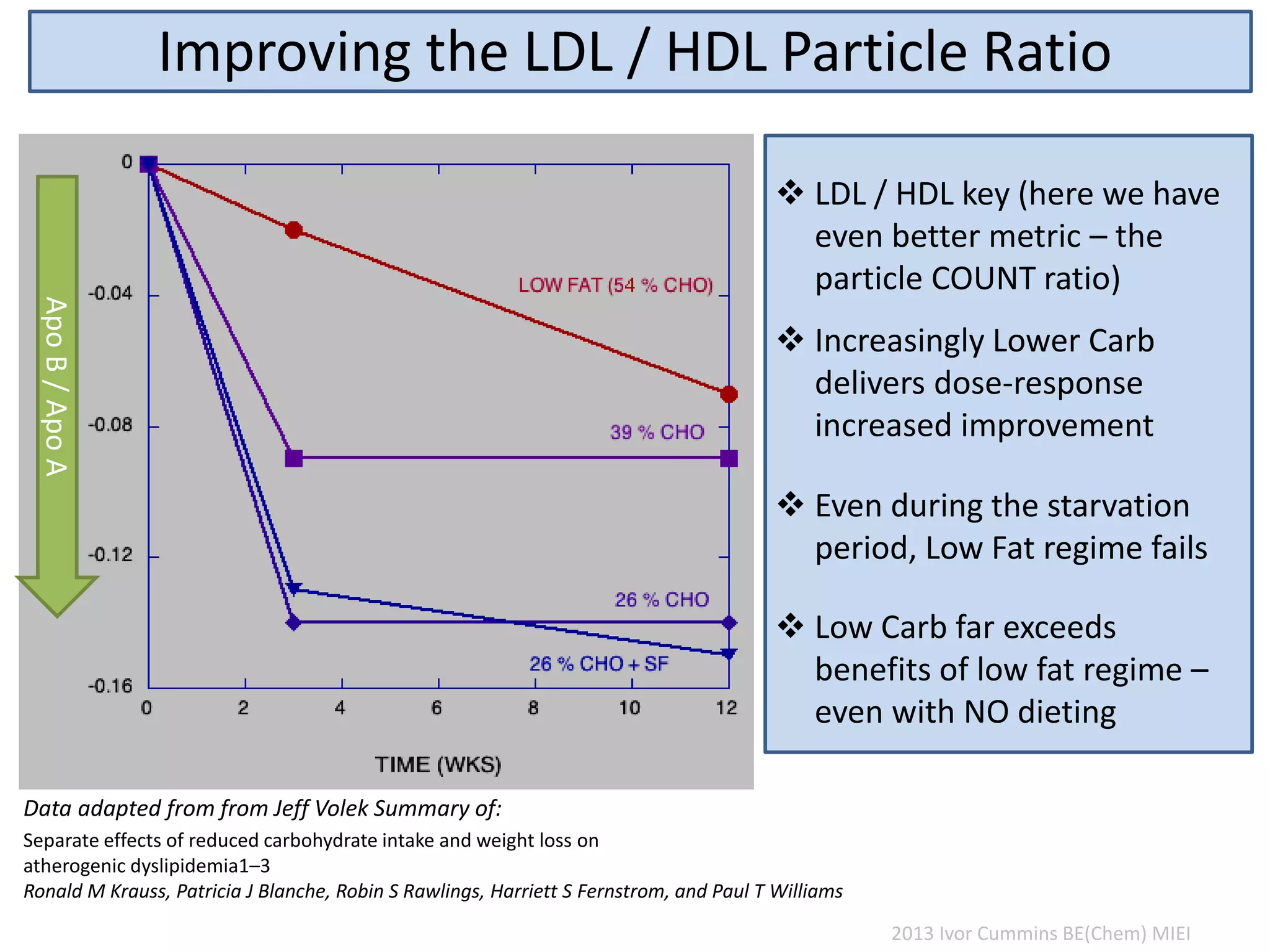
Improving the LDL / HDL Particle Ratio
Separate effects of reduced carbohydrate intake and weight loss on
atherogenic dyslipidemia1–3
Ronald M Krauss, Patricia J Blanche, Robin S Rawlings, Harriett S Fernstrom, and Paul T Williams
Data adapted from from Jeff Volek Summary of:
ApoB/ApoA
 LDL / HDL key (here we have
even better metric – the
particle COUNT ratio)
 Increasingly Lower Carb
delivers dose-response
increased improvement
2013 Ivor Cummins BE(Chem) MIEI
 Low Carb far exceeds
benefits of low fat regime –
even with NO dieting
 Even during the starvation
period, Low Fat regime fails
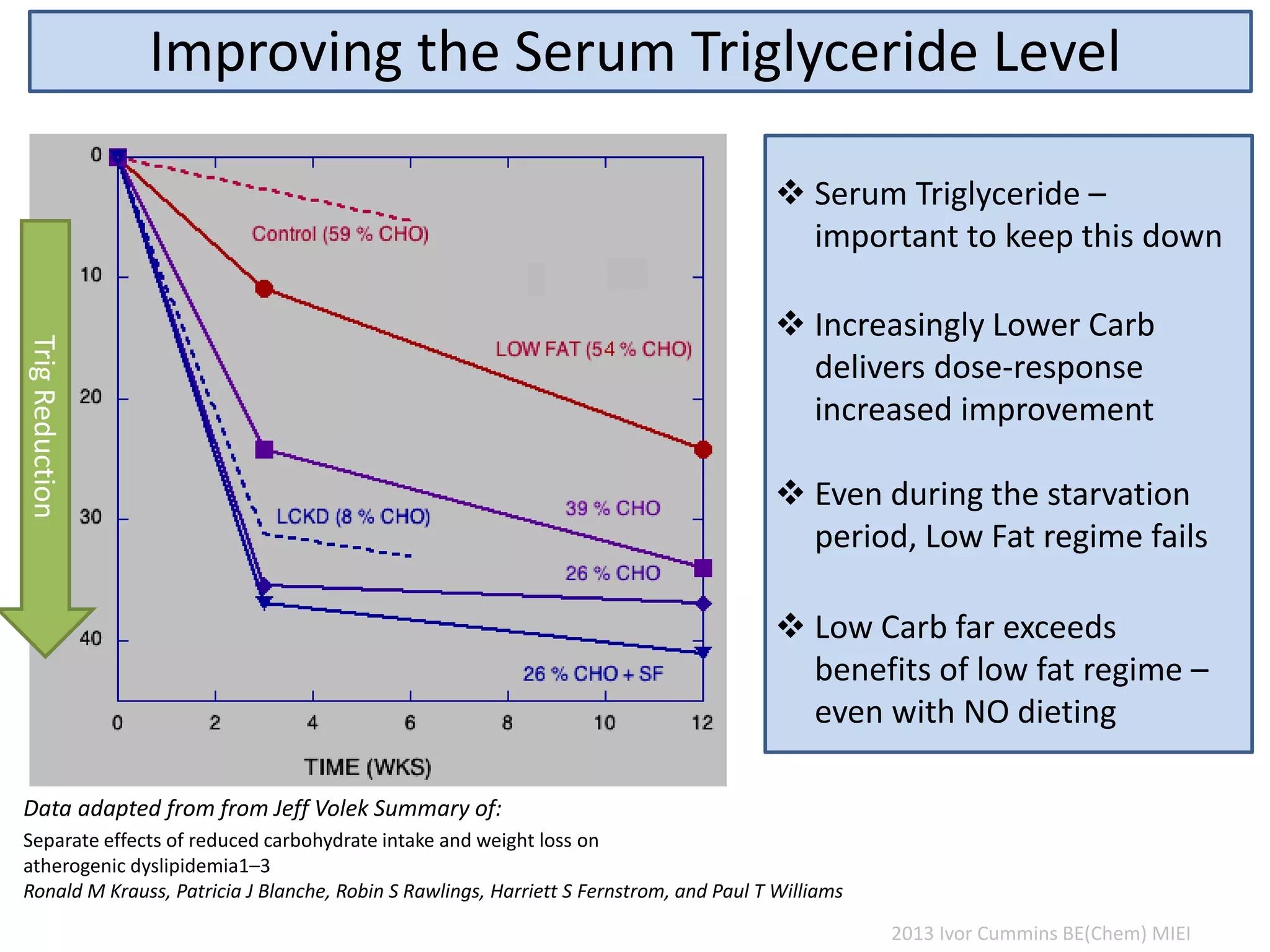
Improving the Serum Triglyceride Level
TrigReduction
2013 Ivor Cummins BE(Chem) MIEI
 Serum Triglyceride –
important to keep this down
 Increasingly Lower Carb
delivers dose-response
increased improvement
 Even during the starvation
period, Low Fat regime fails
Separate effects of reduced carbohydrate intake and weight loss on
atherogenic dyslipidemia1–3
Ronald M Krauss, Patricia J Blanche, Robin S Rawlings, Harriett S Fernstrom, and Paul T Williams
Data adapted from from Jeff Volek Summary of:
 Low Carb far exceeds
benefits of low fat regime –
even with NO dieting
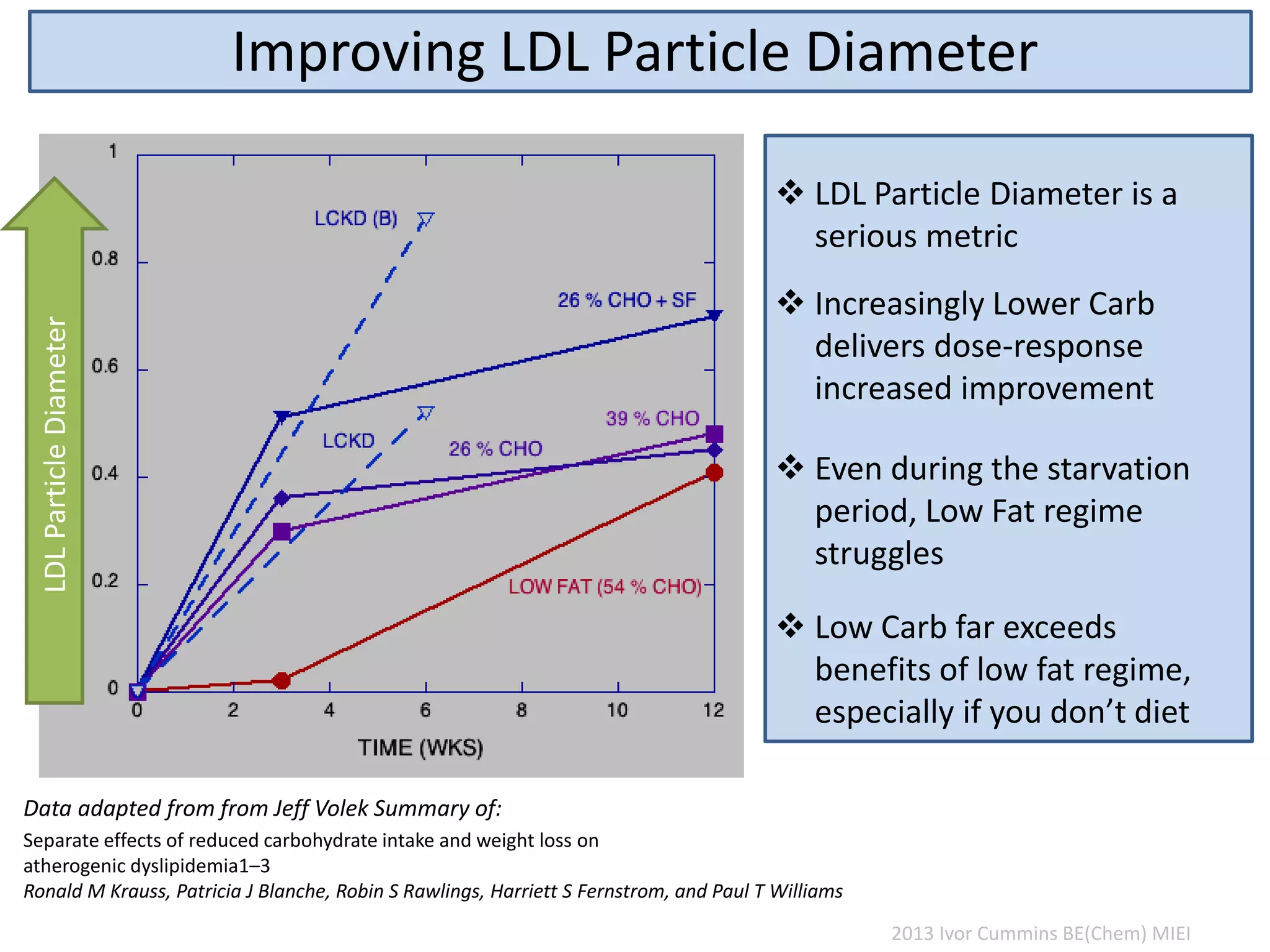
Improving LDL Particle DiameterLDLParticleDiameter
2013 Ivor Cummins BE(Chem) MIEI
 LDL Particle Diameter is a
serious metric
 Increasingly Lower Carb
delivers dose-response
increased improvement
 Low Carb far exceeds
benefits of low fat regime,
especially if you don’t diet
 Even during the starvation
period, Low Fat regime
struggles
Separate effects of reduced carbohydrate intake and weight loss on
atherogenic dyslipidemia1–3
Ronald M Krauss, Patricia J Blanche, Robin S Rawlings, Harriett S Fernstrom, and Paul T Williams
Data adapted from from Jeff Volek Summary of:
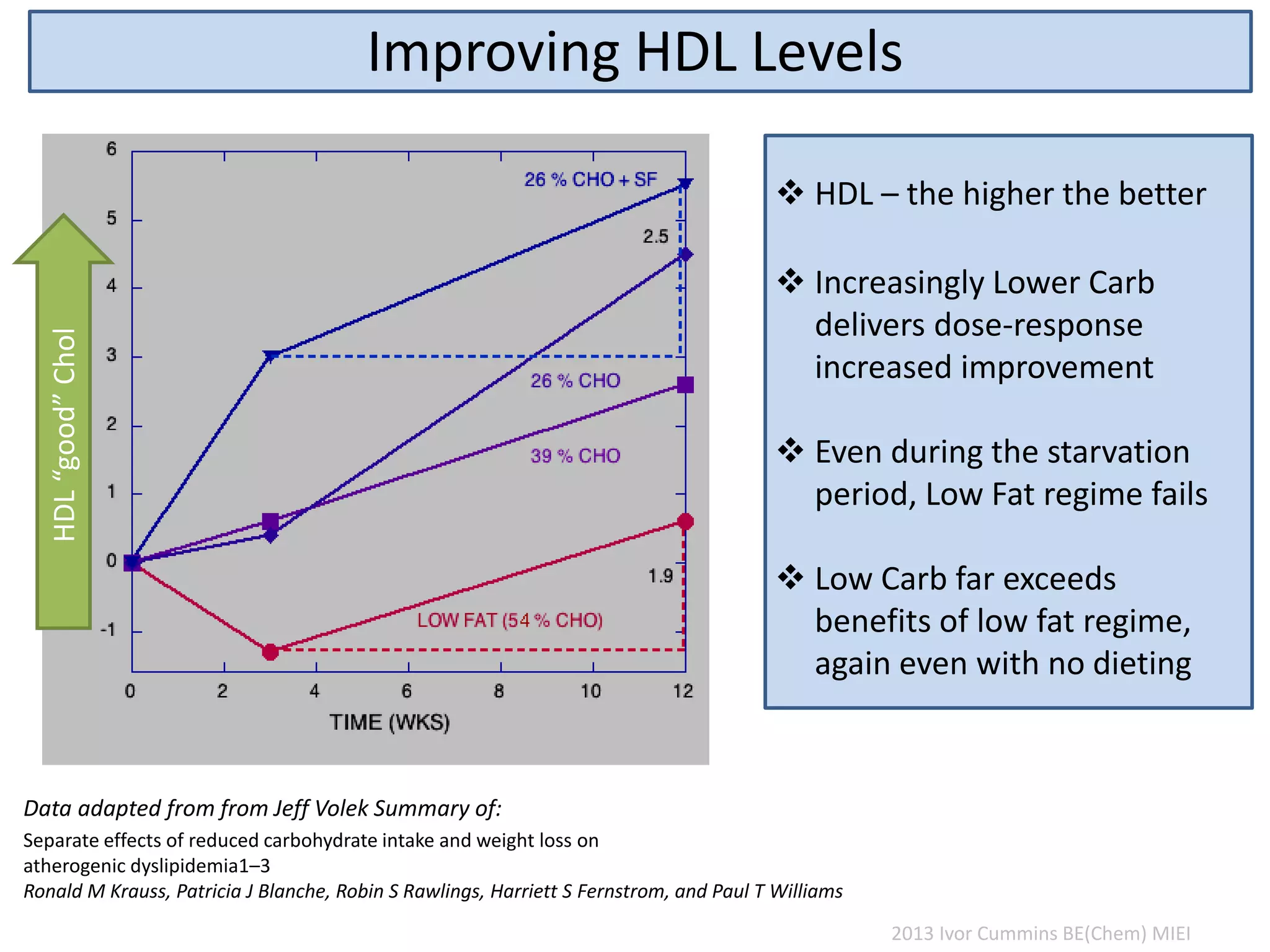
Improving HDL LevelsHDL“good”Chol
2013 Ivor Cummins BE(Chem) MIEI
 HDL – the higher the better
 Increasingly Lower Carb
delivers dose-response
increased improvement
 Low Carb far exceeds
benefits of low fat regime,
again even with no dieting
 Even during the starvation
period, Low Fat regime fails
Separate effects of reduced carbohydrate intake and weight loss on
atherogenic dyslipidemia1–3
Ronald M Krauss, Patricia J Blanche, Robin S Rawlings, Harriett S Fernstrom, and Paul T Williams
Data adapted from from Jeff Volek Summary of:
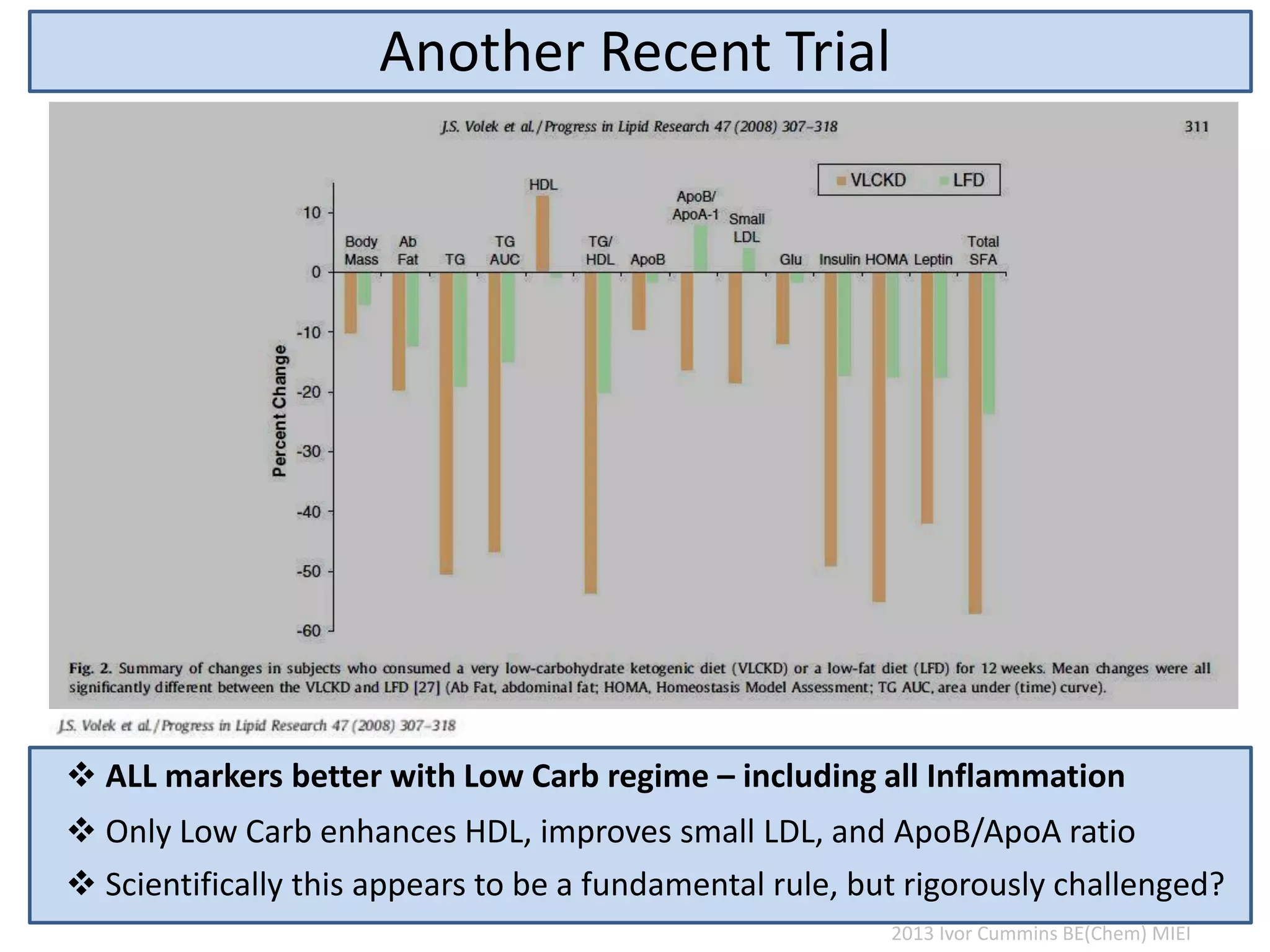
Another Recent Trial
xxxxx.
 ALL markers better with Low Carb regime – including all Inflammation
 Only Low Carb enhances HDL, improves small LDL, and ApoB/ApoA ratio
 Scientifically this appears to be a fundamental rule, but rigorously challenged?
2013 Ivor Cummins BE(Chem) MIEI
For ref....
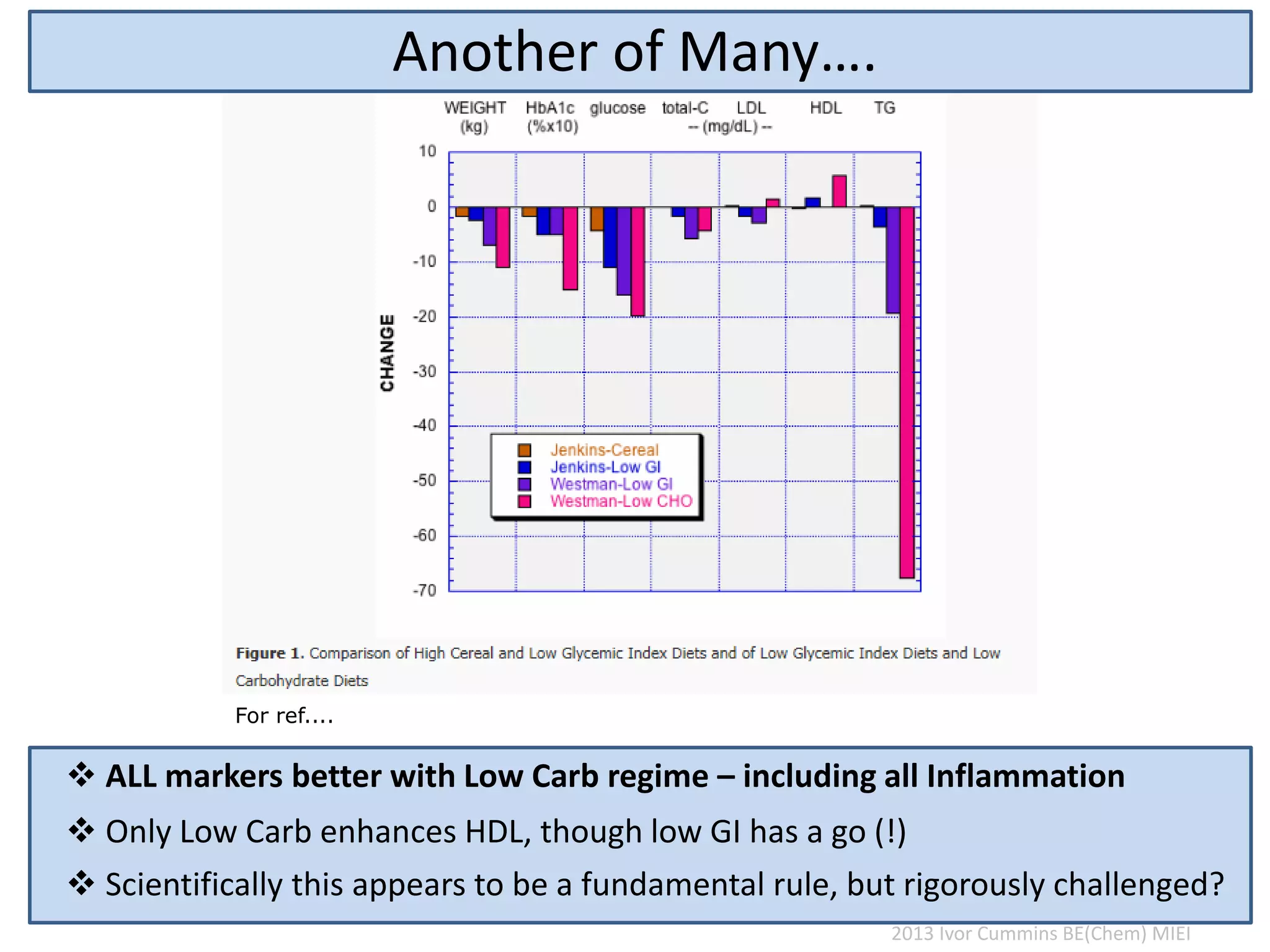
Another of Many….
 ALL markers better with Low Carb regime – including all Inflammation
 Only Low Carb enhances HDL, though low GI has a go (!)
 Scientifically this appears to be a fundamental rule, but rigorously challenged?
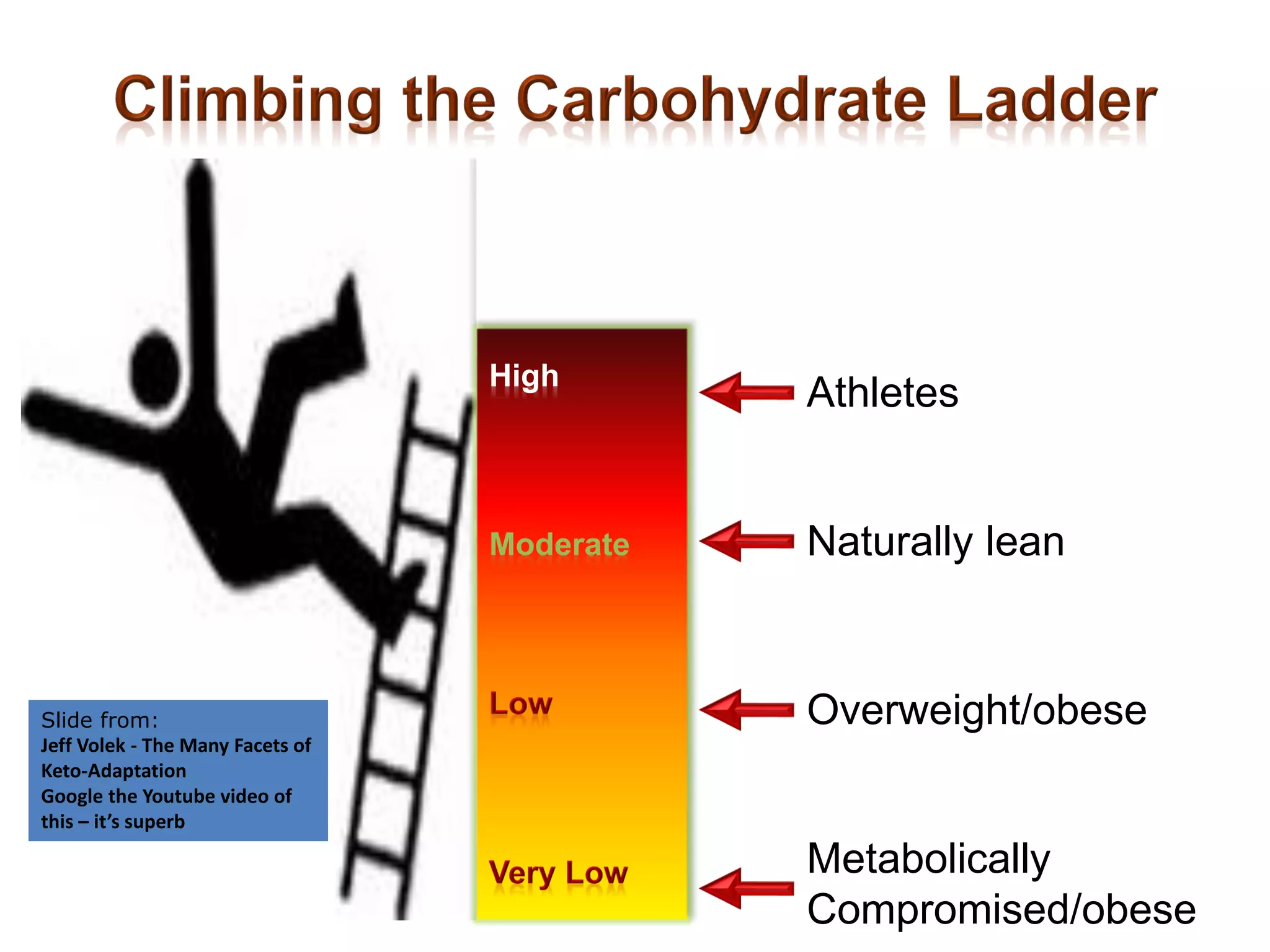
Moderate
High
Metabolically
Compromised/obese
Athletes
Naturally lean
Overweight/obeseSlide from:
Jeff Volek - The Many Facets of
Keto-Adaptation
Google the Youtube video of
this – it’s superb
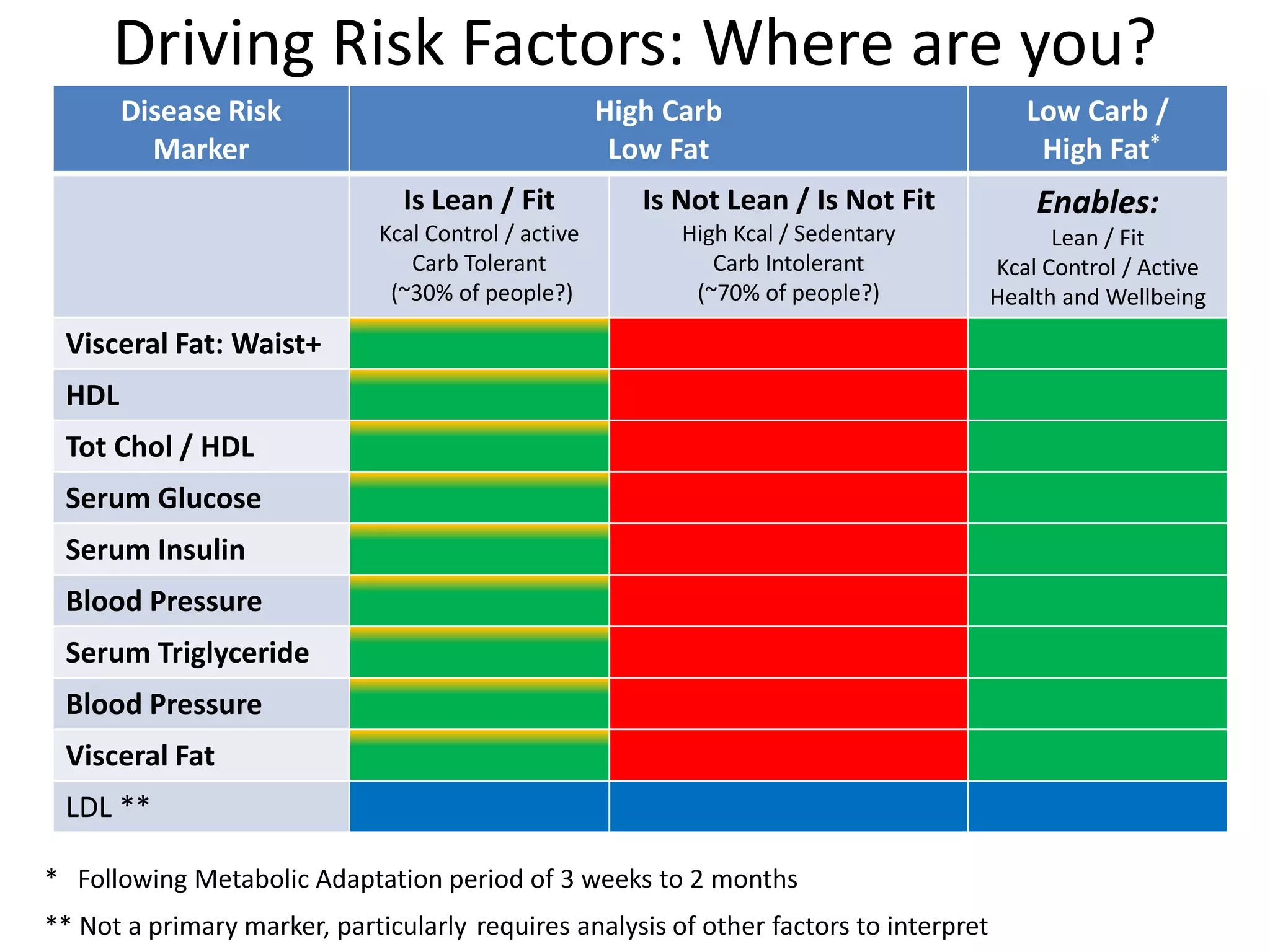
Driving Risk Factors: Where are you?
Disease Risk
Marker
High Carb
Low Fat
Low Carb /
High Fat*
Is Lean / Fit
Kcal Control / active
Carb Tolerant
(~30% of people?)
Is Not Lean / Is Not Fit
High Kcal / Sedentary
Carb Intolerant
(~70% of people?)
Enables:
Lean / Fit
Kcal Control / Active
Health and Wellbeing
Visceral Fat: Waist+
HDL
Tot Chol / HDL
Serum Glucose
Serum Insulin
Blood Pressure
Serum Triglyceride
Blood Pressure
Visceral Fat
LDL **
* Following Metabolic Adaptation period of 3 weeks to 2 months
** Not a primary marker, particularly requires analysis of other factors to interpret
Fundamental Truth
• To successfully gain excellent health and years of
extra life, I believe that you must actually
understand this science to a reasonable degree,
not just “follow the diet”. To achieve this
understanding will likely be the best thing you
ever do for yourself.
• Also, everyone has a different genetic makeup,
and this must be understood also – it’s not one
size fits all – know your phenotype!
(but the key drivers do have much commonality)
THE CRITICAL BIOCHEMISTRY OF
VITAMIN D
• Content in this draft slidepack for latest
science on 25 Hydroxy Vitamin D and related
mortality statistics will follow …..

The Cholesterol Conundrum DRAFT

  • 1.
    The Cholesterol Conundrum Whatdoes the Latest Science Say? Ivor Cummins BE (Chem) March 21st 2014 2013 Ivor Cummins BE(Chem) MIEI
  • 2.
    Why are wein this room today - How does this come about? Academic / Educational History Problem Solving Experience / Aptitude 2013 Ivor Cummins BE(Chem) MIEI
  • 3.
    Quick Update frommy last Seminar At last, The unbiased experts are stepping up to the plate: • Six teaspoons max in 24 hours? • That’s less than a single can of your favorite sugary beverage, and assumes NO other sugar for the rest of the day? • Looks like the Emperor’s suit is getting frayed….. • Gloves off lads, better pour some money into the lobbying chest, and shut this thing down quick 2013 Ivor Cummins BE(Chem) MIEI
  • 4.
    2013 Ivor CumminsBE(Chem) MIEI 1. The Key Molecules 2. The Key Particles 3. Our Common Enemy 4. The Risk Factors 5. How the Cholesterol Processing System Works – High Level 6. The $1M Question – What Drives up the Risk Factors? The Conundrum Content:
  • 5.
    2013 Ivor CumminsBE(Chem) MIEI 1. The Key Molecules
  • 6.
    Cholesterol and Triglyceride •Cholesterol is a Sterol Molecule that is used to build cells, hormones and other core physiological elements • Is critical, and fundamental for life to exist • Is a key element of your bodies damage repair system • Is a precursor to the synthesis of Vitamin D, which in turn is one of the most important agents for mortality deferral – we’ll look at this later…. • Finally, cholesterol generally gets blamed for disease pretty much as a paramedic on the scene might be blamed for the car crash Cholesterol – for Life Itself • Triglyceride (aka Triacylglycerol) is a form of fat • Is three Fatty Acids on a glycerol (sugar-like) backbone • Enters the body via fat-containing food • Is also synthesized by the body (neolipogenisis) for various reasons • Can be good or bad: depends on source, location and quantity…. Trigylceride – for Energy 2013 Ivor Cummins BE(Chem) MIEI
  • 7.
    2013 Ivor CumminsBE(Chem) MIEI 2. The Key Particles
  • 8.
    The Lipoprotein Particles– Boats for Cargo Trigylceride/ Cholesterol An Apo- Lipoprotein Phospholipids  The LIPOPROTEIN PARTICLES are transport vessels (“boats”) created in the body to deliver Triglyceride and Cholesterol (“cargo”), for energy transfer, critical synthesis, and healing purposes….  HDL is the so-called “GOOD Cholesterol”  LDL (from VLDL) is the so-called “BAD Cholesterol”  The Chylomicron is the big one, created to ferry dietary fat and cholesterol, for energy and healing Chylomicron 100 to 1000nm sdLDL <25nm  VLDL is made in the liver to ferry Trigs and Chol…  Small Dense LDL is the real “BAD Cholesterol” HDL 5-15nm LDL >26nm VLDL 30 to 80nm 2013 Ivor Cummins BE(Chem) MIEI
  • 9.
    2013 Ivor CumminsBE(Chem) MIEI And now, a word from our Sponsor…..
  • 10.
    2013 Ivor CumminsBE(Chem) MIEI 3. Our Common Enemy
  • 11.
    Atherosclerosis and CVDMechanism  Ingress of Lipoprotein Particles through Endothelium (inner wall)  Uptake of these by immune system Macrophage  Subsequent transformation into “Foam Cells” and buildup of Plaque  Ultimately a decline in vascular health, then breakouts, blockages….. The Disease Sequence: + Ch Ch Ch Macrophage = FOAM CELL  The Million Dollar Question: What mediates this inflammatory process? TgCh ChCh B100 2013 Ivor Cummins BE(Chem) MIEI
  • 12.
    2013 Ivor CumminsBE(Chem) MIEI 4. The Risk Factors
  • 13.
    Key Predictors ofMortality – Dysfunctional Lipoprotein Status • LDL/HDL Ratio • Serum Triglyceride Levels • Small Dense LDL and associated LDL Particle COUNT – Insulin Levels and Insulin Resistance Status – Blood Glucose Level and HbA1C – High Blood Pressure (generally driven by the above scenarios) – Other markers of Systemic Inflammation 2013 Ivor Cummins BE(Chem) MIEI
  • 14.
    Total Cholesterol asa predictive factor? Is the use of cholesterol in mortality risk algorithms in clinical guidelines valid? Ten years prospective data from the Norwegian HUNT 2 study (>58,000 Participants) Halfdan Petursson MD,1 Johann A. Sigurdsson MD Dr med,2 Calle Bengtsson MD Dr med,3 Tom I. L. Nilsen Dr Philos4 and Linn Getz MD PhD5 Cardiovascular Death IncreasedRisk IncreasedRisk Ischemic Heart Disease Death 2013 Ivor Cummins BE(Chem) MIEI
  • 15.
    Total Cholesterol asa predictive factor? Is the use of cholesterol in mortality risk algorithms in clinical guidelines valid? Ten years prospective data from the Norwegian HUNT 2 study (>58,000 Participants) Halfdan Petursson MD,1 Johann A. Sigurdsson MD Dr med,2 Calle Bengtsson MD Dr med,3 Tom I. L. Nilsen Dr Philos4 and Linn Getz MD PhD5  Age Confounding is a serious issue  US Versus Other Geographies is an issue  Diagnosing via Total Cholesterol no longer supported by the science ALL CAUSE DEATH…. IncreasedRisk Key Takeaways:  Total Cholesterol effectively not considered any more by leading edge researchers  Economics / Hubris retain bad science 2013 Ivor Cummins BE(Chem) MIEI
  • 16.
    LDL-C & HDL-Cas predictive factors? Diagram adapted from article in Journal of Cardiovascular Medicine 2011, Vol 00, No 00 2.58 4.13 5.68 HDL=0.65 HDL = 1.16 HDL = 1.68 HDL = 2.20 RiskofHeartDiseaseafter4Years LDL (the “Bad Cholesterol”)  HDL being adequate/higher is VERY important  The benefit of LDL being low………depends on the HDL status  Risk is determined primarily by the RATIO of these parameters  Diagnosing via LDL is minimally useful in the face of the current science Heart Disease Risk Vs LDL & HDL Data from the Framingham Heart Study showing incidence of CAD over 4 years in men 50-70 years old 2013 Ivor Cummins BE(Chem) MIEI
  • 17.
    LDL-C & HDL-Cas predictive factors? Diagram adapted from article in Journal of Cardiovascular Medicine 2011, Vol 00, No 00 2.58 4.13 5.68 HDL=0.65 HDL = 1.16 HDL = 1.68 HDL = 2.20 RiskofHeartDiseaseafter4Years LDL (the “Bad Cholesterol”)  HDL being adequate/higher is VERY important  The benefit of LDL being low………depends on the HDL status  Risk is determined primarily by the RATIO of these parameters  Diagnosing via LDL is minimally useful in the face of the current science Heart Disease Risk Vs LDL & HDL Data from the Framingham Heart Study showing incidence of CAD over 4 years in men 50-70 years old XXX 2013 Ivor Cummins BE(Chem) MIEI Guess Who?
  • 18.
    SERUM TRIGLYCERIDE asa Predictive Factor Assmann G, Schulte H. Am J Cardiol. 1992;70:733–737. Data from the PROCAM Munster Study  Blood Triglyceride Levels are an important Risk Factor for Coronary Disease  However, they should not be judged alone – vital to balance with other factors  Again we see the importance of LDL/HDL Ratios and interactions with Trigs Key Takeaways: 2013 Ivor Cummins BE(Chem) MIEI
  • 19.
    SERUM INSULIN asa Predictive Factor Assmann G, Schulte H. Am J Cardiol. 1992;70:733–737. Data from the PROCAM Munster Study (from "Interesting slideset around…):  Insulin is fundamental to Coronary Disease and Mortality Risk  Insulin has been grossly underemphasized as a risk factor for decades  Triglyceride risk outgunned by Insulin Status here Key Takeaways: 2013 Ivor Cummins BE(Chem) MIEI Data from the Quebec Study Cardiovascular Study: Despres JP, et al. N Engl J Med. 1996;334:952-957.
  • 20.
    Data taken fromTable 2: Association of Hemoglobin A1c with Cardiovascular Disease and Mortality in Adults: The European Prospective Investigation into Cancer in Norfolk Kay-Tee Khaw, MBBChir, FRCP; Nicholas Wareham, MBBS, FRCP; Sheila Bingham, PhD; Robert Luben, BSc; Ailsa Welch, BSc; and Nicholas Day, PhD Glucose Levels Anyone? - HbA1c as a Risk Factor Assmann G, Schulte H. Am J Cardiol. 1992;70:733–737.  HbA1c is the alteration of Red Blood Cells driven by blood glucose levels  This again is closely related to Insulin & Insulin Resistance Status  HbA1c from this particular study is also an independent risk factor Key Takeaways: 2013 Ivor Cummins BE(Chem) MIEI
  • 21.
    SERUM INSULIN andLDL Particle Count Data from the Quebec Study Cardiovascular Study: Assmann G, Schulte H. Am J Cardiol. 1992;70:733–737.  Again Insulin is key, but significant interaction with LDL Particle Count (ApoB)  LDL Particle Count tracks with Small Dense LDL – I’ll explain this shortly!  Interaction is the operative word – synergy closely follows Key Takeaways: 2013 Ivor Cummins BE(Chem) MIEI Lamarche B, et al. Circulation. 1997;95:69-75.
  • 22.
    Small Dense LDLas a Predictive Factor Assmann G, Schulte H. Am J Cardiol. 1992;70:733–737.  Small Dense LDL and associated LDL Particle Count are Key  These, along with Insulin / Insulin Resistance Status, are Master Markers  So Let’s look at how it all works, shall we? Key Takeaways: 2013 Ivor Cummins BE(Chem) MIEI Reprinted from St-Pierre AC, et al. Circulation. 2001;104: 2295–2299, with permission from Wolters Kluwer Health.
  • 23.
    2013 Ivor CumminsBE(Chem) MIEI 4. How the Cholesterol Processing System Works - High Level (Hope appreciate the artwork here, it took me a while!)
  • 24.
    The Lipoprotein Particles– Boats for Cargo Trigylceride/ Cholesterol An Apo- Lipoprotein Phospholipids  The LIPOPROTEIN PARTICLES are transport vessels (“boats”) created in the body to deliver Triglyceride and Cholesterol (“cargo”), for energy transfer, critical synthesis, and healing purposes….  HDL is the so-called “GOOD Cholesterol”  LDL (from VLDL) is the so-called “BAD Cholesterol”  The Chylomicron is the big one, created to ferry dietary fat and cholesterol, for energy and healing Chylomicron 100 to 1000nm sdLDL <25nm  VLDL is made in the liver to ferry Trigs and Chol…  Small Dense LDL is the real “BAD Cholesterol” HDL 5-15nm LDL >26nm VLDL 30 to 80nm 2013 Ivor Cummins BE(Chem) MIEI
  • 25.
    CHYLOMICRON: for dietaryFat and Chol Dietary Fats Triglycerides Cholesterol CHYLOMICRON B48 TgTgCh TgTgTg Tg Tg Tg Tg Tg Tg Tg Tg TgCh Tg Tg Tg 2013 Ivor Cummins BE(Chem) MIEI
  • 26.
    CHYLOMICRON: for dietaryFat and Chol Dietary Fats Triglycerides Cholesterol E C II CHYLOMICRON B48 TgTgCh TgTgTg Tg Tg Tg Tg Tg Tg Tg Tg Tg CHYLOMICRON B48 TgTgCh TgTgTg Tg Tg Tg Tg Tg Tg Tg Tg TgCh Tg Tg Tg 2013 Ivor Cummins BE(Chem) MIEI
  • 27.
    CHYLOMICRON: for dietaryFat and Chol Dietary Fats Triglycerides Cholesterol E C II CHYLOMICRON B48 TgTgCh TgTgTg Tg Tg Tg Tg Tg Tg Tg Tg Tg CHYLOMICRON B48 TgTgCh TgTgTg Tg Tg Tg Tg Tg Tg Tg Tg TgCh Tg Tg Tg 2013 Ivor Cummins BE(Chem) MIEI
  • 28.
    CHYLOMICRON: for dietaryFat and Chol Dietary Fats Triglycerides Cholesterol E C II CHYLOMICRON B48 TgTgCh TgTgTg Tg Tg Tg Tg Tg Tg Tg Tg Tg CHYLOMICRON B48 TgTgCh TgTgTg Tg Tg Tg Tg Tg Tg Tg Tg Tg B48 CHYLO REMNANT Ch TgTg TgE Ch Tg Tg Tg 2013 Ivor Cummins BE(Chem) MIEI
  • 29.
    CHYLOMICRON: for dietaryFat and Chol Dietary Fats Triglycerides Cholesterol E C II CHYLOMICRON B48 TgTgCh TgTgTg Tg Tg Tg Tg Tg Tg Tg Tg Tg CHYLOMICRON B48 TgTgCh TgTgTg Tg Tg Tg Tg Tg Tg Tg Tg Tg B48 CHYLO REMNANT Ch TgTg TgE Ch Tg Tg Tg 2013 Ivor Cummins BE(Chem) MIEI
  • 30.
    CHYLOMICRON: for dietaryFat and Chol Dietary Fats Triglycerides Cholesterol E C II CHYLOMICRON B48 TgTgCh TgTgTg Tg Tg Tg Tg Tg Tg Tg Tg Tg CHYLOMICRON B48 TgTgCh TgTgTg Tg Tg Tg Tg Tg Tg Tg Tg Tg B48 CHYLO REMNANT Ch TgTg TgELDLR SR-B1 Ch Tg Tg Tg 2013 Ivor Cummins BE(Chem) MIEI
  • 31.
    CHYLOMICRON: for dietaryFat and Chol Dietary Fats Triglycerides Cholesterol E C II CHYLOMICRON B48 TgTgCh TgTgTg Tg Tg Tg Tg Tg Tg Tg Tg Tg CHYLOMICRON B48 TgTgCh TgTgTg Tg Tg Tg Tg Tg Tg Tg Tg Tg B48 CHYLO REMNANT Ch TgTg TgE Ch Ch Ch LDLR SR-B1 Ch Tg Tg Tg 2013 Ivor Cummins BE(Chem) MIEI
  • 32.
    Chylomicron Summary Dietary Fatand Cholesterol is packaged into the Large Chylomicrons (100-1000nm) The latter deliver Triglyceride Molecules For Energy Use in the Heart / Skeletal Muscles Following this energy transfer, the Chylomicron remnants have a short half-life of ~20min in the bloodstream, and are readily taken up by the liver, thus completing the cycle However, the latter description assumes moderate carbohydrate ingestion and insulin secretion….high carb will spike insulin, suppress Triglyceride utilization, and increase remnant residence time…. 2013 Ivor Cummins BE(Chem) MIEI
  • 33.
    VLDL, IDL,LDL…..and SmallDense LDL LDLR VLDL Tg Tg Tg Tg Tg Tg Tg Tg Ch Ch Ch Ch E C II B100 SR-B1 Ch Ch Ch 2013 Ivor Cummins BE(Chem) MIEI
  • 34.
    VLDL, IDL,LDL…..and SmallDense LDL C II LDLR C II LPL VLDL Tg Tg Tg Tg Tg Tg Tg Tg Ch Ch Ch Ch E C II B100 SR-B1 Ch Ch Ch 2013 Ivor Cummins BE(Chem) MIEI
  • 35.
    VLDL, IDL,LDL…..and SmallDense LDL C II LDLR C II LPL VLDL Tg Tg Tg Tg Tg Tg Tg Tg Ch Ch Ch Ch E C II B100 IDL TgTg Tg Ch Ch Ch Ch E B100 SR-B1 Ch Ch Ch 2013 Ivor Cummins BE(Chem) MIEI
  • 36.
    VLDL, IDL,LDL…..and SmallDense LDL C II LDLR C II LPL VLDL Tg Tg Tg Tg Tg Tg Tg Tg Ch Ch Ch Ch E C II B100 IDL TgTg Tg Ch Ch Ch Ch E B100 SR-B1 HL Ch Ch Ch HSL XXX Tg Tg 2013 Ivor Cummins BE(Chem) MIEI
  • 37.
    VLDL, IDL,LDL…..and SmallDense LDL C II LDLR C II LPL VLDL Tg Tg Tg Tg Tg Tg Tg Tg Ch Ch Ch Ch E C II B100 IDL TgTg Tg Ch Ch Ch Ch E B100 TgCh ChCh B100 LDL SR-B1 HL Ch Ch Ch HSL XXX Tg Tg 2013 Ivor Cummins BE(Chem) MIEI
  • 38.
    VLDL, IDL,LDL…..and SmallDense LDL C II LDLR C II LPL VLDL Tg Tg Tg Tg Tg Tg Tg Tg Ch Ch Ch Ch E C II B100 IDL TgTg Tg Ch Ch Ch Ch E B100 TgCh ChCh B100 LDL SR-B1 HL Ch Ch Ch HSL XXX Ch Tg Tg Ch To tissues and cells 2013 Ivor Cummins BE(Chem) MIEI
  • 39.
    VLDL, IDL,LDL…..and SmallDense LDL C II LDLR C II LPL VLDL Tg Tg Tg Tg Tg Tg Tg Tg Ch Ch Ch Ch E C II B100 IDL TgTg Tg Ch Ch Ch Ch E B100 TgCh ChCh B100 LDL SR-B1 HL Ch Ch Ch HSL XXX Ch To tissues and cells Tg Tg Ch 2013 Ivor Cummins BE(Chem) MIEI
  • 40.
    VLDL, IDL,LDL…..and SmallDense LDL C II LDLR C II LPL VLDL Tg Tg Tg Tg Tg Tg Tg Tg Ch Ch Ch Ch E C II B100 IDL TgTg Tg Ch Ch Ch Ch E B100 TgCh ChCh B100 LDL SR-B1 TgCh ChCh B100 LDL SD HL HL Ch Ch Ch HSL XXX Ch Tg Tg Tg Ch TgCh ChCh B100 LDL OX To tissues and cells 2013 Ivor Cummins BE(Chem) MIEI
  • 41.
    VLDL, IDL,LDL…..and SmallDense LDL C II LDLR C II LPL VLDL Tg Tg Tg Tg Tg Tg Tg Tg Ch Ch Ch Ch E C II B100 IDL TgTg Tg Ch Ch Ch Ch E B100 TgCh ChCh B100 LDL SR-B1 TgCh ChCh B100 LDL SD HL HL Ch Ch Ch HSL XXX Ch Tg Tg Tg Ch TgCh ChCh B100 LDL OX To tissues and cells 2013 Ivor Cummins BE(Chem) MIEI
  • 42.
    VLDL, IDL,LDL…..and SmallDense LDL C II LDLR C II LPL VLDL Tg Tg Tg Tg Tg Tg Tg Tg Ch Ch Ch Ch E C II B100 IDL TgTg Tg Ch Ch Ch Ch E B100 TgCh ChCh B100 LDL SR-B1 TgCh ChCh B100 LDL SD HL HL Ch Ch Ch Ch Ch Ch IMMUNE SYSTEM MACROPHAGE / FOAM CELL HSL XXX Ch Tg Tg Tg Ch TgCh ChCh B100 LDL OX To tissues and cells 2013 Ivor Cummins BE(Chem) MIEI
  • 43.
    VLDL to LDLSummary VLDL is produced by the liver to transport Triglyceride cargo for energy uses, and Cholesterol for building tasks As Triglyceride is depleted, Apo CII is shed and the VLDL becomes an IDL; further depletion and shedding of Apo E results in an LDL particle with Apo B100 only LDL should deliver cholesterol and ideally be taken up by the liver receptors before it becomes sdLDL or is oxidized (bad boats, increasing numbers, more risk!) Oxidised LDL reduces takeup by liver – and enhances takeup by macrophage – inflammation and the disease process is augmented 2013 Ivor Cummins BE(Chem) MIEI
  • 44.
    HDL…..and Reverse CholesterolTransport LDLR SR-B1 Ch Ch Ch Ch A HDL Tg E 2013 Ivor Cummins BE(Chem) MIEI
  • 45.
    HDL…..and Reverse CholesterolTransport LDLR SR-B1 Ch Ch Ch Ch A HDL Tg E Ch Adrenal Cortex and Gonads 2013 Ivor Cummins BE(Chem) MIEI
  • 46.
    HDL…..and Reverse CholesterolTransport LDLR SR-B1 Ch Ch Ch Ch A HDL Tg E Ch Adrenal Cortex and Gonads Ch From tissues and cells ABC A1 ABC G1 LCAT 2013 Ivor Cummins BE(Chem) MIEI
  • 47.
    HDL…..and Reverse CholesterolTransport LDLR SR-B1 Ch Ch Ch Ch A HDL Tg E Ch Adrenal Cortex and Gonads Ch ABC A1 ABC G1 LCAT Ch Ch Ch IMMUNE SYSTEM MACROPHAGE / FOAM CELL ABC A1 ABC G1 From tissues and cells 2013 Ivor Cummins BE(Chem) MIEI
  • 48.
    HDL…..and Reverse CholesterolTransport LDLR SR-B1 Ch Ch Ch Ch A HDL Tg E Ch Adrenal Cortex and Gonads Ch ABC A1 ABC G1 LCAT Ch Ch Ch IMMUNE SYSTEM MACROPHAGE / FOAM CELL ABC A1 ABC G1 From tissues and cells 2013 Ivor Cummins BE(Chem) MIEI
  • 49.
    HDL…..and Reverse CholesterolTransport LDLR SR-B1 Ch Ch Ch Ch Ch Ch IMMUNE SYSTEM MACROPHAGE / FOAM CELL Ch A HDL Tg E Ch ABC A1 ABC G1 LCAT LCAT ABC A1 ABC G1 Ch Adrenal Cortex and Gonads From tissues and cells 2013 Ivor Cummins BE(Chem) MIEI + Antioxidant Agents….!
  • 50.
    HDL…..and Reverse CholesterolTransport LDLR VLDL Tg Tg Tg Tg Tg Tg Tg Tg Ch Ch Ch Ch E C II B100 TgCh ChCh B100 LDL SR-B1 Ch Ch Ch Ch Ch Ch IMMUNE SYSTEM MACROPHAGE / FOAM CELL Ch A HDL Tg E Ch ABC A1 ABC G1 LCAT LCAT Ch Ch Tg Tg ABC A1 ABC G1 Ch Adrenal Cortex and Gonads From tissues and cells 2013 Ivor Cummins BE(Chem) MIEI + Antioxidant Agents….!
  • 51.
    HDL Summary HDL hasmany functions, one of which is to remove Cholesterol excess from problematic areas Low / dysfunctional HDL relative ratios generally track with high blood triglyceride, higher sdLDL and higher inflammatory status Thus the various risk factors are connected and synergistic – and have common drivers We’ll see how to influence HDL health shortly – and it’s not as hard as you might think! 2013 Ivor Cummins BE(Chem) MIEI HDL’s other key role is in moderating oxidation in general, and of LDL specifically
  • 52.
    2013 Ivor CumminsBE(Chem) MIEI 6. The $1M Question – What Primarily Drives up the Risk Factors???
  • 53.
    Improving the TotalChol / HDL RatioTotCholesterol/HDL 2013 Ivor Cummins BE(Chem) MIEI  Tot Chol / HDL is a good metric  Increasingly Lower Carb delivers dose-response increased improvement  Low Carb exceeds benefits of low fat regime – even with NO dieting  Even during the starvation period, Low Fat regime struggles Separate effects of reduced carbohydrate intake and weight loss on atherogenic dyslipidemia1–3 Ronald M Krauss, Patricia J Blanche, Robin S Rawlings, Harriett S Fernstrom, and Paul T Williams Data adapted from from Jeff Volek Summary of:
  • 54.
    Improving the LDL/ HDL Particle Ratio Separate effects of reduced carbohydrate intake and weight loss on atherogenic dyslipidemia1–3 Ronald M Krauss, Patricia J Blanche, Robin S Rawlings, Harriett S Fernstrom, and Paul T Williams Data adapted from from Jeff Volek Summary of: ApoB/ApoA  LDL / HDL key (here we have even better metric – the particle COUNT ratio)  Increasingly Lower Carb delivers dose-response increased improvement 2013 Ivor Cummins BE(Chem) MIEI  Low Carb far exceeds benefits of low fat regime – even with NO dieting  Even during the starvation period, Low Fat regime fails
  • 55.
    Improving the SerumTriglyceride Level TrigReduction 2013 Ivor Cummins BE(Chem) MIEI  Serum Triglyceride – important to keep this down  Increasingly Lower Carb delivers dose-response increased improvement  Even during the starvation period, Low Fat regime fails Separate effects of reduced carbohydrate intake and weight loss on atherogenic dyslipidemia1–3 Ronald M Krauss, Patricia J Blanche, Robin S Rawlings, Harriett S Fernstrom, and Paul T Williams Data adapted from from Jeff Volek Summary of:  Low Carb far exceeds benefits of low fat regime – even with NO dieting
  • 56.
    Improving LDL ParticleDiameterLDLParticleDiameter 2013 Ivor Cummins BE(Chem) MIEI  LDL Particle Diameter is a serious metric  Increasingly Lower Carb delivers dose-response increased improvement  Low Carb far exceeds benefits of low fat regime, especially if you don’t diet  Even during the starvation period, Low Fat regime struggles Separate effects of reduced carbohydrate intake and weight loss on atherogenic dyslipidemia1–3 Ronald M Krauss, Patricia J Blanche, Robin S Rawlings, Harriett S Fernstrom, and Paul T Williams Data adapted from from Jeff Volek Summary of:
  • 57.
    Improving HDL LevelsHDL“good”Chol 2013Ivor Cummins BE(Chem) MIEI  HDL – the higher the better  Increasingly Lower Carb delivers dose-response increased improvement  Low Carb far exceeds benefits of low fat regime, again even with no dieting  Even during the starvation period, Low Fat regime fails Separate effects of reduced carbohydrate intake and weight loss on atherogenic dyslipidemia1–3 Ronald M Krauss, Patricia J Blanche, Robin S Rawlings, Harriett S Fernstrom, and Paul T Williams Data adapted from from Jeff Volek Summary of:
  • 58.
    Another Recent Trial xxxxx. ALL markers better with Low Carb regime – including all Inflammation  Only Low Carb enhances HDL, improves small LDL, and ApoB/ApoA ratio  Scientifically this appears to be a fundamental rule, but rigorously challenged? 2013 Ivor Cummins BE(Chem) MIEI
  • 59.
    2013 Ivor CumminsBE(Chem) MIEI For ref.... Another of Many….  ALL markers better with Low Carb regime – including all Inflammation  Only Low Carb enhances HDL, though low GI has a go (!)  Scientifically this appears to be a fundamental rule, but rigorously challenged?
  • 60.
    Moderate High Metabolically Compromised/obese Athletes Naturally lean Overweight/obeseSlide from: JeffVolek - The Many Facets of Keto-Adaptation Google the Youtube video of this – it’s superb
  • 61.
    Driving Risk Factors:Where are you? Disease Risk Marker High Carb Low Fat Low Carb / High Fat* Is Lean / Fit Kcal Control / active Carb Tolerant (~30% of people?) Is Not Lean / Is Not Fit High Kcal / Sedentary Carb Intolerant (~70% of people?) Enables: Lean / Fit Kcal Control / Active Health and Wellbeing Visceral Fat: Waist+ HDL Tot Chol / HDL Serum Glucose Serum Insulin Blood Pressure Serum Triglyceride Blood Pressure Visceral Fat LDL ** * Following Metabolic Adaptation period of 3 weeks to 2 months ** Not a primary marker, particularly requires analysis of other factors to interpret
  • 62.
    Fundamental Truth • Tosuccessfully gain excellent health and years of extra life, I believe that you must actually understand this science to a reasonable degree, not just “follow the diet”. To achieve this understanding will likely be the best thing you ever do for yourself. • Also, everyone has a different genetic makeup, and this must be understood also – it’s not one size fits all – know your phenotype! (but the key drivers do have much commonality)
  • 63.
    THE CRITICAL BIOCHEMISTRYOF VITAMIN D • Content in this draft slidepack for latest science on 25 Hydroxy Vitamin D and related mortality statistics will follow …..