
Training Effectiveness
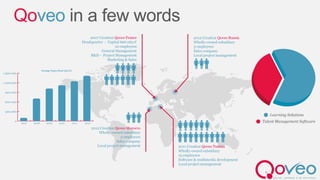
Qoveo
2007 Creation Qoveo France
Headquarter - Capital 666 063 €
10 employees
General Management
R&D – Project Management
Marketing & Sales
2011 Creation Qoveo Tunisia
Wholly-owned subsidiary
15 employees
Software & multimedia development
Local project management
2012 Creation Qoveo Russia
Wholly-owned subsidiary
3 employees
Sales company
Local project management
2012 Creation Qoveo Morocco
Wholly-owned subsidiary
3 employees
Sales company
Local project management
Human Capital
With Qopilot suite, enhance your human
capital to help your organization achieve its
objectives and get the benefits of social
learning & [net]working.
Digital Learning
Project
Consulting & Engineering
of Training
Design & Production
Customizable catalog
Deployment Support & Scalability
A complete range of pedagogical engineering,
from plan’s design to deployment.
Training Effectiveness?
Many training programs fail to deliver the expected
organizational benefits.
Business environment is not standing still.
Is Russian market more concerned than other
countries?
Model
Level 4 - Results
Level 3 - Behavior
Model
Level 1: Reaction
Consider addressing these questions:
Model
Level 2: Learning
Start by identifying what you want to evaluate:
Measure these areas both before and after training.
Model
Level 3: Behavior
Consider these questions:
Note that:
Model
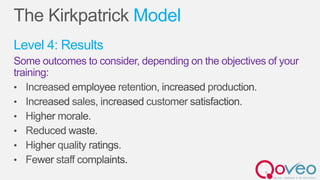
Level 4: Results
Some outcomes to consider, depending on the objectives of your
training:
Model
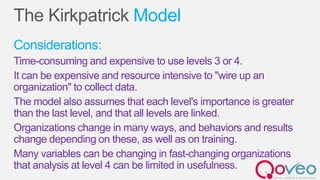
Considerations:
Time-consuming and expensive to use levels 3 or 4.
It can be expensive and resource intensive to "wire up an
organization" to collect data.
The model also assumes that each level's importance is greater
than the last level, and that all levels are linked.
Organizations change in many ways, and behaviors and results
change depending on these, as well as on training.
Many variables can be changing in fast-changing organizations
that analysis at level 4 can be limited in usefulness.
rapid growth
Digital Learning
Evaluate Training Effectiveness - Master Class Elearn Expo 2013

Evaluate Training Effectiveness - Master Class Elearn Expo 2013

  • 1.
  • 3.
    Qoveo 2007 Creation QoveoFrance Headquarter - Capital 666 063 € 10 employees General Management R&D – Project Management Marketing & Sales 2011 Creation Qoveo Tunisia Wholly-owned subsidiary 15 employees Software & multimedia development Local project management 2012 Creation Qoveo Russia Wholly-owned subsidiary 3 employees Sales company Local project management 2012 Creation Qoveo Morocco Wholly-owned subsidiary 3 employees Sales company Local project management
  • 4.
    Human Capital With Qopilotsuite, enhance your human capital to help your organization achieve its objectives and get the benefits of social learning & [net]working.
  • 5.
    Digital Learning Project Consulting &Engineering of Training Design & Production Customizable catalog Deployment Support & Scalability A complete range of pedagogical engineering, from plan’s design to deployment.
  • 7.
    Training Effectiveness? Many trainingprograms fail to deliver the expected organizational benefits. Business environment is not standing still. Is Russian market more concerned than other countries?
  • 8.
    Model Level 4 -Results Level 3 - Behavior
  • 9.
    Model Level 1: Reaction Consideraddressing these questions:
  • 10.
    Model Level 2: Learning Startby identifying what you want to evaluate: Measure these areas both before and after training.
  • 11.
    Model Level 3: Behavior Considerthese questions: Note that:
  • 12.
    Model Level 4: Results Someoutcomes to consider, depending on the objectives of your training:
  • 13.
    Model Considerations: Time-consuming and expensiveto use levels 3 or 4. It can be expensive and resource intensive to "wire up an organization" to collect data. The model also assumes that each level's importance is greater than the last level, and that all levels are linked. Organizations change in many ways, and behaviors and results change depending on these, as well as on training. Many variables can be changing in fast-changing organizations that analysis at level 4 can be limited in usefulness.
  • 15.