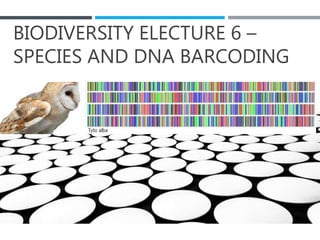
BIODIVERSITY ELECTURE 6 –
SPECIES AND DNA BARCODING
START THE
RECORDING & LIVE
TRANSCRIPT
CONTEXT WITHIN THE
COURSE
 We have found out how to classify organisms.
 We now have to find out about the most fundamental
units of biodiversity – species
 Last time we found out there are >30 different species
concept.
 Today we will look at the most commonly used
concepts and then look at a relatively recent approach
to identifying species.
 Then we will be able to proceed with topics such as
how many species there are, how many there have
been over time and many other topics.
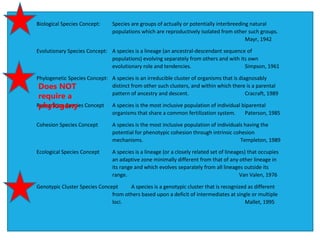
Biological Species Concept: Species are groups of actually or potentially interbreeding natural
populations which are reproductively isolated from other such groups.
Mayr, 1942
Evolutionary Species Concept: A species is a lineage (an ancestral-descendant sequence of
populations) evolving separately from others and with its own
evolutionary role and tendencies. Simpson, 1961
Phylogenetic Species Concept: A species is an irreducible cluster of organisms that is diagnosably
distinct from other such clusters, and within which there is a parental
pattern of ancestry and descent. Cracraft, 1989
Recognition Species Concept A species is the most inclusive population of individual biparental
organisms that share a common fertilization system. Paterson, 1985
Cohesion Species Concept A species is the most inclusive population of individuals having the
potential for phenotypic cohesion through intrinsic cohesion
mechanisms. Templeton, 1989
Ecological Species Concept A species is a lineage (or a closely related set of lineages) that occupies
an adaptive zone minimally different from that of any other lineage in
its range and which evolves separately from all lineages outside its
range. Van Valen, 1976
Genotypic Cluster Species Concept A species is a genotypic cluster that is recognized as different
from others based upon a deficit of intermediates at single or multiple
loci. Mallet, 1995
Does NOT
require a
phylogeny
A species is what a good
taxonomist says it is!
Why is it so hard to
come up with one
species concept for all
organisms? CHAT
WHY IS IT SO HARD TO COME UP WITH ONE SPECIES
CONCEPT FOR ALL ORGANISMS?
Evolution
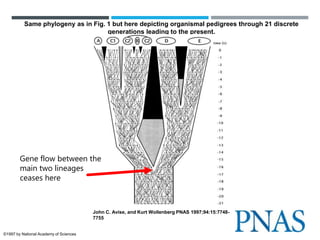
Same phylogeny as in Fig. 1 but here depicting organismal pedigrees through 21 discrete
generations leading to the present.
John C. Avise, and Kurt Wollenberg PNAS 1997;94:15:7748-
7755
©1997 by National Academy of Sciences
Gene flow between the
main two lineages
ceases here
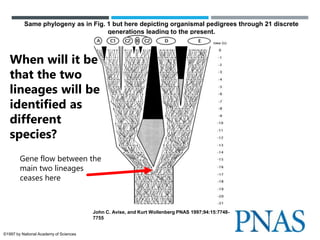
Same phylogeny as in Fig. 1 but here depicting organismal pedigrees through 21 discrete
generations leading to the present.
John C. Avise, and Kurt Wollenberg PNAS 1997;94:15:7748-
7755
©1997 by National Academy of Sciences
Gene flow between the
main two lineages
ceases here
When will it be
that the two
lineages will be
identified as
different
species?
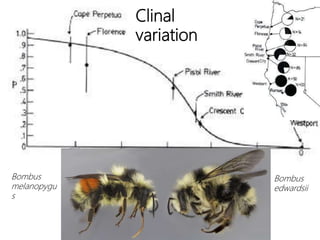
Clinal
variation
Bombus
melanopygu
s
Bombus
edwardsii
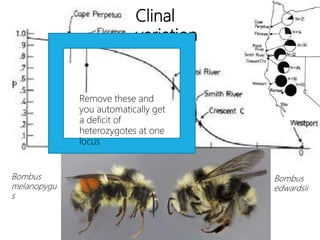
Clinal
variation
Bombus
melanopygu
s
Bombus
edwardsii
Remove these and
you automatically get
a deficit of
heterozygotes at one
locus
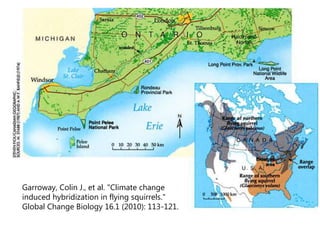
Garroway, Colin J., et al. "Climate change
induced hybridization in flying squirrels."
Global Change Biology 16.1 (2010): 113-121.
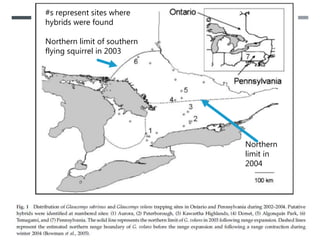
#s represent sites where
hybrids were found
Northern limit of southern
flying squirrel in 2003
Northern
limit in
2004
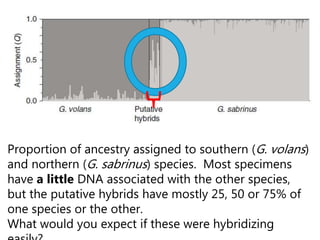
Proportion of ancestry assigned to southern (G. volans)
and northern (G. sabrinus) species. Most specimens
have a little DNA associated with the other species,
but the putative hybrids have mostly 25, 50 or 75% of
one species or the other.
What would you expect if these were hybridizing
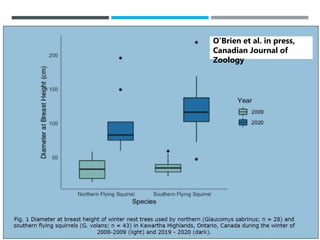
O’Brien et al. in press,
Canadian Journal of
Zoology
DNA BARCODING – A CANADIAN
INVENTION
Identification and species
discovery
ONE OF THE GOALS OF TAXONOMY IS TO MAKE IT
POSSIBLE TO IDENTIFY ORGANISMS
 This is often done through identification
keys
 “Keys are written by people who don’t
need them for people who can’t use them”
 More on this, perhaps, in a later lecture.
 But what of identification of featureless
bits of organisms?
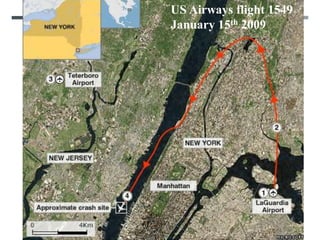
US Airways flight 1549
January 15th 2009
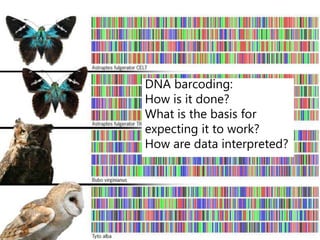
DNA barcoding:
How is it done?
What is the basis for
expecting it to work?
How are data interpreted?
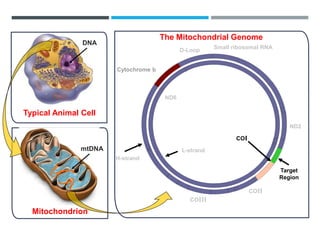
DNA Barcoding – Animal target gene
Typical Animal Cell
Mitochondrion
DNA
mtDNA
Cytochrome b
The Mitochondrial Genome
D-Loop
H-strand
COIII
L-strand
ND6
ND2
COII
Small ribosomal RNA
COI
Target
Region
BIODIVERSITY INSTITUTE OF ONTARIO - INFRASTRUCTURE - 2008
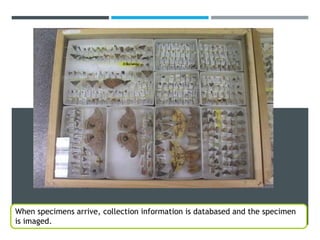
Specimen Imaging and Databasing
When specimens arrive, collection information is databased and the specimen
is imaged.
Specimen Tissue Sampling
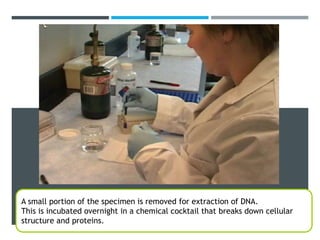
A small portion of the specimen is removed for extraction of DNA.
This is incubated overnight in a chemical cocktail that breaks down cellular
structure and proteins.
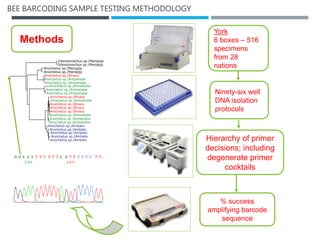
BEE BARCODING SAMPLE TESTING METHODOLOGY
Methods
York
6 boxes – 516
specimens
from 28
nations
Ninety-six well
DNA isolation
protocols
Hierarchy of primer
decisions; including
degenerate primer
cocktails
% success
amplifying barcode
sequence
Anochetus sp.|Ambato
Anochetus sp.|Antsahabe
Anochetus sp.|Binara
Anochetus sp.|Antsahabe
Anochetus sp.|Binara
Anochetus sp.|Antsahabe
Anochetus sp.|Binara
Anochetus sp.|Marojejy
Odontomachus sp.|Marojejy
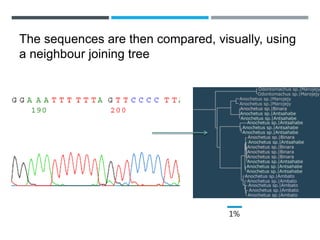
The sequences are then compared, visually, using
a neighbour joining tree
1%
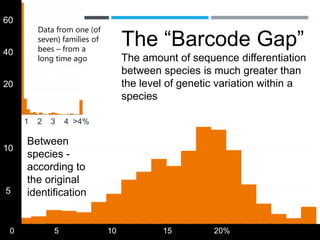
The “Barcode Gap”
The amount of sequence differentiation
between species is much greater than
the level of genetic variation within a
species
1 2 3 4 >4%
0 5 10 15 20%
60
40
20
10
5
Within a
species –
according
to the
original
identification
Between
species -
according to
the original
identification
Data from one (of
seven) families of
bees – from a
long time ago
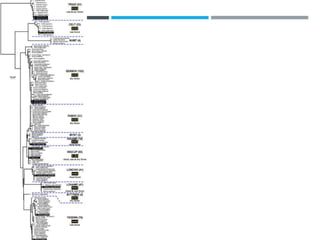
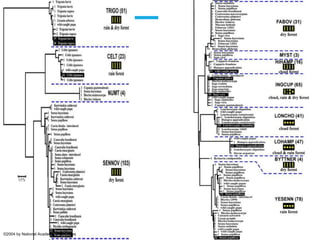
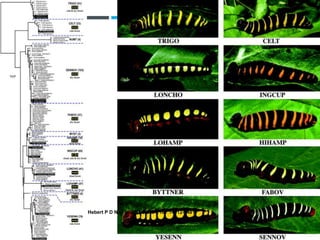
A detailed example: Astraptes fulgerator.
Hebert P D N et al. PNAS 2004;101:14812-14817
©2004 by National Academy of Sciences
Hebert P D N et al. PNAS 2004;101:14812-14817
©2004 by National Academy of Sciences
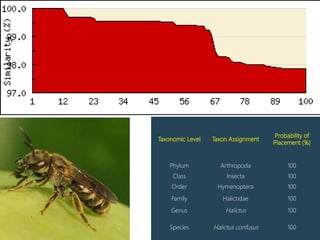
Taxonomic Level Taxon Assignment
Probability of
Placement (%)
Phylum Arthropoda 100
Class Insecta 100
Order Hymenoptera 100
Family Halictidae 100
Genus Halictus 100
Species Halictus confusus 100
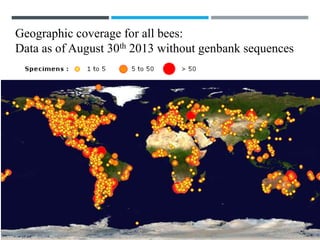
Geographic coverage for all bees:
Data as of August 30th 2013 without genbank sequences
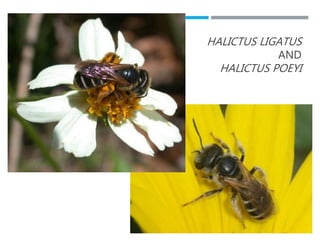
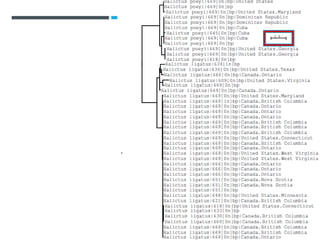
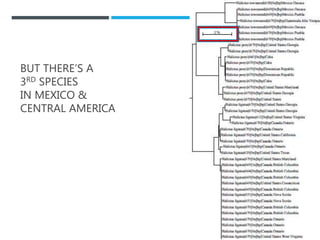
HALICTUS LIGATUS
AND
HALICTUS POEYI
.
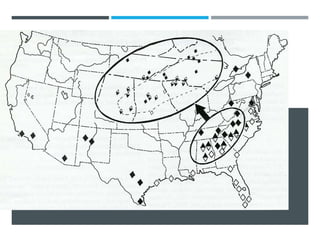
BUT THERE’S A
3RD SPECIES
IN MEXICO &
CENTRAL AMERICA
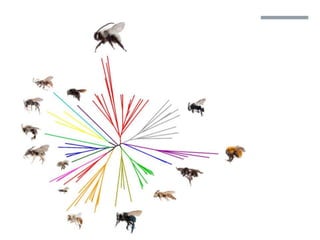
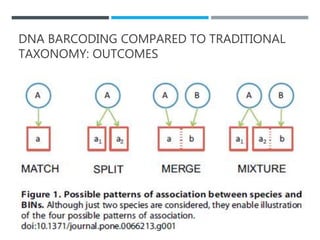
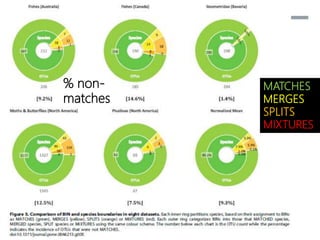
DNA BARCODING COMPARED TO TRADITIONAL
TAXONOMY: OUTCOMES
MATCHES
MERGES
SPLITS
MIXTURES
% non-
matches
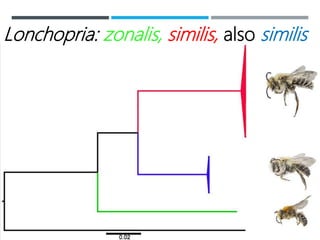
Lonchopria: zonalis, similis, also similis
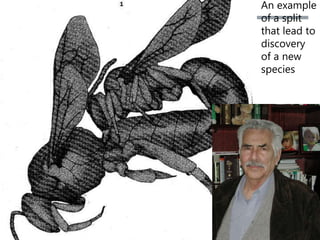
An example
of a split
that lead to
discovery
of a new
species
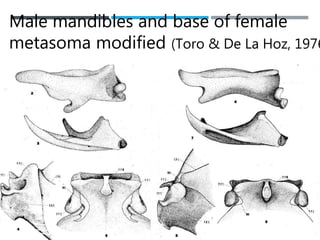
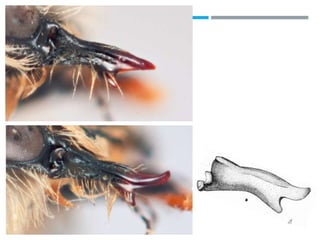
Male mandibles and base of female
metasoma modified (Toro & De La Hoz, 1976
 SOMETIMES DNA BARCODING HELPS US
TELL SPECIES APART THAT WOULD
OTHERWISE BE DIFFICULT TO IMPOSSIBLE
 BUT THERE ARE ALSO EXAMPLES OF BEES
THAT ARE MORPHOLOGICALLY SEPARABLE
BUT HAVE IDENTICAL BARCODES
 THE SAME APPLIES TO OTHER TAXA
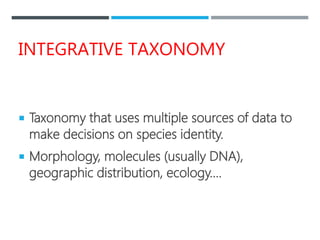
INTEGRATIVE TAXONOMY
 Taxonomy that uses multiple sources of data to
make decisions on species identity.
 Morphology, molecules (usually DNA),
geographic distribution, ecology….
A species is what a good
taxonomist says it is!

Biodiversity electurespecies and DNA Barcoding handout.pptx

  • 1.
    BIODIVERSITY ELECTURE 6– SPECIES AND DNA BARCODING
  • 2.
    START THE RECORDING &LIVE TRANSCRIPT
  • 3.
    CONTEXT WITHIN THE COURSE We have found out how to classify organisms.  We now have to find out about the most fundamental units of biodiversity – species  Last time we found out there are >30 different species concept.  Today we will look at the most commonly used concepts and then look at a relatively recent approach to identifying species.  Then we will be able to proceed with topics such as how many species there are, how many there have been over time and many other topics.
  • 4.
    Biological Species Concept:Species are groups of actually or potentially interbreeding natural populations which are reproductively isolated from other such groups. Mayr, 1942 Evolutionary Species Concept: A species is a lineage (an ancestral-descendant sequence of populations) evolving separately from others and with its own evolutionary role and tendencies. Simpson, 1961 Phylogenetic Species Concept: A species is an irreducible cluster of organisms that is diagnosably distinct from other such clusters, and within which there is a parental pattern of ancestry and descent. Cracraft, 1989 Recognition Species Concept A species is the most inclusive population of individual biparental organisms that share a common fertilization system. Paterson, 1985 Cohesion Species Concept A species is the most inclusive population of individuals having the potential for phenotypic cohesion through intrinsic cohesion mechanisms. Templeton, 1989 Ecological Species Concept A species is a lineage (or a closely related set of lineages) that occupies an adaptive zone minimally different from that of any other lineage in its range and which evolves separately from all lineages outside its range. Van Valen, 1976 Genotypic Cluster Species Concept A species is a genotypic cluster that is recognized as different from others based upon a deficit of intermediates at single or multiple loci. Mallet, 1995 Does NOT require a phylogeny
  • 5.
    A species iswhat a good taxonomist says it is!
  • 6.
    Why is itso hard to come up with one species concept for all organisms? CHAT
  • 7.
    WHY IS ITSO HARD TO COME UP WITH ONE SPECIES CONCEPT FOR ALL ORGANISMS? Evolution
  • 8.
    Same phylogeny asin Fig. 1 but here depicting organismal pedigrees through 21 discrete generations leading to the present. John C. Avise, and Kurt Wollenberg PNAS 1997;94:15:7748- 7755 ©1997 by National Academy of Sciences Gene flow between the main two lineages ceases here
  • 9.
    Same phylogeny asin Fig. 1 but here depicting organismal pedigrees through 21 discrete generations leading to the present. John C. Avise, and Kurt Wollenberg PNAS 1997;94:15:7748- 7755 ©1997 by National Academy of Sciences Gene flow between the main two lineages ceases here When will it be that the two lineages will be identified as different species?
  • 10.
  • 11.
    Clinal variation Bombus melanopygu s Bombus edwardsii Remove these and youautomatically get a deficit of heterozygotes at one locus
  • 12.
    Garroway, Colin J.,et al. "Climate change induced hybridization in flying squirrels." Global Change Biology 16.1 (2010): 113-121.
  • 13.
    #s represent siteswhere hybrids were found Northern limit of southern flying squirrel in 2003 Northern limit in 2004
  • 14.
    Proportion of ancestryassigned to southern (G. volans) and northern (G. sabrinus) species. Most specimens have a little DNA associated with the other species, but the putative hybrids have mostly 25, 50 or 75% of one species or the other. What would you expect if these were hybridizing
  • 15.
    O’Brien et al.in press, Canadian Journal of Zoology
  • 16.
    DNA BARCODING –A CANADIAN INVENTION Identification and species discovery
  • 17.
    ONE OF THEGOALS OF TAXONOMY IS TO MAKE IT POSSIBLE TO IDENTIFY ORGANISMS  This is often done through identification keys  “Keys are written by people who don’t need them for people who can’t use them”  More on this, perhaps, in a later lecture.  But what of identification of featureless bits of organisms?
  • 18.
    US Airways flight1549 January 15th 2009
  • 19.
    DNA barcoding: How isit done? What is the basis for expecting it to work? How are data interpreted?
  • 20.
    DNA Barcoding –Animal target gene Typical Animal Cell Mitochondrion DNA mtDNA Cytochrome b The Mitochondrial Genome D-Loop H-strand COIII L-strand ND6 ND2 COII Small ribosomal RNA COI Target Region
  • 21.
    BIODIVERSITY INSTITUTE OFONTARIO - INFRASTRUCTURE - 2008
  • 22.
    Specimen Imaging andDatabasing When specimens arrive, collection information is databased and the specimen is imaged.
  • 23.
    Specimen Tissue Sampling Asmall portion of the specimen is removed for extraction of DNA. This is incubated overnight in a chemical cocktail that breaks down cellular structure and proteins.
  • 24.
    BEE BARCODING SAMPLETESTING METHODOLOGY Methods York 6 boxes – 516 specimens from 28 nations Ninety-six well DNA isolation protocols Hierarchy of primer decisions; including degenerate primer cocktails % success amplifying barcode sequence Anochetus sp.|Ambato Anochetus sp.|Ambato Anochetus sp.|Ambato Anochetus sp.|Ambato Anochetus sp.|Ambato Anochetus sp.|Antsahabe Anochetus sp.|Antsahabe Anochetus sp.|Antsahabe Anochetus sp.|Binara Anochetus sp.|Binara Anochetus sp.|Binara Anochetus sp.|Antsahabe Anochetus sp.|Binara Anochetus sp.|Antsahabe Anochetus sp.|Antsahabe Anochetus sp.|Antsahabe Anochetus sp.|Antsahabe Anochetus sp.|Antsahabe Anochetus sp.|Binara Anochetus sp.|Marojejy Anochetus sp.|Marojejy Odontomachus sp.|Marojejy Odontomachus sp.|Marojejy
  • 25.
    The sequences arethen compared, visually, using a neighbour joining tree 1%
  • 26.
    The “Barcode Gap” Theamount of sequence differentiation between species is much greater than the level of genetic variation within a species 1 2 3 4 >4% 0 5 10 15 20% 60 40 20 10 5 Within a species – according to the original identification Between species - according to the original identification Data from one (of seven) families of bees – from a long time ago
  • 27.
    A detailed example:Astraptes fulgerator. Hebert P D N et al. PNAS 2004;101:14812-14817 ©2004 by National Academy of Sciences
  • 29.
    ©2004 by NationalAcademy of Sciences
  • 30.
    Hebert P DN et al. PNAS 2004;101:14812-14817 ©2004 by National Academy of Sciences
  • 31.
    Taxonomic Level TaxonAssignment Probability of Placement (%) Phylum Arthropoda 100 Class Insecta 100 Order Hymenoptera 100 Family Halictidae 100 Genus Halictus 100 Species Halictus confusus 100
  • 32.
    Geographic coverage forall bees: Data as of August 30th 2013 without genbank sequences
  • 33.
  • 35.
  • 36.
    BUT THERE’S A 3RDSPECIES IN MEXICO & CENTRAL AMERICA
  • 38.
    DNA BARCODING COMPAREDTO TRADITIONAL TAXONOMY: OUTCOMES
  • 39.
  • 40.
  • 41.
    An example of asplit that lead to discovery of a new species
  • 42.
    Male mandibles andbase of female metasoma modified (Toro & De La Hoz, 1976
  • 44.
     SOMETIMES DNABARCODING HELPS US TELL SPECIES APART THAT WOULD OTHERWISE BE DIFFICULT TO IMPOSSIBLE  BUT THERE ARE ALSO EXAMPLES OF BEES THAT ARE MORPHOLOGICALLY SEPARABLE BUT HAVE IDENTICAL BARCODES  THE SAME APPLIES TO OTHER TAXA
  • 45.
    INTEGRATIVE TAXONOMY  Taxonomythat uses multiple sources of data to make decisions on species identity.  Morphology, molecules (usually DNA), geographic distribution, ecology….
  • 46.
    A species iswhat a good taxonomist says it is!