Purple Loosestrife State-wide Program
Missouri Department of Conservation

           Invasive Plant Workshop
               Powder Valley CA
              Kirkwood , Missouri
                  May 16, 2012


                Kyle Lairmore
        Private Land Conservationist
    Missouri Department of Conservation
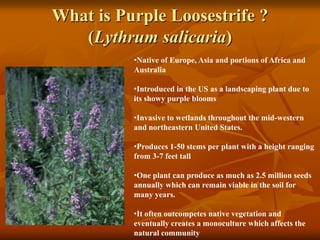
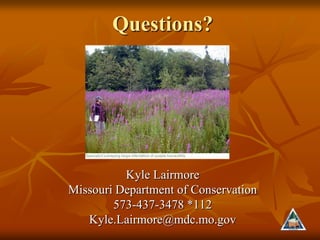
What is Purple Loosestrife ?
   (Lythrum salicaria)
          •Native of Europe, Asia and portions of Africa and
          Australia

          •Introduced in the US as a landscaping plant due to
          its showy purple blooms

          •Invasive to wetlands throughout the mid-western
          and northeastern United States.

          •Produces 1-50 stems per plant with a height ranging
          from 3-7 feet tall

          •One plant can produce as much as 2.5 million seeds
          annually which can remain viable in the soil for
          many years.

          •It often outcompetes native vegetation and
          eventually creates a monoculture which affects the
          natural community
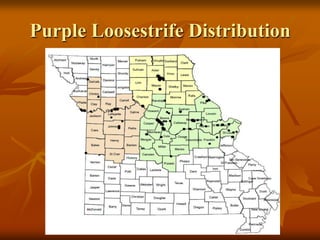
Purple Loosestrife Distribution
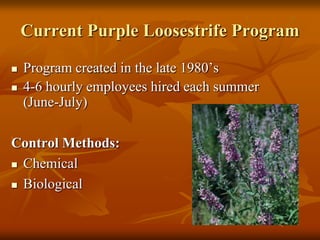
Current Purple Loosestrife Program

   Program created in the late 1980’s
   4-6 hourly employees hired each summer
    (June-July)

Control Methods:
 Chemical

 Biological
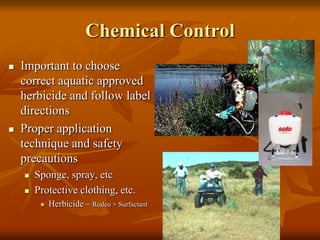
Chemical Control
   Important to choose
    correct aquatic approved
    herbicide and follow label
    directions
   Proper application
    technique and safety
    precautions
       Sponge, spray, etc
       Protective clothing, etc.
            Herbicide – Rodeo + Surfactant
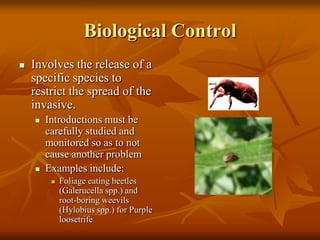
Biological Control
   Involves the release of a
    specific species to
    restrict the spread of the
    invasive.
       Introductions must be
        carefully studied and
        monitored so as to not
        cause another problem
       Examples include:
            Foliage eating beetles
             (Galerucella spp.) and
             root-boring weevils
             (Hylobius spp.) for Purple
             loosetrife
Comparison of Various Herbicides to
     Improve Effectiveness of
    Purple Loosestrife Control
MDC Project Leader: Kyle Lairmore (MDC
PLS)

Principal Investigator: Doreen Mengel (MDC
RS) & Kyle Lairmore (MDC PLS)

Team members: Ivan Vining, Brent
Vandeloecht, Ted Seiler, Bill White, Bob
DeWitt & John Knudsen (ALL MDC)
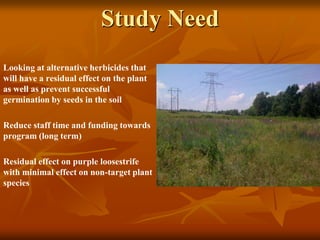
Study Need
Looking at alternative herbicides that
will have a residual effect on the plant
as well as prevent successful
germination by seeds in the soil

Reduce staff time and funding towards
program (long term)

Residual effect on purple loosestrife
with minimal effect on non-target plant
species
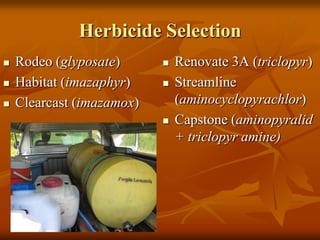
Herbicide Selection
   Rodeo (glyposate)         Renovate 3A (triclopyr)
   Habitat (imazaphyr)       Streamline
   Clearcast (imazamox)       (aminocyclopyrachlor)
                              Capstone (aminopyralid
                               + triclopyr amine)
Management Prediction or Objective

   Determine which treatment provides the most
    effective long-term population control of
    purple loosestrife.

   Determine the effect of each treatment on the
    native plant community.
Uncertainties/Risk Tolerance

   Is there an herbicide labeled for aquatic settings that
    provides long-term control of purple loosestrife?

   What are the risks of not treating purple loosestrife
    annually?

   What are the effects on the native plant community?
Evaluation of Success
   A herbicide will be considered successful if it meets the
    objectives of the study; it shows a long-term effect on
    purple loosestrife while having minimal if no effect on
    native plant community and re-vegetation of desirable plant
    species

   A herbicide would not be selected if it shows no long-term
    effects on purple loosestrife and allows no re-vegetation of
    native and/or desirable plant species
Summary
   Purple Loosestrife continues to be an issue in
    wetlands, competing with native plants while not
    providing any benefits to wildlife

   We have an active state-wide eradication program

   We hope the research project will help us find
    alternative herbicides which will be more
    effective for eradicating Purple Loosestrife
Questions?


          Kyle Lairmore
Missouri Department of Conservation
        573-437-3478 *112
   Kyle.Lairmore@mdc.mo.gov

Purple Loosestrife State-wide Program

  • 1.
    Purple Loosestrife State-wideProgram Missouri Department of Conservation Invasive Plant Workshop Powder Valley CA Kirkwood , Missouri May 16, 2012 Kyle Lairmore Private Land Conservationist Missouri Department of Conservation
  • 2.
    What is PurpleLoosestrife ? (Lythrum salicaria) •Native of Europe, Asia and portions of Africa and Australia •Introduced in the US as a landscaping plant due to its showy purple blooms •Invasive to wetlands throughout the mid-western and northeastern United States. •Produces 1-50 stems per plant with a height ranging from 3-7 feet tall •One plant can produce as much as 2.5 million seeds annually which can remain viable in the soil for many years. •It often outcompetes native vegetation and eventually creates a monoculture which affects the natural community
  • 3.
  • 4.
    Current Purple LoosestrifeProgram  Program created in the late 1980’s  4-6 hourly employees hired each summer (June-July) Control Methods:  Chemical  Biological
  • 5.
    Chemical Control  Important to choose correct aquatic approved herbicide and follow label directions  Proper application technique and safety precautions  Sponge, spray, etc  Protective clothing, etc.  Herbicide – Rodeo + Surfactant
  • 6.
    Biological Control  Involves the release of a specific species to restrict the spread of the invasive.  Introductions must be carefully studied and monitored so as to not cause another problem  Examples include:  Foliage eating beetles (Galerucella spp.) and root-boring weevils (Hylobius spp.) for Purple loosetrife
  • 7.
    Comparison of VariousHerbicides to Improve Effectiveness of Purple Loosestrife Control MDC Project Leader: Kyle Lairmore (MDC PLS) Principal Investigator: Doreen Mengel (MDC RS) & Kyle Lairmore (MDC PLS) Team members: Ivan Vining, Brent Vandeloecht, Ted Seiler, Bill White, Bob DeWitt & John Knudsen (ALL MDC)
  • 8.
    Study Need Looking atalternative herbicides that will have a residual effect on the plant as well as prevent successful germination by seeds in the soil Reduce staff time and funding towards program (long term) Residual effect on purple loosestrife with minimal effect on non-target plant species
  • 9.
    Herbicide Selection  Rodeo (glyposate)  Renovate 3A (triclopyr)  Habitat (imazaphyr)  Streamline  Clearcast (imazamox) (aminocyclopyrachlor)  Capstone (aminopyralid + triclopyr amine)
  • 10.
    Management Prediction orObjective  Determine which treatment provides the most effective long-term population control of purple loosestrife.  Determine the effect of each treatment on the native plant community.
  • 11.
    Uncertainties/Risk Tolerance  Is there an herbicide labeled for aquatic settings that provides long-term control of purple loosestrife?  What are the risks of not treating purple loosestrife annually?  What are the effects on the native plant community?
  • 12.
    Evaluation of Success  A herbicide will be considered successful if it meets the objectives of the study; it shows a long-term effect on purple loosestrife while having minimal if no effect on native plant community and re-vegetation of desirable plant species  A herbicide would not be selected if it shows no long-term effects on purple loosestrife and allows no re-vegetation of native and/or desirable plant species
  • 13.
    Summary  Purple Loosestrife continues to be an issue in wetlands, competing with native plants while not providing any benefits to wildlife  We have an active state-wide eradication program  We hope the research project will help us find alternative herbicides which will be more effective for eradicating Purple Loosestrife
  • 14.
    Questions? Kyle Lairmore Missouri Department of Conservation 573-437-3478 *112 Kyle.Lairmore@mdc.mo.gov

Editor's Notes

  • #6 For the past 15 years, MDC has spent approximately $45.000.00 annually working with private landowners to manage and control this wetland invasive. Foliage eating beetles (Galerucella spp.) and root-boring weevils (Hylobius spp.) for Purple loosetrife