Understanding the Impacts of
Insect Decline on Ecological
Function and Human Well-Being
Introduction
• Insects decline is a major concern for
human health because essential
micronutrients in our diet come from
insect-pollinator mediated crops
• because phyto pharmaceuticals and
nutritional supplements depend on
pollinators
Introduction
• Analysis found that complete removal of
pollinators could increase global deaths
yearly from non-communicable and
malnutrition-related diseases by about 1.4
million and disability- adjusted life-years by
about 27 million an increase of 2.7% for
deaths
Introduction
• Insects decline disturbs the key insect
mediated ecosystems functions including
nutrient cycling, soil formation,
decomposition, and water purification,
pollination services and food web support
that all are critical to ecosystem
functioning and human survival.
• including loss of biodiversity higher-up in
the food-web (e.g. insectivorous birds) and
impairment of ecosystem resilience
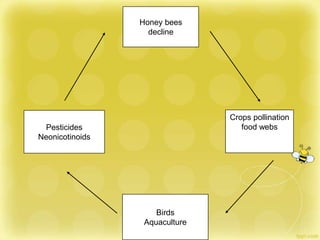
Honey bees
decline
Crops pollination
food webs
Birds
Aquaculture
Pesticides
Neonicotinoids
How pesticides infect honey
bees
• Neoniconitid
• Diazinon
• Imidan
• Malathion
Aims
• Declines were also found in Netherlands
Guardian columnist George Monbiot coined
the term ‘insect ageddon’ to warn that the
impacts of global insect collapse are more
catastrophic than climate breakdown
• Although this term has been criticised as being
overly alarmist and unsubstantiated by data,
entomologists warn that insects are indeed
disappearing before we even have data
Aims
• Of the approximately 5.5 million insect
species, about 90% has not even been named,
nor have their roles in ecosystems been
mapped. No global scientific monitoring of
insect abundance in the past and present exists
and there are no plans for systematic global
monitoring in the near future
Project Summary
• Insects constitute more than half of global
biodiversity and play a central role in the
functioning of terrestrial ecosystems. Declines
of insect abundance, biomass, and range are
being reported from many places around the
world, from the Arctic to the tropics, across
insect orders, and from a spectrum of
ecological guilds but they are not universal,
with certain taxonomic groups, guilds or
communities clearly not declining
• An important aspect of recent studies is the
decline of formerly common species, not just
rare taxa, with the realization that such losses
likely come with changes to ecosystem
function, stability and resilience
• This project will work with existing long-term
insect assemblage and time series datasets to
develop and explore hypotheses about
relationships between insect (or arthropod)
abundance, diversity, and the stability of
ecological functions It will also develop
methods to value ecosystem services provided
by insects, at large or even global scales

Project presentation on insects

  • 1.
    Understanding the Impactsof Insect Decline on Ecological Function and Human Well-Being
  • 2.
    Introduction • Insects declineis a major concern for human health because essential micronutrients in our diet come from insect-pollinator mediated crops • because phyto pharmaceuticals and nutritional supplements depend on pollinators
  • 3.
    Introduction • Analysis foundthat complete removal of pollinators could increase global deaths yearly from non-communicable and malnutrition-related diseases by about 1.4 million and disability- adjusted life-years by about 27 million an increase of 2.7% for deaths
  • 4.
    Introduction • Insects declinedisturbs the key insect mediated ecosystems functions including nutrient cycling, soil formation, decomposition, and water purification, pollination services and food web support that all are critical to ecosystem functioning and human survival. • including loss of biodiversity higher-up in the food-web (e.g. insectivorous birds) and impairment of ecosystem resilience
  • 5.
    Honey bees decline Crops pollination foodwebs Birds Aquaculture Pesticides Neonicotinoids
  • 7.
    How pesticides infecthoney bees • Neoniconitid • Diazinon • Imidan • Malathion
  • 8.
    Aims • Declines werealso found in Netherlands Guardian columnist George Monbiot coined the term ‘insect ageddon’ to warn that the impacts of global insect collapse are more catastrophic than climate breakdown • Although this term has been criticised as being overly alarmist and unsubstantiated by data, entomologists warn that insects are indeed disappearing before we even have data
  • 9.
    Aims • Of theapproximately 5.5 million insect species, about 90% has not even been named, nor have their roles in ecosystems been mapped. No global scientific monitoring of insect abundance in the past and present exists and there are no plans for systematic global monitoring in the near future
  • 10.
    Project Summary • Insectsconstitute more than half of global biodiversity and play a central role in the functioning of terrestrial ecosystems. Declines of insect abundance, biomass, and range are being reported from many places around the world, from the Arctic to the tropics, across insect orders, and from a spectrum of ecological guilds but they are not universal, with certain taxonomic groups, guilds or communities clearly not declining
  • 11.
    • An importantaspect of recent studies is the decline of formerly common species, not just rare taxa, with the realization that such losses likely come with changes to ecosystem function, stability and resilience
  • 12.
    • This projectwill work with existing long-term insect assemblage and time series datasets to develop and explore hypotheses about relationships between insect (or arthropod) abundance, diversity, and the stability of ecological functions It will also develop methods to value ecosystem services provided by insects, at large or even global scales