Embedding Enterprise in the
  Curriculum - the Staff
       Perspective
  Kirsty Grant and Katie Hook, Student
               Researchers
   Sheila Quairney, Enterprise Centre
What is Enterprise in the Curriculum?
•   An approach to learning, not a subject in itself
•   The application of creative ideas and innovation to practical situations
•   A generic concept that can be applied across all areas of education
•   Combines creativity, ideas development and problem solving with
    expression, communication and practical action
•   Does not necessarily refer to creating a project or business venture
•   Produces graduates with the mindset and skills to come up with original
    ideas in response to identified needs and shortfalls, and the ability to act
    on them
•   Includes taking the initiative, intuitive decision making, making things
    happen, networking, identifying opportunities, creative problem solving,
    strategic thinking, and personal effectiveness
•   Enterprise education extends beyond knowledge acquisition to a wide
    range of emotional, intellectual, social, and practical skills
Why do Enterprising Skills Matter?
•   'The labour market requires graduates with enhanced skills who can think on their
    feet and be innovative in a global economic environment' (The Quality Assurance
    Agency for Higher Education (QAA), April 2012)

•   'Universities should reflect on the strategies they use to ensure that students have
    the opportunity to develop enterprise skills both through the formal curriculum
    and through optional study or practice, and reflect on the integration of enterprise
    education in the professional development programmes for academic staff'
    (Review of Business–University Collaboration :Professor Sir Tim Wilson DL)

•   'We must not lose sight of the talent universities are really put on earth to deliver.
    They must provide us with people with the ability to continually learn, to think
    critically and theoretically, to be reflective and reflexive, to innovate and break
    the status quo, and to navigate in the unstable waters of the global economy.' Dr
    David Docherty, chief executive of the Council for Industry and Higher Education
Research Aims

1) To ascertain what involvement staff, at Sheffield
  Hallam University, perceive they should have in
  sharing notions of enterprise with their students

2) To explore the perspectives of academic staff on
  how enterprise might be developed in the
  curriculum to support employability
Methodology

• Convenience sample of lecturers, across faculties

• Participation was voluntary and responses anonymised

• Exploratory qualitative approach

• 30 semi-structured interviews conducted lasting between
  20-30 minutes

• Thematic analysis of data
Our Experience
Results
• Participants N = 30

• All active permanent teaching staff (years teaching
  M = 9.8, SD=8.8)

• 40% (n=12) in faculty of SBS, similar responses
  between D&S, ACES and H&WB

• 46.7% (n=14) of staff previous role had been in
  the private sector with the rest split between
  academic and public sector roles
Preliminary Findings
1) Defining enterprise education

2) Embedding enterprise

3) Influence of staff background

4) Importance of students' real-life experience

5) One size doesn’t fit all

6) Initiative Overload
Defining Enterprise Education?
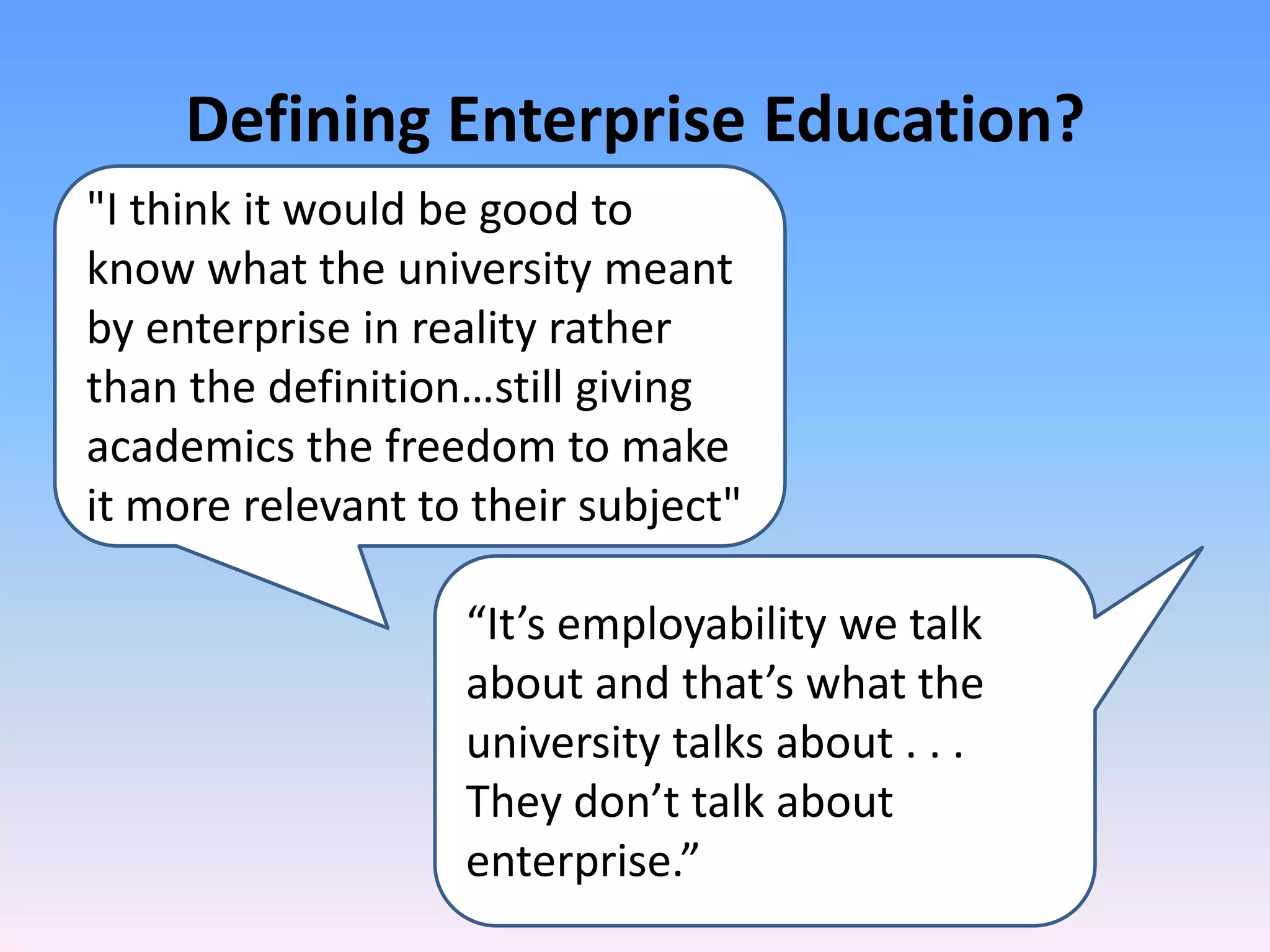
"I think it would be good to
know what the university meant
by enterprise in reality rather
than the definition…still giving
academics the freedom to make
it more relevant to their subject"

                   “It’s employability we talk
                   about and that’s what the
                   university talks about . . .
                   They don’t talk about
                   enterprise.”
Embedding Enterprise
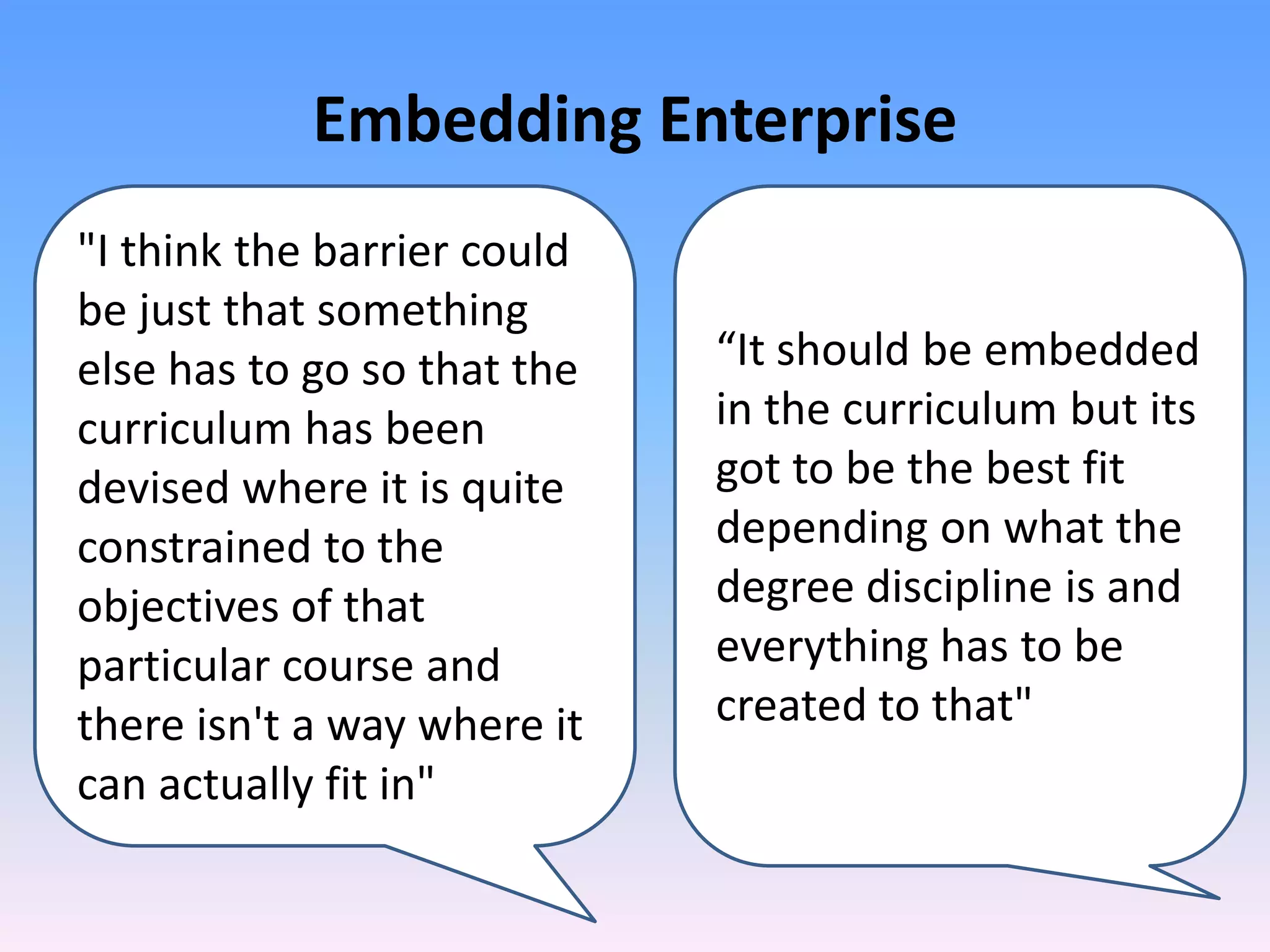
"I think the barrier could
be just that something
else has to go so that the   “It should be embedded
curriculum has been          in the curriculum but its
devised where it is quite    got to be the best fit
constrained to the           depending on what the
objectives of that           degree discipline is and
particular course and        everything has to be
there isn't a way where it   created to that"
can actually fit in"
Influence of Staff Background

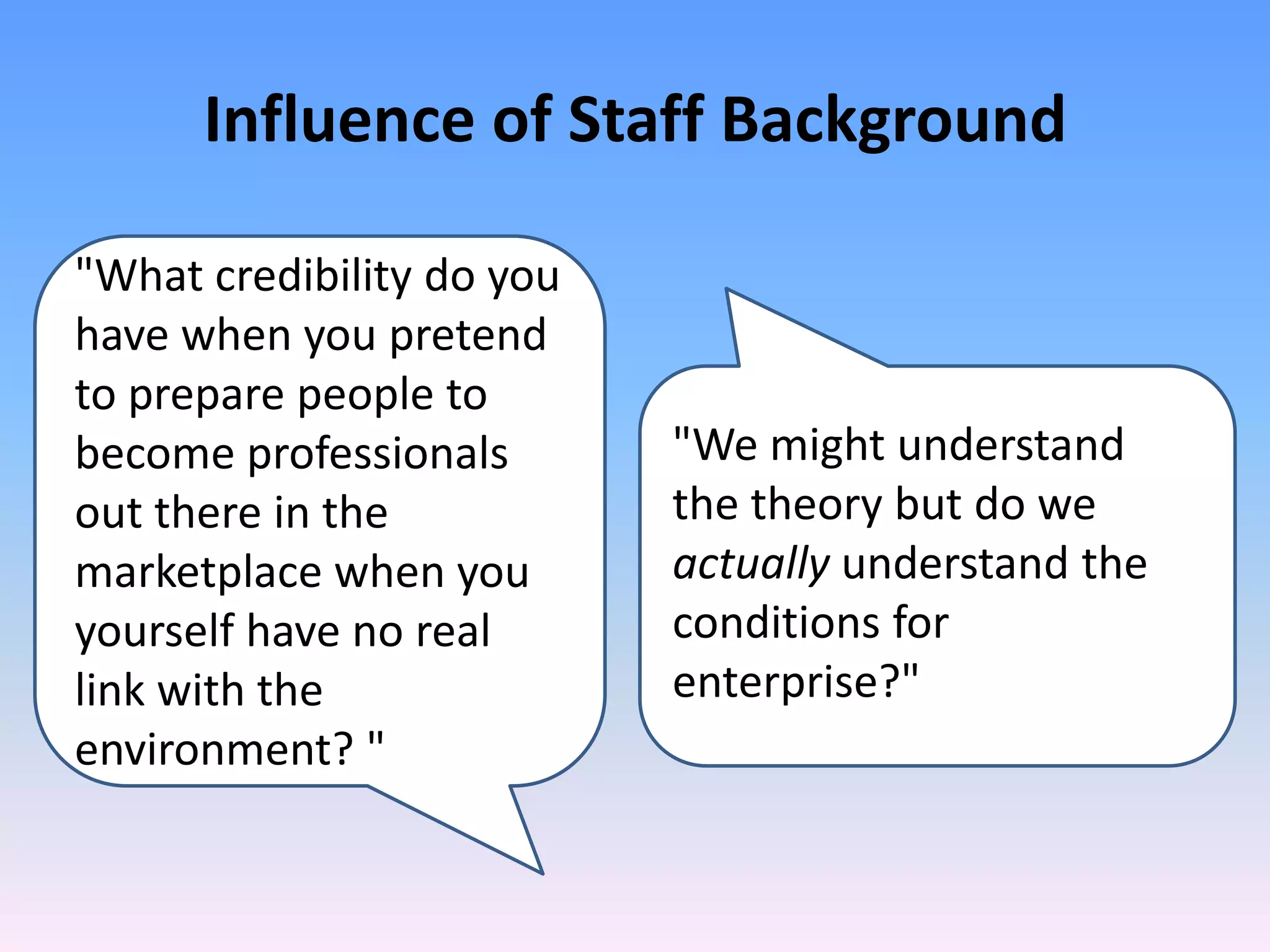
"What credibility do you
have when you pretend
to prepare people to
become professionals       "We might understand
out there in the           the theory but do we
marketplace when you       actually understand the
yourself have no real      conditions for
link with the              enterprise?"
environment? "
Importance of Students' Real-Life
             Experience
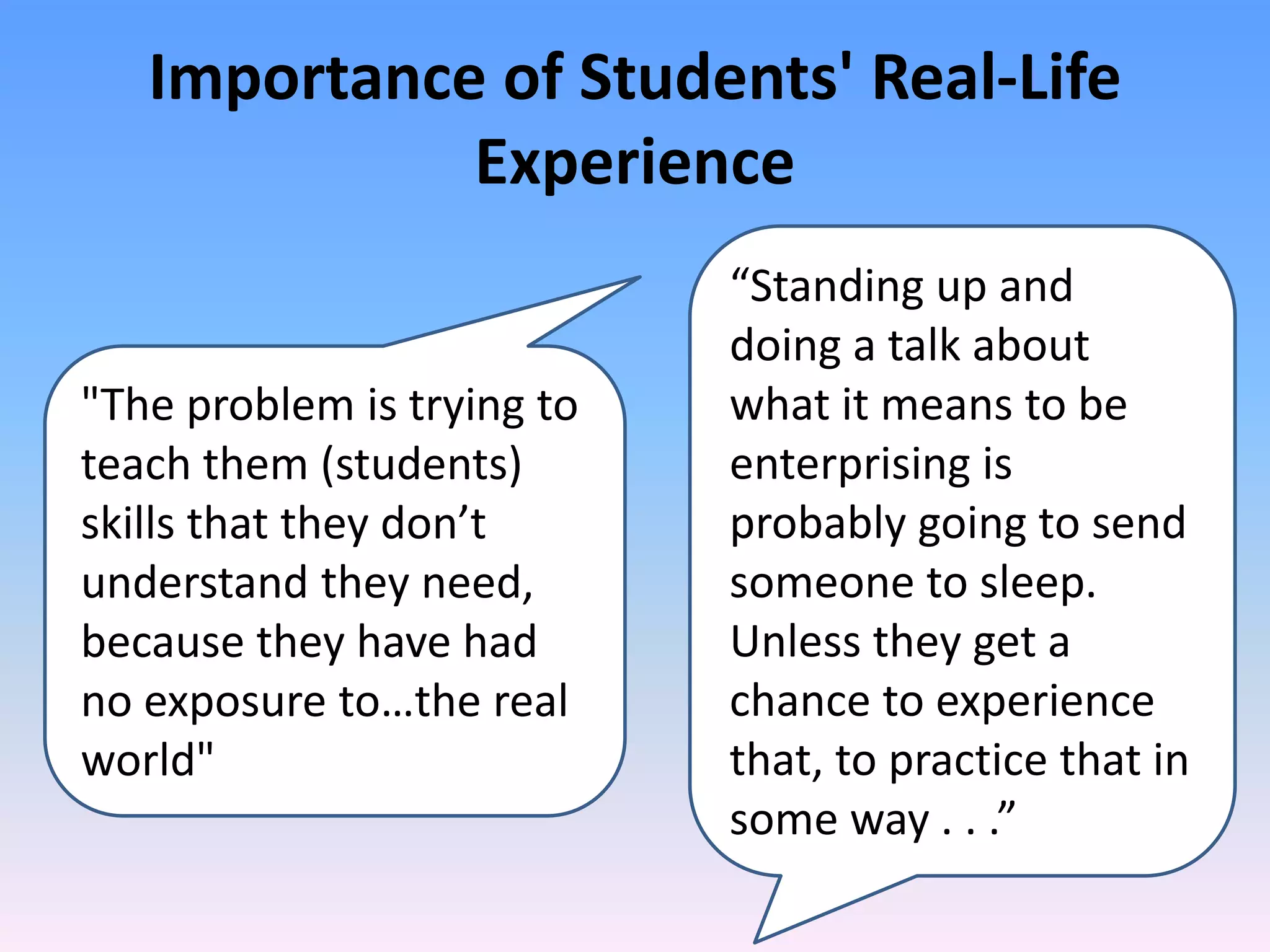
                            “Standing up and
                            doing a talk about
"The problem is trying to   what it means to be
teach them (students)       enterprising is
skills that they don’t      probably going to send
understand they need,       someone to sleep.
because they have had       Unless they get a
no exposure to…the real     chance to experience
world"                      that, to practice that in
                            some way . . .”
One Size Doesn’t Fit All

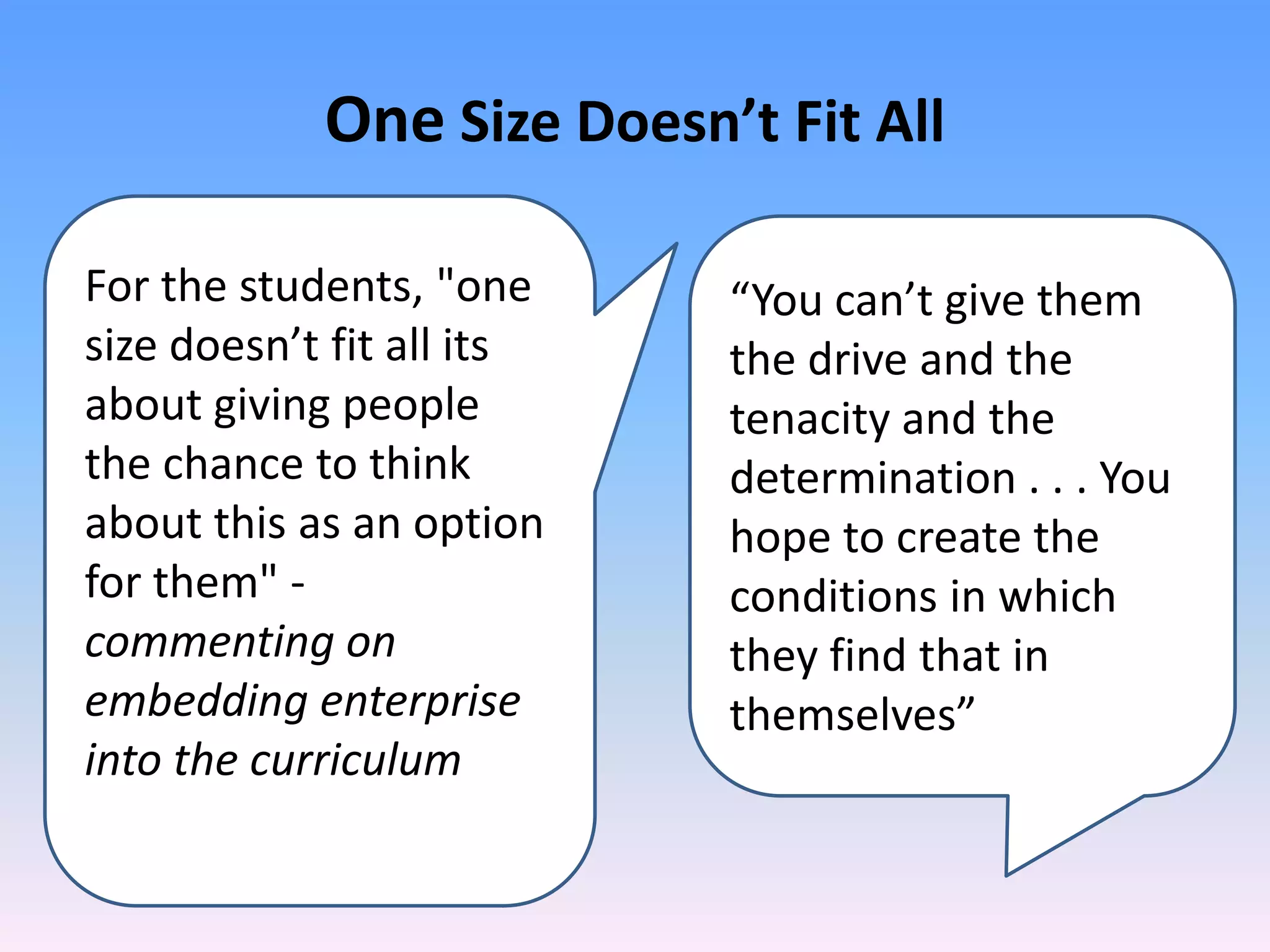
For the students, "one     “You can’t give them
size doesn’t fit all its   the drive and the
about giving people        tenacity and the
the chance to think        determination . . . You
about this as an option    hope to create the
for them" -                conditions in which
commenting on              they find that in
embedding enterprise       themselves”
into the curriculum
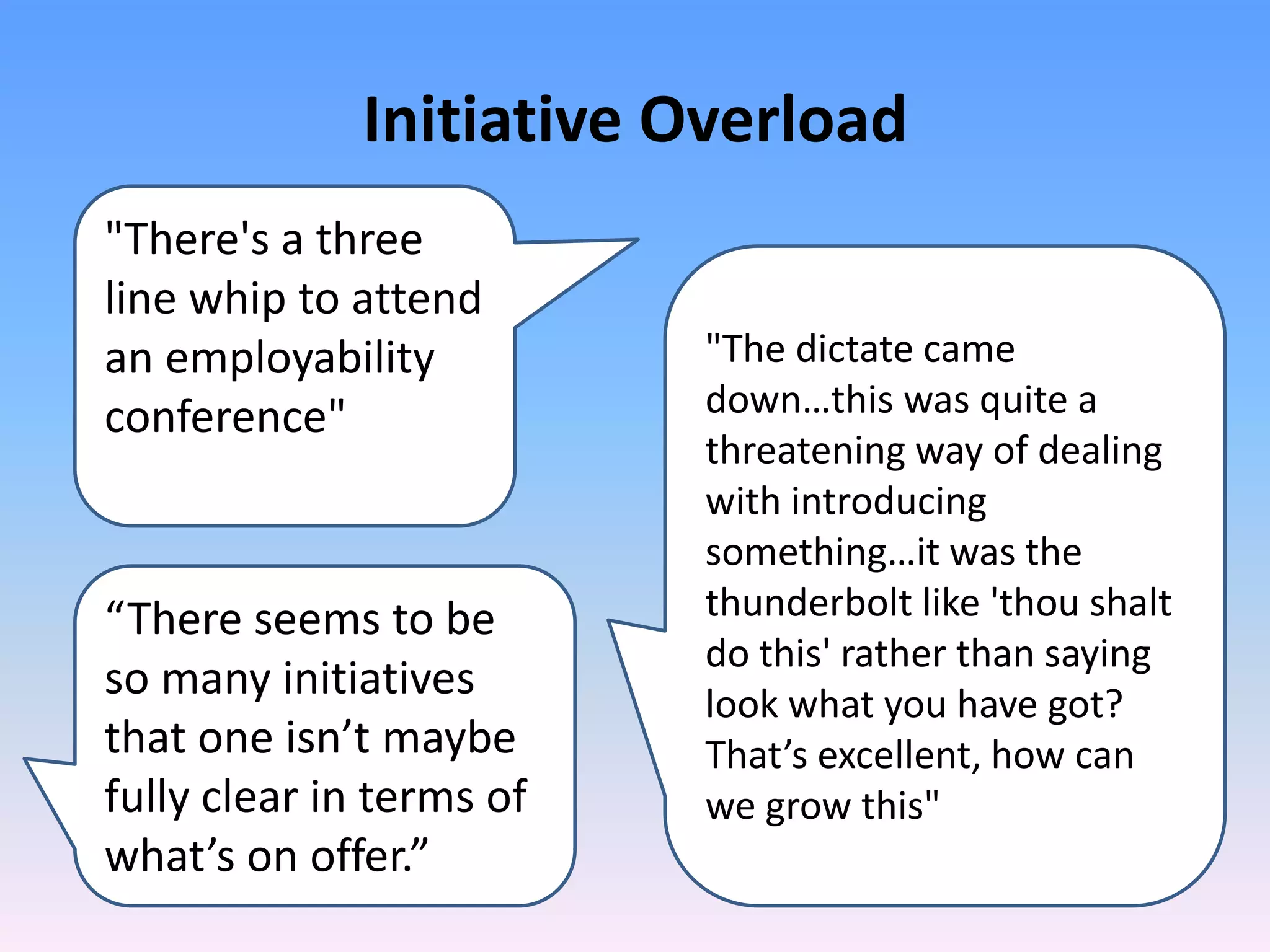
Initiative Overload
"There's a three
line whip to attend
an employability          "The dictate came
conference"               down…this was quite a
                          threatening way of dealing
                          with introducing
                          something…it was the
“There seems to be        thunderbolt like 'thou shalt
                          do this' rather than saying
so many initiatives       look what you have got?
that one isn’t maybe      That’s excellent, how can
fully clear in terms of   we grow this"
what’s on offer.”
Challenges during the Project

• Recruitment of participants

• Time Scale

• Finding mutually convenient dates to meet

• Capitalising on the vast range of ideas
  emerging
Learning and Recommendations
• Staff could see the value of teaching
  enterprising skills to increase students’
  employability but clarification over
  terminology is needed

• Staff would benefit from support from the
  university to develop a clearer picture of how
  they can adapt their subject expertise to be
  delivered in a more enterprising way
Learning and Recommendations
• Staff felt frustrated at the volume and delivery
  of new initiatives. Examples of good practice
  should be celebrated and shared amongst
  staff and across faculties to facilitate shared
  learning.
So what now?
• Continue the thematic analysis

• Disseminate a short report

• Publication for a peer reviewed journal

• Findings to be included as part of the background
  to forthcoming enterprise centre review
We happily invite any questions


    Thank You for Listening

2012 Paper Presentation on Entreprise in HE

  • 1.
    Embedding Enterprise inthe Curriculum - the Staff Perspective Kirsty Grant and Katie Hook, Student Researchers Sheila Quairney, Enterprise Centre
  • 2.
    What is Enterprisein the Curriculum? • An approach to learning, not a subject in itself • The application of creative ideas and innovation to practical situations • A generic concept that can be applied across all areas of education • Combines creativity, ideas development and problem solving with expression, communication and practical action • Does not necessarily refer to creating a project or business venture • Produces graduates with the mindset and skills to come up with original ideas in response to identified needs and shortfalls, and the ability to act on them • Includes taking the initiative, intuitive decision making, making things happen, networking, identifying opportunities, creative problem solving, strategic thinking, and personal effectiveness • Enterprise education extends beyond knowledge acquisition to a wide range of emotional, intellectual, social, and practical skills
  • 3.
    Why do EnterprisingSkills Matter? • 'The labour market requires graduates with enhanced skills who can think on their feet and be innovative in a global economic environment' (The Quality Assurance Agency for Higher Education (QAA), April 2012) • 'Universities should reflect on the strategies they use to ensure that students have the opportunity to develop enterprise skills both through the formal curriculum and through optional study or practice, and reflect on the integration of enterprise education in the professional development programmes for academic staff' (Review of Business–University Collaboration :Professor Sir Tim Wilson DL) • 'We must not lose sight of the talent universities are really put on earth to deliver. They must provide us with people with the ability to continually learn, to think critically and theoretically, to be reflective and reflexive, to innovate and break the status quo, and to navigate in the unstable waters of the global economy.' Dr David Docherty, chief executive of the Council for Industry and Higher Education
  • 4.
    Research Aims 1) Toascertain what involvement staff, at Sheffield Hallam University, perceive they should have in sharing notions of enterprise with their students 2) To explore the perspectives of academic staff on how enterprise might be developed in the curriculum to support employability
  • 5.
    Methodology • Convenience sampleof lecturers, across faculties • Participation was voluntary and responses anonymised • Exploratory qualitative approach • 30 semi-structured interviews conducted lasting between 20-30 minutes • Thematic analysis of data
  • 6.
  • 7.
    Results • Participants N= 30 • All active permanent teaching staff (years teaching M = 9.8, SD=8.8) • 40% (n=12) in faculty of SBS, similar responses between D&S, ACES and H&WB • 46.7% (n=14) of staff previous role had been in the private sector with the rest split between academic and public sector roles
  • 8.
    Preliminary Findings 1) Definingenterprise education 2) Embedding enterprise 3) Influence of staff background 4) Importance of students' real-life experience 5) One size doesn’t fit all 6) Initiative Overload
  • 9.
    Defining Enterprise Education? "Ithink it would be good to know what the university meant by enterprise in reality rather than the definition…still giving academics the freedom to make it more relevant to their subject" “It’s employability we talk about and that’s what the university talks about . . . They don’t talk about enterprise.”
  • 10.
    Embedding Enterprise "I thinkthe barrier could be just that something else has to go so that the “It should be embedded curriculum has been in the curriculum but its devised where it is quite got to be the best fit constrained to the depending on what the objectives of that degree discipline is and particular course and everything has to be there isn't a way where it created to that" can actually fit in"
  • 11.
    Influence of StaffBackground "What credibility do you have when you pretend to prepare people to become professionals "We might understand out there in the the theory but do we marketplace when you actually understand the yourself have no real conditions for link with the enterprise?" environment? "
  • 12.
    Importance of Students'Real-Life Experience “Standing up and doing a talk about "The problem is trying to what it means to be teach them (students) enterprising is skills that they don’t probably going to send understand they need, someone to sleep. because they have had Unless they get a no exposure to…the real chance to experience world" that, to practice that in some way . . .”
  • 13.
    One Size Doesn’tFit All For the students, "one “You can’t give them size doesn’t fit all its the drive and the about giving people tenacity and the the chance to think determination . . . You about this as an option hope to create the for them" - conditions in which commenting on they find that in embedding enterprise themselves” into the curriculum
  • 14.
    Initiative Overload "There's athree line whip to attend an employability "The dictate came conference" down…this was quite a threatening way of dealing with introducing something…it was the “There seems to be thunderbolt like 'thou shalt do this' rather than saying so many initiatives look what you have got? that one isn’t maybe That’s excellent, how can fully clear in terms of we grow this" what’s on offer.”
  • 15.
    Challenges during theProject • Recruitment of participants • Time Scale • Finding mutually convenient dates to meet • Capitalising on the vast range of ideas emerging
  • 16.
    Learning and Recommendations •Staff could see the value of teaching enterprising skills to increase students’ employability but clarification over terminology is needed • Staff would benefit from support from the university to develop a clearer picture of how they can adapt their subject expertise to be delivered in a more enterprising way
  • 17.
    Learning and Recommendations •Staff felt frustrated at the volume and delivery of new initiatives. Examples of good practice should be celebrated and shared amongst staff and across faculties to facilitate shared learning.
  • 18.
    So what now? •Continue the thematic analysis • Disseminate a short report • Publication for a peer reviewed journal • Findings to be included as part of the background to forthcoming enterprise centre review
  • 19.
    We happily inviteany questions Thank You for Listening

Editor's Notes

  • #6 Recruitment - sent out emails to those involved with enterprise centre, venture matrix, emailed to subscribers of Sheffield HallamsSeejot, sent out as part of the eview, sent to the employability forum, 'A theme captures something important about the data in relation to the research question and represents some level of patterned response ormeaning withBraun and Clarke’s ‘guide’ to the 6 phases of conducting thematic analysis1. Becoming familiar with the data.2. Generating initial codes.3. Searching for themes.4. Reviewing themes.5. Defining and naming themes.6. Producing the reportBraun, V. and Clarke, V. (2006). Using thematic analysis in psychology. Qualitative Research in Psychology, 3: 77-101.ta set.’ Braun and Clarke, 2006, p.82.Initially we began looking over transcripts together to begin to identify themes, we then coded all of our individual transcripts before coming together to review and search for themes. The themes identified here are a result of the prelimary themes, these will be reviewing and defined again before the final report is produced. Could say we initially looked at the codes that had been referenced most, then the codes that had appeared in the most sources.
  • #10 Sense that enterprise education and employability were the same thing - staff tended to focus on the more practical applications of skill such as starting up your own business and writing a CV when they talked about how they delivered enterprise education. Few staff had heard of being intraprenuial…there was a sense that enterprise was linked solely with business and financial gains, connected to the private sector. Staff commented on their confusion over what the university expected in terms of employability and enterprise - these definitions overlapped. - staff didn’t understand the difference of what enterprise was in comparision to employability-staff see it as business and finance and therefore cant see how it fits with their teaching-staff see skills such as CV writing and interview skills as enterprise-SBS staff predominately thought they were doing it anyway……..
  • #11 Desire for it be embedded, but not recognising that it doesn’t necessarily a module its self. Do staff recognise that they can teach in a more enterprising way? Lots of comments on moving something away from the curriculum inorder to put enterprise in - very few people talked about teaching in a more enterprising way. Seeing enterprise as a separate entity Staff tended to view enterprise as an additional module rather than seeing how they could adapt their current practice in order to teach it in a more enterprising way. Not about a way of teaching
  • #12 There was a sense that staff felt that their background played a part in them being able to engage with enterprise education. Mention staff wanting to feel at a competant level to teach effectively. Those who had experience talked very positively about how this influenced their work - including it in their teaching and using their connections to support their teaching and students experiences.From those interviewed in Hwb - there was a recognition that the traditional fields of health professionals and science based professions may be changing in the current economic climate. Their were feelings that they perhaps needed support to develop their own understanding of enterprise but a positive sense of moving forward
  • #13 Feeling that whilst you could facilitate a students learning, you cant teach the student everything - "you can prvide the fishing rod but its up to them to get the fish"Academics overwhelming felt that real life experience and examples provided students with something that you cannot teach. There was a feeling that those students who had placement experience were able to reflect upon the skills that they have learnt and benefit greatly from this. They could see the link between their education and their future employment.
  • #14 Key barrier to academics including enterprise education - was that their reluctance to ram it down the throats of those who weren't interested.Much more comfortable in referring individuals than implementing enterprise education activities as a whole Feeling that those who would take an entrepreneurial approach - would already have the drive and motivation to do this independent of their teaching All members of staff felt that it is possible to teach students enterprising skills but that you can only facilitate students’ learning of innovation and creativity, rather than teach an individual to think like an entrepreneur.
  • #15 We didn’t overtly ask about the universities approach to new initiatives…however an overwhelming number of staff commented on their disenchantment with the universities approach to introducing new initiatives. Staff had previous examples of how they thought this had been handled poorly - many felt frustrated that the positive work and their time constraints were not considered in the delivery of new initiatives.There was a sense of fear amongst staff at how they handle new initiatives, they wanted clarity in what is expected of them and the universities lack of communication was frequently sited as a barrier for staff knowing their role in new initiatives.
  • #16 Discuss staff no-shows
  • #17 -Staff development workshops- More guidance on developing the curriculum in a more enterprising wayBased on preliminary results, overall there was a positive response to enterprise education and a desire to embed this within the curriculum. Most members of staff reported that teaching enterprising skills played an important part in increasing students’ employability.  Staff would benefit from support.