Enhancing employability through
enterprise education
1
• Reflection on what enterprise education is and how
it complements and enhances employability
• Discussion and sharing of approaches to addressing
and embedding enterprise education
• An introduction to the HEA resource enhancing
employability through enterprise education
Workshop objectives
2
Defining enterprise education
3
Enterprise education is not business
studies. Entrepreneurship is only one
of the possible outcomes. Enterprise
education aims to equip students
with a set of capabilities which they
can apply to whichever context they
choose; the capability to take
action, effect change, create value,
and lead
University of Sheffield
4
What and Why
Having the attitude, initiative and
ability to recognise opportunities and
the confidence and creativity to
make the most of them. Employers
value Enterprising people for the
fresh thinking they bring to the
workplace.
Staffordshire University
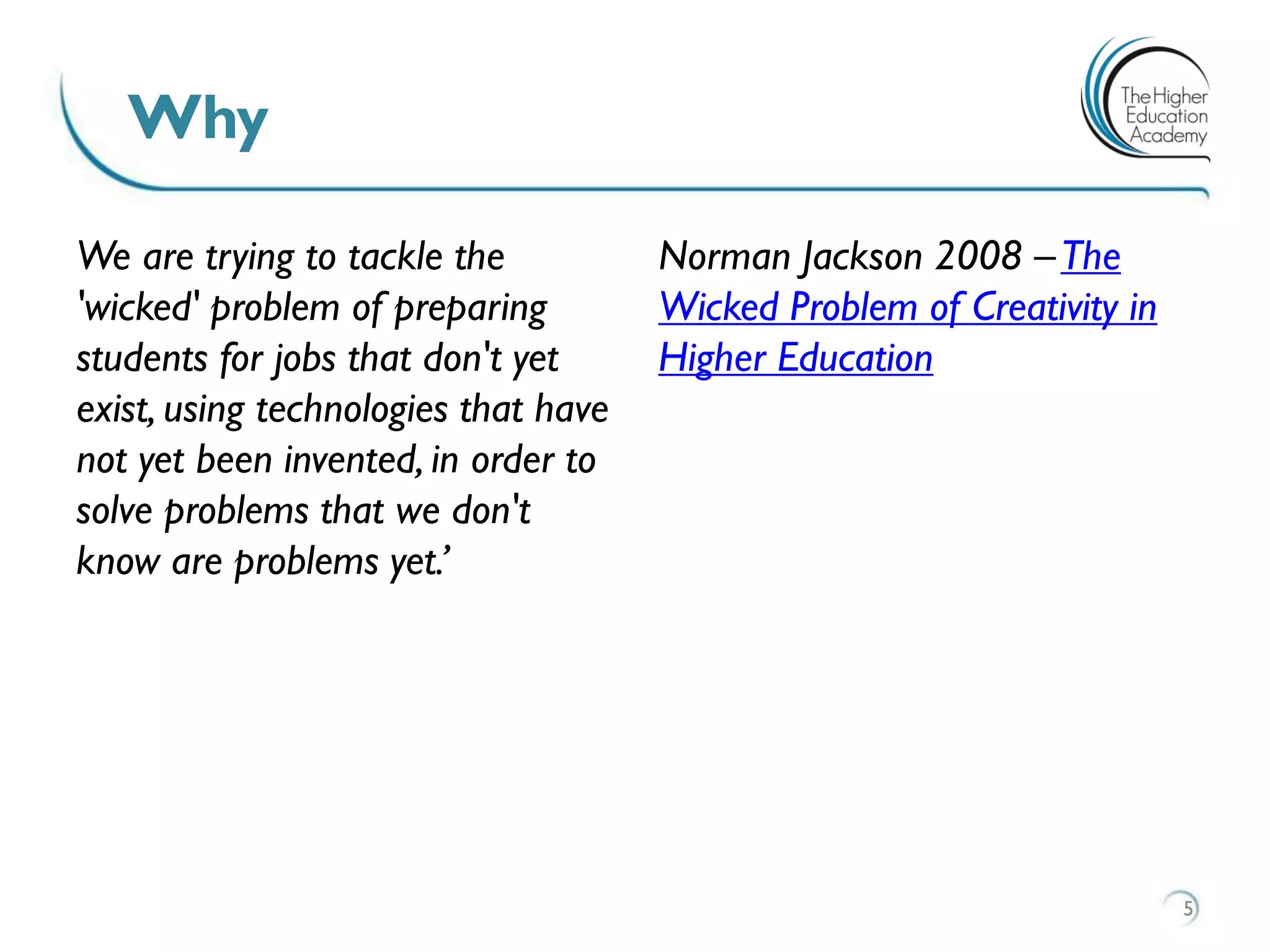
We are trying to tackle the
'wicked' problem of preparing
students for jobs that don't yet
exist, using technologies that have
not yet been invented, in order to
solve problems that we don't
know are problems yet.’
Norman Jackson 2008 –The
Wicked Problem of Creativity in
Higher Education
Why
5
The process of equipping students
(or graduates) with an enhanced
capacity to generate ideas and the
skills to make them happen.
Behaviours
Attributes
Skills
Enterprise and entrepreneurship
education equips students from
all subject areas with the
attributes, capabilities and
skills to be entrepreneurial
within a range of employment
settings
Defining enterprise education
QAA 2012
6
• Creativity and innovation
• Opportunity recognition,
creation and evaluation
• Decision-making
• Problem solving
• Reflection & Action
• Financial & business literacy
• Implementation of ideas
through leadership and
management
• Managing autonomously
• Interpersonal skills &
awareness
• Confidence
• Communication & Strategy
skills
• Networking
• Persuasion & negotiation
• Perseverance & resilience
Enterprise EducationThemes
behaviours, attributes & skills (QAA 2012)
7
Defining employability
8
Achievements, skills, knowledge
and personal attributes – that
enable graduates to gain employment, be
successful in their career, and manage
change effectively.This benefits them, the
organisation, the community and the
economy.
Preparing graduates for the future; for
a constantly changing global labour
market and a constantly changing
society.
‘Graduates need more than academic
knowledge and skills to stand out from
the crowd in today’s competitive global
job market.
In the 21st Century, employers expect
‘graduates to be enterprising,
resilient, reliable, adaptable and
flexible.
Defining employability
9
• Subject specialists
• Investigative
• Independent & critical
thinkers
• Resourceful &
responsible
• Effective communicator
• Confident
• Adaptable
• Experienced
collaborator
• Ethically & socially
aware
• Reflective learner
University of Glasgow: graduate attributes for
employability
10
• Personal development
• Project planning &
evaluation
• Innovation
• Problem-solving
• Business skills
• Communication skills
• Reflection
• Team working
• Sector skills
• Work experience
• Subject skills
• Research skills
• Career development
• Social & cultural
awareness
UCLAN: employability framework
11
Making connections
12
Government expectations
• Expect teaching and learning to develop the skills, knowledge and
attributes required for sustainable economic growth
Student expectations
• Expect value for money
• Expect to enhance their employability
• Expect to successful in their transitions from higher education
• Expect to be prepared for and be able to access options and opportunities
Employers/Labour Market
• Expect and need graduate skills, knowledge, attributes to be effective in a
global economic labour market, including;
flexibility, adaptability, enterprising mind set, being innovative and
ability to think on their feet.
Making the case: drivers
13
It is clear that a lack of
employability skills is harming the
ability of the young to enter the
workforce and being enterprising
is seen as a necessity by
Business.
David Frost Chair LEP Network
An education system fit for an
entrepreneur (2014)
Thread enterprise learning
throughout education. Enterprise
education can have a purposeful
impact in developing both the
soft and hard skills sets of young
people.
RSA Manifesto forYouth
Enterprise (2013)
The value of enterprise education in
enhancing employability
14
Barriers and enablers
15
Enterprise education : barriers
• Clarity of language: what is enterprise education?
• Ownership: is it university wide ?
• Engaging students: how?
• Making connections: employability
• Embedding in curriculum
• Support for staff
• Working together across the HEI
• Engaging employers- particularly SMEs
• Measuring impact
• Expectations
• High on agenda
• Employability
• QAA Guidelines
• Support
• Good practice
• Work related learning
• Working in partnership
internally
• And with external
stakeholders
Enterprise education: Enablers
17
Enterprising behaviours
To help students develop core behaviours for enterprise through learning activities
that enable them to practise, exhibit and develop confidence in key areas.
Enterprising attributes
To help students discover and develop personal attributes for successful enterprise,
develop an awareness of these and find opportunities to enhance them.
Enterprising skills
To help students develop core skills for enterprise and provide opportunities
for these to be practised within a range of situations to gain enhanced
confidence and self belief.
Enterprise education: Role of Educator
(QAA 2012)
18
Enabler: sharing good practice
19
For Details of events, resources, research, staff development
and support
Website www.heacademy.ac.uk
Mailing list
Sign up through My Academy
https://my.heacademy.ac.uk/
20
Thank you, keep in touch

Enhancing employability through enterprise education - Maureen Tibby

  • 1.
  • 2.
    • Reflection onwhat enterprise education is and how it complements and enhances employability • Discussion and sharing of approaches to addressing and embedding enterprise education • An introduction to the HEA resource enhancing employability through enterprise education Workshop objectives 2
  • 3.
  • 4.
    Enterprise education isnot business studies. Entrepreneurship is only one of the possible outcomes. Enterprise education aims to equip students with a set of capabilities which they can apply to whichever context they choose; the capability to take action, effect change, create value, and lead University of Sheffield 4 What and Why Having the attitude, initiative and ability to recognise opportunities and the confidence and creativity to make the most of them. Employers value Enterprising people for the fresh thinking they bring to the workplace. Staffordshire University
  • 5.
    We are tryingto tackle the 'wicked' problem of preparing students for jobs that don't yet exist, using technologies that have not yet been invented, in order to solve problems that we don't know are problems yet.’ Norman Jackson 2008 –The Wicked Problem of Creativity in Higher Education Why 5
  • 6.
    The process ofequipping students (or graduates) with an enhanced capacity to generate ideas and the skills to make them happen. Behaviours Attributes Skills Enterprise and entrepreneurship education equips students from all subject areas with the attributes, capabilities and skills to be entrepreneurial within a range of employment settings Defining enterprise education QAA 2012 6
  • 7.
    • Creativity andinnovation • Opportunity recognition, creation and evaluation • Decision-making • Problem solving • Reflection & Action • Financial & business literacy • Implementation of ideas through leadership and management • Managing autonomously • Interpersonal skills & awareness • Confidence • Communication & Strategy skills • Networking • Persuasion & negotiation • Perseverance & resilience Enterprise EducationThemes behaviours, attributes & skills (QAA 2012) 7
  • 8.
  • 9.
    Achievements, skills, knowledge andpersonal attributes – that enable graduates to gain employment, be successful in their career, and manage change effectively.This benefits them, the organisation, the community and the economy. Preparing graduates for the future; for a constantly changing global labour market and a constantly changing society. ‘Graduates need more than academic knowledge and skills to stand out from the crowd in today’s competitive global job market. In the 21st Century, employers expect ‘graduates to be enterprising, resilient, reliable, adaptable and flexible. Defining employability 9
  • 10.
    • Subject specialists •Investigative • Independent & critical thinkers • Resourceful & responsible • Effective communicator • Confident • Adaptable • Experienced collaborator • Ethically & socially aware • Reflective learner University of Glasgow: graduate attributes for employability 10
  • 11.
    • Personal development •Project planning & evaluation • Innovation • Problem-solving • Business skills • Communication skills • Reflection • Team working • Sector skills • Work experience • Subject skills • Research skills • Career development • Social & cultural awareness UCLAN: employability framework 11
  • 12.
  • 13.
    Government expectations • Expectteaching and learning to develop the skills, knowledge and attributes required for sustainable economic growth Student expectations • Expect value for money • Expect to enhance their employability • Expect to successful in their transitions from higher education • Expect to be prepared for and be able to access options and opportunities Employers/Labour Market • Expect and need graduate skills, knowledge, attributes to be effective in a global economic labour market, including; flexibility, adaptability, enterprising mind set, being innovative and ability to think on their feet. Making the case: drivers 13
  • 14.
    It is clearthat a lack of employability skills is harming the ability of the young to enter the workforce and being enterprising is seen as a necessity by Business. David Frost Chair LEP Network An education system fit for an entrepreneur (2014) Thread enterprise learning throughout education. Enterprise education can have a purposeful impact in developing both the soft and hard skills sets of young people. RSA Manifesto forYouth Enterprise (2013) The value of enterprise education in enhancing employability 14
  • 15.
  • 16.
    Enterprise education :barriers • Clarity of language: what is enterprise education? • Ownership: is it university wide ? • Engaging students: how? • Making connections: employability • Embedding in curriculum • Support for staff • Working together across the HEI • Engaging employers- particularly SMEs • Measuring impact
  • 17.
    • Expectations • Highon agenda • Employability • QAA Guidelines • Support • Good practice • Work related learning • Working in partnership internally • And with external stakeholders Enterprise education: Enablers 17
  • 18.
    Enterprising behaviours To helpstudents develop core behaviours for enterprise through learning activities that enable them to practise, exhibit and develop confidence in key areas. Enterprising attributes To help students discover and develop personal attributes for successful enterprise, develop an awareness of these and find opportunities to enhance them. Enterprising skills To help students develop core skills for enterprise and provide opportunities for these to be practised within a range of situations to gain enhanced confidence and self belief. Enterprise education: Role of Educator (QAA 2012) 18
  • 19.
  • 20.
    For Details ofevents, resources, research, staff development and support Website www.heacademy.ac.uk Mailing list Sign up through My Academy https://my.heacademy.ac.uk/ 20 Thank you, keep in touch