Authoring and sharing open
  educational resources
           Hans Põldoja
         Tallinn University
cba
This work is licensed under the Creative Commons
Attribution-ShareAlike 3.0 Unported License. To view a copy
of this license, visit http://creativecommons.org/licenses/by-sa/
3.0/ or send a letter to Creative Commons, 444 Castro
Street, Suite 900, Mountain View, California, 94041, USA.


          http://www.slideshare.net/hanspoldoja
Outline


•   Open Educational Resources: the concept,
    examples, lessons learned

•   Authoring digital learning resources with simple
    online tools

•   Adding metadata to learning objects
What are OER’s?


Open Educational Resources (OER) are digital
materials that can be re-used for teaching, learning,
research and more, made available free through open
licenses, which allow uses of the materials that would
not be easily permitted under copyright alone.


                                                     (Wikipedia, 2012)
Copyright
(and why it doesn’t
      work)
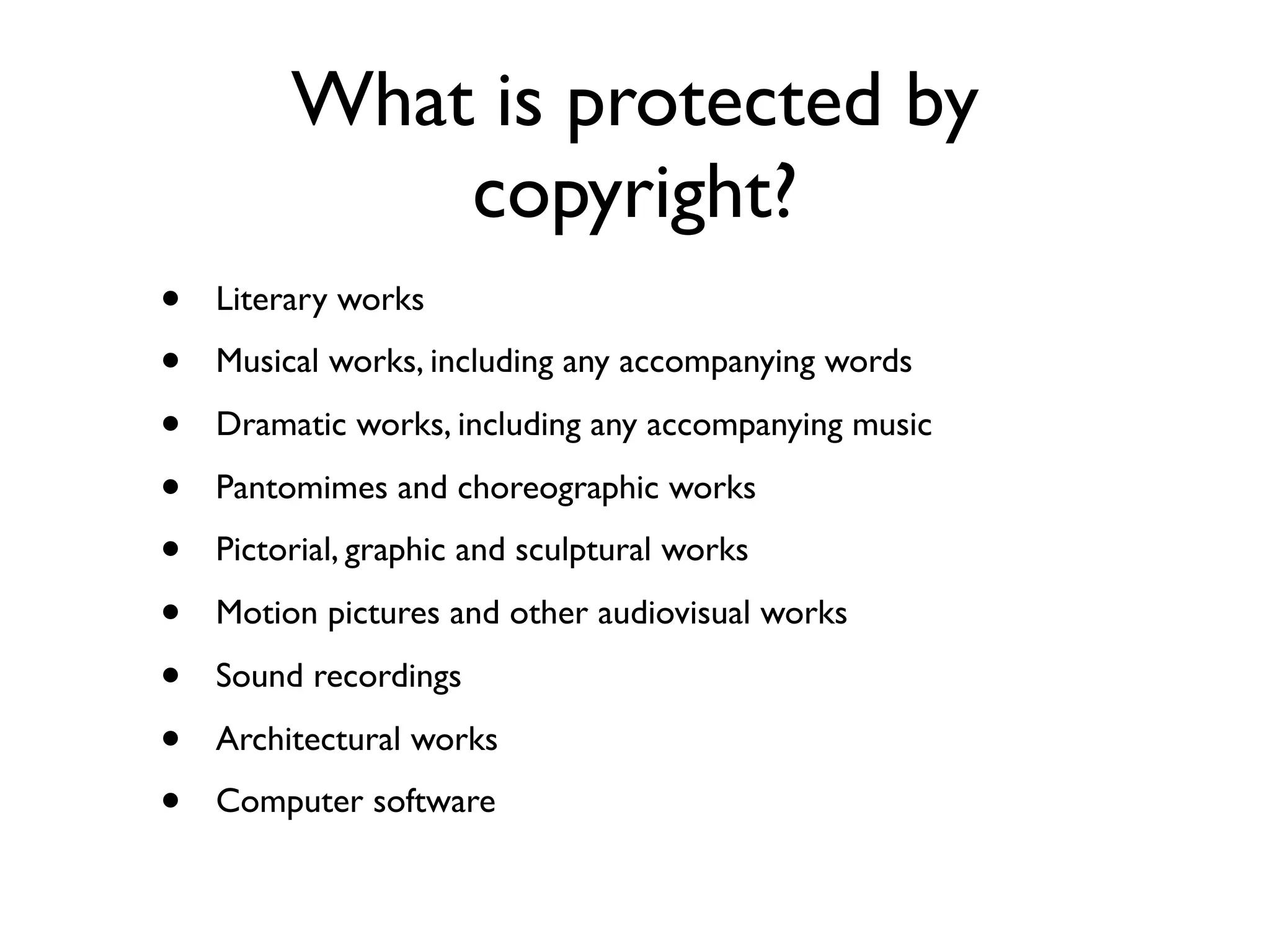
What is protected by
             copyright?
•   Literary works

•   Musical works, including any accompanying words

•   Dramatic works, including any accompanying music

•   Pantomimes and choreographic works

•   Pictorial, graphic and sculptural works

•   Motion pictures and other audiovisual works

•   Sound recordings

•   Architectural works

•   Computer software
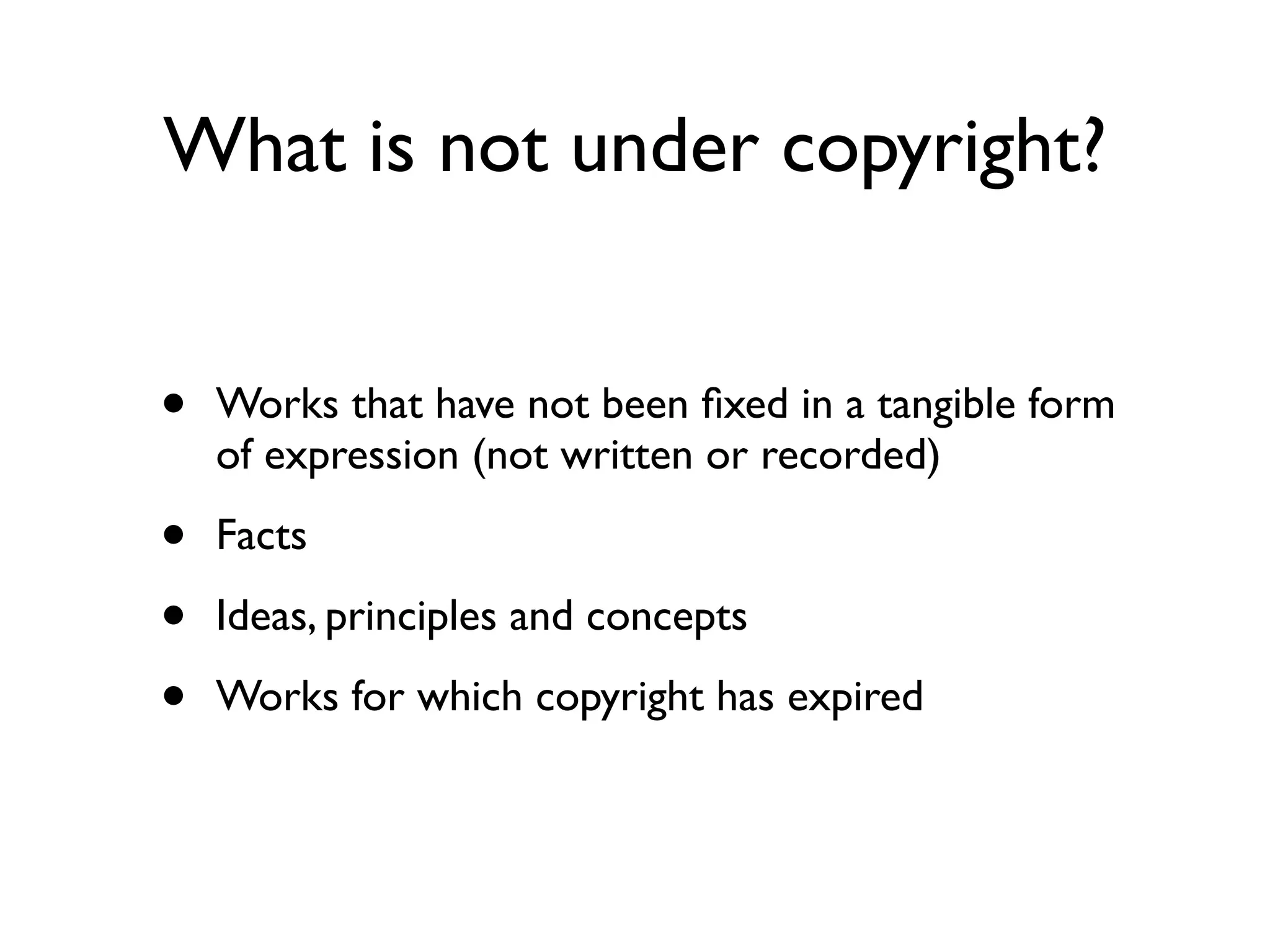
What is not under copyright?


•   Works that have not been fixed in a tangible form
    of expression (not written or recorded)

•   Facts

•   Ideas, principles and concepts

•   Works for which copyright has expired
Duration of copyright


•   Copyright protection starts from the time the
    work is created in a fixed form

•   Copyright protection lasts authors’ lifetime and 70
    years after death
Economic rights

•   Reproduction

•   Distribution

•   Rental

•   Broadcasting

•   Public performance

•   ...
Moral rights

•   Attribution

•   Anonymous or pseudonymous
    publishing

•   Integrity of the work

•   Withdrawal

•   ...
Limitations
EU Copyright Directive lists a number of limitations that
can be applied by the member states, including:

 •   Reproductions by public libraries, educational
     institutions or archives for non-commercial use;

 •   Use for illustration for teaching or scientific research,
     to the extent justified by the non-commercial
     purpose;

 •   Communication of works to the public within the
     premises of public libraries, educational institutions,
     museums or archives

                                                       (Directive 2001/29/EC)
Problems in the context of
     digital learning resources


•   What extent of educational reuse is justified by
    the non-commercial purpose?

•   Translation and modification of the work requires
    agreement from the author
Open Content Licences
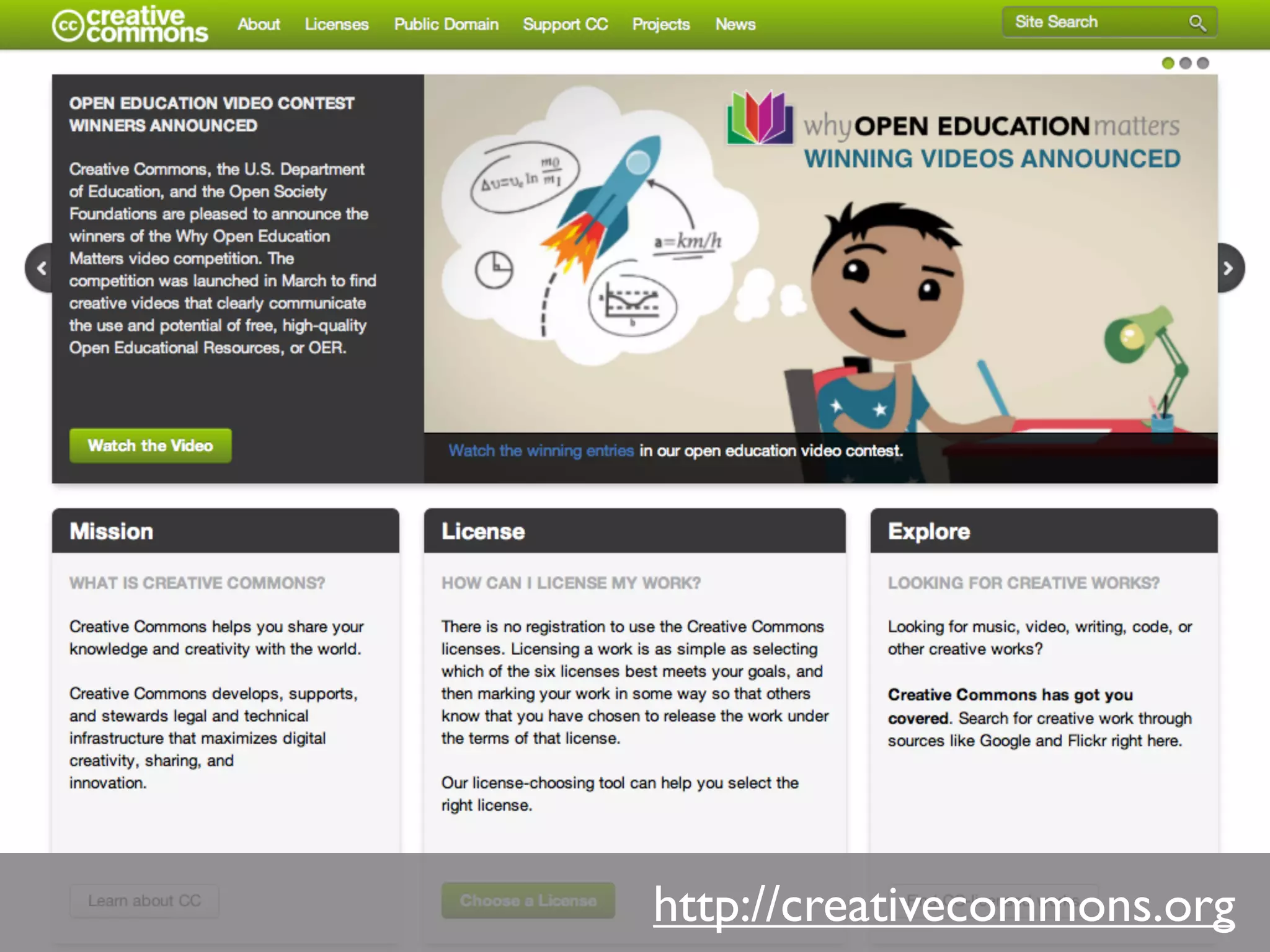
http://creativecommons.org
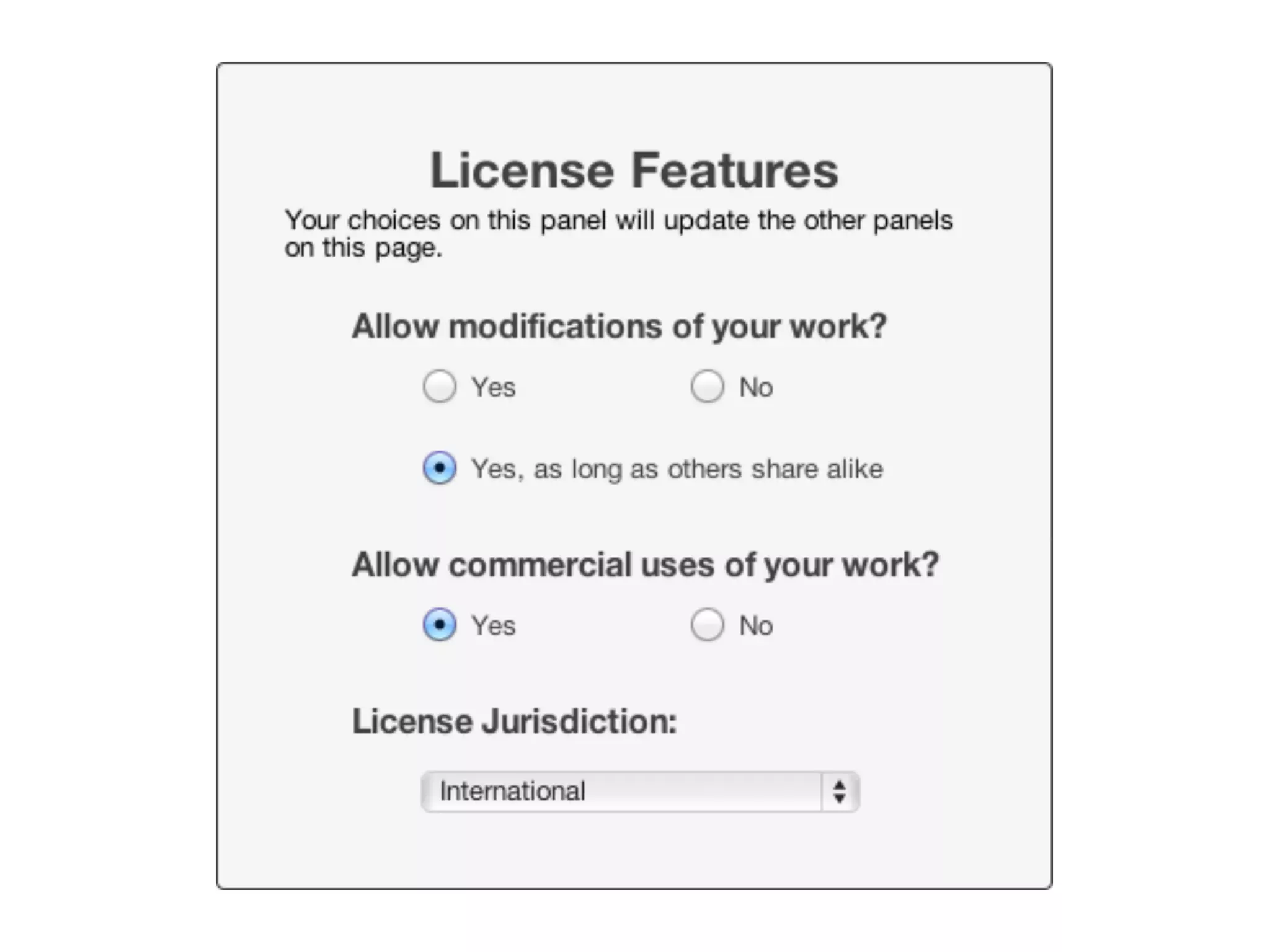
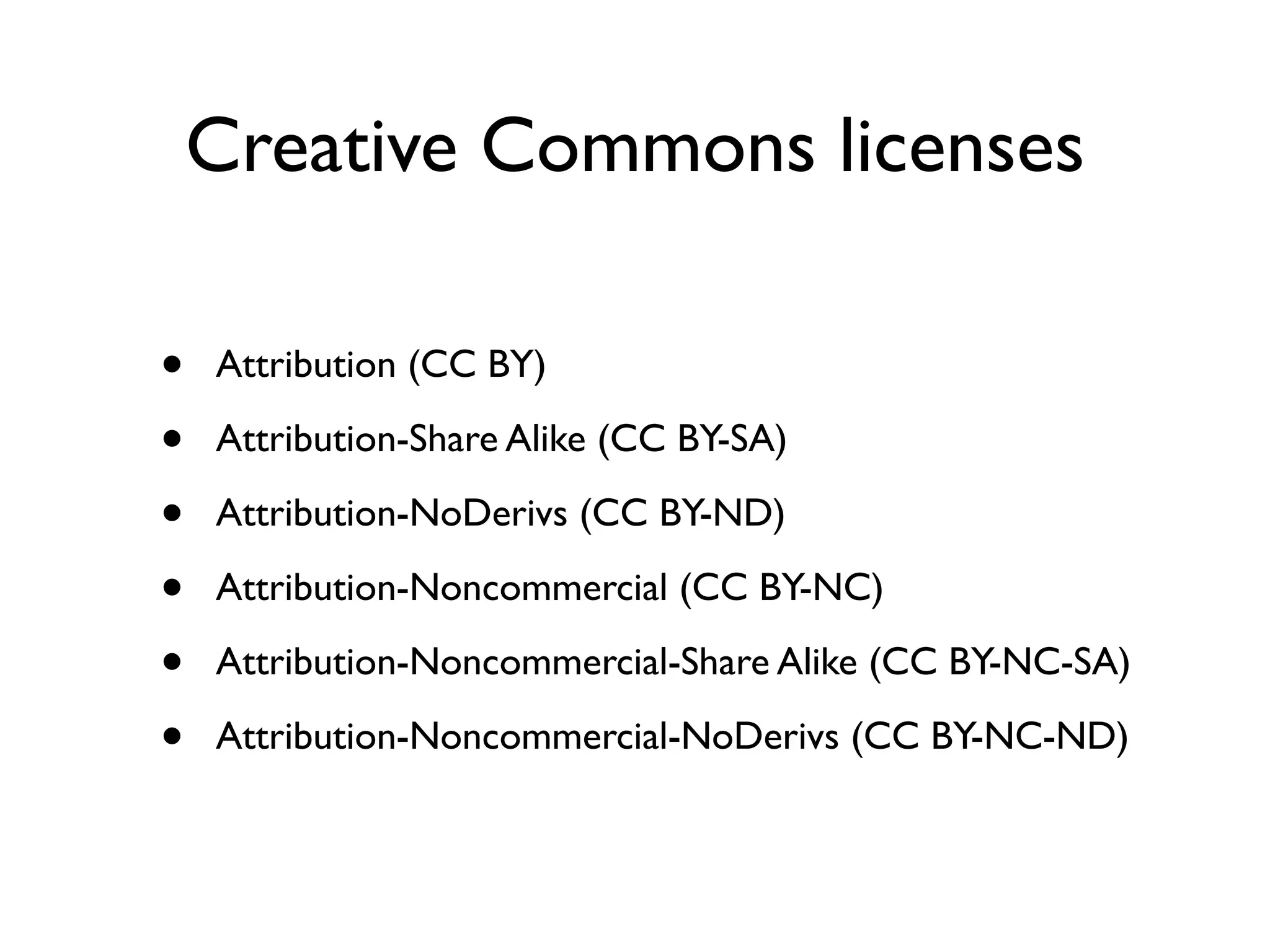
Creative Commons licenses

•   Attribution (CC BY)

•   Attribution-Share Alike (CC BY-SA)

•   Attribution-NoDerivs (CC BY-ND)

•   Attribution-Noncommercial (CC BY-NC)

•   Attribution-Noncommercial-Share Alike (CC BY-NC-SA)

•   Attribution-Noncommercial-NoDerivs (CC BY-NC-ND)
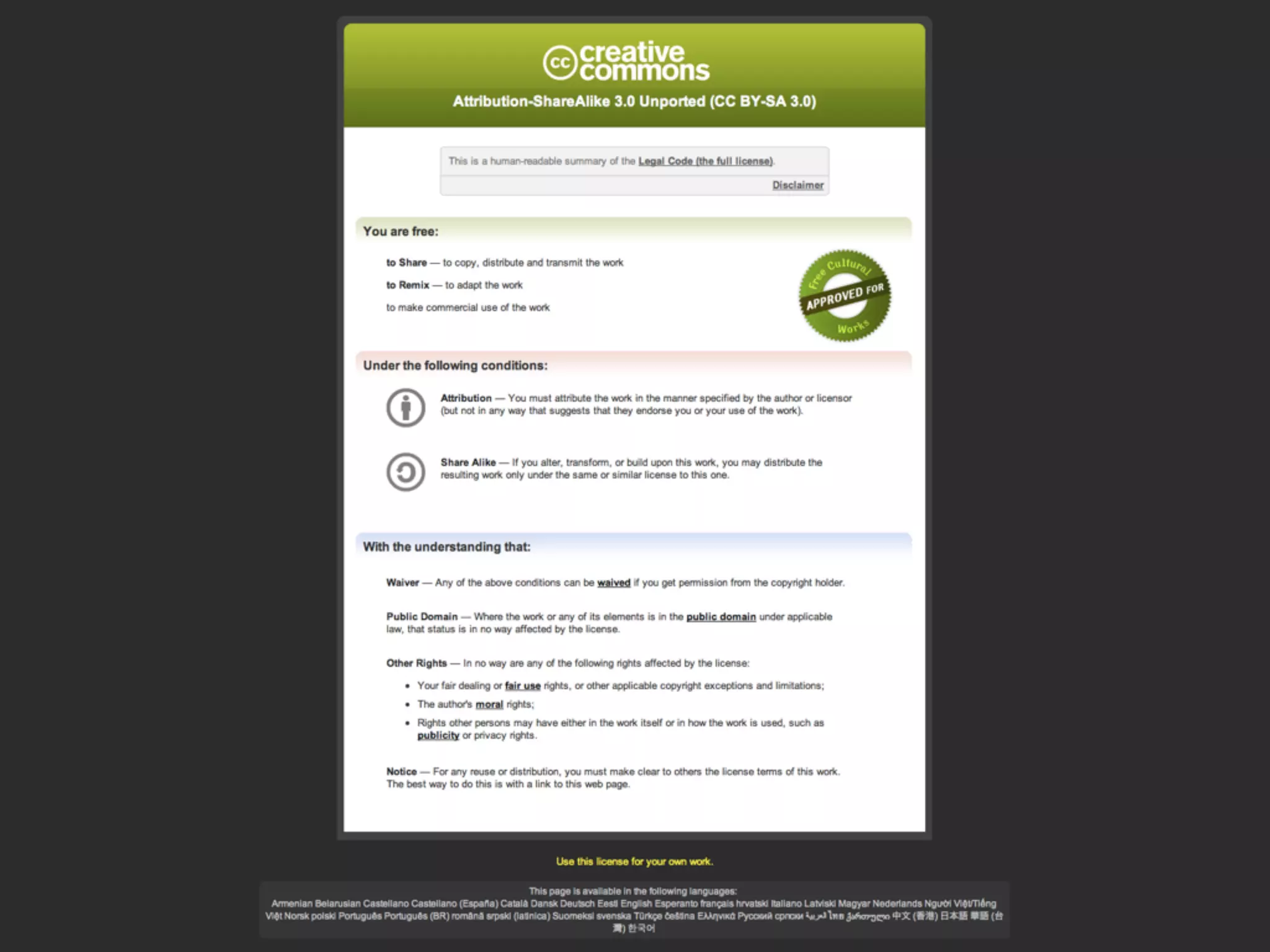
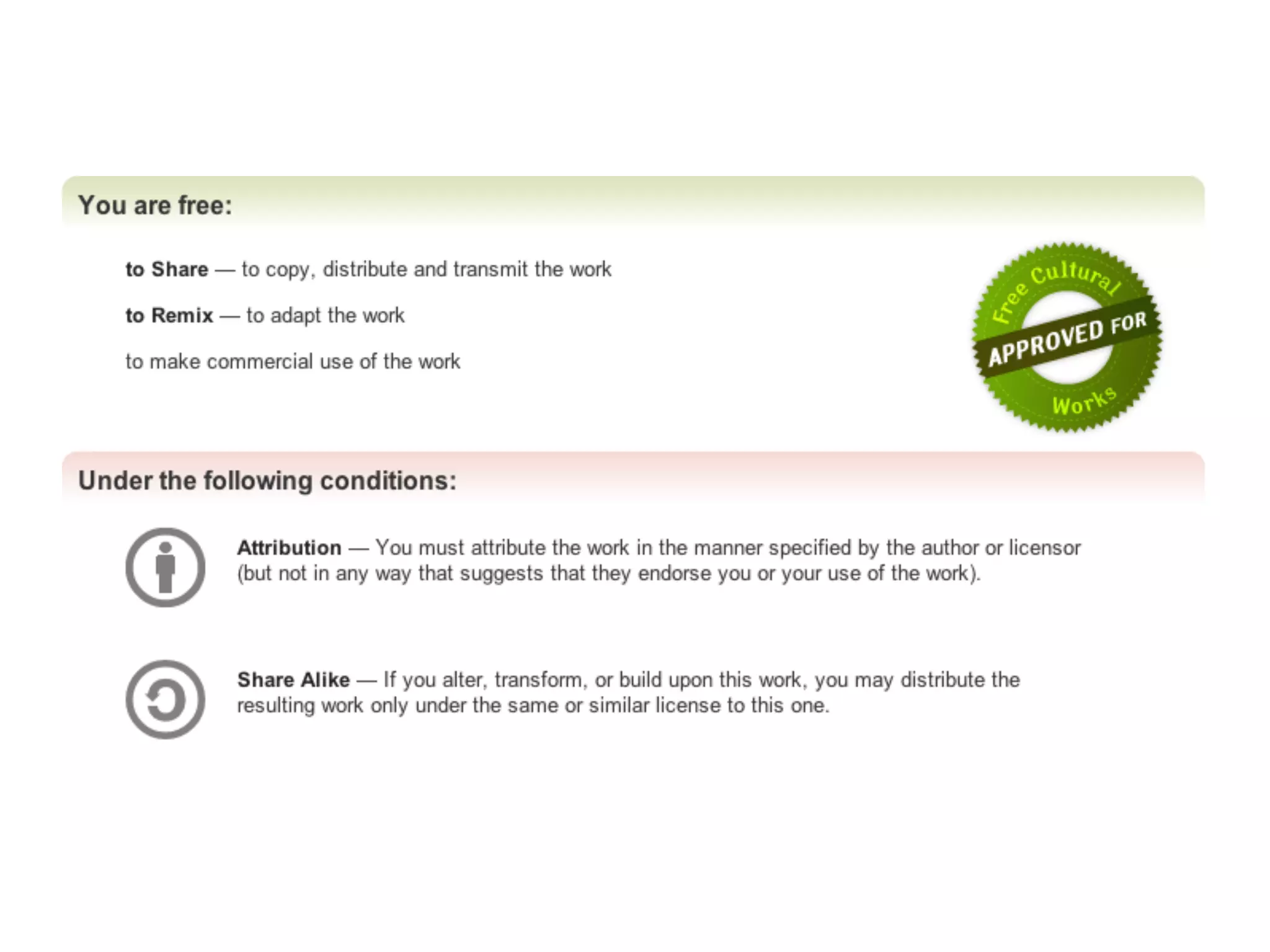
License conditions
    Attribution — You must attribute the work in the
b   manner specified by the author or licensor

    Share Alike — If you alter, transform, or build upon
a   this work, you may distribute the resulting work
    only under the same or similar license to this one

    Noncommercial — You may not use this work for
n   commercial purposes


    No Derivative Works — You may not alter,
d   transform, or build upon this work
Rights


    Share — to copy, distribute and transmit
s   the work


r   Remix — to adapt the work
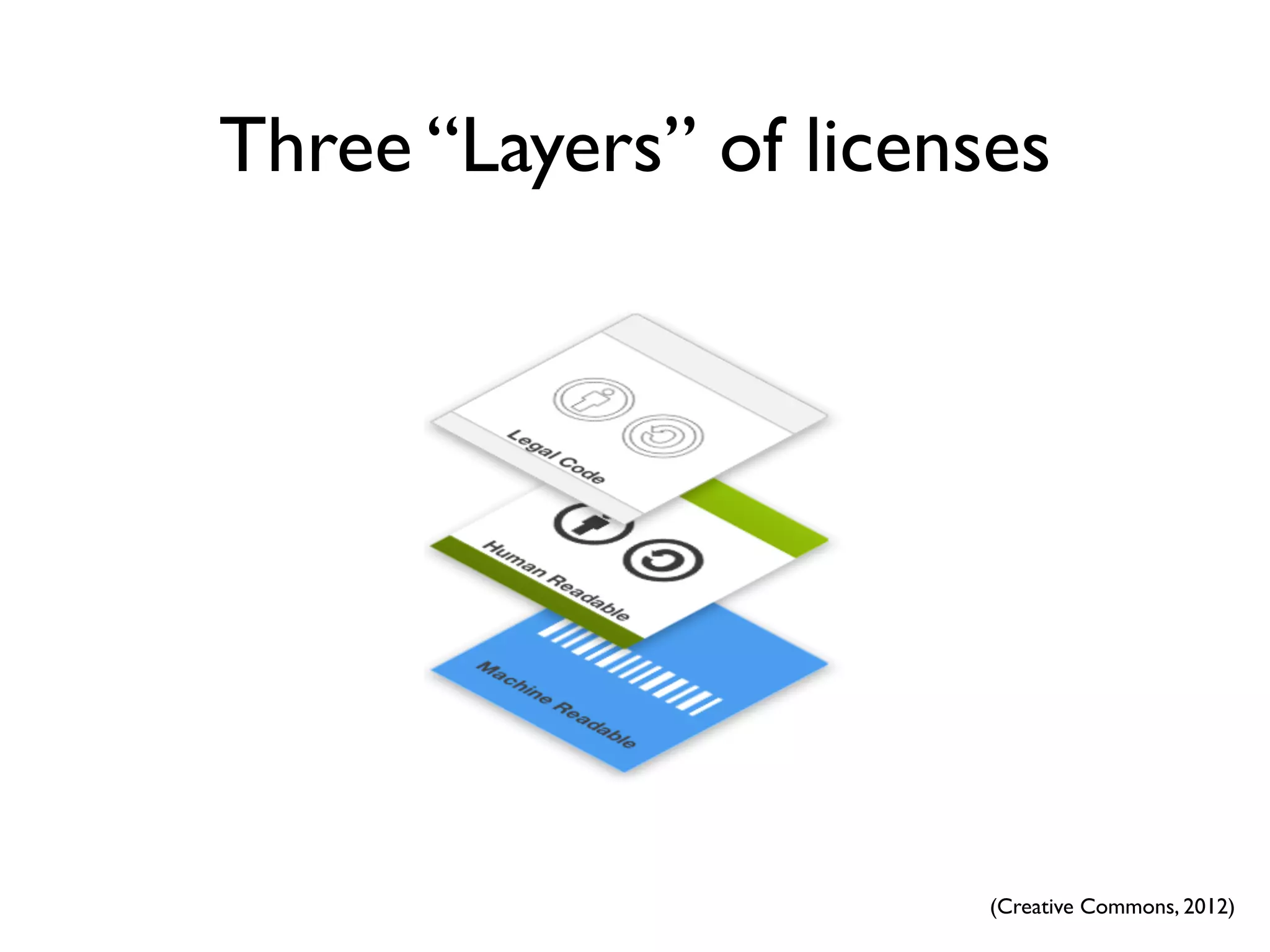
Three “Layers” of licenses


                        (Creative Commons, 2012)
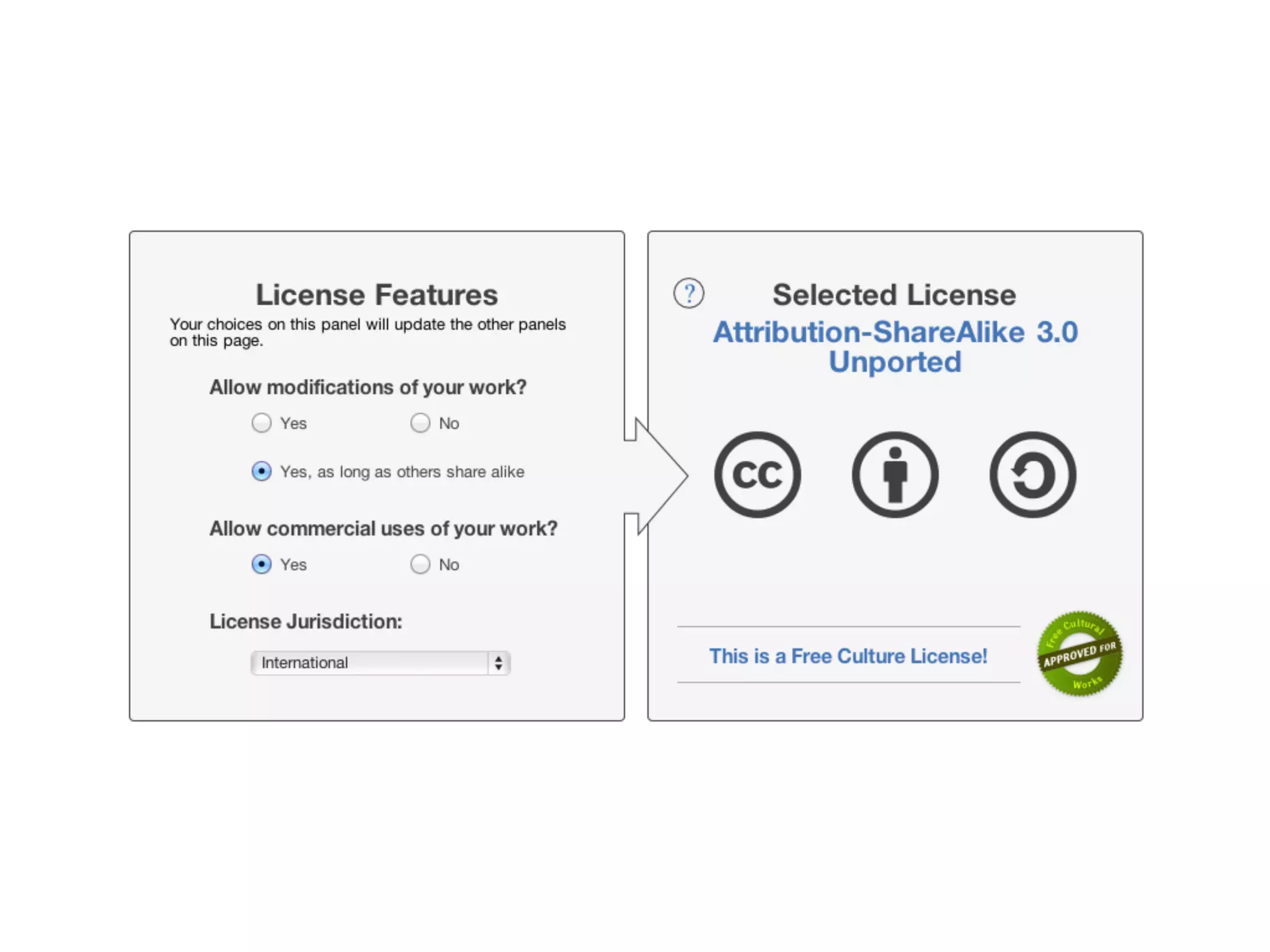
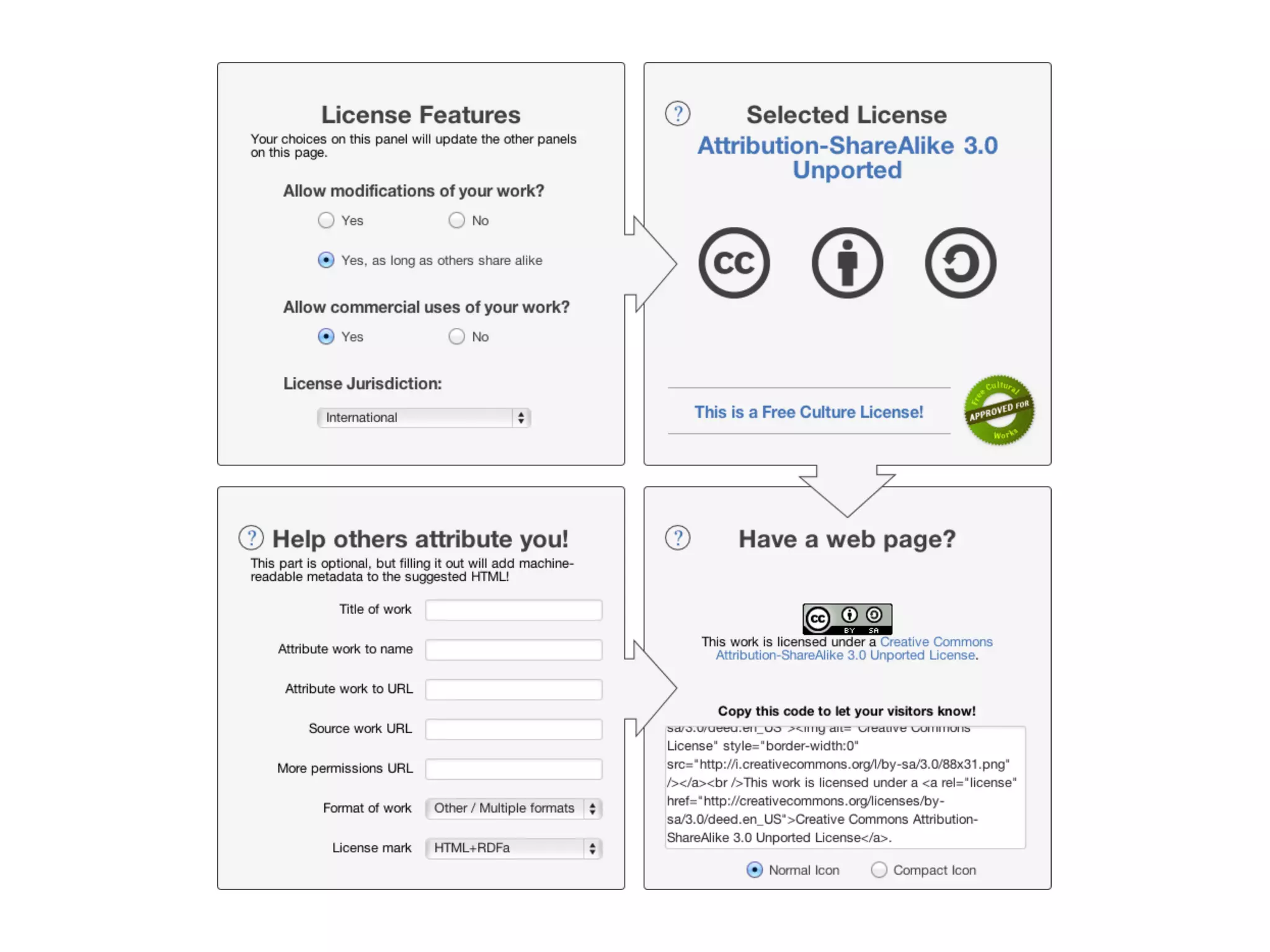
How to recognize CC
  licensed works?
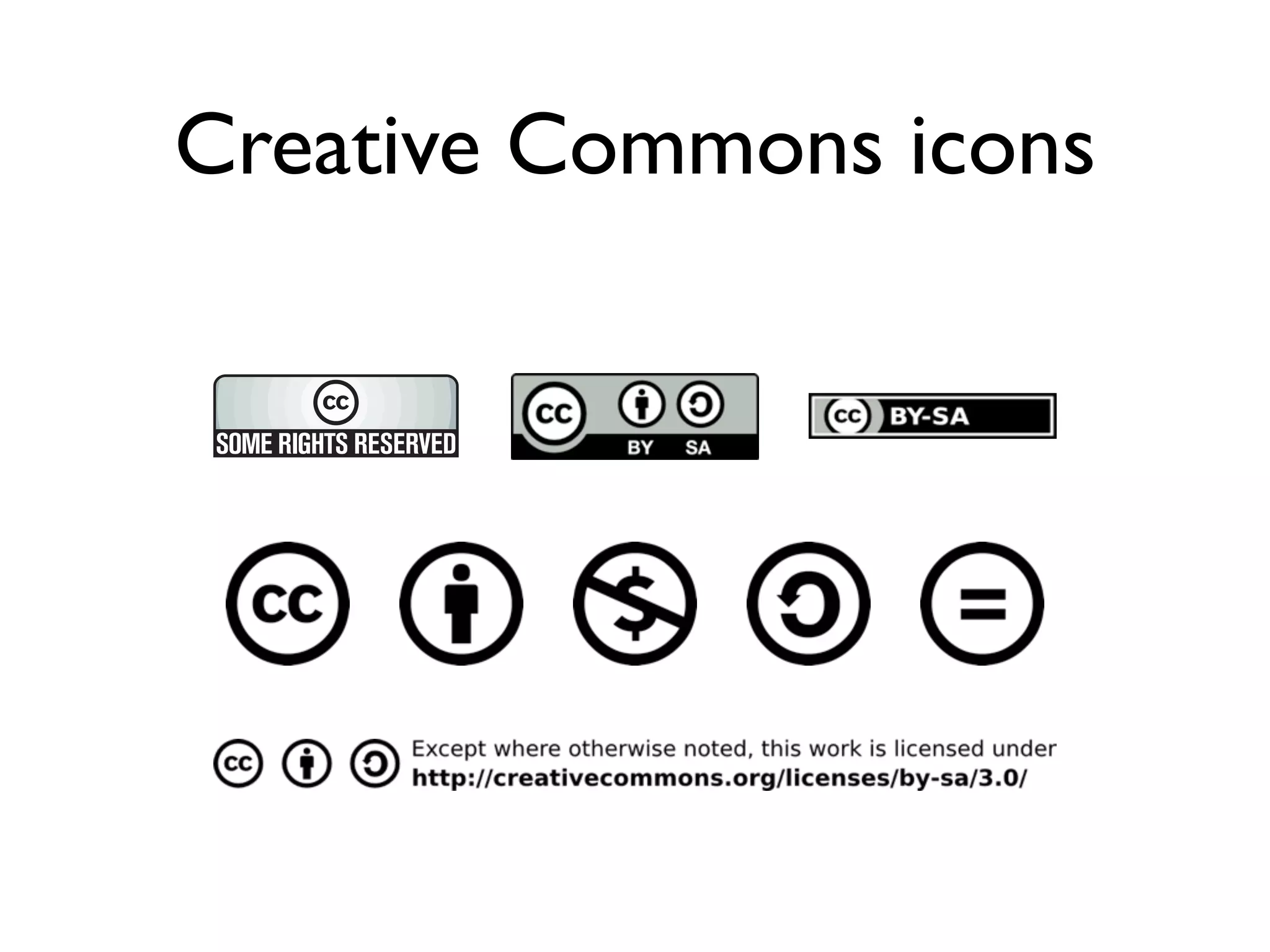
Marking licenses

• If no license information is included
  with the work, then users must
  assume that all rights are reserved
• Title of the license, icon and link are
  added to openly licensed content
Creative Commons icons
OER initiatives
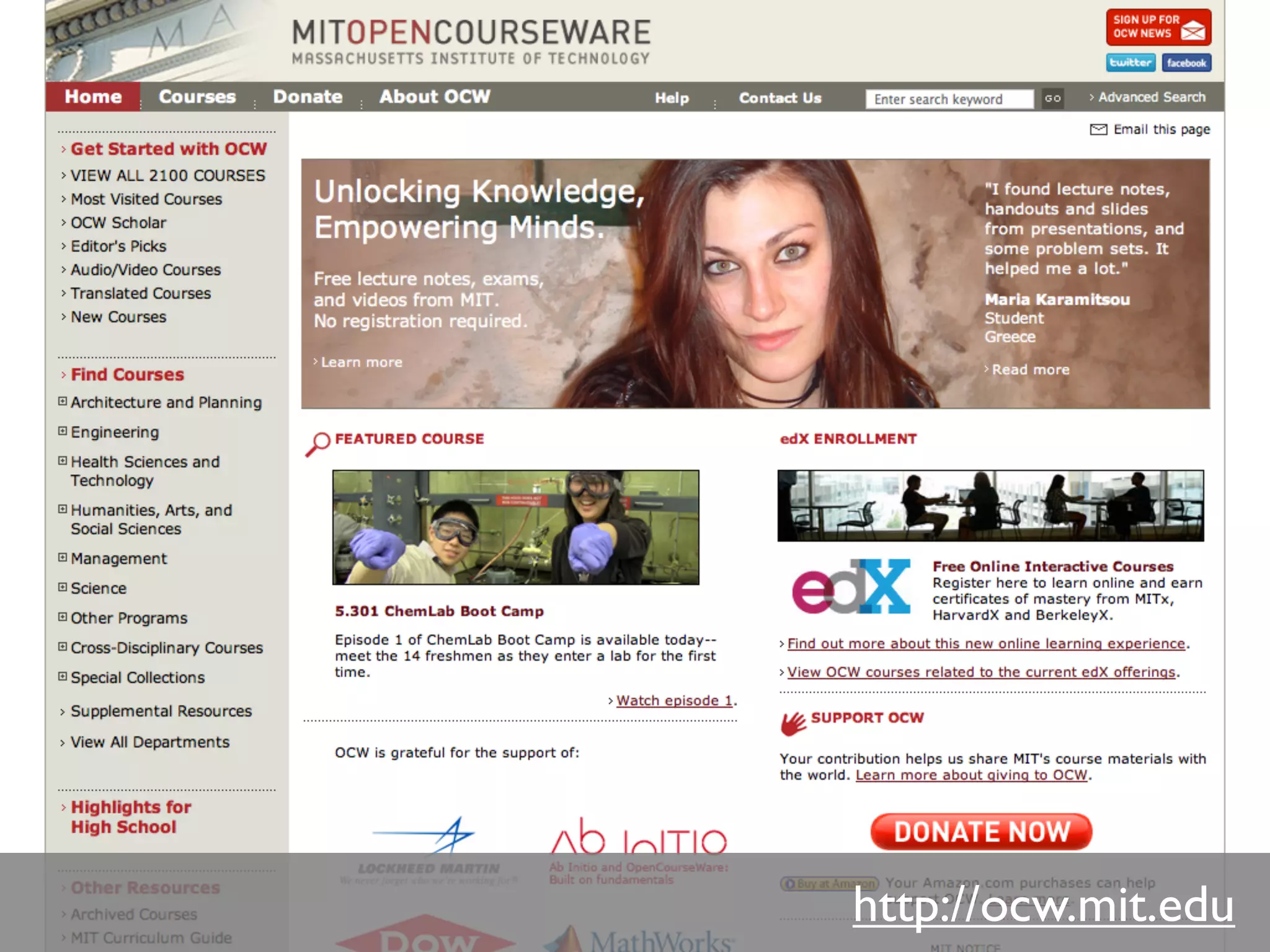
http://ocw.mit.edu
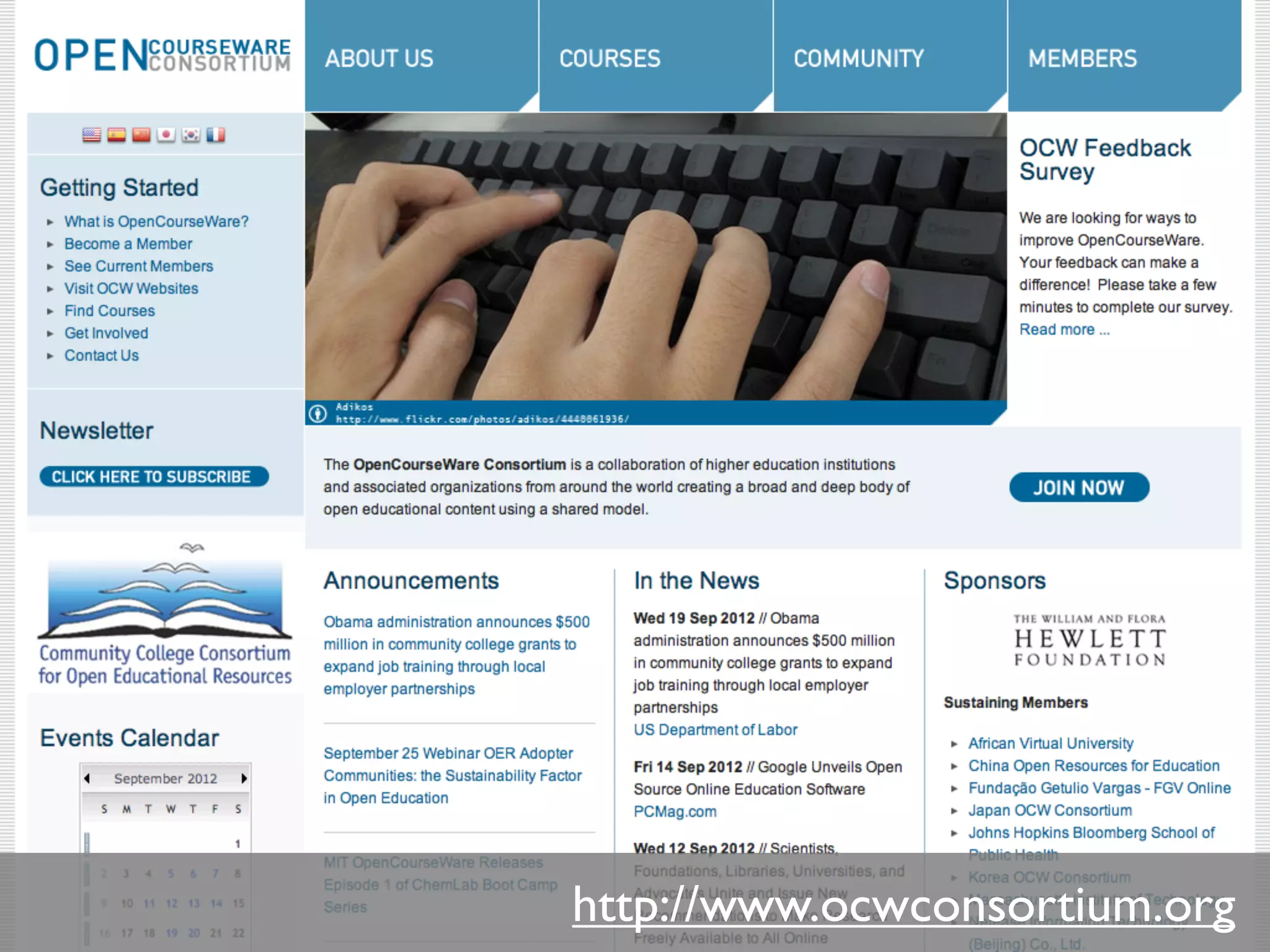
http://www.ocwconsortium.org
http://www.curriki.org
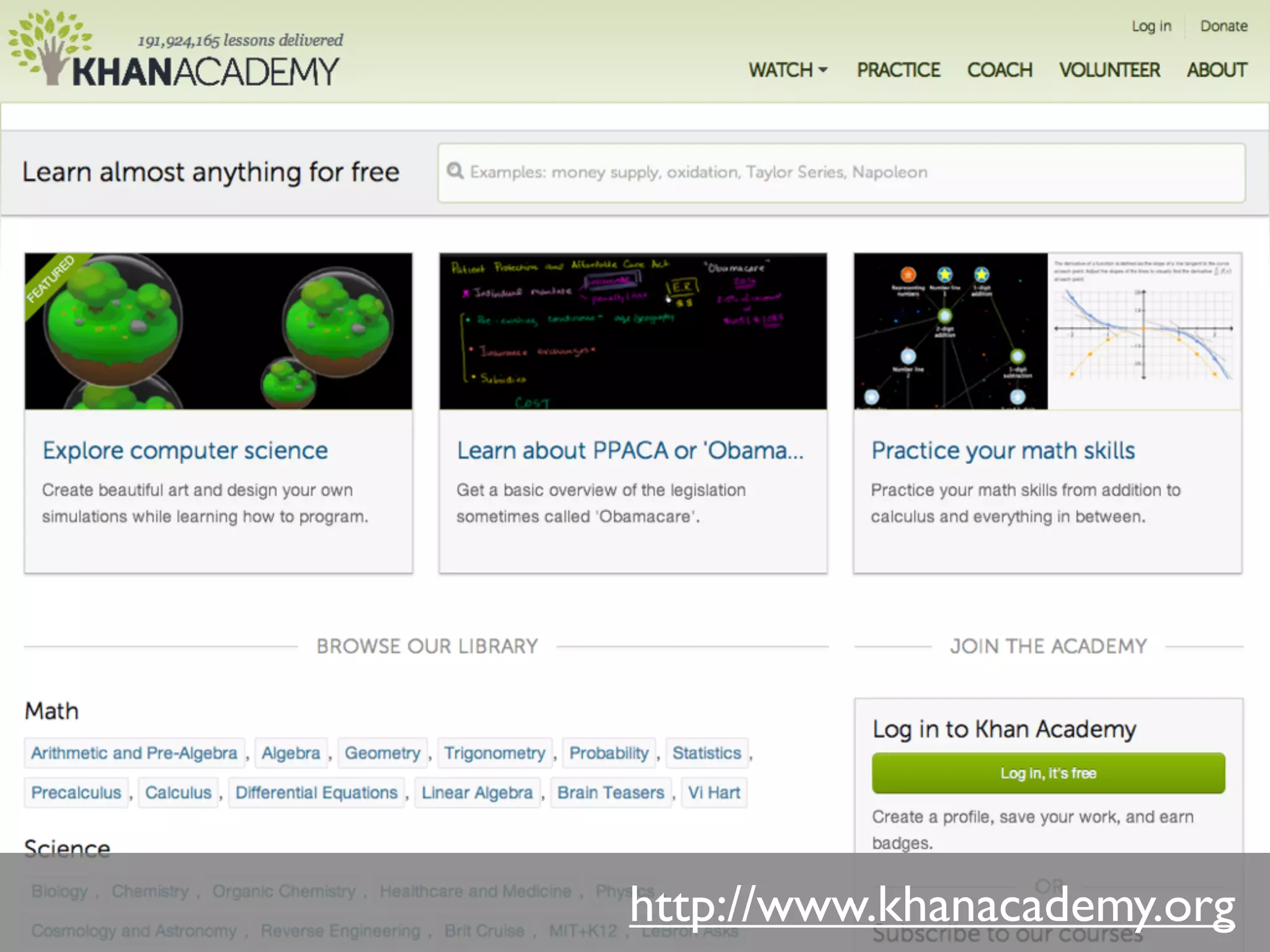
http://www.khanacademy.org
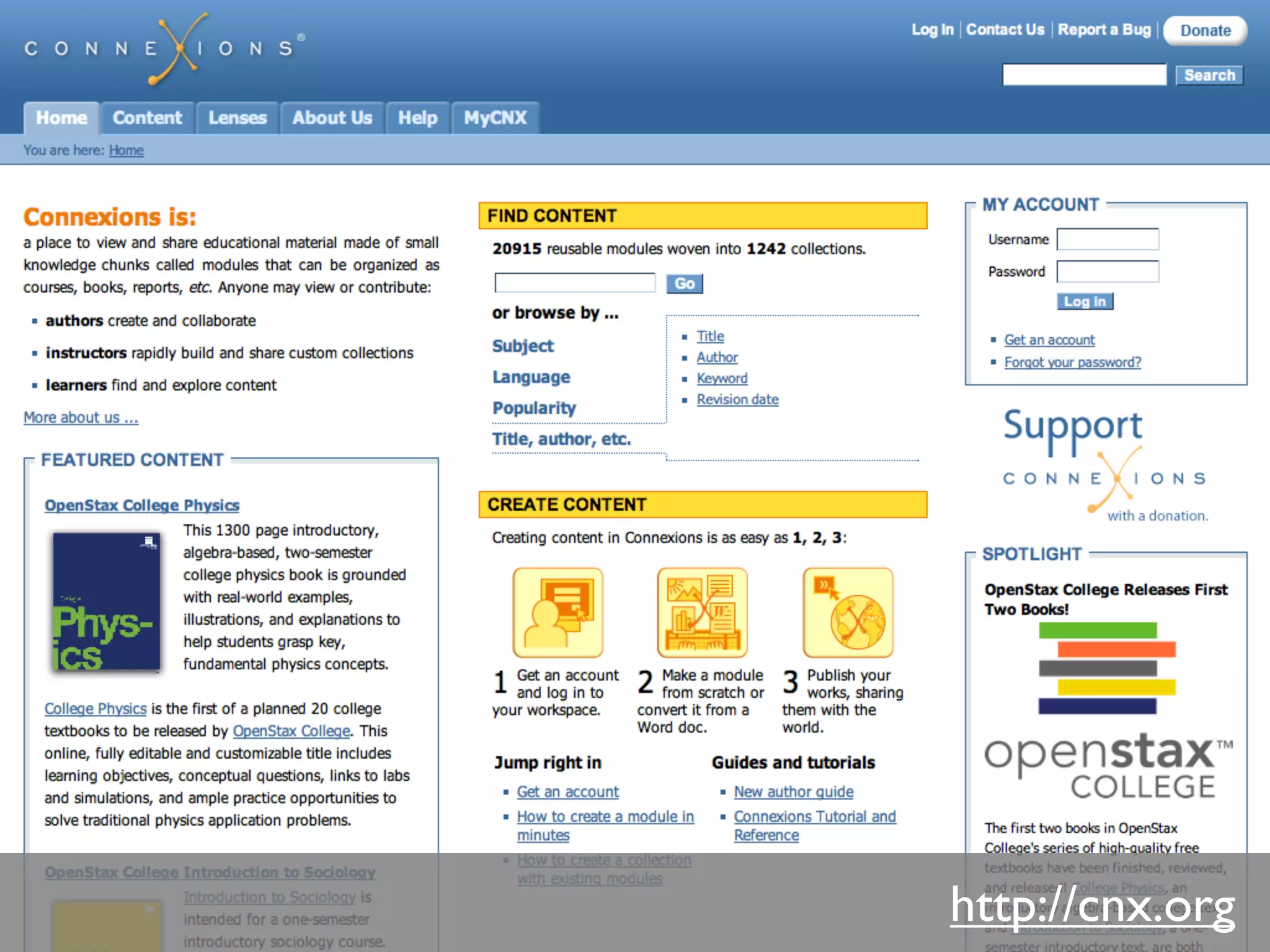
http://cnx.org
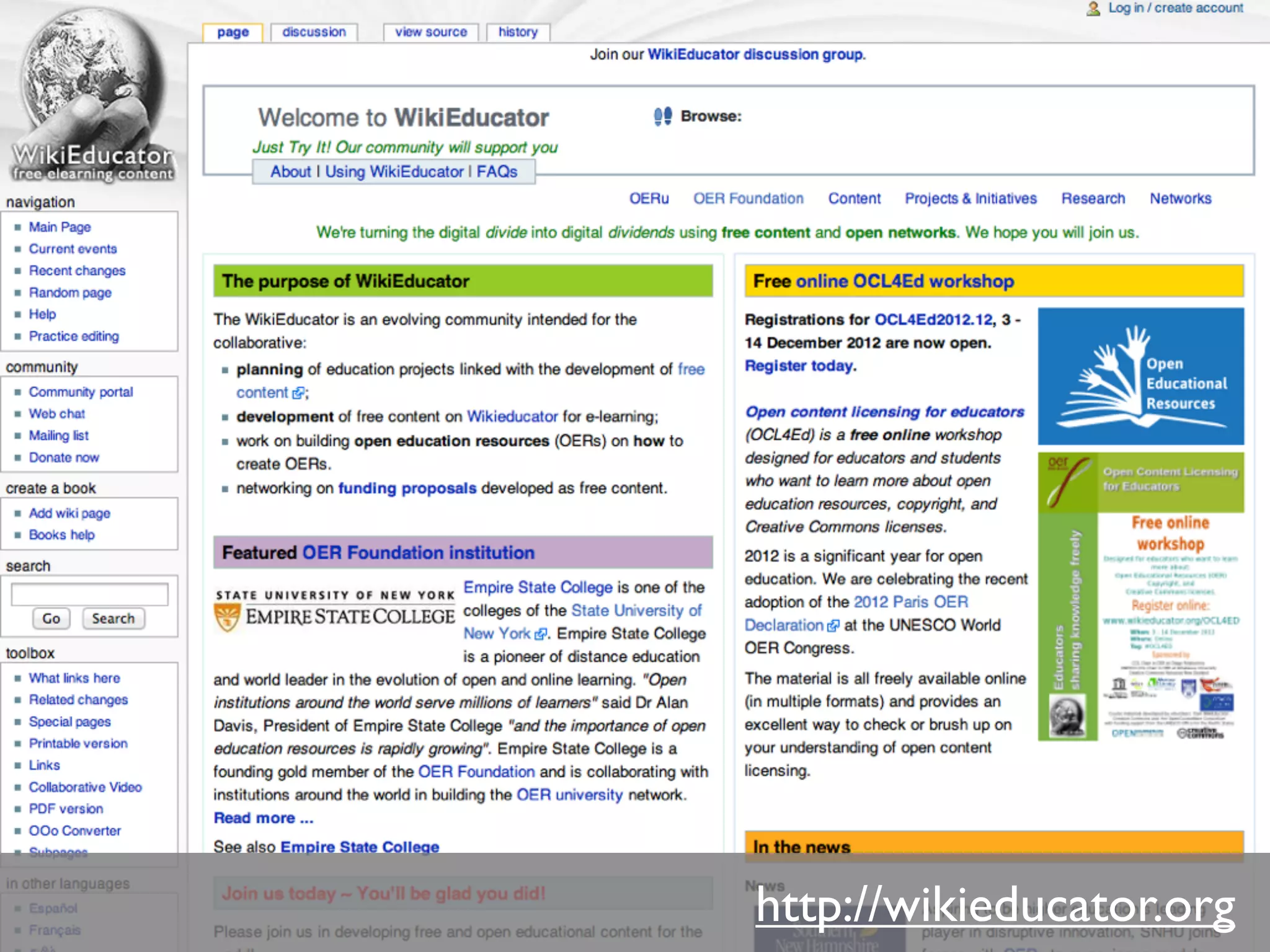
http://wikieducator.org
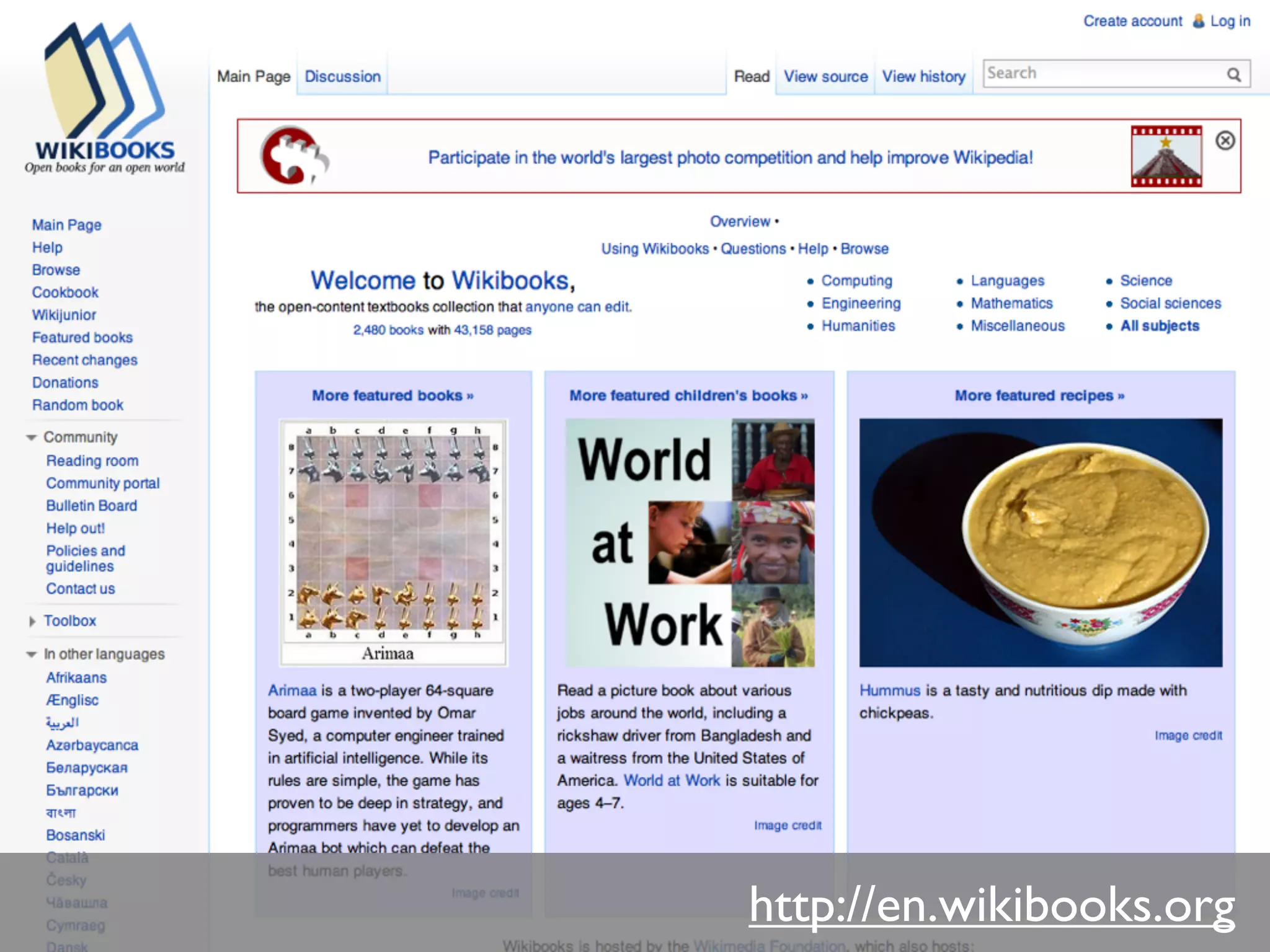
http://en.wikibooks.org
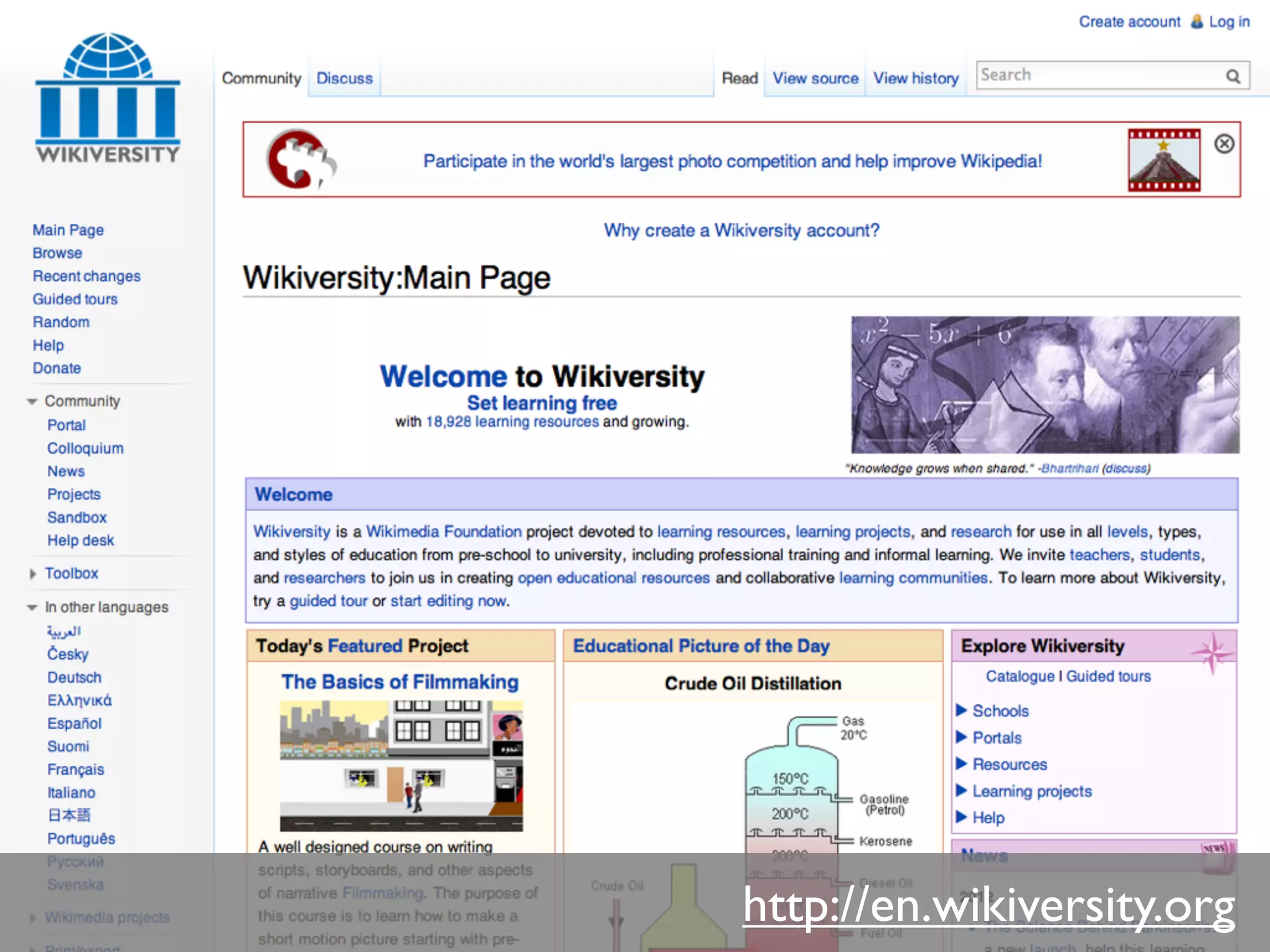
http://en.wikiversity.org
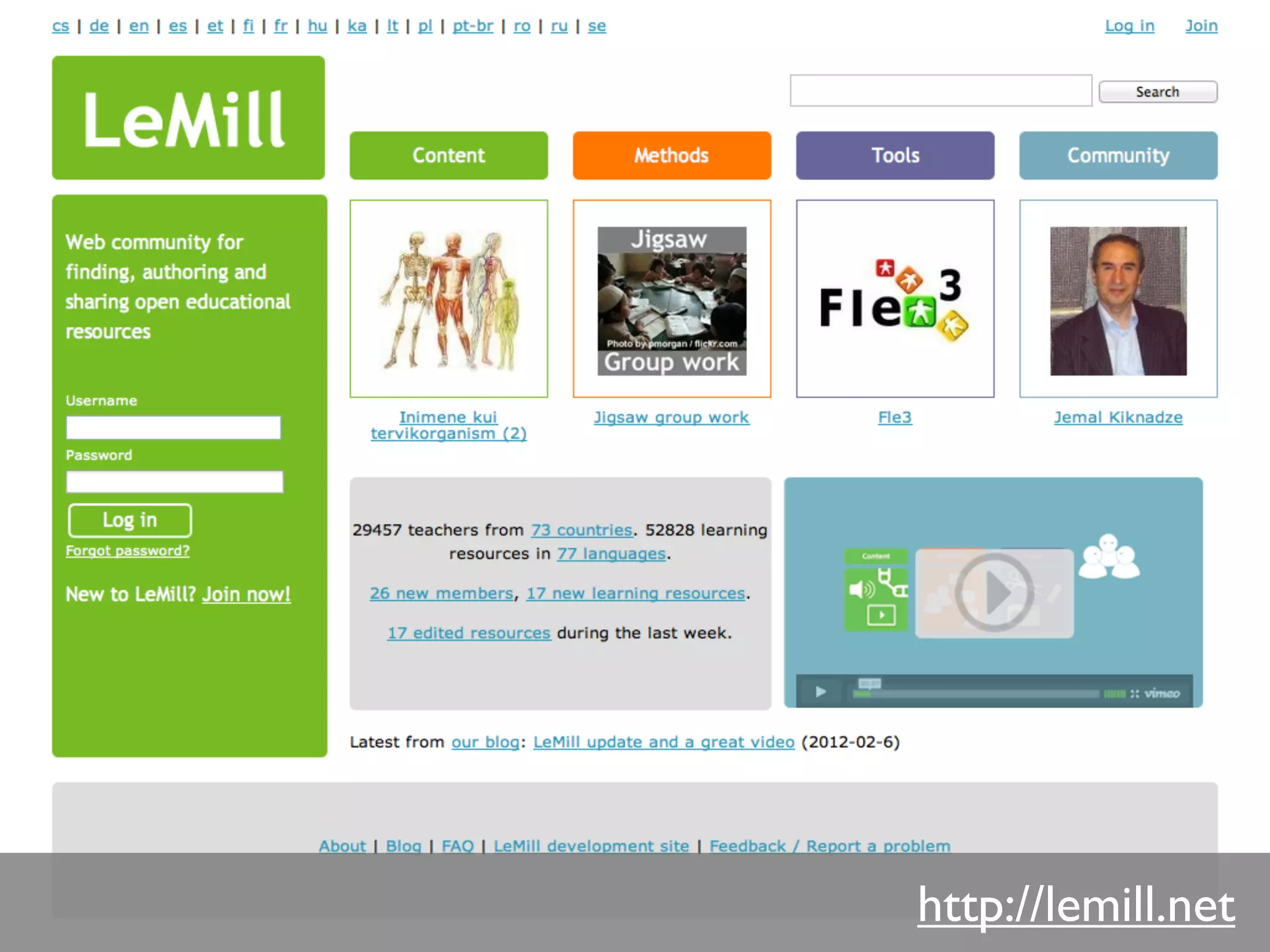
http://lemill.net
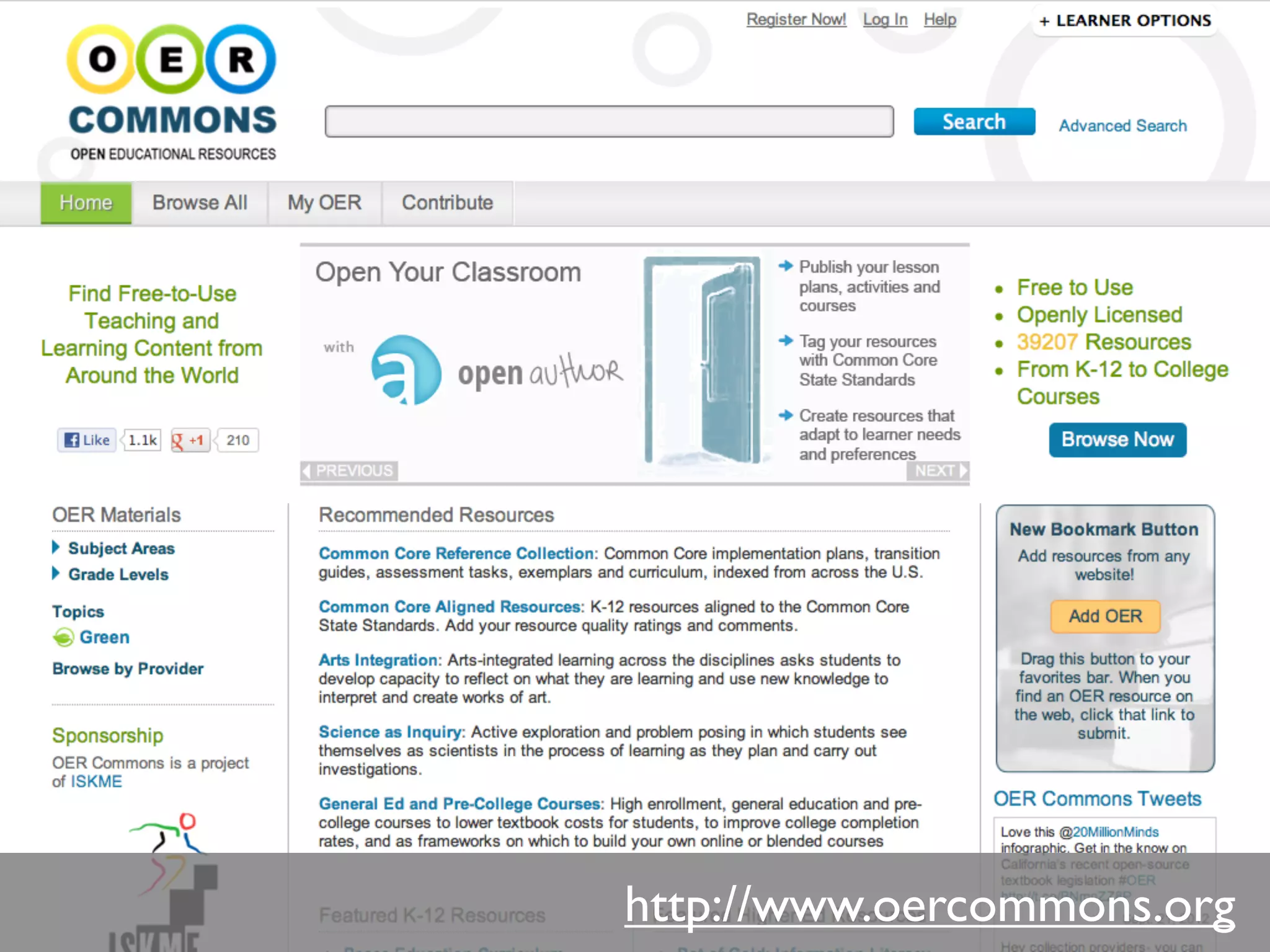
http://www.oercommons.org
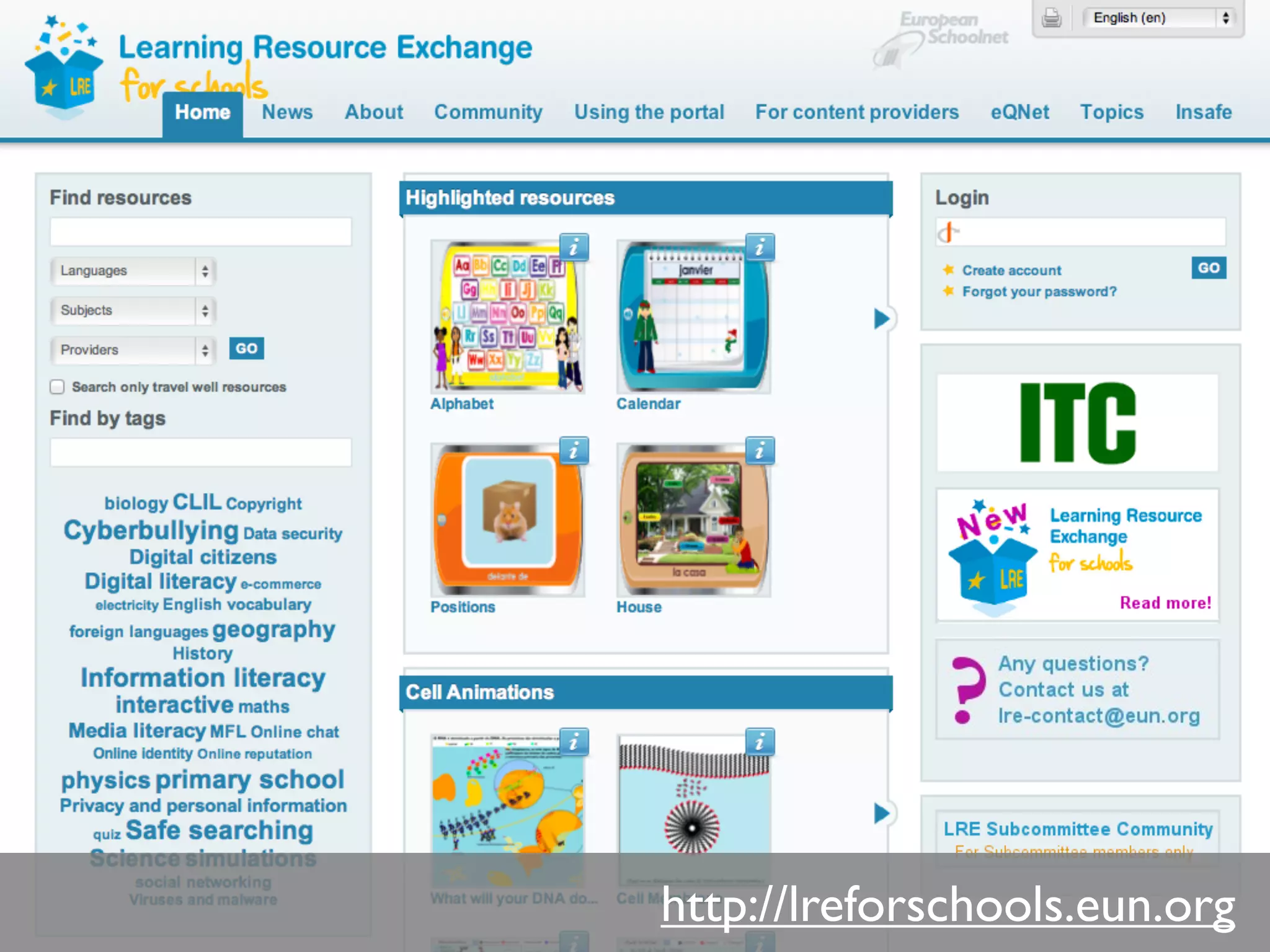
http://lreforschools.eun.org
Task 1


Choose one of the OER initiatives and
search for learning resources in your
subject or area of interest.
OER Initiatives
•   http://ocw.mit.edu

•   http://ocwconsortium.org

•   http://www.curriki.org

•   http://www.khanacademy.org

•   http://cnx.org

•   http://lemill.net

•   http://www.oercommons.org

•   http://lreforschools.eun.org
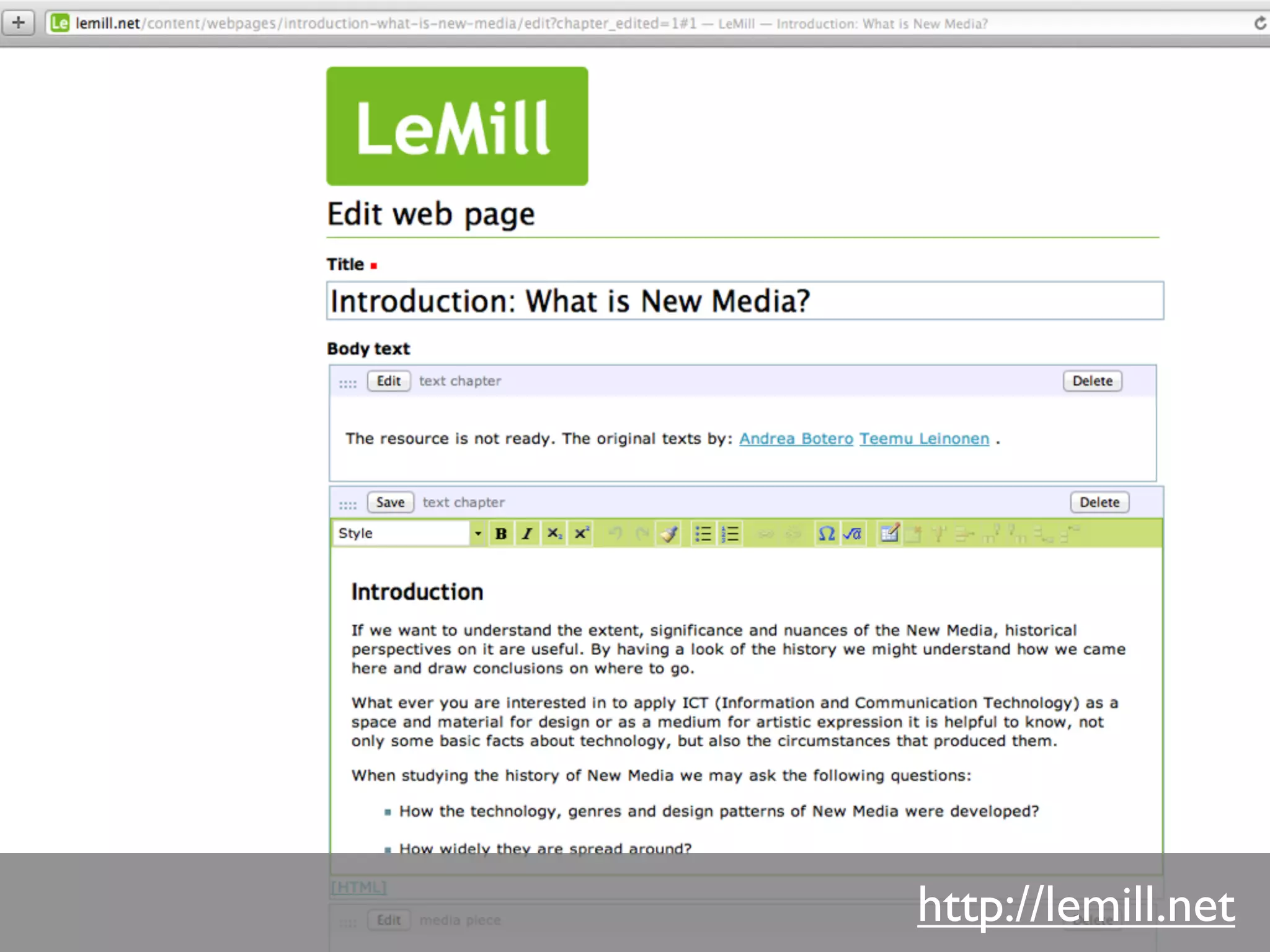
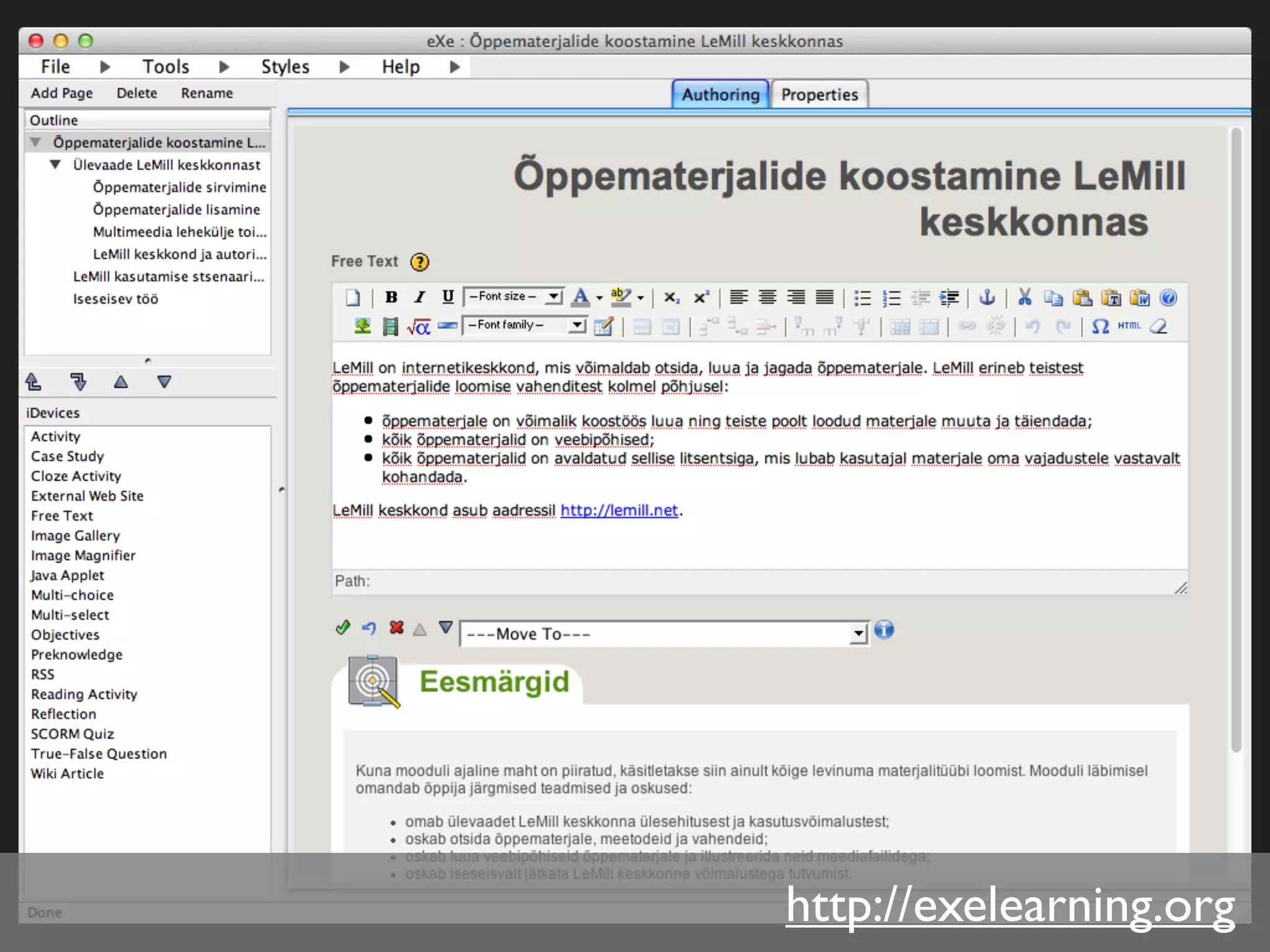
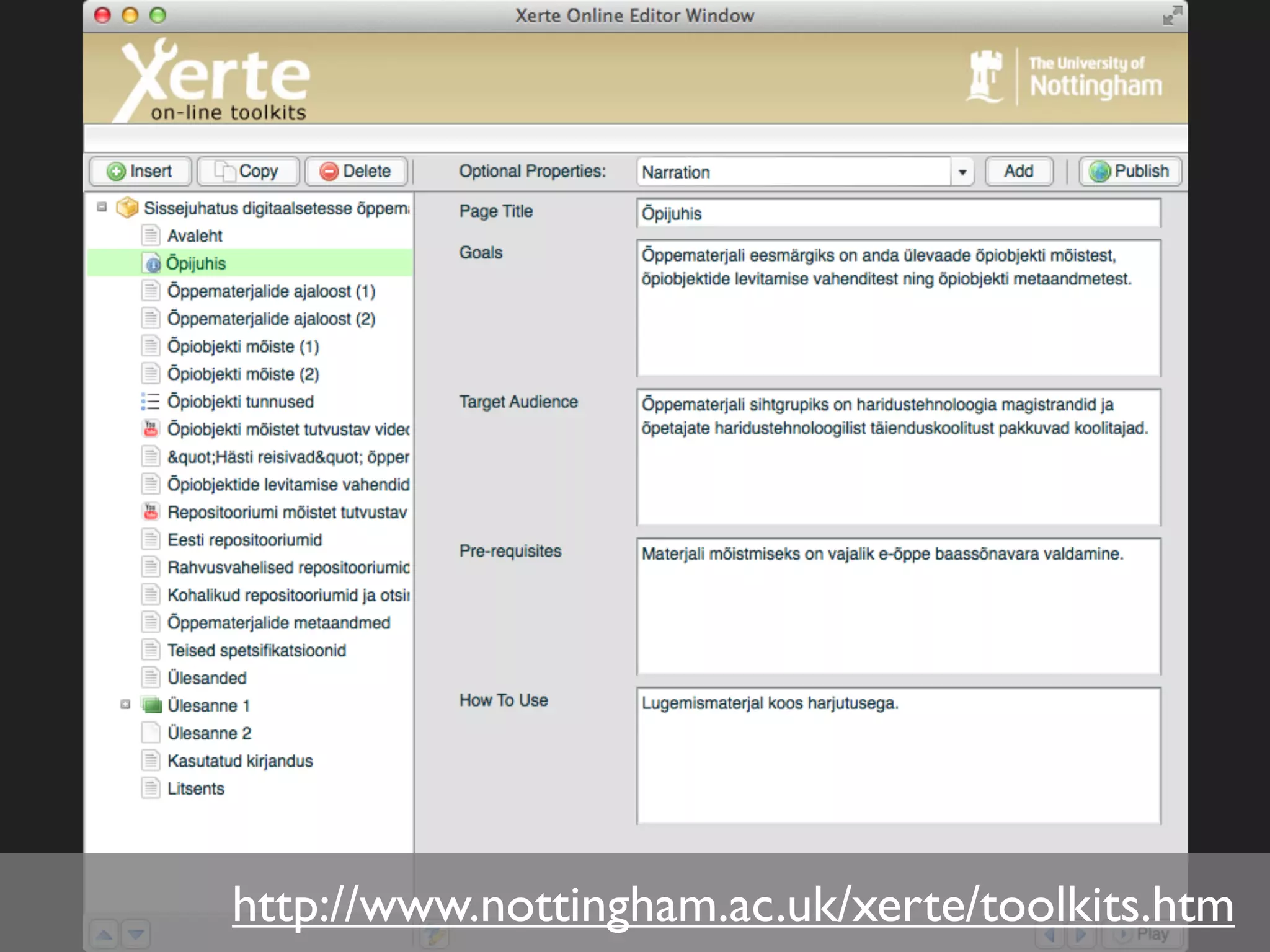
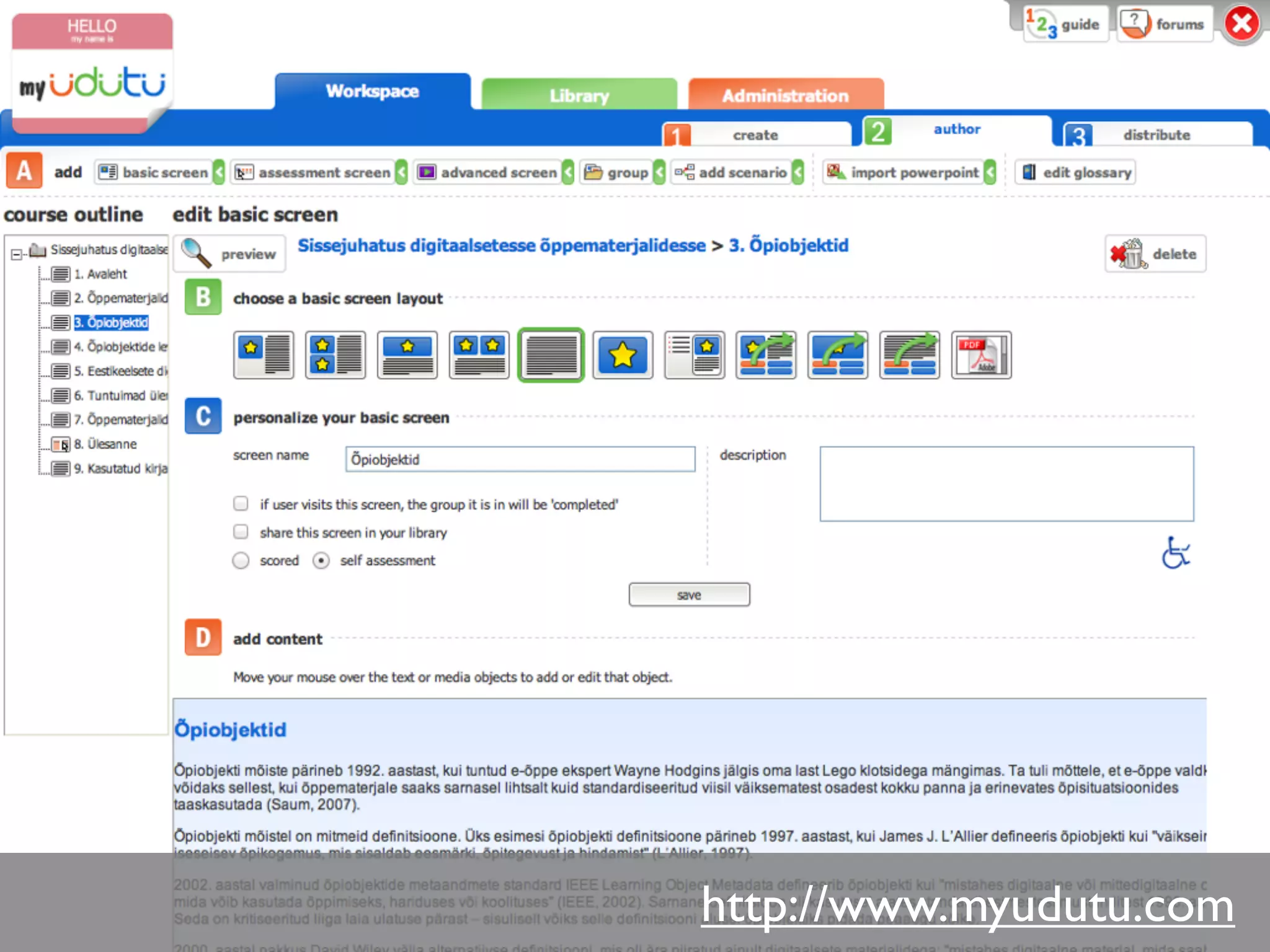
Learning resource authoring tools
http://lemill.net
http://exelearning.org
http://www.nottingham.ac.uk/xerte/toolkits.htm
http://www.myudutu.com
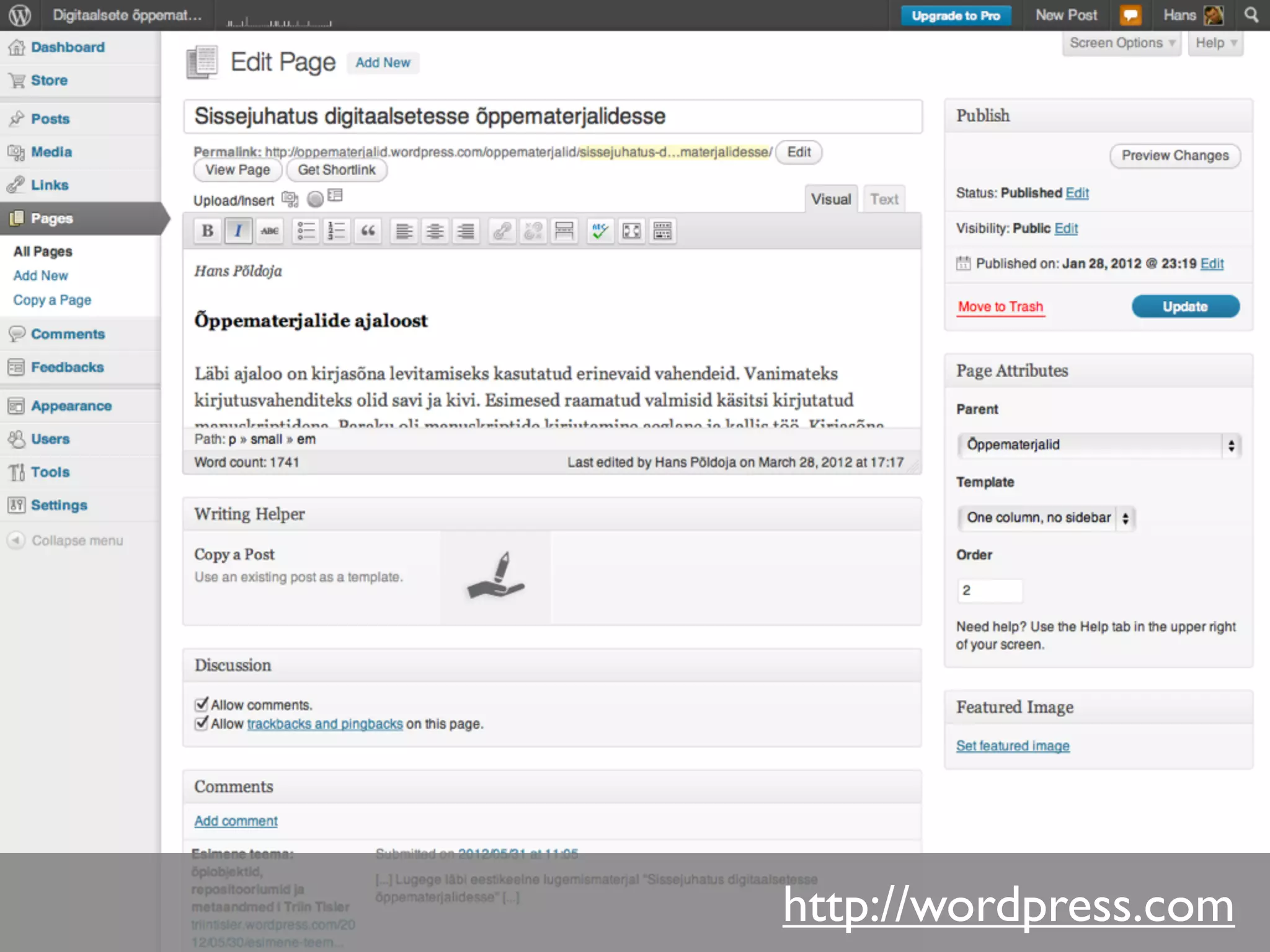
http://wordpress.com
What to choose?

 Learning resource authoring tool
            (eg. LeMill, eXe, ...)


                    vs
Generic content management system
            (eg. WordPress, ...)
Demo:

http://lemill.net
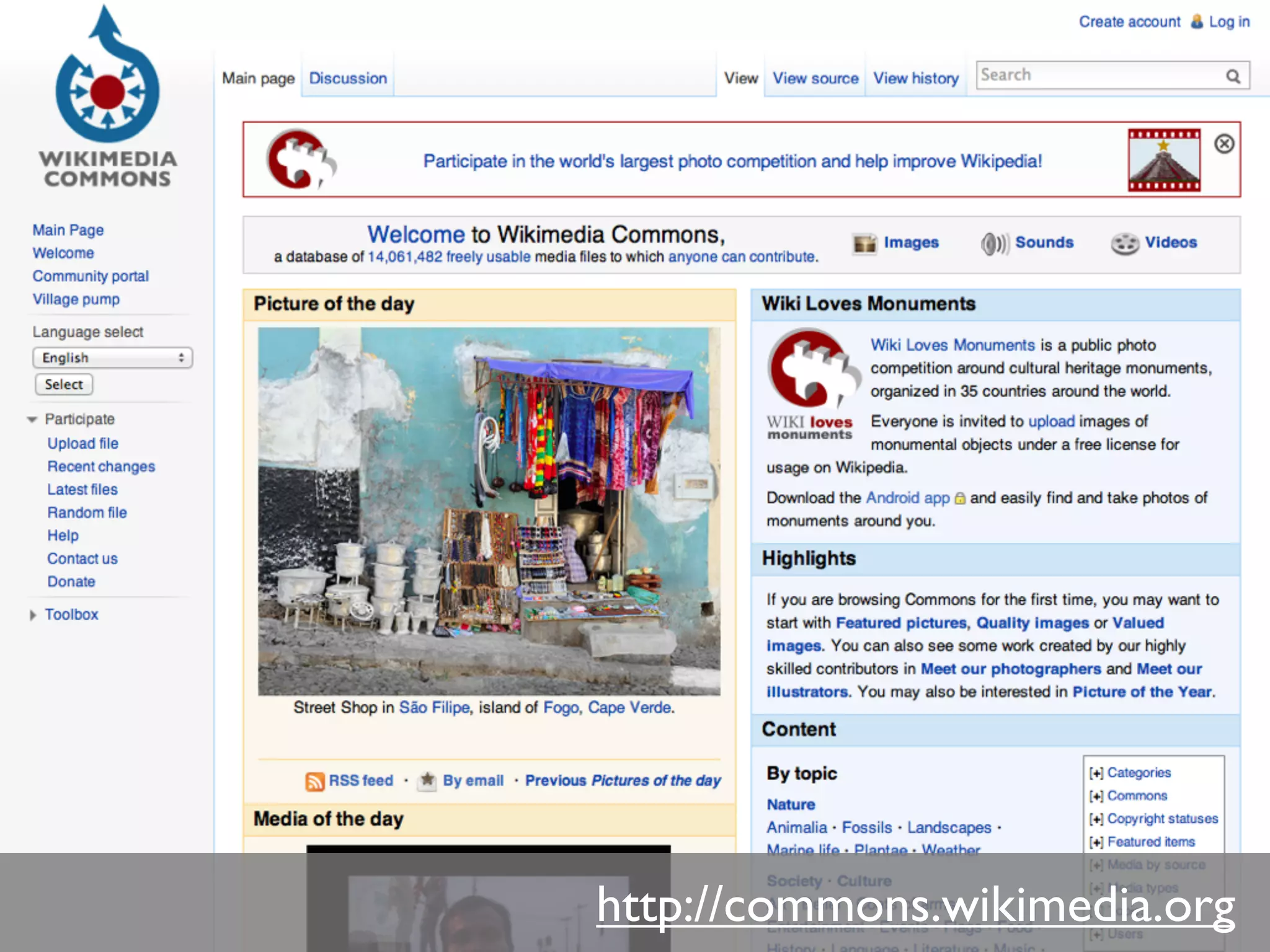
Open content
http://commons.wikimedia.org
Demo:

http://commons.wikimedia.org
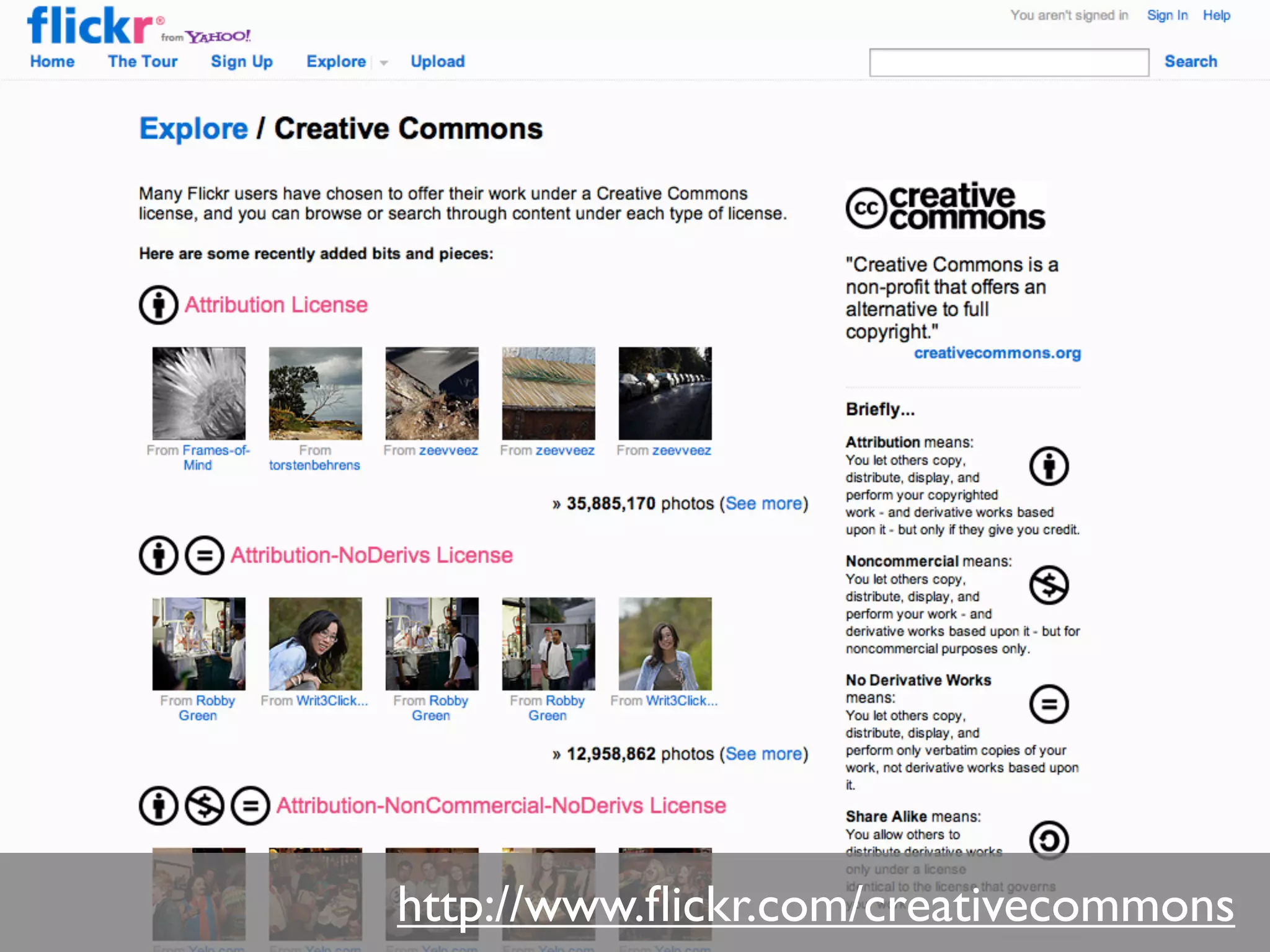
http://www.flickr.com/creativecommons
Demo:

http://www.flickr.com/creativecommons
Embedding
Embedding external content

•   Movies:YouTube,Vimeo, Khan Academy

•   Presentations: SlideShare, Google Docs

•   Mind maps: Spicynodes

•   Timelines: TimeRime

•   Maps: Google Maps

•   Exercises: Quizlet
Embedding from
Embedding to
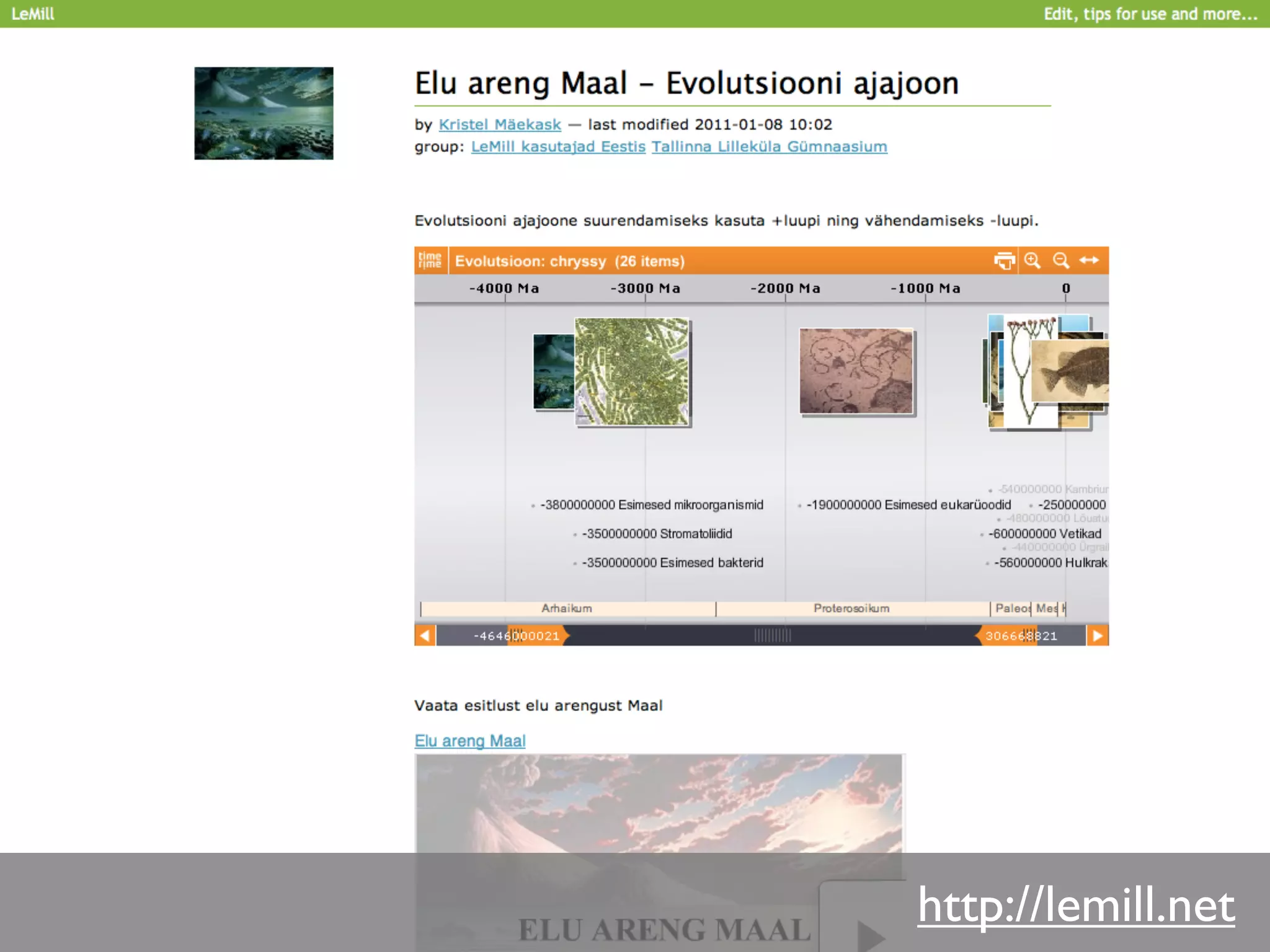
http://lemill.net
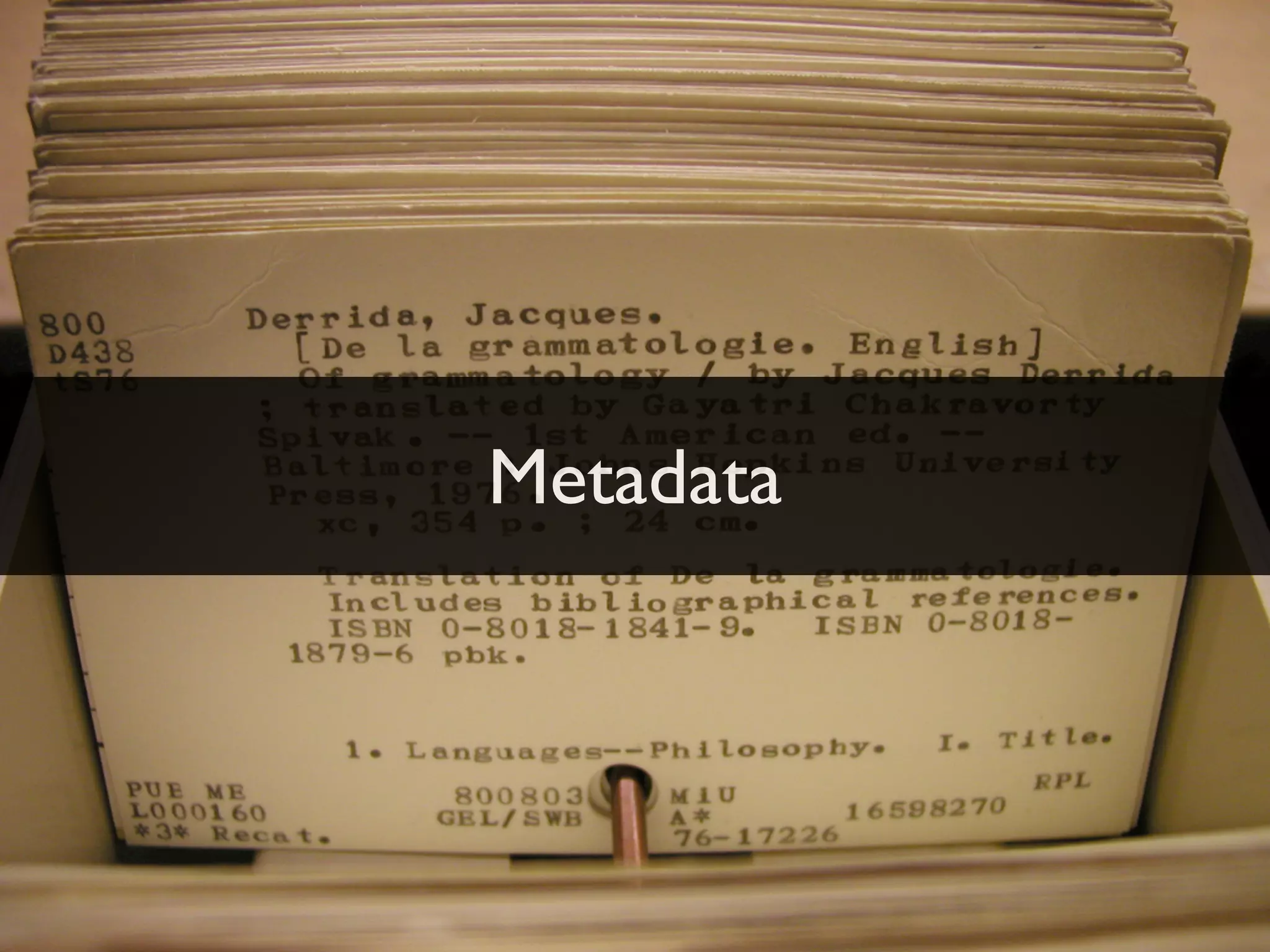
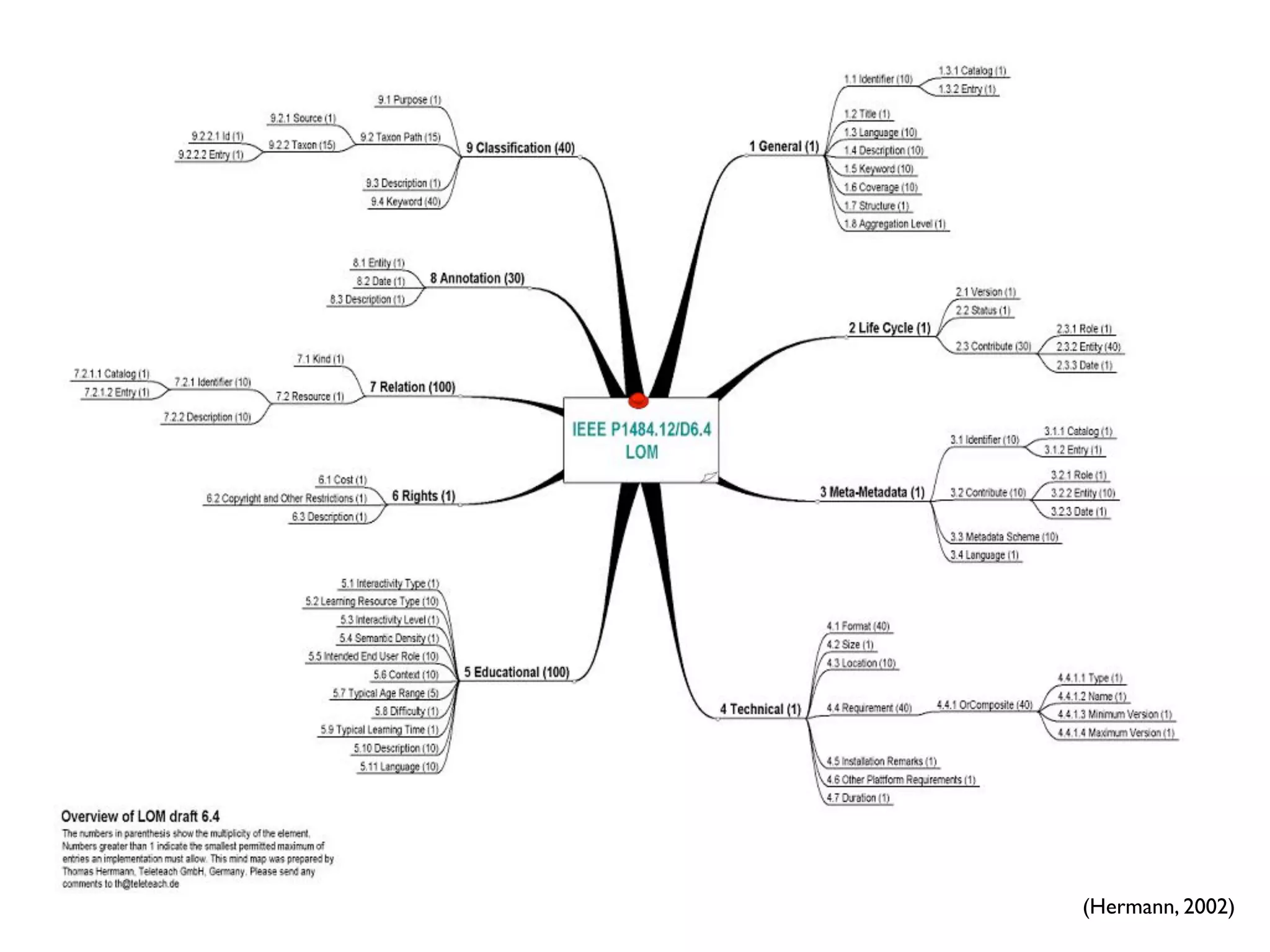
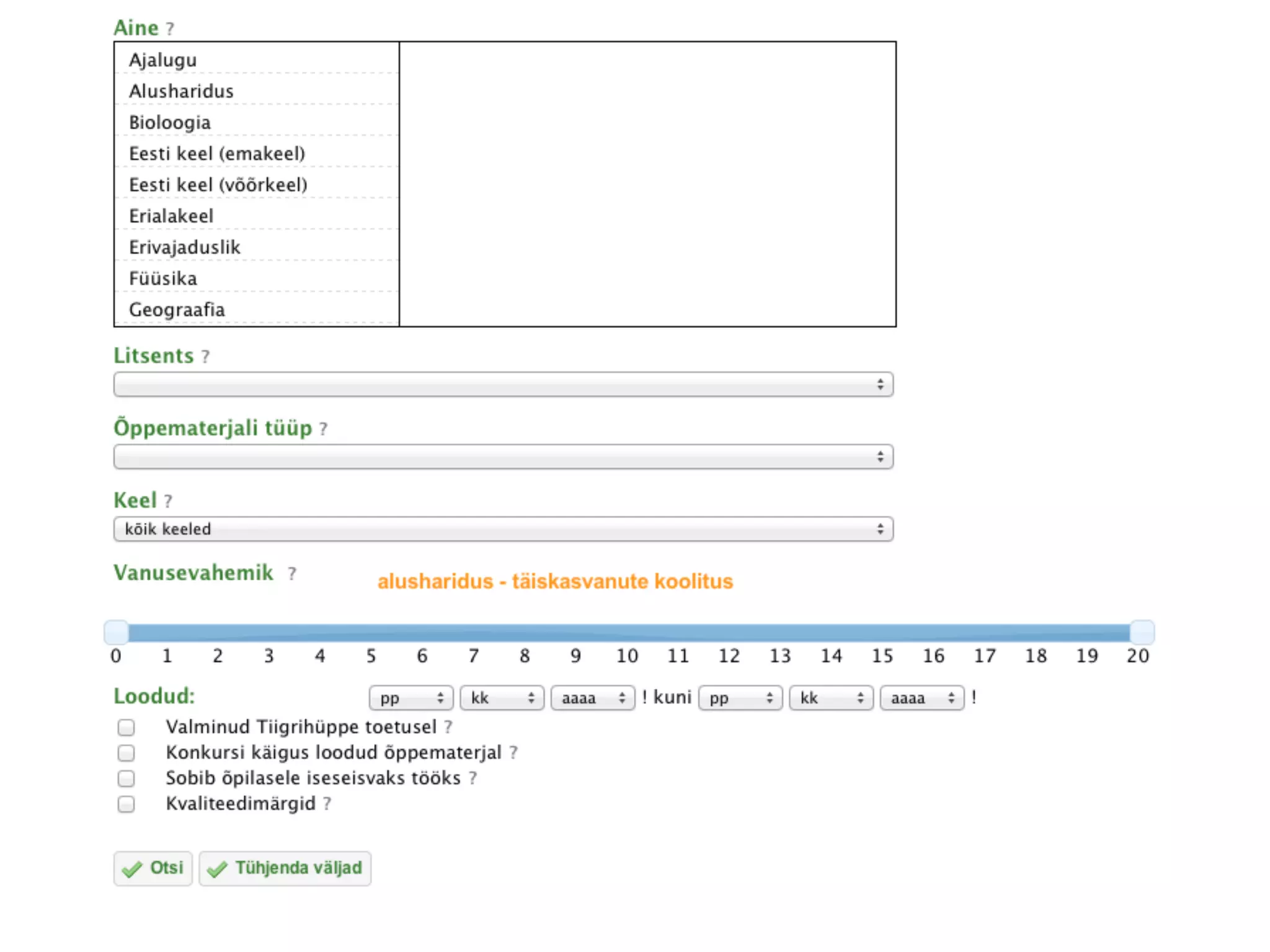
Metadata
(Hermann, 2002)
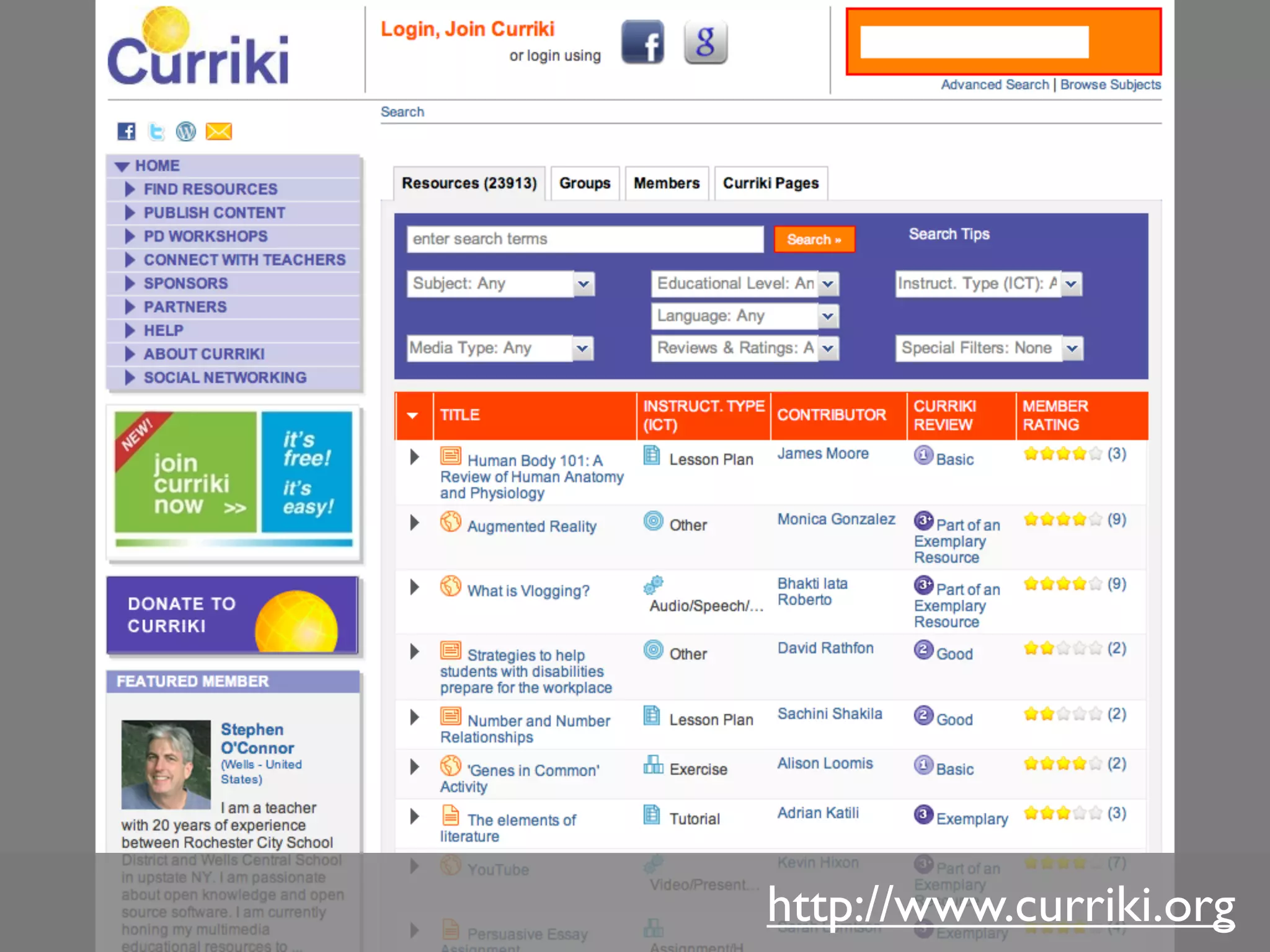
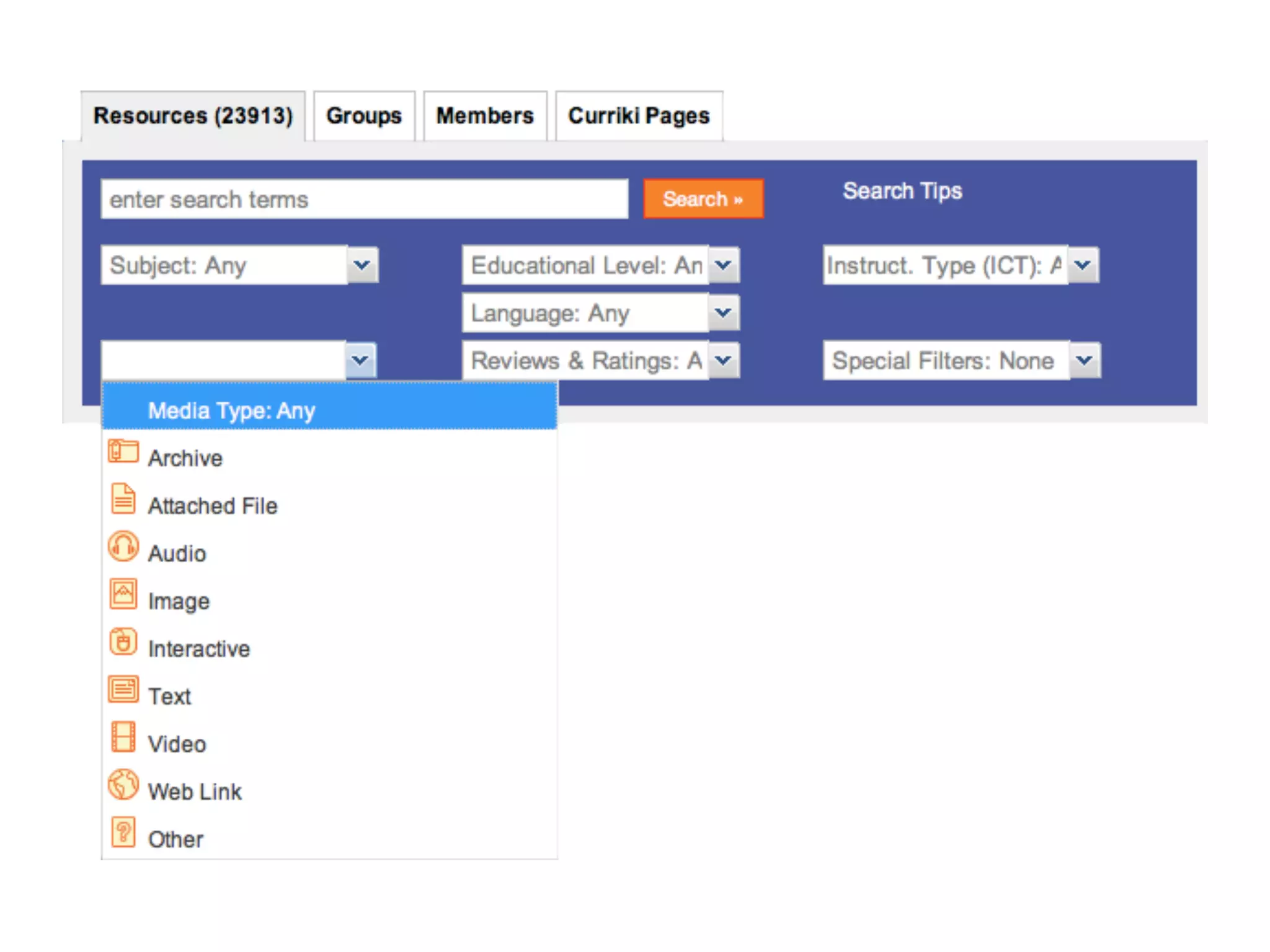
http://www.curriki.org
Tagging
References
• Directive 2001/29/EC, http://eur-lex.europa.eu/LexUriServ/LexUriServ.do?
  uri=CELEX:32001L0029:EN:HTML

• Hermann, T. (2002). Overview of LOM Draft 6.4. http://www.sreb.org/
  programs/EdTech/SCORE/SCORE_Users_Guide.pdf

• Wikipedia (2012). Open educational resources. http://en.wikipedia.org/wiki/
  Open_educational_resources
Photos
• Adrian Nier, http://www.flickr.com/photos/adriannier/5604256326/

• Hamed Saber, http://www.flickr.com/photos/hamed/389212454/

• epSos .de, http://www.flickr.com/photos/epsos/5394616925/

• Laineys Repertoire, http://www.flickr.com/photos/
  76283671@N00/142605716/

• David Fulmer, http://www.flickr.com/photos/annarbor/4349879701/
Thank You!


Hans Põldoja
Researcher
Tallinn University, Estonia


hans.poldoja@tlu.ee
http://www.hanspoldoja.net
http://www.slideshare.net/hanspoldoja

Authoring and sharing open educational resources