Open educational resources - using and creating sharable teaching materials in health care - findings of the PORSCHE OER projectKate LomaxNeLR, London DeaneryLindsay Wood, [Suzanne Hardy], [Megan Quentin-Baxter]HEA MEDEV
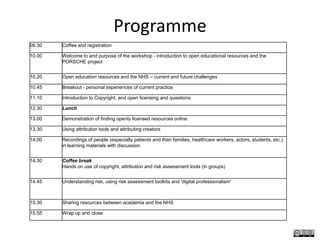
Programme
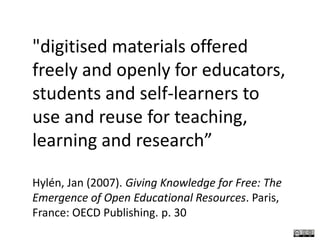
"digitised materials offered freely and openly for educators, students and self-learners to use and reuse for teaching, learning and research”Hylén, Jan (2007). Giving Knowledge for Free: The Emergence of Open Educational Resources. Paris, France: OECD Publishing. p. 30
NHS contextEndless organisational change
increased local ownership of education and training provision.
Simulation, eLearning and emerging technologies – TEL framework
shift towards skills networks, healthcare professionals empowered to deliver results"Times they are a'changing" AGAIN! (http://www.flickr.com/photos/lwr/4018985290/) / LEOL30 (http://www.flickr.com/photos/lwr/) / CC BY-NC-SA 2.0 (http://creativecommons.org/licenses/by-nc-sa/2.0/)
Is there room for OER in the NHS?Pressures for commercial partnerships and income generation opportunitiesBut also doing at a national level only what is best done at a national level – leavingmaximum opportunities for flexible, local implementation and innovation;
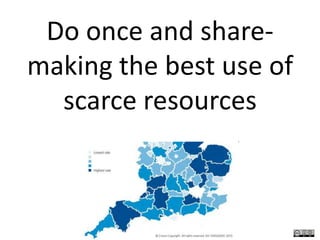
Do once and share- making the best use of scarce resources
Making the case for OERsremoving barriers and disciplinary silos of training and education resources. reduces duplication supports cross-institutional sharing promotes the concept of lifelong learning supports discovery of most used/highest quality resources  Good intentions: improving the evidence base in support of sharing learning materials Lou McGill, Sarah Currier, Charles Duncan, Peter Douglas http://ie-repository.jisc.ac.uk/265/1/goodintentionspublic.pdf
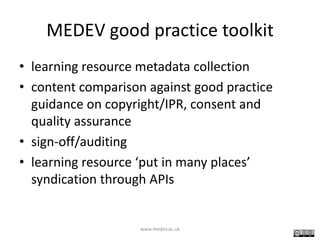
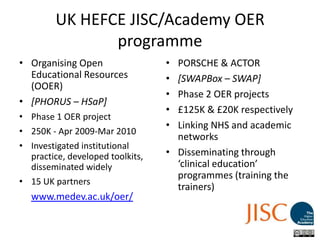
OOERorganising open educational resources Guidance and toolkits for institutional policy, consent, copyright and IPR, quality and pedagogy.
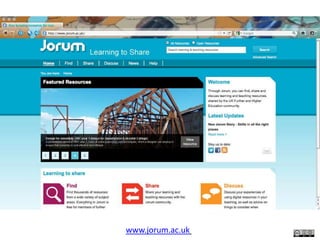
 2000 resources uploaded to www.jorum.ac.uk
 Recommendations included:
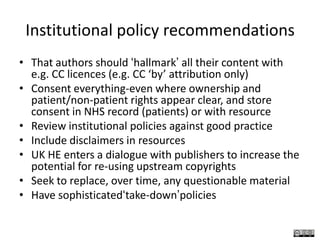
 Authors ‘hallmark’ all content (whether to be made open or not) with CC licences
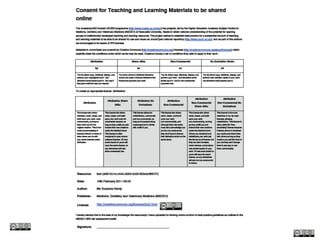
 Consent everything (even where ownership and patient/non-patient rights appear clear) and store copies of consent with resource
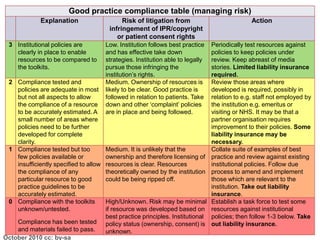
 Review institutional policies against good practice risk-assessment tools
 UK HE enter into dialogue with publishers to increase potential for third party upstream rights (especially images, music and video)
 Establish staff reward system (for recognition of sharing & reusing resources, PDRs, promotion criteria, etc.)www.medev.ac.uk/oer/#ukoer #ooer #medevcontact: suzanne@medev.ac.uk
Institutional policy recommendationsThat authors should ‘hallmark’ all their content with e.g. CC licences(e.g. CC ‘by’ attribution only) Consent everything-even where ownership and patient/non-patient rights appear clear, and store consent in NHS record (patients) or with resourceReview institutional policies against good practiceInclude disclaimers in resourcesUK HE enters a dialogue with publishers to increase the potential for re-using upstream copyrightsSeek to replace, over time, any questionable materialHave sophisticated‘take-down’policies
Pathways for Open Resource Sharing through Convergence in Healthcare Education (PORSCHE)Seamless access to academic and clinical elearning resourcescc: by Tony the Misfithttp://www.flickr.com/photos/tonythemisfit/2580913560/contact: lindsay@medev.ac.uk   www.medev.ac.uk/ourwork/oer/  #porscheoer #ukoer #medev
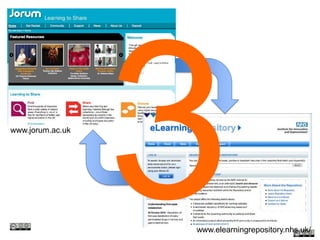
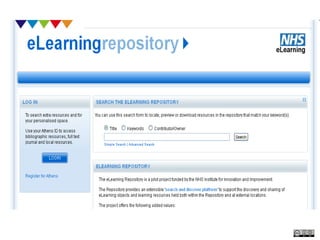
3www.jorum.ac.ukwww.elearningrepository.nhs.uk/
Consent Commons ameliorates uncertainty about the status of educational resources depicting people, and protects institutions from legal risk by developing robust and sophisticated policies and promoting best practice in managing information.consent commons
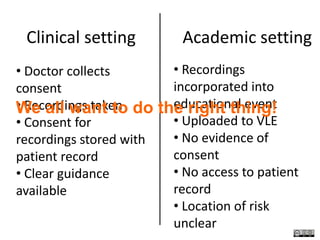
Clinical settingAcademic setting Recordings incorporated into educational event
 Uploaded to VLE
 No evidence of consent
 No access to patient record
 Location of risk unclear
 Doctor collects consent
 Recordings taken
 Consent for recordings stored with patient record
 Clear guidance availableWe all want to do the right thing!
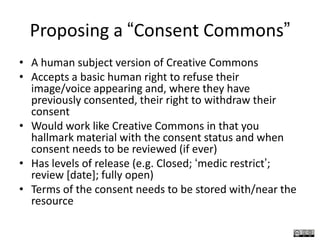
Proposing a “Consent Commons”A human subject version of Creative Commons
Accepts a basic human right to refuse their image/voice appearing and, where they have previously consented, their right to withdraw their consent
Would work like Creative Commons in that you hallmark material with the consent status and when consent needs to be reviewed (if ever)
Has levels of release (e.g. Closed; ‘medic restrict’; review [date]; fully open)
Terms of the consent needs to be stored with/near the resourcewww.medev.ac.uk
Accredited Clinical Teaching Open Resources (ACTOR)Partners: University of Bristol, University of Cambridge, Hull York Medical School, Newcastle University,Peninsula College of Medicine and Dentistry.www.medev.ac.uk/oer/#ukoer #actor #medevcc: by-nc By Maxi Waltonhttp://www.flickr.com/photos/maxiwalton/898138774/Contact: gillian@medev.ac.uk
Icebreaker
personal experiences of current practiceBreakout: group work (20 minutes)
Feedback to group
Pre-workshop areas of interest“appropriate and accurate”“what you don't know”“separating the facts”“pros and cons of sharing e-learning”“responsible for the authenticity of the content ““use of images and other materials - copyright issues”“sharing and copyright issues”
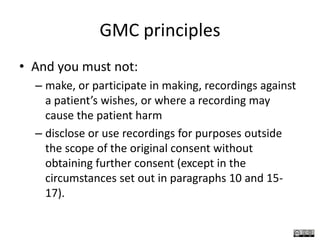
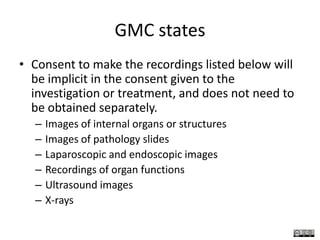
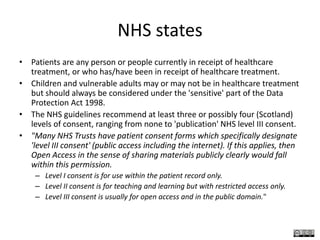
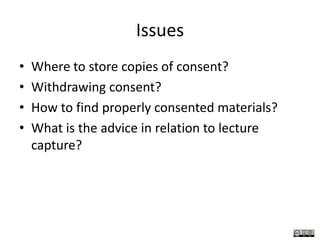
CONSENT
www.medev.ac.ukOctober 2010 cc: by-sa
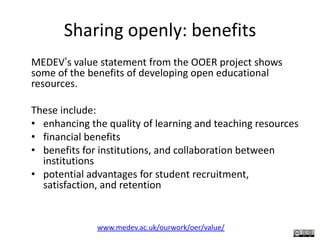
MEDEV’s value statement from the OOER project shows some of the benefits of developing open educational resources.  These include:enhancing the quality of learning and teaching resources
financial benefits
benefits for institutions, and collaboration between institutions
potential advantages for student recruitment, satisfaction, and retentionSharing openly: benefitswww.medev.ac.uk/ourwork/oer/value/
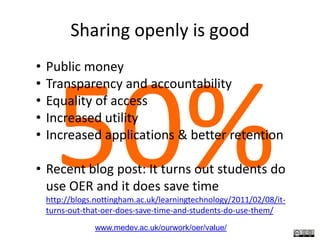
Sharing openly is good50%Public money
Transparency and accountability
Equality of access
Increased utility
Increased applications & better retention
Recent blog post: It turns out students do use OER and it does save time http://blogs.nottingham.ac.uk/learningtechnology/2011/02/08/it-turns-out-that-oer-does-save-time-and-students-do-use-them/www.medev.ac.uk/ourwork/oer/value/
One of the benefits of being explicitly ‘open’ is that it removes the need for people to ask before re-using stuff. Without it, everything boils down to ‘am I allowed to do this?’  type question and many forms of re-use will stop at that hurdle because the costs of getting the answer are too greatAndy Powell comment on David Wiley’s bloghttp://opencontent.org/blog/archives/1735
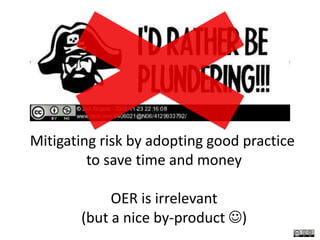
Mitigating risk by adopting good practice to save time and moneyOER is irrelevant(but a nice by-product )
IPR & Copyright issuesOpen Educational Resources
Intellectual property rights (IPR)There are four main types of IP rights
Patents protect what makes things work (e.g. engine parts, chemical formulas)
Trade marks are signs (like words and logos) that distinguish goods and services in the marketplace
Designs protect the appearance of a product/logo, from the shape of an aeroplane to a fashion item
Copyright is an automatic right which applies whenthe work is expressed (fixed, written or recorded)
Copyright, Design and Patents Act, 1988
Copyright arises automatically when an original idea (author uses some judgment or skill) is expressed/created
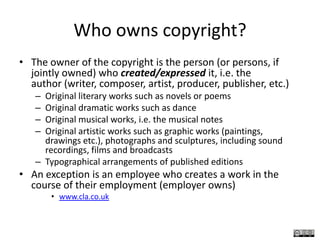
www.ipo.gov.ukWho owns copyright?The owner of the copyright is the person (or persons, if jointly owned) who created/expressed it, i.e. the author (writer, composer, artist, producer, publisher, etc.)
Original literary works such as novels or poems
Original dramatic works such as dance
Original musical works, i.e. the musical notes
Original artistic works such as graphic works (paintings, drawings etc.), photographs and sculptures, including sound recordings, films and broadcasts
Typographical arrangements of published editions
An exception is an employee who creates a work in the course of their employment (employer owns)
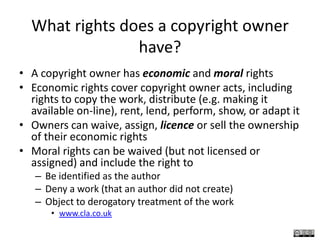
www.cla.co.ukWhat rights does a copyright owner have?A copyright owner has economic and moral rights
Economic rights cover copyright owner acts, including rights to copy the work, distribute (e.g. making it available on-line), rent, lend, perform, show, or adapt it
Owners can waive, assign, licence or sell the ownership of their economic rights
Moral rights can be waived (but not licensed or assigned) and include the right to
Be identified as the author
Deny a work (that an author did not create)
Object to derogatory treatment of the work
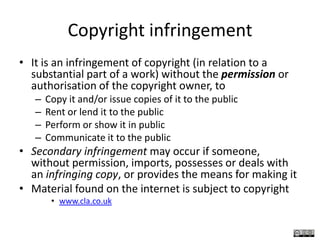
www.cla.co.ukCopyright infringementIt is an infringement of copyright (in relation to a substantial part of a work) without the permission or authorisation of the copyright owner, to
Copy it and/or issue copies of it to the public
Rent or lend it to the public
Perform or show it in public
Communicate it to the public
Secondary infringement may occur if someone, without permission, imports, possesses or deals with an infringing copy, or provides the means for making it
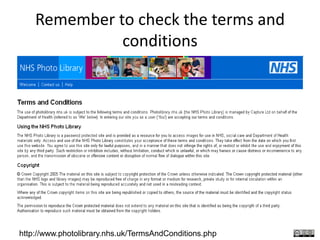
Material found on the internet is subject to copyright
www.cla.co.ukExceptionsYou may copy copyright works if
Copyright has expired (e.g. for literary, dramatic, musical or artistic works = 70 years from when the last author dies)
Your use of the work (which must be acknowledged) is fair dealing as defined under the 1988 Copyright Designs and Patents Act (UK)
Your use of the work is covered under a licensing scheme that you and the copyright holder have subscribed to
The copyright owner has given you permission
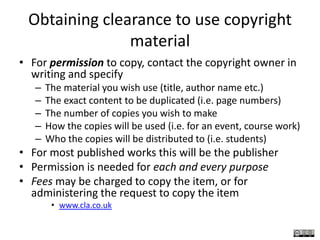
www.copyrightservice.co.ukObtaining clearance to use copyright materialFor permission to copy, contact the copyright owner in writing and specify
The material you wish use (title, author name etc.)
The exact content to be duplicated (i.e. page numbers)
The number of copies you wish to make
How the copies will be used (i.e. for an event, course work)
Who the copies will be distributed to (i.e. students)
For most published works this will be the publisher
Permission is needed for each and every purpose
Fees may be charged to copy the item, or for administering the request to copy the item
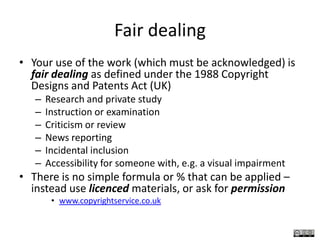
www.cla.co.ukFair dealingYour use of the work (which must be acknowledged) is fair dealing as defined under the 1988 Copyright Designs and Patents Act (UK)
Research and private study
Instruction or examination
Criticism or review
News reporting
Incidental inclusion
Accessibility for someone with, e.g. a visual impairment
There is no simple formula or % that can be applied –instead use licencedmaterials, or ask for permission
www.copyrightservice.co.ukUsing licenced worksA licence (a set of rules) describes how copyright items may be used by others
Licensing schemes (such as Creative Commons) that both authors (owners) and users can access for free
If both sides observe the rules then both parties are instantly protected
Owners licence others to use their content
Users obey the terms of the licence
Creative Commons provides different licences that can be combined together
Policies can be developed to guide owners what licences to use
Introduction to open licensing and creative commonsOpen Educational Resources
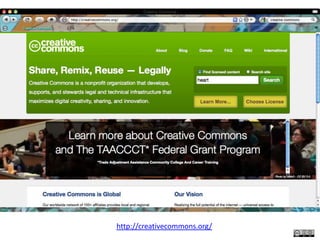
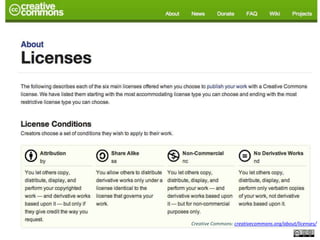
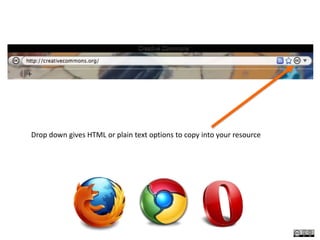
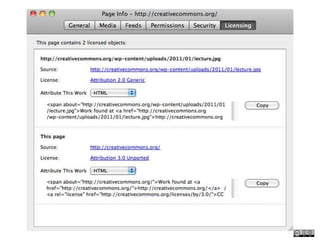
http://creativecommons.org/

Creative Commons: creativecommons.org/about/licenses/
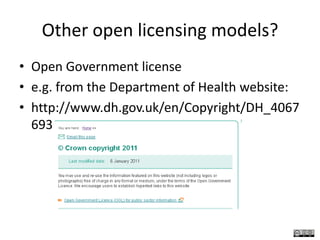
Other open licensing models? Open Government licensee.g. from the Department of Health website:http://www.dh.gov.uk/en/Copyright/DH_4067693
http://www.nationalarchives.gov.uk/information-management/uk-gov-licensing-framework.htm

PORSCHE NHS eLearning Repository Copyright Consent Good Practice

Editor's Notes

  • #3 Welcome, thanks for coming, housekeeping
  • #5 One of the defining characteristics of OERs is that educational materials which have an open licence attached to them. There are several forms of open licence, of which Creative Commons is one. Probably the best known. Open educational resources are inextricably bound up with intellectual property issues, as most educational content is protected under conventional copyright terms that must be honored. Creative Commons, an organisation that provides ready-made licensing agreements that are less restrictive than the "all rights reserved" terms of standard international copyright, is a "critical infrastructure service for the OER movement.
  • #6 What are we talking about? This is my favourite definition – there are a lot of definitions
  • #12 Organising Open Educational Resources had 17 HEIs as partners, who carried out 12 workpackages. The project ran for a year, with a budget of £500,000, with half of that in the form of the grant, and the rest as matched funding.It was about enabling the community. To facilitate HEIs and individuals ‘go open’ by mitigating risk and implementing policies and procedures based on good practice.Part of that is preparedness to engage with the debate, and readiness of content to be released openly.Today I am going to go right back to basics.We wanted to shed light on pools of best practice, and share that across the constituency – making sure that everyone knows in their own context, the people, policies, procedures, and permissions involved in going OER.
  • #13 These are only a few of the many recommendations, but they are the ones which we want to highlight to you . We really need institutions to use CC licences on their works, to clarify exactly who owns what and how it may be used. Institutions frightened of giving away the ‘crown jewels’ may be perfectly happy with releasing up to 75% of a module or programme (which may still be useful to others). To protect ourselves and our colleagues into the future we need sophisticated searching (reputation based materials) and take down policies. We would like to know that staff can be rewarded for getting involved in this, as contributors and users of other people’s resources. We also had many recommendations for JorumOpen (the national repository) who we were working with to implement as many as we can.
  • #15 3 scenariosFull live cross search – fits in with ACErep project in LeedsMetadata exchange, search from entry website, only have to negotiate N3 gateway if need to download materials.Content package exchange – have everything in Jorum accessible from eLearning Repository and vice versa. No need to negotiate gateway.
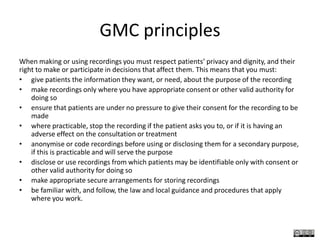
  • #16 SH We would like to propose a consent commons to work alongside or with creative commons as a way of demonstrating due diligence in dealing with issues of consent and using patient data sensitively in learning and teaching with specific reference to being able to share.
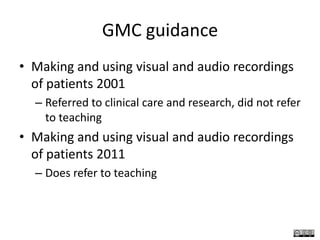
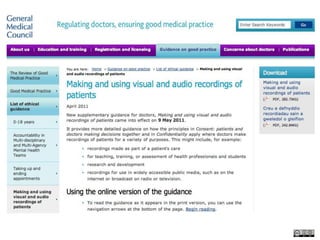
  • #17 Here is the problem.OERs move across clinical and academic settings. The same person might be making and delivering materials.They may be, or the recordings used within them are collected by clinicians under rigorous guidance both at a national (GMC) level and a local trust of health authority level.When these materials are then delivered in an educational event in an academic setting things can go awry.This slide illustrates one of the things that is special to our project and other healthcare projects:Where we have clinicians who are paid by the NHS, who create materials in clinical settings, but deliver them in academic settings under an honorary contract with the university but who are not paid by that universityWhere then does risk and responsibility lie?Enlarging on this a bit further, what we have on the left is a very clear process for taking cosent for using recordings within a clinical setting for treatment, research and ‘local’ education. On the right however, we then wish to re-use images and incorporate them into VLEs, share materials, etc. But no evidence of consent, we don’t have access to the patient record. And so the location of risk is unclear. What we do know is that both the clinical organisation and the academic organisation both want to do what is right. It is not clear where the responsibilities of the clinical setting end – what happens once images left their patch? On the other side, universities are beginning to be aware of their responsibilities but have no mechanisms to handle them But all want to do the right thing. Mobilty of image around the world and the fact that resources are being shared whether they were intended to be shared or notUniversties are not aware of their responsibilities in this settingDoctors want to do it properlyUniversities want to do it properlyNo mechanism is currently in place to support them doing that
  • #18 A human consent version of a Creative Commons licence would enable much more sophisticated recognition of the role and rights of people (whether they are the ‘creators’ or not) to be treated fairly and with respect. We need new technologies to support the implementation of Consent Commons – such as the ability to inform users that a resource has been updated or ‘taken down’.
  • #21 In traditional fashion let’s go round the room, and say who we are, where we are from and what you are hoping to get out of the day.
  • #26 In our field – healthcare education there is a third thing we should be thinking about.If there are people in our resources, if they contain any recordings – video, audio, photographs – we need to additionally think about consent. I am not going to focus on this today, but it is useful to know that there are another couple of pieces of work going on around consent and making this explicit too – email me if you want more details on this, or I can come back another time to talk to you specifically about that.I was at a meeting yesterday which is bringing together experts to put together a set of principles and a code of practice around consent, and in our OER2 project, PORSCHE, we are working with CC UK and others to put together some ideas around a Consent Commons to complement Creative Commons – making consent in resources.
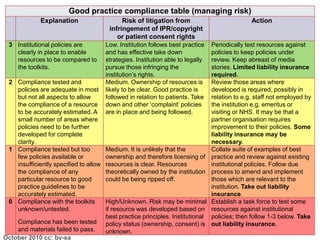
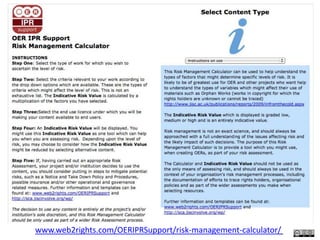
  • #27 Across the UK staff and students are already uploading teaching and other materials to the Internet/web, especially to social networking sites. Failure to follow best practice doesn’t mean that you can’t do it, it just means that you need more insurance. If you have deep pockets and have little conscience you can put materials up, and wait for lawyers to get in touch. The ‘best practice compliance’ table developed in the OOER project was developed to assist institutions to understand how their policies measured up, in order to safeguard themselves from litigation brought against them, and also to establish their own rights in relation to their own copyrights. It is intended as a guide only and legal advice should be sought by those wishing to adopt good practice risk-management policies.
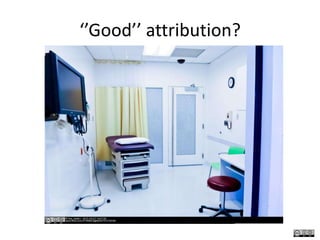
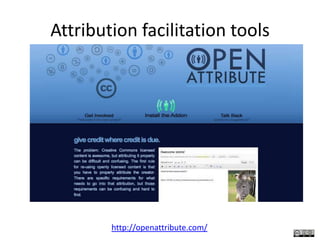
  • #28 How many of us are pirates?We all know people who take materials they find on the internet and use them in their learning and teaching resources…. Managing risk and encouraging good practicePlagiarism well understoodRefencing and citation = but that what about acknowledging sources in teaching materials? Where did that image com from? Whose is it?What are the barriers to adopting good practice in learning and teaching?And who is responsible for ensuring we do the best we can?Today we are going to examine why we should stop doing that, and look at some tools to help us change our practice, and start doing things differently from today.
  • #30 There is emerging evidence that 50% of staff time/resources on preparation for teaching can be saved by engaging with OERThis rerent blog post sets out come compelling evidence for students using OER and that an OER approach can save time and money.The OU has also published work which indicates that student engage with OER prior to enrolling on the course, and only enrol when they know they can pass – so OER can improve retention rates at University.
  • #31 New teachers taking over courses can save time if they know they can reuse the materials created by their predecessor….
  • #32 Managing risk and encouraging good practicePlagiarism well understoodRefencing and citation = but that what about acknowledging sources in teaching materials? Where did that image com from? Whose is it?What are the barriers to adopting good practice in learning and teaching?And who is responsible for ensuring we do the best we can?
  • #35 IPR is made up of Patents, Trade marks, Designs, and Copyright. This presentation focuses on Copyright as the most key IPR relating to OER. The others protect designs, functionality and appearances.
  • #36 Copyright is typically split into OWNERSHIP and LICENCE. Anything which is EXPRESSED (drawn, written, documented) is automatically covered by copyright, whether the author wants it or not. Exceptions include where employees have signed over their rights to their employer.If you tell your friend about an idea that you have had in the pub, and they draw an image of it for you, then they will own the copyright.
  • #37 Economic rights include the rights to financially exploit the creation, and moral rights include the right to have the author’s name attributed on copies. Authors can (explicitly) waive, assign (as if to a publisher), licence or sell the ownership of their works.
  • #38 Essentially if you re-use materials which are copyright to others then this counts as an INFRINGEMENT and the copyright holder may take you to court. If you re-use something that someone else has breached the copyright of then this is secondary infringement and is just as bad as the original offence. People often download un-attributed materials from the Internet thinking that they are safe to re-use; they are not.
  • #39 There are occasions when you can copy copyright works, for example, if the copyright has expired, if it constitutes ‘fair dealing’, the work is covered by a licence or the author has given their permission (if you have permission then always cite the author and state ‘used with permission’).
  • #40 To obtain permission then contact the author or their publisher (owner of the copyright).
  • #41 Fair dealing does allow some rights to copy copyright works for specific purposes, however this is NOT an excuse for infringing another person’s copyright. If in doubt, use materials which are licenced or ask for permission.
  • #42 A licence is simply a legal statement saying what you can and cannot do with the copyright works. Some organisations (such as the Copyright Licencing Agency) use licencing schemes (standard legal clauses) which are well recognised. This makes it easier for owners to share, for users to understand the rules of use, and for both parties to observe protocol. Creative Commons provides some well-recognised licencing schemes.
  • #46 One of the conditions of the funding was that we release everything under CC licenses.One of the main characteristics of an Open Educational Resource, is that it has an open license attached to it. These work in addition to existing copyright, which is made up of 2 parts: ownership and licensing. The copyright part deals with ownership – Creative Commons deals with the licensing part, making explicit to users which they can do with the resource and under what circumstances.You always retain IPR.Creative Commons is the licensing regime we were required to apply, but its not the only one. There are others.CC has a range of licenses with varying degrees of which you are allowed to do, and whether or not you can make commercial use of materials.The simplest is attribution only, the most restrictive is attribution-noncommerical-noderivatives.There are very good reasons you may choose that license – such as if you have material containing data which would be sensitive out of that particular context.We also had to tag everything with ukoer, and deposit materials or metadata into Jorum Open, the national repository at www.jorum.ac.uk Thinking about licensing is something we should be thinking about with all of our resources whether they are going into an open repository or not. If they are being uploaded into a VLE, or if you are distributing them by email, it is likely they are being reshared via email, social networking etc.Making the use of the material and understanding what can and can’t be done with a resource is therefore essential to all of us.CC makes it easy.
  • #47 Such as ‘by’ attribution only (meaning that others have to acknowledge you as the original author); non-commercial to prevent others from making money out of your copyright.
  • #48 http://www.nationalarchives.gov.uk/information-management/uk-gov-licensing-framework.htm?
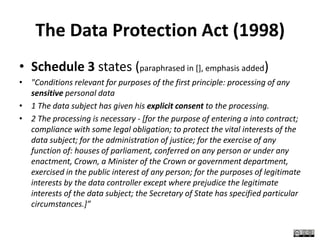
  • #61 While copyright is an automatic right, data protection is better described as a set of principles. Arising from the perspective of patient consent (patient data is classed as ‘sensitive’ under the DPAct1998) for patient materials used in teaching, we argue for additional tools to support consent from people. When creating open educational resources copyright doesn’t quite go far enough to recognise the rights of people who are represented to be respected (whether they have copyright or not). Representation could be a photograph, voice or video recording, data set or patient story. For example, if a person has agreed for their photograph to appear in your open educational resources (they are a student, a member of staff, an actor, etc.), and they pass away, what do you do if their family asks you to take down the OER? (What you are legally required to do may be different to what you would choose to do, in principle). Therefore you are essentially operating ‘policies’.
  • #74 The best way to safeguard yourself and your organisation against copyright infringement is to develop appropriate policies, advertise the policy clearly, train everyone in how to implement it, and follow it. For example, if you have a policy which says that ‘this material has been produced to the highest possible ethical standards and anyone with any concerns should contact xxx in writing after which the offending material will be removed within 10 working days pending investigation’. Then if someone contacts you, do what your policy says. Alternatively, you could just increase your annual insurance premiums to give you greater liability insurance in case of a breach (more on risk in a moment). Together with policies you could also use disclaimers: ‘the material provided on this site has been checked according to xxx however no warranties express or implied…’
  • #75 Across the UK staff and students are already uploading teaching and other materials to the Internet/web, especially to social networking sites. Failure to follow best practice doesn’t mean that you can’t do it, it just means that you need more insurance. If you have deep pockets and have little conscience you can put materials up, and wait for lawyers to get in touch. The ‘best practice compliance’ table developed in the OOER project was developed to assist institutions to understand how their policies measured up, in order to safeguard themselves from litigation brought against them, and also to establish their own rights in relation to their own copyrights. It is intended as a guide only and legal advice should be sought by those wishing to adopt good practice risk-management policies.
  • #76 These are only a few of the many recommendations, but they are the ones which we want to highlight to you . We really need institutions to use CC licences on their works, to clarify exactly who owns what and how it may be used. Institutions frightened of giving away the ‘crown jewels’ may be perfectly happy with releasing up to 75% of a module or programme (which may still be useful to others). To protect ourselves and our colleagues into the future we need sophisticated searching (reputation based materials) and take down policies. We would like to know that staff can be rewarded for getting involved in this, as contributors and users of other people’s resources. We also had many recommendations for JorumOpen (the national repository) who we were working with to implement as many as we can.
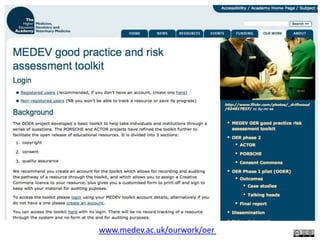
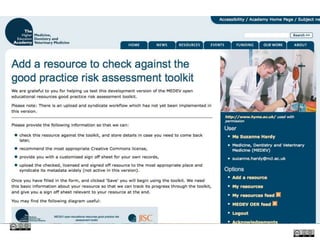
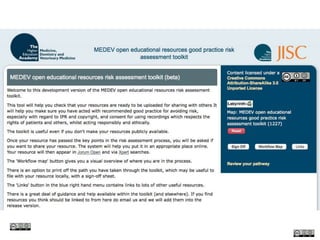
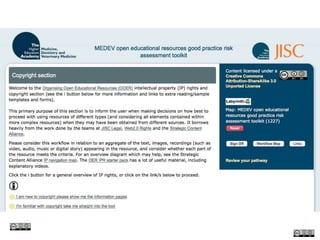
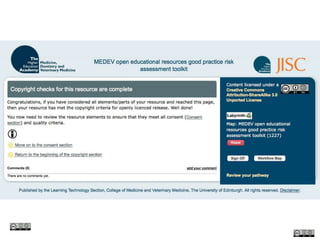
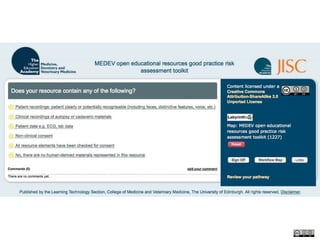
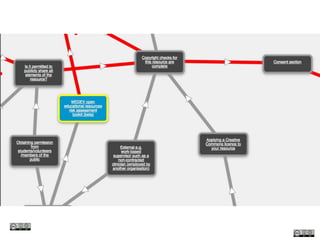
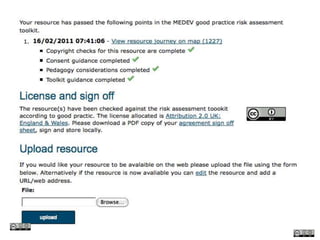
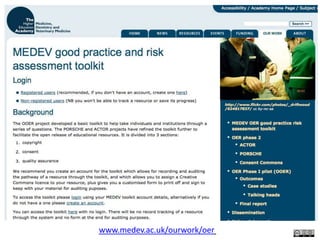
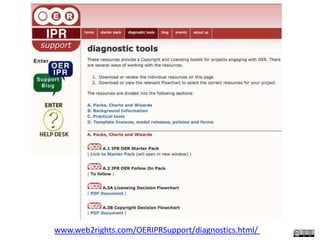
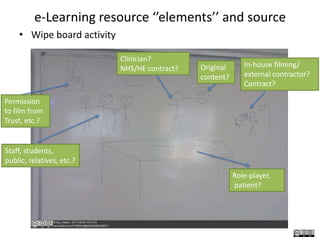
  • #78 Good practice toolkit gets you to think about the learning resource , its ‘elements’, and their source (who? where? licence? permissions? contracts? policies? consent? copyright? source? release-forms? collaborations? institutions? employers? students? public? children?... ... ... )
  • #105 Lindsay Wood, Project OfficerHEFCE, JISC and HEA
  • #109 The best way to safeguard yourself and your organisation against copyright infringement is to develop appropriate policies, advertise the policy clearly, train everyone in how to implement it, and follow it. For example, if you have a policy which says that ‘this material has been produced to the highest possible ethical standards and anyone with any concerns should contact xxx in writing after which the offending material will be removed within 10 working days pending investigation’. Then if someone contacts you, do what your policy says. Alternatively, you could just increase your annual insurance premiums to give you greater liability insurance in case of a breach (more on risk in a moment). Together with policies you could also use disclaimers: ‘the material provided on this site has been checked according to xxx however no warranties express or implied…’
  • #110 These are only a few of the many recommendations, but they are the ones which we want to highlight to you . We really need institutions to use CC licences on their works, to clarify exactly who owns what and how it may be used. Institutions frightened of giving away the ‘crown jewels’ may be perfectly happy with releasing up to 75% of a module or programme (which may still be useful to others). To protect ourselves and our colleagues into the future we need sophisticated searching (reputation based materials) and take down policies. We would like to know that staff can be rewarded for getting involved in this, as contributors and users of other people’s resources. We also had many recommendations for JorumOpen (the national repository) who we were working with to implement as many as we can.
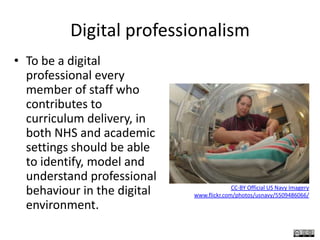
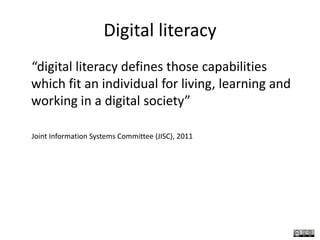
  • #116 Just as we expect students and junior staff to model professional behaviours in real life, we need them to do the same in the digital environment.
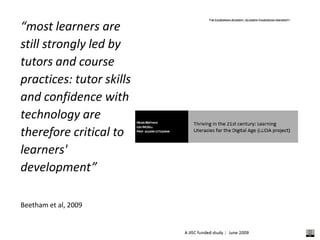
  • #117 LliDA report
  • #120 This was the wording from a recent JISC digital literacies call
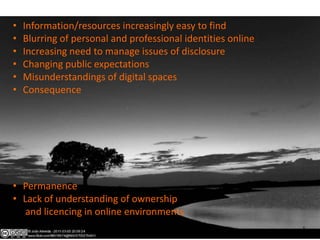
  • #121 No point in blocking social networking sites, or in discouraging natural behaviours – students have to be students as the GMC itself points outWhich presents us with somewhat of a dichotomy
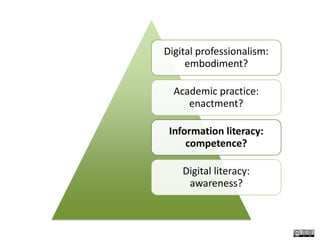
  • #122 Base level – understandingThen can move on to developing skills and competencesThen enabling the individual to act professionallyBut information literacy often the only place it is formally addressed, and then siloed into library skills – and as we heard yesterday, students seem unaware of whay they are learning these skills
  • #124 In one respect Its about assessing and managing risk – what are the threats?