Laura Sagert, CIDE
laura.sagert@cide.edu
CC-BY 3.0
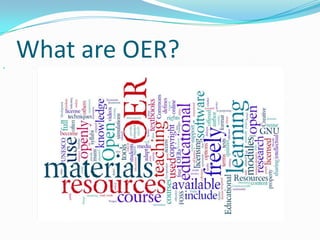
What are OER?

UNESCO, 2002
Paris Declaration, 2012
 …teaching, learning and research

materials in any medium, digital or
otherwise, that reside in the public
domain or have been released under
an open license that permits no-cost
access, use, adaptation and
redistribution by others with no or
limited restrictions.
What types of OER exist?
Written Texts

Media + other information

 Textbooks

 Pictures
 Videos
 Audio . . .

 Articles
 Blogs

 Course syllabi
 Lecture notes
 Tests . . .

 Grammar and vocabulary

exercises
 Corpora (FLAX) . . .

“… anyone can legally and freely copy, use, adapt
and re-share them” (UNESCO, 2002)
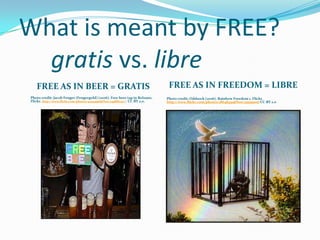
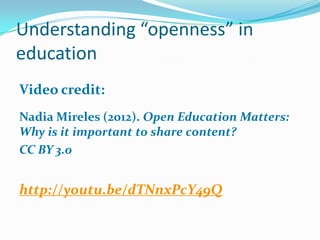
What is meant by FREE?
gratis vs. libre
FREE AS IN BEER = GRATIS
Photo credit: Jacob Fenger (Fengergold) (2006). Free beer tap in Bolzano.
Flickr. http://www.flickr.com/photos/42934556@N00/245866252 /. CC-BY 2.0.

FREE AS IN FREEDOM = LIBRE
Photo credit: Oddsock (2006). Rainbow Freedom 1. Flickr.
http://www.flickr.com/photos/28648431@N00/255199017 CC-BY 2.0
Understanding “openness” in
education
Video credit:
Nadia Mireles (2012). Open Education Matters:
Why is it important to share content?
CC BY 3.0

http://youtu.be/dTNnxPcY49Q
Why does “open” matter?
Shared content can be improved upon.

It can reach people who would not normally have
access to such information and can be changed so
as to be of the most benefit possible to specific
audiences.
The costs of use are limitedin the sense that we
don’t need to pay license rights for each student.
**Video credit: Nadia Mireles (2012). Open Education Matters:
Why is it important to share content? CC BY 3.0
http://youtu.be/dTNnxPcY49Q
Legal use
Respect
To think about:
What are we teaching our students?
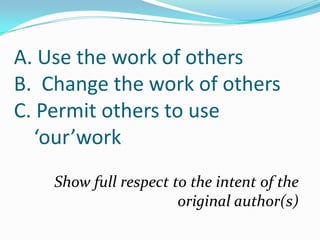
A. Use the work of others
B. Change the work of others
C. Permit others to use
‘our’work
Show full respect to the intent of the
original author(s)
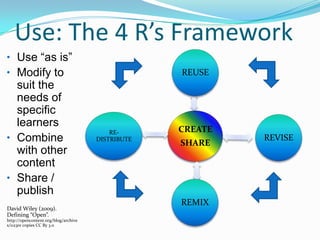
Use: The 4 R’s Framework
• Use “as is”
• Modify to

suit the
needs of
specific
learners
• Combine
with other
content
• Share /
publish
David Wiley (2009).
Defining “Open”.
http://opencontent.org/blog/archive
s/1123re copies CC By 3.0

REUSE

REDISTRIBUTE

CREATE
SHARE

REMIX

REVISE
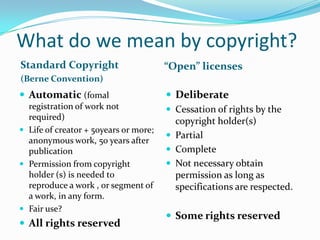
What do we mean by copyright?
Standard Copyright

“Open” licenses

(Berne Convention)

 Automatic (fomal
registration of work not
required)
 Life of creator + 50years or more;
anonymous work, 50 years after
publication
 Permission from copyright
holder (s) is needed to
reproduce a work , or segment of
a work, in any form.
 Fair use?

 All rights reserved

 Deliberate
 Cessation of rights by the
copyright holder(s)
 Partial
 Complete
 Not necessary obtain
permission as long as
specifications are respected.
 Some rights reserved
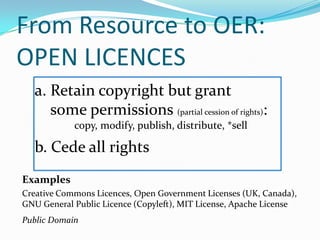
From Resource to OER:
OPEN LICENCES
a. Retain copyright but grant
some permissions (partial cession of rights):
copy, modify, publish, distribute, *sell

b. Cede all rights
Examples
Creative Commons Licences, Open Government Licenses (UK, Canada),
GNU General Public Licence (Copyleft), MIT License, Apache License
Public Domain
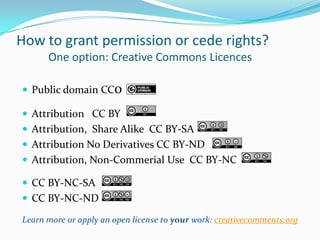
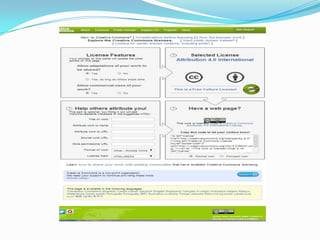
How to grant permission or cede rights?
One option: Creative Commons Licences
 Public domain CC0
 Attribution CC BY
 Attribution, Share Alike CC BY-SA
 Attribution No Derivatives CC BY-ND
 Attribution, Non-Commerial Use CC BY-NC
 CC BY-NC-SA
 CC BY-NC-ND
Learn more or apply an open license to your work: creativecomments.org
• Time
• Variety
• Access

• Learning community
• Set an example
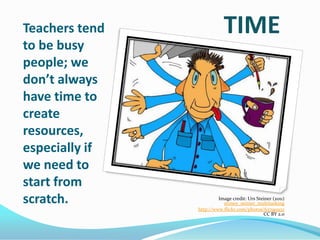
Teachers tend
to be busy
people; we
don’t always
have time to
create
resources,
especially if
we need to
start from
scratch.

TIME

Image credit: Urs Steiner (2011)
stoney_steiner_multitasking
http://www.flickr.com/photos/62790932
CC BY 2.0
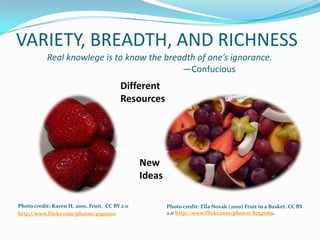
VARIETY, BREADTH, AND RICHNESS
Real knowlege is to know the breadth of one’s ignorance.
—Confucious

Different
Resources

New
Ideas
Photo credit: Karen H. 2010. Fruit. CC BY 2.0
http://www.flickr.com/photos/47409110

Photo credit: Ella Novak (2010) Fruit in a Basket. CC BY
2.0 http://www.flickr.com/photos/82547169.
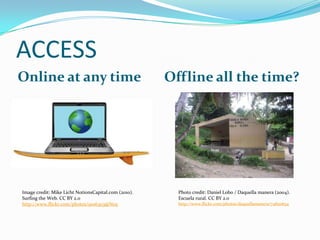
ACCESS
Online at any time

Image credit: Mike Licht NotionsCapital.com (2010).
Surfing the Web. CC BY 2.0
http://www.flickr.com/photos/9106303@N05

Offline all the time?

Photo credit: Daniel Lobo / Daquella manera (2004).
Escuela rural. CC BY 2.0
http://www.flickr.com/photos/daquellamanera/74820634
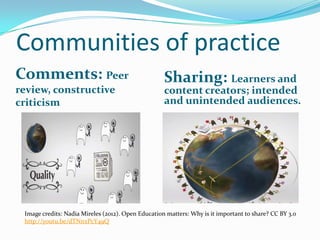
Communities of practice
Comments: Peer
review, constructive
criticism

Sharing: Learners and

content creators; intended
and unintended audiences.

Image credits: Nadia Mireles (2012). Open Education matters: Why is it important to share? CC BY 3.0
http://youtu.be/dTNnxPcY49Q
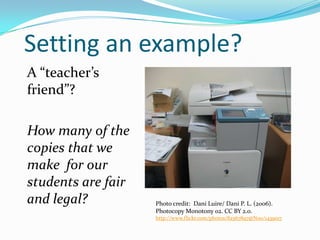
Setting an example?
A “teacher’s
friend”?
How many of the
copies that we
make for our
students are fair
and legal?

Photo credit: Dani Luire/ Dani P. L. (2006).
Photocopy Monotony 02. CC BY 2.0.
http://www.flickr.com/photos/82567897@N00/1439017
a.

Ready-to-use content
(Check the quality!)

b.

Bits and pieces to build upon
in designing your own course materials

c.

Exercises for students
(reflect, combine adapt: active learning)

d.

Evaluate your own work (benchmark)
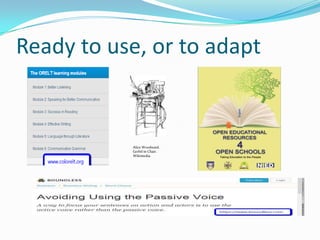
Ready to use, or to adapt

Alice Woodward.
Gerbil in Chair.
Wikimedia.
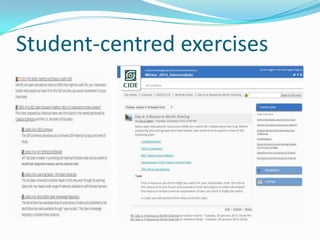
Student-centred exercises
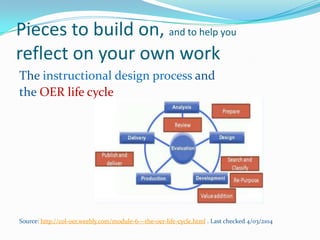
Pieces to build on, and to help you
reflect on your own work
The instructional design process and
the OER life cycle

Source: http://col-oer.weebly.com/module-6---the-oer-life-cycle.html . Last checked 4/03/2104
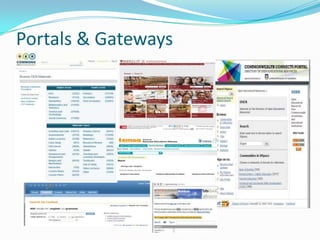
Portals and gateways
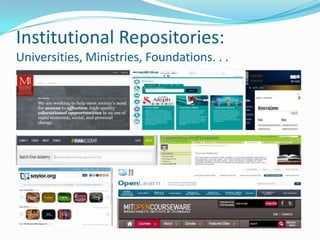
Institutional repositories
Web-search
Portals & Gateways
Institutional Repositories:
Universities, Ministries, Foundations. . .
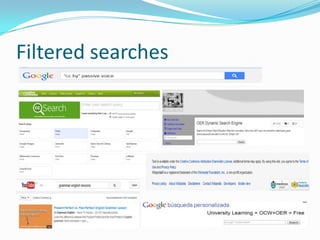
Filtered searches
Learners
Creators
Institutions
Other actors / organizations
Leanr more; suggested links:
JISC Open Educational Resources Info Kit: Stakeholders and benefits
Commonwealth of Learning: Publications
Challenges of sharing OER
 Fear: The “risks” of peer comments.
 Selection: What to share? How to do so? How to be
sure we have the right to share out work?
(Do we “own” our work?)

 Format: Ease of access vs. ease of modification

 Accesibility: Where can we share content other can
find? Site, blog, repositories?

 Motivation: Why bother?
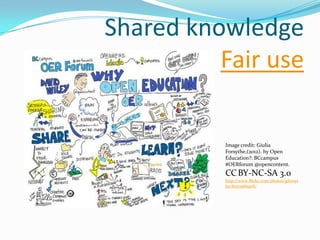
Shared knowledge
Fair use

Image credit: Giulia
Forsythe,(2012). hy Open
Education?: BCcampus
#OERforum @opencontent.

CC BY-NC-SA 3.0
http://www.flickr.com/photos/gforsyt
he/8100966908/
Links: Exploring OER
Learning more about OER

Repositories & search
engines

 COL Open Educational






Reosurces OER (one-day
workshop materials)
 JISC Open Educational
Resources infoKit
 Commonwealth of Learning
(COL): Publications
 UNESCO: OER

Commonwealth Connects
Connexions
Merlot II
OER Commons

 CC Search-Creative

Commons
 OER Dynamic Search Engine
 University Learning =
OCW+OER = Free
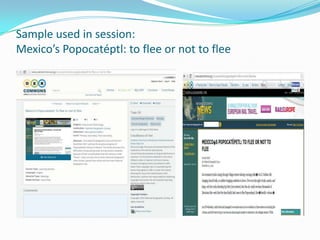
Sample used in session:
Mexico’s Popocatéptl: to flee or not to flee

OER for ELT, BBELT 2014 (Mexico)

  • 1.
  • 2.
  • 3.
    UNESCO, 2002 Paris Declaration,2012  …teaching, learning and research materials in any medium, digital or otherwise, that reside in the public domain or have been released under an open license that permits no-cost access, use, adaptation and redistribution by others with no or limited restrictions.
  • 4.
    What types ofOER exist? Written Texts Media + other information  Textbooks  Pictures  Videos  Audio . . .  Articles  Blogs  Course syllabi  Lecture notes  Tests . . .  Grammar and vocabulary exercises  Corpora (FLAX) . . . “… anyone can legally and freely copy, use, adapt and re-share them” (UNESCO, 2002)
  • 5.
    What is meantby FREE? gratis vs. libre FREE AS IN BEER = GRATIS Photo credit: Jacob Fenger (Fengergold) (2006). Free beer tap in Bolzano. Flickr. http://www.flickr.com/photos/42934556@N00/245866252 /. CC-BY 2.0. FREE AS IN FREEDOM = LIBRE Photo credit: Oddsock (2006). Rainbow Freedom 1. Flickr. http://www.flickr.com/photos/28648431@N00/255199017 CC-BY 2.0
  • 6.
    Understanding “openness” in education Videocredit: Nadia Mireles (2012). Open Education Matters: Why is it important to share content? CC BY 3.0 http://youtu.be/dTNnxPcY49Q
  • 7.
    Why does “open”matter? Shared content can be improved upon. It can reach people who would not normally have access to such information and can be changed so as to be of the most benefit possible to specific audiences. The costs of use are limitedin the sense that we don’t need to pay license rights for each student. **Video credit: Nadia Mireles (2012). Open Education Matters: Why is it important to share content? CC BY 3.0 http://youtu.be/dTNnxPcY49Q
  • 8.
    Legal use Respect To thinkabout: What are we teaching our students?
  • 9.
    A. Use thework of others B. Change the work of others C. Permit others to use ‘our’work Show full respect to the intent of the original author(s)
  • 10.
    Use: The 4R’s Framework • Use “as is” • Modify to suit the needs of specific learners • Combine with other content • Share / publish David Wiley (2009). Defining “Open”. http://opencontent.org/blog/archive s/1123re copies CC By 3.0 REUSE REDISTRIBUTE CREATE SHARE REMIX REVISE
  • 12.
    What do wemean by copyright? Standard Copyright “Open” licenses (Berne Convention)  Automatic (fomal registration of work not required)  Life of creator + 50years or more; anonymous work, 50 years after publication  Permission from copyright holder (s) is needed to reproduce a work , or segment of a work, in any form.  Fair use?  All rights reserved  Deliberate  Cessation of rights by the copyright holder(s)  Partial  Complete  Not necessary obtain permission as long as specifications are respected.  Some rights reserved
  • 13.
    From Resource toOER: OPEN LICENCES a. Retain copyright but grant some permissions (partial cession of rights): copy, modify, publish, distribute, *sell b. Cede all rights Examples Creative Commons Licences, Open Government Licenses (UK, Canada), GNU General Public Licence (Copyleft), MIT License, Apache License Public Domain
  • 14.
    How to grantpermission or cede rights? One option: Creative Commons Licences  Public domain CC0  Attribution CC BY  Attribution, Share Alike CC BY-SA  Attribution No Derivatives CC BY-ND  Attribution, Non-Commerial Use CC BY-NC  CC BY-NC-SA  CC BY-NC-ND Learn more or apply an open license to your work: creativecomments.org
  • 16.
    • Time • Variety •Access • Learning community • Set an example
  • 17.
    Teachers tend to bebusy people; we don’t always have time to create resources, especially if we need to start from scratch. TIME Image credit: Urs Steiner (2011) stoney_steiner_multitasking http://www.flickr.com/photos/62790932 CC BY 2.0
  • 18.
    VARIETY, BREADTH, ANDRICHNESS Real knowlege is to know the breadth of one’s ignorance. —Confucious Different Resources New Ideas Photo credit: Karen H. 2010. Fruit. CC BY 2.0 http://www.flickr.com/photos/47409110 Photo credit: Ella Novak (2010) Fruit in a Basket. CC BY 2.0 http://www.flickr.com/photos/82547169.
  • 19.
    ACCESS Online at anytime Image credit: Mike Licht NotionsCapital.com (2010). Surfing the Web. CC BY 2.0 http://www.flickr.com/photos/9106303@N05 Offline all the time? Photo credit: Daniel Lobo / Daquella manera (2004). Escuela rural. CC BY 2.0 http://www.flickr.com/photos/daquellamanera/74820634
  • 20.
    Communities of practice Comments:Peer review, constructive criticism Sharing: Learners and content creators; intended and unintended audiences. Image credits: Nadia Mireles (2012). Open Education matters: Why is it important to share? CC BY 3.0 http://youtu.be/dTNnxPcY49Q
  • 21.
    Setting an example? A“teacher’s friend”? How many of the copies that we make for our students are fair and legal? Photo credit: Dani Luire/ Dani P. L. (2006). Photocopy Monotony 02. CC BY 2.0. http://www.flickr.com/photos/82567897@N00/1439017
  • 22.
    a. Ready-to-use content (Check thequality!) b. Bits and pieces to build upon in designing your own course materials c. Exercises for students (reflect, combine adapt: active learning) d. Evaluate your own work (benchmark)
  • 23.
    Ready to use,or to adapt Alice Woodward. Gerbil in Chair. Wikimedia.
  • 24.
  • 25.
    Pieces to buildon, and to help you reflect on your own work The instructional design process and the OER life cycle Source: http://col-oer.weebly.com/module-6---the-oer-life-cycle.html . Last checked 4/03/2104
  • 26.
    Portals and gateways Institutionalrepositories Web-search
  • 27.
  • 28.
  • 29.
  • 30.
    Learners Creators Institutions Other actors /organizations Leanr more; suggested links: JISC Open Educational Resources Info Kit: Stakeholders and benefits Commonwealth of Learning: Publications
  • 31.
    Challenges of sharingOER  Fear: The “risks” of peer comments.  Selection: What to share? How to do so? How to be sure we have the right to share out work? (Do we “own” our work?)  Format: Ease of access vs. ease of modification  Accesibility: Where can we share content other can find? Site, blog, repositories?  Motivation: Why bother?
  • 32.
    Shared knowledge Fair use Imagecredit: Giulia Forsythe,(2012). hy Open Education?: BCcampus #OERforum @opencontent. CC BY-NC-SA 3.0 http://www.flickr.com/photos/gforsyt he/8100966908/
  • 33.
    Links: Exploring OER Learningmore about OER Repositories & search engines  COL Open Educational     Reosurces OER (one-day workshop materials)  JISC Open Educational Resources infoKit  Commonwealth of Learning (COL): Publications  UNESCO: OER Commonwealth Connects Connexions Merlot II OER Commons  CC Search-Creative Commons  OER Dynamic Search Engine  University Learning = OCW+OER = Free
  • 34.
    Sample used insession: Mexico’s Popocatéptl: to flee or not to flee