

Overview of Watershed Assessment and Modeling Data
(A i WMT i f ti )(Accessing WMT information)
Hala Flores PE Richard FisherHala Flores, P.E Richard Fisher
Rapid Stream Assessment Protocolsp
Janis Markusic Christopher Victoria
Overview of SPSC Design Guidelines and Calculator
Hala Flores, P.E
HBAM Meetingeet g
February 28th, 2011
Ron Bowen, P.E.
Anne Arundel County Stormwater Management Practices
and Procedures Manual
__________________________________________________
Chapter 11 Appendices 11.6
11 3 Li k t i d /i f ti
11 3 8 D t t f P bli W k t h d
11.3. Links to required resources/information
11.3.8. Department of Public Works watershed
management tool
htt // i ld t / /http://gis-world.aacounty.org/wers/
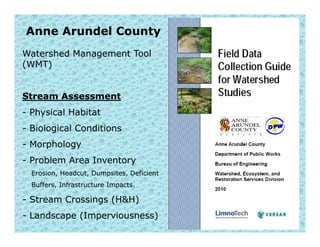
Anne Arundel County
Watershed Management ToolWatershed Management Tool
(WMT)(WMT)
Stream AssessmentStream Assessment
-- Physical HabitatPhysical Habitat
-- Biological ConditionsBiological Conditions
-- MorphologyMorphology
-- Problem Area InventoryProblem Area Inventory
Erosion,Erosion, HeadcutHeadcut, Dumpsites, Deficient, Dumpsites, Deficient
Buffers, Infrastructure Impacts.Buffers, Infrastructure Impacts.
-- Stream Crossings (H&H)Stream Crossings (H&H)Stream Crossings (H&H)Stream Crossings (H&H)
-- Landscape (Imperviousness)Landscape (Imperviousness)
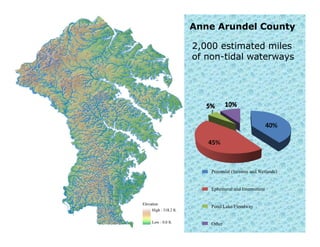
2 000 estimated2 000 estimated milesmiles
Anne Arundel County
2,000 estimated2,000 estimated milesmiles
ofof nonnon--tidal waterwaystidal waterways
P i l (S d W l d )Perennial (Streams and Wetlands)
Ephemeral and Intermittent
Pond/Lake/Floodway
Other
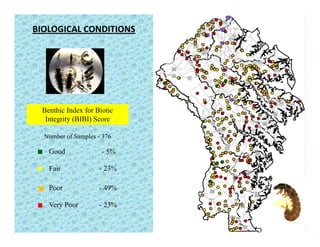
BIOLOGICAL CONDITIONS
B hi I d f Bi iBenthic Index for Biotic
Integrity (BIBI) Score
Number of Samples - 376p
- 5%
- 23%Fair
Good
23%
- 49%
Fair
Poor
- 23%Very Poor
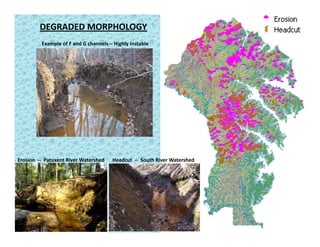
DEGRADED MORPHOLOGY
Example of F and G channels – Highly Instablep g y
Erosion  ‐‐ Patuxent River Watershed Headcut  ‐‐ South River Watershed
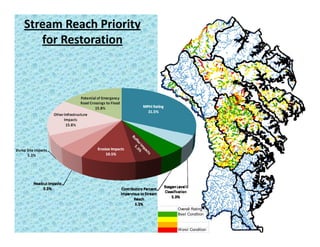
Stream Reach Priority 
for Restoration
Overall Rating
Best Condition
Worst Condition
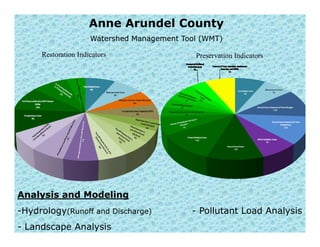
Anne Arundel County
Watershed Management Tool (WMT)Watershed Management Tool (WMT)
Restoration Indicators Preservation Indicators
Analysis and ModelingAnalysis and Modeling
--HydrologyHydrology(Runoff and Discharge)(Runoff and Discharge) -- Pollutant Load AnalysisPollutant Load Analysis
-- Landscape AnalysisLandscape Analysis
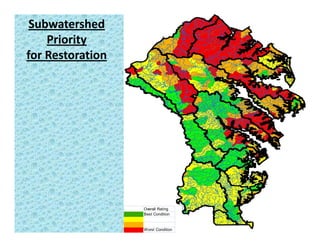
Subwatershed 
Priority y
for Restoration
Overall Rating
Best Condition
Worst Condition
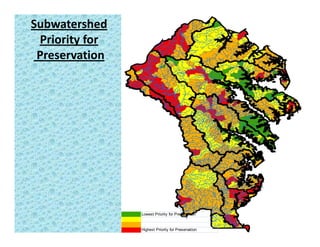
Subwatershed 
Priority fory
Preservation
Lowest Priority for Preservation
Highest Priority for Preservation
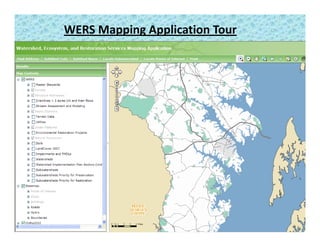
WERS Mapping Application Tour
Stream Assessment Protocol: an
overviewoverview
Anne Arundel County
Department of Public WorksDepartment of Public Works
Bureau of Engineering
Watershed, Ecosystem, and Restoration Services
Ecological Assessment ProgramEcological Assessment Program
Introduction
• Regulatory Triggers
G l W h d Ch i i• General Watershed Characterization
– Land Use and Imperviousness
– Drainage Area and Bankfull Indicator Determination
G l St Ch t i ti• General Stream Characterization
– Rosgen Level II Classification (pebble count, slope determination,
valley type, etc.)
• Lateral Stability DeterminationLateral Stability Determination
– BEHI and NBS Evaluation
– Bank armoring and localized versus widespread issues
• Vertical Stability DeterminationVertical Stability Determination
– Incision Ratio
– Headcuts, control points, depositional features
• Overall Reach Stability Determinationy
– Includes a variety of trend and reach-level evaluations
Regulatory TriggersRegulatory Triggers
• The use of the Stream Assessment Protocol is triggered by a finding of an
“i d f ll” i h f d i i if O b k Fl d“inadequate outfall” in the context of determining if Overbank Flood
Protection is required due to the impact of a given development site.
• Once such an “inadequate outfall” finding is made, a downstream analysis
iis necessary.
• This method is applied only to a “…clearly defined open channel…”
(Section 7.2.2.D.II; Chapter 7, p. 7.4)
• The assessment reach comprises the channel from “…the outfall(s) from
the site and progress[es] to the Point(s) of Investigation (POI).” (Section
7.2, Chapter 7, p. 7.2)
• See the Procedures and Practices Manual for details on what constitutes an
adequate or inadequate outfall and on how to establish the POI.
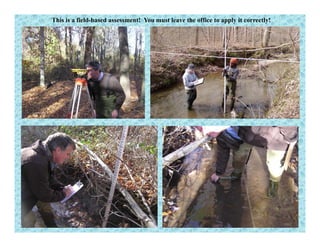
This is a field-based assessment! You must leave the office to apply it correctly!
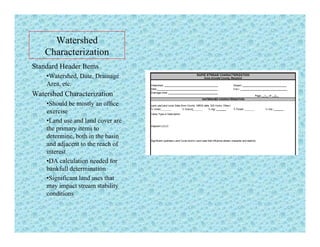
Watershed
Characterization
Standard Header Items
•Watershed Date DrainageWatershed, Date, Drainage
Area, etc.
Watershed Characterization
•Should be mostly an office
exercise
•Land use and land cover are
the primary items to
determine, both in the basin,
and adjacent to the reach of
interest
•DA calculation needed for
bankfull determinationbankfull determination
•Significant land uses that
may impact stream stability
conditions
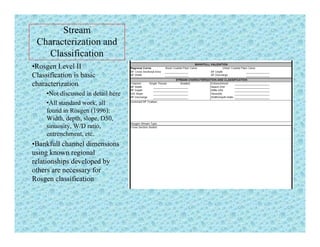
Stream
Characterization and
Classification
•Rosgen Level II
Classification is basicClassification is basic
characterization
•Not discussed in detail here
•All standard work, all
found in Rosgen (1996):
Width, depth, slope, D50,
sinuosity, W/D ratio,
entrenchment, etc.
•Bankfull channel dimensions
using known regional
relationships developed by
others are necessary forothers are necessary for
Rosgen classification
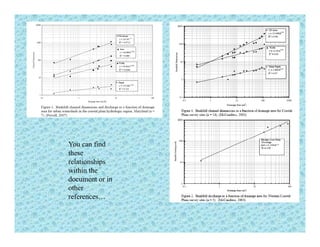
You can find
these
relationships
within thewithin the
document or in
other
references…
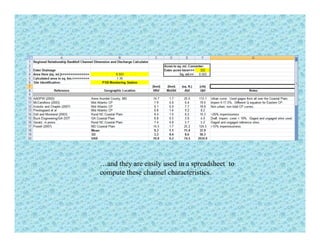
…and they are easily used in a spreadsheet to
h h l h i icompute these channel characteristics.
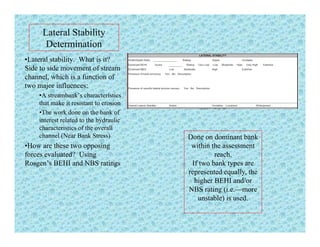
Lateral Stability
DeterminationDetermination
•Lateral stability. What is it?
Side to side movement of stream
channel which is a function ofchannel, which is a function of
two major influences:
•A streambank’s characteristics
that make it resistant to erosion
•The work done on the bank of
interest related to the hydraulic
characteristics of the overall
channel (Near Bank Stress) Done on dominant bank( )
•How are these two opposing
forces evaluated? Using
Rosgen’s BEHI and NBS ratings
Done on dominant bank
within the assessment
reach.
If two bank types are
t d ll threpresented equally, the
higher BEHI and/or
NBS rating (i.e.—more
unstable) is used.)
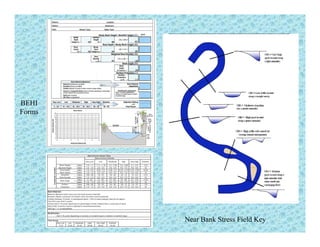
BEHI
Forms
Near Bank Stress Field Key
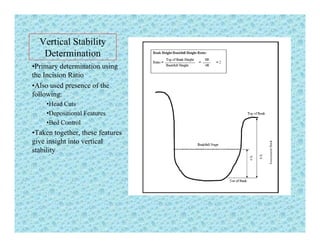
Vertical Stabilityy
Determination
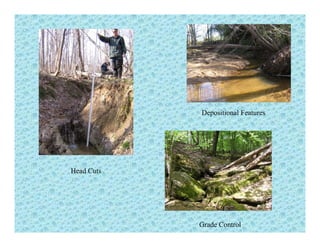
•Primary determination using
the Incision Ratiothe Incision Ratio
•Also used presence of the
following:
•Head Cuts
•Depositional Features
•Bed Control
•Taken together, these features
i i i h i i lgive insight into vertical
stability
Depositional Features
Head CutsHead Cuts
Grade Control
Overall Reach
Stabilityy
Determination
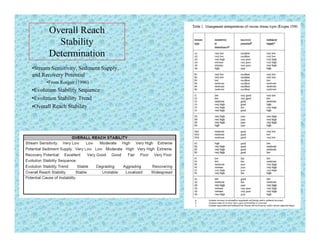
•Stream Sensitivity, Sediment Supply,
and Recovery Potentialy
•From Rosgen (1996)
•Evolution Stability Sequence
•Evolution Stability Trend
•Overall Reach StabilityOverall Reach Stability
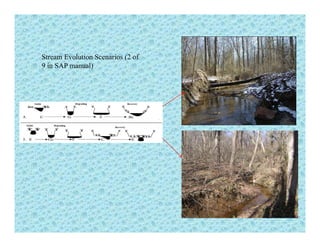
Stream Evolution Scenarios (2 of
9 in SAP manual)
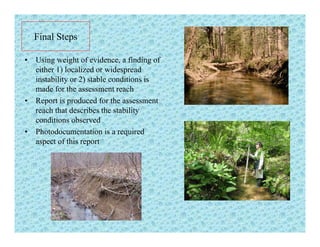
Final Steps
• Using weight of evidence, a finding of
either 1) localized or widespread
i bili 2) bl di i iinstability or 2) stable conditions is
made for the assessment reach
• Report is produced for the assessment
h h d ib h bilireach that describes the stability
conditions observed
• Photodocumentation is a required
f hiaspect of this report
Links
Guidance Documents:
• Stream Assessment Protocols:
http://www aacounty org/DPW/Watershed/DownstreamAdequacyProtocols cfmhttp://www.aacounty.org/DPW/Watershed/DownstreamAdequacyProtocols.cfm
• Stormwater Practices and Procedures Manual:
http://www.aacounty.org/PlanZone/Resources/Practices_Procedures_Manual.pdf
GIS/M i Li kGIS/Mapping Links:
• AA County Watershed Mapping Application:
http://gis-world.aacounty.org/wers/
• GIS Hydro:
http://www.gishydro.umd.edu/ Information Links
• US Fish and Wildlife CBFO:US Fish and Wildlife CBFO:
http://www.fws.gov/chesapeakebay/stream.html
• DNR Rosgen Spreadsheets:
http://www.dnr.state.oh.us/soilandwater/water/streammorphology/default/tabid/9188/Defaulhttp://www.dnr.state.oh.us/soilandwater/water/streammorphology/default/tabid/9188/Defaul
t.aspx
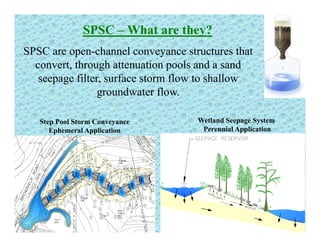
SPSC – What are they?
SPSC are open-channel conveyance structures that
convert, through attenuation pools and a sand
seepage filter s rface storm flo to shalloseepage filter, surface storm flow to shallow
groundwater flow.
Wetland Seepage System
Perennial Application
Step Pool Storm Conveyance
Ephemeral Application
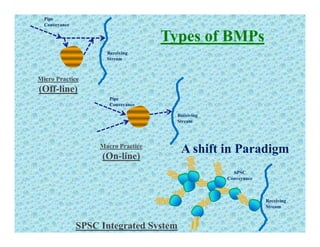
Types of BMPs
Pipe
Conveyance
i i
Receiving
Stream
Micro Practice
(Off-line)
Pipe
Conveyance
Receiving
Stream
Macro Practice
(On-line)
A shift in Paradigm
Receiving
SPSC
Conveyance
SPSC Integrated System
Receiving
Stream
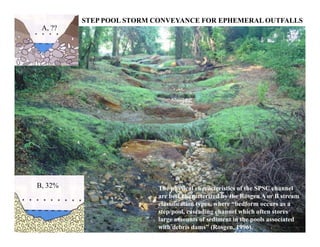
A, ??
STEP POOL STORM CONVEYANCE FOR EPHEMERAL OUTFALLS
B, 32% The physical characteristics of the SPSC channel
are best characterized by the Rosgen A or B stream
classification types, where “bedform occurs as a
step/pool, cascading channel which often stores
large amounts of sediment in the pools associated
with debris dams” (Rosgen, 1996).
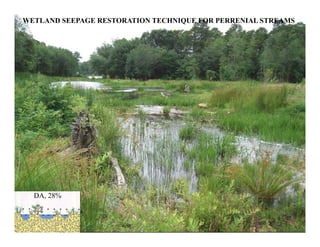
WETLAND SEEPAGE RESTORATION TECHNIQUE FOR PERRENIAL STREAMS
DA, 28%
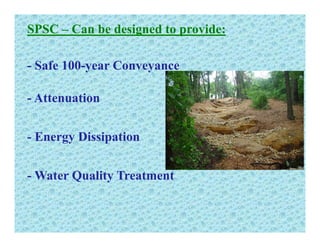
SPSC – Can be designed to provide:
- Safe 100-year Conveyance
- Attenuation
- Energy DissipationEnergy Dissipation
- Water Quality Treatment
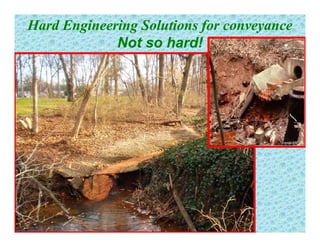
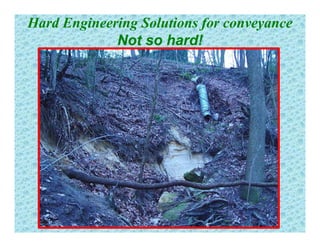
Hard Engineering Solutions for conveyance
Not so hard!Not so hard!
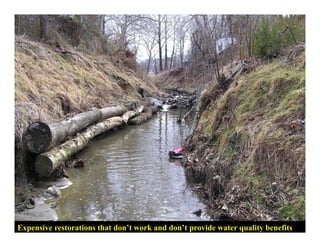
Expensive restorations that don’t work and don’t provide water quality benefits
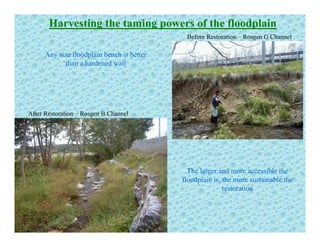
Harvesting the taming powers of the floodplain
Before Restoration – Rosgen G Channel
Any size floodplain bench is better
than a hardened wall
After Restoration – Rosgen B Channel
The larger and more accessible theThe larger and more accessible the
floodplain is, the more sustainable the
restoration
Hard Engineering Solutions for conveyance
Not so hard!
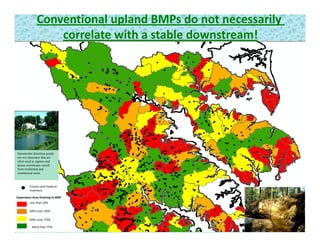
Conventional upland BMPs do not necessarily 
correlate with a stable downstream!
Stormwater detention ponds
are wet structures that are
often used to capture and
detain stormwater runoff
from residential and
Erosion and Headcut 
Inventory
o es de t a a d
commercial areas.
Impervious Area Draining to BMP
Less than 20%
20%< and >50%
More than 75%
50%< and >75%
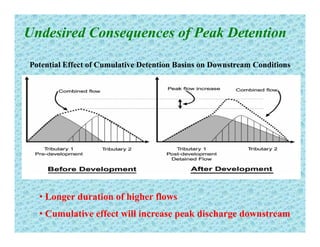
Undesired Consequences of Peak Detention
Potential Effect of Cumulative Detention Basins on Downstream Conditions
• Longer duration of higher flows
• Cumulative effect will increase peak discharge downstream
g g
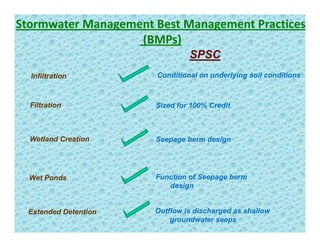
Stormwater Management Best Management Practices
(BMPs)( )
SPSC
Infiltration Conditional on underlying soil conditionsInfiltration Conditional on underlying soil conditions
Filtration Sized for 100% CreditS ed o 00% C ed t
Wetland Creation Seepage berm designWetland Creation Seepage berm design
Wet Ponds Function of Seepage berm
design
Extended Detention Outflow is discharged as shallow
groundwater seeps
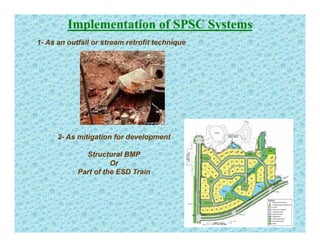
Implementation of SPSC Systems
1- As an outfall or stream retrofit techniqueq
2- As mitigation for development2 As mitigation for development
Structural BMP
Or
P t f th ESD T iPart of the ESD Train
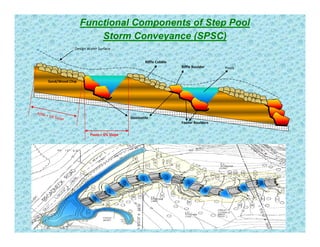
Functional Components of Step Pool
Storm Conveyance (SPSC)
Functional Components of Step Pool
Storm Conveyance (SPSC)
Design Water Surface
Riffle Boulder Pools
Riffle Cobble
Sand/Wood Chip
Footer Boulders
Pools = 0% Slope
Geotextile
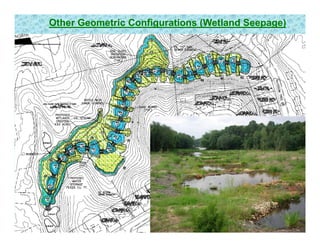
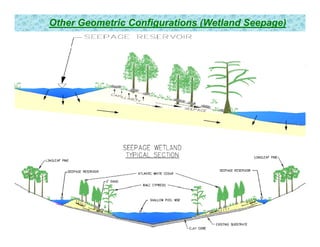
Other Geometric Configurations (Wetland Seepage)Other Geometric Configurations (Wetland Seepage)
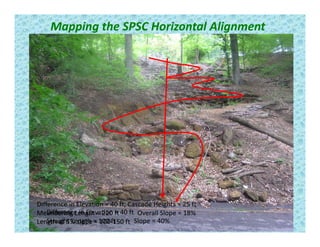
Mapping the SPSC Horizontal Alignment
Difference in Elevation = 40 ft
Straight Length = 100 ft           Slope = 40%
Difference in Elevation = 40 ft, Cascade Heights = 25 ft
Meandering Length = 220 ft           Overall Slope = 18%
Length at 5% slope = 100‐150 ft
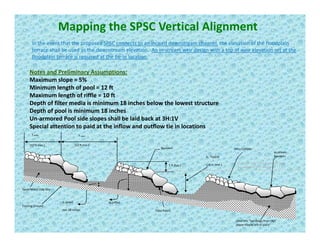
Mapping the SPSC Vertical Alignment
In the event that the proposed SPSC connects to an incised downstream channel, the elevation of the floodplain p p , p
terrace shall be used as the downstream elevation.  An in‐stream weir design with a top of weir elevation set at the 
floodplain terrace is required at the tie‐in location.
Notes and Preliminary Assumptions:
Maximum slope = 5%
Minimum length of pool = 12 ft
Maximum length of riffle = 10 ft
Depth of filter media is minimum 18 inches below the lowest structure
L pool
L Riffle
Depth of pool is minimum 18 inches
Un‐armored Pool side slopes shall be laid back at 3H:1V 
Special attention to paid at the inflow and outflow tie in locations
Silica Cobbles
1 ft (typ.)
(12 ft min.)(10 ft max.)
Boulders
hf Typical
(18 in. min.)
In‐stream 
Boulders
In‐stream 100 – Year floodplain may 
inundate last SPSC structure
Sand/Wood Chip Mix
d ( ffl )d ( l) df (riffle)
Existing Ground
Filter Fabric
df (pool)
min 18 inches
Sand Mix “Sandbags from E&S 
phase maybe left in place”
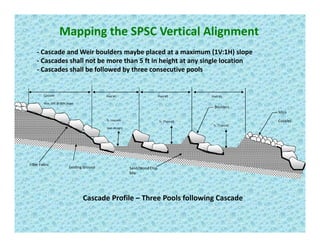
Mapping the SPSC Vertical Alignment
‐ Cascade and Weir boulders maybe placed at a maximum (1V:1H) slope
‐ Cascades shall not be more than 5 ft in height at any single location
‐ Cascades shall be followed by three consecutive pools
Boulders
Cascade 
Max 10ft @ 50% Slope
Pool #1 Pool #2 Pool #3
Silica
Cobbles
Boulders
hf cascade
(per design)
hf (Typical)
hf (Typical)
Existing Ground
Filter Fabric
Sand/Wood Chip 
Cascade Profile – Three Pools following Cascade
Mix
g
Design the typical cross‐section for the riffle/cascade
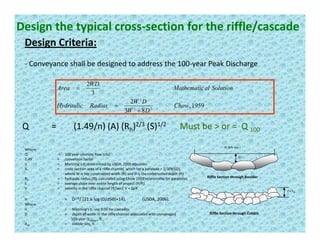
Design Criteria:Design Criteria:
‐ Conveyance shall be designed to address the 100‐year Peak Discharge
1959,
2
3
2
22
2
Chow
DW
RadiusHydraulic
SolutionalMathematic
WD
Area
=
=
,
83 22
DW
y
+
Q =        (1.49/n) (A) (Rh)2/3 (S)1/2 Must be > or =  Q 100
W (8 ft min.)
D
Where:
Q        = 100 year ultimate flow (cfs)
1.49 = conversion factor
n = Manning’s n, determined by USDA, 2006 equation
A = cross‐section area of a riffle channel, which for a parabola = 2/3(W)(D),
Riffle Section through Boulder
2 x d50
n = D1/6/ (21.6 log (D/d50)+14),  (USDA, 2006).
A cross section area of a riffle channel, which for a parabola   2/3(W)(D), 
where W is top constructed width (ft) and D is the constructed depth (ft)
Rh = hydraulic radius (ft), calculated using Chow 1959 relationship for parabolas
S = average slope over entire length of project (ft/ft)
V =  velocity in the riffle channel (ft/sec), V = Q/A
Riffle Section through Cobble
( g ( ) ) ( )
Where:
n = Manning’s n, use 0.05 for cascades.
D = depth of water in the riffle channel associated with unmanaged 
100‐year Q design, ft., 
d50 = cobble size, ft 
Design the typical cross‐section for the riffle/cascade
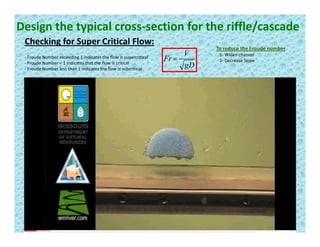
Checking for Super Critical Flow:g p
gD
V
Fr =‐ Froude Number exceeding 1 indicates the flow is supercritical
‐ Froude Number = 1 indicates that the flow is critical
‐ Froude Number less than 1 indicates the flow is subcritical
To reduce the Froude number
1‐ Widen channel
2‐ Decrease Slope
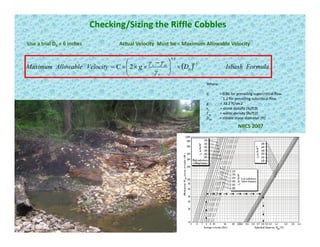
Checking/Sizing the Riffle Cobbles
Use a trial D0 = 6 inches Actual Velocity  Must be < Maximum Allowable Velocity
( ) FormulaIsbashDgCVelocityAllowableMaximum
w
ws 5.0
0
5.0
2 ×⎟⎟
⎠
⎞
⎜⎜
⎝
⎛ −
×××=
γ
γγ
0 y y
Where:
C            = 0.86 for prevailing supercritical flow 
1.2 for prevailing subcritical flow
g             = 32.2 ft/sec2
γ stone density (lb/ft3)γs                  = stone density (lb/ft3)
Γw               = water density (lb/ft3)
D50             = cobble stone diameter (ft)
NRCS 2007
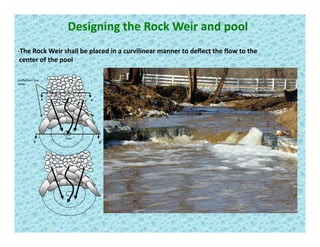
Designing the Rock Weir and pool
‐The Rock Weir shall be placed in a curvilinear manner to deflect the flow to the
center of the pool
A A’
Ineffective Flow 
Areas
Flow
B B’
Flow
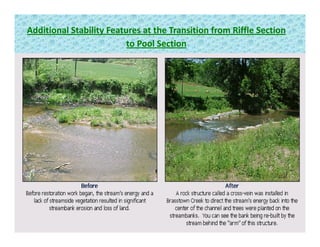
Additional Stability Features at the Transition from Riffle Section 
to Pool Section
Additional Stability Features at the Transition from Riffle Section 
to Pool Sectionto Pool Sectionto Pool Section
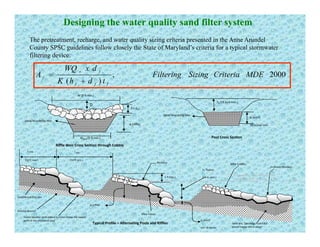
The pretreatment, recharge, and water quality sizing criteria presented in the Anne Arundel
C SPSC id li f ll l l h S f M l d’ i i f i l
Designing the water quality sand filter system
County SPSC guidelines follow closely the State of Maryland’s criteria for a typical stormwater
filtering device.
2000, MDECriteriaSizingFiltering
dxWQ
A
fv
f = 2000,
)(
MDECriteriaSizingFiltering
tdhK
A
fff
f
+
2 x d
W (8 ft min.)
D
hf (18 inch min.)
df (riffle)
Sand/Woodchip Mix
2 x d50
Df  (18 in min.)
Wsand (2 ft min.)
Sand/Woodchip Mix
Pool Cross Section
df (pool)
18 inches min.
Riffle Weir Cross Section through Cobble
sand ( )
Silica Cobbles
L pool
(10 ft min.)(10 ft max.)
Boulders
hf Typical
L Riffle
In‐stream Boulders
Sand/Wood Chip Mix
1 ft (typ.)
hf Typical
(18 in. min.)
In‐stream 100 – Year floodplain may 
inundate last SPSC structure
Typical Profile – Alternating Pools and Riffles
df (riffle)
Existing Ground
Filter Fabric
df (pool)
min 18 inches
Sand Mix “Sandbags from E&S 
phase maybe left in place”
Footer boulder shall extend 6 inches below the lowest 
point in the excavated pool
Checking Storage/Quantity Management
Th d SPSC ill ti f k t flThe proposed SPSC will satisfy peak management flow 
requirements if two conditions are met:
a‐ First, adequate storage volume within the pools 
and sand/woodchip voids shall be provided to meet 
the required storage volume/quantity managementthe required storage volume/quantity management 
for the project 
b Second it must be demonstrated that the designb‐ Second, it must be demonstrated that the design 
renders the hydraulic power equivalent to the 
predevelopment/desired hydraulic power through 
the proposed energy dissipation pools.
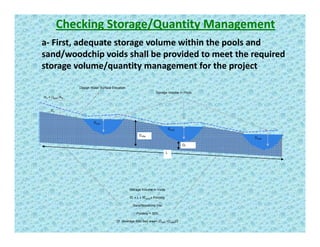
Checking Storage/Quantity Management
a‐ First, adequate storage volume within the pools and , q g p
sand/woodchip voids shall be provided to meet the required 
storage volume/quantity management for the project 
Vin = Qpost /Ain
Storage Volume in Pools
Design Water Surface Elevation
Din
Dout2
Dout3
Dout1
Driffle
L
out3
Df
Storage Volume in Voids
Df x L x Wsand x Porosity
Sand/Woodchip mix
Porosity = 30%
Df (Average filter bed area= (Driifle +Dpool)/2
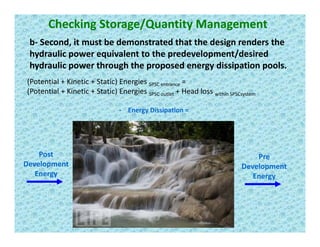
Checking Storage/Quantity Management
b‐ Second, it must be demonstrated that the design renders the , g
hydraulic power equivalent to the predevelopment/desired 
hydraulic power through the proposed energy dissipation pools.
E Di i i
(Potential + Kinetic + Static) Energies SPSC entrance = 
(Potential + Kinetic + Static) Energies SPSC outlet + Head loss within SPSCsystem
‐ Energy Dissipation =
Post 
Development 
Pre
Development 
Energy
p
Energy
SPSC Design Guidelines
i h kliDesign Checklist
Inspection Checklist
SPSC – FAQ
Can SPSC systems be used to provide water quality credit?
SPSC systems can be designed as micro or macro systems.  When designed as macro 
systems, they are treated as structural practices and can provide water quality via 
filtration above the ESD to the MEP criteria When designed as a micro system theyfiltration above the ESD to the MEP criteria.  When designed as a micro system, they 
behave as an ESD filtering device.
Can SPSC systems be used to provide quantity management?Can SPSC systems be used to provide quantity management?
SPSC systems will provide runoff attenuation via storage within the pools and voids 
within the substrate.   HOWEVER……..
SPSC – FAQ
What type of maintenance access is required for SPSC 
systems?
The intend behind the vehicular access requirement is to allow the County access toThe intend behind the vehicular access requirement is to allow the County access to 
public structures for routine maintenance and in the event of structural failure to 
perform necessary fixes.   
• Probability of future utilization of access road‐ Delicate balance
• Considering relaxing current policy of requiring vehicular access to all weirs to 
requiring access to the any point throughout SPSC and existence of sufficient public 
easement around the system to allow the County future access if needed.
SPSC Design Calculator
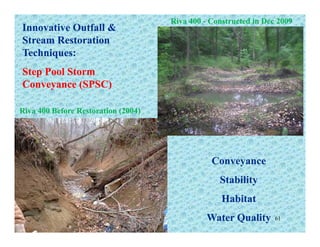
Innovative Outfall &Innovative Outfall &
Stream RestorationStream Restoration
Riva 400Riva 400 -- Constructed in Dec 2009Constructed in Dec 2009
Techniques:Techniques:
Step Pool StormStep Pool Stormpp
Conveyance (SPSC)Conveyance (SPSC)
Riva 400 Before Restoration (2004)Riva 400 Before Restoration (2004)
ConveyanceConveyance
StabilityStability
HabitatHabitatHabitatHabitat
Water QualityWater Quality 61
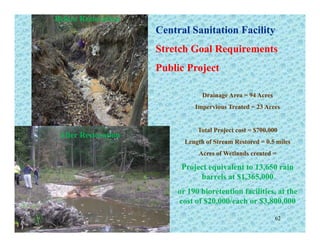
Central Sanitation FacilityCentral Sanitation Facility
S h G l R iS h G l R i
Before RestorationBefore Restoration
Stretch Goal RequirementsStretch Goal Requirements
Public ProjectPublic Project
Drainage Area = 94 AcresDrainage Area = 94 Acres
Impervious Treated = 23 AcresImpervious Treated = 23 AcresImpervious Treated 23 AcresImpervious Treated 23 Acres
Total Project cost = $700,000Total Project cost = $700,000
After RestorationAfter Restoration
Length of Stream Restored = 0.5 milesLength of Stream Restored = 0.5 miles
Acres of Wetlands created =Acres of Wetlands created =
Project equivalent to 13,650 rainProject equivalent to 13,650 rainj q ,j q ,
barrels at $1,365,000barrels at $1,365,000
or 190 bioretention facilities, at theor 190 bioretention facilities, at the
cost of $20 000/each or $3 800 000cost of $20 000/each or $3 800 000
62
cost of $20,000/each or $3,800,000cost of $20,000/each or $3,800,000
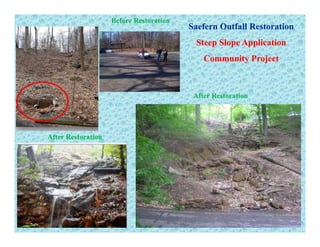
Before RestorationBefore Restoration
Saefern Outfall RestorationSaefern Outfall Restoration
Steep Slope ApplicationSteep Slope Applicationp p ppp p pp
Community ProjectCommunity Project
After RestorationAfter Restoration
After RestorationAfter RestorationAfter RestorationAfter Restoration
63
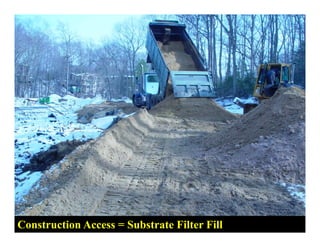
Construction Access = Substrate Filter Fill
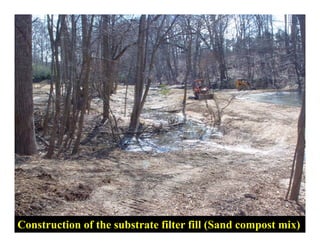
SeepageSeepage BermsBermsConstruction of the substrate filter fill (Sand compost mix)
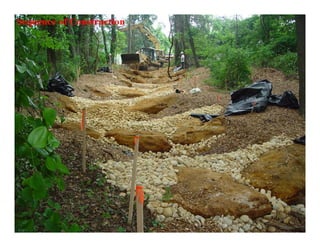
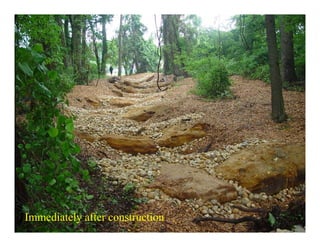
Immediately after construction
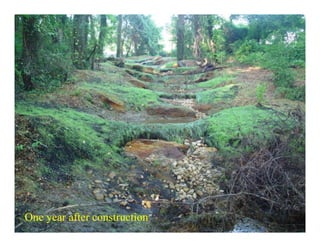
One year after construction
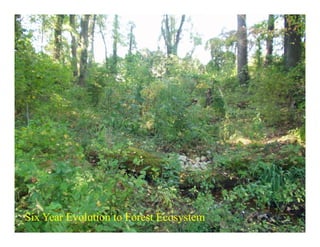
Six Year Evolution to Forest Ecosystem
Contact Information
Janis Markusic Christopher Victoria
Program Manager Environmental Scientist
pwmark02@aacounty.org pwvict16@aacounty.org
Anne Arundel County Department of Public Works
Watershed, Ecosystem, and Restoration Services
Ecological Assessment ProgramEcological Assessment Program
2662 Riva Road
Annapolis, Maryland 21401
410.222.4240410.222.4240
Contact Information
Hala Flores, P.E. Richard Fisher
Program Manager Environmental Scientist
Hala.flores@aacounty.org rfisher@aacounty.org
Anne Arundel County Department of Public Works
Watershed, Ecosystem, and Restoration Services
Ecological Assessment ProgramEcological Assessment Program
2662 Riva Road
Annapolis, Maryland 21401
410.222.4240410.222.4240

20110311 hbam spsc outfall channel presentation

  • 1.
    Overview of WatershedAssessment and Modeling Data (A i WMT i f ti )(Accessing WMT information) Hala Flores PE Richard FisherHala Flores, P.E Richard Fisher Rapid Stream Assessment Protocolsp Janis Markusic Christopher Victoria Overview of SPSC Design Guidelines and Calculator Hala Flores, P.E HBAM Meetingeet g February 28th, 2011 Ron Bowen, P.E.
  • 3.
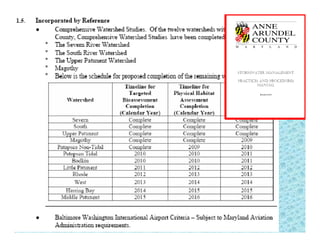
    Anne Arundel CountyStormwater Management Practices and Procedures Manual __________________________________________________ Chapter 11 Appendices 11.6 11 3 Li k t i d /i f ti 11 3 8 D t t f P bli W k t h d 11.3. Links to required resources/information 11.3.8. Department of Public Works watershed management tool htt // i ld t / /http://gis-world.aacounty.org/wers/
  • 4.
    Anne Arundel County WatershedManagement ToolWatershed Management Tool (WMT)(WMT) Stream AssessmentStream Assessment -- Physical HabitatPhysical Habitat -- Biological ConditionsBiological Conditions -- MorphologyMorphology -- Problem Area InventoryProblem Area Inventory Erosion,Erosion, HeadcutHeadcut, Dumpsites, Deficient, Dumpsites, Deficient Buffers, Infrastructure Impacts.Buffers, Infrastructure Impacts. -- Stream Crossings (H&H)Stream Crossings (H&H)Stream Crossings (H&H)Stream Crossings (H&H) -- Landscape (Imperviousness)Landscape (Imperviousness)
  • 5.
    2 000 estimated2000 estimated milesmiles Anne Arundel County 2,000 estimated2,000 estimated milesmiles ofof nonnon--tidal waterwaystidal waterways P i l (S d W l d )Perennial (Streams and Wetlands) Ephemeral and Intermittent Pond/Lake/Floodway Other
  • 6.
    BIOLOGICAL CONDITIONS B hi Id f Bi iBenthic Index for Biotic Integrity (BIBI) Score Number of Samples - 376p - 5% - 23%Fair Good 23% - 49% Fair Poor - 23%Very Poor
  • 7.
    DEGRADED MORPHOLOGY Example of F and G channels – Highly Instablep gy Erosion  ‐‐ Patuxent River Watershed Headcut  ‐‐ South River Watershed
  • 8.
  • 9.
    Anne Arundel County WatershedManagement Tool (WMT)Watershed Management Tool (WMT) Restoration Indicators Preservation Indicators Analysis and ModelingAnalysis and Modeling --HydrologyHydrology(Runoff and Discharge)(Runoff and Discharge) -- Pollutant Load AnalysisPollutant Load Analysis -- Landscape AnalysisLandscape Analysis
  • 10.
  • 11.
    Subwatershed  Priority fory Preservation Lowest Priority forPreservation Highest Priority for Preservation
  • 12.
  • 13.
    Stream Assessment Protocol:an overviewoverview Anne Arundel County Department of Public WorksDepartment of Public Works Bureau of Engineering Watershed, Ecosystem, and Restoration Services Ecological Assessment ProgramEcological Assessment Program
  • 14.
    Introduction • Regulatory Triggers Gl W h d Ch i i• General Watershed Characterization – Land Use and Imperviousness – Drainage Area and Bankfull Indicator Determination G l St Ch t i ti• General Stream Characterization – Rosgen Level II Classification (pebble count, slope determination, valley type, etc.) • Lateral Stability DeterminationLateral Stability Determination – BEHI and NBS Evaluation – Bank armoring and localized versus widespread issues • Vertical Stability DeterminationVertical Stability Determination – Incision Ratio – Headcuts, control points, depositional features • Overall Reach Stability Determinationy – Includes a variety of trend and reach-level evaluations
  • 15.
    Regulatory TriggersRegulatory Triggers •The use of the Stream Assessment Protocol is triggered by a finding of an “i d f ll” i h f d i i if O b k Fl d“inadequate outfall” in the context of determining if Overbank Flood Protection is required due to the impact of a given development site. • Once such an “inadequate outfall” finding is made, a downstream analysis iis necessary. • This method is applied only to a “…clearly defined open channel…” (Section 7.2.2.D.II; Chapter 7, p. 7.4) • The assessment reach comprises the channel from “…the outfall(s) from the site and progress[es] to the Point(s) of Investigation (POI).” (Section 7.2, Chapter 7, p. 7.2) • See the Procedures and Practices Manual for details on what constitutes an adequate or inadequate outfall and on how to establish the POI.
  • 16.
    This is afield-based assessment! You must leave the office to apply it correctly!
  • 17.
    Watershed Characterization Standard Header Items •WatershedDate DrainageWatershed, Date, Drainage Area, etc. Watershed Characterization •Should be mostly an office exercise •Land use and land cover are the primary items to determine, both in the basin, and adjacent to the reach of interest •DA calculation needed for bankfull determinationbankfull determination •Significant land uses that may impact stream stability conditions
  • 18.
    Stream Characterization and Classification •Rosgen LevelII Classification is basicClassification is basic characterization •Not discussed in detail here •All standard work, all found in Rosgen (1996): Width, depth, slope, D50, sinuosity, W/D ratio, entrenchment, etc. •Bankfull channel dimensions using known regional relationships developed by others are necessary forothers are necessary for Rosgen classification
  • 19.
    You can find these relationships withinthewithin the document or in other references…
  • 20.
    …and they areeasily used in a spreadsheet to h h l h i icompute these channel characteristics.
  • 21.
    Lateral Stability DeterminationDetermination •Lateral stability.What is it? Side to side movement of stream channel which is a function ofchannel, which is a function of two major influences: •A streambank’s characteristics that make it resistant to erosion •The work done on the bank of interest related to the hydraulic characteristics of the overall channel (Near Bank Stress) Done on dominant bank( ) •How are these two opposing forces evaluated? Using Rosgen’s BEHI and NBS ratings Done on dominant bank within the assessment reach. If two bank types are t d ll threpresented equally, the higher BEHI and/or NBS rating (i.e.—more unstable) is used.)
  • 22.
  • 23.
    Vertical Stabilityy Determination •Primary determinationusing the Incision Ratiothe Incision Ratio •Also used presence of the following: •Head Cuts •Depositional Features •Bed Control •Taken together, these features i i i h i i lgive insight into vertical stability
  • 24.
  • 25.
    Overall Reach Stabilityy Determination •Stream Sensitivity,Sediment Supply, and Recovery Potentialy •From Rosgen (1996) •Evolution Stability Sequence •Evolution Stability Trend •Overall Reach StabilityOverall Reach Stability
  • 26.
    Stream Evolution Scenarios(2 of 9 in SAP manual)
  • 27.
    Final Steps • Usingweight of evidence, a finding of either 1) localized or widespread i bili 2) bl di i iinstability or 2) stable conditions is made for the assessment reach • Report is produced for the assessment h h d ib h bilireach that describes the stability conditions observed • Photodocumentation is a required f hiaspect of this report
  • 28.
    Links Guidance Documents: • StreamAssessment Protocols: http://www aacounty org/DPW/Watershed/DownstreamAdequacyProtocols cfmhttp://www.aacounty.org/DPW/Watershed/DownstreamAdequacyProtocols.cfm • Stormwater Practices and Procedures Manual: http://www.aacounty.org/PlanZone/Resources/Practices_Procedures_Manual.pdf GIS/M i Li kGIS/Mapping Links: • AA County Watershed Mapping Application: http://gis-world.aacounty.org/wers/ • GIS Hydro: http://www.gishydro.umd.edu/ Information Links • US Fish and Wildlife CBFO:US Fish and Wildlife CBFO: http://www.fws.gov/chesapeakebay/stream.html • DNR Rosgen Spreadsheets: http://www.dnr.state.oh.us/soilandwater/water/streammorphology/default/tabid/9188/Defaulhttp://www.dnr.state.oh.us/soilandwater/water/streammorphology/default/tabid/9188/Defaul t.aspx
  • 29.
    SPSC – Whatare they? SPSC are open-channel conveyance structures that convert, through attenuation pools and a sand seepage filter s rface storm flo to shalloseepage filter, surface storm flow to shallow groundwater flow. Wetland Seepage System Perennial Application Step Pool Storm Conveyance Ephemeral Application
  • 30.
    Types of BMPs Pipe Conveyance ii Receiving Stream Micro Practice (Off-line) Pipe Conveyance Receiving Stream Macro Practice (On-line) A shift in Paradigm Receiving SPSC Conveyance SPSC Integrated System Receiving Stream
  • 31.
    A, ?? STEP POOLSTORM CONVEYANCE FOR EPHEMERAL OUTFALLS B, 32% The physical characteristics of the SPSC channel are best characterized by the Rosgen A or B stream classification types, where “bedform occurs as a step/pool, cascading channel which often stores large amounts of sediment in the pools associated with debris dams” (Rosgen, 1996).
  • 32.
    WETLAND SEEPAGE RESTORATIONTECHNIQUE FOR PERRENIAL STREAMS DA, 28%
  • 33.
    SPSC – Canbe designed to provide: - Safe 100-year Conveyance - Attenuation - Energy DissipationEnergy Dissipation - Water Quality Treatment
  • 34.
    Hard Engineering Solutionsfor conveyance Not so hard!Not so hard!
  • 35.
    Expensive restorations thatdon’t work and don’t provide water quality benefits
  • 36.
    Harvesting the tamingpowers of the floodplain Before Restoration – Rosgen G Channel Any size floodplain bench is better than a hardened wall After Restoration – Rosgen B Channel The larger and more accessible theThe larger and more accessible the floodplain is, the more sustainable the restoration
  • 37.
    Hard Engineering Solutionsfor conveyance Not so hard!
  • 38.
    Conventional upland BMPs do not necessarily  correlate with a stable downstream! Stormwater detention ponds arewet structures that are often used to capture and detain stormwater runoff from residential and Erosion and Headcut  Inventory o es de t a a d commercial areas. Impervious Area Draining to BMP Less than 20% 20%< and >50% More than 75% 50%< and >75%
  • 39.
    Undesired Consequences ofPeak Detention Potential Effect of Cumulative Detention Basins on Downstream Conditions • Longer duration of higher flows • Cumulative effect will increase peak discharge downstream g g
  • 40.
    Stormwater Management Best Management Practices (BMPs)( ) SPSC InfiltrationConditional on underlying soil conditionsInfiltration Conditional on underlying soil conditions Filtration Sized for 100% CreditS ed o 00% C ed t Wetland Creation Seepage berm designWetland Creation Seepage berm design Wet Ponds Function of Seepage berm design Extended Detention Outflow is discharged as shallow groundwater seeps
  • 41.
    Implementation of SPSCSystems 1- As an outfall or stream retrofit techniqueq 2- As mitigation for development2 As mitigation for development Structural BMP Or P t f th ESD T iPart of the ESD Train
  • 42.
    Functional Components ofStep Pool Storm Conveyance (SPSC) Functional Components of Step Pool Storm Conveyance (SPSC) Design Water Surface Riffle Boulder Pools Riffle Cobble Sand/Wood Chip Footer Boulders Pools = 0% Slope Geotextile
  • 43.
    Other Geometric Configurations(Wetland Seepage)Other Geometric Configurations (Wetland Seepage)
  • 44.
    Other Geometric Configurations(Wetland Seepage)Other Geometric Configurations (Wetland Seepage)
  • 45.
  • 46.
    Mapping the SPSC Vertical Alignment In the event that the proposed SPSC connects to an incised downstream channel, the elevation of the floodplain p p ,p terrace shall be used as the downstream elevation.  An in‐stream weir design with a top of weir elevation set at the  floodplain terrace is required at the tie‐in location. Notes and Preliminary Assumptions: Maximum slope = 5% Minimum length of pool = 12 ft Maximum length of riffle = 10 ft Depth of filter media is minimum 18 inches below the lowest structure L pool L Riffle Depth of pool is minimum 18 inches Un‐armored Pool side slopes shall be laid back at 3H:1V  Special attention to paid at the inflow and outflow tie in locations Silica Cobbles 1 ft (typ.) (12 ft min.)(10 ft max.) Boulders hf Typical (18 in. min.) In‐stream  Boulders In‐stream 100 – Year floodplain may  inundate last SPSC structure Sand/Wood Chip Mix d ( ffl )d ( l) df (riffle) Existing Ground Filter Fabric df (pool) min 18 inches Sand Mix “Sandbags from E&S  phase maybe left in place”
  • 47.
    Mapping the SPSC Vertical Alignment ‐ Cascade and Weir boulders maybe placed at a maximum (1V:1H) slope ‐ Cascades shall not be more than 5 ft in height at any single location ‐Cascades shall be followed by three consecutive pools Boulders Cascade  Max 10ft @ 50% Slope Pool #1 Pool #2 Pool #3 Silica Cobbles Boulders hf cascade (per design) hf (Typical) hf (Typical) Existing Ground Filter Fabric Sand/Wood Chip  Cascade Profile – Three Pools following Cascade Mix g
  • 48.
    Design the typical cross‐section for the riffle/cascade Design Criteria:Design Criteria: ‐ Conveyance shall be designed to address the 100‐year Peak Discharge 1959, 2 3 2 22 2 Chow DW RadiusHydraulic SolutionalMathematic WD Area = = , 8322 DW y + Q =        (1.49/n) (A) (Rh)2/3 (S)1/2 Must be > or =  Q 100 W (8 ft min.) D Where: Q        = 100 year ultimate flow (cfs) 1.49 = conversion factor n = Manning’s n, determined by USDA, 2006 equation A = cross‐section area of a riffle channel, which for a parabola = 2/3(W)(D), Riffle Section through Boulder 2 x d50 n = D1/6/ (21.6 log (D/d50)+14),  (USDA, 2006). A cross section area of a riffle channel, which for a parabola   2/3(W)(D),  where W is top constructed width (ft) and D is the constructed depth (ft) Rh = hydraulic radius (ft), calculated using Chow 1959 relationship for parabolas S = average slope over entire length of project (ft/ft) V =  velocity in the riffle channel (ft/sec), V = Q/A Riffle Section through Cobble ( g ( ) ) ( ) Where: n = Manning’s n, use 0.05 for cascades. D = depth of water in the riffle channel associated with unmanaged  100‐year Q design, ft.,  d50 = cobble size, ft 
  • 49.
    Design the typical cross‐section for the riffle/cascade Checking for Super Critical Flow:g p gD V Fr =‐Froude Number exceeding 1 indicates the flow is supercritical ‐ Froude Number = 1 indicates that the flow is critical ‐ Froude Number less than 1 indicates the flow is subcritical To reduce the Froude number 1‐ Widen channel 2‐ Decrease Slope
  • 50.
    Checking/Sizing the Riffle Cobbles Use a trial D0 = 6 inches Actual Velocity  Must be < Maximum Allowable Velocity () FormulaIsbashDgCVelocityAllowableMaximum w ws 5.0 0 5.0 2 ×⎟⎟ ⎠ ⎞ ⎜⎜ ⎝ ⎛ − ×××= γ γγ 0 y y Where: C            = 0.86 for prevailing supercritical flow  1.2 for prevailing subcritical flow g             = 32.2 ft/sec2 γ stone density (lb/ft3)γs                  = stone density (lb/ft3) Γw               = water density (lb/ft3) D50             = cobble stone diameter (ft) NRCS 2007
  • 51.
  • 52.
  • 53.
    The pretreatment, recharge,and water quality sizing criteria presented in the Anne Arundel C SPSC id li f ll l l h S f M l d’ i i f i l Designing the water quality sand filter system County SPSC guidelines follow closely the State of Maryland’s criteria for a typical stormwater filtering device. 2000, MDECriteriaSizingFiltering dxWQ A fv f = 2000, )( MDECriteriaSizingFiltering tdhK A fff f + 2 x d W (8 ft min.) D hf (18 inch min.) df (riffle) Sand/Woodchip Mix 2 x d50 Df  (18 in min.) Wsand (2 ft min.) Sand/Woodchip Mix Pool Cross Section df (pool) 18 inches min. Riffle Weir Cross Section through Cobble sand ( ) Silica Cobbles L pool (10 ft min.)(10 ft max.) Boulders hf Typical L Riffle In‐stream Boulders Sand/Wood Chip Mix 1 ft (typ.) hf Typical (18 in. min.) In‐stream 100 – Year floodplain may  inundate last SPSC structure Typical Profile – Alternating Pools and Riffles df (riffle) Existing Ground Filter Fabric df (pool) min 18 inches Sand Mix “Sandbags from E&S  phase maybe left in place” Footer boulder shall extend 6 inches below the lowest  point in the excavated pool
  • 54.
    Checking Storage/Quantity Management Th d SPSCill ti f k t flThe proposed SPSC will satisfy peak management flow  requirements if two conditions are met: a‐ First, adequate storage volume within the pools  and sand/woodchip voids shall be provided to meet  the required storage volume/quantity managementthe required storage volume/quantity management  for the project  b Second it must be demonstrated that the designb‐ Second, it must be demonstrated that the design  renders the hydraulic power equivalent to the  predevelopment/desired hydraulic power through  the proposed energy dissipation pools.
  • 55.
    Checking Storage/Quantity Management a‐ First, adequate storage volume within the pools and , qg p sand/woodchip voids shall be provided to meet the required  storage volume/quantity management for the project  Vin = Qpost /Ain Storage Volume in Pools Design Water Surface Elevation Din Dout2 Dout3 Dout1 Driffle L out3 Df Storage Volume in Voids Df x L x Wsand x Porosity Sand/Woodchip mix Porosity = 30% Df (Average filter bed area= (Driifle +Dpool)/2
  • 56.
    Checking Storage/Quantity Management b‐ Second, it must be demonstrated that the design renders the , g hydraulic power equivalent to the predevelopment/desired  hydraulic power through the proposed energy dissipation pools. EDi i i (Potential + Kinetic + Static) Energies SPSC entrance =  (Potential + Kinetic + Static) Energies SPSC outlet + Head loss within SPSCsystem ‐ Energy Dissipation = Post  Development  Pre Development  Energy p Energy
  • 57.
  • 58.
    SPSC – FAQ Can SPSC systems be used to provide water quality credit? SPSC systems can be designed as micro or macro systems.  When designed as macro  systems, they are treated as structural practices and can provide water quality via  filtration abovethe ESD to the MEP criteria When designed as a micro system theyfiltration above the ESD to the MEP criteria.  When designed as a micro system, they  behave as an ESD filtering device. Can SPSC systems be used to provide quantity management?Can SPSC systems be used to provide quantity management? SPSC systems will provide runoff attenuation via storage within the pools and voids  within the substrate.   HOWEVER……..
  • 59.
    SPSC – FAQ What type of maintenance access is required for SPSC  systems? The intendbehind the vehicular access requirement is to allow the County access toThe intend behind the vehicular access requirement is to allow the County access to  public structures for routine maintenance and in the event of structural failure to  perform necessary fixes.    • Probability of future utilization of access road‐ Delicate balance • Considering relaxing current policy of requiring vehicular access to all weirs to  requiring access to the any point throughout SPSC and existence of sufficient public  easement around the system to allow the County future access if needed.
  • 60.
  • 61.
    Innovative Outfall &InnovativeOutfall & Stream RestorationStream Restoration Riva 400Riva 400 -- Constructed in Dec 2009Constructed in Dec 2009 Techniques:Techniques: Step Pool StormStep Pool Stormpp Conveyance (SPSC)Conveyance (SPSC) Riva 400 Before Restoration (2004)Riva 400 Before Restoration (2004) ConveyanceConveyance StabilityStability HabitatHabitatHabitatHabitat Water QualityWater Quality 61
  • 62.
    Central Sanitation FacilityCentralSanitation Facility S h G l R iS h G l R i Before RestorationBefore Restoration Stretch Goal RequirementsStretch Goal Requirements Public ProjectPublic Project Drainage Area = 94 AcresDrainage Area = 94 Acres Impervious Treated = 23 AcresImpervious Treated = 23 AcresImpervious Treated 23 AcresImpervious Treated 23 Acres Total Project cost = $700,000Total Project cost = $700,000 After RestorationAfter Restoration Length of Stream Restored = 0.5 milesLength of Stream Restored = 0.5 miles Acres of Wetlands created =Acres of Wetlands created = Project equivalent to 13,650 rainProject equivalent to 13,650 rainj q ,j q , barrels at $1,365,000barrels at $1,365,000 or 190 bioretention facilities, at theor 190 bioretention facilities, at the cost of $20 000/each or $3 800 000cost of $20 000/each or $3 800 000 62 cost of $20,000/each or $3,800,000cost of $20,000/each or $3,800,000
  • 63.
    Before RestorationBefore Restoration SaefernOutfall RestorationSaefern Outfall Restoration Steep Slope ApplicationSteep Slope Applicationp p ppp p pp Community ProjectCommunity Project After RestorationAfter Restoration After RestorationAfter RestorationAfter RestorationAfter Restoration 63
  • 64.
    Construction Access =Substrate Filter Fill
  • 65.
    SeepageSeepage BermsBermsConstruction ofthe substrate filter fill (Sand compost mix)
  • 67.
  • 68.
    One year afterconstruction
  • 69.
    Six Year Evolutionto Forest Ecosystem
  • 70.
    Contact Information Janis MarkusicChristopher Victoria Program Manager Environmental Scientist pwmark02@aacounty.org pwvict16@aacounty.org Anne Arundel County Department of Public Works Watershed, Ecosystem, and Restoration Services Ecological Assessment ProgramEcological Assessment Program 2662 Riva Road Annapolis, Maryland 21401 410.222.4240410.222.4240
  • 71.
    Contact Information Hala Flores,P.E. Richard Fisher Program Manager Environmental Scientist Hala.flores@aacounty.org rfisher@aacounty.org Anne Arundel County Department of Public Works Watershed, Ecosystem, and Restoration Services Ecological Assessment ProgramEcological Assessment Program 2662 Riva Road Annapolis, Maryland 21401 410.222.4240410.222.4240