OpenCV TutorialItseezVictor EruhimovItseez, CTOhttp://opencv.willowgarage.comwww.willowgarage.comwww.itseez.com
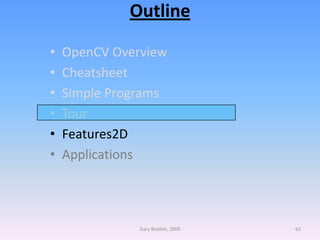
OutlineOpenCV OverviewCheatsheetSimple ProgramsTourFeatures2DApplications2
OpenCV Czar
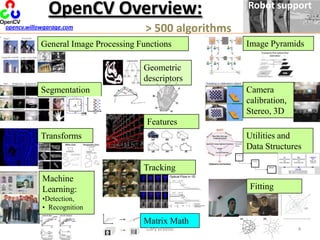
OpenCV Overview: Robot support> 500 algorithmsopencv.willowgarage.comImage PyramidsGeneral Image Processing FunctionsGeometric descriptorsCamera calibration,Stereo, 3DSegmentationFeaturesUtilities and Data StructuresTransformsTrackingMachine Learning:Detection,
  RecognitionFittingMatrix Math4Gary Bradski
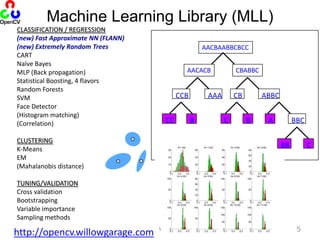
Machine Learning Library (MLL)‏AACBAABBCBCCAACACBCBABBCAAACCBABBCCBBCCBCABBCCBBCLASSIFICATION / REGRESSION(new) Fast Approximate NN (FLANN)(new) Extremely Random TreesCARTNaïve BayesMLP (Back propagation)‏Statistical Boosting, 4 flavorsRandom ForestsSVMFace Detector(Histogram matching)‏(Correlation)‏CLUSTERINGK-MeansEM(Mahalanobis distance)‏TUNING/VALIDATIONCross validationBootstrappingVariable importanceSampling methods55http://opencv.willowgarage.com
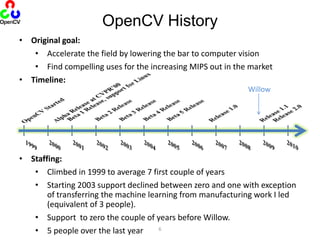
OpenCV HistoryOriginal goal:
Accelerate the field by lowering the bar to computer vision
Find compelling uses for the increasing MIPS out in the market
Timeline:
Staffing:
Climbed in 1999 to average 7 first couple of years
Starting 2003 support declined between zero and one with exception of transferring the machine learning from manufacturing work I led (equivalent of 3 people).
Support  to zero the couple of years before Willow.
5 people over the last yearWillowBeta 1 Release, support for LinuxAlpha Release at CVPR’00Beta 2 ReleaseBeta 3 ReleaseBeta 4 ReleaseBeta 5 ReleaseOpenCV StartedRelease 1.0Release 1.1Release 2.01019992000200120032004200520062007200820092010200250Gary Bradski66
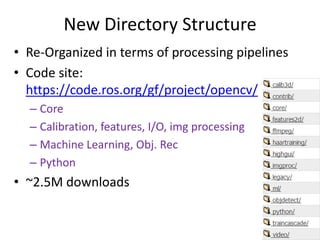
New Directory StructureRe-Organized in terms of processing pipelinesCode site: https://code.ros.org/gf/project/opencv/CoreCalibration, features, I/O, img processingMachine Learning, Obj. RecPython~2.5M downloads
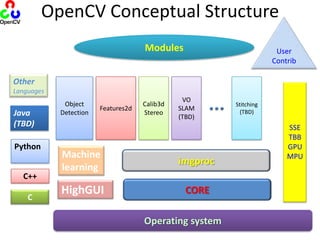
OpenCV Conceptual StructureUser ContribModulesOtherLanguagesObjectDetectionFeatures2dCalib3dStereoVOSLAM(TBD)Stitching(TBD)SSETBBGPUMPUJava (TBD)PythonMachine learningimgprocC++COREHighGUICOperating system
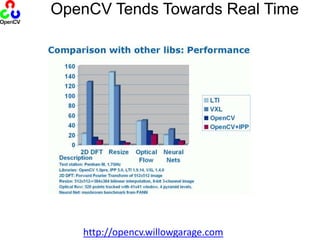
OpenCV Tends Towards Real Timehttp://opencv.willowgarage.com
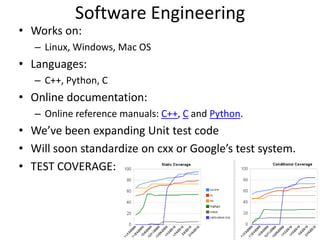
Software EngineeringWorks on: Linux, Windows, Mac OSLanguages: C++, Python, COnline documentation:Online reference manuals: C++, C and Python. We’ve been expanding Unit test codeWill soon standardize on cxx or Google’s test system.TEST COVERAGE:
LicenseBased on BSD license
Free for commercial or research use
In whole or in part
Does not force your code to be open
You need not contribute back
We hope you will contribute back, recent contribution, C++ wrapper class used for Google Street Maps** Thanks to Daniel FilipGary Bradski (c) 20081111Gary Bradski, 2009
What’s added in December 2010OpenCV 2.2?Detector/Descriptor pipeline (Features2D)Many supporting detectors and descriptor featuresEasy interface to Pascal VOCBOW and Latent SVM classification enginesExperimental User ContribFocus detector?Visualization (“HighGUI”) will be based on QtOfficial support of Android OSUpdated FLANN libraryLimited Cuda support (stereo)
What’s in Progress?GPU support throughout the libraryMore functionality in features2dBetter pose estimation algorithmsePnPStereo pose estimationCircles pattern detectorBetter support of Android Support for google test
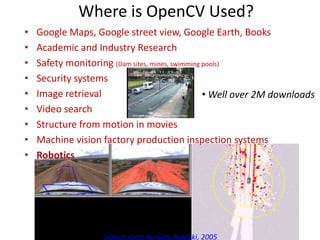
Where is OpenCV Used?Google Maps, Google street view, Google Earth, BooksAcademic and Industry ResearchSafety monitoring (Dam sites, mines, swimming pools)Security systemsImage retrievalVideo searchStructure from motion in moviesMachine vision factory production inspection systemsRobotics Well over 2M downloads2M downloadsScreen shots by Gary Bradski, 2005
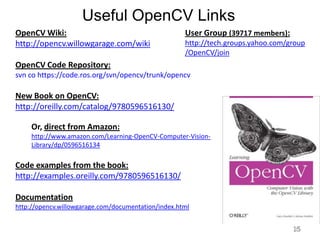
Useful OpenCV Links1515OpenCV Wiki:http://opencv.willowgarage.com/wikiOpenCV Code Repository:svn co https://code.ros.org/svn/opencv/trunk/opencvNew Book on OpenCV:http://oreilly.com/catalog/9780596516130/Or, direct from Amazon:http://www.amazon.com/Learning-OpenCV-Computer-Vision-Library/dp/0596516134Code examples from the book:http://examples.oreilly.com/9780596516130/Documentationhttp://opencv.willowgarage.com/documentation/index.htmlUser Group (39717 members):http://tech.groups.yahoo.com/group/OpenCV/joinGary Bradski, 2009
OutlineOpenCV OverviewCheatsheetSimple ProgramsTourFeatures2DApplicationsGary Bradski, 200916
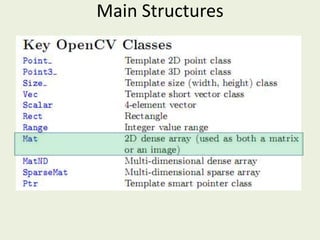
Main Structures
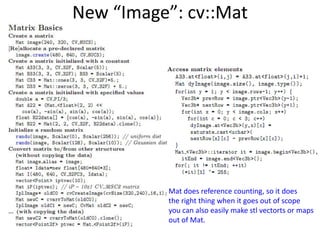
New “Image”: cv::MatMat does reference counting, so it doesthe right thing when it goes out of scopeyou can also easily make stl vectorts or maps out of Mat.
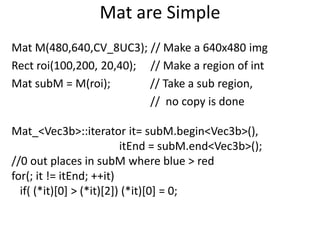
Mat are SimpleMat M(480,640,CV_8UC3); // Make a 640x480 imgRect roi(100,200, 20,40);     // Make a region of intMat subM = M(roi);              // Take a sub region,                                                 //  no copy is doneMat_<Vec3b>::iterator it= subM.begin<Vec3b>(),                                       itEnd = subM.end<Vec3b>();//0 out places in subM where blue > redfor(; it != itEnd; ++it)   if( (*it)[0] > (*it)[2]) (*it)[0] = 0;
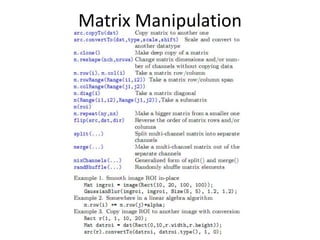
Matrix Manipulation
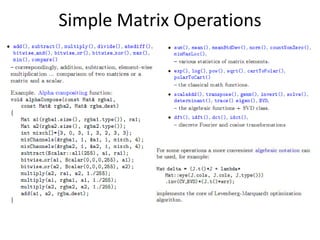
Simple Matrix Operations
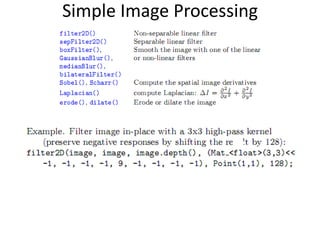
Simple Image Processing
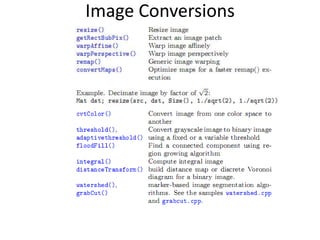
Image Conversions
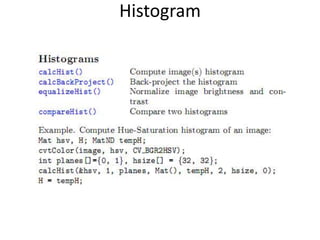
Histogram
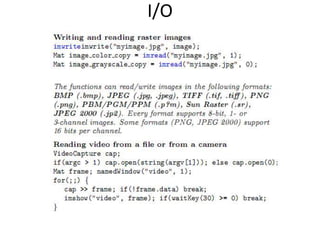
I/O
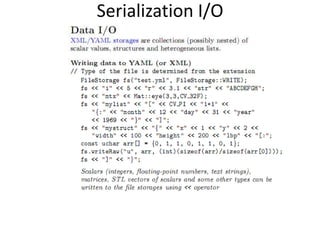
Serialization I/O
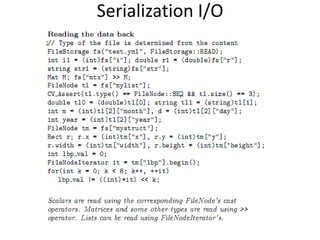
Serialization I/O
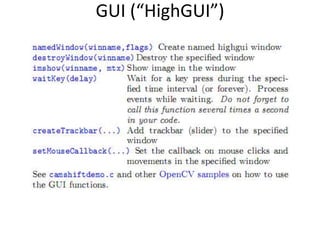
GUI (“HighGUI”)
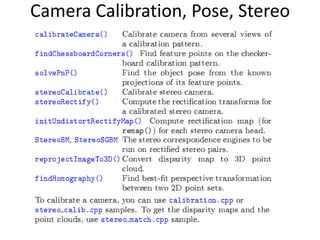
Camera Calibration, Pose, Stereo
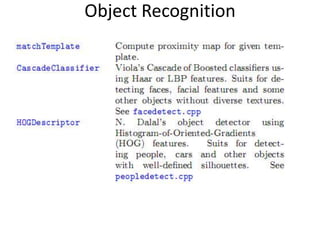
Object Recognition
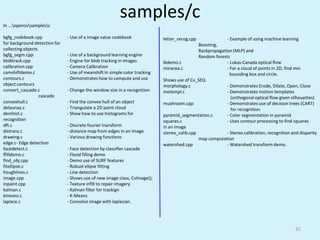
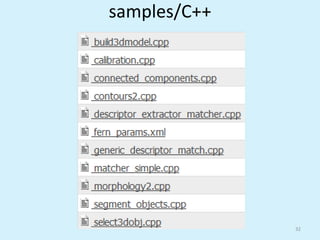
samples/c31In ...\opencv\samples\cbgfg_codebook.cpp	- Use of a image value codebook for background detection for collecting objectsbgfg_segm.cpp		- Use of a background learning engineblobtrack.cpp		- Engine for blob tracking in imagescalibration.cpp		- Camera Calibrationcamshiftdemo.c		- Use of meanshift in simple color trackingcontours.c		- Demonstrates how to compute and use object contoursconvert_cascade.c	- Change the window size in a recognition	   cascadeconvexhull.c		- Find the convex hull of an objectdelaunay.c		- Triangulate a 2D point clouddemhist.c		- Show how to use histograms for recognitiondft.c		- Discrete fourier transformdistrans.c		- distance map from edges in an imagedrawing.c		- Various drawing functionsedge.c- Edge detectionfacedetect.c		- Face detection by classifier cascadeffilldemo.c		- Flood filling demofind_obj.cpp		- Demo use of SURF featuresfitellipse.c		- Robust elipse fittinghoughlines.c		- Line detectionimage.cpp		- Shows use of new image class, CvImage();inpaint.cpp		- Texture infill to repair imagerykalman.c		- Kalman filter for trackignkmeans.c		- K-Meanslaplace.c		- Convolve image with laplacian.  letter_recog.cpp	- Example of using machine learning 	   Boosting, 	   Backpropagation (MLP) and 	   Random forestslkdemo.c		- Lukas-Canada optical flowminarea.c		- For a cloud of points in 2D, find min 		  bounding box and circle.  Shows use of Cv_SEQmorphology.c		- Demonstrates Erode, Dilate, Open, Closemotempl.c		- Demonstrates motion templates		   (orthogonal optical flow given silhouettes)mushroom.cpp		- Demonstrates use of decision trees (CART)		   for recognitionpyramid_segmentation.c	- Color segmentation in pyramidsquares.c		- Uses contour processing to find squares in an imagestereo_calib.cpp	- Stereo calibration, recognition and disparity 	   map computationwatershed.cpp		- Watershed transform demo.
samples/C++32
Samples/python
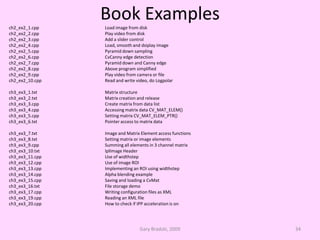
Book ExamplesGary Bradski, 200934ch2_ex2_1.cpp			Load image from disk		ch2_ex2_2.cpp			Play video from diskch2_ex2_3.cpp			Add a slider controlch2_ex2_4.cpp			Load, smooth and dsiplay imagech2_ex2_5.cpp			Pyramid down samplingch2_ex2_6.cpp			CvCanny edge detectionch2_ex2_7.cpp			Pyramid down and Canny edgech2_ex2_8.cpp			Above program simplifiedch2_ex2_9.cpp			Play video from camera or filech2_ex2_10.cpp		Read and write video, do Logpolarch3_ex3_1.txt			Matrix structurech3_ex3_2.txt			Matrix creation and releasech3_ex3_3.cpp			Create matrix from data listch3_ex3_4.cpp			Accessing matrix data CV_MAT_ELEM()ch3_ex3_5.cpp			Setting matrix CV_MAT_ELEM_PTR()ch3_ex3_6.txt			Pointer access to matrix data			ch3_ex3_7.txt			Image and Matrix Element access functionsch3_ex3_8.txt			Setting matrix or image elementsch3_ex3_9.cpp			Summing all elements in 3 channel matrixch3_ex3_10.txt			IplImage Headerch3_ex3_11.cpp		Use of widthstepch3_ex3_12.cpp		Use of image ROIch3_ex3_13.cpp		Implementing an ROI using widthstepch3_ex3_14.cpp		Alpha blending examplech3_ex3_15.cpp		Saving and loading a CvMatch3_ex3_16.txt			File storage democh3_ex3_17.cpp		Writing configuration files as XMLch3_ex3_19.cpp		Reading an XML filech3_ex3_20.cpp		How to check if IPP acceleration is on
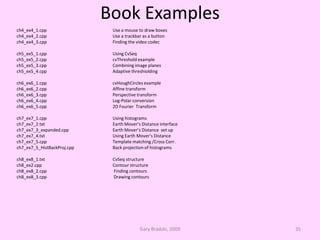
Book ExamplesGary Bradski, 200935ch4_ex4_1.cpp			Use a mouse to draw boxesch4_ex4_2.cpp			Use a trackbar as a buttonch4_ex4_3.cpp			Finding the video codecch5_ex5_1.cpp			Using CvSeq			ch5_ex5_2.cpp			cvThreshold examplech5_ex5_3.cpp			Combining image planesch5_ex5_4.cpp			Adaptive threshioldingch6_ex6_1.cpp			cvHoughCircles examplech6_ex6_2.cpp			Affine transformch6_ex6_3.cpp			Perspective transformch6_ex6_4.cpp			Log-Polar conversionch6_ex6_5.cpp			2D Fourier  Transformch7_ex7_1.cpp			Using histogramsch7_ex7_2.txt			Earth Mover’s Distance interfacech7_ex7_3_expanded.cpp		Earth Mover’s Distance  set upch7_ex7_4.txt			Using Earth Mover’s Distancech7_ex7_5.cpp			Template matching /Cross Corr.ch7_ex7_5_HistBackProj.cpp		Back projection of histogramsch8_ex8_1.txt			CvSeq structurech8_ex2.cpp			Contour structurech8_ex8_2.cpp			 Finding contoursch8_ex8_3.cpp			 Drawing contours
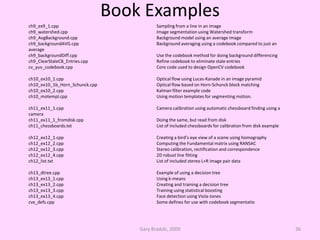
Book ExamplesGary Bradski, 200936ch9_ex9_1.cpp				Sampling from a line in an imagech9_watershed.cpp			Image segmentation using Watershed transformch9_AvgBackground.cpp			Background model using an average imagech9_backgroundAVG.cpp			Background averaging using a codebook compared to just an averagech9_backgroundDiff.cpp			Use the codebook method for doing background differencingch9_ClearStaleCB_Entries.cpp			Refine codebook to eliminate stale entriescv_yuv_codebook.cpp			Core code used to design OpenCV codebookch10_ex10_1.cpp			Optical flow using Lucas-Kanade in an image pyramidch10_ex10_1b_Horn_Schunck.cpp		Optical flow based on Horn-Schunck block matchingch10_ex10_2.cpp			Kalman filter example codech10_motempl.cpp			Using motion templates for segmenting motion.ch11_ex11_1.cpp			Camera calibration using automatic chessboard finding using a camerach11_ex11_1_fromdisk.cpp			Doing the same, but read from diskch11_chessboards.txt			List of included chessboards for calibration from disk examplech12_ex12_1.cpp			Creating a bird’s eye view of a scene using homographych12_ex12_2.cpp			Computing the Fundamental matrix using RANSACch12_ex12_3.cpp			Stereo calibration, rectification and correspondencech12_ex12_4.cpp			2D robust line fittingch12_list.txt				List of included stereo L+R image pair datach13_dtree.cpp				Example of using a decision treech13_ex13_1.cpp			Using k-meansch13_ex13_2.cpp			Creating and training a decision tree		ch13_ex13_3.cpp			Training using statistical boostingch13_ex13_4.cpp			Face detection using Viola-Jonescvx_defs.cpp				Some defines for use with codebook segmentatio
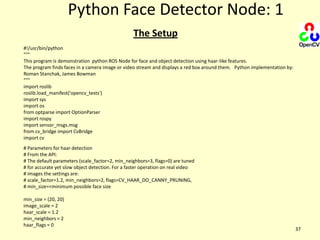
Python Face Detector Node: 137The Setup#!/usr/bin/python"""This program is demonstration  python ROS Node for face and object detection using haar-like features.The program finds faces in a camera image or video stream and displays a red box around them.   Python implementation by: Roman Stanchak, James Bowman"""import roslibroslib.load_manifest('opencv_tests')import sysimport osfrom optparse import OptionParserimport rospyimport sensor_msgs.msgfrom cv_bridge import CvBridgeimport cv# Parameters for haar detection# From the API:# The default parameters (scale_factor=2, min_neighbors=3, flags=0) are tuned # for accurate yet slow object detection. For a faster operation on real video # images the settings are: # scale_factor=1.2, min_neighbors=2, flags=CV_HAAR_DO_CANNY_PRUNING, # min_size=<minimum possible face sizemin_size = (20, 20)image_scale = 2haar_scale = 1.2min_neighbors = 2haar_flags = 0
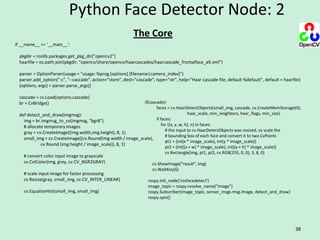
Python Face Detector Node: 238The Coreif __name__ == '__main__':    pkgdir = roslib.packages.get_pkg_dir("opencv2")    haarfile = os.path.join(pkgdir, "opencv/share/opencv/haarcascades/haarcascade_frontalface_alt.xml")    parser = OptionParser(usage = "usage: %prog [options] [filename|camera_index]")    parser.add_option("-c", "--cascade", action="store", dest="cascade", type="str", help="Haar cascade file, default %default", default = haarfile)    (options, args) = parser.parse_args()    cascade = cv.Load(options.cascade)    br = CvBridge()    def detect_and_draw(imgmsg):        img = br.imgmsg_to_cv(imgmsg, "bgr8")        # allocate temporary images        gray = cv.CreateImage((img.width,img.height), 8, 1)        small_img = cv.CreateImage((cv.Round(img.width / image_scale),                       cv.Round (img.height / image_scale)), 8, 1)        # convert color input image to grayscale        cv.CvtColor(img, gray, cv.CV_BGR2GRAY)        # scale input image for faster processing        cv.Resize(gray, small_img, cv.CV_INTER_LINEAR)        cv.EqualizeHist(small_img, small_img) if(cascade):            faces = cv.HaarDetectObjects(small_img, cascade, cv.CreateMemStorage(0),                                         haar_scale, min_neighbors, haar_flags, min_size)            if faces:                for ((x, y, w, h), n) in faces:                    # the input to cv.HaarDetectObjects was resized, so scale the                     # bounding box of each face and convert it to two CvPoints                    pt1 = (int(x * image_scale), int(y * image_scale))                    pt2 = (int((x + w) * image_scale), int((y + h) * image_scale))                    cv.Rectangle(img, pt1, pt2, cv.RGB(255, 0, 0), 3, 8, 0)        cv.ShowImage("result", img)        cv.WaitKey(6)    rospy.init_node('rosfacedetect')    image_topic = rospy.resolve_name("image")    rospy.Subscriber(image_topic, sensor_msgs.msg.Image, detect_and_draw)    rospy.spin()
OutlineOpenCV OverviewCheatsheetSimple ProgramsTourFeatures2DApplicationsGary Bradski, 200939
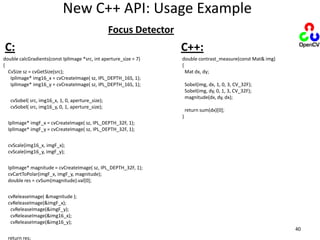
New C++ API: Usage ExampleFocus DetectorC:C++:double calcGradients(const IplImage *src, int aperture_size = 7){    CvSize sz = cvGetSize(src);      IplImage* img16_x = cvCreateImage( sz, IPL_DEPTH_16S, 1);      IplImage* img16_y = cvCreateImage( sz, IPL_DEPTH_16S, 1);      cvSobel( src, img16_x, 1, 0, aperture_size);      cvSobel( src, img16_y, 0, 1, aperture_size);    IplImage* imgF_x = cvCreateImage( sz, IPL_DEPTH_32F, 1);    IplImage* imgF_y = cvCreateImage( sz, IPL_DEPTH_32F, 1);    cvScale(img16_x, imgF_x);    cvScale(img16_y, imgF_y);        IplImage* magnitude = cvCreateImage( sz, IPL_DEPTH_32F, 1);    cvCartToPolar(imgF_x, imgF_y, magnitude);    double res = cvSum(magnitude).val[0];    cvReleaseImage( &magnitude );     cvReleaseImage(&imgF_x);      cvReleaseImage(&imgF_y);      cvReleaseImage(&img16_x);      cvReleaseImage(&img16_y);    return res;}double contrast_measure(const Mat& img){  Mat dx, dy;  Sobel(img, dx, 1, 0, 3, CV_32F);  Sobel(img, dy, 0, 1, 3, CV_32F);  magnitude(dx, dy, dx);  return sum(dx)[0];}40
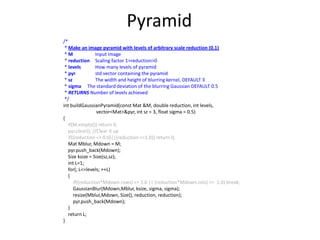
Pyramid/* * Make an image pyramid with levels of arbitrary scale reduction (0,1) * M 	Input image * reduction 	Scaling factor 1>reduction>0 * levels 	How many levels of pyramid * pyr 	std vector containing the pyramid * sz    	The width and height of blurring kernel, DEFAULT 3 * sigma     The standard deviation of the blurring Gaussian DEFAULT 0.5 * RETURNS Number of levels achieved */int buildGaussianPyramid(const Mat &M, double reduction, int levels,                            vector<Mat> &pyr, int sz = 3, float sigma = 0.5){    if(M.empty()) return 0;    pyr.clear(); //Clear it up    if((reduction <= 0.0)||(reduction >=1.0)) return 0;    Mat Mblur, Mdown = M;    pyr.push_back(Mdown);    Size ksize = Size(sz,sz);       int L=1;    for(; L<=levels; ++L)    {        if((reduction*Mdown.rows) <= 1.0 || (reduction*Mdown.cols) <=  1.0) break;        GaussianBlur(Mdown,Mblur, ksize, sigma, sigma);        resize(Mblur,Mdown, Size(), reduction, reduction);        pyr.push_back(Mdown);    }    return L;}
OutlineOpenCV OverviewCheatsheetSimple ProgramsTourFeatures2DApplicationsGary Bradski, 200942
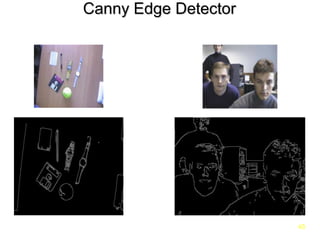
Canny Edge Detector43
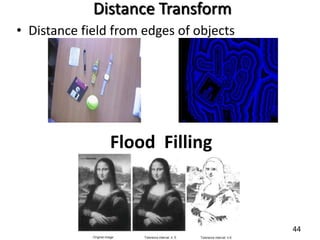
Distance TransformDistance field from edges of objectsFlood  Filling44
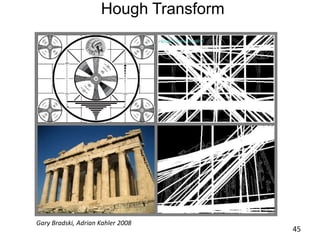
Hough TransformGary Bradski, Adrian Kahler 200845
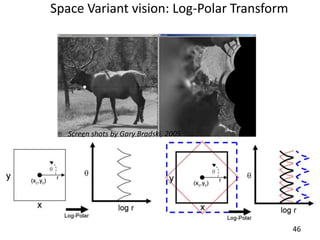
Space Variant vision: Log-Polar TransformScreen shots by Gary Bradski, 200546
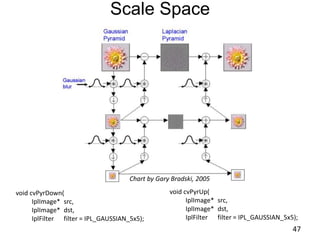
Scale SpaceChart by Gary Bradski, 2005void cvPyrUp(	IplImage*	src, 	IplImage*	dst, 	IplFilter	filter = IPL_GAUSSIAN_5x5);void cvPyrDown(	IplImage*	src, 	IplImage*	dst, 	IplFilter	filter = IPL_GAUSSIAN_5x5);47
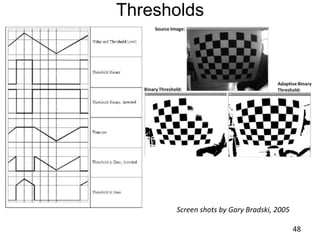
ThresholdsScreen shots by Gary Bradski, 200548
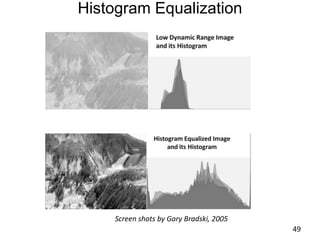
Histogram EqualizationScreen shots by Gary Bradski, 200549
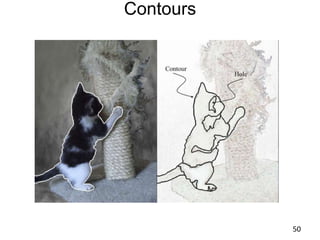
Contours 50
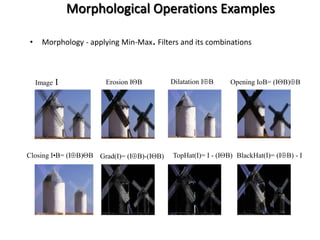
Morphological Operations ExamplesMorphology - applying Min-Max. Filters and its combinationsDilatation IBOpening IoB= (IB)BErosion IBImage IClosing I•B= (IB)BTopHat(I)= I - (IB)BlackHat(I)= (IB) - IGrad(I)= (IB)-(IB)
Image textures Inpainting:Removes damage to images, in this case, it removes the text.
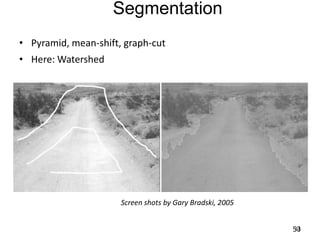
SegmentationPyramid, mean-shift, graph-cut
Here: WatershedScreen shots by Gary Bradski, 20055353
Recent Algorithms:GrabCutGraph Cut based segmentationImages by Gary Bradski, © 201054
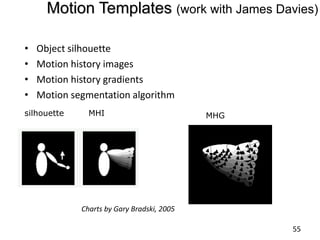
Motion Templates (work with James Davies)‏Object silhouette
Motion history images
Motion history gradients
Motion segmentation algorithmsilhouetteMHIMHGCharts by Gary Bradski, 200555
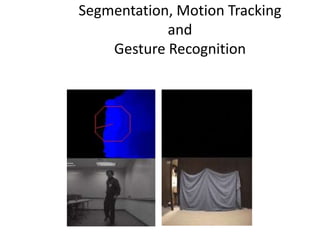
Segmentation, Motion TrackingandGesture RecognitionMotionSegmentationMotionSegmentationPoseRecognitionGestureRecognitionScreen shots by Gary Bradski, 2005
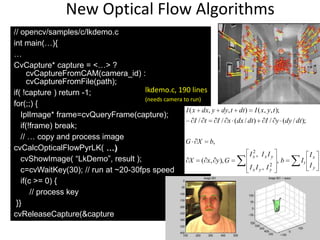
New Optical Flow Algorithms// opencv/samples/c/lkdemo.cint main(…){…CvCapture* capture = <…> ? cvCaptureFromCAM(camera_id) : cvCaptureFromFile(path);if( !capture ) return -1;for(;;) {   IplImage* frame=cvQueryFrame(capture);   if(!frame) break;   // … copy and process imagecvCalcOpticalFlowPyrLK( …)   cvShowImage( “LkDemo”, result );   c=cvWaitKey(30); // run at ~20-30fps speed   if(c >= 0) {       // process key }}cvReleaseCapture(&capture);} lkdemo.c, 190 lines(needs camera to run)
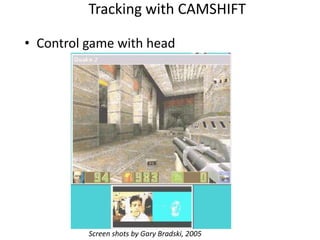
Tracking with CAMSHIFTControl game with headScreen shots by Gary Bradski, 2005
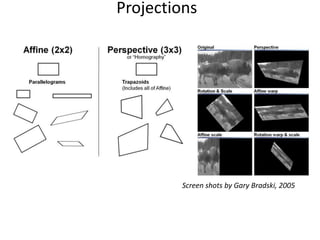
ProjectionsScreen shots by Gary Bradski, 2005
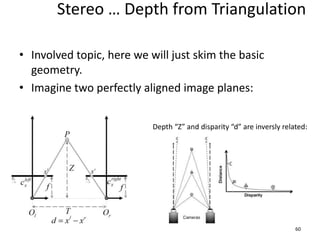
Stereo … Depth from TriangulationInvolved topic, here we will just skim the basic geometry.Imagine two perfectly aligned image planes:Depth “Z” and disparity “d” are inversly related:60
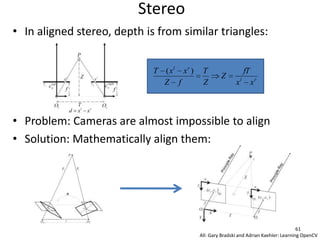
StereoIn aligned stereo, depth is from similar triangles:Problem: Cameras are almost impossible to alignSolution: Mathematically align them:61All: Gary Bradski and Adrian Kaehler: Learning OpenCV
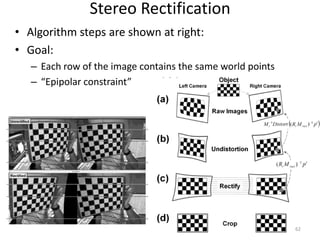
Stereo RectificationAlgorithm steps are shown at right:Goal:Each row of the image contains the same world points“Epipolar constraint”Result: Epipolar alignment of features:62All: Gary Bradski and Adrian Kaehler: Learning OpenCV
OutlineOpenCV OverviewCheatsheetSimple ProgramsTourFeatures2DApplicationsGary Bradski, 200963
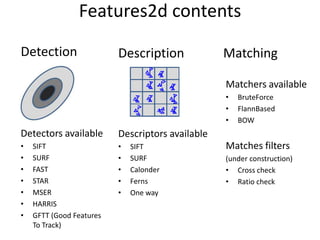
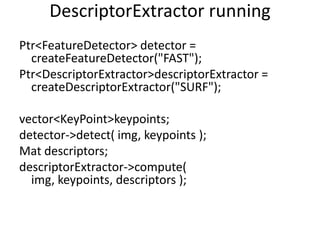
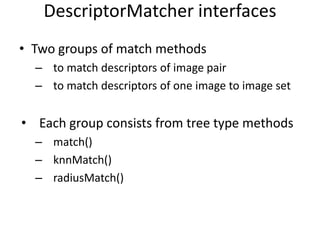
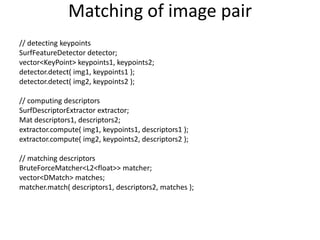
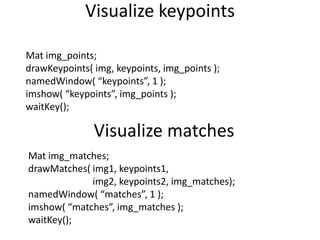
Features2d contentsDetectionDescriptionMatchingMatchers availableBruteForce

20110220 computer vision_eruhimov_lecture02

  • 1.
    OpenCV TutorialItseezVictor EruhimovItseez,CTOhttp://opencv.willowgarage.comwww.willowgarage.comwww.itseez.com
  • 2.
  • 3.
  • 4.
    OpenCV Overview: Robotsupport> 500 algorithmsopencv.willowgarage.comImage PyramidsGeneral Image Processing FunctionsGeometric descriptorsCamera calibration,Stereo, 3DSegmentationFeaturesUtilities and Data StructuresTransformsTrackingMachine Learning:Detection,
  • 5.
    RecognitionFittingMatrixMath4Gary Bradski
  • 6.
    Machine Learning Library(MLL)‏AACBAABBCBCCAACACBCBABBCAAACCBABBCCBBCCBCABBCCBBCLASSIFICATION / REGRESSION(new) Fast Approximate NN (FLANN)(new) Extremely Random TreesCARTNaïve BayesMLP (Back propagation)‏Statistical Boosting, 4 flavorsRandom ForestsSVMFace Detector(Histogram matching)‏(Correlation)‏CLUSTERINGK-MeansEM(Mahalanobis distance)‏TUNING/VALIDATIONCross validationBootstrappingVariable importanceSampling methods55http://opencv.willowgarage.com
  • 7.
  • 8.
    Accelerate the fieldby lowering the bar to computer vision
  • 9.
    Find compelling usesfor the increasing MIPS out in the market
  • 10.
  • 11.
  • 12.
    Climbed in 1999to average 7 first couple of years
  • 13.
    Starting 2003 supportdeclined between zero and one with exception of transferring the machine learning from manufacturing work I led (equivalent of 3 people).
  • 14.
    Support tozero the couple of years before Willow.
  • 15.
    5 people overthe last yearWillowBeta 1 Release, support for LinuxAlpha Release at CVPR’00Beta 2 ReleaseBeta 3 ReleaseBeta 4 ReleaseBeta 5 ReleaseOpenCV StartedRelease 1.0Release 1.1Release 2.01019992000200120032004200520062007200820092010200250Gary Bradski66
  • 16.
    New Directory StructureRe-Organizedin terms of processing pipelinesCode site: https://code.ros.org/gf/project/opencv/CoreCalibration, features, I/O, img processingMachine Learning, Obj. RecPython~2.5M downloads
  • 17.
    OpenCV Conceptual StructureUserContribModulesOtherLanguagesObjectDetectionFeatures2dCalib3dStereoVOSLAM(TBD)Stitching(TBD)SSETBBGPUMPUJava (TBD)PythonMachine learningimgprocC++COREHighGUICOperating system
  • 18.
    OpenCV Tends TowardsReal Timehttp://opencv.willowgarage.com
  • 19.
    Software EngineeringWorks on:Linux, Windows, Mac OSLanguages: C++, Python, COnline documentation:Online reference manuals: C++, C and Python. We’ve been expanding Unit test codeWill soon standardize on cxx or Google’s test system.TEST COVERAGE:
  • 20.
  • 21.
    Free for commercialor research use
  • 22.
  • 23.
    Does not forceyour code to be open
  • 24.
    You need notcontribute back
  • 25.
    We hope youwill contribute back, recent contribution, C++ wrapper class used for Google Street Maps** Thanks to Daniel FilipGary Bradski (c) 20081111Gary Bradski, 2009
  • 26.
    What’s added inDecember 2010OpenCV 2.2?Detector/Descriptor pipeline (Features2D)Many supporting detectors and descriptor featuresEasy interface to Pascal VOCBOW and Latent SVM classification enginesExperimental User ContribFocus detector?Visualization (“HighGUI”) will be based on QtOfficial support of Android OSUpdated FLANN libraryLimited Cuda support (stereo)
  • 27.
    What’s in Progress?GPUsupport throughout the libraryMore functionality in features2dBetter pose estimation algorithmsePnPStereo pose estimationCircles pattern detectorBetter support of Android Support for google test
  • 28.
    Where is OpenCVUsed?Google Maps, Google street view, Google Earth, BooksAcademic and Industry ResearchSafety monitoring (Dam sites, mines, swimming pools)Security systemsImage retrievalVideo searchStructure from motion in moviesMachine vision factory production inspection systemsRobotics Well over 2M downloads2M downloadsScreen shots by Gary Bradski, 2005
  • 29.
    Useful OpenCV Links1515OpenCVWiki:http://opencv.willowgarage.com/wikiOpenCV Code Repository:svn co https://code.ros.org/svn/opencv/trunk/opencvNew Book on OpenCV:http://oreilly.com/catalog/9780596516130/Or, direct from Amazon:http://www.amazon.com/Learning-OpenCV-Computer-Vision-Library/dp/0596516134Code examples from the book:http://examples.oreilly.com/9780596516130/Documentationhttp://opencv.willowgarage.com/documentation/index.htmlUser Group (39717 members):http://tech.groups.yahoo.com/group/OpenCV/joinGary Bradski, 2009
  • 30.
  • 31.
  • 32.
    New “Image”: cv::MatMatdoes reference counting, so it doesthe right thing when it goes out of scopeyou can also easily make stl vectorts or maps out of Mat.
  • 33.
    Mat are SimpleMatM(480,640,CV_8UC3); // Make a 640x480 imgRect roi(100,200, 20,40); // Make a region of intMat subM = M(roi); // Take a sub region, // no copy is doneMat_<Vec3b>::iterator it= subM.begin<Vec3b>(), itEnd = subM.end<Vec3b>();//0 out places in subM where blue > redfor(; it != itEnd; ++it) if( (*it)[0] > (*it)[2]) (*it)[0] = 0;
  • 34.
  • 35.
  • 36.
  • 37.
  • 38.
  • 39.
  • 40.
  • 41.
  • 42.
  • 43.
  • 44.
  • 45.
    samples/c31In ...\opencv\samples\cbgfg_codebook.cpp - Useof a image value codebook for background detection for collecting objectsbgfg_segm.cpp - Use of a background learning engineblobtrack.cpp - Engine for blob tracking in imagescalibration.cpp - Camera Calibrationcamshiftdemo.c - Use of meanshift in simple color trackingcontours.c - Demonstrates how to compute and use object contoursconvert_cascade.c - Change the window size in a recognition cascadeconvexhull.c - Find the convex hull of an objectdelaunay.c - Triangulate a 2D point clouddemhist.c - Show how to use histograms for recognitiondft.c - Discrete fourier transformdistrans.c - distance map from edges in an imagedrawing.c - Various drawing functionsedge.c- Edge detectionfacedetect.c - Face detection by classifier cascadeffilldemo.c - Flood filling demofind_obj.cpp - Demo use of SURF featuresfitellipse.c - Robust elipse fittinghoughlines.c - Line detectionimage.cpp - Shows use of new image class, CvImage();inpaint.cpp - Texture infill to repair imagerykalman.c - Kalman filter for trackignkmeans.c - K-Meanslaplace.c - Convolve image with laplacian. letter_recog.cpp - Example of using machine learning Boosting, Backpropagation (MLP) and Random forestslkdemo.c - Lukas-Canada optical flowminarea.c - For a cloud of points in 2D, find min bounding box and circle. Shows use of Cv_SEQmorphology.c - Demonstrates Erode, Dilate, Open, Closemotempl.c - Demonstrates motion templates (orthogonal optical flow given silhouettes)mushroom.cpp - Demonstrates use of decision trees (CART) for recognitionpyramid_segmentation.c - Color segmentation in pyramidsquares.c - Uses contour processing to find squares in an imagestereo_calib.cpp - Stereo calibration, recognition and disparity map computationwatershed.cpp - Watershed transform demo.
  • 46.
  • 47.
  • 48.
    Book ExamplesGary Bradski,200934ch2_ex2_1.cpp Load image from disk ch2_ex2_2.cpp Play video from diskch2_ex2_3.cpp Add a slider controlch2_ex2_4.cpp Load, smooth and dsiplay imagech2_ex2_5.cpp Pyramid down samplingch2_ex2_6.cpp CvCanny edge detectionch2_ex2_7.cpp Pyramid down and Canny edgech2_ex2_8.cpp Above program simplifiedch2_ex2_9.cpp Play video from camera or filech2_ex2_10.cpp Read and write video, do Logpolarch3_ex3_1.txt Matrix structurech3_ex3_2.txt Matrix creation and releasech3_ex3_3.cpp Create matrix from data listch3_ex3_4.cpp Accessing matrix data CV_MAT_ELEM()ch3_ex3_5.cpp Setting matrix CV_MAT_ELEM_PTR()ch3_ex3_6.txt Pointer access to matrix data ch3_ex3_7.txt Image and Matrix Element access functionsch3_ex3_8.txt Setting matrix or image elementsch3_ex3_9.cpp Summing all elements in 3 channel matrixch3_ex3_10.txt IplImage Headerch3_ex3_11.cpp Use of widthstepch3_ex3_12.cpp Use of image ROIch3_ex3_13.cpp Implementing an ROI using widthstepch3_ex3_14.cpp Alpha blending examplech3_ex3_15.cpp Saving and loading a CvMatch3_ex3_16.txt File storage democh3_ex3_17.cpp Writing configuration files as XMLch3_ex3_19.cpp Reading an XML filech3_ex3_20.cpp How to check if IPP acceleration is on
  • 49.
    Book ExamplesGary Bradski,200935ch4_ex4_1.cpp Use a mouse to draw boxesch4_ex4_2.cpp Use a trackbar as a buttonch4_ex4_3.cpp Finding the video codecch5_ex5_1.cpp Using CvSeq ch5_ex5_2.cpp cvThreshold examplech5_ex5_3.cpp Combining image planesch5_ex5_4.cpp Adaptive threshioldingch6_ex6_1.cpp cvHoughCircles examplech6_ex6_2.cpp Affine transformch6_ex6_3.cpp Perspective transformch6_ex6_4.cpp Log-Polar conversionch6_ex6_5.cpp 2D Fourier Transformch7_ex7_1.cpp Using histogramsch7_ex7_2.txt Earth Mover’s Distance interfacech7_ex7_3_expanded.cpp Earth Mover’s Distance set upch7_ex7_4.txt Using Earth Mover’s Distancech7_ex7_5.cpp Template matching /Cross Corr.ch7_ex7_5_HistBackProj.cpp Back projection of histogramsch8_ex8_1.txt CvSeq structurech8_ex2.cpp Contour structurech8_ex8_2.cpp Finding contoursch8_ex8_3.cpp Drawing contours
  • 50.
    Book ExamplesGary Bradski,200936ch9_ex9_1.cpp Sampling from a line in an imagech9_watershed.cpp Image segmentation using Watershed transformch9_AvgBackground.cpp Background model using an average imagech9_backgroundAVG.cpp Background averaging using a codebook compared to just an averagech9_backgroundDiff.cpp Use the codebook method for doing background differencingch9_ClearStaleCB_Entries.cpp Refine codebook to eliminate stale entriescv_yuv_codebook.cpp Core code used to design OpenCV codebookch10_ex10_1.cpp Optical flow using Lucas-Kanade in an image pyramidch10_ex10_1b_Horn_Schunck.cpp Optical flow based on Horn-Schunck block matchingch10_ex10_2.cpp Kalman filter example codech10_motempl.cpp Using motion templates for segmenting motion.ch11_ex11_1.cpp Camera calibration using automatic chessboard finding using a camerach11_ex11_1_fromdisk.cpp Doing the same, but read from diskch11_chessboards.txt List of included chessboards for calibration from disk examplech12_ex12_1.cpp Creating a bird’s eye view of a scene using homographych12_ex12_2.cpp Computing the Fundamental matrix using RANSACch12_ex12_3.cpp Stereo calibration, rectification and correspondencech12_ex12_4.cpp 2D robust line fittingch12_list.txt List of included stereo L+R image pair datach13_dtree.cpp Example of using a decision treech13_ex13_1.cpp Using k-meansch13_ex13_2.cpp Creating and training a decision tree ch13_ex13_3.cpp Training using statistical boostingch13_ex13_4.cpp Face detection using Viola-Jonescvx_defs.cpp Some defines for use with codebook segmentatio
  • 51.
    Python Face DetectorNode: 137The Setup#!/usr/bin/python"""This program is demonstration python ROS Node for face and object detection using haar-like features.The program finds faces in a camera image or video stream and displays a red box around them. Python implementation by: Roman Stanchak, James Bowman"""import roslibroslib.load_manifest('opencv_tests')import sysimport osfrom optparse import OptionParserimport rospyimport sensor_msgs.msgfrom cv_bridge import CvBridgeimport cv# Parameters for haar detection# From the API:# The default parameters (scale_factor=2, min_neighbors=3, flags=0) are tuned # for accurate yet slow object detection. For a faster operation on real video # images the settings are: # scale_factor=1.2, min_neighbors=2, flags=CV_HAAR_DO_CANNY_PRUNING, # min_size=<minimum possible face sizemin_size = (20, 20)image_scale = 2haar_scale = 1.2min_neighbors = 2haar_flags = 0
  • 52.
    Python Face DetectorNode: 238The Coreif __name__ == '__main__': pkgdir = roslib.packages.get_pkg_dir("opencv2") haarfile = os.path.join(pkgdir, "opencv/share/opencv/haarcascades/haarcascade_frontalface_alt.xml") parser = OptionParser(usage = "usage: %prog [options] [filename|camera_index]") parser.add_option("-c", "--cascade", action="store", dest="cascade", type="str", help="Haar cascade file, default %default", default = haarfile) (options, args) = parser.parse_args() cascade = cv.Load(options.cascade) br = CvBridge() def detect_and_draw(imgmsg): img = br.imgmsg_to_cv(imgmsg, "bgr8") # allocate temporary images gray = cv.CreateImage((img.width,img.height), 8, 1) small_img = cv.CreateImage((cv.Round(img.width / image_scale), cv.Round (img.height / image_scale)), 8, 1) # convert color input image to grayscale cv.CvtColor(img, gray, cv.CV_BGR2GRAY) # scale input image for faster processing cv.Resize(gray, small_img, cv.CV_INTER_LINEAR) cv.EqualizeHist(small_img, small_img) if(cascade): faces = cv.HaarDetectObjects(small_img, cascade, cv.CreateMemStorage(0), haar_scale, min_neighbors, haar_flags, min_size) if faces: for ((x, y, w, h), n) in faces: # the input to cv.HaarDetectObjects was resized, so scale the # bounding box of each face and convert it to two CvPoints pt1 = (int(x * image_scale), int(y * image_scale)) pt2 = (int((x + w) * image_scale), int((y + h) * image_scale)) cv.Rectangle(img, pt1, pt2, cv.RGB(255, 0, 0), 3, 8, 0) cv.ShowImage("result", img) cv.WaitKey(6) rospy.init_node('rosfacedetect') image_topic = rospy.resolve_name("image") rospy.Subscriber(image_topic, sensor_msgs.msg.Image, detect_and_draw) rospy.spin()
  • 53.
  • 54.
    New C++ API:Usage ExampleFocus DetectorC:C++:double calcGradients(const IplImage *src, int aperture_size = 7){ CvSize sz = cvGetSize(src); IplImage* img16_x = cvCreateImage( sz, IPL_DEPTH_16S, 1); IplImage* img16_y = cvCreateImage( sz, IPL_DEPTH_16S, 1); cvSobel( src, img16_x, 1, 0, aperture_size); cvSobel( src, img16_y, 0, 1, aperture_size); IplImage* imgF_x = cvCreateImage( sz, IPL_DEPTH_32F, 1); IplImage* imgF_y = cvCreateImage( sz, IPL_DEPTH_32F, 1); cvScale(img16_x, imgF_x); cvScale(img16_y, imgF_y); IplImage* magnitude = cvCreateImage( sz, IPL_DEPTH_32F, 1); cvCartToPolar(imgF_x, imgF_y, magnitude); double res = cvSum(magnitude).val[0]; cvReleaseImage( &magnitude ); cvReleaseImage(&imgF_x); cvReleaseImage(&imgF_y); cvReleaseImage(&img16_x); cvReleaseImage(&img16_y); return res;}double contrast_measure(const Mat& img){ Mat dx, dy; Sobel(img, dx, 1, 0, 3, CV_32F); Sobel(img, dy, 0, 1, 3, CV_32F); magnitude(dx, dy, dx); return sum(dx)[0];}40
  • 55.
    Pyramid/* * Makean image pyramid with levels of arbitrary scale reduction (0,1) * M Input image * reduction Scaling factor 1>reduction>0 * levels How many levels of pyramid * pyr std vector containing the pyramid * sz The width and height of blurring kernel, DEFAULT 3 * sigma The standard deviation of the blurring Gaussian DEFAULT 0.5 * RETURNS Number of levels achieved */int buildGaussianPyramid(const Mat &M, double reduction, int levels, vector<Mat> &pyr, int sz = 3, float sigma = 0.5){ if(M.empty()) return 0; pyr.clear(); //Clear it up if((reduction <= 0.0)||(reduction >=1.0)) return 0; Mat Mblur, Mdown = M; pyr.push_back(Mdown); Size ksize = Size(sz,sz); int L=1; for(; L<=levels; ++L) { if((reduction*Mdown.rows) <= 1.0 || (reduction*Mdown.cols) <= 1.0) break; GaussianBlur(Mdown,Mblur, ksize, sigma, sigma); resize(Mblur,Mdown, Size(), reduction, reduction); pyr.push_back(Mdown); } return L;}
  • 56.
  • 57.
  • 58.
    Distance TransformDistance fieldfrom edges of objectsFlood Filling44
  • 59.
    Hough TransformGary Bradski,Adrian Kahler 200845
  • 60.
    Space Variant vision:Log-Polar TransformScreen shots by Gary Bradski, 200546
  • 61.
    Scale SpaceChart byGary Bradski, 2005void cvPyrUp( IplImage* src, IplImage* dst, IplFilter filter = IPL_GAUSSIAN_5x5);void cvPyrDown( IplImage* src, IplImage* dst, IplFilter filter = IPL_GAUSSIAN_5x5);47
  • 62.
    ThresholdsScreen shots byGary Bradski, 200548
  • 63.
    Histogram EqualizationScreen shotsby Gary Bradski, 200549
  • 64.
  • 65.
    Morphological Operations ExamplesMorphology- applying Min-Max. Filters and its combinationsDilatation IBOpening IoB= (IB)BErosion IBImage IClosing I•B= (IB)BTopHat(I)= I - (IB)BlackHat(I)= (IB) - IGrad(I)= (IB)-(IB)
  • 66.
    Image textures Inpainting:Removesdamage to images, in this case, it removes the text.
  • 67.
  • 68.
    Here: WatershedScreen shotsby Gary Bradski, 20055353
  • 69.
    Recent Algorithms:GrabCutGraph Cutbased segmentationImages by Gary Bradski, © 201054
  • 70.
    Motion Templates (workwith James Davies)‏Object silhouette
  • 71.
  • 72.
  • 73.
  • 74.
    Segmentation, Motion TrackingandGestureRecognitionMotionSegmentationMotionSegmentationPoseRecognitionGestureRecognitionScreen shots by Gary Bradski, 2005
  • 75.
    New Optical FlowAlgorithms// opencv/samples/c/lkdemo.cint main(…){…CvCapture* capture = <…> ? cvCaptureFromCAM(camera_id) : cvCaptureFromFile(path);if( !capture ) return -1;for(;;) { IplImage* frame=cvQueryFrame(capture); if(!frame) break; // … copy and process imagecvCalcOpticalFlowPyrLK( …) cvShowImage( “LkDemo”, result ); c=cvWaitKey(30); // run at ~20-30fps speed if(c >= 0) { // process key }}cvReleaseCapture(&capture);} lkdemo.c, 190 lines(needs camera to run)
  • 76.
    Tracking with CAMSHIFTControlgame with headScreen shots by Gary Bradski, 2005
  • 77.
    ProjectionsScreen shots byGary Bradski, 2005
  • 78.
    Stereo … Depthfrom TriangulationInvolved topic, here we will just skim the basic geometry.Imagine two perfectly aligned image planes:Depth “Z” and disparity “d” are inversly related:60
  • 79.
    StereoIn aligned stereo,depth is from similar triangles:Problem: Cameras are almost impossible to alignSolution: Mathematically align them:61All: Gary Bradski and Adrian Kaehler: Learning OpenCV
  • 80.
    Stereo RectificationAlgorithm stepsare shown at right:Goal:Each row of the image contains the same world points“Epipolar constraint”Result: Epipolar alignment of features:62All: Gary Bradski and Adrian Kaehler: Learning OpenCV
  • 81.
  • 82.