
Doubling Investment in Infrastructure
 to Rs. 41 lakh cr. ($1 tr.) for India’s
         12th Five-Year Plan
                 (2012-17)


               - Gajendra Haldea

                 March 4, 2011
                  New Delhi
Infrastructure Deficit
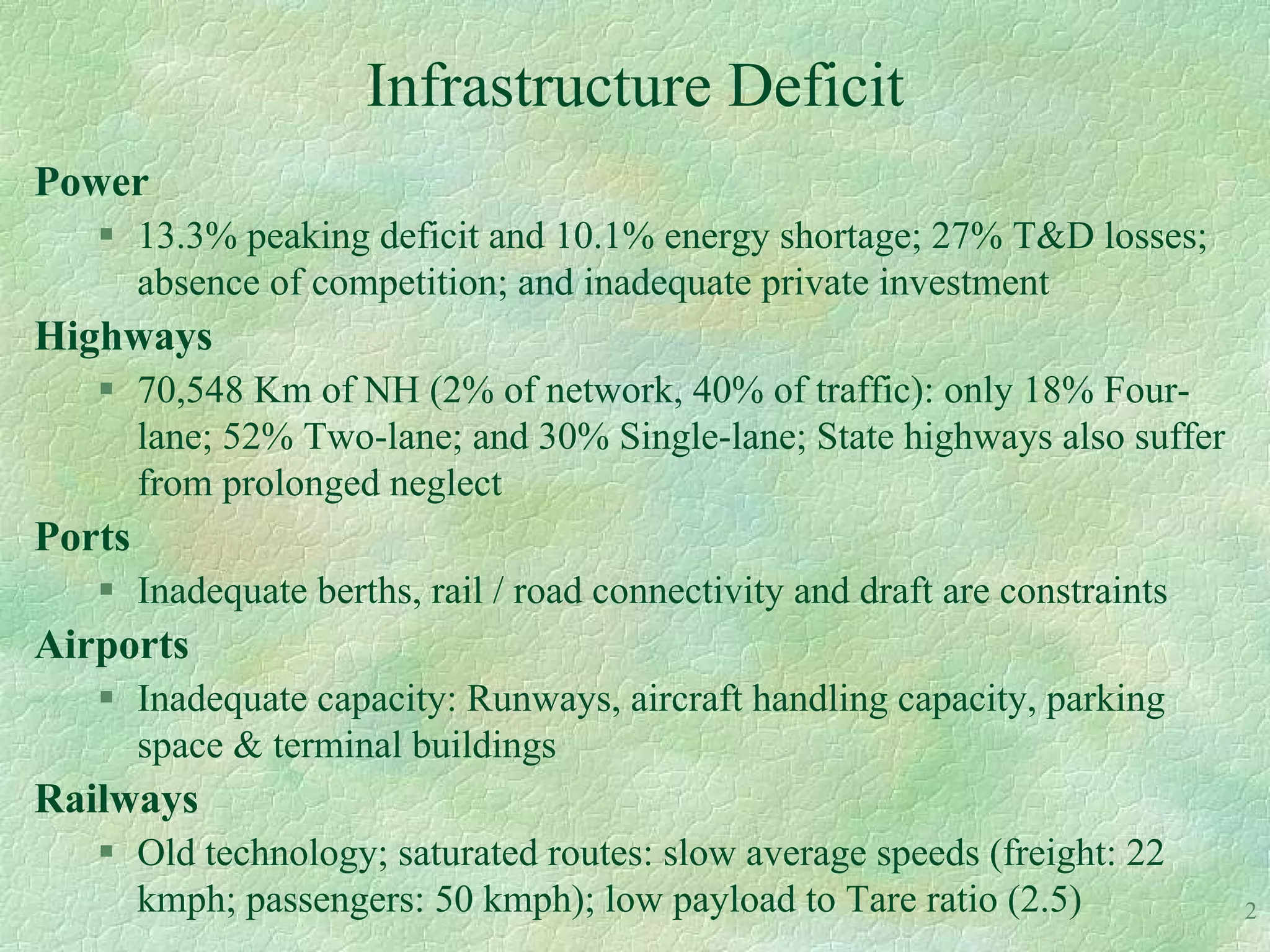
Power
    13.3% peaking deficit and 10.1% energy shortage; 27% T&D losses;
     absence of competition; and inadequate private investment
Highways
    70,548 Km of NH (2% of network, 40% of traffic): only 18% Four-
     lane; 52% Two-lane; and 30% Single-lane; State highways also suffer
     from prolonged neglect
Ports
    Inadequate berths, rail / road connectivity and draft are constraints
Airports
    Inadequate capacity: Runways, aircraft handling capacity, parking
     space & terminal buildings
Railways
    Old technology; saturated routes: slow average speeds (freight: 22
     kmph; passengers: 50 kmph); low payload to Tare ratio (2.5)             2
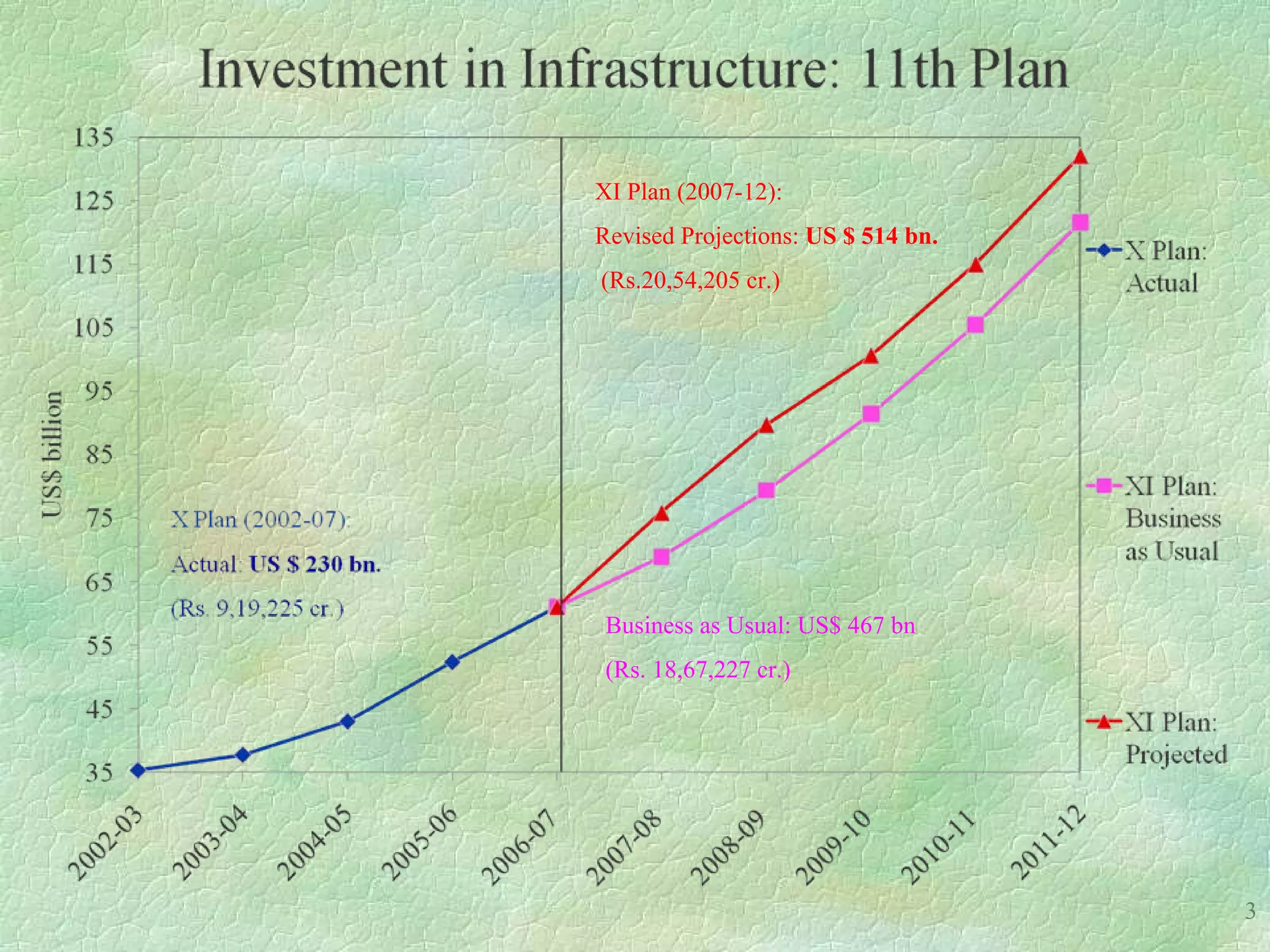
XI Plan (2007-12):
Revised Projections: US $ 514 bn.
(Rs.20,54,205 cr.)


 Business as Usual: US$ 467 bn
 (Rs. 18,67,227 cr.)


                                    3
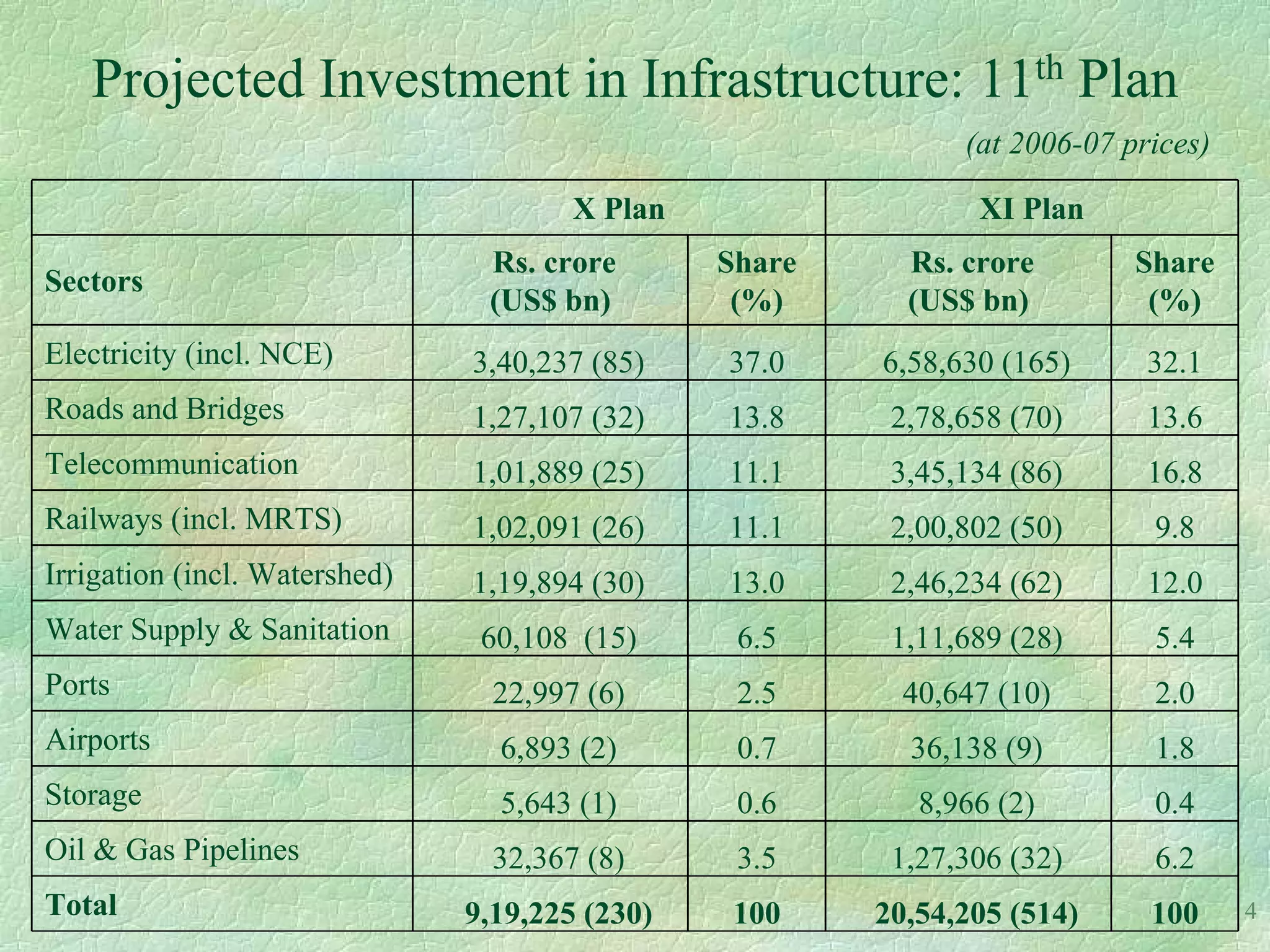
Projected Investment in Infrastructure: 11th Plan
                                                              (at 2006-07 prices)

                                       X Plan                  XI Plan
                                Rs. crore       Share     Rs. crore        Share
Sectors
                                (US$ bn)         (%)      (US$ bn)          (%)
Electricity (incl. NCE)        3,40,237 (85)    37.0    6,58,630 (165)      32.1
Roads and Bridges              1,27,107 (32)    13.8     2,78,658 (70)      13.6
Telecommunication              1,01,889 (25)    11.1     3,45,134 (86)      16.8
Railways (incl. MRTS)          1,02,091 (26)    11.1     2,00,802 (50)      9.8
Irrigation (incl. Watershed)   1,19,894 (30)    13.0     2,46,234 (62)      12.0
Water Supply & Sanitation       60,108 (15)      6.5     1,11,689 (28)      5.4
Ports                            22,997 (6)      2.5      40,647 (10)       2.0
Airports                         6,893 (2)       0.7      36,138 (9)        1.8
Storage                          5,643 (1)       0.6       8,966 (2)        0.4
Oil & Gas Pipelines              32,367 (8)      3.5     1,27,306 (32)      6.2
Total                          9,19,225 (230)    100    20,54,205 (514)     100     4
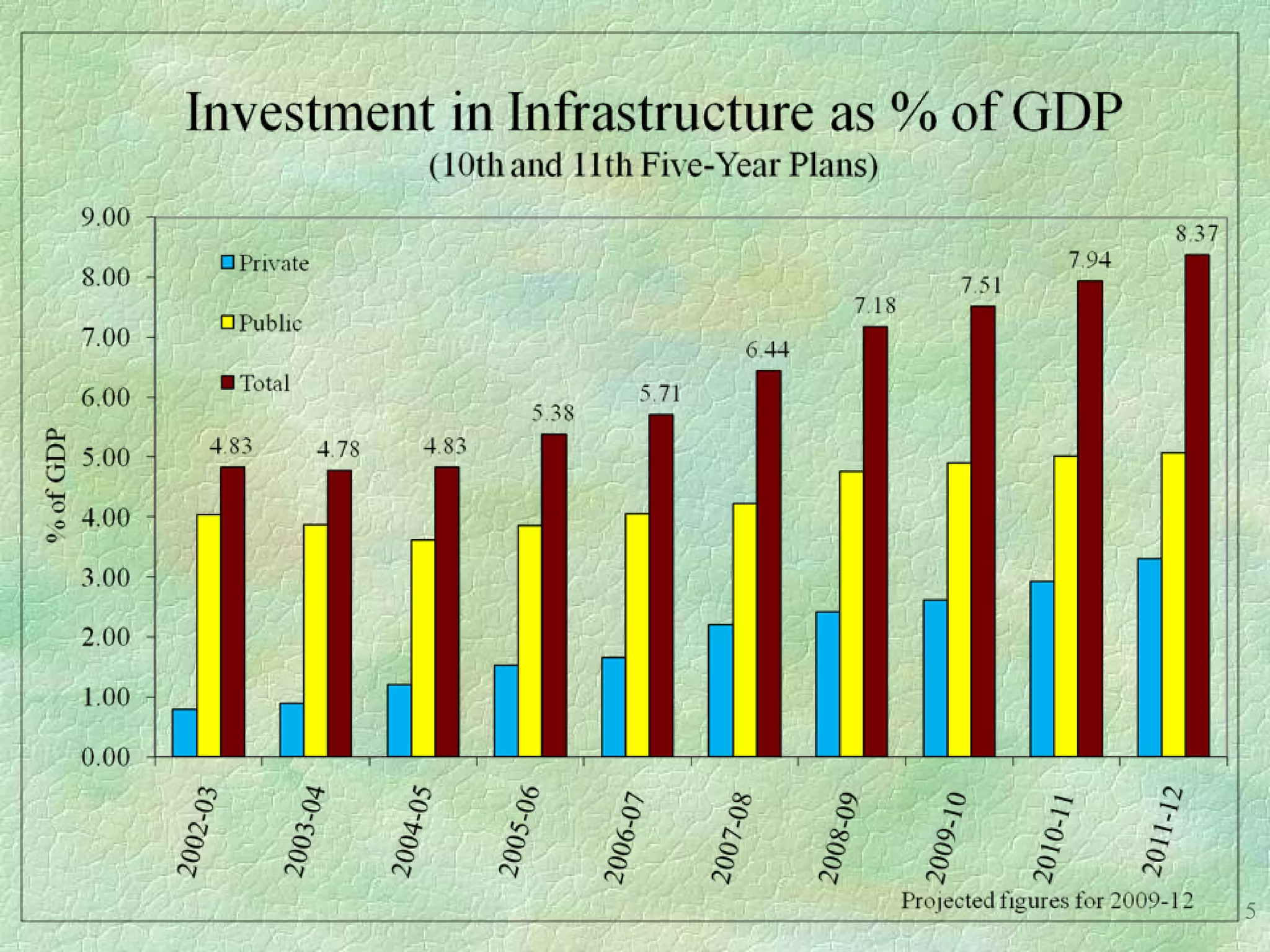
5
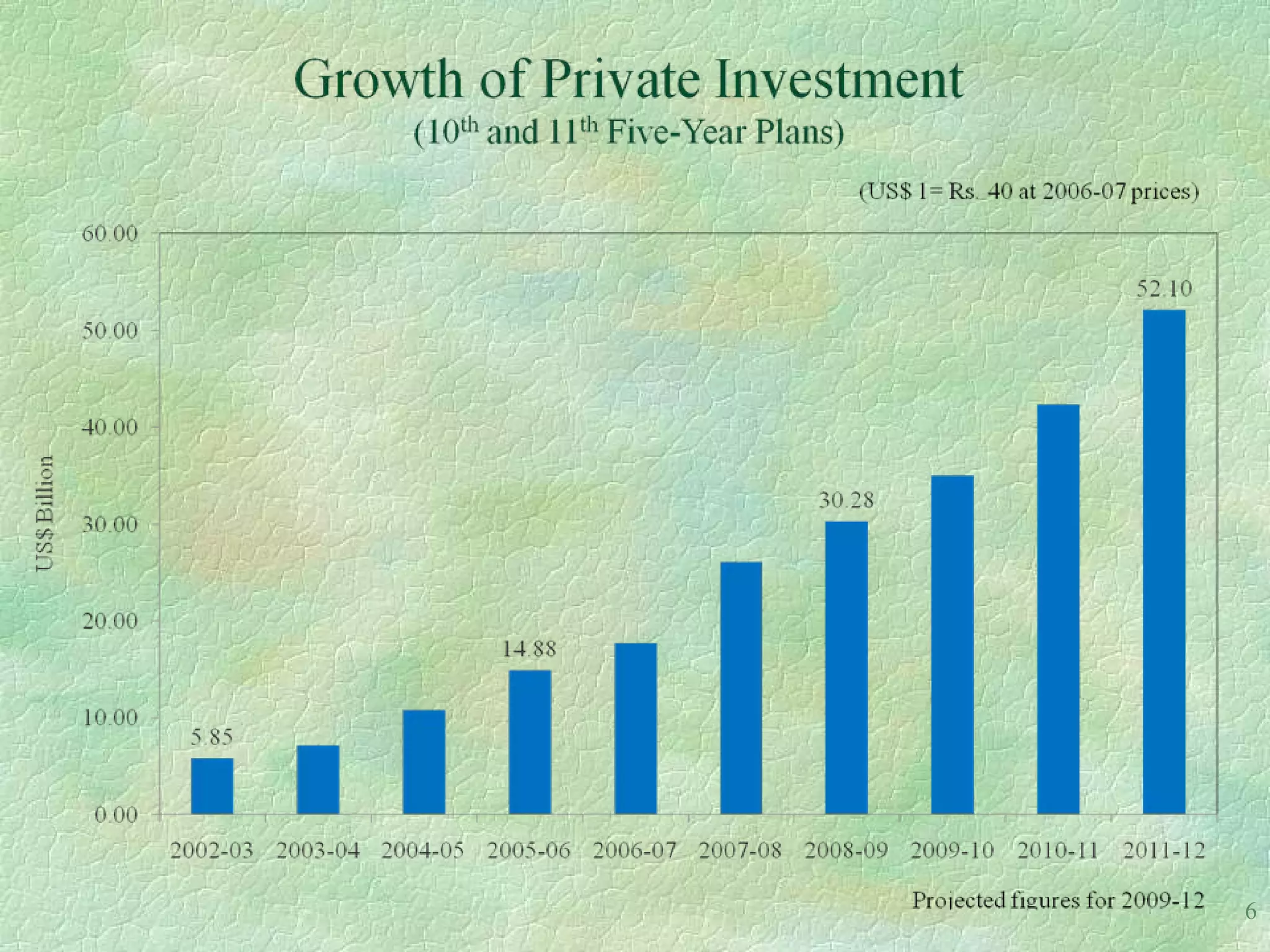
6
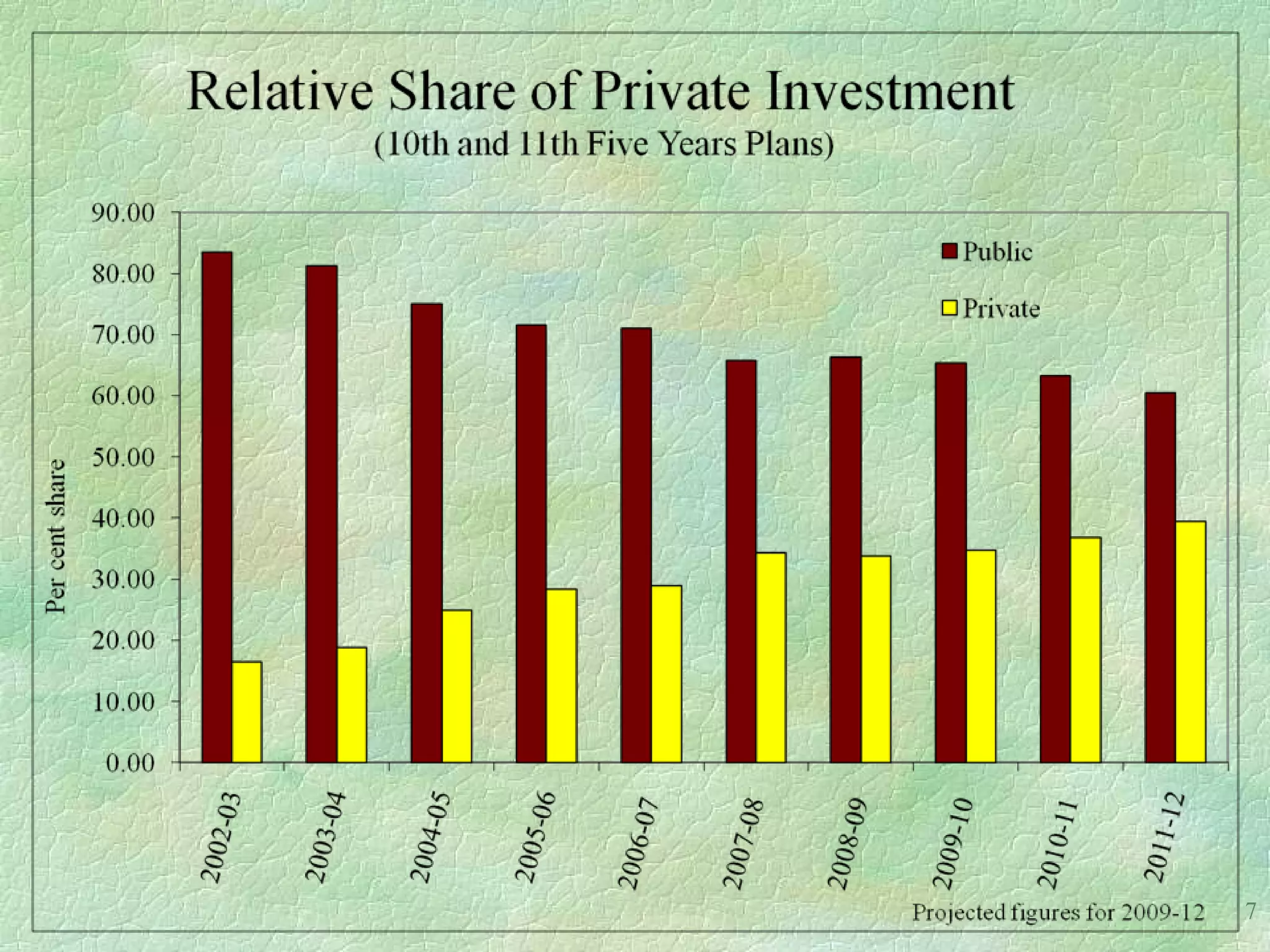
7
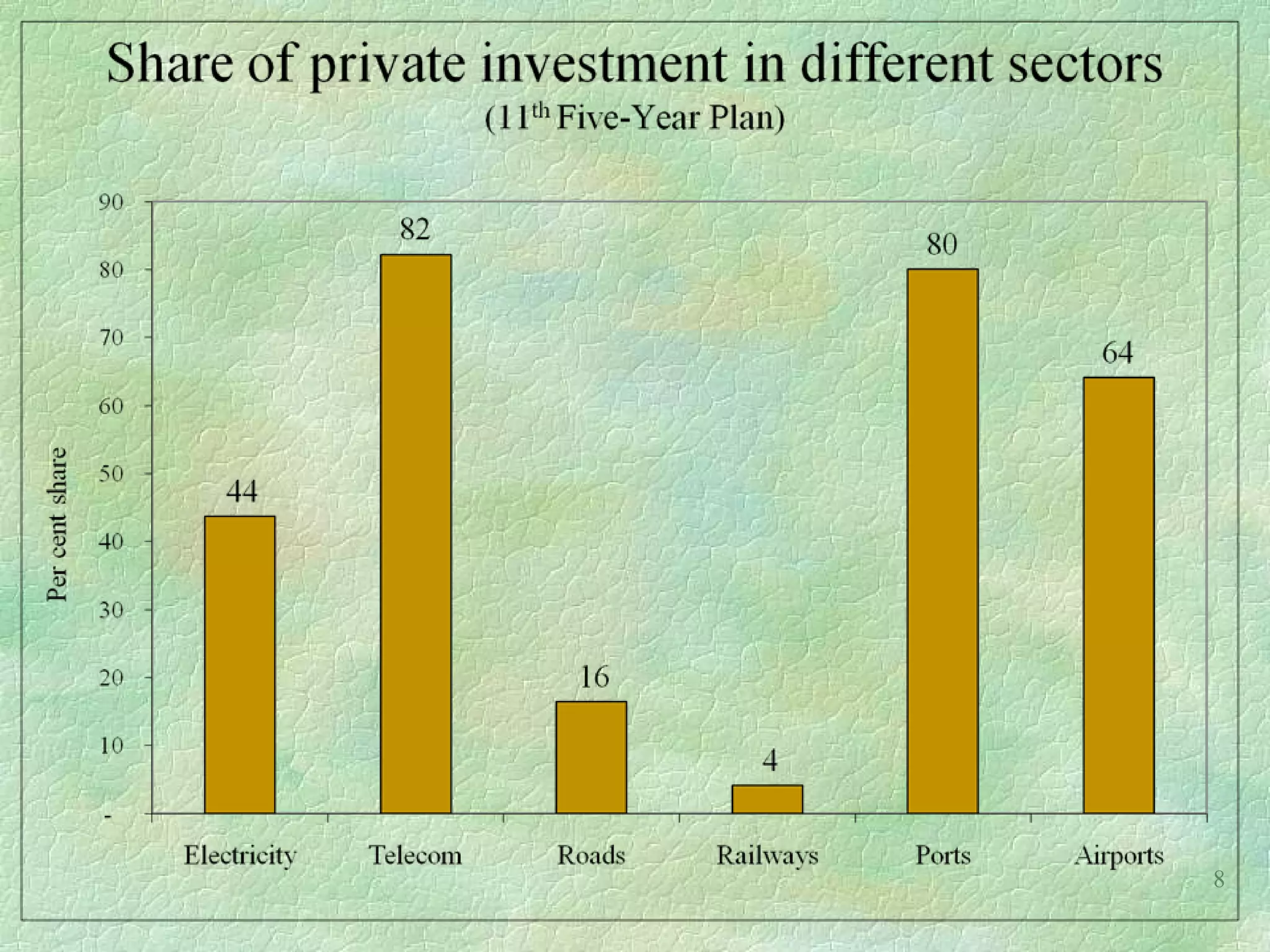
8
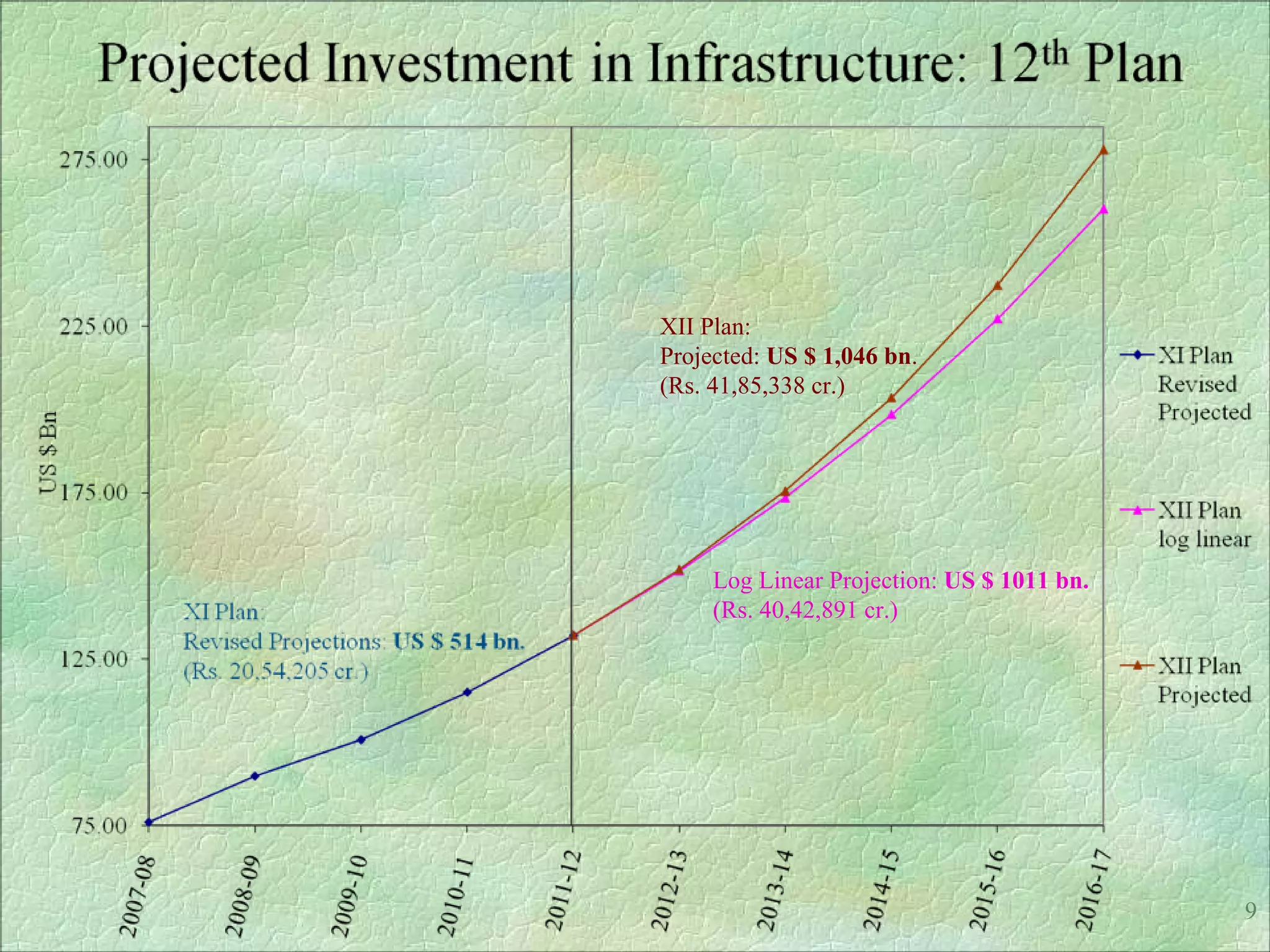
XII Plan:
Projected: US $ 1,046 bn.
(Rs. 41,85,338 cr.)


     Log Linear Projection: US $ 1011 bn.
     (Rs. 40,42,891 cr.)


                                            9
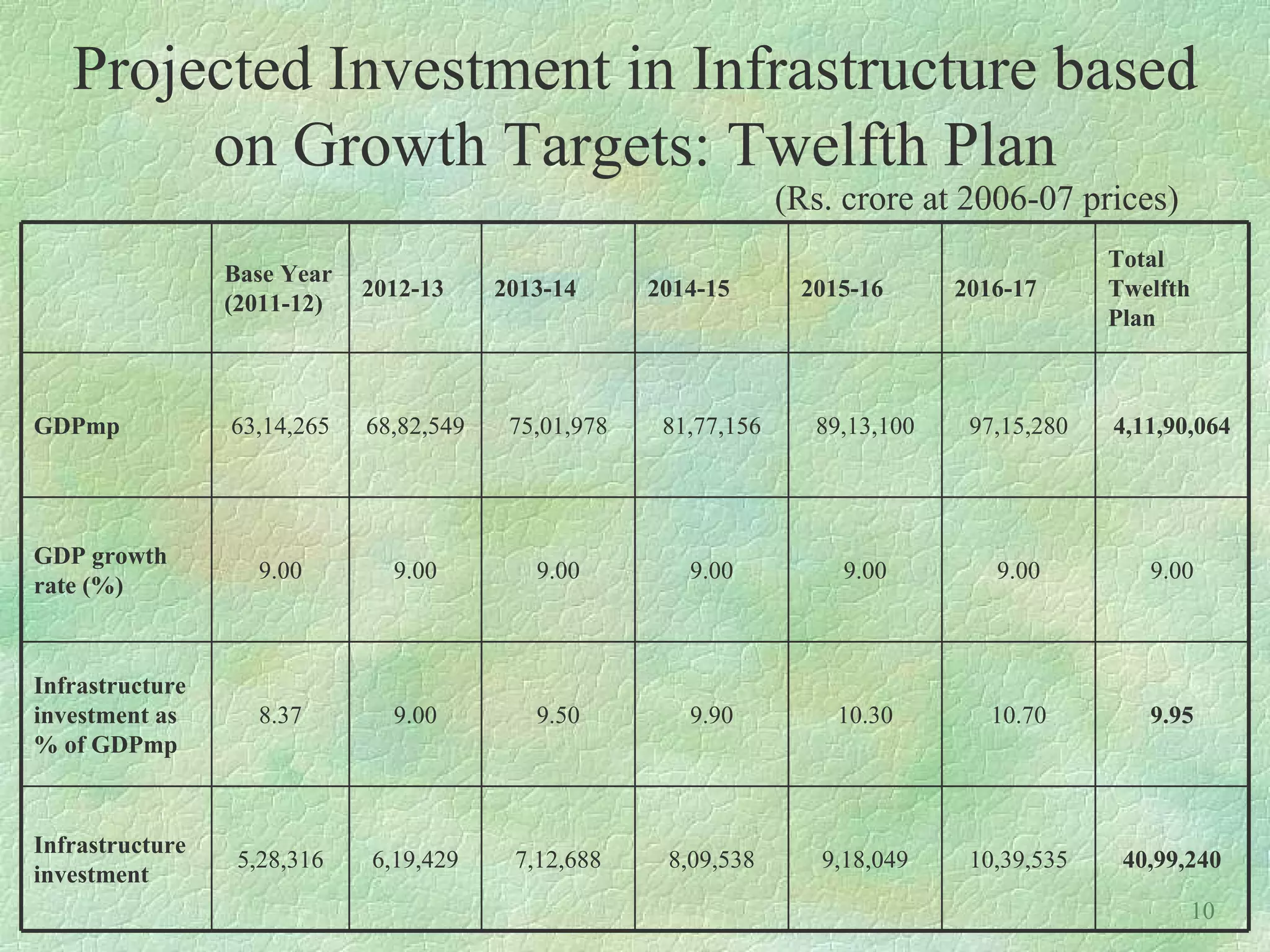
Projected Investment in Infrastructure based
        on Growth Targets: Twelfth Plan
                                                                   (Rs. crore at 2006-07 prices)
                                                                                              Total
                 Base Year
                             2012-13     2013-14      2014-15       2015-16      2016-17      Twelfth
                 (2011-12)
                                                                                              Plan


GDPmp            63,14,265   68,82,549    75,01,978    81,77,156     89,13,100    97,15,280   4,11,90,064


GDP growth
                    9.00       9.00         9.00         9.00           9.00        9.00         9.00
rate (%)


Infrastructure
investment as      8.37        9.00         9.50         9.90          10.30        10.70        9.95
% of GDPmp


Infrastructure
                  5,28,316   6,19,429     7,12,688     8,09,538       9,18,049    10,39,535    40,99,240
investment
                                                                                                     10
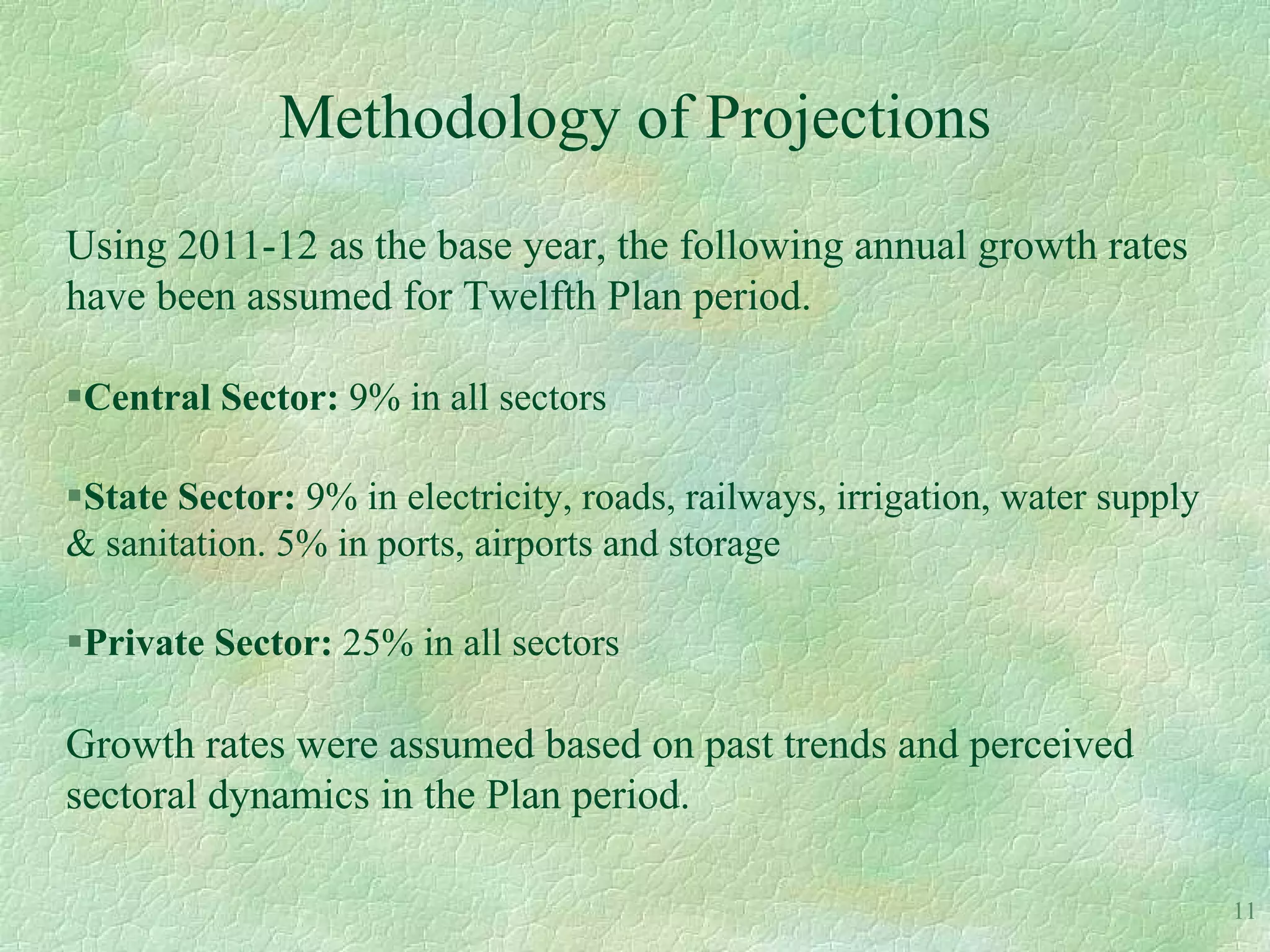
Methodology of Projections
Using 2011-12 as the base year, the following annual growth rates
have been assumed for Twelfth Plan period.

Central Sector: 9% in all sectors

State Sector: 9% in electricity, roads, railways, irrigation, water supply
& sanitation. 5% in ports, airports and storage

Private Sector: 25% in all sectors

Growth rates were assumed based on past trends and perceived
sectoral dynamics in the Plan period.

                                                                              11
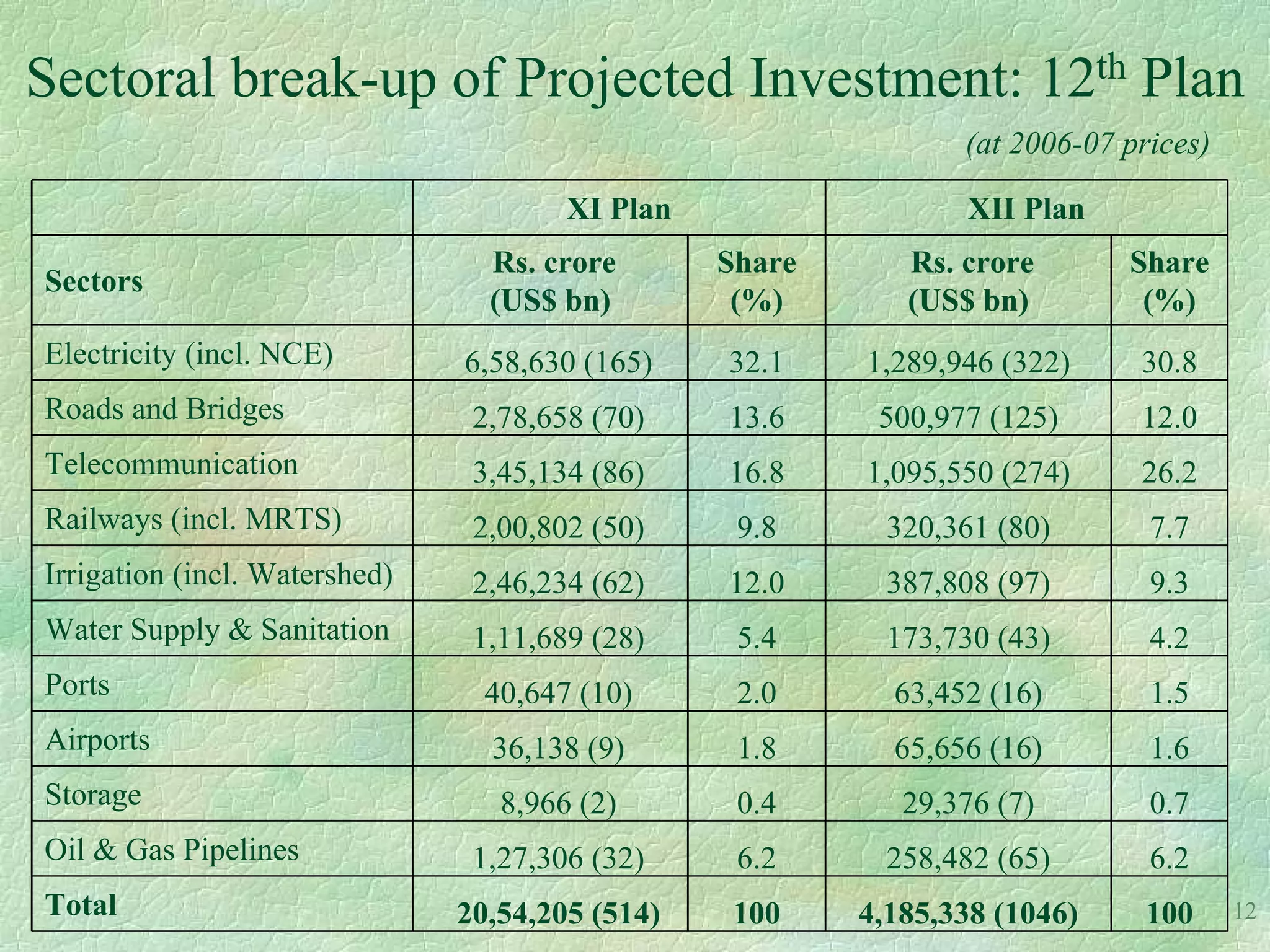
Sectoral break-up of Projected Investment: 12th Plan
                                                                (at 2006-07 prices)

                                       XI Plan                  XII Plan
                                 Rs. crore       Share      Rs. crore       Share
Sectors
                                 (US$ bn)         (%)       (US$ bn)         (%)
Electricity (incl. NCE)        6,58,630 (165)    32.1    1,289,946 (322)     30.8
Roads and Bridges               2,78,658 (70)    13.6     500,977 (125)      12.0
Telecommunication               3,45,134 (86)    16.8    1,095,550 (274)     26.2
Railways (incl. MRTS)           2,00,802 (50)     9.8      320,361 (80)       7.7
Irrigation (incl. Watershed)    2,46,234 (62)    12.0      387,808 (97)       9.3
Water Supply & Sanitation       1,11,689 (28)     5.4      173,730 (43)       4.2
Ports                            40,647 (10)      2.0      63,452 (16)        1.5
Airports                         36,138 (9)       1.8      65,656 (16)        1.6
Storage                           8,966 (2)       0.4       29,376 (7)        0.7
Oil & Gas Pipelines             1,27,306 (32)     6.2      258,482 (65)       6.2
Total                          20,54,205 (514)   100     4,185,338 (1046)    100      12
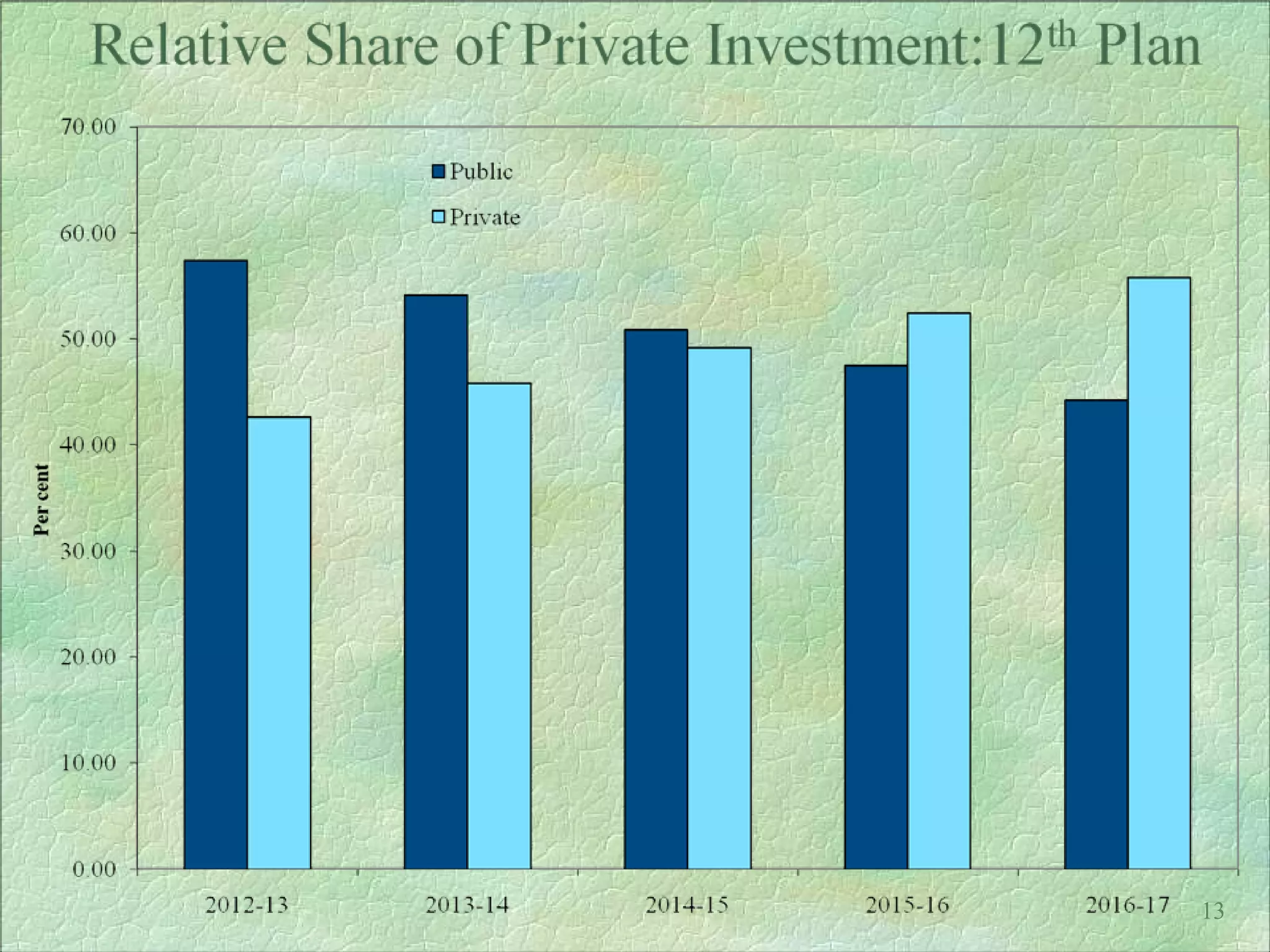
13
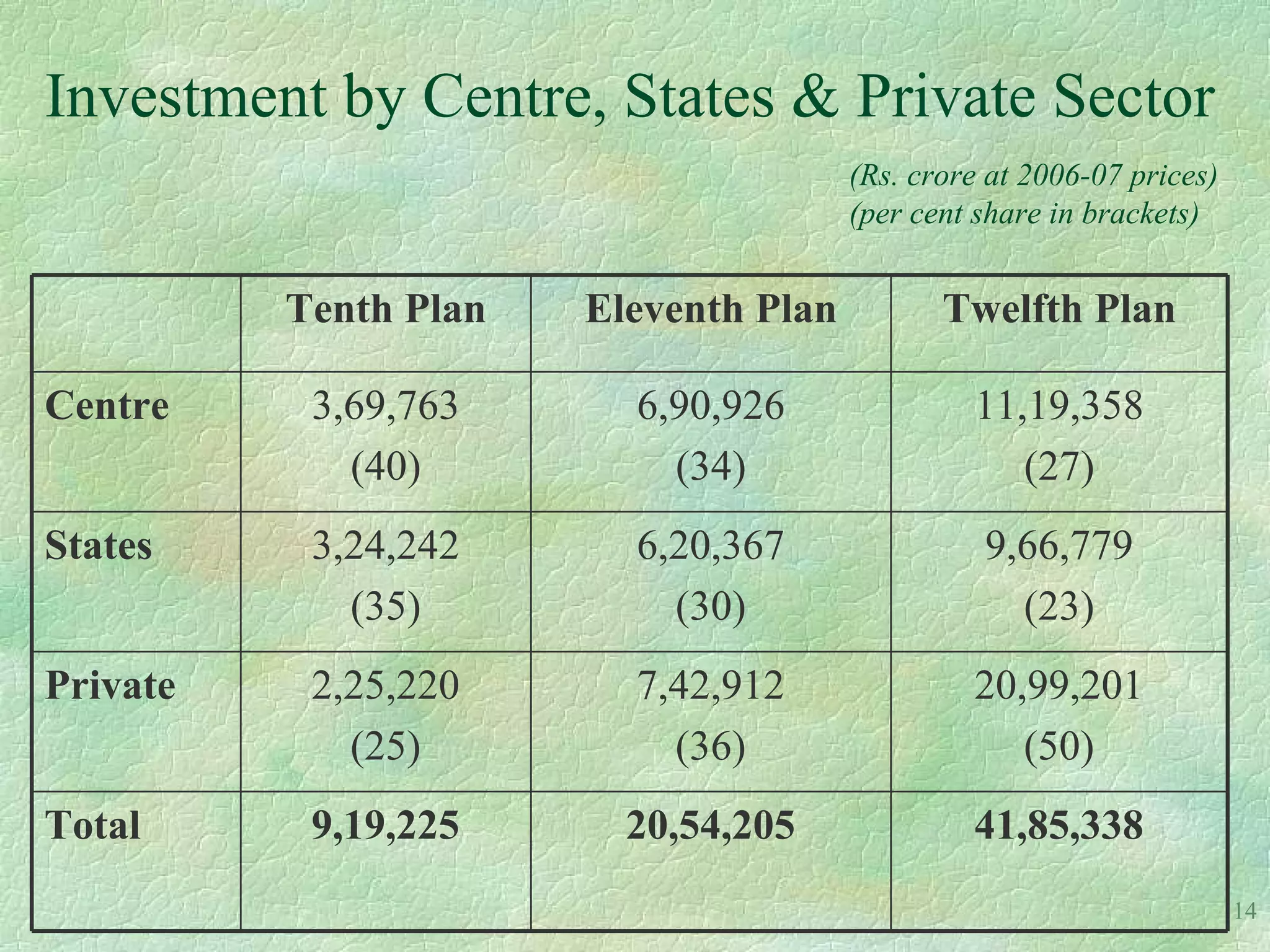
Investment by Centre, States & Private Sector
                                       (Rs. crore at 2006-07 prices)
                                       (per cent share in brackets)


          Tenth Plan   Eleventh Plan          Twelfth Plan

Centre     3,69,763      6,90,926               11,19,358
             (40)          (34)                    (27)
States     3,24,242      6,20,367                9,66,779
             (35)          (30)                    (23)
Private    2,25,220      7,42,912               20,99,201
             (25)          (36)                    (50)
Total      9,19,225      20,54,205              41,85,338
                                                                       14
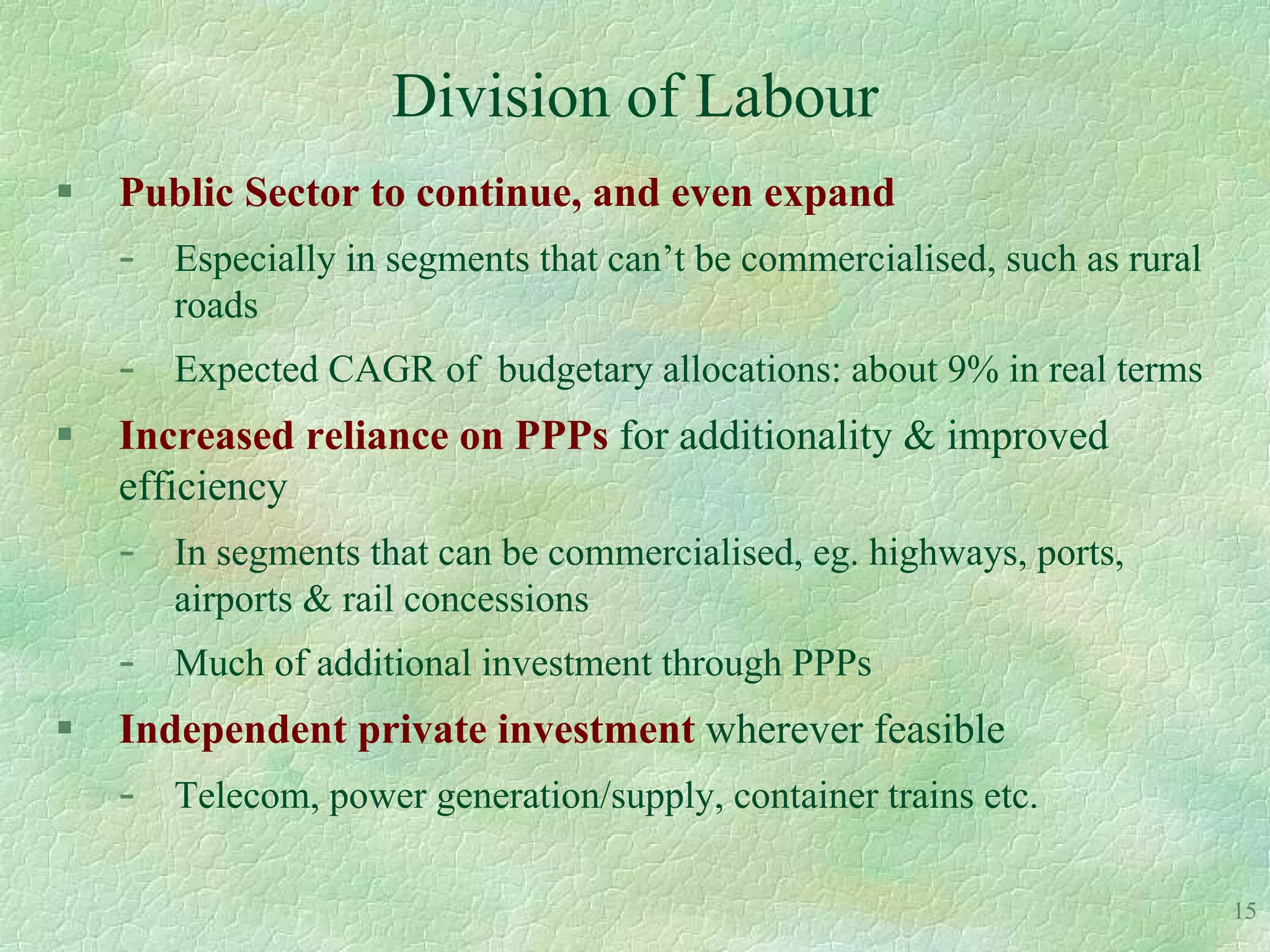
Division of Labour
   Public Sector to continue, and even expand
    -   Especially in segments that can’t be commercialised, such as rural
        roads
    -   Expected CAGR of budgetary allocations: about 9% in real terms
   Increased reliance on PPPs for additionality & improved
    efficiency
    -   In segments that can be commercialised, eg. highways, ports,
        airports & rail concessions
    -   Much of additional investment through PPPs
   Independent private investment wherever feasible
    -   Telecom, power generation/supply, container trains etc.

                                                                             15
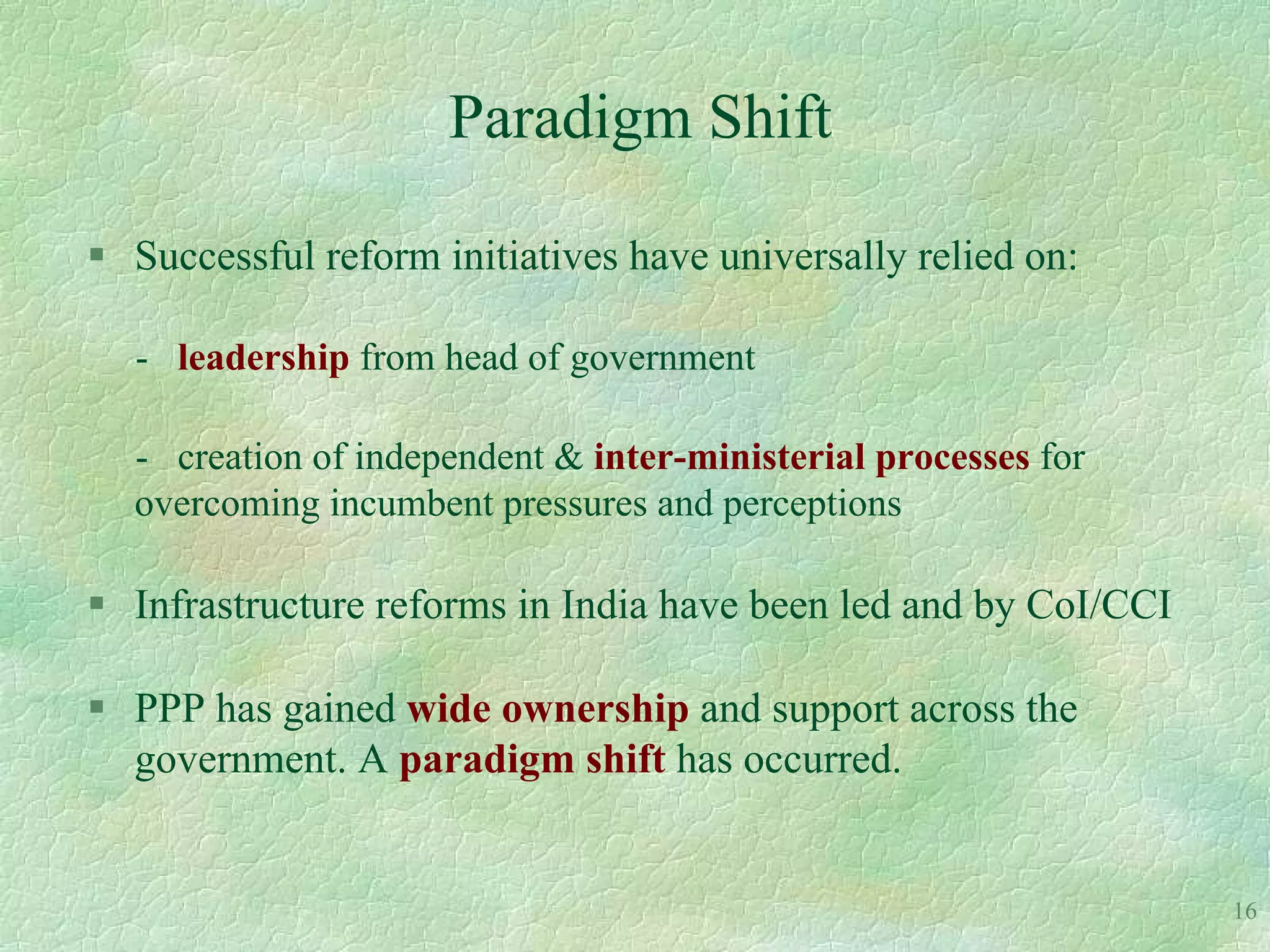
Paradigm Shift

 Successful reform initiatives have universally relied on:

  - leadership from head of government

  - creation of independent & inter-ministerial processes for
  overcoming incumbent pressures and perceptions

 Infrastructure reforms in India have been led and by CoI/CCI

 PPP has gained wide ownership and support across the
  government. A paradigm shift has occurred.


                                                                 16
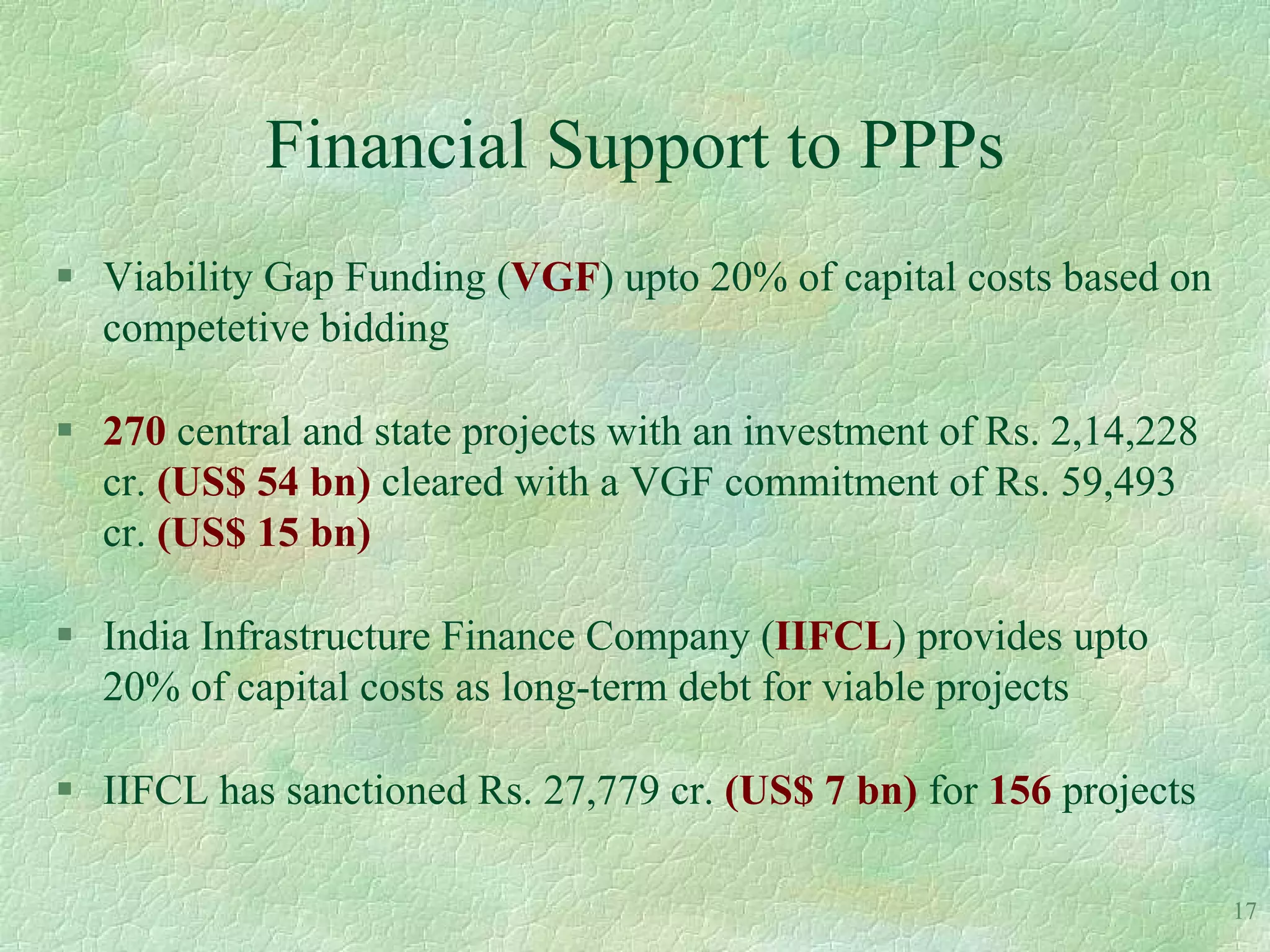
Financial Support to PPPs
 Viability Gap Funding (VGF) upto 20% of capital costs based on
  competetive bidding

 270 central and state projects with an investment of Rs. 2,14,228
  cr. (US$ 54 bn) cleared with a VGF commitment of Rs. 59,493
  cr. (US$ 15 bn)

 India Infrastructure Finance Company (IIFCL) provides upto
  20% of capital costs as long-term debt for viable projects

 IIFCL has sanctioned Rs. 27,779 cr. (US$ 7 bn) for 156 projects

                                                                      17
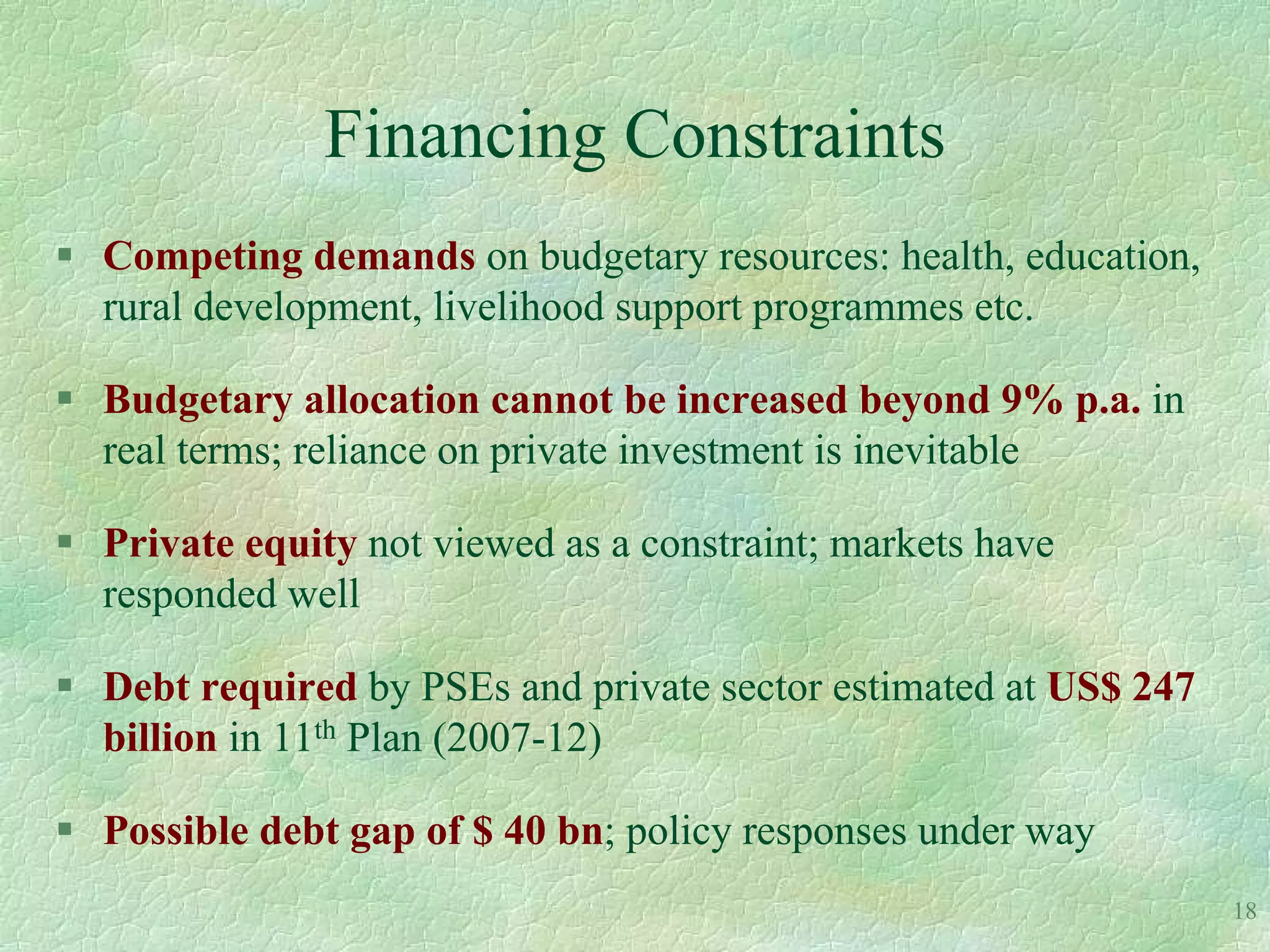
Financing Constraints
 Competing demands on budgetary resources: health, education,
  rural development, livelihood support programmes etc.

 Budgetary allocation cannot be increased beyond 9% p.a. in
  real terms; reliance on private investment is inevitable

 Private equity not viewed as a constraint; markets have
  responded well

 Debt required by PSEs and private sector estimated at US$ 247
  billion in 11th Plan (2007-12)

 Possible debt gap of $ 40 bn; policy responses under way
                                                                  18
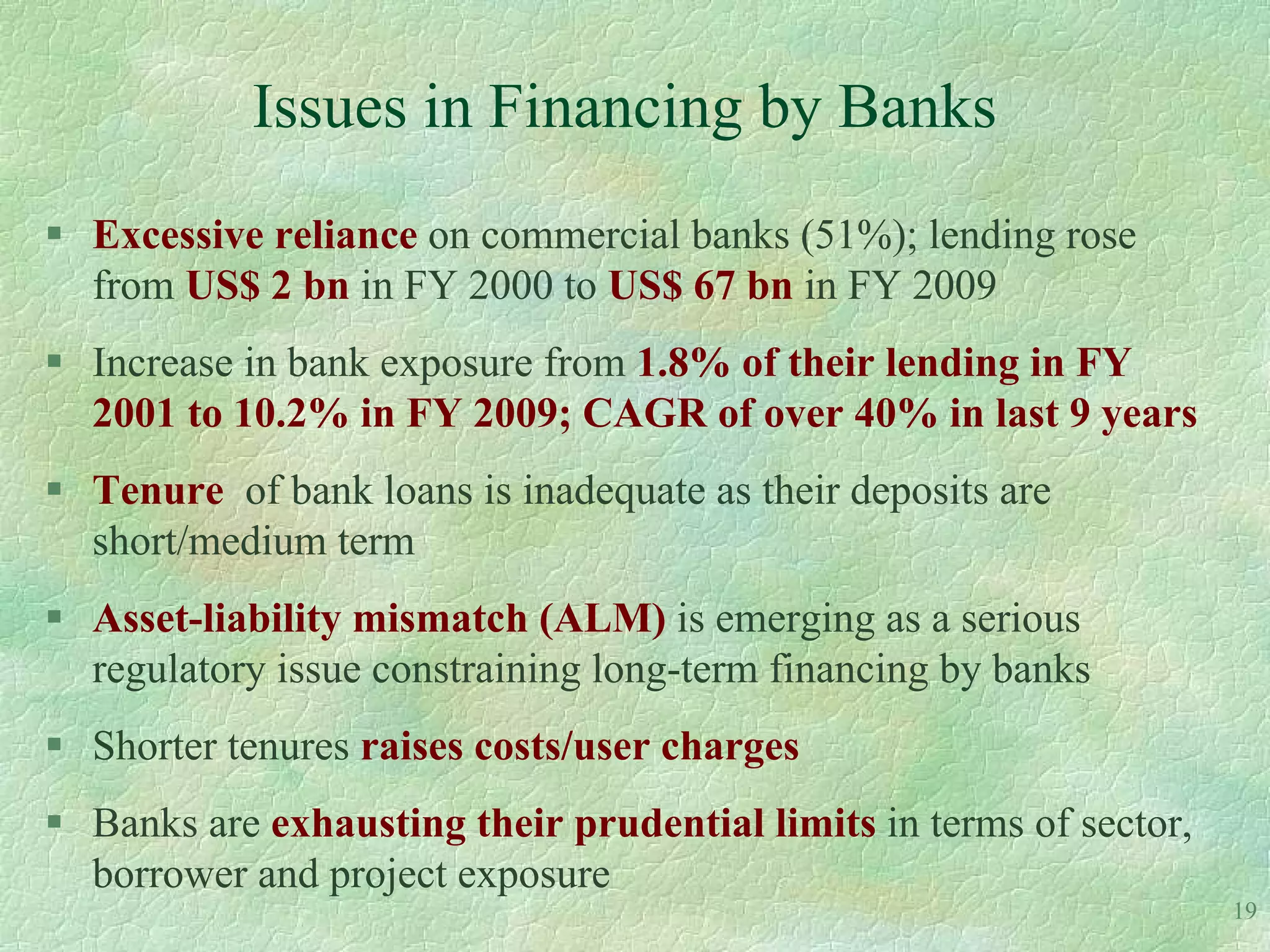
Issues in Financing by Banks
 Excessive reliance on commercial banks (51%); lending rose
  from US$ 2 bn in FY 2000 to US$ 67 bn in FY 2009
 Increase in bank exposure from 1.8% of their lending in FY
  2001 to 10.2% in FY 2009; CAGR of over 40% in last 9 years
 Tenure of bank loans is inadequate as their deposits are
  short/medium term
 Asset-liability mismatch (ALM) is emerging as a serious
  regulatory issue constraining long-term financing by banks
 Shorter tenures raises costs/user charges
 Banks are exhausting their prudential limits in terms of sector,
  borrower and project exposure
                                                                     19
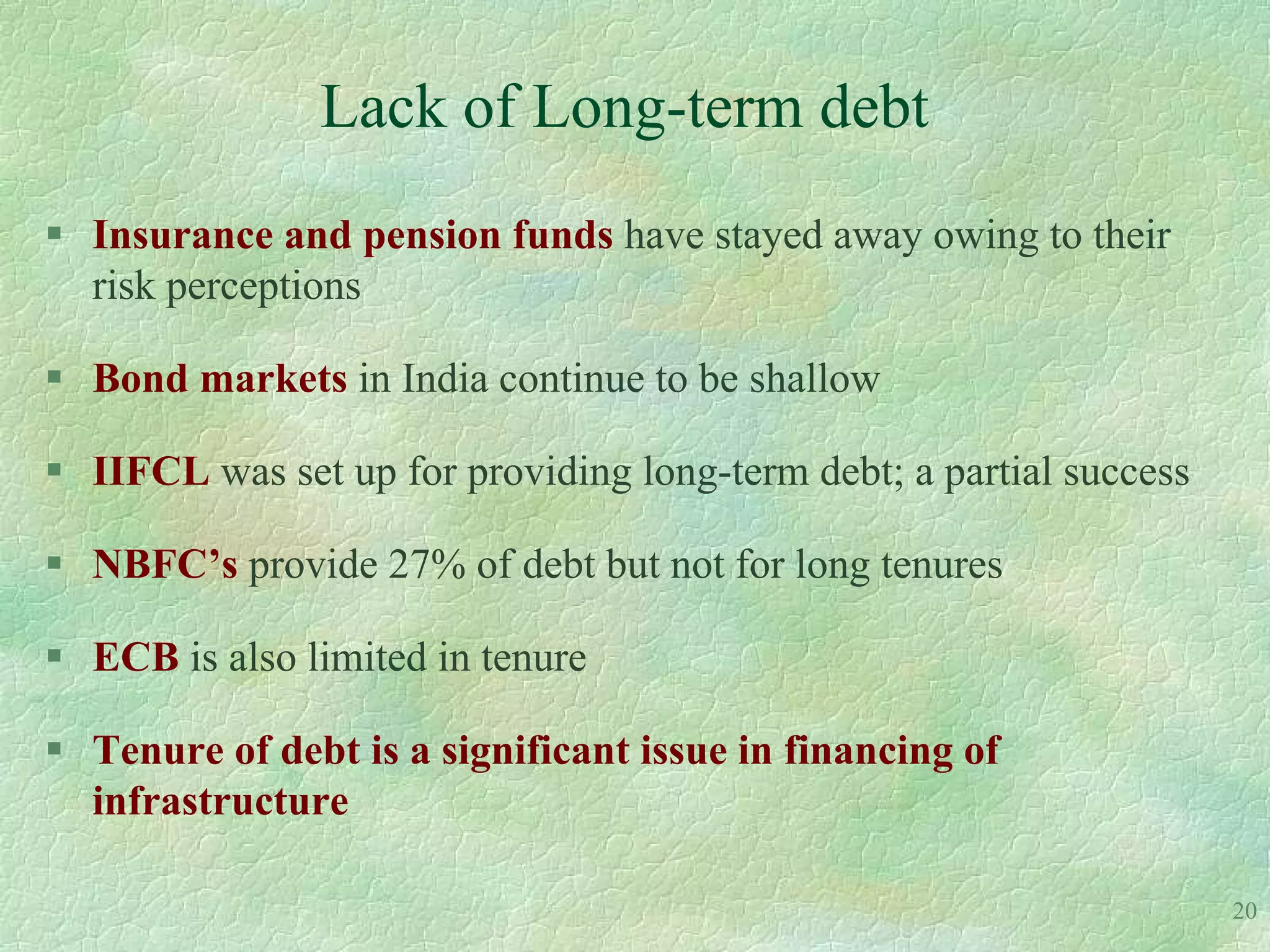
Lack of Long-term debt
 Insurance and pension funds have stayed away owing to their
  risk perceptions

 Bond markets in India continue to be shallow

 IIFCL was set up for providing long-term debt; a partial success

 NBFC’s provide 27% of debt but not for long tenures

 ECB is also limited in tenure

 Tenure of debt is a significant issue in financing of
  infrastructure

                                                                     20
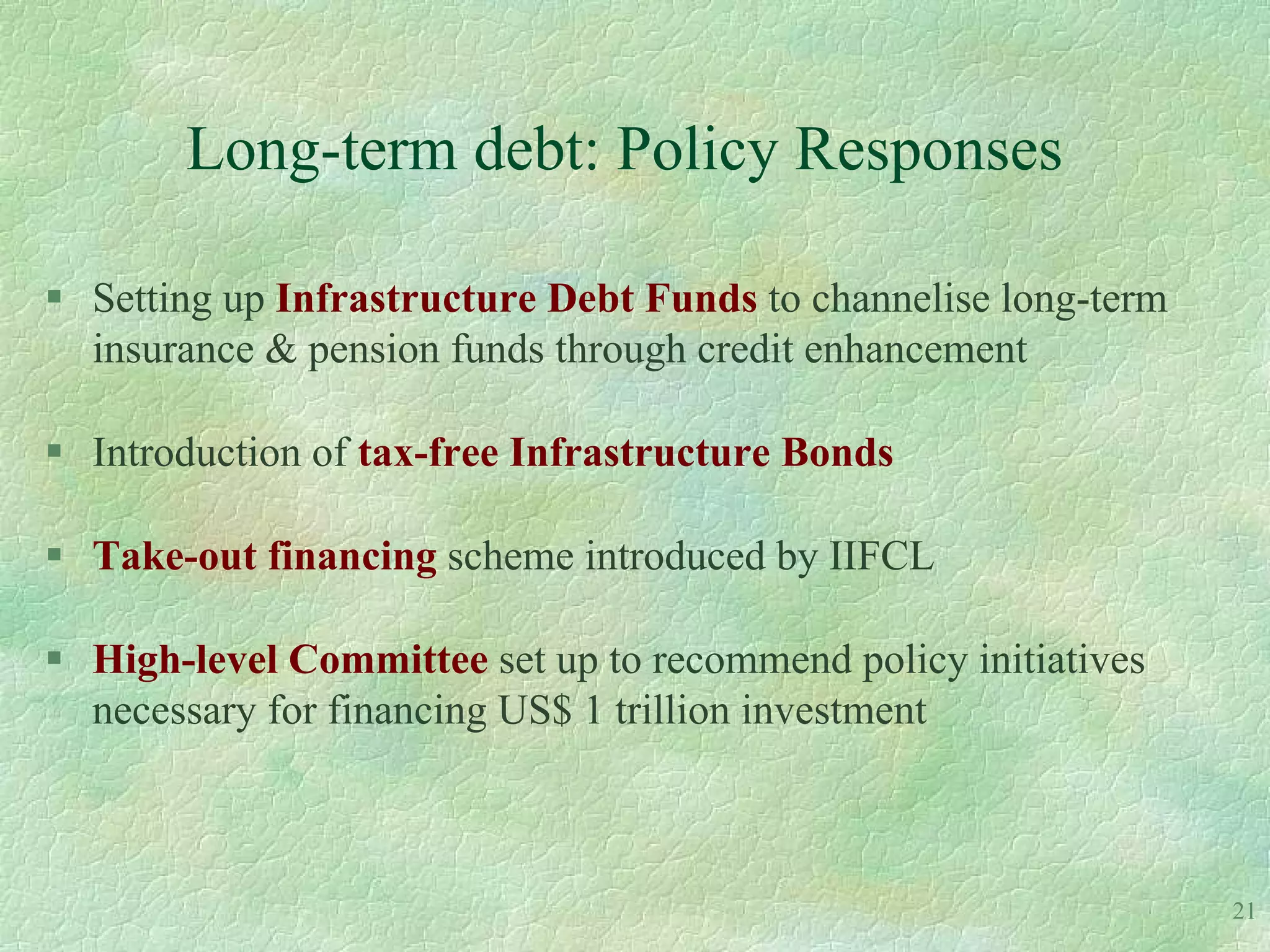
Long-term debt: Policy Responses

 Setting up Infrastructure Debt Funds to channelise long-term
  insurance & pension funds through credit enhancement

 Introduction of tax-free Infrastructure Bonds

 Take-out financing scheme introduced by IIFCL

 High-level Committee set up to recommend policy initiatives
  necessary for financing US$ 1 trillion investment


                                                                 21
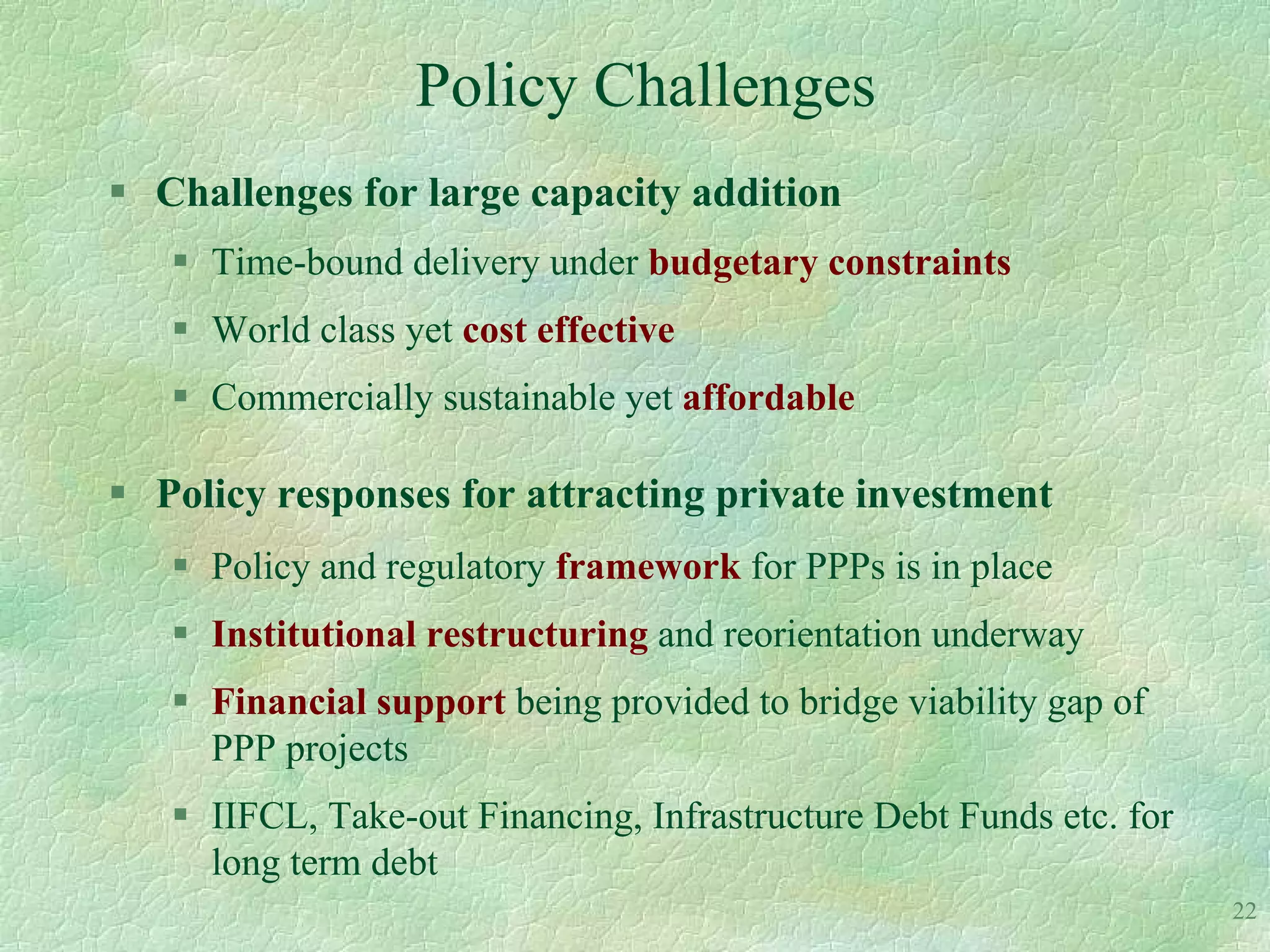
Policy Challenges
 Challenges for large capacity addition
    Time-bound delivery under budgetary constraints
    World class yet cost effective
    Commercially sustainable yet affordable

 Policy responses for attracting private investment
    Policy and regulatory framework for PPPs is in place
    Institutional restructuring and reorientation underway
    Financial support being provided to bridge viability gap of
     PPP projects
    IIFCL, Take-out Financing, Infrastructure Debt Funds etc. for
     long term debt
                                                                     22
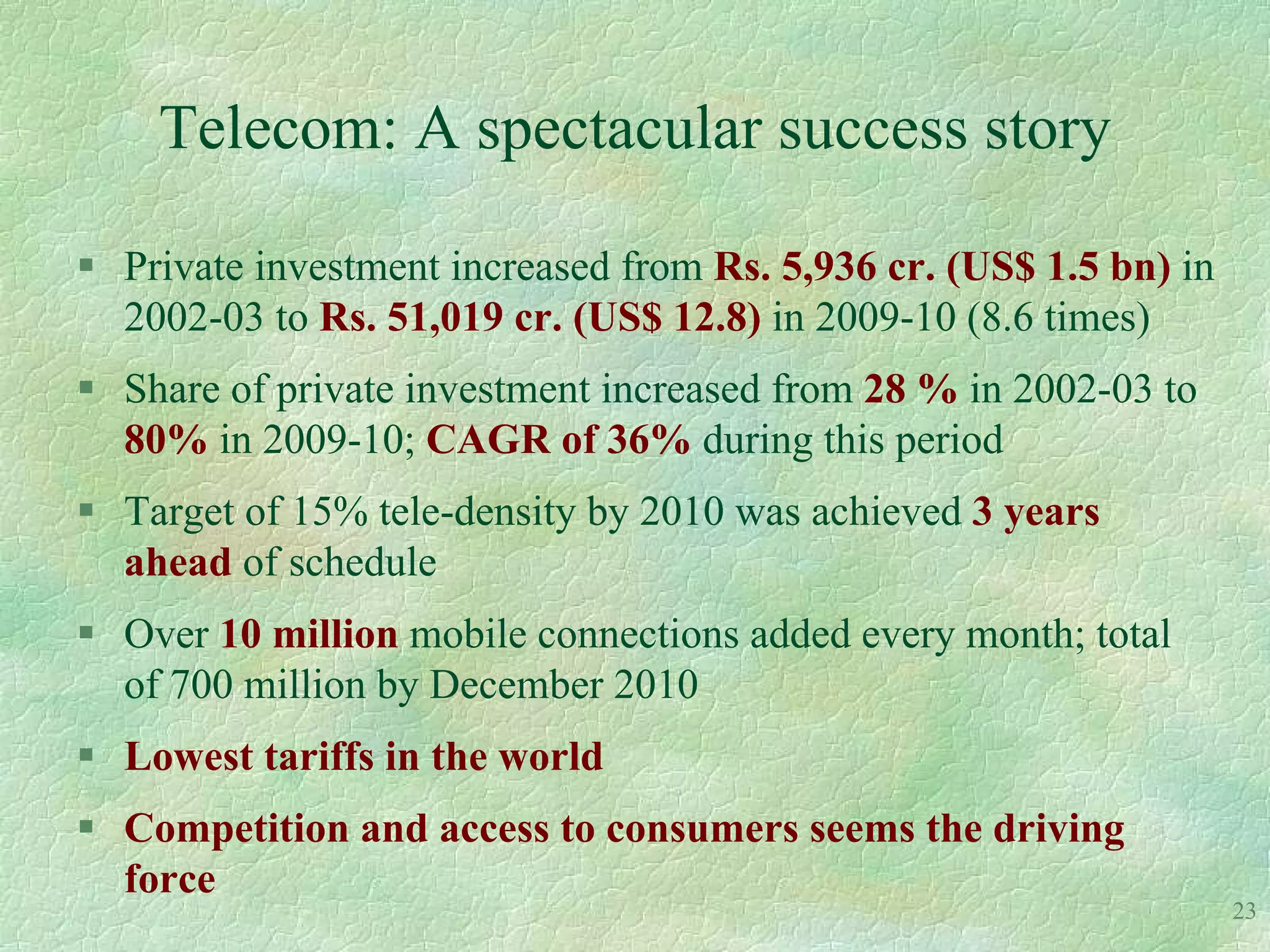
Telecom: A spectacular success story

 Private investment increased from Rs. 5,936 cr. (US$ 1.5 bn) in
  2002-03 to Rs. 51,019 cr. (US$ 12.8) in 2009-10 (8.6 times)
 Share of private investment increased from 28 % in 2002-03 to
  80% in 2009-10; CAGR of 36% during this period
 Target of 15% tele-density by 2010 was achieved 3 years
  ahead of schedule
 Over 10 million mobile connections added every month; total
  of 700 million by December 2010
 Lowest tariffs in the world
 Competition and access to consumers seems the driving
  force
                                                                    23
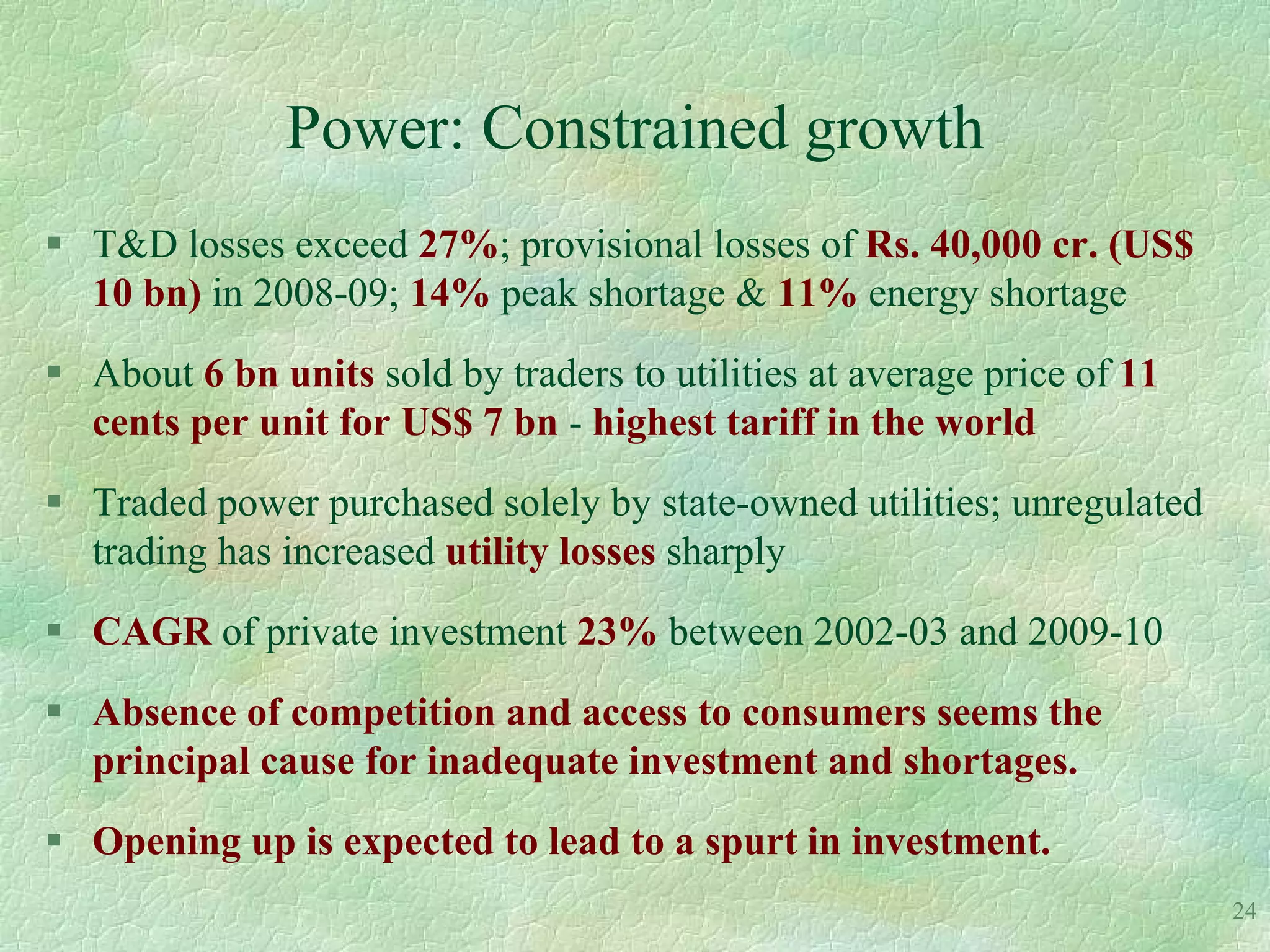
Power: Constrained growth
 T&D losses exceed 27%; provisional losses of Rs. 40,000 cr. (US$
  10 bn) in 2008-09; 14% peak shortage & 11% energy shortage
 About 6 bn units sold by traders to utilities at average price of 11
  cents per unit for US$ 7 bn - highest tariff in the world
 Traded power purchased solely by state-owned utilities; unregulated
  trading has increased utility losses sharply
 CAGR of private investment 23% between 2002-03 and 2009-10
 Absence of competition and access to consumers seems the
  principal cause for inadequate investment and shortages.
 Opening up is expected to lead to a spurt in investment.
                                                                         24
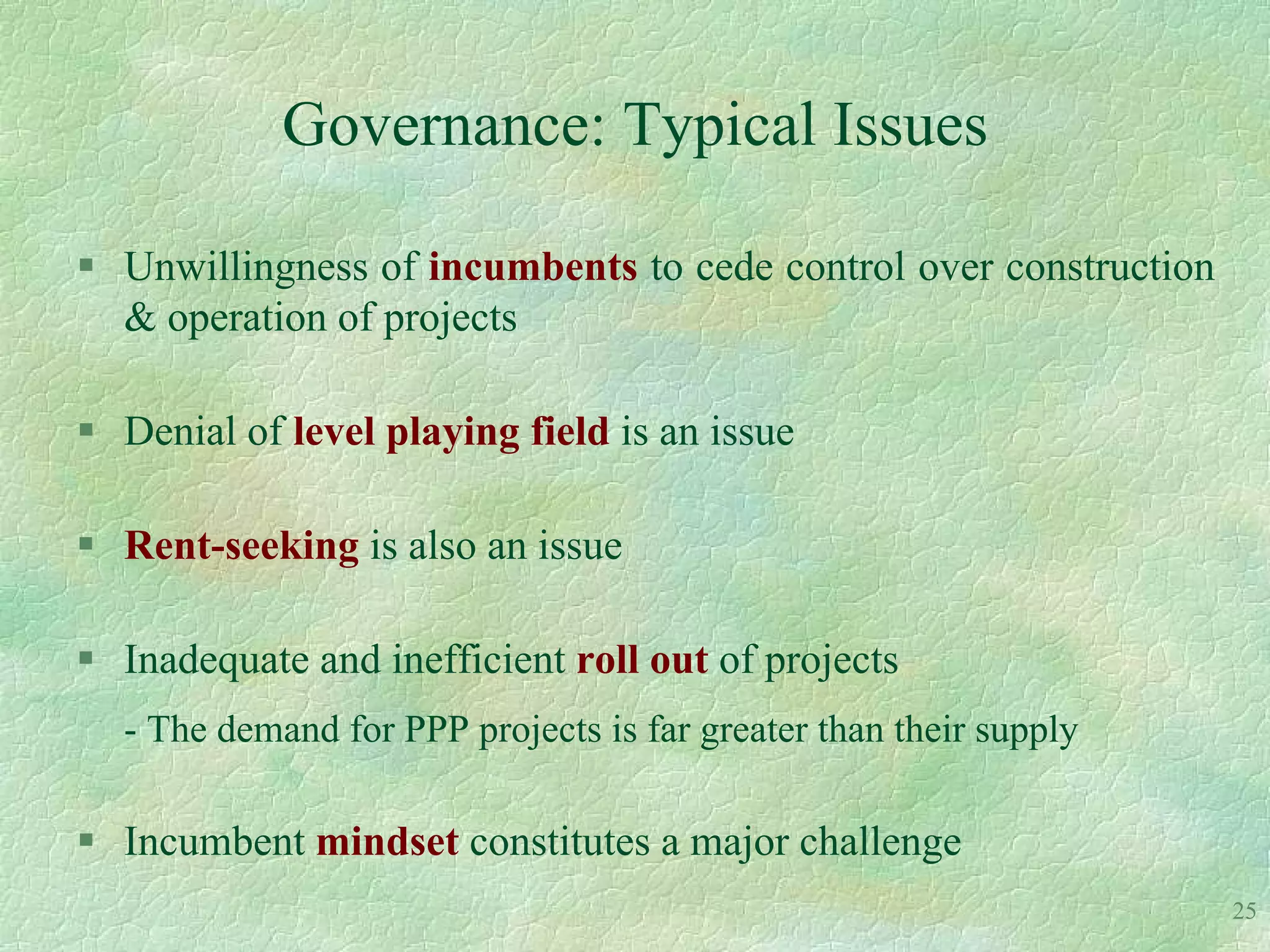
Governance: Typical Issues

 Unwillingness of incumbents to cede control over construction
  & operation of projects

 Denial of level playing field is an issue

 Rent-seeking is also an issue

 Inadequate and inefficient roll out of projects
  - The demand for PPP projects is far greater than their supply

 Incumbent mindset constitutes a major challenge
                                                                   25
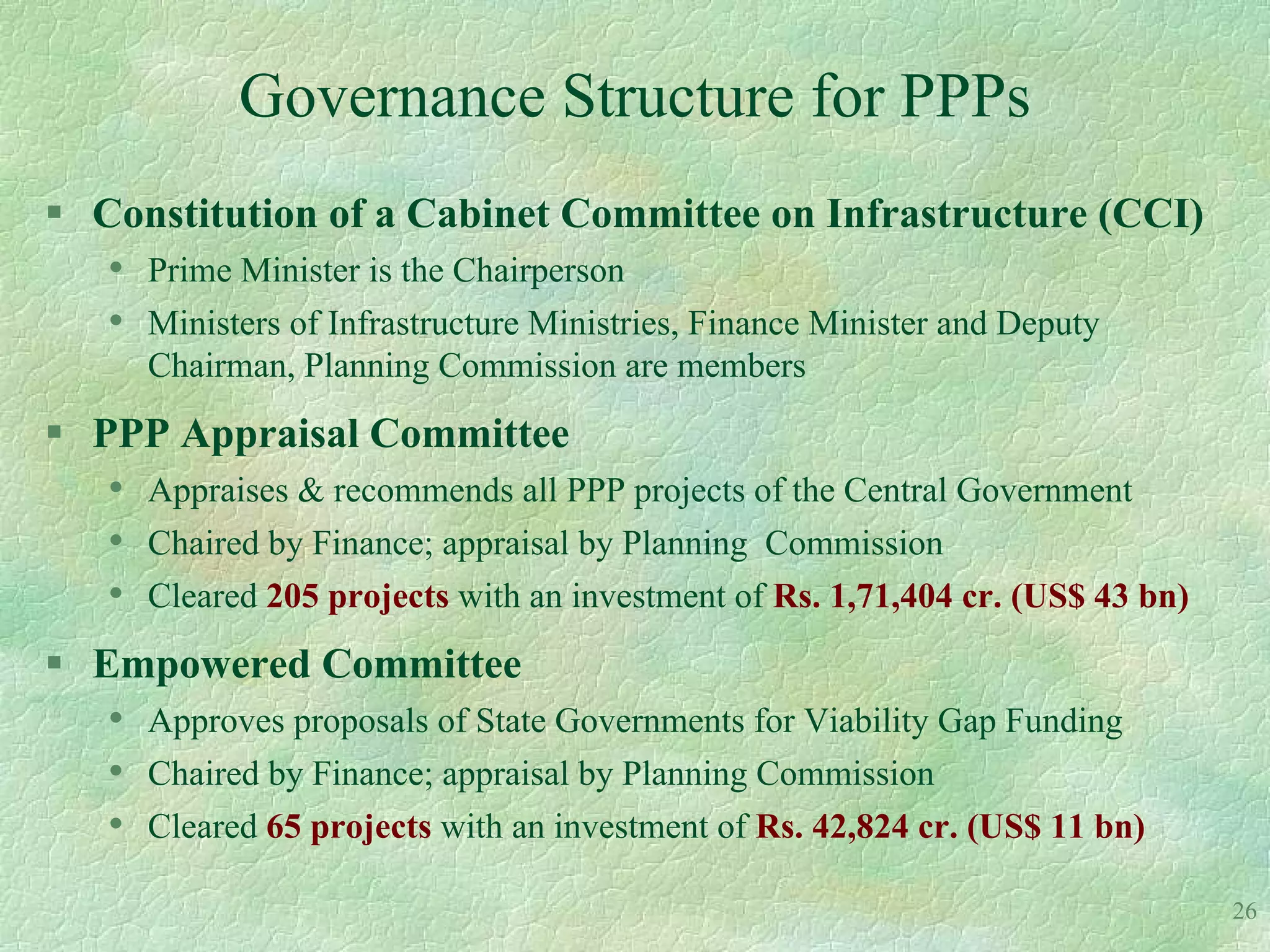
Governance Structure for PPPs
 Constitution of a Cabinet Committee on Infrastructure (CCI)
   • Prime Minister is the Chairperson
   • Ministers of Infrastructure Ministries, Finance Minister and Deputy
      Chairman, Planning Commission are members
 PPP Appraisal Committee
   • Appraises & recommends all PPP projects of the Central Government
   • Chaired by Finance; appraisal by Planning Commission
   • Cleared 205 projects with an investment of Rs. 1,71,404 cr. (US$ 43 bn)
 Empowered Committee
   • Approves proposals of State Governments for Viability Gap Funding
   • Chaired by Finance; appraisal by Planning Commission
   • Cleared 65 projects with an investment of Rs. 42,824 cr. (US$ 11 bn)
                                                                               26
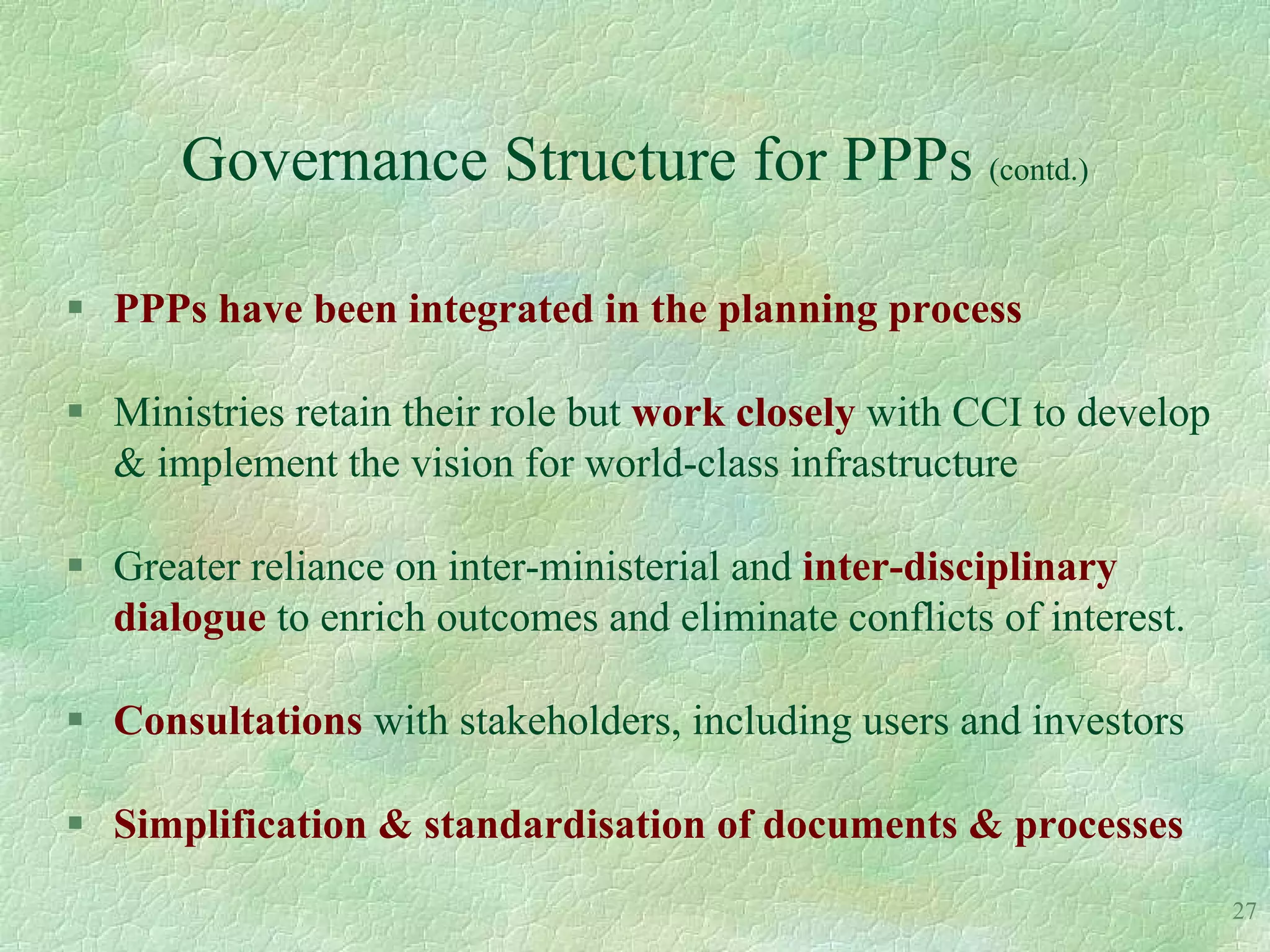
Governance Structure for PPPs (contd.)

 PPPs have been integrated in the planning process

 Ministries retain their role but work closely with CCI to develop
  & implement the vision for world-class infrastructure

 Greater reliance on inter-ministerial and inter-disciplinary
  dialogue to enrich outcomes and eliminate conflicts of interest.

 Consultations with stakeholders, including users and investors

 Simplification & standardisation of documents & processes
                                                                      27
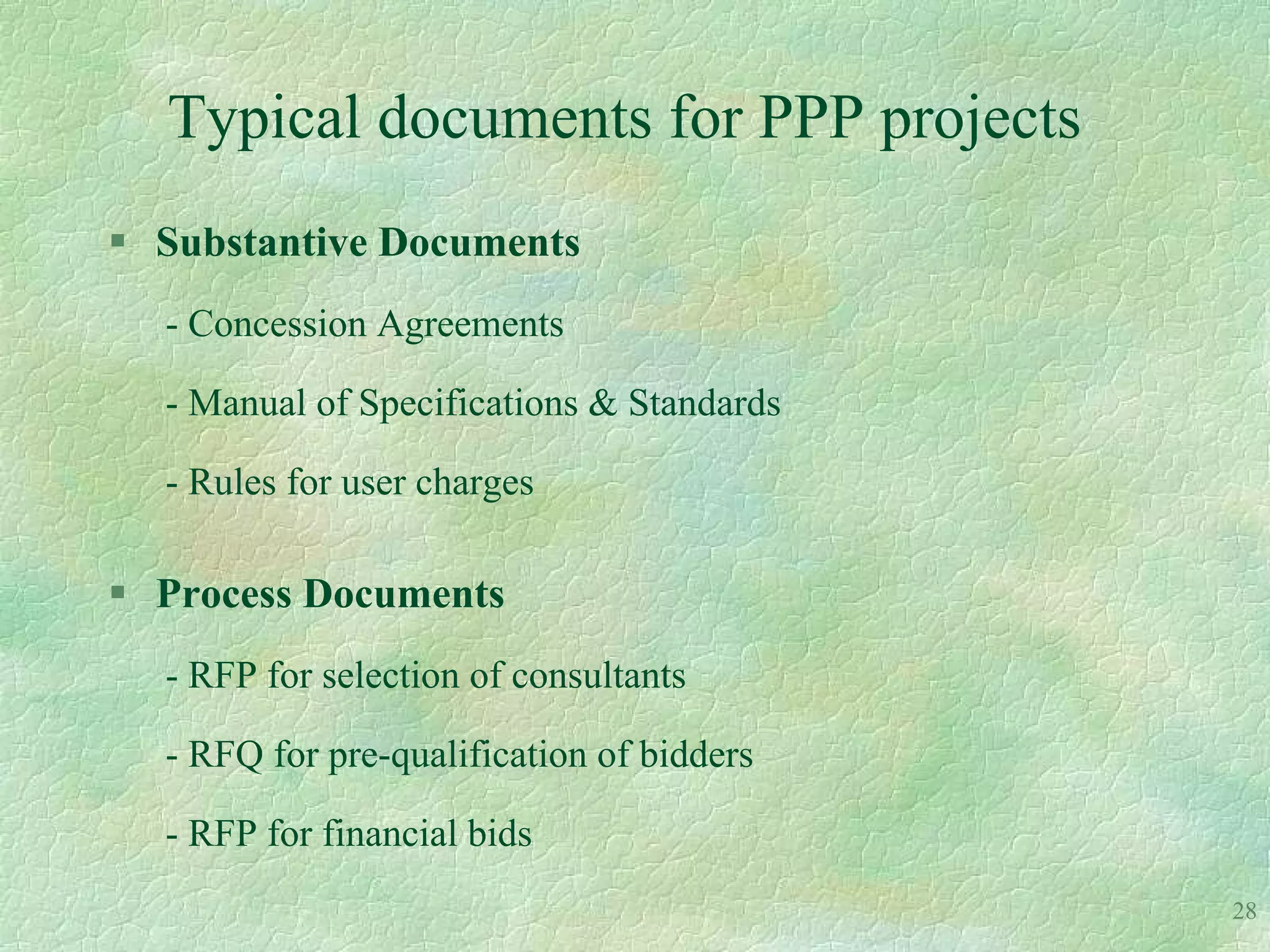
Typical documents for PPP projects
 Substantive Documents
  - Concession Agreements

  - Manual of Specifications & Standards

  - Rules for user charges

 Process Documents
  - RFP for selection of consultants

  - RFQ for pre-qualification of bidders

  - RFP for financial bids
                                           28
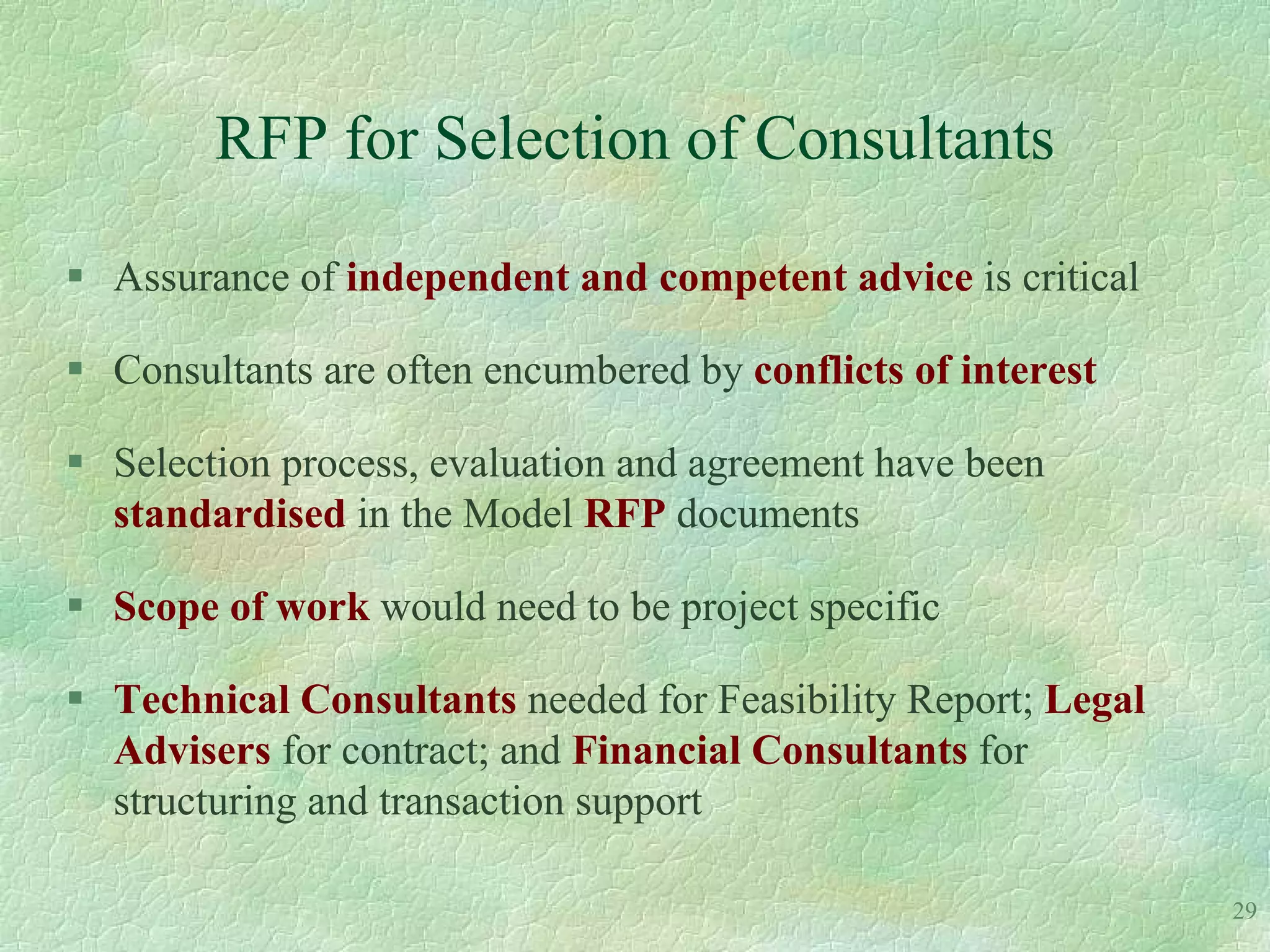
RFP for Selection of Consultants

 Assurance of independent and competent advice is critical

 Consultants are often encumbered by conflicts of interest

 Selection process, evaluation and agreement have been
  standardised in the Model RFP documents

 Scope of work would need to be project specific

 Technical Consultants needed for Feasibility Report; Legal
  Advisers for contract; and Financial Consultants for
  structuring and transaction support

                                                               29
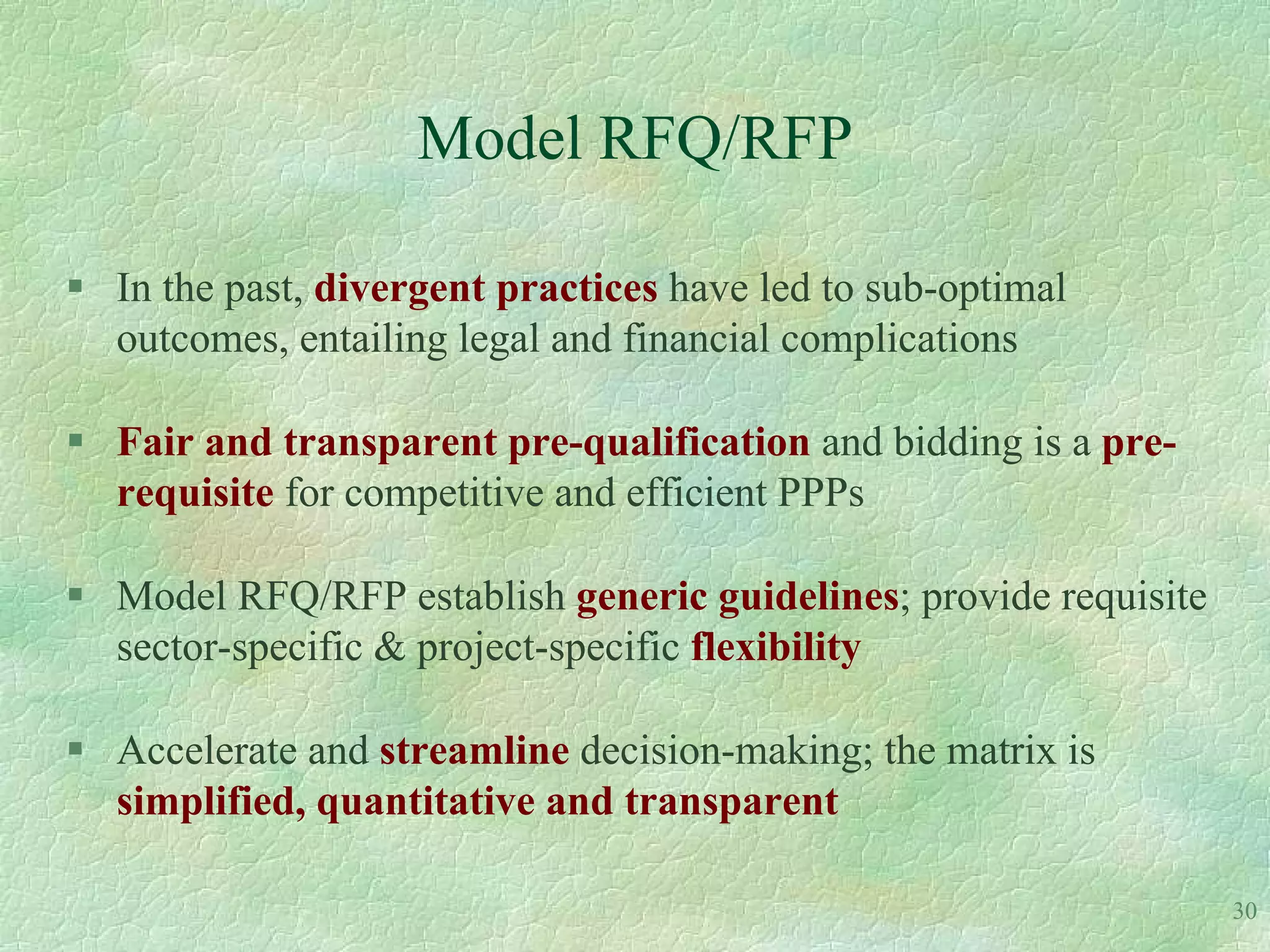
Model RFQ/RFP

 In the past, divergent practices have led to sub-optimal
  outcomes, entailing legal and financial complications

 Fair and transparent pre-qualification and bidding is a pre-
  requisite for competitive and efficient PPPs

 Model RFQ/RFP establish generic guidelines; provide requisite
  sector-specific & project-specific flexibility

 Accelerate and streamline decision-making; the matrix is
  simplified, quantitative and transparent

                                                                  30
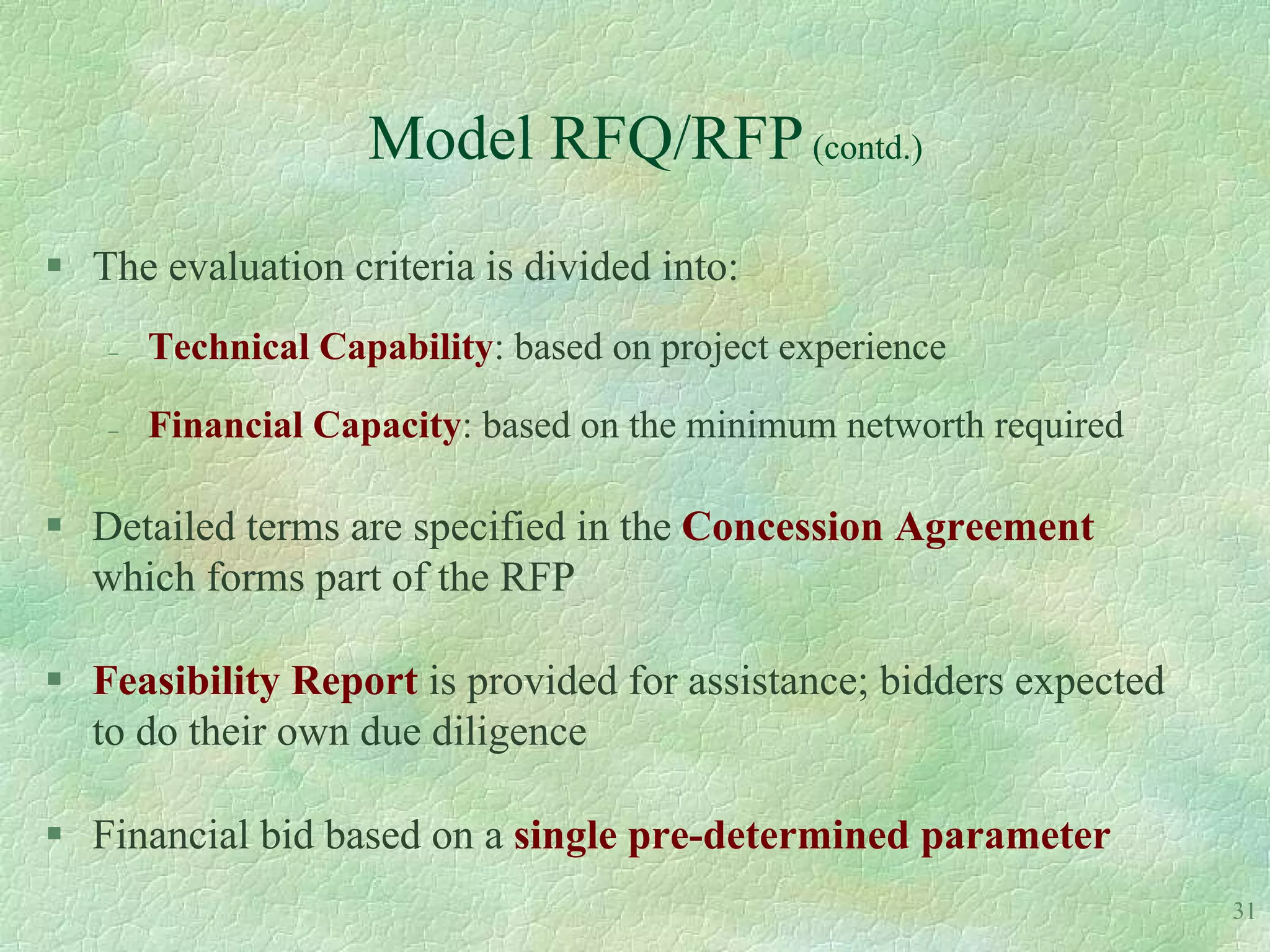
Model RFQ/RFP (contd.)
 The evaluation criteria is divided into:
      Technical Capability: based on project experience

      Financial Capacity: based on the minimum networth required

 Detailed terms are specified in the Concession Agreement
  which forms part of the RFP

 Feasibility Report is provided for assistance; bidders expected
  to do their own due diligence

 Financial bid based on a single pre-determined parameter
                                                                    31
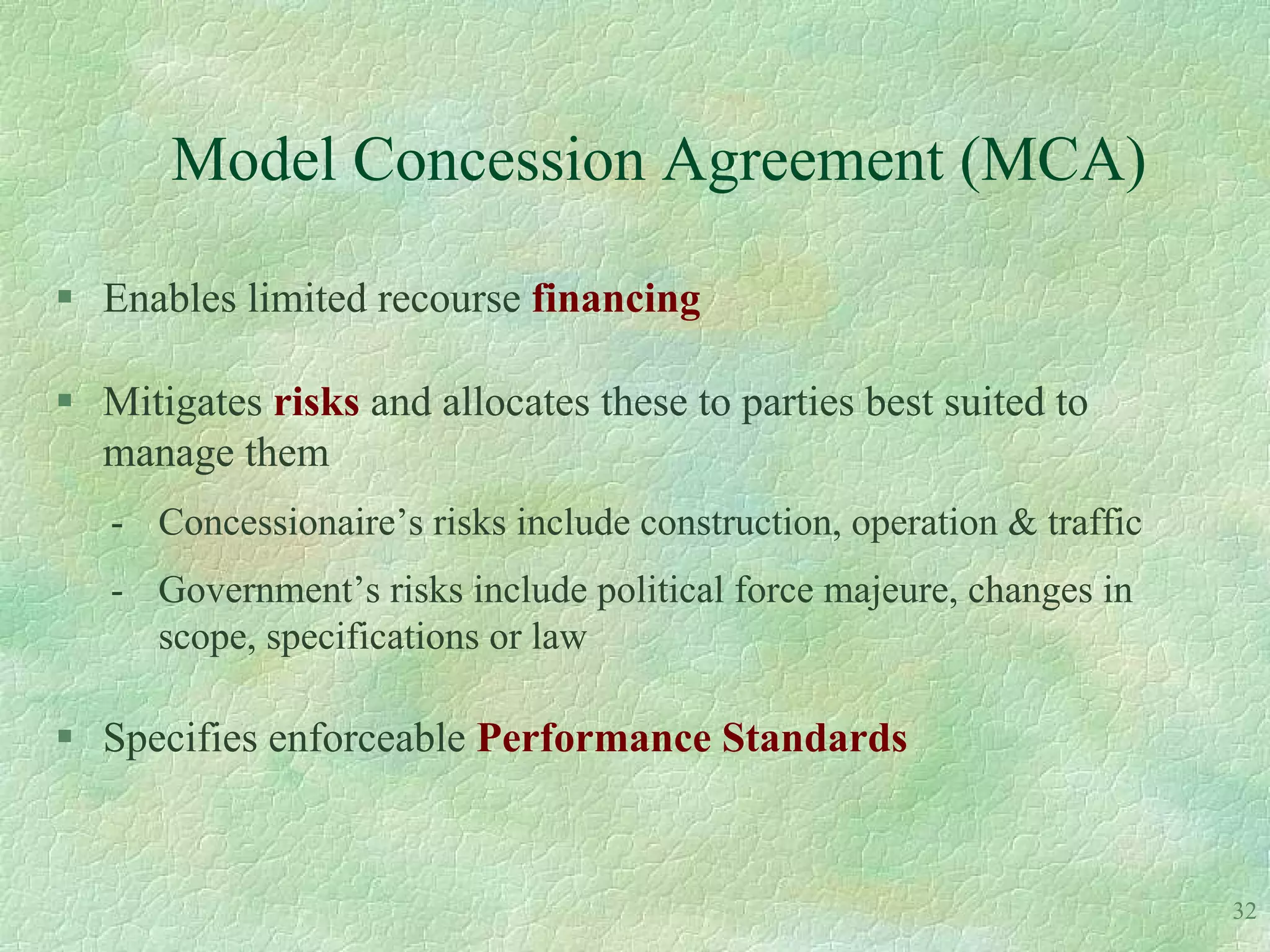
Model Concession Agreement (MCA)

 Enables limited recourse financing

 Mitigates risks and allocates these to parties best suited to
  manage them
   - Concessionaire’s risks include construction, operation & traffic
   - Government’s risks include political force majeure, changes in
     scope, specifications or law

 Specifies enforceable Performance Standards


                                                                        32
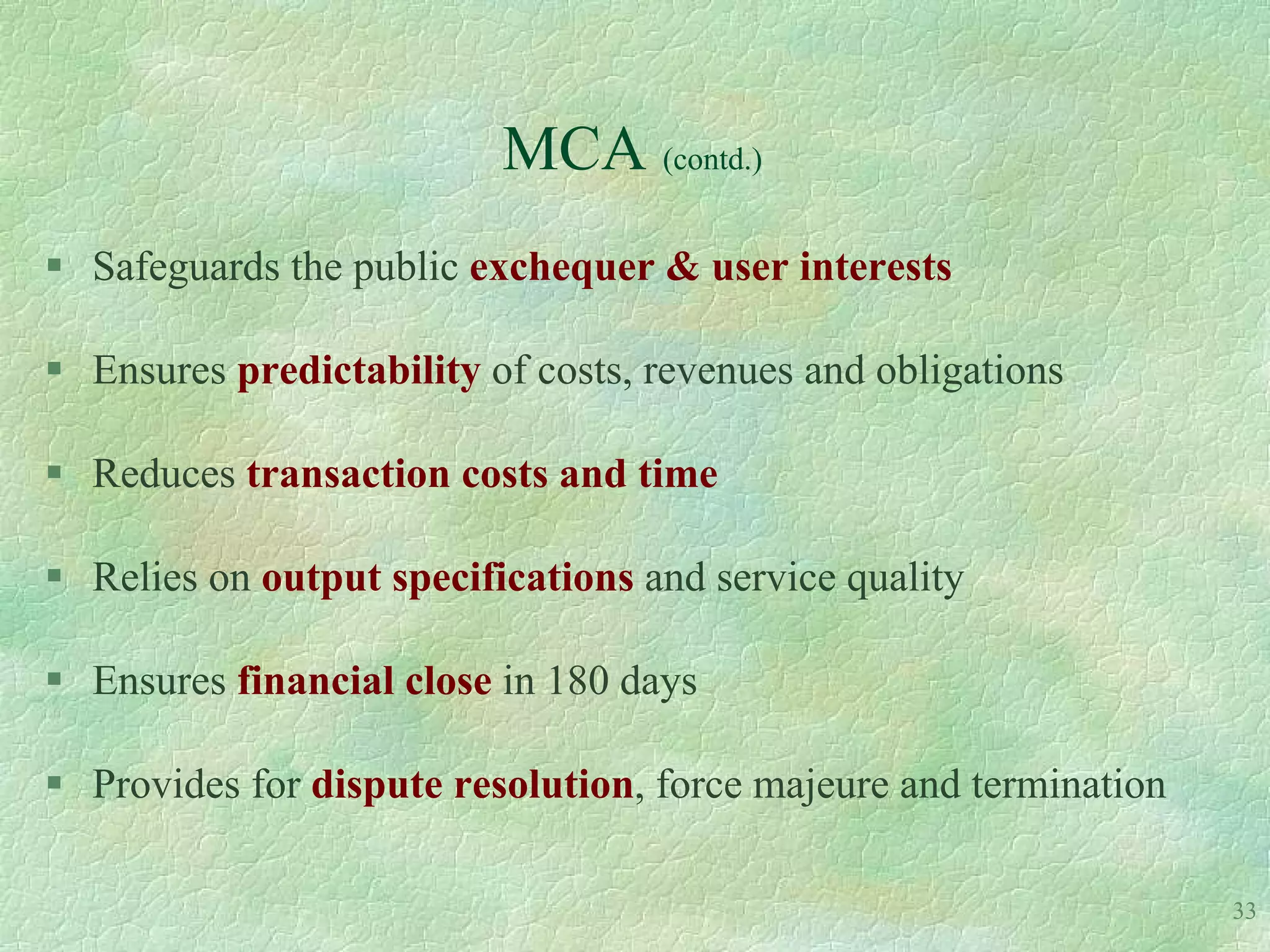
MCA (contd.)
 Safeguards the public exchequer & user interests

 Ensures predictability of costs, revenues and obligations

 Reduces transaction costs and time

 Relies on output specifications and service quality

 Ensures financial close in 180 days

 Provides for dispute resolution, force majeure and termination

                                                                   33
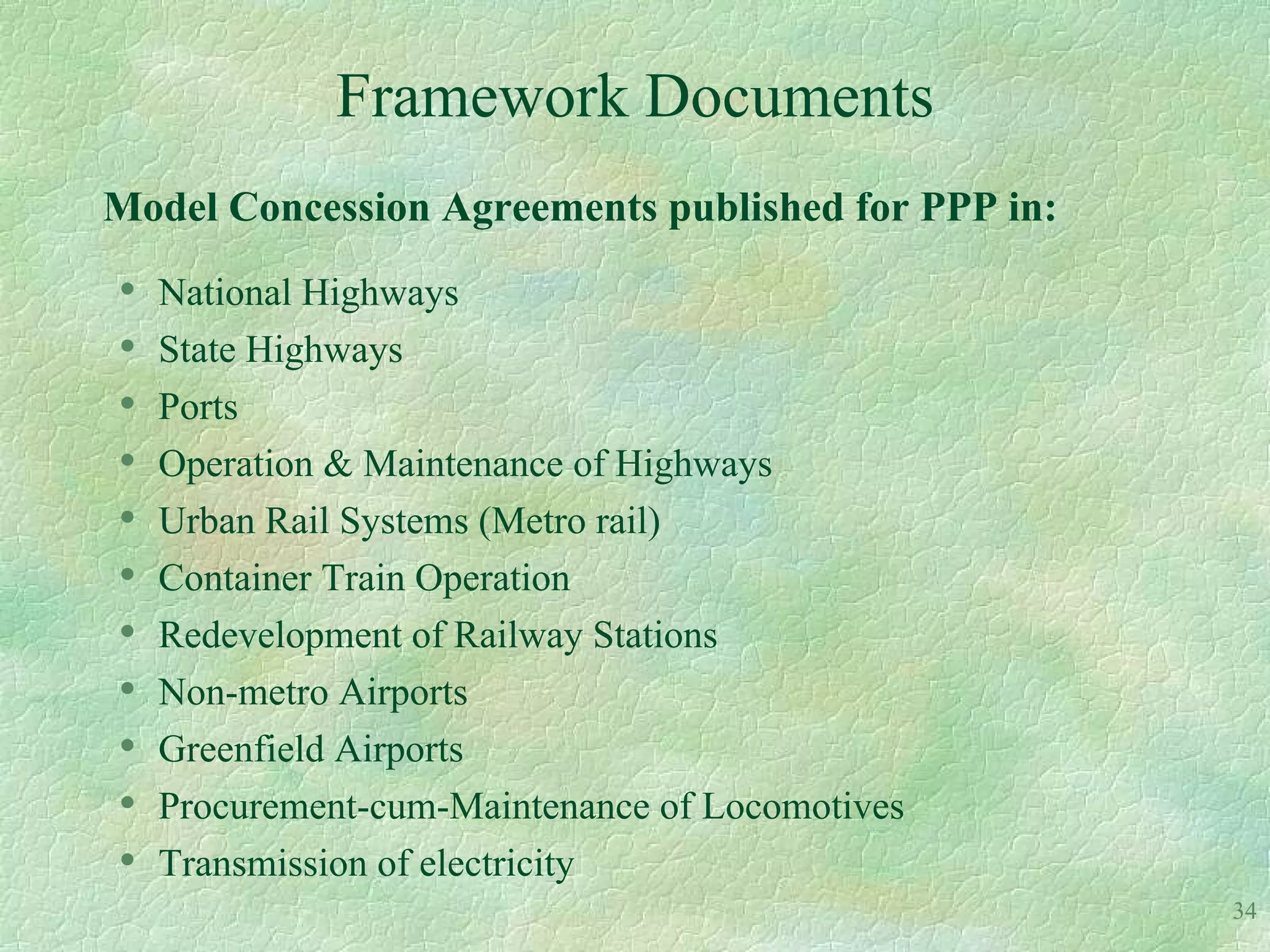
Framework Documents
Model Concession Agreements published for PPP in:
•   National Highways
•   State Highways
•   Ports
•   Operation & Maintenance of Highways
•   Urban Rail Systems (Metro rail)
•   Container Train Operation
•   Redevelopment of Railway Stations
•   Non-metro Airports
•   Greenfield Airports
•   Procurement-cum-Maintenance of Locomotives
•   Transmission of electricity
                                                    34
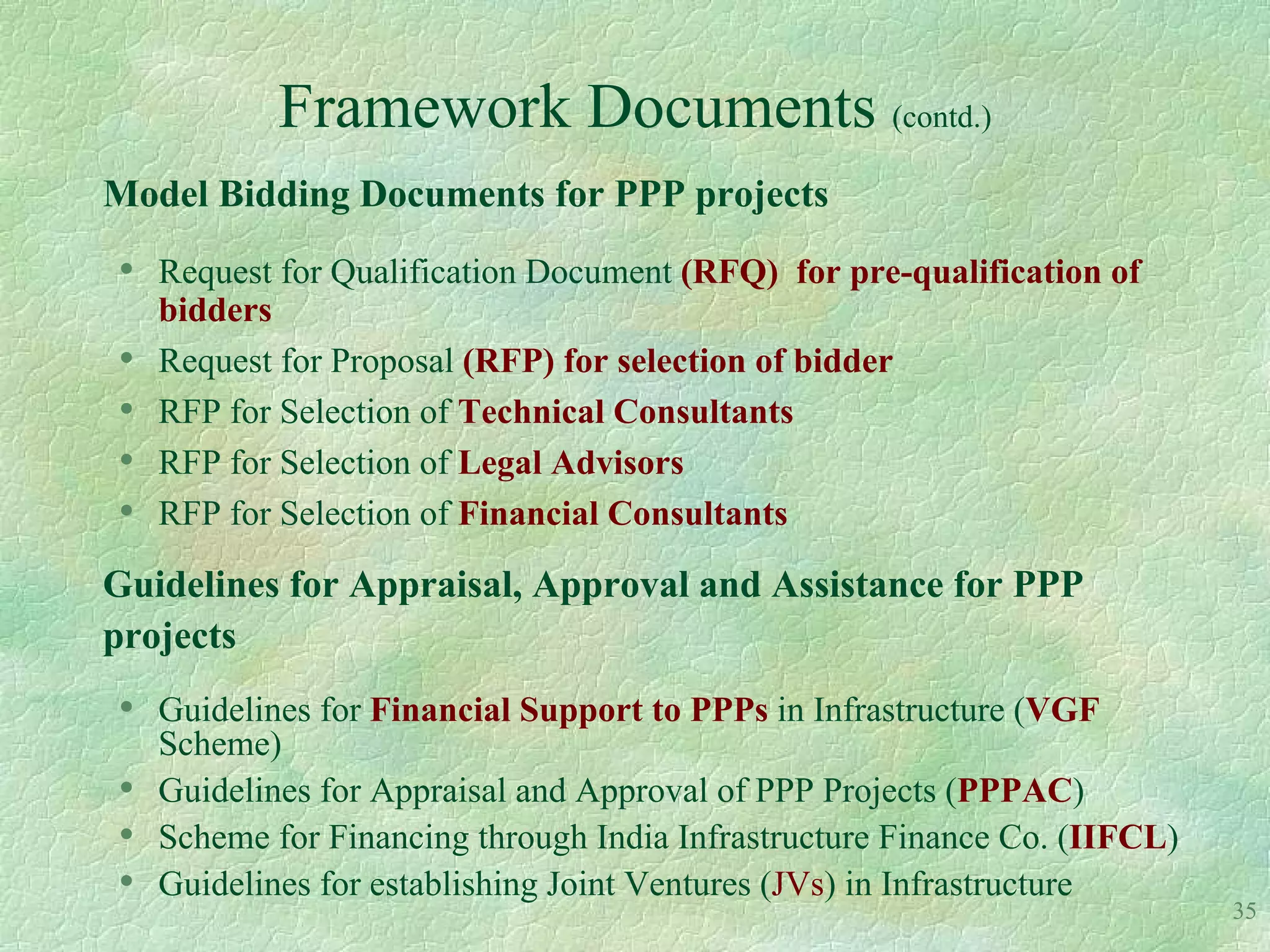
Framework Documents (contd.)
Model Bidding Documents for PPP projects
•   Request for Qualification Document (RFQ) for pre-qualification of
    bidders
•   Request for Proposal (RFP) for selection of bidder
•   RFP for Selection of Technical Consultants
•   RFP for Selection of Legal Advisors
•   RFP for Selection of Financial Consultants

Guidelines for Appraisal, Approval and Assistance for PPP
projects
•   Guidelines for Financial Support to PPPs in Infrastructure (VGF
    Scheme)
•   Guidelines for Appraisal and Approval of PPP Projects (PPPAC)
•   Scheme for Financing through India Infrastructure Finance Co. (IIFCL)
•   Guidelines for establishing Joint Ventures (JVs) in Infrastructure
                                                                            35
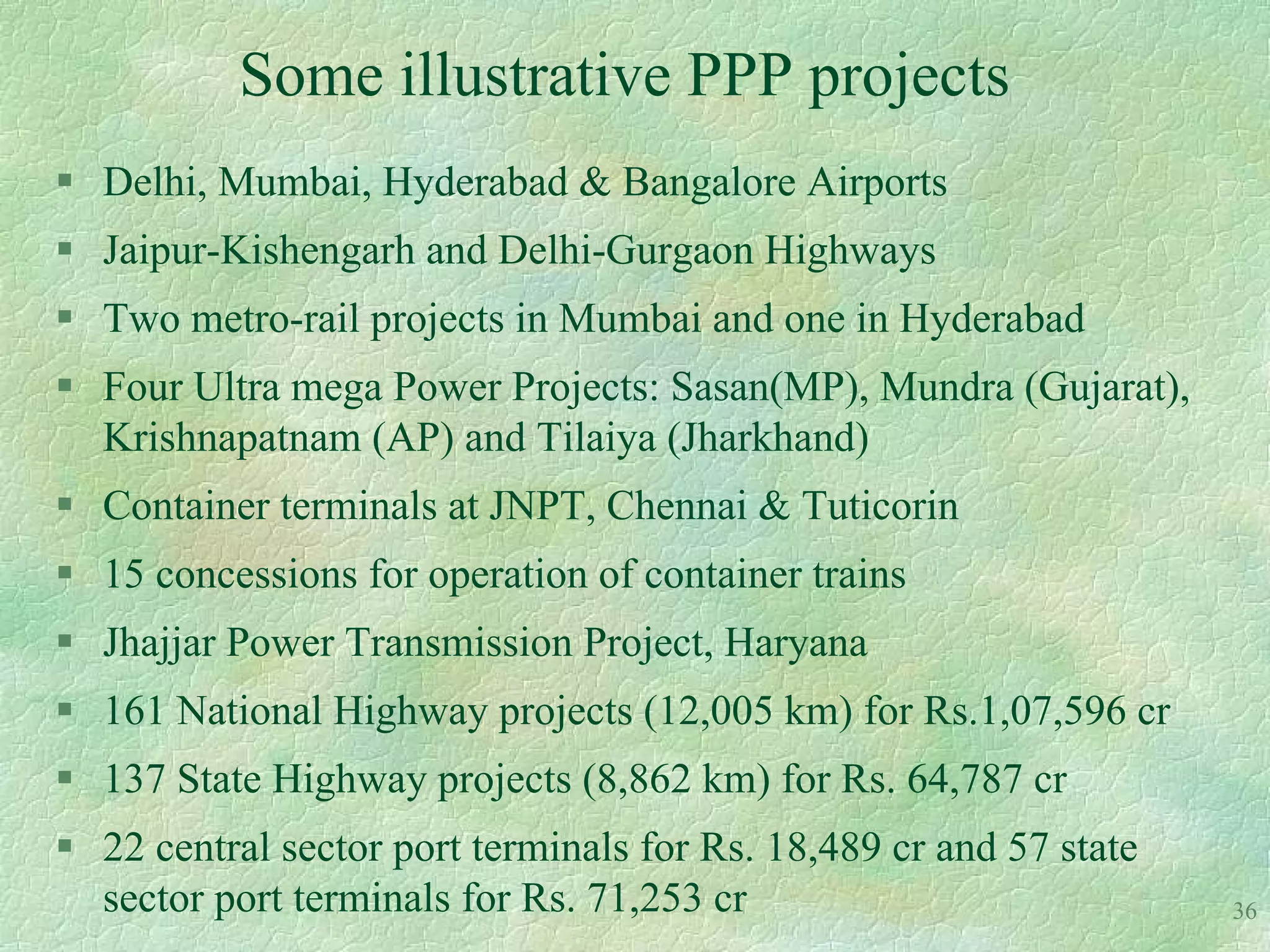
Some illustrative PPP projects
 Delhi, Mumbai, Hyderabad & Bangalore Airports
 Jaipur-Kishengarh and Delhi-Gurgaon Highways
 Two metro-rail projects in Mumbai and one in Hyderabad
 Four Ultra mega Power Projects: Sasan(MP), Mundra (Gujarat),
  Krishnapatnam (AP) and Tilaiya (Jharkhand)
 Container terminals at JNPT, Chennai & Tuticorin
 15 concessions for operation of container trains
 Jhajjar Power Transmission Project, Haryana
 161 National Highway projects (12,005 km) for Rs.1,07,596 cr
 137 State Highway projects (8,862 km) for Rs. 64,787 cr
 22 central sector port terminals for Rs. 18,489 cr and 57 state
  sector port terminals for Rs. 71,253 cr                           36
Way forward
 Reinforce the enabling environment for private investment

 Adopt standardised documents for accelerating investment
  flows & for ensuring safe and competitive delivery

 Leverage budgetary resources & multi-lateral loans for PPPs

 Accelerate the roll-out of PPP projects

 Enhance the flow of long-term debt to infrastructure sector

 Objective is to create world class infrastructure
                                                                37
Thank You


For further details please visit
 http://infrastructure.gov.in

2012-17 India Infrastructure Needs

  • 1.
    Doubling Investment inInfrastructure to Rs. 41 lakh cr. ($1 tr.) for India’s 12th Five-Year Plan (2012-17) - Gajendra Haldea March 4, 2011 New Delhi
  • 2.
    Infrastructure Deficit Power  13.3% peaking deficit and 10.1% energy shortage; 27% T&D losses; absence of competition; and inadequate private investment Highways  70,548 Km of NH (2% of network, 40% of traffic): only 18% Four- lane; 52% Two-lane; and 30% Single-lane; State highways also suffer from prolonged neglect Ports  Inadequate berths, rail / road connectivity and draft are constraints Airports  Inadequate capacity: Runways, aircraft handling capacity, parking space & terminal buildings Railways  Old technology; saturated routes: slow average speeds (freight: 22 kmph; passengers: 50 kmph); low payload to Tare ratio (2.5) 2
  • 3.
    XI Plan (2007-12): RevisedProjections: US $ 514 bn. (Rs.20,54,205 cr.) Business as Usual: US$ 467 bn (Rs. 18,67,227 cr.) 3
  • 4.
    Projected Investment inInfrastructure: 11th Plan (at 2006-07 prices) X Plan XI Plan Rs. crore Share Rs. crore Share Sectors (US$ bn) (%) (US$ bn) (%) Electricity (incl. NCE) 3,40,237 (85) 37.0 6,58,630 (165) 32.1 Roads and Bridges 1,27,107 (32) 13.8 2,78,658 (70) 13.6 Telecommunication 1,01,889 (25) 11.1 3,45,134 (86) 16.8 Railways (incl. MRTS) 1,02,091 (26) 11.1 2,00,802 (50) 9.8 Irrigation (incl. Watershed) 1,19,894 (30) 13.0 2,46,234 (62) 12.0 Water Supply & Sanitation 60,108 (15) 6.5 1,11,689 (28) 5.4 Ports 22,997 (6) 2.5 40,647 (10) 2.0 Airports 6,893 (2) 0.7 36,138 (9) 1.8 Storage 5,643 (1) 0.6 8,966 (2) 0.4 Oil & Gas Pipelines 32,367 (8) 3.5 1,27,306 (32) 6.2 Total 9,19,225 (230) 100 20,54,205 (514) 100 4
  • 5.
  • 6.
  • 7.
  • 8.
  • 9.
    XII Plan: Projected: US$ 1,046 bn. (Rs. 41,85,338 cr.) Log Linear Projection: US $ 1011 bn. (Rs. 40,42,891 cr.) 9
  • 10.
    Projected Investment inInfrastructure based on Growth Targets: Twelfth Plan (Rs. crore at 2006-07 prices) Total Base Year 2012-13 2013-14 2014-15 2015-16 2016-17 Twelfth (2011-12) Plan GDPmp 63,14,265 68,82,549 75,01,978 81,77,156 89,13,100 97,15,280 4,11,90,064 GDP growth 9.00 9.00 9.00 9.00 9.00 9.00 9.00 rate (%) Infrastructure investment as 8.37 9.00 9.50 9.90 10.30 10.70 9.95 % of GDPmp Infrastructure 5,28,316 6,19,429 7,12,688 8,09,538 9,18,049 10,39,535 40,99,240 investment 10
  • 11.
    Methodology of Projections Using2011-12 as the base year, the following annual growth rates have been assumed for Twelfth Plan period. Central Sector: 9% in all sectors State Sector: 9% in electricity, roads, railways, irrigation, water supply & sanitation. 5% in ports, airports and storage Private Sector: 25% in all sectors Growth rates were assumed based on past trends and perceived sectoral dynamics in the Plan period. 11
  • 12.
    Sectoral break-up ofProjected Investment: 12th Plan (at 2006-07 prices) XI Plan XII Plan Rs. crore Share Rs. crore Share Sectors (US$ bn) (%) (US$ bn) (%) Electricity (incl. NCE) 6,58,630 (165) 32.1 1,289,946 (322) 30.8 Roads and Bridges 2,78,658 (70) 13.6 500,977 (125) 12.0 Telecommunication 3,45,134 (86) 16.8 1,095,550 (274) 26.2 Railways (incl. MRTS) 2,00,802 (50) 9.8 320,361 (80) 7.7 Irrigation (incl. Watershed) 2,46,234 (62) 12.0 387,808 (97) 9.3 Water Supply & Sanitation 1,11,689 (28) 5.4 173,730 (43) 4.2 Ports 40,647 (10) 2.0 63,452 (16) 1.5 Airports 36,138 (9) 1.8 65,656 (16) 1.6 Storage 8,966 (2) 0.4 29,376 (7) 0.7 Oil & Gas Pipelines 1,27,306 (32) 6.2 258,482 (65) 6.2 Total 20,54,205 (514) 100 4,185,338 (1046) 100 12
  • 13.
  • 14.
    Investment by Centre,States & Private Sector (Rs. crore at 2006-07 prices) (per cent share in brackets) Tenth Plan Eleventh Plan Twelfth Plan Centre 3,69,763 6,90,926 11,19,358 (40) (34) (27) States 3,24,242 6,20,367 9,66,779 (35) (30) (23) Private 2,25,220 7,42,912 20,99,201 (25) (36) (50) Total 9,19,225 20,54,205 41,85,338 14
  • 15.
    Division of Labour  Public Sector to continue, and even expand - Especially in segments that can’t be commercialised, such as rural roads - Expected CAGR of budgetary allocations: about 9% in real terms  Increased reliance on PPPs for additionality & improved efficiency - In segments that can be commercialised, eg. highways, ports, airports & rail concessions - Much of additional investment through PPPs  Independent private investment wherever feasible - Telecom, power generation/supply, container trains etc. 15
  • 16.
    Paradigm Shift  Successfulreform initiatives have universally relied on: - leadership from head of government - creation of independent & inter-ministerial processes for overcoming incumbent pressures and perceptions  Infrastructure reforms in India have been led and by CoI/CCI  PPP has gained wide ownership and support across the government. A paradigm shift has occurred. 16
  • 17.
    Financial Support toPPPs  Viability Gap Funding (VGF) upto 20% of capital costs based on competetive bidding  270 central and state projects with an investment of Rs. 2,14,228 cr. (US$ 54 bn) cleared with a VGF commitment of Rs. 59,493 cr. (US$ 15 bn)  India Infrastructure Finance Company (IIFCL) provides upto 20% of capital costs as long-term debt for viable projects  IIFCL has sanctioned Rs. 27,779 cr. (US$ 7 bn) for 156 projects 17
  • 18.
    Financing Constraints  Competingdemands on budgetary resources: health, education, rural development, livelihood support programmes etc.  Budgetary allocation cannot be increased beyond 9% p.a. in real terms; reliance on private investment is inevitable  Private equity not viewed as a constraint; markets have responded well  Debt required by PSEs and private sector estimated at US$ 247 billion in 11th Plan (2007-12)  Possible debt gap of $ 40 bn; policy responses under way 18
  • 19.
    Issues in Financingby Banks  Excessive reliance on commercial banks (51%); lending rose from US$ 2 bn in FY 2000 to US$ 67 bn in FY 2009  Increase in bank exposure from 1.8% of their lending in FY 2001 to 10.2% in FY 2009; CAGR of over 40% in last 9 years  Tenure of bank loans is inadequate as their deposits are short/medium term  Asset-liability mismatch (ALM) is emerging as a serious regulatory issue constraining long-term financing by banks  Shorter tenures raises costs/user charges  Banks are exhausting their prudential limits in terms of sector, borrower and project exposure 19
  • 20.
    Lack of Long-termdebt  Insurance and pension funds have stayed away owing to their risk perceptions  Bond markets in India continue to be shallow  IIFCL was set up for providing long-term debt; a partial success  NBFC’s provide 27% of debt but not for long tenures  ECB is also limited in tenure  Tenure of debt is a significant issue in financing of infrastructure 20
  • 21.
    Long-term debt: PolicyResponses  Setting up Infrastructure Debt Funds to channelise long-term insurance & pension funds through credit enhancement  Introduction of tax-free Infrastructure Bonds  Take-out financing scheme introduced by IIFCL  High-level Committee set up to recommend policy initiatives necessary for financing US$ 1 trillion investment 21
  • 22.
    Policy Challenges  Challengesfor large capacity addition  Time-bound delivery under budgetary constraints  World class yet cost effective  Commercially sustainable yet affordable  Policy responses for attracting private investment  Policy and regulatory framework for PPPs is in place  Institutional restructuring and reorientation underway  Financial support being provided to bridge viability gap of PPP projects  IIFCL, Take-out Financing, Infrastructure Debt Funds etc. for long term debt 22
  • 23.
    Telecom: A spectacularsuccess story  Private investment increased from Rs. 5,936 cr. (US$ 1.5 bn) in 2002-03 to Rs. 51,019 cr. (US$ 12.8) in 2009-10 (8.6 times)  Share of private investment increased from 28 % in 2002-03 to 80% in 2009-10; CAGR of 36% during this period  Target of 15% tele-density by 2010 was achieved 3 years ahead of schedule  Over 10 million mobile connections added every month; total of 700 million by December 2010  Lowest tariffs in the world  Competition and access to consumers seems the driving force 23
  • 24.
    Power: Constrained growth T&D losses exceed 27%; provisional losses of Rs. 40,000 cr. (US$ 10 bn) in 2008-09; 14% peak shortage & 11% energy shortage  About 6 bn units sold by traders to utilities at average price of 11 cents per unit for US$ 7 bn - highest tariff in the world  Traded power purchased solely by state-owned utilities; unregulated trading has increased utility losses sharply  CAGR of private investment 23% between 2002-03 and 2009-10  Absence of competition and access to consumers seems the principal cause for inadequate investment and shortages.  Opening up is expected to lead to a spurt in investment. 24
  • 25.
    Governance: Typical Issues Unwillingness of incumbents to cede control over construction & operation of projects  Denial of level playing field is an issue  Rent-seeking is also an issue  Inadequate and inefficient roll out of projects - The demand for PPP projects is far greater than their supply  Incumbent mindset constitutes a major challenge 25
  • 26.
    Governance Structure forPPPs  Constitution of a Cabinet Committee on Infrastructure (CCI) • Prime Minister is the Chairperson • Ministers of Infrastructure Ministries, Finance Minister and Deputy Chairman, Planning Commission are members  PPP Appraisal Committee • Appraises & recommends all PPP projects of the Central Government • Chaired by Finance; appraisal by Planning Commission • Cleared 205 projects with an investment of Rs. 1,71,404 cr. (US$ 43 bn)  Empowered Committee • Approves proposals of State Governments for Viability Gap Funding • Chaired by Finance; appraisal by Planning Commission • Cleared 65 projects with an investment of Rs. 42,824 cr. (US$ 11 bn) 26
  • 27.
    Governance Structure forPPPs (contd.)  PPPs have been integrated in the planning process  Ministries retain their role but work closely with CCI to develop & implement the vision for world-class infrastructure  Greater reliance on inter-ministerial and inter-disciplinary dialogue to enrich outcomes and eliminate conflicts of interest.  Consultations with stakeholders, including users and investors  Simplification & standardisation of documents & processes 27
  • 28.
    Typical documents forPPP projects  Substantive Documents - Concession Agreements - Manual of Specifications & Standards - Rules for user charges  Process Documents - RFP for selection of consultants - RFQ for pre-qualification of bidders - RFP for financial bids 28
  • 29.
    RFP for Selectionof Consultants  Assurance of independent and competent advice is critical  Consultants are often encumbered by conflicts of interest  Selection process, evaluation and agreement have been standardised in the Model RFP documents  Scope of work would need to be project specific  Technical Consultants needed for Feasibility Report; Legal Advisers for contract; and Financial Consultants for structuring and transaction support 29
  • 30.
    Model RFQ/RFP  Inthe past, divergent practices have led to sub-optimal outcomes, entailing legal and financial complications  Fair and transparent pre-qualification and bidding is a pre- requisite for competitive and efficient PPPs  Model RFQ/RFP establish generic guidelines; provide requisite sector-specific & project-specific flexibility  Accelerate and streamline decision-making; the matrix is simplified, quantitative and transparent 30
  • 31.
    Model RFQ/RFP (contd.) The evaluation criteria is divided into:  Technical Capability: based on project experience  Financial Capacity: based on the minimum networth required  Detailed terms are specified in the Concession Agreement which forms part of the RFP  Feasibility Report is provided for assistance; bidders expected to do their own due diligence  Financial bid based on a single pre-determined parameter 31
  • 32.
    Model Concession Agreement(MCA)  Enables limited recourse financing  Mitigates risks and allocates these to parties best suited to manage them - Concessionaire’s risks include construction, operation & traffic - Government’s risks include political force majeure, changes in scope, specifications or law  Specifies enforceable Performance Standards 32
  • 33.
    MCA (contd.)  Safeguardsthe public exchequer & user interests  Ensures predictability of costs, revenues and obligations  Reduces transaction costs and time  Relies on output specifications and service quality  Ensures financial close in 180 days  Provides for dispute resolution, force majeure and termination 33
  • 34.
    Framework Documents Model ConcessionAgreements published for PPP in: • National Highways • State Highways • Ports • Operation & Maintenance of Highways • Urban Rail Systems (Metro rail) • Container Train Operation • Redevelopment of Railway Stations • Non-metro Airports • Greenfield Airports • Procurement-cum-Maintenance of Locomotives • Transmission of electricity 34
  • 35.
    Framework Documents (contd.) ModelBidding Documents for PPP projects • Request for Qualification Document (RFQ) for pre-qualification of bidders • Request for Proposal (RFP) for selection of bidder • RFP for Selection of Technical Consultants • RFP for Selection of Legal Advisors • RFP for Selection of Financial Consultants Guidelines for Appraisal, Approval and Assistance for PPP projects • Guidelines for Financial Support to PPPs in Infrastructure (VGF Scheme) • Guidelines for Appraisal and Approval of PPP Projects (PPPAC) • Scheme for Financing through India Infrastructure Finance Co. (IIFCL) • Guidelines for establishing Joint Ventures (JVs) in Infrastructure 35
  • 36.
    Some illustrative PPPprojects  Delhi, Mumbai, Hyderabad & Bangalore Airports  Jaipur-Kishengarh and Delhi-Gurgaon Highways  Two metro-rail projects in Mumbai and one in Hyderabad  Four Ultra mega Power Projects: Sasan(MP), Mundra (Gujarat), Krishnapatnam (AP) and Tilaiya (Jharkhand)  Container terminals at JNPT, Chennai & Tuticorin  15 concessions for operation of container trains  Jhajjar Power Transmission Project, Haryana  161 National Highway projects (12,005 km) for Rs.1,07,596 cr  137 State Highway projects (8,862 km) for Rs. 64,787 cr  22 central sector port terminals for Rs. 18,489 cr and 57 state sector port terminals for Rs. 71,253 cr 36
  • 37.
    Way forward  Reinforcethe enabling environment for private investment  Adopt standardised documents for accelerating investment flows & for ensuring safe and competitive delivery  Leverage budgetary resources & multi-lateral loans for PPPs  Accelerate the roll-out of PPP projects  Enhance the flow of long-term debt to infrastructure sector  Objective is to create world class infrastructure 37
  • 38.
    Thank You For furtherdetails please visit http://infrastructure.gov.in