INFRASTRUCTURE SECTOR
IN INDIA
By Mentees of
Prof. Pallavi Badre
•Ekta Mandpe
•Hitesh Sonkuwar
•Sumedh Badole
By Mentees of
Prof. Pallavi
Sangole
•Gaurav Hedaoo
•Mohammed umer
•Pradeep Meshram
INTRODUCTION
 Infrastructure sector is a key driver for the Indian
economy. It is a wide-ranging sector which
includes electricity, roads, airports, railways,
water systems, public utilities, and
telecommunications.
 Highways, ports, airports, roads, and rail are all
necessary conduits for commerce, making their
construction, improvement, and expansion all
the more vital.
 India's infrastructure and transport sector
contributes about 5% of its GDP.
CONTD…
 Government in the budget has allocated Rs
3,96,135 crores (almost 4 trillion) for the sector
during the next Financial Year 2017-18.
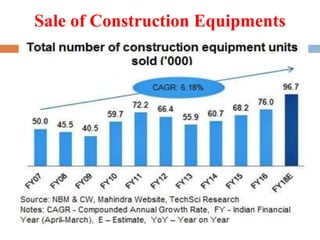
 The Indian construction equipment industry is
expected to grow to US$ 5 billion by FY2019-20
from current size of US$ 2.8 billion
 India needs Rs 31 trillion (US$ 454.83 billion) to
be spent on infrastructure development over the
next five years, with 70 per cent of funds
needed for power, roads and urban
infrastructure segments.
MARKET SIZE
 India needs Rs 31 trillion(US$ 454.83 billion)
to be spent on infrastructure development over
the next five years, with 70 per cent funds
needed for power, roads and urban
infrastructure segment.
 The Indian power sector itself has an
investment potential of US$ 250 billion in the
next 4-5 years, providing immense
opportunities in power generation, distribution,
transmission and equipment, according to Mr
Piyush Goyal, Union minister of coal, power
and renewable energy.
CONTD…
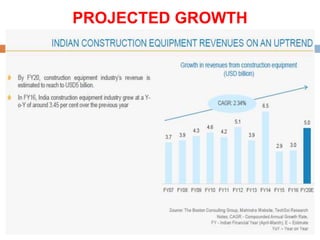
 The Indian construction equipment industry is
reviving after a gap of four year and is expected to
grow to US$ 5 billion by FY 2019-20 from current
size of US$ 2.8 billion, according to a report
released by the Indian Construction Equipment
Manufacturers’ Association(ICEMA).
 Foreign Direct Investment (FDI) received in
construction development sector from April 2000
to march 2016 stood at US $24.19 billion,
according to the Department of Industrial Policy
and Promotion (DIPP)
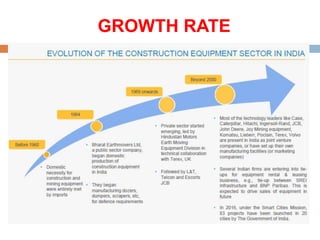
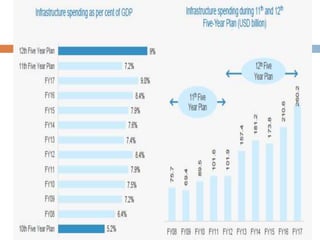
GROWTH RATE
MAJOR PLAYERS .
Larsen & Toubro
Jaypee Group
Mahindra Rise
Punj Llyod
Gammon India
CONTD…
Tata Hitachi
JCB
BEML
JSW steel
NTPC
PROJECTED GROWTH
Sale of Construction Equipments
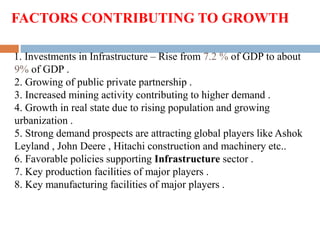
FACTORS CONTRIBUTING TO GROWTH
1. Investments in Infrastructure – Rise from 7.2 % of GDP to about
9% of GDP .
2. Growing of public private partnership .
3. Increased mining activity contributing to higher demand .
4. Growth in real state due to rising population and growing
urbanization .
5. Strong demand prospects are attracting global players like Ashok
Leyland , John Deere , Hitachi construction and machinery etc..
6. Favorable policies supporting Infrastructure sector .
7. Key production facilities of major players .
8. Key manufacturing facilities of major players .
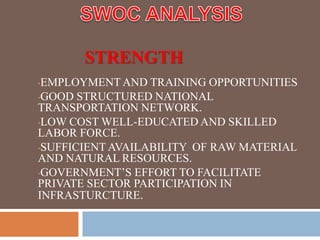
STRENGTH
•EMPLOYMENT AND TRAINING OPPORTUNITIES
•GOOD STRUCTURED NATIONAL
TRANSPORTATION NETWORK.
•LOW COST WELL-EDUCATED AND SKILLED
LABOR FORCE.
•SUFFICIENT AVAILABILITY OF RAW MATERIAL
AND NATURAL RESOURCES.
•GOVERNMENT’S EFFORT TO FACILITATE
PRIVATE SECTOR PARTICIPATION IN
INFRASTURCTURE.
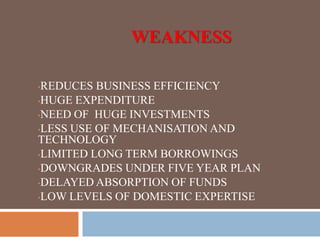
WEAKNESS
•REDUCES BUSINESS EFFICIENCY
•HUGE EXPENDITURE
•NEED OF HUGE INVESTMENTS
•LESS USE OF MECHANISATION AND
TECHNOLOGY
•LIMITED LONG TERM BORROWINGS
•DOWNGRADES UNDER FIVE YEAR PLAN
•DELAYED ABSORPTION OF FUNDS
•LOW LEVELS OF DOMESTIC EXPERTISE
OPPORTUNITIES
•GREEN FIELD PROJECTS
•ROADS AND HIGHWAYS
•RAILWAYS
•PORTS AND AIRPORTS
•POWER
•PUBLIC-PRIVATE PARTNERSHIPS(PPP)
CHALLENGES
•OIL AND GAS
•POWER
•URBAN INFRANSTRUCTURE
•UNEVEN PRIVATE PARTNERSHIP
•LAND AQUISITON
•INFRASTRUCTURE GAP
•THE NEW REGULATORY FRAMEWORK
•GOVERNANCE RELATED CONCERN
•NATURAL CALAMITY
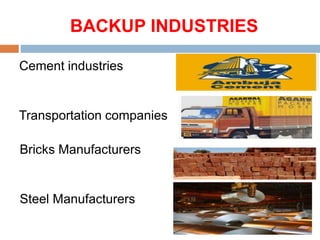
BACKUP INDUSTRIES
Cement industries
Transportation companies
Bricks Manufacturers
Steel Manufacturers
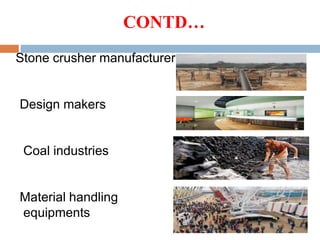
CONTD…
Stone crusher manufacturer
Design makers
Coal industries
Material handling
equipments
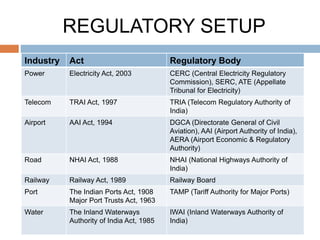
REGULATORY SETUP
Industry Act Regulatory Body
Power Electricity Act, 2003 CERC (Central Electricity Regulatory
Commission), SERC, ATE (Appellate
Tribunal for Electricity)
Telecom TRAI Act, 1997 TRIA (Telecom Regulatory Authority of
India)
Airport AAI Act, 1994 DGCA (Directorate General of Civil
Aviation), AAI (Airport Authority of India),
AERA (Airport Economic & Regulatory
Authority)
Road NHAI Act, 1988 NHAI (National Highways Authority of
India)
Railway Railway Act, 1989 Railway Board
Port The Indian Ports Act, 1908
Major Port Trusts Act, 1963
TAMP (Tariff Authority for Major Ports)
Water The Inland Waterways
Authority of India Act, 1985
IWAI (Inland Waterways Authority of
India)
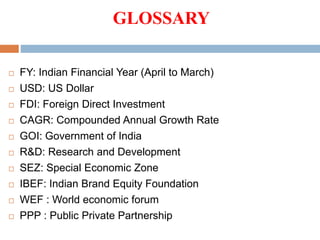
GLOSSARY
 FY: Indian Financial Year (April to March)
 USD: US Dollar
 FDI: Foreign Direct Investment
 CAGR: Compounded Annual Growth Rate
 GOI: Government of India
 R&D: Research and Development
 SEZ: Special Economic Zone
 IBEF: Indian Brand Equity Foundation
 WEF : World economic forum
 PPP : Public Private Partnership
REFERENCES
 http://www.ibef.org/industry/infrastructure-sector-
india.aspx
 http://planningcommission.gov.in/plans/planrel/12
appdrft/appraoch_12plan.pdf
Infrastructure sector in India

Infrastructure sector in India

  • 1.
    INFRASTRUCTURE SECTOR IN INDIA ByMentees of Prof. Pallavi Badre •Ekta Mandpe •Hitesh Sonkuwar •Sumedh Badole By Mentees of Prof. Pallavi Sangole •Gaurav Hedaoo •Mohammed umer •Pradeep Meshram
  • 2.
    INTRODUCTION  Infrastructure sectoris a key driver for the Indian economy. It is a wide-ranging sector which includes electricity, roads, airports, railways, water systems, public utilities, and telecommunications.  Highways, ports, airports, roads, and rail are all necessary conduits for commerce, making their construction, improvement, and expansion all the more vital.  India's infrastructure and transport sector contributes about 5% of its GDP.
  • 3.
    CONTD…  Government inthe budget has allocated Rs 3,96,135 crores (almost 4 trillion) for the sector during the next Financial Year 2017-18.  The Indian construction equipment industry is expected to grow to US$ 5 billion by FY2019-20 from current size of US$ 2.8 billion  India needs Rs 31 trillion (US$ 454.83 billion) to be spent on infrastructure development over the next five years, with 70 per cent of funds needed for power, roads and urban infrastructure segments.
  • 4.
    MARKET SIZE  Indianeeds Rs 31 trillion(US$ 454.83 billion) to be spent on infrastructure development over the next five years, with 70 per cent funds needed for power, roads and urban infrastructure segment.  The Indian power sector itself has an investment potential of US$ 250 billion in the next 4-5 years, providing immense opportunities in power generation, distribution, transmission and equipment, according to Mr Piyush Goyal, Union minister of coal, power and renewable energy.
  • 5.
    CONTD…  The Indianconstruction equipment industry is reviving after a gap of four year and is expected to grow to US$ 5 billion by FY 2019-20 from current size of US$ 2.8 billion, according to a report released by the Indian Construction Equipment Manufacturers’ Association(ICEMA).  Foreign Direct Investment (FDI) received in construction development sector from April 2000 to march 2016 stood at US $24.19 billion, according to the Department of Industrial Policy and Promotion (DIPP)
  • 6.
  • 9.
    MAJOR PLAYERS . Larsen& Toubro Jaypee Group Mahindra Rise Punj Llyod Gammon India
  • 10.
  • 11.
  • 12.
  • 13.
    FACTORS CONTRIBUTING TOGROWTH 1. Investments in Infrastructure – Rise from 7.2 % of GDP to about 9% of GDP . 2. Growing of public private partnership . 3. Increased mining activity contributing to higher demand . 4. Growth in real state due to rising population and growing urbanization . 5. Strong demand prospects are attracting global players like Ashok Leyland , John Deere , Hitachi construction and machinery etc.. 6. Favorable policies supporting Infrastructure sector . 7. Key production facilities of major players . 8. Key manufacturing facilities of major players .
  • 14.
    STRENGTH •EMPLOYMENT AND TRAININGOPPORTUNITIES •GOOD STRUCTURED NATIONAL TRANSPORTATION NETWORK. •LOW COST WELL-EDUCATED AND SKILLED LABOR FORCE. •SUFFICIENT AVAILABILITY OF RAW MATERIAL AND NATURAL RESOURCES. •GOVERNMENT’S EFFORT TO FACILITATE PRIVATE SECTOR PARTICIPATION IN INFRASTURCTURE.
  • 15.
    WEAKNESS •REDUCES BUSINESS EFFICIENCY •HUGEEXPENDITURE •NEED OF HUGE INVESTMENTS •LESS USE OF MECHANISATION AND TECHNOLOGY •LIMITED LONG TERM BORROWINGS •DOWNGRADES UNDER FIVE YEAR PLAN •DELAYED ABSORPTION OF FUNDS •LOW LEVELS OF DOMESTIC EXPERTISE
  • 16.
    OPPORTUNITIES •GREEN FIELD PROJECTS •ROADSAND HIGHWAYS •RAILWAYS •PORTS AND AIRPORTS •POWER •PUBLIC-PRIVATE PARTNERSHIPS(PPP)
  • 17.
    CHALLENGES •OIL AND GAS •POWER •URBANINFRANSTRUCTURE •UNEVEN PRIVATE PARTNERSHIP •LAND AQUISITON •INFRASTRUCTURE GAP •THE NEW REGULATORY FRAMEWORK •GOVERNANCE RELATED CONCERN •NATURAL CALAMITY
  • 18.
    BACKUP INDUSTRIES Cement industries Transportationcompanies Bricks Manufacturers Steel Manufacturers
  • 19.
    CONTD… Stone crusher manufacturer Designmakers Coal industries Material handling equipments
  • 20.
    REGULATORY SETUP Industry ActRegulatory Body Power Electricity Act, 2003 CERC (Central Electricity Regulatory Commission), SERC, ATE (Appellate Tribunal for Electricity) Telecom TRAI Act, 1997 TRIA (Telecom Regulatory Authority of India) Airport AAI Act, 1994 DGCA (Directorate General of Civil Aviation), AAI (Airport Authority of India), AERA (Airport Economic & Regulatory Authority) Road NHAI Act, 1988 NHAI (National Highways Authority of India) Railway Railway Act, 1989 Railway Board Port The Indian Ports Act, 1908 Major Port Trusts Act, 1963 TAMP (Tariff Authority for Major Ports) Water The Inland Waterways Authority of India Act, 1985 IWAI (Inland Waterways Authority of India)
  • 21.
    GLOSSARY  FY: IndianFinancial Year (April to March)  USD: US Dollar  FDI: Foreign Direct Investment  CAGR: Compounded Annual Growth Rate  GOI: Government of India  R&D: Research and Development  SEZ: Special Economic Zone  IBEF: Indian Brand Equity Foundation  WEF : World economic forum  PPP : Public Private Partnership
  • 22.