INDIA INFRASTRUCTURE
PERSPECTIVE & TRENDS
Vaibhav Jha
@ SJMSoM, IIT Bombay
On 31st Jan, 2018
CONTENT
 India Infrastructure Push – A comparative Perspective
 India infrastructure initiatives
 Conclusion
“I guess this means we are
an emerging economy”
Source: Cartoonstock.com
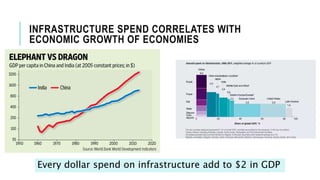
INFRASTRUCTURE SPEND CORRELATES WITH
ECONOMIC GROWTH OF ECONOMIES
Every dollar spend on infrastructure add to $2 in GDP
SECTOR WISE CONTRIBUTION OF EXPORTS
India has highest %age of services as part of exports. This has its
disadvantages
TYPES OF INFRASTRUCTURE
Most of the investment being talked about in India are in Hard and Soft
Economic type
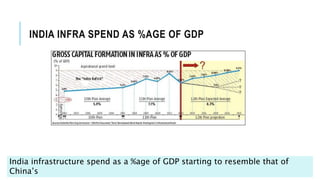
INDIA INFRA SPEND AS %AGE OF GDP
India infrastructure spend as a %age of GDP starting to resemble that of
China’s
INDIA IS EXPECTED TO IMPROVE MANUFACTURING
COMPETITIVENESS GOING FORWARD
That US will be #1 shows the future of manufacturing will be driven by
automation. Brazil & Russia will keep struggling due to political factors.
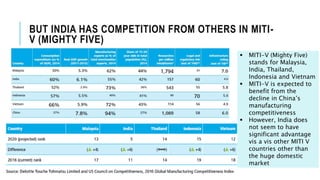
BUT INDIA HAS COMPETITION FROM OTHERS IN MITI-
V (MIGHTY FIVE)
 MITI-V (Mighty Five)
stands for Malaysia,
India, Thailand,
Indonesia and Vietnam
 MITI-V is expected to
benefit from the
decline in China’s
manufacturing
competitiveness
 However, India does
not seem to have
significant advantage
vis a vis other MITI V
countries other than
the huge domestic
market
HARD AND SOFT INFRASTRUCTURE ARE THE BASIS OF
MANUFACTURING COMPETITIVENESS
Most of the top ranked criteria for manufacturing competitiveness are soft
infrastructure related
* The numbers in boxes are the rank of
the importance of drivers
Source : Global CEO Survey (Deloitte Manufacturing Competitiveness Survey (2016)
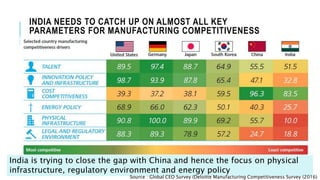
INDIA NEEDS TO CATCH UP ON ALMOST ALL KEY
PARAMETERS FOR MANUFACTURING COMPETITIVENESS
India is trying to close the gap with China and hence the focus on physical
infrastructure, regulatory environment and energy policy
Source : Global CEO Survey (Deloitte Manufacturing Competitiveness Survey (2016)
 India Infrastructure Push – A comparative Perspective
 India infrastructure initiatives
 Conclusion
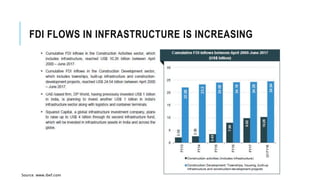
FDI FLOWS IN INFRASTRUCTURE IS INCREASING
Source: www.ibef.com
STRONG MOMENTUM IN EXPANSION OF ROADWAYS
Source: www.ibef.com
RAILWAY ACTIVITY IS ALSO LOOKING UP
Source: www.ibef.com
POWER GENERATION HAS GROWN AT A GOOD PACE
Source: www.ibef.com
OTHER GOVERNMENT INITIATIVES
Source: www.ibef.com
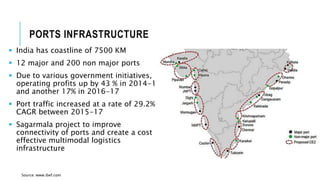
PORTS INFRASTRUCTURE
 India has coastline of 7500 KM
 12 major and 200 non major ports
 Due to various government initiatives,
operating profits up by 43 % in 2014-15
and another 17% in 2016-17
 Port traffic increased at a rate of 29.2%
CAGR between 2015-17
 Sagarmala project to improve
connectivity of ports and create a cost
effective multimodal logistics
infrastructure
Source: www.ibef.com
LOGISTICS COSTS IN INDIA ARE SUBOPTIMAL
 Logistics cost in India is 14% of the cost of goods compared to
global average of 6%
 Logistics cost in India (USD 7/KM) for road transport as compared to
USD 2.5 in China, USD 3 in SL and USD 2.5 in Bangladesh
 The proposed integrated transport and logistics framework is
expected to increase the average speed of freight transport from
current 20-25 KM/hour to 50-60 KM/hour
 Investment of Rs. 5L crore to create hub and spoke model
Source: www.ibef.com
INLAND WATERWAYS
 India has 14,500 KM of inland
navigable waterways
 However cargo movement
through this route is 0.1% of total
inland traffic
Source: www.ibef.com
LONG WAY TO GO IN EASING THE BUSINESS
TALENT IS IN ABUNDANCE BUT NOT COMPETITIVE
 India Infrastructure Push – A comparative Perspective
 India infrastructure initiatives
 Conclusion
BUT FUTURE IS TRICKY!!! ARE WE READY?
Future will belong to the Artificially Intelligent nations. India is barely
beyond the start line.
CLOSING THOUGHTS
 India needs to overcome historic scarcity of infrastructure spend by spending
more in order to improve the manufacturing competitiveness
 While hard infrastructure spends are in right direction soft social infrastructure
too needs to be hauled up
 The future of manufacturing will look for much higher skills and automation,
soft infrastructure focus is a must to overcome that
Thank you!!
REFERENCES
1. Deloitte Global Manufacturing Competitiveness Index (2016)
2. Infrastructure Report by IBEF
3. Personal research – primary and secondary

India infrastructure Trends

  • 1.
    INDIA INFRASTRUCTURE PERSPECTIVE &TRENDS Vaibhav Jha @ SJMSoM, IIT Bombay On 31st Jan, 2018
  • 2.
    CONTENT  India InfrastructurePush – A comparative Perspective  India infrastructure initiatives  Conclusion
  • 3.
    “I guess thismeans we are an emerging economy” Source: Cartoonstock.com
  • 4.
    INFRASTRUCTURE SPEND CORRELATESWITH ECONOMIC GROWTH OF ECONOMIES Every dollar spend on infrastructure add to $2 in GDP
  • 5.
    SECTOR WISE CONTRIBUTIONOF EXPORTS India has highest %age of services as part of exports. This has its disadvantages
  • 6.
    TYPES OF INFRASTRUCTURE Mostof the investment being talked about in India are in Hard and Soft Economic type
  • 7.
    INDIA INFRA SPENDAS %AGE OF GDP India infrastructure spend as a %age of GDP starting to resemble that of China’s
  • 8.
    INDIA IS EXPECTEDTO IMPROVE MANUFACTURING COMPETITIVENESS GOING FORWARD That US will be #1 shows the future of manufacturing will be driven by automation. Brazil & Russia will keep struggling due to political factors.
  • 9.
    BUT INDIA HASCOMPETITION FROM OTHERS IN MITI- V (MIGHTY FIVE)  MITI-V (Mighty Five) stands for Malaysia, India, Thailand, Indonesia and Vietnam  MITI-V is expected to benefit from the decline in China’s manufacturing competitiveness  However, India does not seem to have significant advantage vis a vis other MITI V countries other than the huge domestic market
  • 10.
    HARD AND SOFTINFRASTRUCTURE ARE THE BASIS OF MANUFACTURING COMPETITIVENESS Most of the top ranked criteria for manufacturing competitiveness are soft infrastructure related * The numbers in boxes are the rank of the importance of drivers Source : Global CEO Survey (Deloitte Manufacturing Competitiveness Survey (2016)
  • 11.
    INDIA NEEDS TOCATCH UP ON ALMOST ALL KEY PARAMETERS FOR MANUFACTURING COMPETITIVENESS India is trying to close the gap with China and hence the focus on physical infrastructure, regulatory environment and energy policy Source : Global CEO Survey (Deloitte Manufacturing Competitiveness Survey (2016)
  • 12.
     India InfrastructurePush – A comparative Perspective  India infrastructure initiatives  Conclusion
  • 13.
    FDI FLOWS ININFRASTRUCTURE IS INCREASING Source: www.ibef.com
  • 14.
    STRONG MOMENTUM INEXPANSION OF ROADWAYS Source: www.ibef.com
  • 15.
    RAILWAY ACTIVITY ISALSO LOOKING UP Source: www.ibef.com
  • 16.
    POWER GENERATION HASGROWN AT A GOOD PACE Source: www.ibef.com
  • 17.
  • 18.
    PORTS INFRASTRUCTURE  Indiahas coastline of 7500 KM  12 major and 200 non major ports  Due to various government initiatives, operating profits up by 43 % in 2014-15 and another 17% in 2016-17  Port traffic increased at a rate of 29.2% CAGR between 2015-17  Sagarmala project to improve connectivity of ports and create a cost effective multimodal logistics infrastructure Source: www.ibef.com
  • 19.
    LOGISTICS COSTS ININDIA ARE SUBOPTIMAL  Logistics cost in India is 14% of the cost of goods compared to global average of 6%  Logistics cost in India (USD 7/KM) for road transport as compared to USD 2.5 in China, USD 3 in SL and USD 2.5 in Bangladesh  The proposed integrated transport and logistics framework is expected to increase the average speed of freight transport from current 20-25 KM/hour to 50-60 KM/hour  Investment of Rs. 5L crore to create hub and spoke model Source: www.ibef.com
  • 20.
    INLAND WATERWAYS  Indiahas 14,500 KM of inland navigable waterways  However cargo movement through this route is 0.1% of total inland traffic Source: www.ibef.com
  • 21.
    LONG WAY TOGO IN EASING THE BUSINESS
  • 22.
    TALENT IS INABUNDANCE BUT NOT COMPETITIVE
  • 23.
     India InfrastructurePush – A comparative Perspective  India infrastructure initiatives  Conclusion
  • 24.
    BUT FUTURE ISTRICKY!!! ARE WE READY? Future will belong to the Artificially Intelligent nations. India is barely beyond the start line.
  • 25.
    CLOSING THOUGHTS  Indianeeds to overcome historic scarcity of infrastructure spend by spending more in order to improve the manufacturing competitiveness  While hard infrastructure spends are in right direction soft social infrastructure too needs to be hauled up  The future of manufacturing will look for much higher skills and automation, soft infrastructure focus is a must to overcome that
  • 26.
  • 27.
    REFERENCES 1. Deloitte GlobalManufacturing Competitiveness Index (2016) 2. Infrastructure Report by IBEF 3. Personal research – primary and secondary