VECTORS
Mickey Frost
Frances Coronel
!
Pre-Calculus
Mrs. Zborowski
Definition
directed line segment where the length
represents magnitude and the direction
represents direction
used to represent quantities with both
magnitude and direction (i.e. force, velocity)
Visualize
Initial Point:(1,2)
Terminal Point:(4,4)
Definition-Pictures
Initial Point:(1,2)
Terminal Point:(4,4)
1
2
3
4
1 2 3 4
5
6
7
8
9
75 6 8 9
10
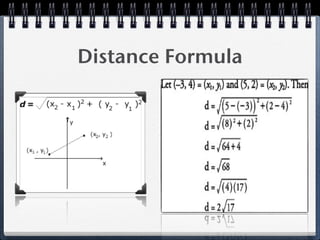
Distance Formula
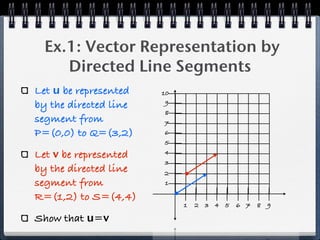
Ex.1: Vector Representation by
Directed Line Segments
Let u be represented
by the directed line
segment from
P=(0,0) to Q=(3,2)
Let v be represented
by the directed line
segment from
R=(1,2) to S=(4,4)
Show that u=v
Definition-Pictures
Initial Point:(1,2)
Terminal Point:(4,4)
1
2
3
4
1 2 3 4
5
6
7
8
9
75 6 8 9
10
Solution to Ex.1
Distance=
The distance formula shows PQ and RS have same magnitude.
✓ IIPQII =√((3-0)²+(2-0)²)=√13
✓ IIRSII =√((4-1)²+(4-2)²)=√13
Both line segments have same direction because they are both
directed towards upper right on lines having slope of 2/3. SO
IIPQII and IIRSII have same magnitude and direction so u=v
Component Form of Vector
Component Form of vector with initial point
P(p1,p2) and terminal point Q(q1,q2) is given by:
PQ= <q₁-p₁, q₂-p₂>=<v₁,V₂>=v
Magnitude (length) is given by:
IIvII= √((q₁-p₁)²+(q₂-p₂)²)= √v₁²+V₂²
If IIvII is 1, v --->unit vector
IIvII=o if and only if v is the zero vector 0
Ex.2: Component Form of
Vectors
Find
component
form and
magnitude of
vector v that
has initial
point (4,-7)
and terminal
point (-1,5)
PQ= <-1-4, 5-(-7)>=<-5,12>=v
PQ= <q₁-p₁, q₂-p₂>=<v₁,V₂>=v
So P=(4,-7)=(p₁,p₂) and
Q=(-1,5)=(q₁,q₂)
Finding
component
form
SO v=<-5,12> and
magnitude of v is:
IIvII=√v₁²+V₂²
IIvII=√(-5)²+(12)²
IIvII=√169
IIvII=13
Finding
magnitude
IIvII=√(25+144)
Two Basic Vector
Operations
1. Scalar Multiplication
2. Vector Addition
Definitions of Vector
Operations
Let u=<u₁,u₂> and v=<v₁, v₂> be vectors
and let k be a scalar (a real number). Then the
sum of u and v is the vector
u+v = <u₁+v₁, u₂+v₂>
and the scalar multiple of k times u is the vector
ku=k<u₁,u₂>=<ku₁,ku₂>
SUM
Scalar
Multiple
The negative of v=<v₁, v₂> is
-v=(-1)v
=<-v₁, -v₂>
and the difference of u and v is
u-v= u +(-v)
= <u₁-v₁, u₂-v₂>
Definitions of Vector
Operations Continued
Negative
Add (-v)
Differenc
Ex. 3: Vector Operations
Let v=<-2, 5> and w=<3,4> and find
each of the following vectors.
a. 2v
b. w-v
c. v+2w
Solution to Ex. 3
a. Because v=<-2,5>,
you have
2v=2<-2,5>
=<2(-2),2(5)>
=<-4,10>
b. The difference of w and
v is
w-v=<3-(-2), 4-5>
=<5,-1>
c. The sum of v and 2w is
=v+2w=<-2,5>
+2<3,4>
=<-2,5>+<2(3),2(4)>
=<-2,5>+<6,8>
=<-2+6, 5+8>
=<4,13>
v=<-2, 5> and w=<3,4>
Properties of Vector Addition and
Scalar Multiplication
1. u + v = v + u

2. (u + v) + w= u + (v + w) 

3. u + 0 = u

4. u + (-u) = 0 

6. (c+d)u= cu + d
7. c(du) = (cd)u

8. c(u + v) = cu + cv
9. IIcvII=IcI IIvII
For all vectors u,
v, and w, and for
all scalars c and
d, the following
properties are
true:
Unit Vectors
Definition: vector with magnitude of 1
It’s helpful to find unit vectors in same
direction as another vector
u= unit vector = v = 1
IIvII IIvII
v
Scalar
Vector
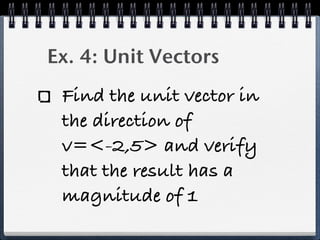
Ex. 4: Unit Vectors
Find the unit vector in
the direction of
v=<-2,5> and verify
that the result has a
magnitude of 1
Solution to Ex. 4
v =IIvII
<-2,5>
√(-2)²+(5)²
= 1
√29
<-2,5> =
√29 √29
< >
-2 5,
Vector has a magnitude of 1 because:
√ 2
√29( )+ 5
√29( )=√4
2 2
√29
+25
√29
= √29
29 =1
Standard Unit Vectors
Unit vectors <1,0> and <0,1> are referred to as standard
unit vectors denoted by
i=<1,0> and j=<0,1>
We use these to write component form of vectors as linear
combination of vectors i and j
<-1,1> = -1i+1j
Ex. 5: Standard Unit Vectors
Let u= -3i+8j and v=2i-j
=2u-3v
=2(-3i+8J)-3(2i-j)
=-6i+16j-6i+3j
=-12i+19j
Direction Angles
If v=ai+bj is any vector
that makes angle θ with
positive x-axis, it has the
same direction as u
v=IIvII <cosθ, sinθ>
=IIvII(cosθ)i+IIvII(sinθ)j
Direction angle is
then determined by:
tanθ = sinθ
cosθ
=
IIvIIsinθ
IIvIIcosθ
= b
a
Ex. 6: Direction Angles
Find direction angle for u=3i+3j
tan θ =3/3=1 so θ=45°
Find component form given IIvII=5/2 and θ=45°
=5/2 <cos(45°), sin(45°)>
=5/2 <√2/2, √2/2>
=<5/2(√2/2), 5/2(√2/2)>
=(5√2/4, 5√2/4)
Dot Product
u=<u₁,u₂> and v=<v₁, v₂>
u · v= u₁v₁+u₂v₂
Ex. 7
1) <3,4> · <2,-3>
=(3)(2)+(4)(-3)
=6+(-12)
= -6
Orthogonal
Vectors
Orthogonal Vectors exist when
the dot product=0
This means the vector is
perpendicular and normal
Ex. 8
Are the vectors orthogonal?
u=<-12,30> v= <5/4,1/2>
=(-12)(5/4)+(30)(1/2)
=-15+15=0
So yes they are.
Properties of Dot Product
1.u · v = v · u
2.0 · v = 0
3.u · (v+w) = u · v + u · w
4.v · v = IIvII²
5.c (u · v) = cu · v = u · cv
Let u, v, and w,
be vectors in the
plane or in space
and let c be a
scalar:
Angle Between 2 Vectors
u · v
IIuII IIvIIcosθ = angle θ ; 0 ≤ θ ≤ π
Ex.9
Find the angle between u=<4,3> and v= <3,5>
cosθ = u · v
IIuII IIvII
1. <4,3> · <3,5>
= 27
θ= arccos 27/5√34 ≈ 22.2°II<4,3>II II<3,5>II
(√4²+3²)(√3²+5²)
(√25)(√34)=5√34
5√34
Work
W= IIFII IIPQII
magnitude
Distance
W= cosθ IIFII IIPQII
Determine work done by lifting
2400 lbs car 5 feet with crane
W=2400lbsx5ft=1200 ft-lbs
To slide an object across a floor, a
person pulls a rope a constant force
of 25 lbs at a constant angle of 35°
above horizontal. Find work done if
object dragged 40 ft
W=(cos35°)(25lbs)(40ft)
!
W=819.5 ft-lbs
Pre-Calculus - Vectors

Pre-Calculus - Vectors

  • 1.
  • 2.
    Definition directed line segmentwhere the length represents magnitude and the direction represents direction used to represent quantities with both magnitude and direction (i.e. force, velocity)
  • 3.
    Visualize Initial Point:(1,2) Terminal Point:(4,4) Definition-Pictures InitialPoint:(1,2) Terminal Point:(4,4) 1 2 3 4 1 2 3 4 5 6 7 8 9 75 6 8 9 10
  • 4.
  • 5.
    Ex.1: Vector Representationby Directed Line Segments Let u be represented by the directed line segment from P=(0,0) to Q=(3,2) Let v be represented by the directed line segment from R=(1,2) to S=(4,4) Show that u=v Definition-Pictures Initial Point:(1,2) Terminal Point:(4,4) 1 2 3 4 1 2 3 4 5 6 7 8 9 75 6 8 9 10
  • 6.
    Solution to Ex.1 Distance= Thedistance formula shows PQ and RS have same magnitude. ✓ IIPQII =√((3-0)²+(2-0)²)=√13 ✓ IIRSII =√((4-1)²+(4-2)²)=√13 Both line segments have same direction because they are both directed towards upper right on lines having slope of 2/3. SO IIPQII and IIRSII have same magnitude and direction so u=v
  • 7.
    Component Form ofVector Component Form of vector with initial point P(p1,p2) and terminal point Q(q1,q2) is given by: PQ= <q₁-p₁, q₂-p₂>=<v₁,V₂>=v Magnitude (length) is given by: IIvII= √((q₁-p₁)²+(q₂-p₂)²)= √v₁²+V₂² If IIvII is 1, v --->unit vector IIvII=o if and only if v is the zero vector 0
  • 8.
    Ex.2: Component Formof Vectors Find component form and magnitude of vector v that has initial point (4,-7) and terminal point (-1,5) PQ= <-1-4, 5-(-7)>=<-5,12>=v PQ= <q₁-p₁, q₂-p₂>=<v₁,V₂>=v So P=(4,-7)=(p₁,p₂) and Q=(-1,5)=(q₁,q₂) Finding component form SO v=<-5,12> and magnitude of v is: IIvII=√v₁²+V₂² IIvII=√(-5)²+(12)² IIvII=√169 IIvII=13 Finding magnitude IIvII=√(25+144)
  • 9.
    Two Basic Vector Operations 1.Scalar Multiplication 2. Vector Addition
  • 10.
    Definitions of Vector Operations Letu=<u₁,u₂> and v=<v₁, v₂> be vectors and let k be a scalar (a real number). Then the sum of u and v is the vector u+v = <u₁+v₁, u₂+v₂> and the scalar multiple of k times u is the vector ku=k<u₁,u₂>=<ku₁,ku₂> SUM Scalar Multiple
  • 11.
    The negative ofv=<v₁, v₂> is -v=(-1)v =<-v₁, -v₂> and the difference of u and v is u-v= u +(-v) = <u₁-v₁, u₂-v₂> Definitions of Vector Operations Continued Negative Add (-v) Differenc
  • 12.
    Ex. 3: VectorOperations Let v=<-2, 5> and w=<3,4> and find each of the following vectors. a. 2v b. w-v c. v+2w
  • 13.
    Solution to Ex.3 a. Because v=<-2,5>, you have 2v=2<-2,5> =<2(-2),2(5)> =<-4,10> b. The difference of w and v is w-v=<3-(-2), 4-5> =<5,-1> c. The sum of v and 2w is =v+2w=<-2,5> +2<3,4> =<-2,5>+<2(3),2(4)> =<-2,5>+<6,8> =<-2+6, 5+8> =<4,13> v=<-2, 5> and w=<3,4>
  • 14.
    Properties of VectorAddition and Scalar Multiplication 1. u + v = v + u
 2. (u + v) + w= u + (v + w) 
 3. u + 0 = u
 4. u + (-u) = 0 
 6. (c+d)u= cu + d 7. c(du) = (cd)u
 8. c(u + v) = cu + cv 9. IIcvII=IcI IIvII For all vectors u, v, and w, and for all scalars c and d, the following properties are true:
  • 15.
    Unit Vectors Definition: vectorwith magnitude of 1 It’s helpful to find unit vectors in same direction as another vector u= unit vector = v = 1 IIvII IIvII v Scalar Vector
  • 16.
    Ex. 4: UnitVectors Find the unit vector in the direction of v=<-2,5> and verify that the result has a magnitude of 1
  • 17.
    Solution to Ex.4 v =IIvII <-2,5> √(-2)²+(5)² = 1 √29 <-2,5> = √29 √29 < > -2 5, Vector has a magnitude of 1 because: √ 2 √29( )+ 5 √29( )=√4 2 2 √29 +25 √29 = √29 29 =1
  • 18.
    Standard Unit Vectors Unitvectors <1,0> and <0,1> are referred to as standard unit vectors denoted by i=<1,0> and j=<0,1> We use these to write component form of vectors as linear combination of vectors i and j <-1,1> = -1i+1j
  • 19.
    Ex. 5: StandardUnit Vectors Let u= -3i+8j and v=2i-j =2u-3v =2(-3i+8J)-3(2i-j) =-6i+16j-6i+3j =-12i+19j
  • 20.
    Direction Angles If v=ai+bjis any vector that makes angle θ with positive x-axis, it has the same direction as u v=IIvII <cosθ, sinθ> =IIvII(cosθ)i+IIvII(sinθ)j Direction angle is then determined by: tanθ = sinθ cosθ = IIvIIsinθ IIvIIcosθ = b a
  • 21.
    Ex. 6: DirectionAngles Find direction angle for u=3i+3j tan θ =3/3=1 so θ=45° Find component form given IIvII=5/2 and θ=45° =5/2 <cos(45°), sin(45°)> =5/2 <√2/2, √2/2> =<5/2(√2/2), 5/2(√2/2)> =(5√2/4, 5√2/4)
  • 22.
    Dot Product u=<u₁,u₂> andv=<v₁, v₂> u · v= u₁v₁+u₂v₂ Ex. 7 1) <3,4> · <2,-3> =(3)(2)+(4)(-3) =6+(-12) = -6 Orthogonal Vectors Orthogonal Vectors exist when the dot product=0 This means the vector is perpendicular and normal Ex. 8 Are the vectors orthogonal? u=<-12,30> v= <5/4,1/2> =(-12)(5/4)+(30)(1/2) =-15+15=0 So yes they are.
  • 23.
    Properties of DotProduct 1.u · v = v · u 2.0 · v = 0 3.u · (v+w) = u · v + u · w 4.v · v = IIvII² 5.c (u · v) = cu · v = u · cv Let u, v, and w, be vectors in the plane or in space and let c be a scalar:
  • 24.
    Angle Between 2Vectors u · v IIuII IIvIIcosθ = angle θ ; 0 ≤ θ ≤ π Ex.9 Find the angle between u=<4,3> and v= <3,5> cosθ = u · v IIuII IIvII 1. <4,3> · <3,5> = 27 θ= arccos 27/5√34 ≈ 22.2°II<4,3>II II<3,5>II (√4²+3²)(√3²+5²) (√25)(√34)=5√34 5√34
  • 25.
    Work W= IIFII IIPQII magnitude Distance W=cosθ IIFII IIPQII Determine work done by lifting 2400 lbs car 5 feet with crane W=2400lbsx5ft=1200 ft-lbs To slide an object across a floor, a person pulls a rope a constant force of 25 lbs at a constant angle of 35° above horizontal. Find work done if object dragged 40 ft W=(cos35°)(25lbs)(40ft) ! W=819.5 ft-lbs