European Standardization in Facility Management
Backround, Targets, Status
Wolfgang Moderegger, AIS Management GmbH, Mรผnchen
Agenda


  European Standardization in Facility Management โ€“ CEN TC 348


  Guidance how to achieve/ensure quality in facility management
  Draft EN 15221 โ€“ Part 3


  Quality Management โ€“ Examples


  Contact
Existing Standards
EN 15221-1 und EN 15221-2


  EN 15221-1: Facility Management - Part 1:
  Terms and Definitions
  Version EN 15221-1:2006
  This draft European standard gives relevant terms and definitions in the area of Facility Management. It also provides a
  structure of facility services.


  EN 15221-2: Facility Management - Part 2:
  Facility Management โ€” Agreements -Guidance on how to prepare Facility Management agreements
  Version EN 15221-2:2006
  This document is a working and standardized tool intended for parties who wish to draw up the Facility Management
  agreement within the European Common Market. It offers headings, which are not exhaustive. Parties may or may not
  include, exclude, modify and adapt these headings to their own contracts.


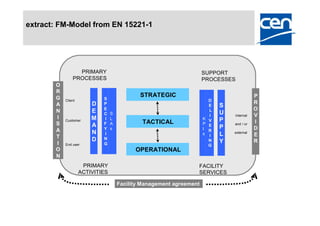
  Definition of Facility Management
  an integrated process to support and improve the effectiveness of the primary activities of an organization by the
  management and delivery of agreed support services for the appropriate environment that is needed to achieve its
  changing objectives
extract: FM-Model from EN 15221-1


                 PRIMARY                                             SUPPORT
               PROCESSES                                             PROCESSES
       O
       R
       G                                     STRATEGIC                                    P
           Client           S                                          D
       A                D   P                                                             R
                                                                       E   S
       N                E   E                                          L                  O
                            C    S                                     I
                                                                           U   Internal   V
       I   Customer     M   I    L                                   K V   P
       S                    F    A           TACTICAL                P E                  I
                        A        s                                         P
                                                                               and / or
                                                                                          D
       A                    Y                                        I R
                        N   I                                        s I   L   external
                                                                                          E
       T
                        D   N                                          N   Y              R
       I   End User
               user         G                                          G
       O                                   OPERATIONAL
       N
                     PRIMARY                                     FACILITY
                    ACTIVITIES                                   SERVICES

                                     Facility Management agreement
                                                         Agreement
current projects of the CEN TC 348


  EN 15221-3: facility management - Part 3:
  Guidance how to achieve/ensure quality in facility management
  Provides guidance how to measure, achieve and improve quality in fm. It gives complementary
  guidelines to ISO 9000, ISO 9001 and EN 15221-2 within the framework of EN 15221-1.

  EN 15221-4: facility management - Part 4:
  Taxonomy of facility management
  Focused on the concept of classified facility products / services by defining relevant interrelationship of service elements
  and their hierarchical structures, associated terms and cost allocation

  EN 15221-5: facility management - Part 5:
  Guidance on the development and improvement of processes
  Provides guidance to fm organisations on the development and improvement of their processes to support the primary
  activities.

  EN 15221-6: facility management - Part 6:
  Space measurement
  Area and space measurement for existing buildings
Agenda


  European Standardization in Facility Management โ€“ CEN TC 348


  Guidance how to achieve/ensure quality in facility management
  Draft EN 15221 โ€“ Part 3


  Quality Management โ€“ Examples


  Contact
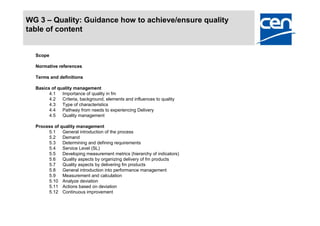
WG 3 โ€“ Quality: Guidance how to achieve/ensure quality
table of content


  Scope

  Normative references

  Terms and definitions

  Basics of quality management
        4.1   Importance of quality in fm
        4.2   Criteria, background, elements and influences to quality
        4.3   Type of characteristics
        4.4   Pathway from needs to experiencing Delivery
        4.5   Quality management

  Process of quality management
       5.1    General introduction of the process
       5.2    Demand
       5.3    Determining and defining requirements
       5.4    Service Level (SL)
       5.5    Developing measurement metrics (hierarchy of indicators)
       5.6    Quality aspects by organizing delivery of fm products
       5.7    Quality aspects by delivering fm products
       5.8    General introduction into performance management
       5.9    Measurement and calculation
       5.10 Analyze deviation
       5.11 Actions based on deviation
       5.12 Continuous improvement
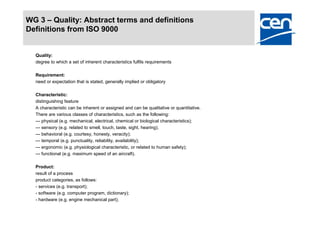
WG 3 โ€“ Quality: Abstract terms and definitions
Definitions from ISO 9000


  Quality:
  degree to which a set of inherent characteristics fulfils requirements

  Requirement:
  need or expectation that is stated, generally implied or obligatory

  Characteristic:
  distinguishing feature
  A characteristic can be inherent or assigned and can be qualitative or quantitative.
  There are various classes of characteristics, such as the following:
  โ€” physical (e.g. mechanical, electrical, chemical or biological characteristics);
  โ€” sensory (e.g. related to smell, touch, taste, sight, hearing);
  โ€” behavioral (e.g. courtesy, honesty, veracity);
  โ€” temporal (e.g. punctuality, reliability, availability);
  โ€” ergonomic (e.g. physiological characteristic, or related to human safety);
  โ€” functional (e.g. maximum speed of an aircraft).

  Product:
  result of a process
  product categories, as follows:
  - services (e.g. transport);
  - software (e.g. computer program, dictionary);
  - hardware (e.g. engine mechanical part);
WG 3 โ€“ Quality: abstract of terms and definitions


  grade
  Category or rank given to different quality requirements for products, processes or systems having the same functional
  use.

  service level
  Complete description of requirements of a product, process or system with their characteristics.
  The described set of characteristics in the SL can be graded within boundaries suitable for measurement and analysis.

  indicator
  Ceasured or calculated characteristic (or a set of characteristics) of a product according to a given formula, which
  assess the status or level of performance at defined time.

  key performance indicator
  Indicator that provides essential information about performance of the clientยดs organisation.
  The key performance indicators have to be given by the clientยดs organisation, based on its strategic goals pursuing the
  development of the primary activities.

  fm-indicator
  Indicator that measures the quality of fm products.
  They are used on different levels (e.g. strategic, tactical or operational Level).

  fm-key performance indicator (fm kpi)
  Indicator directly impacting the primary activities and the objectives of the clientยดs organisation.
  Fm-indicator linked to client's organisation objectives and related product which directly impacts the primary activities.
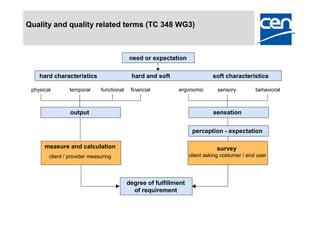
Quality and quality related terms (TC 348 WG3)


                                           need or expectation

    hard characteristics                    hard and soft                    soft characteristics

 physical       temporal      functional    financial        ergonomic         sensory         behavioral


                 output                                                      sensation


                                                                    perception - expectation

      measure and calculation                                                  survey
        client / provider measuring                                client asking costumer / end user


                                           degree of fulfillment
                                             of requirement
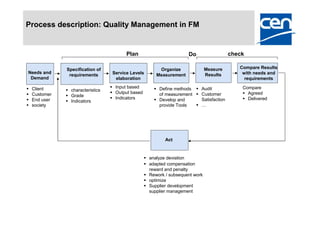
Process description: Quality Management in FM


                                         Plan                          Do                  check

               Specification of                           Organize               Measure      Compare Results
Needs and                          Service Levels                                              with needs and
                requirements                             Measurement             Results
 Demand                             elaboration                                                 requirements

๏‚ง   Client                         ๏‚ง Input based        ๏‚ง Define methods ๏‚ง Audit               Compare
               ๏‚ง characteristics
๏‚ง   Customer                       ๏‚ง Output based         of measurement ๏‚ง Customer            ๏‚ง Agreed
               ๏‚ง Grade
๏‚ง   End user                       ๏‚ง Indicators         ๏‚ง Develop and      Satisfaction        ๏‚ง Delivered
               ๏‚ง Indicators
๏‚ง   society                                               provide Tools  ๏‚ง โ€ฆ


                                                             Act


                                                    ๏‚ง analyze deviation
                                                    ๏‚ง adapted compensation
                                                      reward and penalty
                                                    ๏‚ง Rework / subsequent work
                                                    ๏‚ง optimize
                                                    ๏‚ง Supplier development
                                                      supplier management
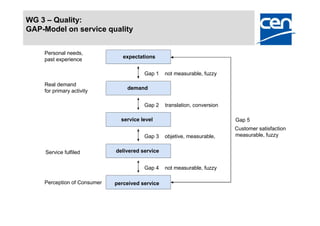
WG 3 โ€“ Quality:
GAP-Model on service quality


    Personal needs,
                                expectations
    past experience

                                        Gap 1    not measurable, fuzzy

    Real demand
                                 demand
    for primary activity

                                        Gap 2    translation, conversion

                               service level                               Gap 5
                                                                           Customer satisfaction
                                        Gap 3    objetive, measurable,     measurable, fuzzy


     Service fulfiled        delivered service


                                        Gap 4    not measurable, fuzzy

    Perception of Consumer   perceived service
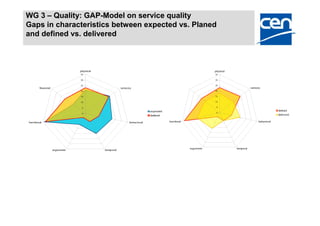
WG 3 โ€“ Quality: GAP-Model on service quality
Gaps in characteristics between expected vs. Planed
and defined vs. delivered
Agenda


  European Standardization in Facility Management โ€“ CEN TC 348


  Guidance how to achieve/ensure quality in facility management
  Draft EN 15221 โ€“ Part 3


  Quality Management โ€“ Examples


  Contact
Kontakt


Wolfgang Moderegger
Rosenheimer StraรŸe 139
81671 Mรผnchen
Deutschland

Telefon: +49 (0)89 / 62 81 70-0
Telefax: +49 (0)89 / 62 81 70-59
E-Mail:  w.moderegger@ais-management.de
Twitter: @wolfmode
Homepage: www.ais-management.de

20091127 Din En 15221 3

  • 1.
    European Standardization inFacility Management Backround, Targets, Status Wolfgang Moderegger, AIS Management GmbH, Mรผnchen
  • 2.
    Agenda EuropeanStandardization in Facility Management โ€“ CEN TC 348 Guidance how to achieve/ensure quality in facility management Draft EN 15221 โ€“ Part 3 Quality Management โ€“ Examples Contact
  • 3.
    Existing Standards EN 15221-1und EN 15221-2 EN 15221-1: Facility Management - Part 1: Terms and Definitions Version EN 15221-1:2006 This draft European standard gives relevant terms and definitions in the area of Facility Management. It also provides a structure of facility services. EN 15221-2: Facility Management - Part 2: Facility Management โ€” Agreements -Guidance on how to prepare Facility Management agreements Version EN 15221-2:2006 This document is a working and standardized tool intended for parties who wish to draw up the Facility Management agreement within the European Common Market. It offers headings, which are not exhaustive. Parties may or may not include, exclude, modify and adapt these headings to their own contracts. Definition of Facility Management an integrated process to support and improve the effectiveness of the primary activities of an organization by the management and delivery of agreed support services for the appropriate environment that is needed to achieve its changing objectives
  • 4.
    extract: FM-Model fromEN 15221-1 PRIMARY SUPPORT PROCESSES PROCESSES O R G STRATEGIC P Client S D A D P R E S N E E L O C S I U Internal V I Customer M I L K V P S F A TACTICAL P E I A s P and / or D A Y I R N I s I L external E T D N N Y R I End User user G G O OPERATIONAL N PRIMARY FACILITY ACTIVITIES SERVICES Facility Management agreement Agreement
  • 5.
    current projects ofthe CEN TC 348 EN 15221-3: facility management - Part 3: Guidance how to achieve/ensure quality in facility management Provides guidance how to measure, achieve and improve quality in fm. It gives complementary guidelines to ISO 9000, ISO 9001 and EN 15221-2 within the framework of EN 15221-1. EN 15221-4: facility management - Part 4: Taxonomy of facility management Focused on the concept of classified facility products / services by defining relevant interrelationship of service elements and their hierarchical structures, associated terms and cost allocation EN 15221-5: facility management - Part 5: Guidance on the development and improvement of processes Provides guidance to fm organisations on the development and improvement of their processes to support the primary activities. EN 15221-6: facility management - Part 6: Space measurement Area and space measurement for existing buildings
  • 6.
    Agenda EuropeanStandardization in Facility Management โ€“ CEN TC 348 Guidance how to achieve/ensure quality in facility management Draft EN 15221 โ€“ Part 3 Quality Management โ€“ Examples Contact
  • 7.
    WG 3 โ€“Quality: Guidance how to achieve/ensure quality table of content Scope Normative references Terms and definitions Basics of quality management 4.1 Importance of quality in fm 4.2 Criteria, background, elements and influences to quality 4.3 Type of characteristics 4.4 Pathway from needs to experiencing Delivery 4.5 Quality management Process of quality management 5.1 General introduction of the process 5.2 Demand 5.3 Determining and defining requirements 5.4 Service Level (SL) 5.5 Developing measurement metrics (hierarchy of indicators) 5.6 Quality aspects by organizing delivery of fm products 5.7 Quality aspects by delivering fm products 5.8 General introduction into performance management 5.9 Measurement and calculation 5.10 Analyze deviation 5.11 Actions based on deviation 5.12 Continuous improvement
  • 8.
    WG 3 โ€“Quality: Abstract terms and definitions Definitions from ISO 9000 Quality: degree to which a set of inherent characteristics fulfils requirements Requirement: need or expectation that is stated, generally implied or obligatory Characteristic: distinguishing feature A characteristic can be inherent or assigned and can be qualitative or quantitative. There are various classes of characteristics, such as the following: โ€” physical (e.g. mechanical, electrical, chemical or biological characteristics); โ€” sensory (e.g. related to smell, touch, taste, sight, hearing); โ€” behavioral (e.g. courtesy, honesty, veracity); โ€” temporal (e.g. punctuality, reliability, availability); โ€” ergonomic (e.g. physiological characteristic, or related to human safety); โ€” functional (e.g. maximum speed of an aircraft). Product: result of a process product categories, as follows: - services (e.g. transport); - software (e.g. computer program, dictionary); - hardware (e.g. engine mechanical part);
  • 9.
    WG 3 โ€“Quality: abstract of terms and definitions grade Category or rank given to different quality requirements for products, processes or systems having the same functional use. service level Complete description of requirements of a product, process or system with their characteristics. The described set of characteristics in the SL can be graded within boundaries suitable for measurement and analysis. indicator Ceasured or calculated characteristic (or a set of characteristics) of a product according to a given formula, which assess the status or level of performance at defined time. key performance indicator Indicator that provides essential information about performance of the clientยดs organisation. The key performance indicators have to be given by the clientยดs organisation, based on its strategic goals pursuing the development of the primary activities. fm-indicator Indicator that measures the quality of fm products. They are used on different levels (e.g. strategic, tactical or operational Level). fm-key performance indicator (fm kpi) Indicator directly impacting the primary activities and the objectives of the clientยดs organisation. Fm-indicator linked to client's organisation objectives and related product which directly impacts the primary activities.
  • 10.
    Quality and qualityrelated terms (TC 348 WG3) need or expectation hard characteristics hard and soft soft characteristics physical temporal functional financial ergonomic sensory behavioral output sensation perception - expectation measure and calculation survey client / provider measuring client asking costumer / end user degree of fulfillment of requirement
  • 11.
    Process description: QualityManagement in FM Plan Do check Specification of Organize Measure Compare Results Needs and Service Levels with needs and requirements Measurement Results Demand elaboration requirements ๏‚ง Client ๏‚ง Input based ๏‚ง Define methods ๏‚ง Audit Compare ๏‚ง characteristics ๏‚ง Customer ๏‚ง Output based of measurement ๏‚ง Customer ๏‚ง Agreed ๏‚ง Grade ๏‚ง End user ๏‚ง Indicators ๏‚ง Develop and Satisfaction ๏‚ง Delivered ๏‚ง Indicators ๏‚ง society provide Tools ๏‚ง โ€ฆ Act ๏‚ง analyze deviation ๏‚ง adapted compensation reward and penalty ๏‚ง Rework / subsequent work ๏‚ง optimize ๏‚ง Supplier development supplier management
  • 12.
    WG 3 โ€“Quality: GAP-Model on service quality Personal needs, expectations past experience Gap 1 not measurable, fuzzy Real demand demand for primary activity Gap 2 translation, conversion service level Gap 5 Customer satisfaction Gap 3 objetive, measurable, measurable, fuzzy Service fulfiled delivered service Gap 4 not measurable, fuzzy Perception of Consumer perceived service
  • 13.
    WG 3 โ€“Quality: GAP-Model on service quality Gaps in characteristics between expected vs. Planed and defined vs. delivered
  • 14.
    Agenda EuropeanStandardization in Facility Management โ€“ CEN TC 348 Guidance how to achieve/ensure quality in facility management Draft EN 15221 โ€“ Part 3 Quality Management โ€“ Examples Contact
  • 15.
    Kontakt Wolfgang Moderegger Rosenheimer StraรŸe139 81671 Mรผnchen Deutschland Telefon: +49 (0)89 / 62 81 70-0 Telefax: +49 (0)89 / 62 81 70-59 E-Mail: w.moderegger@ais-management.de Twitter: @wolfmode Homepage: www.ais-management.de