Introducing Puppet to
       SASAG
      Garrett Honeycutt
       May 14th, 2009
What?


•   Puppet is open source and released under GPL

•   Backed by Reductive Labs - great training and audits available

•   Used by organizations such as Google, Marchex, Whitepages.com,
    Stanford University, Harvard, Fedora, SANS Institute, etc..

•   “Puppet is a declarative language for expressing system configuration, a
    client and server for distributing it, and a library for realizing the
    configuration.” [1]
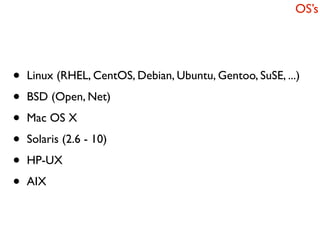
OS’s


•   Linux (RHEL, CentOS, Debian, Ubuntu, Gentoo, SuSE, ...)

•   BSD (Open, Net)

•   Mac OS X

•   Solaris (2.6 - 10)

•   HP-UX

•   AIX
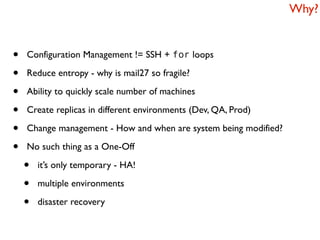
Why?


•   Configuration Management != SSH + for loops

•   Reduce entropy - why is mail27 so fragile?

•   Ability to quickly scale number of machines

•   Create replicas in different environments (Dev, QA, Prod)

•   Change management - How and when are system being modified?

•   No such thing as a One-Off

    •   it’s only temporary - HA!

    •   multiple environments

    •   disaster recovery
What?


•   Only need to describe parts of the system that you care about

    •   So you can start in existing environments

    •   not re-describe what a package already gets right
Idempotency


• Everything is built to be idempotent, even exec’s
 • no effect if the state is already achieved
 • safe to run multiple times
Repeatable State


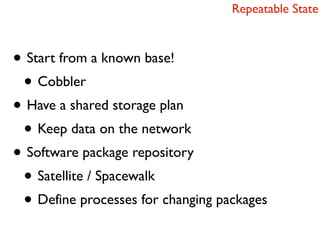
• Start from a known base!
 • Cobbler
• Have a shared storage plan
 • Keep data on the network
• Software package repository
 • Satellite / Spacewalk
 • Define processes for changing packages
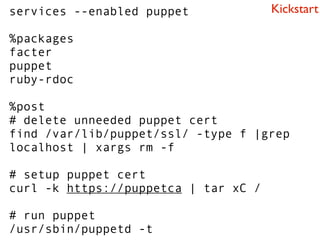
services --enabled puppet             Kickstart

%packages
facter
puppet
ruby-rdoc

%post
# delete unneeded puppet cert
find /var/lib/puppet/ssl/ -type f |grep
localhost | xargs rm -f

# setup puppet cert
curl -k https://puppetca | tar xC /

# run puppet
/usr/sbin/puppetd -t
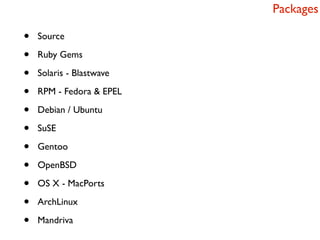
Packages

•   Source

•   Ruby Gems

•   Solaris - Blastwave

•   RPM - Fedora & EPEL

•   Debian / Ubuntu

•   SuSE

•   Gentoo

•   OpenBSD

•   OS X - MacPorts

•   ArchLinux

•   Mandriva
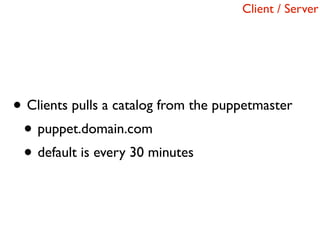
Client / Server


• Clients pulls a catalog from the puppetmaster
 • puppet.domain.com
 • default is every 30 minutes
Server


• webrick by default
• standard setup is web server (apache, nginx)
  reverse proxying to mongrel
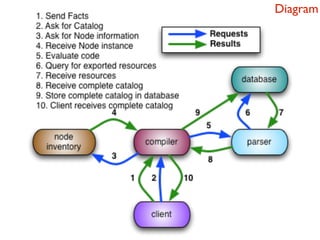
Diagram
Certs

 • Puppet communication is SSL encrypted XML-RPC
  • Supports auto signing - use with caution

[client]$ sudo puppetd --test

[puppetmaster]$ sudo puppetca --sign client.foo.com
Written by Robert Long IV                                              gencert.php
<?php
  # don't assume we have a path
  $gencert = "/usr/sbin/puppetca -g";
  $tar     = "/bin/tar";
  $sudo    = "/usr/bin/sudo";

  # set some   paths up.
  $cabase =    "/var/lib/puppet/ssl/";
  $certdir =   "$cabase/certs";
  $private =   "$cabase/private_keys";

  # yeah, its reverse DNS, but don't assume its safe.
  $host    = escapeshellarg(gethostbyaddr($_SERVER['REMOTE_ADDR']));

  # create the certs
  exec("$sudo $gencert $host", $out, $ret);
  $ret && error_log("Error creating cert for $host: $outn");

  # tar up the three files we need to make the client work.
  exec("$sudo $tar -c $certdir/$host.pem $private/$host.pem $certdir/ca.pem 2>/dev/
null", $certs, $ret);
  $ret && error_log("Error tar'ing cert for $host: $certsn");

  # most of this is useless, but it will give curl an idea of what to expect in terms
of content
  header("Content-Description: File Transfer");
  header('Content-disposition: attachment; filename='.$host.'tar');
  header("Content-Type: application/octet-stream");
  header("Content-Transfer-Encoding: binary");

  # and the content goes here.
  print join("n", $certs);
?>
Resource Abstraction Layer

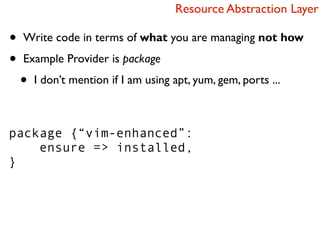
•   Write code in terms of what you are managing not how

•   Example Provider is package

    •   I don’t mention if I am using apt, yum, gem, ports ...


package {“vim-enhanced”:
    ensure => installed,
}
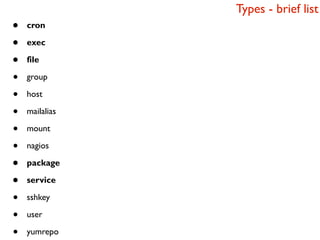
Types - brief list
•   cron

•   exec

•   file

•   group

•   host

•   mailalias

•   mount

•   nagios

•   package

•   service

•   sshkey

•   user

•   yumrepo
Facter
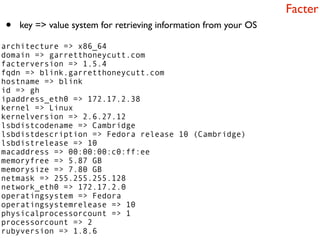
•   key => value system for retrieving information from your OS

architecture => x86_64
domain => garretthoneycutt.com
facterversion => 1.5.4
fqdn => blink.garretthoneycutt.com
hostname => blink
id => gh
ipaddress_eth0 => 172.17.2.38
kernel => Linux
kernelversion => 2.6.27.12
lsbdistcodename => Cambridge
lsbdistdescription => Fedora release 10 (Cambridge)
lsbdistrelease => 10
macaddress => 00:00:00:c0:ff:ee
memoryfree => 5.87 GB
memorysize => 7.80 GB
netmask => 255.255.255.128
network_eth0 => 172.17.2.0
operatingsystem => Fedora
operatingsystemrelease => 10
physicalprocessorcount => 1
processorcount => 2
rubyversion => 1.8.6
Facter

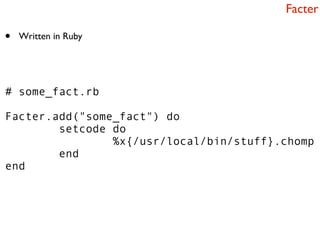
•   Written in Ruby


# some_fact.rb

Facter.add("some_fact") do
        setcode do
                %x{/usr/local/bin/stuff}.chomp
        end
end
You are a developer


• Speakeasy has 6000+ lines of code in one year
• You need a VCS
 • and plan on how to use it
 • go talk to your Dev’s - they’ve probably figured
    this all out
Different environments


• Puppet allows for the notion of different
  environments
 • It’s a hack
• Run a different puppet server in each
  environment
 • Easy to run different puppetmasters off of
    different branches/tags of your code
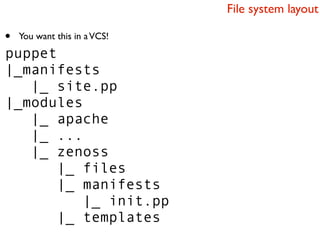
File system layout

•   You want this in a VCS!
puppet
|_manifests
   |_ site.pp
|_modules
   |_ apache
   |_ ...
   |_ zenoss
       |_ files
       |_ manifests
          |_ init.pp
       |_ templates
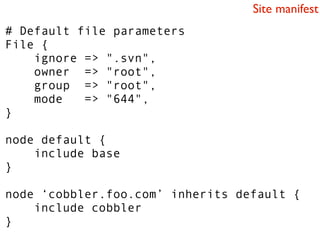
Site manifest
# Default file parameters
File {
    ignore => ".svn",
    owner => "root",
    group => "root",
    mode   => "644",
}

node default {
    include base
}

node ‘cobbler.foo.com’ inherits default {
    include cobbler
}
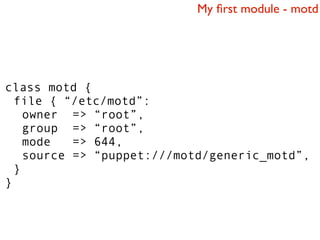
My first module - motd


class motd {
  file { “/etc/motd”:
    owner => “root”,
    group => “root”,
    mode   => 644,
    source => “puppet:///motd/generic_motd”,
  }
}
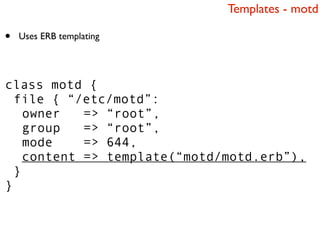
Templates - motd

•   Uses ERB templating


class motd {
  file { “/etc/motd”:
    owner   => “root”,
    group   => “root”,
    mode    => 644,
    content => template(“motd/motd.erb”),
  }
}
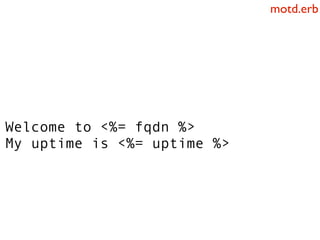
motd.erb


Welcome to <%= fqdn %>
My uptime is <%= uptime %>
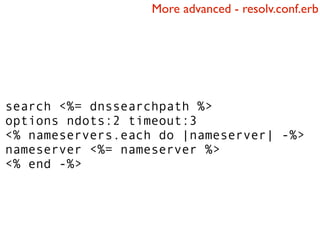
More advanced - resolv.conf.erb


search <%= dnssearchpath %>
options ndots:2 timeout:3
<% nameservers.each do |nameserver| -%>
nameserver <%= nameserver %>
<% end -%>
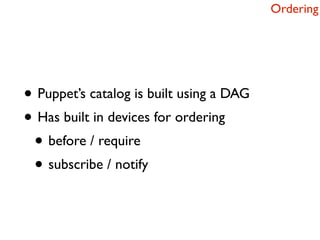
Ordering


• Puppet’s catalog is built using a DAG
• Has built in devices for ordering
 • before / require
 • subscribe / notify
Ordering - require


class vim {

    package { "vim-enhanced": ensure => installed, }

    file { "/etc/vimrc":
      source => "puppet:///vim/vimrc-$operatingsystem",
      mode => "644",
      require => Package["vim-enhanced"],
    }
}
Ordering - notify


class bind {

    package { "bind”: ensure => installed, }

    file { "/etc/named.conf":
      content => template("bind/named.conf.ern"),
      mode    => "644",
      notify => Service["named"],
    }

    service { “named”:
      ensure => running,
      enable => true,
      require => [ Package[“bind”], File[“/etc/
      named.conf”] ],
    }
}
Inheritance - postfix

class postfix {
  package { “postfix”: ensure => present }

    file { “/etc/postfix/aliases”:
      require => Package[“postfix”],
      content => template(“postfix/aliases.erb”),
      notify => Exec[“postalias”],
    }

    service {   “postfix”:
      ensure    => running,
      enable    => true,
      require   => Package[“postfix”],
    }

    exec { “postalias”:
      command     => “/usr/sbin/postalias /etc/postfix/aliases”,
      require     => File[“/etc/postfix/aliases”],
      refreshonly => true,
    }
}
Inheritance - postfix

class postfix::perim inherits postfix {
  File { “/etc/postfix/aliases”:
    content => template(“postfix/perim-aliases.erb”),
  }

    file { “/etc/postfix/sender_regexp”:
      require => Package[“postfix”],
      notify => Service[“postfix”],
      content => template(“postfix/sender_regexp.erb”),
    }
}

class postfix::voicemail inherits postfix {
  File { “/etc/postfix/aliases”:
    content => template(“postfix/voicemail-aliases.erb”),
  }

    file { “/etc/postfix/network_table”:
      require => Package[“postfix”],
      notify => Service[“postfix”],
      source => “puppet:///postfix/voicemail-network_table”,
    }
}
defines
class postfix {
 ... all that stuff from before

    define post_files() {
      File {
        require => Package[“postfix”],
        notify => Service[“postfix”],
      }
      file {
        “/etc/postfix/master.cf”:
         source => “puppet:///postfix/$name/master.cf”;
        “/etc/postfix/main.cf”:
         source => “puppet:///postfix/$name/main.cf”;
      }
    }
}

class postfix::voicemail inherits postfix {
  post_files {“voicemail”: }
}
Q &A
Garrett Honeycutt
 May 14th, 2009
References


•   1. http://reductivelabs.com/trac/puppet/wiki/BigPicture

•   Architecture diagram from slide 12 - http://reductivelabs.com/trac/
    puppet/wiki/ParsingArchitecture

20090514 Introducing Puppet To Sasag

  • 1.
    Introducing Puppet to SASAG Garrett Honeycutt May 14th, 2009
  • 2.
    What? • Puppet is open source and released under GPL • Backed by Reductive Labs - great training and audits available • Used by organizations such as Google, Marchex, Whitepages.com, Stanford University, Harvard, Fedora, SANS Institute, etc.. • “Puppet is a declarative language for expressing system configuration, a client and server for distributing it, and a library for realizing the configuration.” [1]
  • 3.
    OS’s • Linux (RHEL, CentOS, Debian, Ubuntu, Gentoo, SuSE, ...) • BSD (Open, Net) • Mac OS X • Solaris (2.6 - 10) • HP-UX • AIX
  • 4.
    Why? • Configuration Management != SSH + for loops • Reduce entropy - why is mail27 so fragile? • Ability to quickly scale number of machines • Create replicas in different environments (Dev, QA, Prod) • Change management - How and when are system being modified? • No such thing as a One-Off • it’s only temporary - HA! • multiple environments • disaster recovery
  • 5.
    What? • Only need to describe parts of the system that you care about • So you can start in existing environments • not re-describe what a package already gets right
  • 6.
    Idempotency • Everything isbuilt to be idempotent, even exec’s • no effect if the state is already achieved • safe to run multiple times
  • 7.
    Repeatable State • Startfrom a known base! • Cobbler • Have a shared storage plan • Keep data on the network • Software package repository • Satellite / Spacewalk • Define processes for changing packages
  • 8.
    services --enabled puppet Kickstart %packages facter puppet ruby-rdoc %post # delete unneeded puppet cert find /var/lib/puppet/ssl/ -type f |grep localhost | xargs rm -f # setup puppet cert curl -k https://puppetca | tar xC / # run puppet /usr/sbin/puppetd -t
  • 9.
    Packages • Source • Ruby Gems • Solaris - Blastwave • RPM - Fedora & EPEL • Debian / Ubuntu • SuSE • Gentoo • OpenBSD • OS X - MacPorts • ArchLinux • Mandriva
  • 10.
    Client / Server •Clients pulls a catalog from the puppetmaster • puppet.domain.com • default is every 30 minutes
  • 11.
    Server • webrick bydefault • standard setup is web server (apache, nginx) reverse proxying to mongrel
  • 12.
  • 13.
    Certs • Puppetcommunication is SSL encrypted XML-RPC • Supports auto signing - use with caution [client]$ sudo puppetd --test [puppetmaster]$ sudo puppetca --sign client.foo.com
  • 14.
    Written by RobertLong IV gencert.php <?php # don't assume we have a path $gencert = "/usr/sbin/puppetca -g"; $tar = "/bin/tar"; $sudo = "/usr/bin/sudo"; # set some paths up. $cabase = "/var/lib/puppet/ssl/"; $certdir = "$cabase/certs"; $private = "$cabase/private_keys"; # yeah, its reverse DNS, but don't assume its safe. $host = escapeshellarg(gethostbyaddr($_SERVER['REMOTE_ADDR'])); # create the certs exec("$sudo $gencert $host", $out, $ret); $ret && error_log("Error creating cert for $host: $outn"); # tar up the three files we need to make the client work. exec("$sudo $tar -c $certdir/$host.pem $private/$host.pem $certdir/ca.pem 2>/dev/ null", $certs, $ret); $ret && error_log("Error tar'ing cert for $host: $certsn"); # most of this is useless, but it will give curl an idea of what to expect in terms of content header("Content-Description: File Transfer"); header('Content-disposition: attachment; filename='.$host.'tar'); header("Content-Type: application/octet-stream"); header("Content-Transfer-Encoding: binary"); # and the content goes here. print join("n", $certs); ?>
  • 15.
    Resource Abstraction Layer • Write code in terms of what you are managing not how • Example Provider is package • I don’t mention if I am using apt, yum, gem, ports ... package {“vim-enhanced”: ensure => installed, }
  • 16.
    Types - brieflist • cron • exec • file • group • host • mailalias • mount • nagios • package • service • sshkey • user • yumrepo
  • 17.
    Facter • key => value system for retrieving information from your OS architecture => x86_64 domain => garretthoneycutt.com facterversion => 1.5.4 fqdn => blink.garretthoneycutt.com hostname => blink id => gh ipaddress_eth0 => 172.17.2.38 kernel => Linux kernelversion => 2.6.27.12 lsbdistcodename => Cambridge lsbdistdescription => Fedora release 10 (Cambridge) lsbdistrelease => 10 macaddress => 00:00:00:c0:ff:ee memoryfree => 5.87 GB memorysize => 7.80 GB netmask => 255.255.255.128 network_eth0 => 172.17.2.0 operatingsystem => Fedora operatingsystemrelease => 10 physicalprocessorcount => 1 processorcount => 2 rubyversion => 1.8.6
  • 18.
    Facter • Written in Ruby # some_fact.rb Facter.add("some_fact") do setcode do %x{/usr/local/bin/stuff}.chomp end end
  • 19.
    You are adeveloper • Speakeasy has 6000+ lines of code in one year • You need a VCS • and plan on how to use it • go talk to your Dev’s - they’ve probably figured this all out
  • 20.
    Different environments • Puppetallows for the notion of different environments • It’s a hack • Run a different puppet server in each environment • Easy to run different puppetmasters off of different branches/tags of your code
  • 21.
    File system layout • You want this in a VCS! puppet |_manifests |_ site.pp |_modules |_ apache |_ ... |_ zenoss |_ files |_ manifests |_ init.pp |_ templates
  • 22.
    Site manifest # Defaultfile parameters File { ignore => ".svn", owner => "root", group => "root", mode => "644", } node default { include base } node ‘cobbler.foo.com’ inherits default { include cobbler }
  • 23.
    My first module- motd class motd { file { “/etc/motd”: owner => “root”, group => “root”, mode => 644, source => “puppet:///motd/generic_motd”, } }
  • 24.
    Templates - motd • Uses ERB templating class motd { file { “/etc/motd”: owner => “root”, group => “root”, mode => 644, content => template(“motd/motd.erb”), } }
  • 25.
    motd.erb Welcome to <%=fqdn %> My uptime is <%= uptime %>
  • 26.
    More advanced -resolv.conf.erb search <%= dnssearchpath %> options ndots:2 timeout:3 <% nameservers.each do |nameserver| -%> nameserver <%= nameserver %> <% end -%>
  • 27.
    Ordering • Puppet’s catalogis built using a DAG • Has built in devices for ordering • before / require • subscribe / notify
  • 28.
    Ordering - require classvim { package { "vim-enhanced": ensure => installed, } file { "/etc/vimrc": source => "puppet:///vim/vimrc-$operatingsystem", mode => "644", require => Package["vim-enhanced"], } }
  • 29.
    Ordering - notify classbind { package { "bind”: ensure => installed, } file { "/etc/named.conf": content => template("bind/named.conf.ern"), mode => "644", notify => Service["named"], } service { “named”: ensure => running, enable => true, require => [ Package[“bind”], File[“/etc/ named.conf”] ], } }
  • 30.
    Inheritance - postfix classpostfix { package { “postfix”: ensure => present } file { “/etc/postfix/aliases”: require => Package[“postfix”], content => template(“postfix/aliases.erb”), notify => Exec[“postalias”], } service { “postfix”: ensure => running, enable => true, require => Package[“postfix”], } exec { “postalias”: command => “/usr/sbin/postalias /etc/postfix/aliases”, require => File[“/etc/postfix/aliases”], refreshonly => true, } }
  • 31.
    Inheritance - postfix classpostfix::perim inherits postfix { File { “/etc/postfix/aliases”: content => template(“postfix/perim-aliases.erb”), } file { “/etc/postfix/sender_regexp”: require => Package[“postfix”], notify => Service[“postfix”], content => template(“postfix/sender_regexp.erb”), } } class postfix::voicemail inherits postfix { File { “/etc/postfix/aliases”: content => template(“postfix/voicemail-aliases.erb”), } file { “/etc/postfix/network_table”: require => Package[“postfix”], notify => Service[“postfix”], source => “puppet:///postfix/voicemail-network_table”, } }
  • 32.
    defines class postfix { ... all that stuff from before define post_files() { File { require => Package[“postfix”], notify => Service[“postfix”], } file { “/etc/postfix/master.cf”: source => “puppet:///postfix/$name/master.cf”; “/etc/postfix/main.cf”: source => “puppet:///postfix/$name/main.cf”; } } } class postfix::voicemail inherits postfix { post_files {“voicemail”: } }
  • 33.
  • 34.
    References • 1. http://reductivelabs.com/trac/puppet/wiki/BigPicture • Architecture diagram from slide 12 - http://reductivelabs.com/trac/ puppet/wiki/ParsingArchitecture