How I hack Puppet
and made my life soo much easier
               by
         Kris Buytaert
Kris Buytaert
●   I used to be a Dev,
●   Then Became an Op
●   Chief Trolling Officer and Open Source
    Consultant @inuits.eu
●   Everything is an effing DNS Problem
●   Building Clouds since before the bookstore
●   Some books, some papers, some blogs
●   Evangelizing devops
●   But mostly, trying to be good at my job
Today

•   Vagrant
•   Style
•   Testing Puppet
•   Modules vs Modules
•   Jenkins
•   Demo ?
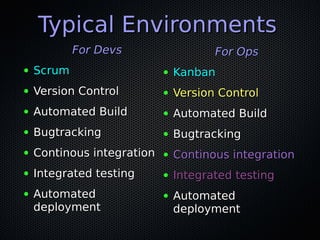
Typical Environments
            For Devs                   For Ops
●   Scrum                   ●   Kanban
●   Version Control         ●   Version Control
●   Automated Build         ●   Automated Build
●   Bugtracking             ●   Bugtracking
●   Continous integration   ●   Continous integration
●   Integrated testing      ●   Integrated testing
●   Automated               ●   Automated
    deployment                  deployment
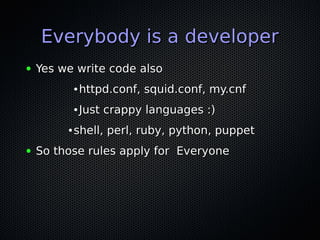
Everybody is a developer
●   Yes we write code also
             ●   httpd.conf, squid.conf, my.cnf
             ●   Just crappy languages :)
         ●   shell, perl, ruby, python, puppet
●   So those rules apply for Everyone
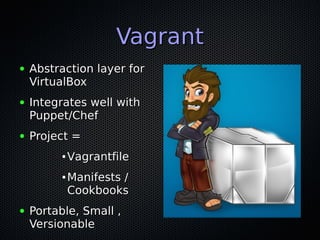
Vagrant
●   Abstraction layer for
    VirtualBox
●   Integrates well with
    Puppet/Chef
●   Project =
         ●   Vagrantfile
         ●   Manifests /
             Cookbooks
●   Portable, Small ,
    Versionable
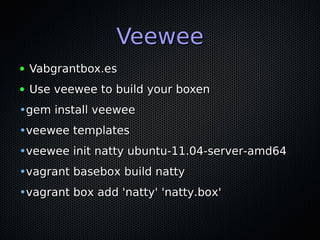
Veewee
●   Vabgrantbox.es
●   Use veewee to build your boxen
•gem install veewee
•veewee templates
•veewee init natty ubuntu-11.04-server-amd64
•vagrant basebox build natty
•vagrant box add 'natty' 'natty.box'
A Vagrant project

[sdog@mine vagrant-graphite]$ ls
manifests modules README TODO Vagrantfile
[sdog@mine vagrant-graphite]$ tree -dL 2
.
├── manifests
│   └── hosts
└── modules
   ├── apache
   ├── collectd
   ├── graphite
   ├── jmxtrans
   ├── logster
   ├── statsd
   └── tattle
10 directories
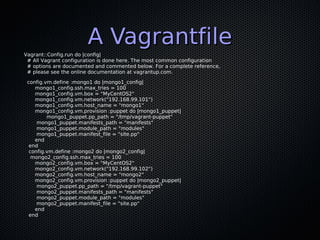
A Vagrantfile
Vagrant::Config.run do |config|
 # All Vagrant configuration is done here. The most common configuration
 # options are documented and commented below. For a complete reference,
 # please see the online documentation at vagrantup.com.

 config.vm.define :mongo1 do |mongo1_config|
    mongo1_config.ssh.max_tries = 100
    mongo1_config.vm.box = "MyCentOS2"
    mongo1_config.vm.network("192.168.99.101")
    mongo1_config.vm.host_name = "mongo1"
    mongo1_config.vm.provision :puppet do |mongo1_puppet|
         mongo1_puppet.pp_path = "/tmp/vagrant-puppet"
     mongo1_puppet.manifests_path = "manifests"
     mongo1_puppet.module_path = "modules"
     mongo1_puppet.manifest_file = "site.pp"
    end
  end
  config.vm.define :mongo2 do |mongo2_config|
   mongo2_config.ssh.max_tries = 100
    mongo2_config.vm.box = "MyCentOS2"
    mongo2_config.vm.network("192.168.99.102")
    mongo2_config.vm.host_name = "mongo2"
    mongo2_config.vm.provision :puppet do |mongo2_puppet|
     mongo2_puppet.pp_path = "/tmp/vagrant-puppet"
     mongo2_puppet.manifests_path = "manifests"
     mongo2_puppet.module_path = "modules"
     mongo2_puppet.manifest_file = "site.pp"
    end
  end
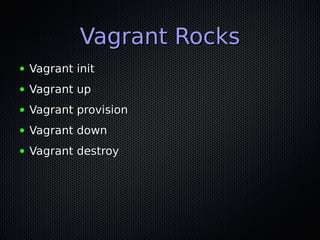
Vagrant Rocks
●   Vagrant init
●   Vagrant up
●   Vagrant provision
●   Vagrant down
●   Vagrant destroy
Booting Up
[sdog@stillmine vagrant-graphite]$ vagrant up
[default] VM already created. Booting if its not already running...
[default] Preparing host only network...
[default] Clearing any previously set forwarded ports...
[default] Forwarding ports...
[default] -- carbon: 2003 => 2021 (adapter 1)
[default] -- http2: 8080 => 50051 (adapter 1)
[default] -- http: 80 => 50050 (adapter 1)
[default] -- ssh: 22 => 2222 (adapter 1)
[default] Cleaning previously set shared folders...
[default] Creating shared folders metadata...
[default] Running any VM customizations...
[default] Booting VM...
[default] Waiting for VM to boot. This can take a few minutes.
[default] VM booted and ready for use!
[default] Enabling host only network...
[default] Setting host name...
[default] Mounting shared folders...
[default] -- v-root: /vagrant
[default] -- manifests: /tmp/vagrant-puppet/manifests
[default] -- v-pp-m0: /tmp/vagrant-puppet/modules-0
[default] Running provisioner: Vagrant::Provisioners::Puppet...
[default] Running Puppet with site.pp...
[default] notice: /Stage[main]/Default-repo/Yumrepo[epel]/descr: descr changed 'Extra Packages for Enterprise Linux 6.x' to 'Extra Packages for Enterpris
     '
[default]
[default] notice: /Stage[main]/Up-graph::Document-throughput/File[/usr/local/up-graph/document-throughput/graph.sh]/content: content changed '{md5}
[default]
[default] notice: /Stage[main]/Collectd/Service[collectd]/ensure: ensure changed 'stopped' to 'running'
[default]
[default] notice: Finished catalog run in 12.45 seconds
[default]
Failed Provisioning
[sdog@stillmine vagrant-graphite]$ vagrant provision
[default] Running provisioner: Vagrant::Provisioners::Puppet...
[default] Running Puppet with site.pp...
[default] Could not parse for environment production: Syntax error at 'import'; expected '}' at /tmp/vagrant-puppet/manifests/site.pp:5 on node graphite.lan
[default]
The following SSH command responded with a non-zero exit status.
Vagrant assumes that this means the command failed!

cd /tmp/vagrant-puppet/manifests
puppet apply --modulepath '/tmp/vagrant-puppet/modules-0' site.pp

The output of the command prior to failing is outputted below:

[no output]
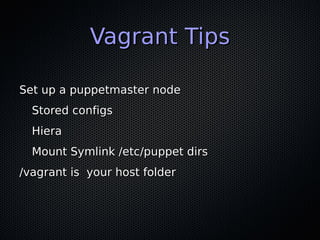
Vagrant Tips

Set up a puppetmaster node
  Stored configs
  Hiera
  Mount Symlink /etc/puppet dirs
/vagrant is your host folder
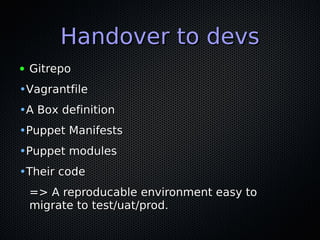
Handover to devs
●   Gitrepo
•Vagrantfile
•A Box definition
•Puppet Manifests
•Puppet modules
•Their code
    => A reproducable environment easy to
    migrate to test/uat/prod.
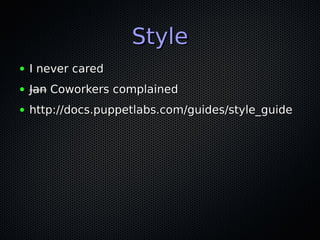
Style
●   I never cared
●   Jan Coworkers complained
●   http://docs.puppetlabs.com/guides/style_guide
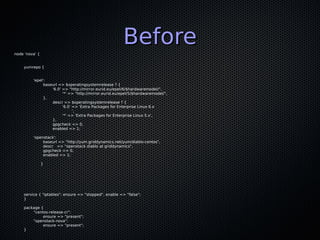
node 'nova' {
                                                       Before
    yumrepo {


         'epel':
              baseurl => $operatingsystemrelease ? {
                  '6.0' => "http://mirror.eurid.eu/epel/6/$hardwaremodel/",
                        '*' => "http://mirror.eurid.eu/epel/5/$hardwaremodel/",
              },
                  descr => $operatingsystemrelease ? {
                        '6.0' => 'Extra Packages for Enterprise Linux 6.x
                              ',
                        '*' => 'Extra Packages for Enterprise Linux 5.x',
                  },
                  gpgcheck => 0,
                  enabled => 1;

         'openstack':
              baseurl => "http://yum.griddynamics.net/yum/diablo-centos",
              descr => "openstack diablo at griddynamics",
              gpgcheck => 0,
              enabled => 1;

                }


    service { "iptables": ensure => "stopped", enable => "false";
    }

    package {
        "centos-release-cr":
             ensure => "present";
        "openstack-nova":
             ensure => "present";
    }
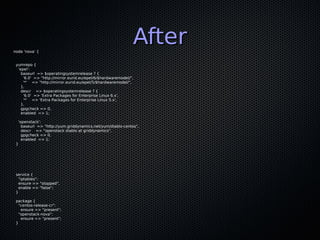
node 'nova' {
                                                              After
 yumrepo {
  'epel':
    baseurl => $operatingsystemrelease ? {
     '6.0' => "http://mirror.eurid.eu/epel/6/$hardwaremodel/",
     '*' => "http://mirror.eurid.eu/epel/5/$hardwaremodel/",
    },
    descr => $operatingsystemrelease ? {
     '6.0' => 'Extra Packages for Enterprise Linux 6.x',
     '*' => 'Extra Packages for Enterprise Linux 5.x',
    },
    gpgcheck => 0,
    enabled => 1;

     'openstack':
       baseurl => "http://yum.griddynamics.net/yum/diablo-centos",
       descr => "openstack diablo at griddynamics",
       gpgcheck => 0,
       enabled => 1;
 }


 service {
   "iptables":
   ensure => "stopped",
   enable => "false";
 }

 package {
   "centos-release-cr":
    ensure => "present";
   "openstack-nova":
    ensure => "present";
 }
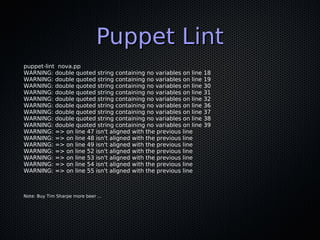
Puppet Lint
puppet-lint nova.pp
WARNING: double quoted string containing no variables on line   18
WARNING: double quoted string containing no variables on line   19
WARNING: double quoted string containing no variables on line   30
WARNING: double quoted string containing no variables on line   31
WARNING: double quoted string containing no variables on line   32
WARNING: double quoted string containing no variables on line   36
WARNING: double quoted string containing no variables on line   37
WARNING: double quoted string containing no variables on line   38
WARNING: double quoted string containing no variables on line   39
WARNING: => on line 47 isn't aligned with the previous line
WARNING: => on line 48 isn't aligned with the previous line
WARNING: => on line 49 isn't aligned with the previous line
WARNING: => on line 52 isn't aligned with the previous line
WARNING: => on line 53 isn't aligned with the previous line
WARNING: => on line 54 isn't aligned with the previous line
WARNING: => on line 55 isn't aligned with the previous line


Note: Buy Tim Sharpe more beer ...
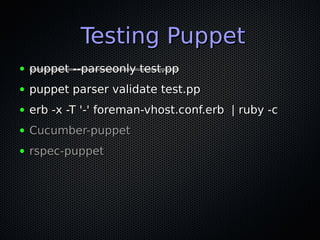
Testing Puppet
●   puppet --parseonly test.pp
●   puppet parser validate test.pp
●   erb -x -T '-' foreman-vhost.conf.erb | ruby -c
●   Cucumber-puppet
●   rspec-puppet
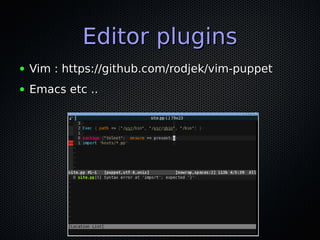
Editor plugins
●   Vim : https://github.com/rodjek/vim-puppet
●   Emacs etc ..
Puppet-module
●   Generates a clean structure
              ●   and unused code
●   Does stuff with forge (Does anyone actually use forge ? )
●   + shell script also create class stubs
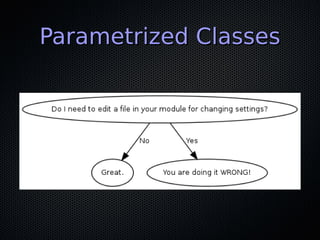
Classes vs Modules
●   Module :
          ●   Abstract definition on configuring a
              service
●   Class :
          ●   Specific implementation of your use case
              of such a module
•e.g usernames / passwords / hosts do not
belong in modules
Parametrized Classes
Services and Modules
    Not in my cluster               service {

    please !                          'blah':

                                          Ensure => running,

                                    }

class autofs::disable inherits autofs {

    Service['autofs'] {

        ensure => 'stopped' ,

        enable => false,

    }

}
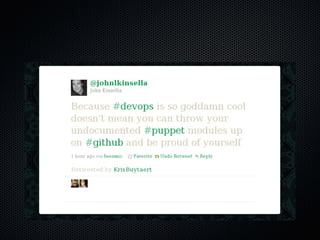
GitHub

The Nr 1 place for your modules
                      (Till forge.puppetlabs.org is revamped)
A github project

[sdog@mine vagrant-graphite]$ ls
manifests modules README TODO Vagrantfile
[sdog@mine vagrant-graphite]$ tree -dL 2
.
├── manifests
│   └── hosts
└── modules
   ├── apache
   ├── collectd
   ├── graphite
   ├── jmxtrans
   ├── logster
   ├── statsd
   └── tattle
10 directories
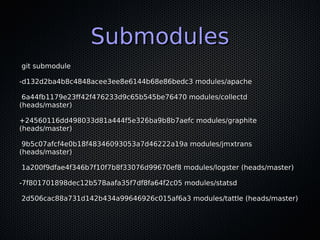
Submodules
git submodule

-d132d2ba4b8c4848acee3ee8e6144b68e86bedc3 modules/apache

 6a44fb1179e23ff42f476233d9c65b545be76470 modules/collectd
(heads/master)

+24560116dd498033d81a444f5e326ba9b8b7aefc modules/graphite
(heads/master)

 9b5c07afcf4e0b18f48346093053a7d46222a19a modules/jmxtrans
(heads/master)

1a200f9dfae4f346b7f10f7b8f33076d99670ef8 modules/logster (heads/master)

-7f801701898dec12b578aafa35f7df8fa64f2c05 modules/statsd

2d506cac88a731d142b434a99646926c015af6a3 modules/tattle (heads/master)
Git Flow
●   git flow feature start blah
●   git flow feature finish blah


●   git flow release start blah
●   git flow release finish blah
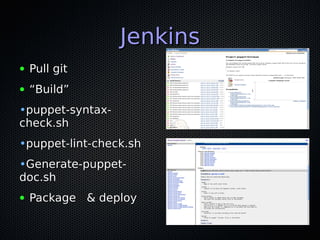
Jenkins
●   Pull git
●   “Build”
•puppet-syntax-
check.sh
•puppet-lint-check.sh
•Generate-puppet-
doc.sh
●   Package & deploy
Demo
$git clone git@github.com:KrisBuytaert/vagrant-
graphite.git
$cd vagrant-graphite
$git submodule init
$git submodule update
There's a submodule in a submodule !


$vagrant up
$vagrant provision
$vagrant provision (or fix your ordering)
My code sucked, but I try to make it suck less
step by step,
                                patches welcome
Homework:
●   puppet-rspec
●   cucumber-puppet
●   guard
●   jenkins vagrant plugin
Contact
Kris Buytaert
Kris.Buytaert@inuits.eu

Further Reading
@krisbuytaert
http://krisbuytaert.be/blog/
http://www.inuits.eu/


                               Inuits
                               Duboistraat 50
                               2060 Antwerpen
                               Belgium
                               891.514.231

                               +32 475 961221

How I hack on puppet modules

  • 1.
    How I hackPuppet and made my life soo much easier by Kris Buytaert
  • 2.
    Kris Buytaert ● I used to be a Dev, ● Then Became an Op ● Chief Trolling Officer and Open Source Consultant @inuits.eu ● Everything is an effing DNS Problem ● Building Clouds since before the bookstore ● Some books, some papers, some blogs ● Evangelizing devops ● But mostly, trying to be good at my job
  • 3.
    Today • Vagrant • Style • Testing Puppet • Modules vs Modules • Jenkins • Demo ?
  • 4.
    Typical Environments For Devs For Ops ● Scrum ● Kanban ● Version Control ● Version Control ● Automated Build ● Automated Build ● Bugtracking ● Bugtracking ● Continous integration ● Continous integration ● Integrated testing ● Integrated testing ● Automated ● Automated deployment deployment
  • 5.
    Everybody is adeveloper ● Yes we write code also ● httpd.conf, squid.conf, my.cnf ● Just crappy languages :) ● shell, perl, ruby, python, puppet ● So those rules apply for Everyone
  • 6.
    Vagrant ● Abstraction layer for VirtualBox ● Integrates well with Puppet/Chef ● Project = ● Vagrantfile ● Manifests / Cookbooks ● Portable, Small , Versionable
  • 7.
    Veewee ● Vabgrantbox.es ● Use veewee to build your boxen •gem install veewee •veewee templates •veewee init natty ubuntu-11.04-server-amd64 •vagrant basebox build natty •vagrant box add 'natty' 'natty.box'
  • 8.
    A Vagrant project [sdog@minevagrant-graphite]$ ls manifests modules README TODO Vagrantfile [sdog@mine vagrant-graphite]$ tree -dL 2 . ├── manifests │   └── hosts └── modules ├── apache ├── collectd ├── graphite ├── jmxtrans ├── logster ├── statsd └── tattle 10 directories
  • 9.
    A Vagrantfile Vagrant::Config.run do|config| # All Vagrant configuration is done here. The most common configuration # options are documented and commented below. For a complete reference, # please see the online documentation at vagrantup.com. config.vm.define :mongo1 do |mongo1_config| mongo1_config.ssh.max_tries = 100 mongo1_config.vm.box = "MyCentOS2" mongo1_config.vm.network("192.168.99.101") mongo1_config.vm.host_name = "mongo1" mongo1_config.vm.provision :puppet do |mongo1_puppet| mongo1_puppet.pp_path = "/tmp/vagrant-puppet" mongo1_puppet.manifests_path = "manifests" mongo1_puppet.module_path = "modules" mongo1_puppet.manifest_file = "site.pp" end end config.vm.define :mongo2 do |mongo2_config| mongo2_config.ssh.max_tries = 100 mongo2_config.vm.box = "MyCentOS2" mongo2_config.vm.network("192.168.99.102") mongo2_config.vm.host_name = "mongo2" mongo2_config.vm.provision :puppet do |mongo2_puppet| mongo2_puppet.pp_path = "/tmp/vagrant-puppet" mongo2_puppet.manifests_path = "manifests" mongo2_puppet.module_path = "modules" mongo2_puppet.manifest_file = "site.pp" end end
  • 10.
    Vagrant Rocks ● Vagrant init ● Vagrant up ● Vagrant provision ● Vagrant down ● Vagrant destroy
  • 11.
    Booting Up [sdog@stillmine vagrant-graphite]$vagrant up [default] VM already created. Booting if its not already running... [default] Preparing host only network... [default] Clearing any previously set forwarded ports... [default] Forwarding ports... [default] -- carbon: 2003 => 2021 (adapter 1) [default] -- http2: 8080 => 50051 (adapter 1) [default] -- http: 80 => 50050 (adapter 1) [default] -- ssh: 22 => 2222 (adapter 1) [default] Cleaning previously set shared folders... [default] Creating shared folders metadata... [default] Running any VM customizations... [default] Booting VM... [default] Waiting for VM to boot. This can take a few minutes. [default] VM booted and ready for use! [default] Enabling host only network... [default] Setting host name... [default] Mounting shared folders... [default] -- v-root: /vagrant [default] -- manifests: /tmp/vagrant-puppet/manifests [default] -- v-pp-m0: /tmp/vagrant-puppet/modules-0 [default] Running provisioner: Vagrant::Provisioners::Puppet... [default] Running Puppet with site.pp... [default] notice: /Stage[main]/Default-repo/Yumrepo[epel]/descr: descr changed 'Extra Packages for Enterprise Linux 6.x' to 'Extra Packages for Enterpris ' [default] [default] notice: /Stage[main]/Up-graph::Document-throughput/File[/usr/local/up-graph/document-throughput/graph.sh]/content: content changed '{md5} [default] [default] notice: /Stage[main]/Collectd/Service[collectd]/ensure: ensure changed 'stopped' to 'running' [default] [default] notice: Finished catalog run in 12.45 seconds [default]
  • 12.
    Failed Provisioning [sdog@stillmine vagrant-graphite]$vagrant provision [default] Running provisioner: Vagrant::Provisioners::Puppet... [default] Running Puppet with site.pp... [default] Could not parse for environment production: Syntax error at 'import'; expected '}' at /tmp/vagrant-puppet/manifests/site.pp:5 on node graphite.lan [default] The following SSH command responded with a non-zero exit status. Vagrant assumes that this means the command failed! cd /tmp/vagrant-puppet/manifests puppet apply --modulepath '/tmp/vagrant-puppet/modules-0' site.pp The output of the command prior to failing is outputted below: [no output]
  • 13.
    Vagrant Tips Set upa puppetmaster node Stored configs Hiera Mount Symlink /etc/puppet dirs /vagrant is your host folder
  • 14.
    Handover to devs ● Gitrepo •Vagrantfile •A Box definition •Puppet Manifests •Puppet modules •Their code => A reproducable environment easy to migrate to test/uat/prod.
  • 15.
    Style ● I never cared ● Jan Coworkers complained ● http://docs.puppetlabs.com/guides/style_guide
  • 16.
    node 'nova' { Before yumrepo { 'epel': baseurl => $operatingsystemrelease ? { '6.0' => "http://mirror.eurid.eu/epel/6/$hardwaremodel/", '*' => "http://mirror.eurid.eu/epel/5/$hardwaremodel/", }, descr => $operatingsystemrelease ? { '6.0' => 'Extra Packages for Enterprise Linux 6.x ', '*' => 'Extra Packages for Enterprise Linux 5.x', }, gpgcheck => 0, enabled => 1; 'openstack': baseurl => "http://yum.griddynamics.net/yum/diablo-centos", descr => "openstack diablo at griddynamics", gpgcheck => 0, enabled => 1; } service { "iptables": ensure => "stopped", enable => "false"; } package { "centos-release-cr": ensure => "present"; "openstack-nova": ensure => "present"; }
  • 17.
    node 'nova' { After yumrepo { 'epel': baseurl => $operatingsystemrelease ? { '6.0' => "http://mirror.eurid.eu/epel/6/$hardwaremodel/", '*' => "http://mirror.eurid.eu/epel/5/$hardwaremodel/", }, descr => $operatingsystemrelease ? { '6.0' => 'Extra Packages for Enterprise Linux 6.x', '*' => 'Extra Packages for Enterprise Linux 5.x', }, gpgcheck => 0, enabled => 1; 'openstack': baseurl => "http://yum.griddynamics.net/yum/diablo-centos", descr => "openstack diablo at griddynamics", gpgcheck => 0, enabled => 1; } service { "iptables": ensure => "stopped", enable => "false"; } package { "centos-release-cr": ensure => "present"; "openstack-nova": ensure => "present"; }
  • 18.
    Puppet Lint puppet-lint nova.pp WARNING:double quoted string containing no variables on line 18 WARNING: double quoted string containing no variables on line 19 WARNING: double quoted string containing no variables on line 30 WARNING: double quoted string containing no variables on line 31 WARNING: double quoted string containing no variables on line 32 WARNING: double quoted string containing no variables on line 36 WARNING: double quoted string containing no variables on line 37 WARNING: double quoted string containing no variables on line 38 WARNING: double quoted string containing no variables on line 39 WARNING: => on line 47 isn't aligned with the previous line WARNING: => on line 48 isn't aligned with the previous line WARNING: => on line 49 isn't aligned with the previous line WARNING: => on line 52 isn't aligned with the previous line WARNING: => on line 53 isn't aligned with the previous line WARNING: => on line 54 isn't aligned with the previous line WARNING: => on line 55 isn't aligned with the previous line Note: Buy Tim Sharpe more beer ...
  • 19.
    Testing Puppet ● puppet --parseonly test.pp ● puppet parser validate test.pp ● erb -x -T '-' foreman-vhost.conf.erb | ruby -c ● Cucumber-puppet ● rspec-puppet
  • 20.
    Editor plugins ● Vim : https://github.com/rodjek/vim-puppet ● Emacs etc ..
  • 21.
    Puppet-module ● Generates a clean structure ● and unused code ● Does stuff with forge (Does anyone actually use forge ? ) ● + shell script also create class stubs
  • 22.
    Classes vs Modules ● Module : ● Abstract definition on configuring a service ● Class : ● Specific implementation of your use case of such a module •e.g usernames / passwords / hosts do not belong in modules
  • 23.
  • 24.
    Services and Modules Not in my cluster service { please ! 'blah': Ensure => running, } class autofs::disable inherits autofs { Service['autofs'] { ensure => 'stopped' , enable => false, } }
  • 25.
    GitHub The Nr 1place for your modules (Till forge.puppetlabs.org is revamped)
  • 26.
    A github project [sdog@minevagrant-graphite]$ ls manifests modules README TODO Vagrantfile [sdog@mine vagrant-graphite]$ tree -dL 2 . ├── manifests │   └── hosts └── modules ├── apache ├── collectd ├── graphite ├── jmxtrans ├── logster ├── statsd └── tattle 10 directories
  • 27.
    Submodules git submodule -d132d2ba4b8c4848acee3ee8e6144b68e86bedc3 modules/apache 6a44fb1179e23ff42f476233d9c65b545be76470 modules/collectd (heads/master) +24560116dd498033d81a444f5e326ba9b8b7aefc modules/graphite (heads/master) 9b5c07afcf4e0b18f48346093053a7d46222a19a modules/jmxtrans (heads/master) 1a200f9dfae4f346b7f10f7b8f33076d99670ef8 modules/logster (heads/master) -7f801701898dec12b578aafa35f7df8fa64f2c05 modules/statsd 2d506cac88a731d142b434a99646926c015af6a3 modules/tattle (heads/master)
  • 28.
    Git Flow ● git flow feature start blah ● git flow feature finish blah ● git flow release start blah ● git flow release finish blah
  • 29.
    Jenkins ● Pull git ● “Build” •puppet-syntax- check.sh •puppet-lint-check.sh •Generate-puppet- doc.sh ● Package & deploy
  • 31.
    Demo $git clone git@github.com:KrisBuytaert/vagrant- graphite.git $cdvagrant-graphite $git submodule init $git submodule update There's a submodule in a submodule ! $vagrant up $vagrant provision $vagrant provision (or fix your ordering)
  • 32.
    My code sucked,but I try to make it suck less step by step, patches welcome
  • 33.
    Homework: ● puppet-rspec ● cucumber-puppet ● guard ● jenkins vagrant plugin
  • 34.