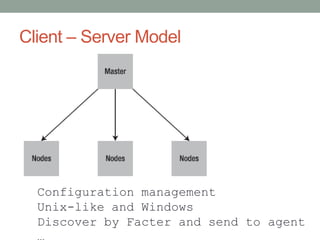
Client – Server Model


  Configuration management
  Unix-like and Windows
  Discover by Facter and send to agent
Procedural vs. Declarative
How vs. What
Shell vs. Puppet

     package { "vim":
       ensure => present,
     }
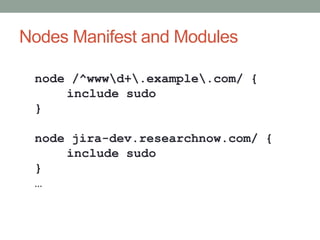
Nodes Manifest and Modules

 node /^wwwd+.example.com/ {
     include sudo
 }

 node jira-dev.researchnow.com/ {
     include sudo
 }
 …
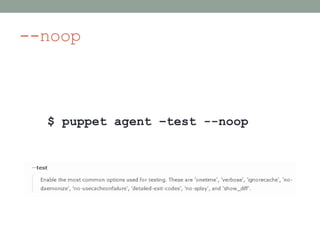
--noop


  $ puppet agent –test --noop
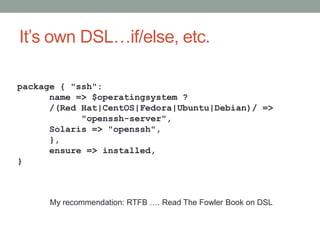
It’s own DSL…if/else, etc.

package { "ssh":
      name => $operatingsystem ?
      /(Red Hat|CentOS|Fedora|Ubuntu|Debian)/ =>
            "openssh-server",
      Solaris => "openssh",
      },
      ensure => installed,
}


      My recommendation: RTFB …. Read The Fowler Book on DSL
Audit

file { '/etc/hosts':
      audit => [ owner, group, mode ],
}

audit change: previously recorded value owner root
has been changed to owner daemon
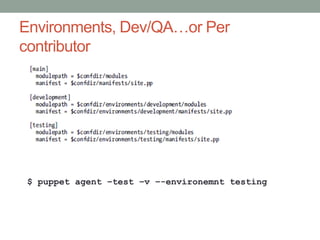
Environments, Dev/QA…or Per
contributor


 $ puppet agent –test –v –-environemnt testing
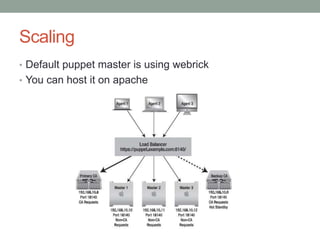
Scaling
• Default puppet master is using webrick
• You can host it on apache
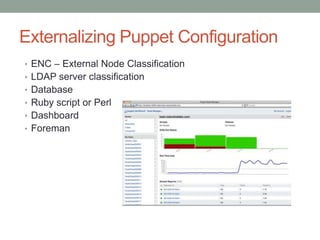
Externalizing Puppet Configuration
• ENC – External Node Classification
• LDAP server classification
• Database
• Ruby script or Perl
• Dashboard
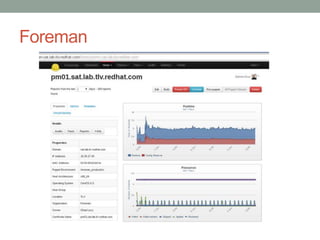
• Foreman
Foreman
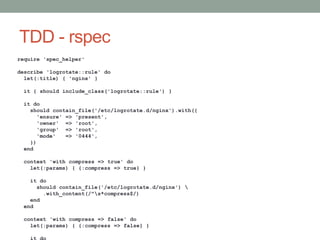
TDD - rspec
require 'spec_helper'

describe 'logrotate::rule' do
  let(:title) { 'nginx' }

 it { should include_class('logrotate::rule') }

 it do
   should contain_file('/etc/logrotate.d/nginx').with({
      'ensure' => 'present',
      'owner' => 'root',
      'group' => 'root',
      'mode'   => '0444',
   })
 end

 context 'with compress => true' do
   let(:params) { {:compress => true} }

   it do
     should contain_file('/etc/logrotate.d/nginx') 
       .with_content(/^s*compress$/)
   end
 end

 context 'with compress => false' do
   let(:params) { {:compress => false} }
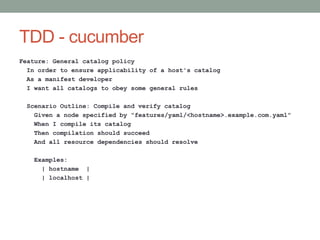
TDD - cucumber
Feature: General catalog policy
  In order to ensure applicability of a host's catalog
  As a manifest developer
  I want all catalogs to obey some general rules

 Scenario Outline: Compile and verify catalog
   Given a node specified by "features/yaml/<hostname>.example.com.yaml"
   When I compile its catalog
   Then compilation should succeed
   And all resource dependencies should resolve

   Examples:
     | hostname |
     | localhost |
Tips
•   # install latest puppet
•   wget http://apt.puppetlabs.com/puppetlabs-release-precise.deb
•   sudo dpkg -i puppetlabs-release-precise.deb
•   sudo apt-get update sudo apt-get install puppetmaster

•   # chaining
•   # ntp.conf is applied first, and will notify the ntpd service
•   # if it changes:
•   File['/etc/ntp.conf'] ~> Service['ntpd']

•   # Certification tips
•   puppet cert clean liferay-dev.local
•   rm -f /var/lib/puppet/ssl/certs/liferay-dev.local.pem
•   find /var/lib/puppet -type f -print0 |xargs -0r rm

•   # Debug
•   puppet master   --no-daemonize --debug --verbose –trace
•   puppet config   print manifest
•   puppet config   print all
•   puppet config   print modulepath
What do we have so far?


     https://github.com/rsn-innovation/puppets

Puppet

  • 2.
    Client – ServerModel Configuration management Unix-like and Windows Discover by Facter and send to agent
  • 3.
    Procedural vs. Declarative Howvs. What Shell vs. Puppet package { "vim": ensure => present, }
  • 4.
    Nodes Manifest andModules node /^wwwd+.example.com/ { include sudo } node jira-dev.researchnow.com/ { include sudo } …
  • 5.
    --noop $puppet agent –test --noop
  • 6.
    It’s own DSL…if/else,etc. package { "ssh": name => $operatingsystem ? /(Red Hat|CentOS|Fedora|Ubuntu|Debian)/ => "openssh-server", Solaris => "openssh", }, ensure => installed, } My recommendation: RTFB …. Read The Fowler Book on DSL
  • 7.
    Audit file { '/etc/hosts': audit => [ owner, group, mode ], } audit change: previously recorded value owner root has been changed to owner daemon
  • 8.
    Environments, Dev/QA…or Per contributor $ puppet agent –test –v –-environemnt testing
  • 9.
    Scaling • Default puppetmaster is using webrick • You can host it on apache
  • 10.
    Externalizing Puppet Configuration •ENC – External Node Classification • LDAP server classification • Database • Ruby script or Perl • Dashboard • Foreman
  • 11.
  • 12.
    TDD - rspec require'spec_helper' describe 'logrotate::rule' do let(:title) { 'nginx' } it { should include_class('logrotate::rule') } it do should contain_file('/etc/logrotate.d/nginx').with({ 'ensure' => 'present', 'owner' => 'root', 'group' => 'root', 'mode' => '0444', }) end context 'with compress => true' do let(:params) { {:compress => true} } it do should contain_file('/etc/logrotate.d/nginx') .with_content(/^s*compress$/) end end context 'with compress => false' do let(:params) { {:compress => false} }
  • 13.
    TDD - cucumber Feature:General catalog policy In order to ensure applicability of a host's catalog As a manifest developer I want all catalogs to obey some general rules Scenario Outline: Compile and verify catalog Given a node specified by "features/yaml/<hostname>.example.com.yaml" When I compile its catalog Then compilation should succeed And all resource dependencies should resolve Examples: | hostname | | localhost |
  • 14.
    Tips • # install latest puppet • wget http://apt.puppetlabs.com/puppetlabs-release-precise.deb • sudo dpkg -i puppetlabs-release-precise.deb • sudo apt-get update sudo apt-get install puppetmaster • # chaining • # ntp.conf is applied first, and will notify the ntpd service • # if it changes: • File['/etc/ntp.conf'] ~> Service['ntpd'] • # Certification tips • puppet cert clean liferay-dev.local • rm -f /var/lib/puppet/ssl/certs/liferay-dev.local.pem • find /var/lib/puppet -type f -print0 |xargs -0r rm • # Debug • puppet master --no-daemonize --debug --verbose –trace • puppet config print manifest • puppet config print all • puppet config print modulepath
  • 15.
    What do wehave so far? https://github.com/rsn-innovation/puppets