Advancing Opportunity in the Mahoning Valleyjohn a. powellDirector, Kirwan Institute for the Study of Race and EthnicityWilliams Chair in Civil Rights & Civil Liberties, Moritz College of LawWarren Ministerial AllianceAugust 14, 20091
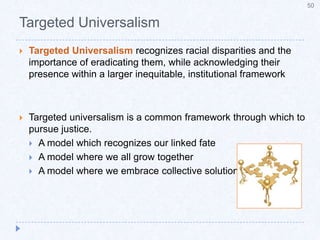
Today’s Conversation2Opportunity matters – neighborhoods & access to opportunityPatterns of racial and economic segregationRecommendations for organizing around criminal justice reform & housing------------------------------------------------------------------------------------------Appendix:Targeted universalismCoalition buildingTransformative leadership
Opportunity mattersPlace and life outcomes3
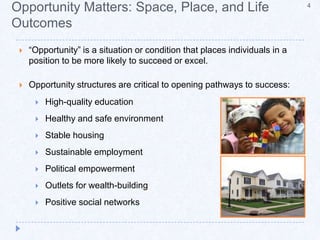
Opportunity Matters: Space, Place, and Life Outcomes4“Opportunity” is a situation or condition that places individuals in a position to be more likely to succeed or excel.Opportunity structures are critical to opening pathways to success:High-quality educationHealthy and safe environmentStable housingSustainable employmentPolitical empowermentOutlets for wealth-buildingPositive social networks
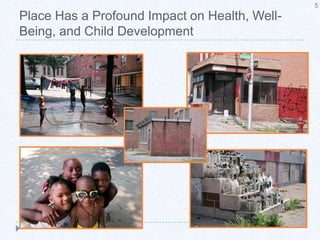
Place Has a Profound Impact on Health, Well-Being, and Child Development5
6Opportunity is RacializedStructures and policies are not neutral.  They unevenly distribute benefits and burdens.
Institutions can operate jointly to produce racialized outcomes.
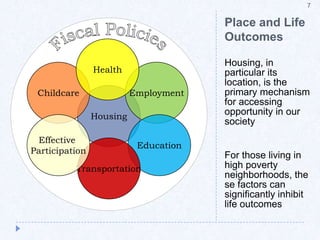
This institutional uneven distribution & racial marking has negative consequences for all of us.7Fiscal PoliciesHealthChildcareEmploymentHousingEducationEffective ParticipationTransportationPlace and Life OutcomesHousing, in particular its location, is the primary mechanism for accessing opportunity in our society For those living in high poverty neighborhoods, these factors can significantly inhibit life outcomes
Opportunity Matters: Neighborhoods & Access to Opportunity8High poverty areas with poor employment, underperforming schools,  distressed housing, and public health/safety risks depress life outcomesA system of disadvantagePeople of color are far more likely to live in opportunity deprived neighborhoods & communities
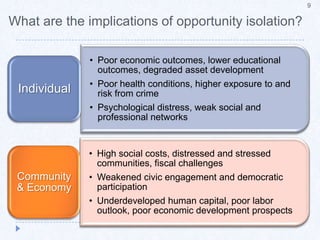
What are the implications of opportunity isolation? 9
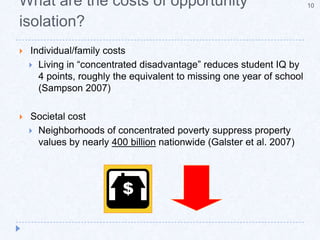
What are the costs of opportunity isolation?10Individual/family costs
Living in “concentrated disadvantage” reduces student IQ by 4 points, roughly the equivalent to missing one year of school (Sampson 2007)
Societal cost
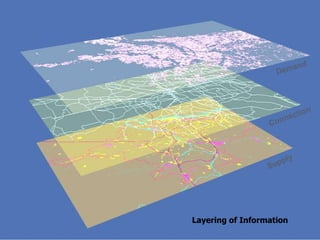
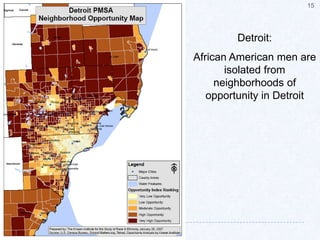
Neighborhoods of concentrated poverty suppress property values by nearly 400 billion nationwide (Galster et al. 2007)Opportunity Mapping11Because opportunity is a spatial phenomenon,  maps are an effective representationOpportunity mapping is a research tool that allows us to understand the dynamics of opportunityMaps are incredibly efficient, compacting volumes of data into single pictures that can be understood at a glanceMaps allow us to understand volumes of data at a glance through layering
12DemandConnectionSupplyLayering of Information
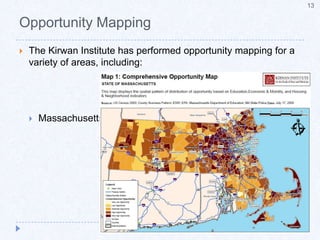
Opportunity Mapping13The Kirwan Institute has performed opportunity mapping for a variety of areas, including:Massachusetts
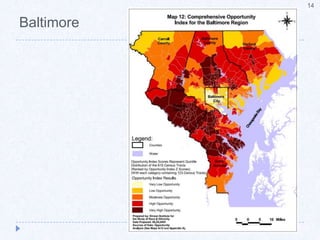
Baltimore14
15Detroit: African American men are isolated from neighborhoods of opportunity in Detroit
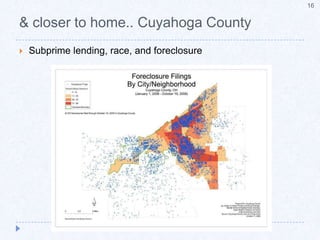
& closer to home.. Cuyahoga County16Subprime lending, race, and foreclosure
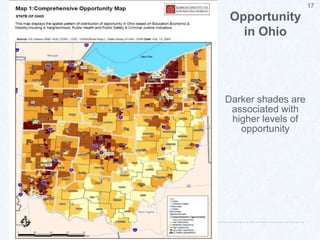
Opportunity in OhioDarker shades are associated with higher levels of opportunity17
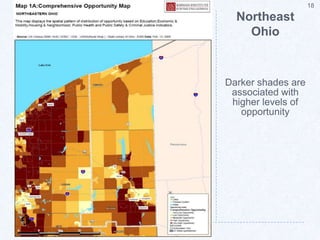
Northeast OhioDarker shades are associated with higher levels of opportunity18
Patterns of Racial and Economic SegregationCity of WarrenMahoning Valley area19
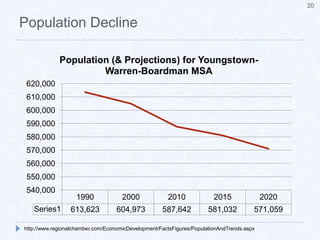
Population Decline20http://www.regionalchamber.com/EconomicDevelopment/FactsFigures/PopulationAndTrends.aspx
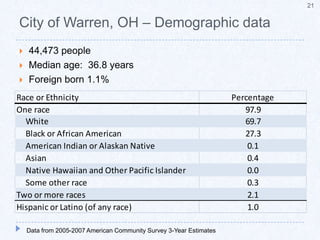
City of Warren, OH – Demographic data2144,473 peopleMedian age:  36.8 yearsForeign born 1.1%Data from 2005-2007 American Community Survey 3-Year Estimates
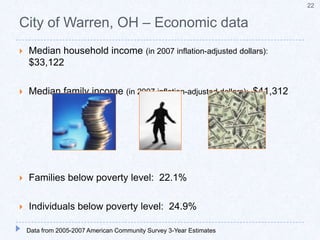
City of Warren, OH – Economic data22Median household income (in 2007 inflation-adjusted dollars):  $33,122Median family income (in 2007 inflation-adjusted dollars):  $41,312Families below poverty level:  22.1%Individuals below poverty level:  24.9%Data from 2005-2007 American Community Survey 3-Year Estimates
Index of Dissimilarity  Measures whether one particular group is distributed across census tracts in the metropolitan area in the same way as another group.
  Range 0-100;  Higher values = high degree of segregation
Interpretation:  A value of 60 means that 60% of the members of one group would need to move to a different tract in order for the two groups to be equally distributed. 23City of WarrenBlacks and Hispanics are re-segregating.http://mumford.albany.edu/census/WholePop/CitySegdata/3980892City.htm
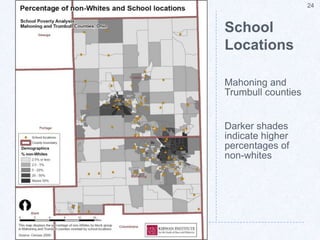
School LocationsMahoning and Trumbull countiesDarker shades indicate higher percentages of non-whites24
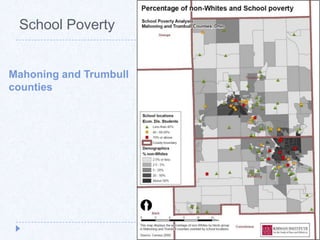
School PovertyMahoning and Trumbull counties25
Lowest-Performing Schools are usually High-Poverty Schools.26
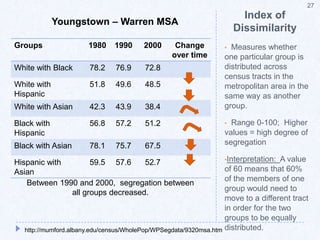
Index of Dissimilarity  Measures whether one particular group is distributed across census tracts in the metropolitan area in the same way as another group.
  Range 0-100;  Higher values = high degree of segregation
Interpretation:  A value of 60 means that 60% of the members of one group would need to move to a different tract in order for the two groups to be equally distributed. 27Youngstown – Warren MSABetween 1990 and 2000,  segregation between all groups decreased.http://mumford.albany.edu/census/WholePop/WPSegdata/9320msa.htm
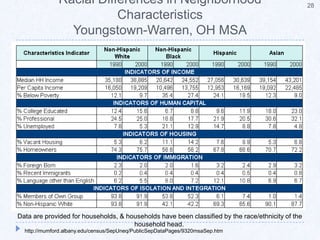
Racial Differences in Neighborhood CharacteristicsYoungstown-Warren, OH MSA28Data are provided for households, & households have been classified by the race/ethnicity of the household head. http://mumford.albany.edu/census/SepUneq/PublicSepDataPages/9320msaSep.htm
Unemployment:  Youngstown-Warren MSA29http://www.regionalchamber.com/EconomicDevelopment/FactsFigures/LocalEconomy/Unemployment.aspxhttp://www.regionalchamber.com/EconomicDevelopment/FactsFigures/Monthly%20EconomicIndicators.aspx
Youngstown-Warren-Boardman MSA EMPLOYMENT30http://www.regionalchamber.com/EconomicDevelopment/FactsFigures/LocalEconomy/JobGrowth.aspx
Organizing and AdvocacyFraming the issues31
Fragmentation, Regionalism, and Equity32Investing in equity builds the economy of the entire region, thus uplifting everyone“…even controlling for the fact that growth itself probably lowers poverty and inequality, improvements in various equity measures are likely to improve regional performance and therefore benefit city dwellers and suburbanites alike.” (p. 98)“But our research, both in Los Angeles and in the rest of the country, suggests that individuals and communities that are better connected to regional opportunities experience higher incomes and increased efficacy.” (p. 12)Pastor,  Manuel, et al. Regions that Work: How Cities and Suburbs Can Grow Together (University of Minnesota Press, 2000).
Creating Empathetic Space33Everyone needs help now and then; we all want to do betterWe share deep values, concerns, and hopesAddressing the problems that have a racial footprint has implications and benefits for all members of society, not just marginalized groups – linked fateIt’s not “robbing Peter to pay Paul;” instead, everyone benefitshttp://www.equaljusticesociety.org/2008/12/talking-about-race-in-the-obama-era/
Framing Conversations34Lead with values:Opportunity“Everyone deserves a fair chance to achieve his/her potential.”Security“All people should have the tools & resources necessary to support themselves & their families.”Mobility (moving forward)“Everyone in our society should have the chance to move forward in economic and educational status, no matter where they started out.”Talking Points: Opportunity and Economic Recovery (2009).  Opportunity Agenda.
Framing Conversations 35Lead with values:Community“We are all in it together in our society and share interests and responsibilities for each other and the common good.”Equality“What we look like or where we come from should not determine the burdens, benefits, or responsibilities that we bear in society.”Redemption“People grow and change over time, and deserve a chance to start over after missteps or misfortune.”Talking Points: Opportunity and Economic Recovery (2009).  Opportunity Agenda.
Organizing for Criminal Justice Reform36Seek analyses of successful efforts elsewhereGather data such as whether crime increased, feelings of public safety, etc.Learn about how those efforts were conductedCampaign strategiesCommunication tacticsCompare the Warren area to the areas involved in other effortsHow does your community relate?  How does it differ?
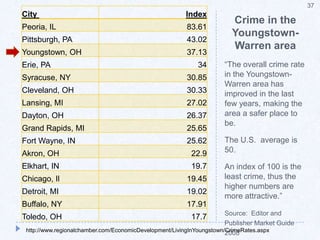
Crime in the Youngstown-Warren area“The overall crime rate in the Youngstown-Warren area has improved in the last few years, making the area a safer place to be.The U.S.  average is 50. An index of 100 is the least crime, thus the higher numbers are more attractive.”Source:  Editor and Publisher Market Guide 200837http://www.regionalchamber.com/EconomicDevelopment/LivingInYoungstown/CrimeRates.aspx
Ohio Criminal Justice Reform Initiatives38Ohio Justice and Policy Center (OJPC) in Cincinnati In 2004 OJPC sued the Ohio Secretary of State and 21 boards of elections who had been erroneously advising felons that they could not vote. OJPC was co-counsel to two class action lawsuits against the Ohio Department of Youth Services (2007 & 2008), forcing the state to make major improvements to the existing system.  Additionally in 2008 they filed a class action suit challenging residency restrictions for convicted sex-offenders.
Ohio Criminal Justice Reform Initiatives39Voices for Ohio’s Children: Juvenile Justice Initiative (Columbus and Cleveland)Earlier this year Voices partnered with nearly 20 other Ohio based organizations from across the state and created a work group to publish a report called: “Framework for Transforming the Juvenile Justice System.” This report provides a model Ohio Department of Youth Services (ODYS) care continuum.   Although the report identifies sixteen attributes of a model ODYS, one of the center points of this vision is to reduce institutionalization by expanding effective community-based alternatives.
Ohio Criminal Justice Reform Initiatives40ACLU of Ohio The ACLU works on criminal justice reform issues specifically related to juvenile justice.  They released a 2009 report card for Ohio’s Juvenile Justice System publicizing the ways that Ohio is failing its children, such as, permitting them to be routinely shackled, requiring them to be charged as adults for certain crimes, and waiving their right to an attorney.  Defending children’s right to counsel and access to the courts is one of the ACLU’s main juvenile justice emphases.   ACLU Ohio also offers a variety of informational and advocacy resources on their website including the “cradle to the prison pipeline,” juveniles’ rights, and pending legislative action.
Reform on a National Level41Ban the BoxThis campaign calls for the elimination of the questions about past convictions on initial public employment applications.  This campaign challenges many “boxes” on a variety of applications (i.e. employment, housing, social services, etc.) we are required to check that supports structural discrimination against formerly-incarcerated people.Banning the box on public employment applications will contribute to public safety because it will promote stable employment in our communities. People with jobs and stable community lives are much less likely to return committing crimes in order to survive.Boston, San Francisco, Chicago and Minneapolis/St. Paul are among the cities that have removed the box from applications for government jobs. Boston’s ordinance extends to vendors with government contracts.Partially quoted from: http://www.allofusornone.org/campaigns/ban-the-boxhttp://www.examiner.com/x-662-Strange-News-Examiner~y2009m1d10-Ban-the-box--exconvict-job-seekers-no-longer-required-to-disclose-criminal-past
Reform on a National Level42The Justice Project – Opportunities for ReformImproving Eyewitness Identification ProceduresExpanding Post-Conviction DNA TestingImproving Forensic Evidence Testing ProceduresImproving Standards for Admissibility of Accomplice and Snitch TestimonyEnsuring Proper Safeguards Against Prosecutorial MisconductExpanding Discovery in Criminal CasesElectronic Recording of Custodial InterrogationsEnsuring Standards for the Appointment and Performance of Counsel in Capital Cases
Reform on a National Level – The Justice Project’s Successes43Ensuring Passage of the Innocence Protection Act-  TJPled a five-year campaign to pass the Innocence Protection Act (IPA), the first federal death penalty reform legislation to pass Congress and be signed into law. The IPA includes funding for the Kirk Bloodsworth Post-Conviction DNA Testing Program, which provides funding for DNA testing of individuals who may have been wrongfully convicted.Leading the Campaign to End the Juvenile Death PenaltyOn March 1, 2005, the U.S. Supreme Court struck down the juvenile death penalty in a landmark 5-4 decision in Roper v. Simmons. TJP coordinated a national campaign, “Kids Are Different,” to illustrate that kids are mentally, emotionally and physically different from adults and therefore less culpable for their actions.Preserving Habeas CorpusThe Justice Project successfully fought legislation in the 109th Congress that would have effectively eliminated federal review of criminal cases and increased errors and injustice in the criminal justice system.
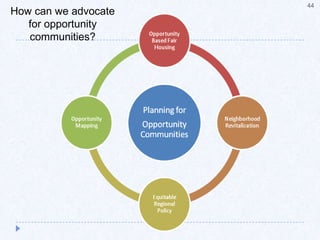
How can we advocate for opportunity communities?44
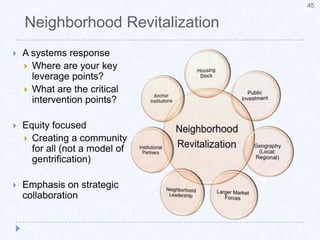
Neighborhood Revitalization45A systems responseWhere are your key leverage points?What are the critical intervention points?Equity focusedCreating a community for all (not a model of gentrification)Emphasis on strategic collaboration
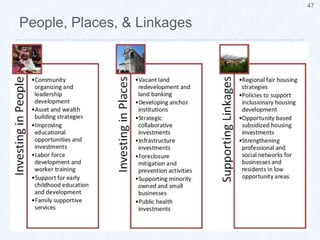
Remedying Opportunity Isolation46Adopt strategies that open up access to levers of opportunity for marginalized individuals, families, and communities
Connect people to existing opportunities throughout the metropolitan region

2009 08 14_warren_ministerial

  • 1.
    Advancing Opportunity inthe Mahoning Valleyjohn a. powellDirector, Kirwan Institute for the Study of Race and EthnicityWilliams Chair in Civil Rights & Civil Liberties, Moritz College of LawWarren Ministerial AllianceAugust 14, 20091
  • 2.
    Today’s Conversation2Opportunity matters– neighborhoods & access to opportunityPatterns of racial and economic segregationRecommendations for organizing around criminal justice reform & housing------------------------------------------------------------------------------------------Appendix:Targeted universalismCoalition buildingTransformative leadership
  • 3.
  • 4.
    Opportunity Matters: Space,Place, and Life Outcomes4“Opportunity” is a situation or condition that places individuals in a position to be more likely to succeed or excel.Opportunity structures are critical to opening pathways to success:High-quality educationHealthy and safe environmentStable housingSustainable employmentPolitical empowermentOutlets for wealth-buildingPositive social networks
  • 5.
    Place Has aProfound Impact on Health, Well-Being, and Child Development5
  • 6.
    6Opportunity is RacializedStructuresand policies are not neutral. They unevenly distribute benefits and burdens.
  • 7.
    Institutions can operatejointly to produce racialized outcomes.
  • 8.
    This institutional unevendistribution & racial marking has negative consequences for all of us.7Fiscal PoliciesHealthChildcareEmploymentHousingEducationEffective ParticipationTransportationPlace and Life OutcomesHousing, in particular its location, is the primary mechanism for accessing opportunity in our society For those living in high poverty neighborhoods, these factors can significantly inhibit life outcomes
  • 9.
    Opportunity Matters: Neighborhoods& Access to Opportunity8High poverty areas with poor employment, underperforming schools, distressed housing, and public health/safety risks depress life outcomesA system of disadvantagePeople of color are far more likely to live in opportunity deprived neighborhoods & communities
  • 10.
    What are theimplications of opportunity isolation? 9
  • 11.
    What are thecosts of opportunity isolation?10Individual/family costs
  • 12.
    Living in “concentrateddisadvantage” reduces student IQ by 4 points, roughly the equivalent to missing one year of school (Sampson 2007)
  • 13.
  • 14.
    Neighborhoods of concentratedpoverty suppress property values by nearly 400 billion nationwide (Galster et al. 2007)Opportunity Mapping11Because opportunity is a spatial phenomenon, maps are an effective representationOpportunity mapping is a research tool that allows us to understand the dynamics of opportunityMaps are incredibly efficient, compacting volumes of data into single pictures that can be understood at a glanceMaps allow us to understand volumes of data at a glance through layering
  • 15.
  • 16.
    Opportunity Mapping13The KirwanInstitute has performed opportunity mapping for a variety of areas, including:Massachusetts
  • 17.
  • 18.
    15Detroit: African Americanmen are isolated from neighborhoods of opportunity in Detroit
  • 19.
    & closer tohome.. Cuyahoga County16Subprime lending, race, and foreclosure
  • 20.
    Opportunity in OhioDarkershades are associated with higher levels of opportunity17
  • 21.
    Northeast OhioDarker shadesare associated with higher levels of opportunity18
  • 22.
    Patterns of Racialand Economic SegregationCity of WarrenMahoning Valley area19
  • 23.
  • 24.
    City of Warren,OH – Demographic data2144,473 peopleMedian age: 36.8 yearsForeign born 1.1%Data from 2005-2007 American Community Survey 3-Year Estimates
  • 25.
    City of Warren,OH – Economic data22Median household income (in 2007 inflation-adjusted dollars): $33,122Median family income (in 2007 inflation-adjusted dollars): $41,312Families below poverty level: 22.1%Individuals below poverty level: 24.9%Data from 2005-2007 American Community Survey 3-Year Estimates
  • 26.
    Index of Dissimilarity Measures whether one particular group is distributed across census tracts in the metropolitan area in the same way as another group.
  • 27.
    Range0-100; Higher values = high degree of segregation
  • 28.
    Interpretation: Avalue of 60 means that 60% of the members of one group would need to move to a different tract in order for the two groups to be equally distributed. 23City of WarrenBlacks and Hispanics are re-segregating.http://mumford.albany.edu/census/WholePop/CitySegdata/3980892City.htm
  • 29.
    School LocationsMahoning andTrumbull countiesDarker shades indicate higher percentages of non-whites24
  • 30.
    School PovertyMahoning andTrumbull counties25
  • 31.
    Lowest-Performing Schools areusually High-Poverty Schools.26
  • 32.
    Index of Dissimilarity Measures whether one particular group is distributed across census tracts in the metropolitan area in the same way as another group.
  • 33.
    Range0-100; Higher values = high degree of segregation
  • 34.
    Interpretation: Avalue of 60 means that 60% of the members of one group would need to move to a different tract in order for the two groups to be equally distributed. 27Youngstown – Warren MSABetween 1990 and 2000, segregation between all groups decreased.http://mumford.albany.edu/census/WholePop/WPSegdata/9320msa.htm
  • 35.
    Racial Differences inNeighborhood CharacteristicsYoungstown-Warren, OH MSA28Data are provided for households, & households have been classified by the race/ethnicity of the household head. http://mumford.albany.edu/census/SepUneq/PublicSepDataPages/9320msaSep.htm
  • 36.
    Unemployment: Youngstown-WarrenMSA29http://www.regionalchamber.com/EconomicDevelopment/FactsFigures/LocalEconomy/Unemployment.aspxhttp://www.regionalchamber.com/EconomicDevelopment/FactsFigures/Monthly%20EconomicIndicators.aspx
  • 37.
  • 38.
  • 39.
    Fragmentation, Regionalism, andEquity32Investing in equity builds the economy of the entire region, thus uplifting everyone“…even controlling for the fact that growth itself probably lowers poverty and inequality, improvements in various equity measures are likely to improve regional performance and therefore benefit city dwellers and suburbanites alike.” (p. 98)“But our research, both in Los Angeles and in the rest of the country, suggests that individuals and communities that are better connected to regional opportunities experience higher incomes and increased efficacy.” (p. 12)Pastor, Manuel, et al. Regions that Work: How Cities and Suburbs Can Grow Together (University of Minnesota Press, 2000).
  • 40.
    Creating Empathetic Space33Everyoneneeds help now and then; we all want to do betterWe share deep values, concerns, and hopesAddressing the problems that have a racial footprint has implications and benefits for all members of society, not just marginalized groups – linked fateIt’s not “robbing Peter to pay Paul;” instead, everyone benefitshttp://www.equaljusticesociety.org/2008/12/talking-about-race-in-the-obama-era/
  • 41.
    Framing Conversations34Lead withvalues:Opportunity“Everyone deserves a fair chance to achieve his/her potential.”Security“All people should have the tools & resources necessary to support themselves & their families.”Mobility (moving forward)“Everyone in our society should have the chance to move forward in economic and educational status, no matter where they started out.”Talking Points: Opportunity and Economic Recovery (2009). Opportunity Agenda.
  • 42.
    Framing Conversations 35Leadwith values:Community“We are all in it together in our society and share interests and responsibilities for each other and the common good.”Equality“What we look like or where we come from should not determine the burdens, benefits, or responsibilities that we bear in society.”Redemption“People grow and change over time, and deserve a chance to start over after missteps or misfortune.”Talking Points: Opportunity and Economic Recovery (2009). Opportunity Agenda.
  • 43.
    Organizing for CriminalJustice Reform36Seek analyses of successful efforts elsewhereGather data such as whether crime increased, feelings of public safety, etc.Learn about how those efforts were conductedCampaign strategiesCommunication tacticsCompare the Warren area to the areas involved in other effortsHow does your community relate? How does it differ?
  • 44.
    Crime in theYoungstown-Warren area“The overall crime rate in the Youngstown-Warren area has improved in the last few years, making the area a safer place to be.The U.S. average is 50. An index of 100 is the least crime, thus the higher numbers are more attractive.”Source: Editor and Publisher Market Guide 200837http://www.regionalchamber.com/EconomicDevelopment/LivingInYoungstown/CrimeRates.aspx
  • 45.
    Ohio Criminal JusticeReform Initiatives38Ohio Justice and Policy Center (OJPC) in Cincinnati In 2004 OJPC sued the Ohio Secretary of State and 21 boards of elections who had been erroneously advising felons that they could not vote. OJPC was co-counsel to two class action lawsuits against the Ohio Department of Youth Services (2007 & 2008), forcing the state to make major improvements to the existing system. Additionally in 2008 they filed a class action suit challenging residency restrictions for convicted sex-offenders.
  • 46.
    Ohio Criminal JusticeReform Initiatives39Voices for Ohio’s Children: Juvenile Justice Initiative (Columbus and Cleveland)Earlier this year Voices partnered with nearly 20 other Ohio based organizations from across the state and created a work group to publish a report called: “Framework for Transforming the Juvenile Justice System.” This report provides a model Ohio Department of Youth Services (ODYS) care continuum. Although the report identifies sixteen attributes of a model ODYS, one of the center points of this vision is to reduce institutionalization by expanding effective community-based alternatives.
  • 47.
    Ohio Criminal JusticeReform Initiatives40ACLU of Ohio The ACLU works on criminal justice reform issues specifically related to juvenile justice. They released a 2009 report card for Ohio’s Juvenile Justice System publicizing the ways that Ohio is failing its children, such as, permitting them to be routinely shackled, requiring them to be charged as adults for certain crimes, and waiving their right to an attorney. Defending children’s right to counsel and access to the courts is one of the ACLU’s main juvenile justice emphases. ACLU Ohio also offers a variety of informational and advocacy resources on their website including the “cradle to the prison pipeline,” juveniles’ rights, and pending legislative action.
  • 48.
    Reform on aNational Level41Ban the BoxThis campaign calls for the elimination of the questions about past convictions on initial public employment applications. This campaign challenges many “boxes” on a variety of applications (i.e. employment, housing, social services, etc.) we are required to check that supports structural discrimination against formerly-incarcerated people.Banning the box on public employment applications will contribute to public safety because it will promote stable employment in our communities. People with jobs and stable community lives are much less likely to return committing crimes in order to survive.Boston, San Francisco, Chicago and Minneapolis/St. Paul are among the cities that have removed the box from applications for government jobs. Boston’s ordinance extends to vendors with government contracts.Partially quoted from: http://www.allofusornone.org/campaigns/ban-the-boxhttp://www.examiner.com/x-662-Strange-News-Examiner~y2009m1d10-Ban-the-box--exconvict-job-seekers-no-longer-required-to-disclose-criminal-past
  • 49.
    Reform on aNational Level42The Justice Project – Opportunities for ReformImproving Eyewitness Identification ProceduresExpanding Post-Conviction DNA TestingImproving Forensic Evidence Testing ProceduresImproving Standards for Admissibility of Accomplice and Snitch TestimonyEnsuring Proper Safeguards Against Prosecutorial MisconductExpanding Discovery in Criminal CasesElectronic Recording of Custodial InterrogationsEnsuring Standards for the Appointment and Performance of Counsel in Capital Cases
  • 50.
    Reform on aNational Level – The Justice Project’s Successes43Ensuring Passage of the Innocence Protection Act- TJPled a five-year campaign to pass the Innocence Protection Act (IPA), the first federal death penalty reform legislation to pass Congress and be signed into law. The IPA includes funding for the Kirk Bloodsworth Post-Conviction DNA Testing Program, which provides funding for DNA testing of individuals who may have been wrongfully convicted.Leading the Campaign to End the Juvenile Death PenaltyOn March 1, 2005, the U.S. Supreme Court struck down the juvenile death penalty in a landmark 5-4 decision in Roper v. Simmons. TJP coordinated a national campaign, “Kids Are Different,” to illustrate that kids are mentally, emotionally and physically different from adults and therefore less culpable for their actions.Preserving Habeas CorpusThe Justice Project successfully fought legislation in the 109th Congress that would have effectively eliminated federal review of criminal cases and increased errors and injustice in the criminal justice system.
  • 51.
    How can weadvocate for opportunity communities?44
  • 52.
    Neighborhood Revitalization45A systemsresponseWhere are your key leverage points?What are the critical intervention points?Equity focusedCreating a community for all (not a model of gentrification)Emphasis on strategic collaboration
  • 53.
    Remedying Opportunity Isolation46Adoptstrategies that open up access to levers of opportunity for marginalized individuals, families, and communities
  • 54.
    Connect people toexisting opportunities throughout the metropolitan region