The Impact of the Economic Crisis on Communities of Color & Strategies for Moving Forward john a. powell Director, Kirwan Institute for the Study of Race and Ethnicity Williams Chair in Civil Rights & Civil Liberties, Moritz College of Law People of Color in Philanthropy Network May 8, 2009 Seattle, WA
Overview of today’s conversation The current recession & racially disparate effects Is the response addressing an uneven landscape of opportunity? Applying targeted universalism & systems thinking Strategies and Best Practices The role of foundations in promoting a just economic recovery
Key Takeaways The economic recession has landed unevenly, and on an uneven landscape of opportunity Universal policies fail to acknowledge how people are differently situated  Treating people who are situated differently as if they were equally able to access the benefits of “universal” policies can in fact lead to greater inequities We can work proactively to spur transformative change Mind the gap & fix the gap
The Current Recession:  Racially Disparate Effects
The Current Recession The current recession has affected everyone – but not all to the same degree. Although the U.S. has been in a recession for more than a year, people of color have been in a recession for nearly  five  years and have entered a depression during the current economic crisis.
Poverty Gaps Compared to whites (2007 data): Blacks were 3.0 times as likely as whites to live in poverty American Indian/Alaska Native were 2.9 times as likely as whites to live in poverty Hispanics were 2.6 times as likely as whites to live in poverty Asians were 1.2 times as likely as whites to live in poverty “ The State of Opportunity: 2009 Report.”  The Opportunity Agenda
Poverty Rates Although the black poverty rate fell 8.5% from 1989 to 2000, the black family poverty rate increased 2.8% from 2000 to 2007. Poverty rates for Hispanic families grew .5% from 2000 to 2007.  The Hispanic family poverty rate (19.7%) is roughly twice that of the overall poverty rate (9.8%).
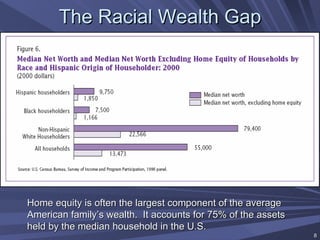
The Racial Wealth Gap Home equity is often the largest component of the average American family’s wealth.  It accounts for 75% of the assets held by the median household in the U.S.
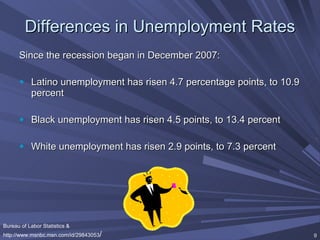
Differences in Unemployment Rates Since the recession began in December 2007: Latino unemployment has risen 4.7 percentage points, to 10.9 percent  Black unemployment has risen 4.5 points, to 13.4 percent White unemployment has risen 2.9 points, to 7.3 percent Bureau of Labor Statistics &  http://www.msnbc.msn.com/id/29843053 /
Unemployment and Black Men Between November 2007 and March 2009, the national decline in the number of black men with jobs was 660,000, accounting for  82 percent  of the job losses among all black workers.  During this time period, black men experienced the highest rate of job loss among any gender or racial/ethnic group. Marlow, Ron, and Andrew Sum. “A Job Crisis for Young Black Men.”  The Boston Globe   22 Apr 2009.
Data for the Seattle-Tacoma consolidated metropolitan area 2007 Labor Force Participation Rates Total Population:  69.4%  White:  69.5% Black:  69.3% Asian: 67.1% Latino: 75.6% Unemployment Rates  Total Population:  3.5%    White:  3.1%   Black:  6.0%   Asian: 3.1%   Latino: 3.2%   *Data from American Community Survey.  Note that the unemployed are still calculated as being actively in the labor force
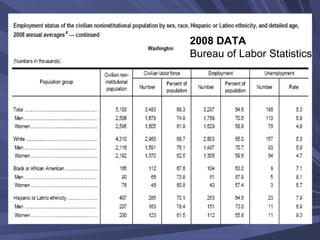
2008 DATA  Bureau of Labor Statistics
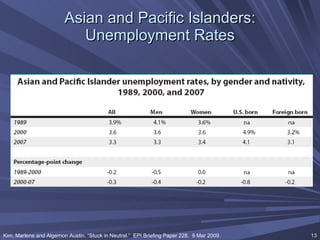
Asian and Pacific Islanders: Unemployment Rates Kim, Marlene and Algernon Austin. “Stuck in Neutral.”  EPI Briefing Paper 228.  9 Mar 2009.
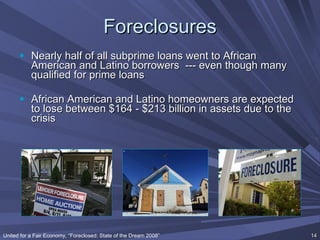
Foreclosures Nearly half of all subprime loans went to African American and Latino borrowers  --- even though many qualified for prime loans African American and Latino homeowners are expected to lose between $164 - $213 billion in assets due to the crisis United for a Fair Economy, “Foreclosed: State of the Dream 2008”
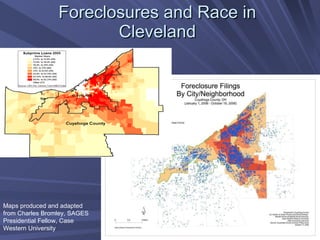
Foreclosures and Race in Cleveland Maps produced and adapted from Charles Bromley, SAGES Presidential Fellow, Case Western University
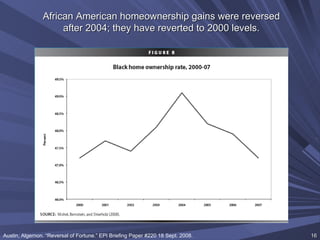
African American homeownership gains were reversed after 2004; they have reverted to 2000 levels. Austin, Algernon. “Reversal of Fortune.” EPI Briefing Paper #220 18 Sept. 2008.
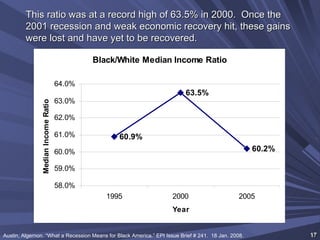
This ratio was at a record high of 63.5% in 2000.  Once the 2001 recession and weak economic recovery hit, these gains were lost and have yet to be recovered. Austin, Algernon. “What a Recession Means for Black America.” EPI Issue Brief # 241.  18 Jan. 2008.
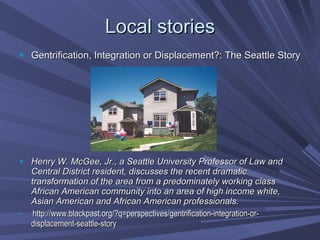
Local stories Gentrification, Integration or Displacement?: The Seattle Story Henry W. McGee, Jr., a Seattle University Professor of Law and Central District resident, discusses the recent dramatic transformation of the area from a predominately working class African American community into an area of high income white, Asian American and African American professionals. http://www.blackpast.org/?q=perspectives/gentrification-integration-or-displacement-seattle-story
Rapid Changes to Seattle’s Central Area Central Area is in an advanced stage of gentrification Between 1990 and 2000: Central Area’s population increased by 10% to 22,000 The white and Latino population increased while the African American population decreased The average home values increased by 81% Household incomes increased by 48% African Americans who are leaving Central Area are moving to the SE and SE areas of Seattle http://www.blackpast.org/?q=perspectives/gentrification-integration-or-displacement-seattle-story
Gentrification in Seattle’s Central Area Thousands of African Americans have been displaced from the city’s oldest identifiably African American community   Yet this is not simply a story of whites replacing blacks in a community.   Many black residents remain There is also a growing population of other people of color, including recent arrivals from Africa, Asia, and Latin America Will the Central Area become a viable, vibrant interracial community, or will it do a reverse “flip” and become an essentially nearly all-European American area?  http://www.urban.org/UploadedPDF/411294_gentrification.pdf
Housing Strategies in Central Area Infill development, including the development of mixed-use projects The availability of underdeveloped parcels of land and some vacant lots allow for infill development for at least two more years Citywide housing levies to raise funds for the production and preservation of affordable housing, both rental and homeownership.  Special Objective Areas (SOA) are areas that the city has designated as economically distressed.  Central Area is one of the four SOAs listed in the 2002 levy.  http://www.urban.org/UploadedPDF/411294_gentrification.pdf
Targeted Universalism and Systems Thinking
Crisis    Opportunity “ You never want a serious crisis to go to waste"  ~ Rahm Emanuel A crisis creates a sense of urgency No one can deny that the system is broken An opportunity to learn what worked and what did not Civil War    Reconstruction Depression    New Deal 2008-2009 Recession    ?
Learning From Our Mistakes? If we fail to pay attention to populations and the resources that communities possess, we are likely to repeat the mistakes of the New Deal. For example, Social Security benefits were initially denied to household and farm laborers – effectively excluding 65% of the Black population at the time How do we avoid the New Deal mistakes? We must be intentional.  Policies should be targeted and programs should be structured so that they reach certain populations and communities.
We Need A New Paradigm Targeted policies alone are not desirable because they appear to show favoritism toward a certain group, thus stigmatizing them. Universal policies alone are not truly universal. They fail to account for the fact that people are situated differently in the economic and social landscape “ Universal” policies are often based on a non-universal standard  Ex: Social Security: able-bodied white males working outside the home full-time for pay Thus…  Targeted Universalism
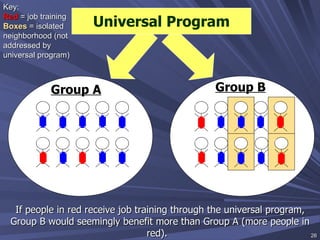
Group A Group B If people in red receive job training through the universal program, Group B would seemingly benefit more than Group A (more people in red).   Universal Program Key: Red  = job training  Boxes  = isolated neighborhood (not addressed by universal program)
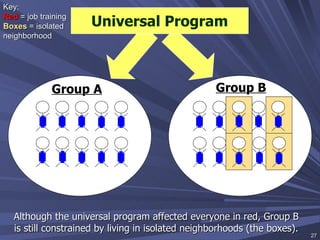
Group A Group B Although the universal program affected everyone in red, Group B is still constrained by living in isolated neighborhoods (the boxes). Universal Program Key: Red  = job training  Boxes  = isolated neighborhood
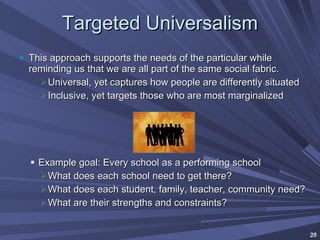
Targeted Universalism This approach supports the needs of the particular while reminding us that we are all part of the same social fabric. Universal, yet captures how people are differently situated  Inclusive, yet targets those who are most marginalized Example goal: Every school as a performing school What does each school need to get there? What does each student, family, teacher, community need? What are their strengths and constraints?
Targeted Universalism Targeted Universalism recognizes racial disparities and the importance of eradicating them, while acknowledging their presence within a larger inequitable, institutional framework Targeted universalism is a common framework through which to pursue justice. A model which recognizes our linked fate A model where we all grow together A model where we embrace collective solutions
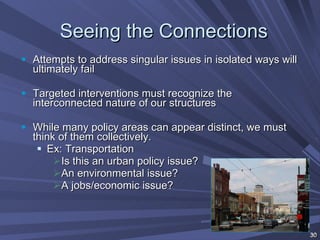
Seeing the Connections Attempts to address singular issues in isolated ways will ultimately fail Targeted interventions must recognize the interconnected nature of our structures While many policy areas can appear distinct, we must think of them collectively. Ex: Transportation Is this an urban policy issue? An environmental issue?  A jobs/economic issue?
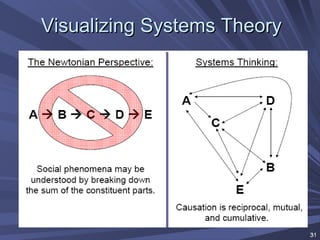
Visualizing Systems Theory
Systems Interventions We need to identify both the problems and the opportunities that exist. A systems perspective would advocate that we focus on design and outputs rather instead of inputs and the process.
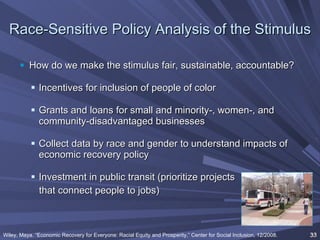
Race-Sensitive Policy Analysis of the Stimulus How do we make the stimulus fair, sustainable, accountable? Incentives for inclusion of people of color Grants and loans for small and minority-, women-, and community-disadvantaged businesses Collect data by race and gender to understand impacts of economic recovery policy Investment in public transit (prioritize projects  that connect people to jobs) Wiley, Maya. “Economic Recovery for Everyone: Racial Equity and Prosperity,” Center for Social Inclusion, 12/2008.
Racially Sensitive Policies What do racially sensitive policies look like? Targeted : They recognize the nature of our interconnected structures / larger inequitable, institutional framework. Pay attention to situatedness : They account for the fact that people are situated differently in the economic and social landscape of society. Driven by outcomes : It may seem great if unemployment is cut in half, but if all the jobs go to white males, serious problems remain. Include people of color in the process : Their input is vital.
Racially Sensitive Policies (con’t) What do racially sensitive policies look like? Transparent : - Transparency allows for gauging progress and making corrections if necessary. Multi-faceted : Incentivize a systems approach.  Reorient how we think about policy. Serve as a bridge to the next economy : These policies should be the stepping stones for the future.
Strategies and Best Practices The role of foundations in promoting a just economic recovery
Ways to Produce Change How do foundations think about ways in which you can make change? 3 options:   1)  Do what’s “fair” - a lot of people receive a little help 2)  Triage – help those who are in the worst situation 3)  Transformative – figure out what went wrong in  order to correct it
Transformative Change What can foundations do to produce transformative change? Collaborate and focus your efforts Allocate your money strategically – a little bit in a lot of places is not as effective as focused efforts that can later be replicated elsewhere Invest in learning models Invest in communications models and capacities
Toward a Just Economic Recovery Reflect on the intersection of need and opportunity Some communities and people have greater needs (i.e., communities suffering from high foreclosure rates) Focus on strategic interventions / turning points “ Will this make the water turn into steam?” Embrace advocacy We should be proactive rather than passive! This is our government, our money, and our  opportunity!
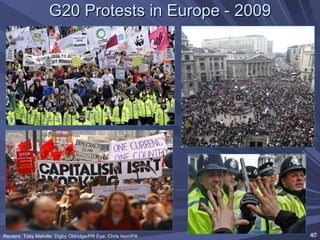
G20 Protests in Europe - 2009 Reuters: Toby Melville; Digby Oldridge/PR Eye; Chris Ison/PA
Toward a Just Economic Recovery What are these billions of dollars actually fixing? Are we only fixing the ‘status quo’? Are we transformative yet? Are opportunity gaps shrinking? Mind the gap & fix the gap: Reduce the existing disparities between communities of color both in terms of people and places while growing the economy for all This requires: ■   Baseline  ■   Monitoring  ■   Strategy
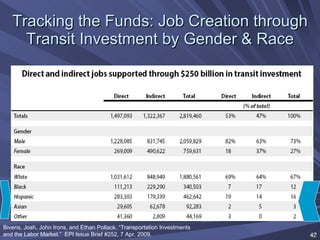
Tracking the Funds: Job Creation through Transit Investment by Gender & Race Bivens, Josh, John Irons, and Ethan Pollack. “Transportation Investments and the Labor Market.”  EPI Issue Brief #252, 7 Apr. 2009.
Opportunities for Philanthropy Short term: Draw on your experience and research Present a clear, informed perspective regarding communities of color that have been devastated by the economic recession Foundations need to  proactively  shape and direct the flow of money. Intervene in the public dialogue: Targeting the flow of stimulus money dispersed to states Connecting education and housing policy through the targeted use of LIHTC funds
Opportunities for Philanthropy Long term : Employ strategic communications regarding race Help push national dialogue to overcome the common binary of (1) we’re in a post-racial world where race ‘doesn’t matter’; (2) we’re stuck in the past where race is ‘everything’ Emphasize productive discussions around race that thoughtfully inform policy design and advocacy Capacity building Increase the participation of marginalized groups in policy design Improve data collection, monitoring, and evaluation of state and federal programs Legal advocacy
Questions or Comments?  For More Information, Visit Us Online: www.KirwanInstitute.org And… Coming soon: www.fairrecovery.org

The Impact of the Economic Crisis on Communities of Color & Strategies for Moving Forward

  • 1.
    The Impact ofthe Economic Crisis on Communities of Color & Strategies for Moving Forward john a. powell Director, Kirwan Institute for the Study of Race and Ethnicity Williams Chair in Civil Rights & Civil Liberties, Moritz College of Law People of Color in Philanthropy Network May 8, 2009 Seattle, WA
  • 2.
    Overview of today’sconversation The current recession & racially disparate effects Is the response addressing an uneven landscape of opportunity? Applying targeted universalism & systems thinking Strategies and Best Practices The role of foundations in promoting a just economic recovery
  • 3.
    Key Takeaways Theeconomic recession has landed unevenly, and on an uneven landscape of opportunity Universal policies fail to acknowledge how people are differently situated Treating people who are situated differently as if they were equally able to access the benefits of “universal” policies can in fact lead to greater inequities We can work proactively to spur transformative change Mind the gap & fix the gap
  • 4.
    The Current Recession: Racially Disparate Effects
  • 5.
    The Current RecessionThe current recession has affected everyone – but not all to the same degree. Although the U.S. has been in a recession for more than a year, people of color have been in a recession for nearly five years and have entered a depression during the current economic crisis.
  • 6.
    Poverty Gaps Comparedto whites (2007 data): Blacks were 3.0 times as likely as whites to live in poverty American Indian/Alaska Native were 2.9 times as likely as whites to live in poverty Hispanics were 2.6 times as likely as whites to live in poverty Asians were 1.2 times as likely as whites to live in poverty “ The State of Opportunity: 2009 Report.” The Opportunity Agenda
  • 7.
    Poverty Rates Althoughthe black poverty rate fell 8.5% from 1989 to 2000, the black family poverty rate increased 2.8% from 2000 to 2007. Poverty rates for Hispanic families grew .5% from 2000 to 2007. The Hispanic family poverty rate (19.7%) is roughly twice that of the overall poverty rate (9.8%).
  • 8.
    The Racial WealthGap Home equity is often the largest component of the average American family’s wealth. It accounts for 75% of the assets held by the median household in the U.S.
  • 9.
    Differences in UnemploymentRates Since the recession began in December 2007: Latino unemployment has risen 4.7 percentage points, to 10.9 percent Black unemployment has risen 4.5 points, to 13.4 percent White unemployment has risen 2.9 points, to 7.3 percent Bureau of Labor Statistics & http://www.msnbc.msn.com/id/29843053 /
  • 10.
    Unemployment and BlackMen Between November 2007 and March 2009, the national decline in the number of black men with jobs was 660,000, accounting for 82 percent of the job losses among all black workers. During this time period, black men experienced the highest rate of job loss among any gender or racial/ethnic group. Marlow, Ron, and Andrew Sum. “A Job Crisis for Young Black Men.” The Boston Globe 22 Apr 2009.
  • 11.
    Data for theSeattle-Tacoma consolidated metropolitan area 2007 Labor Force Participation Rates Total Population: 69.4% White: 69.5% Black: 69.3% Asian: 67.1% Latino: 75.6% Unemployment Rates Total Population: 3.5%   White: 3.1%   Black: 6.0%   Asian: 3.1%   Latino: 3.2%   *Data from American Community Survey. Note that the unemployed are still calculated as being actively in the labor force
  • 12.
    2008 DATA Bureau of Labor Statistics
  • 13.
    Asian and PacificIslanders: Unemployment Rates Kim, Marlene and Algernon Austin. “Stuck in Neutral.” EPI Briefing Paper 228. 9 Mar 2009.
  • 14.
    Foreclosures Nearly halfof all subprime loans went to African American and Latino borrowers --- even though many qualified for prime loans African American and Latino homeowners are expected to lose between $164 - $213 billion in assets due to the crisis United for a Fair Economy, “Foreclosed: State of the Dream 2008”
  • 15.
    Foreclosures and Racein Cleveland Maps produced and adapted from Charles Bromley, SAGES Presidential Fellow, Case Western University
  • 16.
    African American homeownershipgains were reversed after 2004; they have reverted to 2000 levels. Austin, Algernon. “Reversal of Fortune.” EPI Briefing Paper #220 18 Sept. 2008.
  • 17.
    This ratio wasat a record high of 63.5% in 2000. Once the 2001 recession and weak economic recovery hit, these gains were lost and have yet to be recovered. Austin, Algernon. “What a Recession Means for Black America.” EPI Issue Brief # 241. 18 Jan. 2008.
  • 18.
    Local stories Gentrification,Integration or Displacement?: The Seattle Story Henry W. McGee, Jr., a Seattle University Professor of Law and Central District resident, discusses the recent dramatic transformation of the area from a predominately working class African American community into an area of high income white, Asian American and African American professionals. http://www.blackpast.org/?q=perspectives/gentrification-integration-or-displacement-seattle-story
  • 19.
    Rapid Changes toSeattle’s Central Area Central Area is in an advanced stage of gentrification Between 1990 and 2000: Central Area’s population increased by 10% to 22,000 The white and Latino population increased while the African American population decreased The average home values increased by 81% Household incomes increased by 48% African Americans who are leaving Central Area are moving to the SE and SE areas of Seattle http://www.blackpast.org/?q=perspectives/gentrification-integration-or-displacement-seattle-story
  • 20.
    Gentrification in Seattle’sCentral Area Thousands of African Americans have been displaced from the city’s oldest identifiably African American community Yet this is not simply a story of whites replacing blacks in a community.  Many black residents remain There is also a growing population of other people of color, including recent arrivals from Africa, Asia, and Latin America Will the Central Area become a viable, vibrant interracial community, or will it do a reverse “flip” and become an essentially nearly all-European American area? http://www.urban.org/UploadedPDF/411294_gentrification.pdf
  • 21.
    Housing Strategies inCentral Area Infill development, including the development of mixed-use projects The availability of underdeveloped parcels of land and some vacant lots allow for infill development for at least two more years Citywide housing levies to raise funds for the production and preservation of affordable housing, both rental and homeownership. Special Objective Areas (SOA) are areas that the city has designated as economically distressed. Central Area is one of the four SOAs listed in the 2002 levy. http://www.urban.org/UploadedPDF/411294_gentrification.pdf
  • 22.
    Targeted Universalism andSystems Thinking
  • 23.
    Crisis  Opportunity “ You never want a serious crisis to go to waste" ~ Rahm Emanuel A crisis creates a sense of urgency No one can deny that the system is broken An opportunity to learn what worked and what did not Civil War  Reconstruction Depression  New Deal 2008-2009 Recession  ?
  • 24.
    Learning From OurMistakes? If we fail to pay attention to populations and the resources that communities possess, we are likely to repeat the mistakes of the New Deal. For example, Social Security benefits were initially denied to household and farm laborers – effectively excluding 65% of the Black population at the time How do we avoid the New Deal mistakes? We must be intentional. Policies should be targeted and programs should be structured so that they reach certain populations and communities.
  • 25.
    We Need ANew Paradigm Targeted policies alone are not desirable because they appear to show favoritism toward a certain group, thus stigmatizing them. Universal policies alone are not truly universal. They fail to account for the fact that people are situated differently in the economic and social landscape “ Universal” policies are often based on a non-universal standard Ex: Social Security: able-bodied white males working outside the home full-time for pay Thus… Targeted Universalism
  • 26.
    Group A GroupB If people in red receive job training through the universal program, Group B would seemingly benefit more than Group A (more people in red). Universal Program Key: Red = job training Boxes = isolated neighborhood (not addressed by universal program)
  • 27.
    Group A GroupB Although the universal program affected everyone in red, Group B is still constrained by living in isolated neighborhoods (the boxes). Universal Program Key: Red = job training Boxes = isolated neighborhood
  • 28.
    Targeted Universalism Thisapproach supports the needs of the particular while reminding us that we are all part of the same social fabric. Universal, yet captures how people are differently situated Inclusive, yet targets those who are most marginalized Example goal: Every school as a performing school What does each school need to get there? What does each student, family, teacher, community need? What are their strengths and constraints?
  • 29.
    Targeted Universalism TargetedUniversalism recognizes racial disparities and the importance of eradicating them, while acknowledging their presence within a larger inequitable, institutional framework Targeted universalism is a common framework through which to pursue justice. A model which recognizes our linked fate A model where we all grow together A model where we embrace collective solutions
  • 30.
    Seeing the ConnectionsAttempts to address singular issues in isolated ways will ultimately fail Targeted interventions must recognize the interconnected nature of our structures While many policy areas can appear distinct, we must think of them collectively. Ex: Transportation Is this an urban policy issue? An environmental issue? A jobs/economic issue?
  • 31.
  • 32.
    Systems Interventions Weneed to identify both the problems and the opportunities that exist. A systems perspective would advocate that we focus on design and outputs rather instead of inputs and the process.
  • 33.
    Race-Sensitive Policy Analysisof the Stimulus How do we make the stimulus fair, sustainable, accountable? Incentives for inclusion of people of color Grants and loans for small and minority-, women-, and community-disadvantaged businesses Collect data by race and gender to understand impacts of economic recovery policy Investment in public transit (prioritize projects that connect people to jobs) Wiley, Maya. “Economic Recovery for Everyone: Racial Equity and Prosperity,” Center for Social Inclusion, 12/2008.
  • 34.
    Racially Sensitive PoliciesWhat do racially sensitive policies look like? Targeted : They recognize the nature of our interconnected structures / larger inequitable, institutional framework. Pay attention to situatedness : They account for the fact that people are situated differently in the economic and social landscape of society. Driven by outcomes : It may seem great if unemployment is cut in half, but if all the jobs go to white males, serious problems remain. Include people of color in the process : Their input is vital.
  • 35.
    Racially Sensitive Policies(con’t) What do racially sensitive policies look like? Transparent : - Transparency allows for gauging progress and making corrections if necessary. Multi-faceted : Incentivize a systems approach. Reorient how we think about policy. Serve as a bridge to the next economy : These policies should be the stepping stones for the future.
  • 36.
    Strategies and BestPractices The role of foundations in promoting a just economic recovery
  • 37.
    Ways to ProduceChange How do foundations think about ways in which you can make change? 3 options: 1) Do what’s “fair” - a lot of people receive a little help 2) Triage – help those who are in the worst situation 3) Transformative – figure out what went wrong in order to correct it
  • 38.
    Transformative Change Whatcan foundations do to produce transformative change? Collaborate and focus your efforts Allocate your money strategically – a little bit in a lot of places is not as effective as focused efforts that can later be replicated elsewhere Invest in learning models Invest in communications models and capacities
  • 39.
    Toward a JustEconomic Recovery Reflect on the intersection of need and opportunity Some communities and people have greater needs (i.e., communities suffering from high foreclosure rates) Focus on strategic interventions / turning points “ Will this make the water turn into steam?” Embrace advocacy We should be proactive rather than passive! This is our government, our money, and our opportunity!
  • 40.
    G20 Protests inEurope - 2009 Reuters: Toby Melville; Digby Oldridge/PR Eye; Chris Ison/PA
  • 41.
    Toward a JustEconomic Recovery What are these billions of dollars actually fixing? Are we only fixing the ‘status quo’? Are we transformative yet? Are opportunity gaps shrinking? Mind the gap & fix the gap: Reduce the existing disparities between communities of color both in terms of people and places while growing the economy for all This requires: ■ Baseline ■ Monitoring ■ Strategy
  • 42.
    Tracking the Funds:Job Creation through Transit Investment by Gender & Race Bivens, Josh, John Irons, and Ethan Pollack. “Transportation Investments and the Labor Market.” EPI Issue Brief #252, 7 Apr. 2009.
  • 43.
    Opportunities for PhilanthropyShort term: Draw on your experience and research Present a clear, informed perspective regarding communities of color that have been devastated by the economic recession Foundations need to proactively shape and direct the flow of money. Intervene in the public dialogue: Targeting the flow of stimulus money dispersed to states Connecting education and housing policy through the targeted use of LIHTC funds
  • 44.
    Opportunities for PhilanthropyLong term : Employ strategic communications regarding race Help push national dialogue to overcome the common binary of (1) we’re in a post-racial world where race ‘doesn’t matter’; (2) we’re stuck in the past where race is ‘everything’ Emphasize productive discussions around race that thoughtfully inform policy design and advocacy Capacity building Increase the participation of marginalized groups in policy design Improve data collection, monitoring, and evaluation of state and federal programs Legal advocacy
  • 45.
    Questions or Comments? For More Information, Visit Us Online: www.KirwanInstitute.org And… Coming soon: www.fairrecovery.org