Beyond Post-Racialism, Toward Opportunity and Social Justice  john a. powell, Executive Director of the Kirwan Institute for the Study of Race and Ethnicity, and Williams Chair in Civil Rights & Civil Liberties,  Moritz College of Law Presentation at the MOSES 12th Annual  Dr. Martin Luther King Jr. Banquet   January 19, 2009
Today’s Conversation Reflecting on Dr. Martin Luther King Jr. Our current situation Difficulties faced by Detroit Recognizing the relevance of race Moving forward Opportunity, coalition building and targeted universalism Importance of community organizations like MOSES
“ Let us rise up tonight with a greater readiness. Let us stand with a greater determination. And let us move on in these powerful days, these days of challenge to make America what it ought to be. We have an opportunity to make America a better nation.”  -Dr. Martin Luther King Jr. Dr. King and Barack Obama
Dr. King and Barack Obama “ This is our moment. This is our time, to put our people back to work and open doors of opportunity for our kids; to restore prosperity and promote the cause of peace; to reclaim the American Dream and reaffirm that fundamental truth, that, out of many, we are one; that while we breathe, we hope. And where we are met with cynicism and doubts and those who tell us that we can't, we will respond with that timeless creed that sums up the spirit of a people: Yes, we can.”  -Barack Obama
Dr. King on Economic Justice Called for an “economic bill of rights” and a massive jobs program and worked on the Poor People’s campaign “ It must not be just black people…We must include American Indians, Puerto Ricans, Mexicans, and even poor whites.” In 1968, Dr. King supported a sanitation workers strike in Memphis “ Our only hope today lies in our ability to recapture the revolutionary spirit and go out into a sometimes hostile world declaring eternal hostility to poverty, racism, and militarism.
Poverty by the Numbers The official 2007 poverty rate was 12.5 percent 37.3 million people were in poverty, up from 36.5 million in 2006.   Poverty did not change for Whites (8.2 percent), Blacks (24.5 percent), and Asians (10.2 percent) from 2006, however they increased for Hispanics  The poverty rate increased to 18% for children under 18 years old while it remained unchanged for people 18-64 years old and people over 65 Over 3 times as many families fall below family budget thresholds as opposed to the poverty line   Source: US Census Bureau
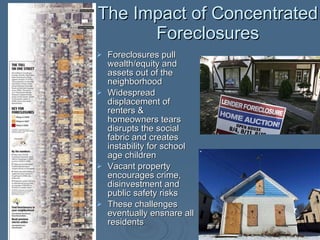
The Impact of Concentrated Foreclosures Foreclosures pull wealth/equity and assets out of the neighborhood Widespread displacement of renters & homeowners tears disrupts the social fabric and creates instability for school age children Vacant property encourages crime, disinvestment and public safety risks These challenges eventually ensnare all residents
Disproportionate Impact Surge in foreclosures Nearly 900,000 homes repossessed by banks in just the last 12 months Foreclosures rose 81% ensnaring 2.3 million U.S. households during 2008 A global crisis with racially disparate impacts Nearly half of all subprime loans went to African American and Latino borrowers  even though many qualified for prime loans African American and Latino homeowners are expected to lose between $164-$213 billion in assets due to the crisis* Sources: United for a Fair Economy, “Foreclosed: State of the Dream 2008”  Detroit Free Press, “Foreclosures up by 81% in US.”  http://www.freep.com/article/20090115/BUSINESS07/901150357/-1/rss07
Detroit and Foreclosures According to RealtyTrac Inc, Wayne County fell to 10th place in 2008 foreclosure filings after being 1 st  in the nation in 2007  Filings fell by 7.7% from 2007 The rest of metro Detroit (Oakland, Macomb, St. Clair, Lapeer and Livingston counties) was up 42% from 2007.  Bank repossessions rose 19% in Michigan last year and the state ranked 6 th  nationwide in the number of foreclosure filings Filings are up 107% from 2006  Source: Detroit Free Press, “Foreclosures up by 81% in US.”  http://www.freep.com/article/20090115/BUSINESS07/901150357/-1/rss07
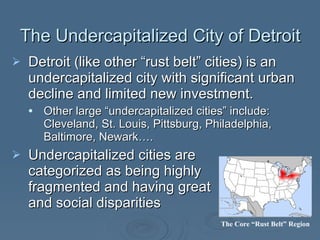
Detroit (like other “rust belt” cities) is an undercapitalized city with significant urban decline and limited new investment. Other large “undercapitalized cities” include: Cleveland, St. Louis, Pittsburg, Philadelphia, Baltimore, Newark…. Undercapitalized cities are  categorized as being highly  fragmented and having great  racial and social disparities  The Undercapitalized City of Detroit The Core “Rust Belt” Region
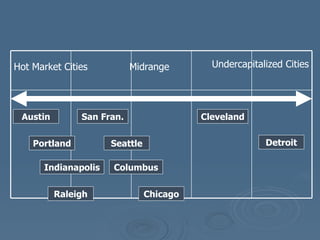
Austin Portland Indianapolis Raleigh Detroit Cleveland Chicago San Fran. Seattle Columbus Hot Market Cities Undercapitalized Cities Midrange
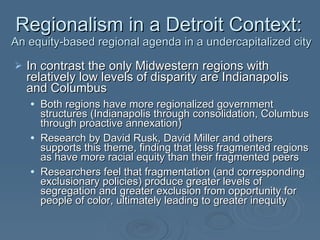
In contrast the only Midwestern regions with relatively low levels of disparity are Indianapolis and Columbus  Both regions have more regionalized government structures (Indianapolis through consolidation, Columbus through proactive annexation) Research by David Rusk, David Miller and others supports this theme, finding that less fragmented regions as have more racial equity than their fragmented peers Researchers feel that fragmentation (and corresponding exclusionary policies) produce greater levels of segregation and greater exclusion from opportunity for people of color, ultimately leading to greater inequity Regionalism in a Detroit Context:  An equity-based regional agenda in a undercapitalized city
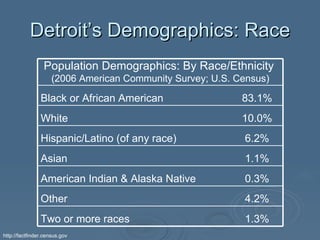
Detroit’s Demographics: Race http://factfinder.census.gov 1.3% Two or more races 4.2% Other 0.3% American Indian & Alaska Native 1.1% Asian 6.2% Hispanic/Latino (of any race) 10.0% White 83.1% Black or African American Population Demographics: By Race/Ethnicity   (2006 American Community Survey; U.S. Census)
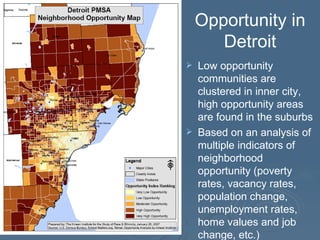
Low opportunity communities are clustered in inner city, high opportunity areas are found in the suburbs Based on an analysis of multiple indicators of neighborhood opportunity (poverty rates, vacancy rates, population change, unemployment rates, home values and job change, etc.) Opportunity in Detroit
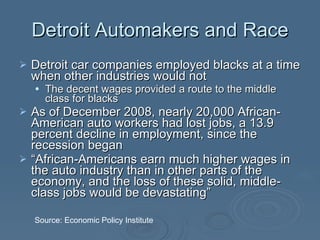
Detroit Automakers and Race Detroit car companies employed blacks at a time when other industries would not The decent wages provided a route to the middle class for blacks As of December 2008, nearly 20,000 African-American auto workers had lost jobs, a 13.9 percent decline in employment, since the recession began  “ African-Americans earn much higher wages in the auto industry than in other parts of the economy, and the loss of these solid, middle-class jobs would be devastating”  Source: Economic Policy Institute
Race and the Economic Situation White unemployment was at 6.6 percent in December, but black unemployment was nearly 12% percent.  The unemployment rate for black men was 13.4% According to report by the Economic Mobility Project, African-American children were less likely than their white children to earn more than their parents did. This is true even for middle class blacks 45% of African American children fell to the bottom of the income scale as adults compared to only 16 % of whites  Source: U.S. Intra-generational Economic Mobility from 1984-2004 http://www.economicmobility.org/assets/pdfs/PEW_EMP_MOBILITY_1984_TO_2004_KEY_FINDINGS.pdf  New York Times, “As Detroit Suffers, Black Workers Hurt.” http://www.nytimes.com/2008/12/30/business/30detroit.html?_r=1&partner=MOREOVERNEWS&ei=5040
The Continuing Relevance of Race Why does race continue to play such a critical role in determining societal outcomes?  Haven’t we entered a post-racial moment with the election of Barack Obama? While significant in many ways, Obama’s victory does not erase the persistent inequalities that hinder the life chances for marginalized groups
Myth of Post-racialism Conservative and liberal political commentators termed Obama as a post-racial candidate much different from Rev. Al Sharpton or Jesse Jackson “ This was a color-blind election” – Deneen Borelli,  National Center for Public Policy Research   Many others question the notion of past-racialism and worry about Obama’s desire to transcend a critical black narrative about America “ My fear is that, should Obama succeed with his effort to renegotiate the implicit American racial contract, then the prophetic African American voice – which is occasionally strident and necessarily a dissident, outsider's voice – could be lost to us forever.” – Glenn Loury, Brown Univ.
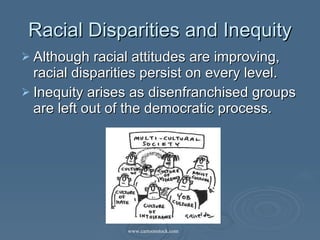
Racial Disparities and Inequity Although racial attitudes are improving, racial disparities persist on every level. Inequity arises as disenfranchised groups are left out of the democratic process.  www.cartoonstock.com
Spatial Racism and Inequality The government plays a central role in the arrangement of space and opportunities These arrangements are not “neutral” or “natural” or “colorblind” Social and racial inequities are geographically inscribed There is a polarization between the rich and the poor that is directly related to the areas in which they live
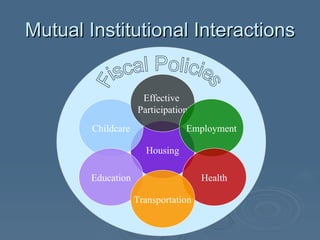
Mutual Institutional Interactions Fiscal Policies Housing Childcare Effective  Participation Employment Health Education Transportation
The Cumulative Effects of Racial and  Opportunity Segregation Zoning laws prevent affordable housing development in many suburbs Municipalities subsidize the relocation of businesses out of the city Transportation spending favors highways, metropolitan expansion and urban sprawl Court decisions prevent metropolitan school desegregation School funding is tied to property taxes
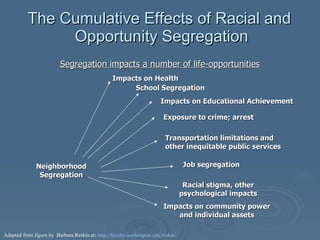
The Cumulative Effects of Racial and  Opportunity Segregation Neighborhood Segregation School Segregation Racial stigma, other psychological impacts Job segregation Impacts on community power and individual assets Impacts on Educational Achievement Exposure to crime; arrest Transportation limitations and other inequitable public services Adapted from figure by  Barbara Reskin at:  http://faculty.washington.edu/reskin/ Segregation impacts a number of life-opportunities Impacts on Health
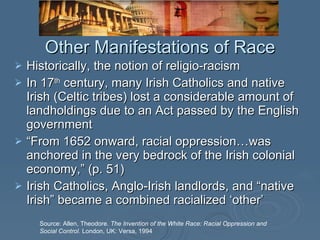
Other Manifestations of Race Historically, the notion of religio-racism In 17 th  century, many Irish Catholics and native Irish (Celtic tribes) lost a considerable amount of landholdings due to an Act passed by the English government “ From 1652 onward, racial oppression…was anchored in the very bedrock of the Irish colonial economy,” (p. 51) Irish Catholics, Anglo-Irish landlords, and “native Irish” became a combined racialized ‘other’ Source: Allen, Theodore.  The Invention of the White Race: Racial Oppression and Social Control.  London, UK: Versa, 1994
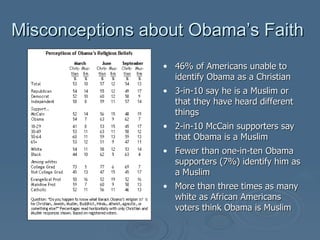
Misconceptions about Obama’s Faith  46% of Americans unable to identify Obama as a Christian  3-in-10 say he is a Muslim or that they have heard different things  2-in-10 McCain supporters say that Obama is a Muslim Fewer than one-in-ten Obama supporters (7%) identify him as a Muslim More than three times as many white as African Americans voters think Obama is Muslim
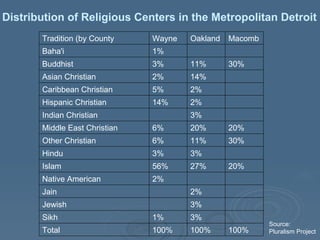
Distribution of Religious Centers in the Metropolitan Detroit Source:  Pluralism Project 100%  100%  100%  Total     3%  1%  Sikh     3%     Jewish     2%     Jain        2%  Native American  20%  27%  56%  Islam     3%  3%  Hindu  30%  11%  6%  Other Christian  20%  20%  6%  Middle East Christian     3%     Indian Christian     2%  14%  Hispanic Christian     2%  5%  Caribbean Christian     14%  2%  Asian Christian  30%  11%  3%  Buddhist        1%  Baha'i  Macomb Oakland Wayne Tradition (by County
Moving Forward Effectively and Proactively How do we make sense of all of this? Understanding Opportunity Recognizing our interconnectedness Targeted Universalism as an approach Coalition building and the role of community organizations like MOSES
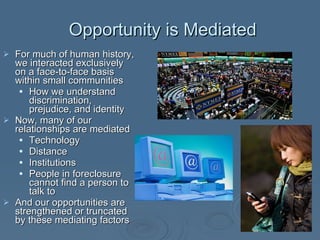
Opportunity is Mediated For much of human history, we interacted exclusively on a face-to-face basis within small communities How we understand discrimination, prejudice, and identity Now, many of our relationships are mediated Technology Distance Institutions People in foreclosure cannot find a person to talk to And our opportunities are strengthened or truncated by these mediating factors
Opportunity is Global Our world today is more complex and interconnected. Current and future changes will not be only driven by local/national issues, but influenced by systemic global trends and challenges Examples Globalization Climate change The credit and foreclosure crisis Growing diversity and widening inequality We must adjust our lens of analysis to reflect these changing conditions Moving towards a systems approach of problem solving and identifying solutions
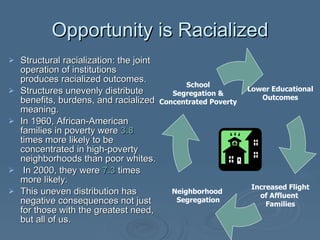
Opportunity is Racialized Structural racialization: the joint operation of institutions produces racialized outcomes. Structures unevenly distribute benefits, burdens, and racialized meaning. In 1960, African-American families in poverty were  3.8  times more likely to be concentrated in high-poverty neighborhoods than poor whites. In 2000, they were  7.3  times more likely. This uneven distribution has negative consequences not just for those with the greatest need, but all of us. Lower Educational Outcomes Increased Flight of Affluent  Families Neighborhood  Segregation School Segregation & Concentrated Poverty
Emphasizing our Linked Fate and Interconnectedness All members of a society share a linked fate Inequality is a sign of an economically/socially inefficient society, where proper investments are not made in human capital, and where much of the population can not meet its creative potential. These disparities and inequities make our nation less competitive, depressing opportunities for all should be collaborative and focus on coalition building recognize the interconnectedness of our being and fate re-conceptualize society to promote the political, economic, spiritual, and psychological health of all
Targeted Universalism Through collective imagination, we need to define what the future should look like A New Paradigm!: Targeted Universalism What is our alternative vision? A model where we all grow together A model where we embrace collective solutions This vision requires collective action and will require coalitions to be successful
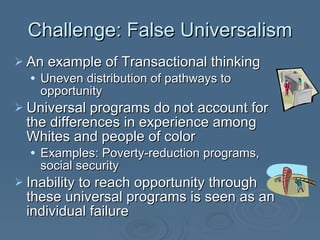
Challenge: False Universalism An example of Transactional thinking Uneven distribution of pathways to opportunity Universal programs do not account for the differences in experience among Whites and people of color Examples: Poverty-reduction programs, social security Inability to reach opportunity through these universal programs is seen as an individual failure
Coalition Building Move from transactional level to a deeper transformative level Coalition across groups, space, ideology Ethics of connectedness and linked fate Structures, policies, institutions actively disconnect us whereas they could proactively connect us
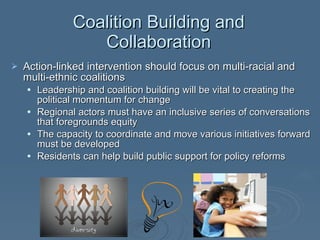
Coalition Building and Collaboration Action-linked intervention should focus on multi-racial and multi-ethnic coalitions  Leadership and coalition building will be vital to creating the political momentum for change Regional actors must have an inclusive series of conversations that foregrounds equity The capacity to coordinate and move various initiatives forward must be developed  Residents can help build public support for policy reforms
Importance of community organizations: MOSES Community organizations play an essential role especially with an administration that is likely to be more receptive  MOSES is geared toward the community and its mission is conducive to coalition-based grass-roots activism Faith serves as important anchor  Broad engagement in a number of social issues including employment, healthcare, immigration, land banks, civil rights
MOSES Initiatives and ‘Greening’ Efforts to enrich and expand the mass transit system in Southeastern Michigan Pushing for wider availability of high quality, healthy, and affordable foods These initiatives are critical in terms of community building and going green Pressure on Detroit automakers provides an opportunity for groups like MOSES to push for new, more environmentally friendly car product lines
Let us rise up tonight with a greater readiness. Let us stand with a greater determination. And let us move on in these powerful days, these days of challenge to make America what it ought to be. We have an opportunity to make America a better nation.  -Dr. Martin Luther King Jr.
Questions or Comments?  For More Information Visit Us On-Line: www.KirwanInstitute.org

Beyond Post-Racialism, Toward Opportunity and Social Justice

  • 1.
    Beyond Post-Racialism, TowardOpportunity and Social Justice john a. powell, Executive Director of the Kirwan Institute for the Study of Race and Ethnicity, and Williams Chair in Civil Rights & Civil Liberties, Moritz College of Law Presentation at the MOSES 12th Annual Dr. Martin Luther King Jr. Banquet January 19, 2009
  • 2.
    Today’s Conversation Reflectingon Dr. Martin Luther King Jr. Our current situation Difficulties faced by Detroit Recognizing the relevance of race Moving forward Opportunity, coalition building and targeted universalism Importance of community organizations like MOSES
  • 3.
    “ Let usrise up tonight with a greater readiness. Let us stand with a greater determination. And let us move on in these powerful days, these days of challenge to make America what it ought to be. We have an opportunity to make America a better nation.” -Dr. Martin Luther King Jr. Dr. King and Barack Obama
  • 4.
    Dr. King andBarack Obama “ This is our moment. This is our time, to put our people back to work and open doors of opportunity for our kids; to restore prosperity and promote the cause of peace; to reclaim the American Dream and reaffirm that fundamental truth, that, out of many, we are one; that while we breathe, we hope. And where we are met with cynicism and doubts and those who tell us that we can't, we will respond with that timeless creed that sums up the spirit of a people: Yes, we can.” -Barack Obama
  • 5.
    Dr. King onEconomic Justice Called for an “economic bill of rights” and a massive jobs program and worked on the Poor People’s campaign “ It must not be just black people…We must include American Indians, Puerto Ricans, Mexicans, and even poor whites.” In 1968, Dr. King supported a sanitation workers strike in Memphis “ Our only hope today lies in our ability to recapture the revolutionary spirit and go out into a sometimes hostile world declaring eternal hostility to poverty, racism, and militarism.
  • 6.
    Poverty by theNumbers The official 2007 poverty rate was 12.5 percent 37.3 million people were in poverty, up from 36.5 million in 2006. Poverty did not change for Whites (8.2 percent), Blacks (24.5 percent), and Asians (10.2 percent) from 2006, however they increased for Hispanics The poverty rate increased to 18% for children under 18 years old while it remained unchanged for people 18-64 years old and people over 65 Over 3 times as many families fall below family budget thresholds as opposed to the poverty line Source: US Census Bureau
  • 7.
    The Impact ofConcentrated Foreclosures Foreclosures pull wealth/equity and assets out of the neighborhood Widespread displacement of renters & homeowners tears disrupts the social fabric and creates instability for school age children Vacant property encourages crime, disinvestment and public safety risks These challenges eventually ensnare all residents
  • 8.
    Disproportionate Impact Surgein foreclosures Nearly 900,000 homes repossessed by banks in just the last 12 months Foreclosures rose 81% ensnaring 2.3 million U.S. households during 2008 A global crisis with racially disparate impacts Nearly half of all subprime loans went to African American and Latino borrowers even though many qualified for prime loans African American and Latino homeowners are expected to lose between $164-$213 billion in assets due to the crisis* Sources: United for a Fair Economy, “Foreclosed: State of the Dream 2008” Detroit Free Press, “Foreclosures up by 81% in US.” http://www.freep.com/article/20090115/BUSINESS07/901150357/-1/rss07
  • 9.
    Detroit and ForeclosuresAccording to RealtyTrac Inc, Wayne County fell to 10th place in 2008 foreclosure filings after being 1 st in the nation in 2007 Filings fell by 7.7% from 2007 The rest of metro Detroit (Oakland, Macomb, St. Clair, Lapeer and Livingston counties) was up 42% from 2007. Bank repossessions rose 19% in Michigan last year and the state ranked 6 th nationwide in the number of foreclosure filings Filings are up 107% from 2006 Source: Detroit Free Press, “Foreclosures up by 81% in US.” http://www.freep.com/article/20090115/BUSINESS07/901150357/-1/rss07
  • 10.
    Detroit (like other“rust belt” cities) is an undercapitalized city with significant urban decline and limited new investment. Other large “undercapitalized cities” include: Cleveland, St. Louis, Pittsburg, Philadelphia, Baltimore, Newark…. Undercapitalized cities are categorized as being highly fragmented and having great racial and social disparities The Undercapitalized City of Detroit The Core “Rust Belt” Region
  • 11.
    Austin Portland IndianapolisRaleigh Detroit Cleveland Chicago San Fran. Seattle Columbus Hot Market Cities Undercapitalized Cities Midrange
  • 12.
    In contrast theonly Midwestern regions with relatively low levels of disparity are Indianapolis and Columbus Both regions have more regionalized government structures (Indianapolis through consolidation, Columbus through proactive annexation) Research by David Rusk, David Miller and others supports this theme, finding that less fragmented regions as have more racial equity than their fragmented peers Researchers feel that fragmentation (and corresponding exclusionary policies) produce greater levels of segregation and greater exclusion from opportunity for people of color, ultimately leading to greater inequity Regionalism in a Detroit Context: An equity-based regional agenda in a undercapitalized city
  • 13.
    Detroit’s Demographics: Racehttp://factfinder.census.gov 1.3% Two or more races 4.2% Other 0.3% American Indian & Alaska Native 1.1% Asian 6.2% Hispanic/Latino (of any race) 10.0% White 83.1% Black or African American Population Demographics: By Race/Ethnicity (2006 American Community Survey; U.S. Census)
  • 14.
    Low opportunity communitiesare clustered in inner city, high opportunity areas are found in the suburbs Based on an analysis of multiple indicators of neighborhood opportunity (poverty rates, vacancy rates, population change, unemployment rates, home values and job change, etc.) Opportunity in Detroit
  • 15.
    Detroit Automakers andRace Detroit car companies employed blacks at a time when other industries would not The decent wages provided a route to the middle class for blacks As of December 2008, nearly 20,000 African-American auto workers had lost jobs, a 13.9 percent decline in employment, since the recession began “ African-Americans earn much higher wages in the auto industry than in other parts of the economy, and the loss of these solid, middle-class jobs would be devastating” Source: Economic Policy Institute
  • 16.
    Race and theEconomic Situation White unemployment was at 6.6 percent in December, but black unemployment was nearly 12% percent. The unemployment rate for black men was 13.4% According to report by the Economic Mobility Project, African-American children were less likely than their white children to earn more than their parents did. This is true even for middle class blacks 45% of African American children fell to the bottom of the income scale as adults compared to only 16 % of whites Source: U.S. Intra-generational Economic Mobility from 1984-2004 http://www.economicmobility.org/assets/pdfs/PEW_EMP_MOBILITY_1984_TO_2004_KEY_FINDINGS.pdf New York Times, “As Detroit Suffers, Black Workers Hurt.” http://www.nytimes.com/2008/12/30/business/30detroit.html?_r=1&partner=MOREOVERNEWS&ei=5040
  • 17.
    The Continuing Relevanceof Race Why does race continue to play such a critical role in determining societal outcomes? Haven’t we entered a post-racial moment with the election of Barack Obama? While significant in many ways, Obama’s victory does not erase the persistent inequalities that hinder the life chances for marginalized groups
  • 18.
    Myth of Post-racialismConservative and liberal political commentators termed Obama as a post-racial candidate much different from Rev. Al Sharpton or Jesse Jackson “ This was a color-blind election” – Deneen Borelli, National Center for Public Policy Research Many others question the notion of past-racialism and worry about Obama’s desire to transcend a critical black narrative about America “ My fear is that, should Obama succeed with his effort to renegotiate the implicit American racial contract, then the prophetic African American voice – which is occasionally strident and necessarily a dissident, outsider's voice – could be lost to us forever.” – Glenn Loury, Brown Univ.
  • 19.
    Racial Disparities andInequity Although racial attitudes are improving, racial disparities persist on every level. Inequity arises as disenfranchised groups are left out of the democratic process. www.cartoonstock.com
  • 20.
    Spatial Racism andInequality The government plays a central role in the arrangement of space and opportunities These arrangements are not “neutral” or “natural” or “colorblind” Social and racial inequities are geographically inscribed There is a polarization between the rich and the poor that is directly related to the areas in which they live
  • 21.
    Mutual Institutional InteractionsFiscal Policies Housing Childcare Effective Participation Employment Health Education Transportation
  • 22.
    The Cumulative Effectsof Racial and Opportunity Segregation Zoning laws prevent affordable housing development in many suburbs Municipalities subsidize the relocation of businesses out of the city Transportation spending favors highways, metropolitan expansion and urban sprawl Court decisions prevent metropolitan school desegregation School funding is tied to property taxes
  • 23.
    The Cumulative Effectsof Racial and Opportunity Segregation Neighborhood Segregation School Segregation Racial stigma, other psychological impacts Job segregation Impacts on community power and individual assets Impacts on Educational Achievement Exposure to crime; arrest Transportation limitations and other inequitable public services Adapted from figure by Barbara Reskin at: http://faculty.washington.edu/reskin/ Segregation impacts a number of life-opportunities Impacts on Health
  • 24.
    Other Manifestations ofRace Historically, the notion of religio-racism In 17 th century, many Irish Catholics and native Irish (Celtic tribes) lost a considerable amount of landholdings due to an Act passed by the English government “ From 1652 onward, racial oppression…was anchored in the very bedrock of the Irish colonial economy,” (p. 51) Irish Catholics, Anglo-Irish landlords, and “native Irish” became a combined racialized ‘other’ Source: Allen, Theodore. The Invention of the White Race: Racial Oppression and Social Control. London, UK: Versa, 1994
  • 25.
    Misconceptions about Obama’sFaith 46% of Americans unable to identify Obama as a Christian 3-in-10 say he is a Muslim or that they have heard different things 2-in-10 McCain supporters say that Obama is a Muslim Fewer than one-in-ten Obama supporters (7%) identify him as a Muslim More than three times as many white as African Americans voters think Obama is Muslim
  • 26.
    Distribution of ReligiousCenters in the Metropolitan Detroit Source: Pluralism Project 100% 100% 100% Total   3% 1% Sikh   3%   Jewish   2%   Jain     2% Native American 20% 27% 56% Islam   3% 3% Hindu 30% 11% 6% Other Christian 20% 20% 6% Middle East Christian   3%   Indian Christian   2% 14% Hispanic Christian   2% 5% Caribbean Christian   14% 2% Asian Christian 30% 11% 3% Buddhist     1% Baha'i Macomb Oakland Wayne Tradition (by County
  • 27.
    Moving Forward Effectivelyand Proactively How do we make sense of all of this? Understanding Opportunity Recognizing our interconnectedness Targeted Universalism as an approach Coalition building and the role of community organizations like MOSES
  • 28.
    Opportunity is MediatedFor much of human history, we interacted exclusively on a face-to-face basis within small communities How we understand discrimination, prejudice, and identity Now, many of our relationships are mediated Technology Distance Institutions People in foreclosure cannot find a person to talk to And our opportunities are strengthened or truncated by these mediating factors
  • 29.
    Opportunity is GlobalOur world today is more complex and interconnected. Current and future changes will not be only driven by local/national issues, but influenced by systemic global trends and challenges Examples Globalization Climate change The credit and foreclosure crisis Growing diversity and widening inequality We must adjust our lens of analysis to reflect these changing conditions Moving towards a systems approach of problem solving and identifying solutions
  • 30.
    Opportunity is RacializedStructural racialization: the joint operation of institutions produces racialized outcomes. Structures unevenly distribute benefits, burdens, and racialized meaning. In 1960, African-American families in poverty were 3.8 times more likely to be concentrated in high-poverty neighborhoods than poor whites. In 2000, they were 7.3 times more likely. This uneven distribution has negative consequences not just for those with the greatest need, but all of us. Lower Educational Outcomes Increased Flight of Affluent Families Neighborhood Segregation School Segregation & Concentrated Poverty
  • 31.
    Emphasizing our LinkedFate and Interconnectedness All members of a society share a linked fate Inequality is a sign of an economically/socially inefficient society, where proper investments are not made in human capital, and where much of the population can not meet its creative potential. These disparities and inequities make our nation less competitive, depressing opportunities for all should be collaborative and focus on coalition building recognize the interconnectedness of our being and fate re-conceptualize society to promote the political, economic, spiritual, and psychological health of all
  • 32.
    Targeted Universalism Throughcollective imagination, we need to define what the future should look like A New Paradigm!: Targeted Universalism What is our alternative vision? A model where we all grow together A model where we embrace collective solutions This vision requires collective action and will require coalitions to be successful
  • 33.
    Challenge: False UniversalismAn example of Transactional thinking Uneven distribution of pathways to opportunity Universal programs do not account for the differences in experience among Whites and people of color Examples: Poverty-reduction programs, social security Inability to reach opportunity through these universal programs is seen as an individual failure
  • 34.
    Coalition Building Movefrom transactional level to a deeper transformative level Coalition across groups, space, ideology Ethics of connectedness and linked fate Structures, policies, institutions actively disconnect us whereas they could proactively connect us
  • 35.
    Coalition Building andCollaboration Action-linked intervention should focus on multi-racial and multi-ethnic coalitions Leadership and coalition building will be vital to creating the political momentum for change Regional actors must have an inclusive series of conversations that foregrounds equity The capacity to coordinate and move various initiatives forward must be developed Residents can help build public support for policy reforms
  • 36.
    Importance of communityorganizations: MOSES Community organizations play an essential role especially with an administration that is likely to be more receptive MOSES is geared toward the community and its mission is conducive to coalition-based grass-roots activism Faith serves as important anchor Broad engagement in a number of social issues including employment, healthcare, immigration, land banks, civil rights
  • 37.
    MOSES Initiatives and‘Greening’ Efforts to enrich and expand the mass transit system in Southeastern Michigan Pushing for wider availability of high quality, healthy, and affordable foods These initiatives are critical in terms of community building and going green Pressure on Detroit automakers provides an opportunity for groups like MOSES to push for new, more environmentally friendly car product lines
  • 38.
    Let us riseup tonight with a greater readiness. Let us stand with a greater determination. And let us move on in these powerful days, these days of challenge to make America what it ought to be. We have an opportunity to make America a better nation. -Dr. Martin Luther King Jr.
  • 39.
    Questions or Comments? For More Information Visit Us On-Line: www.KirwanInstitute.org

Editor's Notes

  • #35 Coalition as an expression of trying to create a body that comes together around an issue (e.g.. union, church, family)