Gastric cancer: Current standards and next steps  Philippe ROUGIER, Sce HGE-Oncologie Digestive HEGP, 75015 PARIS [email_address]   UFR PIFO UVSQ  Université Versailles-Saint Quentin  en Yveline
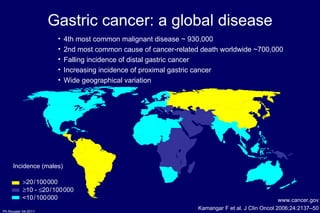
Gastric cancer: a global disease 4th most common malignant disease ~ 930,000 2nd most common cause of cancer-related death worldwide ~700,000 Falling incidence of distal gastric cancer Increasing incidence of proximal gastric cancer Wide geographical variation www.cancer.gov Kamangar F et al. J Clin Oncol 2006;24:2137–50  20   /   100   000  <10   /   100   000   10 -   20   /   100   000  Incidence (males)
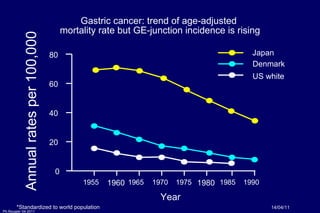
Gastric cancer: trend of age-adjusted  mortality rate but GE-junction incidence is rising 14/04/11 *Standardized to world population Year 80 60 40 20 0 1955 1960 1965 1970 1975 1980 1985 1990 Japan Denmark US white Annual rates per 100,000
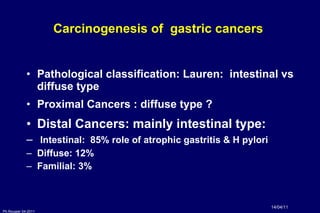
Carcinogenesis of  gastric cancers  Pathological classification: Lauren:  intestinal vs diffuse type Proximal Cancers : diffuse type ? Distal Cancers: mainly intestinal type: Intestinal:  85% role of atrophic gastritis & H pylori Diffuse: 12% Familial: 3% 14/04/11
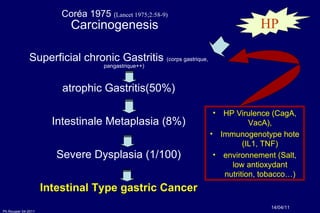
Coréa 1975  ( Lancet 1975;2:58-9) Carcinogenesis Superficial chronic Gastritis  (corps gastrique, pangastrique++) atrophic Gastritis(50%) Intestinale Metaplasia (8%) Severe Dysplasia (1/100) Intestinal Type gastric Cancer 14/04/11 HP HP Virulence (CagA, VacA), Immunogenotype hote (IL1, TNF) environnement (Salt, low antioxydant nutrition, tobacco…)
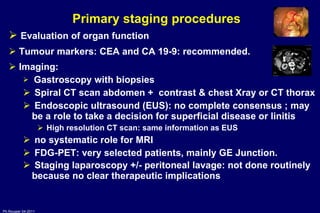
Primary staging  procedures  Evaluation of organ function Tumour markers: CEA and CA 19-9: recommended. Imaging:  Gastroscopy with biopsies Spiral CT scan abdomen +  contrast & chest Xray or CT thorax Endoscopic ultrasound (EUS): no complete consensus ; may be a role to take a decision for superficial disease or linitis  High resolution CT scan: same information as EUS no systematic role for MRI FDG-PET: very selected patients, mainly GE Junction. Staging laparoscopy +/- peritoneal lavage: not done routinely because no clear therapeutic implications
Gastric Cancers:  TREATMENT SURGERY (NEO) ADJUVANT TREATMENTS TREATMENT OF ADVANCED CASES
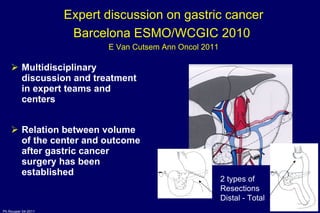
Multidisciplinary discussion and treatment in expert teams and centers Relation between volume of the center and outcome after gastric cancer surgery has been established Expert discussion on gastric cancer Barcelona ESMO/WCGIC 2010  E Van Cutsem Ann Oncol 2011 2 types of  Resections Distal - Total
Type of  surgical procedure in resectable  gastric cancer Extend of resection   Partial vs total: depending on location, margins (> 5 cm) and histology: diffuse type/signet cells Partial gastrectomy for distal cancer (antrum) Total gastrectomy for cancer from the upper part of the stomach Proximal gastrectomy increasingly performed Diffuse type/ signet cells: total gastrectomy GE junction tumours depending on extent of disease:  esophago+prox.gastrectomy, esophago+total gastrectomy D2 LN dissection  preferred: better long term outcome Splenectomy: not done, unless direct invasion laparoscopic resection: clinical trials Expert discussion on gastric cancer ESMO / WCGC June 30 – July 3, 2010, Barcelona
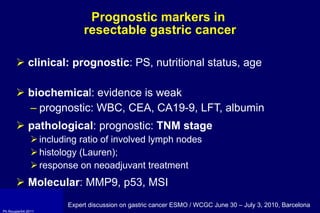
P rognostic markers in  resectable gastric cancer clinical: prognostic :  PS ,  nutritional status , a ge  biochemica l: evidence is weak prognostic:  WBC, CEA, CA19-9, LFT, albumin pathological : prognostic:  TNM  stage including ratio of involved lymph nodes histology (Lauren);  response on neoadjuvant treatment Molecular : MMP9, p53, MSI Expert discussion on gastric cancer  ESMO / WCGC June 30 – July 3, 2010, Barcelona
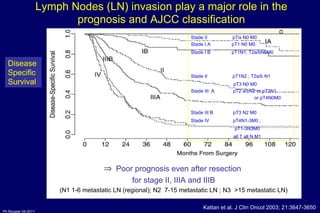
Kattan et al. J Clin Oncol 2003; 21:3647-3650  Lymph Nodes (LN) invasion play a major role in the prognosis and AJCC classification Poor prognosis even after resection  for stage II, IIIA and IIIB (N1 1-6 metastatic LN (regional); N2  7-15 metastatic LN ; N3  >15 metastatic LN) Stade 0                   pTis N0 M0  Stade I A                pT1 N0 M0  Stade I B  pT1N1; T2a/bN0M0 Stade II                 pT1N2 ; T2a/b N1 pT3 N0 M0  Stade III  A              pT2 a/bN2 or pT3N1   or pT4N0M0  Stade III B               pT3 N2 M0  Stade IV                  pT4N1-3M0 ;  pT1-3N3M0 all T all N M1  Disease  Specific  Survival
complementary treatment in gastric cancer ? Ajuvant treatment  Neoadjuvant / perioperative tt Chemotherapy (CT) ? Radio-chemotherapy (RT-CT)
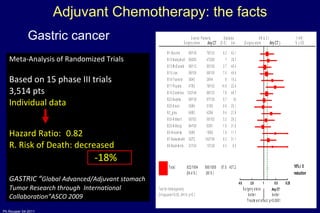
Adjuvant Chemotherapy: the facts Gastric cancer Meta-Analysis of Randomized Trials Based on 15 phase III trials 3,514 pts  Individual data Hazard Ratio:  0.82 R. Risk of Death: decreased  -18% GASTRIC “ Global Advanced/Adjuvant stomach Tumor Research through  International Collaboration”ASCO 2009
Adjuvant chemotherapy: GASTRIC Meta-analysis Gastric cancer HR:0.82  p<0.0001 + 7% at 5 years + 8% at 10 years years 5y 10y Surgery 51% 40% Any CT 58% 48% Meta-Analysis of Randomized Trials interim Results  Based on 3,514 pts  Results: HR: 0.82 5 y survival: 58% vs 51% + 7% at 5-years GASTRIC “Global Advanced/Adjuvant stomach Tumor Research through  International Collaboration” ASCO 2009
S1 compound in adjuvant (2007) Benefit on DFS & OS at 3 year (+ 12% and + 10.4%) Benefit non dependant on age or sexe… mainly stage II and IIIa tumors  100 50 0 2 3 4 5 1 Ans HR = 0,68 [0,52-0,87] p = 0,0024 Overall survival (n = 1 059) 100 50 0 2 3 4 5 1 Ans HR = 0,62 [0,50-0,77] p < 0,0001 Disease free Survival (n = 1 059) % % ASCO GI 2007 – D’après Sasako et al., Tokyo, Japon, abstr. 8 actualisé ; lancet  80,5 % 70,1 % Surgery + S-1 Surgery only 72,2 % 60,1 % Surgery +   S-1 Surgery only
Adjuvant chemotherapy in gastric cancer conclusion  Increase the overall survival  between 5 and 10% benefit at 5 years Decrease the risk of death by 18% No regimen is superior to 5FU monochemotherapy No superiority of protocols continaing cis-platinum
Adjuvant treatment in gastric cancer ? Chemotherapy (CT) ? Radio-chemotherapy (RT-CT)
582 pts gastric ADK & GEJ Stade IB-IV (M0)  5FU-AF (5j) surgery RT 45 Gy 5FU-AF 5FU-AF  X 2 Follow-up Mac Donald et al.  N Engl J Med 2001 Adjuvant Radio-chemotherapy in Gastric Cancer: The only randomized Trial  Against Surgery Only  SWOG 9008/INT 0116 phase III trial: o verall survival per treatment arm R
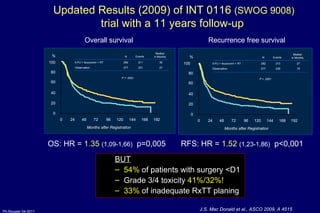
Updated Results (2009) of INT 0116  (SWOG 9008)  trial with a 11 years follow-up  Overall survival Recurrence free survival 0 20 40 60 80 100 % 0 24 48 72 96 120 144 168 192 Months after Registration 0 20 40 60 80 100 % 0 24 48 72 96 120 144 168 192 Months after Registration J.S. Mac Donald et al., ASCO 2009, A 4515 OS: HR =  1.35   (1,09-1,66)   p=0,005  RFS: HR =  1.52   (1,23-1,86)   p<0,001 BUT 54%  of patients with surgery <D1 Grade 3/4 toxicity  41%/32%! 33%  of inadequate RxTT planing 5-FU + leucovorin + RT Observation 282 277 213 239 27 19 N Events Median in Months P < .0001 5-FU + leucovorin + RT Observation 282 277 211 231 35 27 N Events Median in Months P = .0051
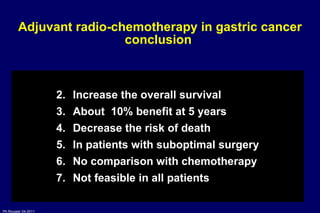
Adjuvant radio-chemotherapy in gastric cancer conclusion  Increase the overall survival  About  10% benefit at 5 years Decrease the risk of death In patients with suboptimal surgery No comparison with chemotherapy Not feasible in all patients
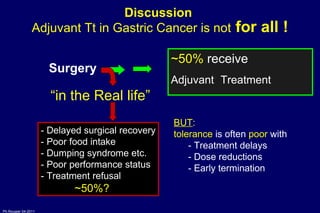
Discussion   Adjuvant Tt in Gastric Cancer is not  for all ! Surgery - Delayed surgical recovery - Poor food intake - Dumping syndrome etc. - Poor performance status - Treatment refusal   ~50%? BUT : tolerance  is often  poor  with - Treatment delays - Dose reductions - Early termination ~50%  receive  Adjuvant  Treatment “ in the Real life”
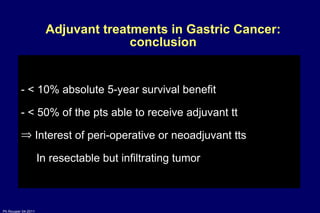
Adjuvant treatments in Gastric Cancer: conclusion HR:0.82 ; p<0.0001 - < 10% absolute 5-year survival benefit - < 50% of the pts able to receive adjuvant tt Interest of peri-operative or neoadjuvant tts In resectable but infiltrating tumor
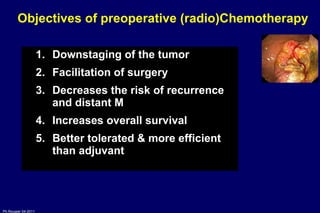
Objectives of preoperative (radio)Chemotherapy Downstaging of the tumor Facilitation of surgery  Decreases the risk of recurrence and distant M Increases overall survival  Better tolerated & more efficient than adjuvant
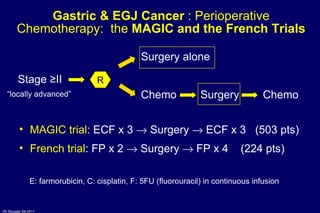
Gastric & EGJ Cancer  : Perioperative Chemotherapy:  the  MAGIC and the French Trials Surgery alone R Stage ≥II “ locally advanced” Chemo Surgery Chemo MAGIC trial : ECF x 3    Surgery    ECF x 3  (503 pts) French trial : FP x 2    Surgery    FP x 4  (224 pts) E: farmorubicin, C: cisplatin, F: 5FU (fluorouracil) in continuous infusion
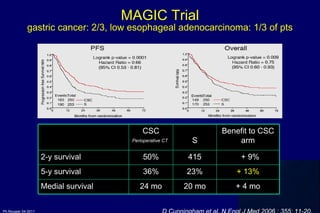
MAGIC Trial gastric cancer: 2/3, low esophageal adenocarcinoma: 1/3 of pts D Cunningham et al. N Engl J Med 2006 ; 355: 11-20. CSC  Perioperative CT   S Benefit to CSC arm 2-y survival 50% 415 + 9% 5-y survival 36% 23% + 13% Medial survival 24 mo 20 mo + 4 mo
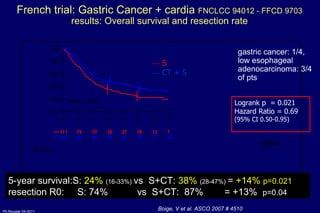
___  S ___  CT + S years French trial: Gastric Cancer + cardia  FNCLCC 94012 - FFCD 9703  results:  Overall survival and resection rate At risk 5-year survival:S:  24%   (16-33%)   vs  S+CT:  38%   (28-47%)   =  +14%  p=0.021 resection  R0:  S: 74%  vs  S+CT:  87%  = +13%  p=0.04 Logrank p  = 0.021 Hazard Ratio = 0.69  (95% CI 0.50-0.95) Boige, V et al. ASCO 2007 # 4510 gastric cancer: 1/4,  low esophageal  adenocarcinoma: 3/4  of pts
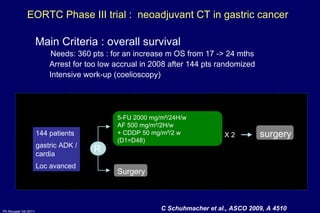
C Schuhmacher et al., ASCO 2009, A 4510 144 patients gastric ADK / cardia Loc avanced 5-FU 2000 mg/m²/24H/w AF 500 mg/m²/2H/w + CDDP 50 mg/m²/2 w (D1=D48) Surgery X 2 surgery Main Criteria : overall survival Needs: 360 pts : for an increase m OS from 17 -> 24 mths Arrest for too low accrual in 2008 after 144 pts randomized Intensive work-up (coelioscopy) EORTC Phase III trial :  neoadjuvant CT in gastric cancer R
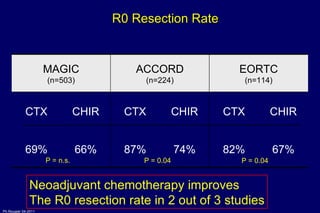
R0 Resection Rate Neoadjuvant chemotherapy improves The R0 resection rate in 2 out of 3 studies P = n.s. P = 0.04 P = 0.04 MAGIC (n=503) ACCORD (n=224) EORTC (n=114) CTX CHIR CTX CHIR CTX CHIR 69% 66% 87% 74% 82% 67%
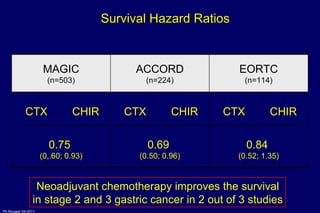
Survival Hazard Ratios Neoadjuvant chemotherapy improves the survival in stage 2 and 3 gastric cancer in 2 out of 3 studies MAGIC (n=503) ACCORD (n=224) EORTC (n=114) CTX CHIR CTX CHIR CTX CHIR 0.75  (0,.60; 0.93) 0.69  (0.50; 0.96) 0.84  (0.52; 1.35)
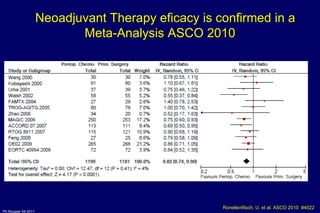
Neoadjuvant Therapy eficacy is confirmed in a Meta-Analysis ASCO 2010 Ronellenfitsch, U. et al. ASCO 2010  #4022
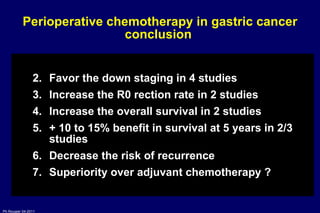
Perioperative chemotherapy in gastric cancer conclusion  Favor the down staging in 4 studies Increase the R0 rection rate in 2 studies Increase the overall survival in 2 studies + 10 to 15% benefit in survival at 5 years in 2/3 studies Decrease the risk of recurrence Superiority over adjuvant chemotherapy ?
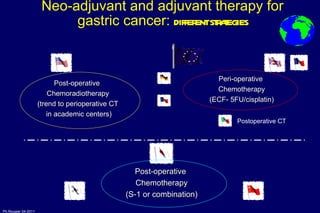
Neo-adjuvant and adjuvant therapy for gastric cancer:  different strategies Post-operative  Chemoradiotherapy (trend to perioperative CT in academic centers) Peri-operative  Chemotherapy (ECF- 5FU/cisplatin) Post-operative  Chemotherapy (S-1 or combination) Postoperative CT
Treatment of metastatic gastric cancer ? chemotherapy Targetted therapy TT
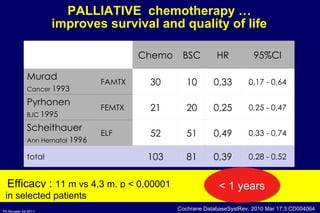
PALLIATIVE  chemotherapy … improves survival and quality of life Efficacy :  11 m vs 4,3 m, p < 0,00001 Cochrane DatabaseSystRev. 2010 Mar 17;3:CD004064 in selected patients < 1 years Chemo BSC HR 95%CI Murad Cancer  1993 FAMTX 30 10 0,33 0,17 - 0,64 Pyrhonen BJC  1995 FEMTX 21 20 0,25 0,25 - 0,47 Scheithauer   Ann Hematol  1996 ELF 52 51 0,49 0,33 - 0,74 total 103 81 0,39 0,28 - 0,52
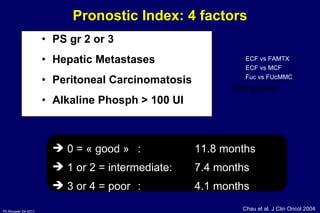
Pronostic Index: 4 factors PS gr 2 or 3 Hepatic Metastases Peritoneal Carcinomatosis Alkaline Phosph > 100 UI Chau et al. J Clin Oncol 2004 ECF vs FAMTX ECF vs MCF Fuc vs FUcMMC 1080 patients 0 = « good » : 11.8 months 1 or 2 = intermediate:  7.4 months 3 or 4 = poor : 4.1 months
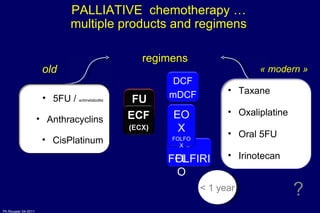
old « modern » < 1 year ? PALLIATIVE  chemotherapy … multiple products and regimens DCF mDCF IF FOLFIRI EOX FOLFOX FLO regimens Taxane Oxaliplatine Oral 5FU  Irinotecan 5FU /  antimetabolite Anthracyclins CisPlatinum
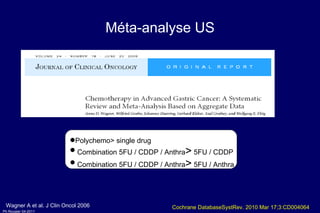
Méta-analyse US Polychemo> single drug Combination 5FU / CDDP / Anthra >  5FU / CDDP  Combination 5FU / CDDP / Anthra >  5FU / Anthra  Wagner A et al. J Clin Oncol 2006 Cochrane DatabaseSystRev. 2010 Mar 17;3:CD004064
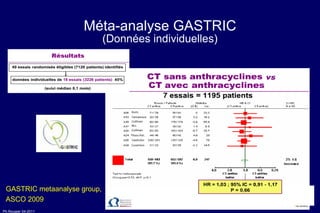
Méta-analyse GASTRIC (Données individuelles) GASTRIC metaanalyse group,  ASCO 2009
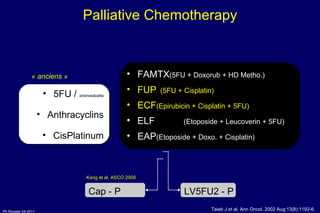
« anciens » Palliative Chemotherapy 5FU /  antimetabolite Anthracyclins CisPlatinum FAMTX (5FU + Doxorub + HD Metho.) FUP   (5FU + Cisplatin) ECF (Epirubicin + Cisplatin + 5FU) ELF   (Etoposide + Leucoverin + 5FU) EAP (Etoposide + Doxo. + Cisplatin) = LV5FU2 - P Cap - P Taieb J et al, Ann Oncol. 2002 Aug;13(8):1192-6. Kang et al, ASCO 2006
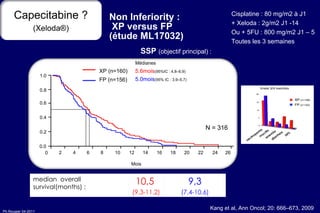
SSP  (objectif principal) : Non Inferiority :  XP versus FP (étude ML17032) XP (n=160)  FP (n=156) Médianes 5.6mois (95%IC : 4.8–6.9) 5.0mois (95% IC : 3.9–5.7) Mois 2 4 6 8 10 12 14 16 18 20 22 24 26 1.0 0.8 0.6 0.4 0.2 0.0 Kang et al, Ann Oncol; 20: 666–673, 2009 N = 316 Cisplatine : 80 mg/m2 à J1 + Xeloda : 2g/m2 J1 -14 Ou + 5FU : 800 mg/m2 J1 – 5 Toutes les 3 semaines 0 median  overall survival(months) : 10,5  (9,3-11,2) 9,3 (7,4-10,6) Capecitabine ? (Xeloda®)
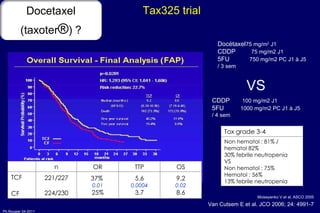
Moiseyenko V et al, ASCO 2005 Van Cutsem E et al. JCO 2006; 24: 4991-7 Tax325 trial Docétaxel 75 mg/m 2  J1 CDDP   75 mg/m2 J1 5FU    750 mg/m2 PC J1 à J5 / 3 sem CDDP    100 mg/m2 J1  5FU  1000 mg/m2 PC J1 à J5 / 4 sem VS n OR TTP OS TCF CF 221/227 224/230 37%  0.01 25% 5.6 0.0004 3.7 9.2 0.02 8.6 Tox grade 3-4 Non hematol : 81% /  hematol 82% 30% febrile neutropenia VS Non hematol : 75% Hematol : 56%  13% febrile neutropenia Docetaxel (taxoter ® ) ?
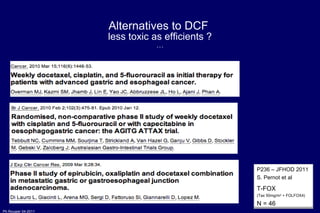
Alternatives to DCF  less toxic as efficients ? … P236 – JFHOD 2011  S. Pernot et al T-FOX  (Tax 50mg/m 2  + FOLFOX4) N = 46
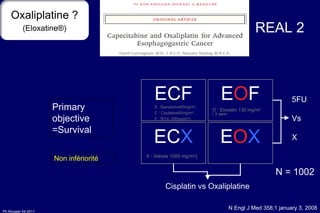
E : Epirubicine50mg/m 2 , C : Cisplatine60mg/m 2 , F : 5FUc 200mg/m 2 /j REAL 2 ECF E O F E O X EC X X : Xeloda 1000 mg/m 2 /j O : Eloxatin 130 mg/m 2 / 3 sem. 5 FU Vs X Cisplatin vs Oxaliplatine N Engl J Med 358;1 january 3, 2008 Non infériorité Primary objective =Survival  N = 1002 Oxaliplatine ? (Eloxatine®)
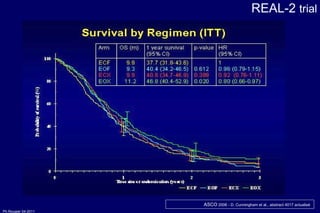
REAL-2  trial ASCO  2006 - D. Cunningham et al., abstract 4017 actualisé
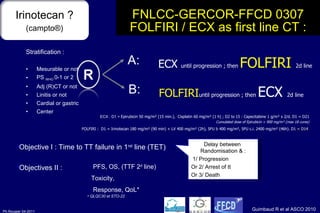
Stratification : Mesurable or not PS  WHO  0-1 or 2 Adj (R)CT or not Linitis or not Cardial or gastric Center FNLCC-GERCOR-FFCD 0307 FOLFIRI / ECX as first line CT : A: B: ECX  until progression ; then  FOLFIRI   2d line  FOLFIRI until progression ; then  ECX  2d line  Delay between  Randomisation & : 1/ Progression  Or 2/ Arrest of tt Or 3/ Death Objective I : Time to TT failure in 1 rst  line (TET) Objectives II : PFS, OS, (TTF 2 d  line)  Toxicity,  Response, QoL* QLQC30 et STO-22 ECX : D1 =  Epirubicin 50 mg/m² (15 min.),  Cisplatin 60 mg/m² (1 h) ; D2 to 15 : Capecitabine 1 g/m² x 2/d. D1 = D21 Cumulated dose of Epirubicin < 900 mg/m² (max 18 cures) FOLFIRI :  D1 = Irinotecan 180 mg/m² (90 min) + LV 400 mg/m² (2h), 5FU b 400 mg/m², 5FU c.i. 2400 mg/m² (46h). D 1 = D14  Guimbaud R et al ASCO 2010 Irinotecan ? (campto®)
FNLCC-GERCOR-FFCD 0307 FOLFIRI / ECX as first line CT : primary objective : Time to First line treatment Failure  p  (Log-rank) = 0.008  HR  ( B vs  A) = 0.77 [0.63;0.94] ECX   1 rst line : 4.24 m   [3.48; 4.65] FOLFIRI   1 rst line : 5.09 m   [4.53; 5.68] Overall Survival : ECX 1 ère  ligne) : 9.49 m. [ 8.77; 11.14] FOLFIRI 1 ère  ligne) : 9.72 m . [8.54; 11.27] p (Log-rank)= 0.95  HR (B vs A)= 1.01 [0.82; 1.24] less toxicity with FOLFIRI = Guimbaud R et al ASCO 2010 Bras A 209 108 33 8 4 2 1 1 1 Bras B 207 123 50 19 6 3 2 1 0 TTF 0.0 0.2 0.4 0.6 0.8 1.0 Time (months) 0 4 8 12 16 20 24 28 32
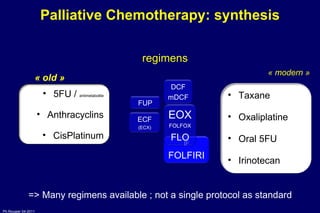
« old » Palliative Chemotherapy: synthesis « modern » regimens => Many regimens available ; not a single protocol as standard DCF mDCF IF FOLFIRI EOX FOLFOX FLO FUP ECF (ECX) 5FU /  antimetabolite Anthracyclins CisPlatinum Taxane Oxaliplatine Oral 5FU  Irinotecan
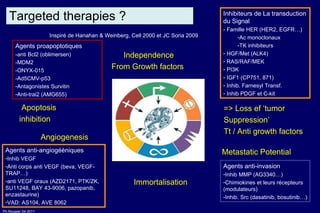
Targeted therapies ?  Metastatic Potential Immortalisation Angiogenesis Independence From Growth factors  => Loss ef ‘tumor Suppression’ Tt / Anti growth factors Apoptosis inhibition Inspiré de Hanahan & Weinberg, Cell 2000 et JC Soria 2009 Inhibiteurs de La transduction du Signal - Famille HER (HER2, EGFR…) Ac monoclonaux TK inhibiteurs HGF/Met (ALK4) RAS/RAF/MEK PI3K  IGF1 (CP751, 871) Inhib. Farnesyl Transf.  Inhib PDGF et C-kit Agents anti-invasion Inhib MMP (AG3340…) Chimiokines et leurs récepteurs (modulateurs) Inhib. Src (dasatinib, bosutinib…) Agents anti-angiogéèniques Inhib VEGF Anti corps anti VEGF (beva, VEGF-TRAP…) anti VEGF oraux (AZD2171, PTK/ZK, SU11248, BAY 43-9006, pazopanib, enzastaurine) VAD: AS104, AVE 8062 Agents proapoptotiques -anti Bcl2 (oblimersen) -MDM2 -ONYX-015 -Ad5CMV-p53 Antagonistes Survitin Anti-trai2 (AMG655)
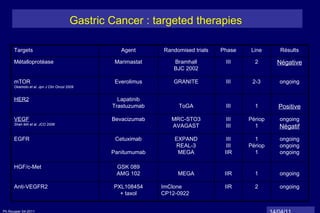
Gastric Cancer : targeted therapies  14/04/11 Targets Agent Randomised trials Phase Line Résults Métalloprotéase Marimastat Bramhall BJC 2002 III 2 Négative mTOR Okamoto et al. Jpn J Clin Oncol 2009 Everolimus GRANITE III 2-3 ongoing HER2 Lapatinib Trastuzumab ToGA III 1 Positive VEGF Shah MA et al. JCO 2006 Bevacizumab MRC-STO3 AVAGAST III III Périop 1 ongoing Négatif EGFR Cetuximab Panitumumab EXPAND REAL-3 MEGA III III IIR 1 Périop 1 ongoing ongoing ongoing HGF/c-Met GSK 089 AMG 102 MEGA IIR 1 ongoing Anti-VEGFR2 PXL108454 + taxol ImClone CP12-0922  IIR 2 ongoing
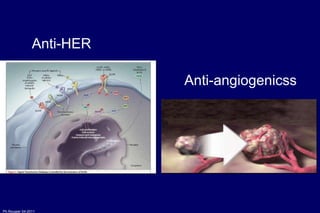
Anti-HER Anti-angiogenicss
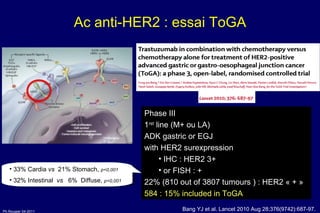
Ac anti-HER2 : essai ToGA Bang YJ et al. Lancet 2010 Aug 28;376(9742):687-97.  Phase III 1 rst  line (M+ ou LA) ADK gastric or EGJ  with HER2 surexpression IHC : HER2 3+  or FISH : +  22% (810 out of 3807 tumours ) : HER2 « + » 584 : 15% included in ToGA 33% Cardia  vs   21% Stomach,  p<0,001 32% Intestinal  vs   6%  Diffuse,  p<0,001
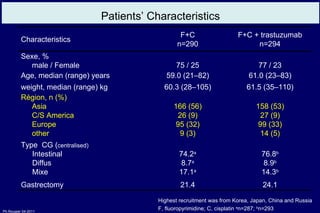
Patients’ Characteristics Highest recruitment was from Korea, Japan, China and Russia  F, fluoropyrimidine; C, cisplatin  a n=287;  b n=293 Characteristics F+C n=290 F+C +  trastuzumab n=294 Sexe, % male / Female 75 / 25 77 / 23 Age, median (range) years 59.0 (21–82) 61.0 (23–83) weight, median (range) kg 60.3 (28–105) 61.5 (35–110) Région, n (%) Asia C/S America Europe other 166 (56) 26 (9) 95 (32) 9 (3) 158 (53) 27 (9) 99 (33) 14 (5) Type  CG ( centralised) Intestinal Diffus Mixe 74.2 a 8.7 a 17.1 a 76.8 b 8.9 b 14.3 b Gastrectomy 21.4 24.1
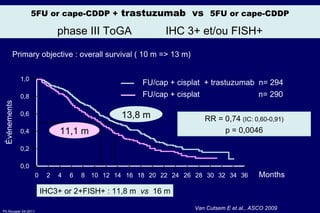
Months 0,2 0,4 0,6 0,8 1,0 0 2 4 6 8 10 12 14 16 18 20 22 24 26 28 30 32 34 36 FU/cap + cisplat  n= 290 FU/cap + cisplat  + trastuzumab  n= 294 Événements RR = 0,74  (IC: 0,60-0,91) p = 0,0046 Van Cutsem E et al., ASCO 2009 13,8 m 11,1 m IHC3+ or 2+FISH+ : 11,8 m  vs   16 m Primary objective : overall survival ( 10 m => 13 m) 5FU or cape-CDDP +  trastuzumab  vs  5FU or cape-CDDP phase III ToGA  IHC 3+ et/ou FISH+ 0,0
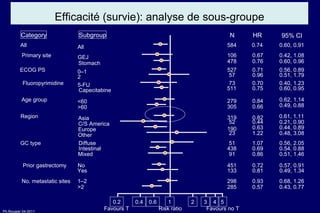
Efficacité (survie): analyse de sous-groupe Risk ratio 0.2 1 2 5 0.4 0.6 3 4 All All 584 0.60, 0.91 0.74 GEJ Primary site 106 0.42, 1.08 0.67 Stomach 478 0.60, 0.96 0.76 Region Asia 319 0.61, 1.11 0.82 C/S America 52 0.21, 0.90 0.44 Europe 190 0.44, 0.89 0.63 Other 23 0.48, 3.08 1.22 0–1 ECOG PS 527 0.56, 0.89 0.71 2 57 0.51, 1.79 0.96 279 0.84 <60 Age group 0.62, 1.14 >60 305 0.49, 0.88 0.66 Fluoropyrimidine 5-FU 73 0.40, 1.23 0.70 Capecitabine 511 0.60, 0.95 0.75 Category Subgroup N 95% CI HR Diffuse GC type 51 0.56, 2.05 1.07 Intestinal 438 0.54, 0.88 0.69 Mixed 91 0.51, 1.46 0.86 1–2 No. metastatic sites 298 0.68, 1.26 0.93 >2 285 0.43, 0.77 0.57 No Yes Prior gastrectomy 451 133 0.72 0.81 0.57, 0.91 0.49, 1.34 Favours T Favours no T
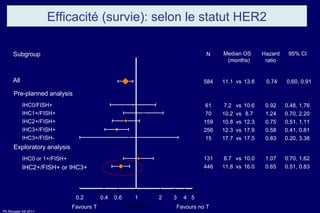
Efficacité (survie): selon le statut HER2 Subgroup Median OS   (months) All 11.1 13.8 vs Pre-planned analysis IHC0/FISH+ IHC1+/FISH+ IHC2+/FISH+ IHC3+/FISH+ IHC3+/FISH- 7.2 10.2 10.8 12.3 17.7 10.6 8.7 12.3 17.9 17.5 Exploratory analysis IHC0 or 1+/FISH+ IHC2+/FISH+ or IHC3+ 8.7 11.8 10.0 16.0 vs vs vs vs vs vs vs 0.92 1.24 0.75 0.58 0.83 0.48, 1.76 0.70, 2.20 0.51, 1.11 0.41, 0.81 0.20, 3.38 Hazard ratio 95% CI  0.74 0.60, 0.91 1.07 0.65 0.70, 1.62 0.51, 0.83 Risk ratio Favours T Favours no T 584 61 70 159 256 15 131 446 N 0.2 0.4 0.6 1 2 3 4 5
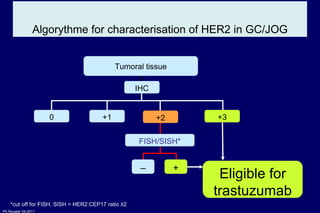
Algorythme for characterisation of HER2 in GC/JOG 0 FISH/SISH* + – Eligible for trastuzumab +1 +3 IHC Tumoral tissue +2 *cut off for FISH, SISH = HER2:CEP17 ratio ≥2
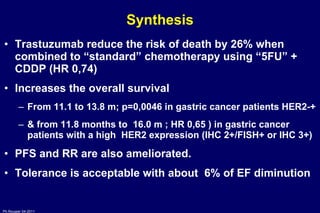
Synthesis Trastuzumab reduce the risk of death by 26% when combined to “standard” chemotherapy using “5FU” + CDDP (HR 0,74) Increases the overall survival  From 11.1 to 13.8 m; p=0,0046 in gastric cancer patients HER2-+ & from  11.8 months to  16.0 m ; HR 0,65 )  in gastric cancer patients with a high  HER2 expression (IHC 2+/FISH+ or IHC 3+) PFS and RR are also ameliorated. Tolerance is acceptable with about  6% of EF diminution
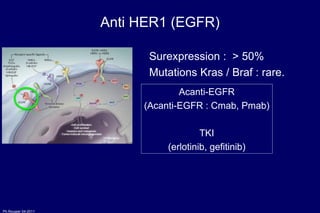
Anti HER1 (EGFR) Acanti-EGFR (Acanti-EGFR : Cmab, Pmab) TKI (erlotinib, gefitinib) Surexpression :  > 50% Mutations Kras / Braf : rare.
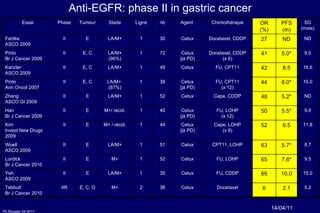
Anti-EGFR: phase II in gastric cancer 14/04/11 Essai Phase Tumeur Stade Ligne nb Agent  Chimiothérapie OR (%) PFS (m) SG (mois) Fahlke ASCO 2009 II E LA/M+ 1 30 Cetux Docetaxel, CDDP 27 ND ND Pinto Br J Cancer 2009 II E, C LA/M+ (96%) 1 72 Cetux (jà PD) Docetaxel, CDDP (x 6) 41 5.0* 9.0 Kanzler ASCO 2009 II E, C LA/M+ 1 49 Cetux FU, CPT11 42 8.5 16.6 Pinto Ann Oncol 2007 II E, C LA/M+  (87%) 1 38 Cetux (jà PD) FU, CPT11 (x 12) 44 8.0* 16.0 Zhang ASCO GI 2009 II E LA/M+ 1 52 Cetux Cape, CDDP 48 5.2* ND Han Br J Cancer 2009 II E M+/ récid. 1 40 Cetux (jà PD) FU, LOHP (x 12) 50 5.5* 9.9 Kim Invest New Drugs 2009 II E M+ / récid. 1 44 Cetux (jà PD) Cape, LOHP (x 8) 52 6.5 11.8 Woell ASCO 2009 II E LA/M+ 1 51 Cetux CPT11, LOHP 63 5.7* 8.7 Lordick Br J Cancer 2010 II E M+ 1 52 Cetux FU, LOHP 65 7.6* 9.5 Yeh ASCO 2009 II E LA/M+ 1 35 Cetux FU, CDDP 69 10.0 15.0 Tebbutt Br J Cancer 2010 IIR E, C, O M+ 2 38 Cetux Docetaxel 6 2.1 5.2
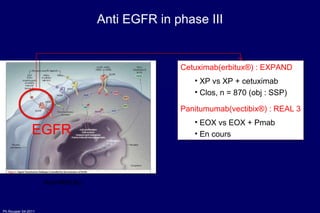
Anti EGFR in phase III Anti-HER(Ac) Cetuximab(erbitux®) : EXPAND XP vs XP + cetuximab Clos, n = 870 (obj : SSP) Panitumumab(vectibix®) : REAL 3 EOX vs EOX + Pmab En cours EGFR
Ab Anti-VEGF : AvaGast trial Y. Kang et al., ASCO 2010, LBA #4007 Phase III 1 ère  ligne (M+  ou LA ) ADK gastriques ou JOG
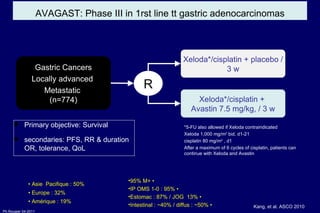
AVAGAST:  P hase III in 1rst line tt gastric adenocarcinomas Xeloda*/cisplatin + placebo / 3 w Xeloda*/cisplatin +  Avastin 7.5   mg/kg ,  / 3 w Gastric Cancers Locally advanced  Metastatic  (n=774) R Primary objective: Survival secondaries: PFS, RR & duration OR, tolerance, QoL Kang, et al. ASCO 2010 *5-FU also allowed if Xeloda contraindicated Xeloda 1 , 000   mg/m 2  bid , d1-21 cisplatin 80   mg/m 2  , d1 After a maximum of 6 cycles of cisplatin, patients can continue with Xeloda and Avastin •  Asie  Pacifique : 50% •  Europe : 32% •  Amérique : 19% 95% M+ •  IP OMS 1-0 : 95% •  Estomac : 87% / JOG  13% •  Intestinal : ~40% / diffus : ~50% •
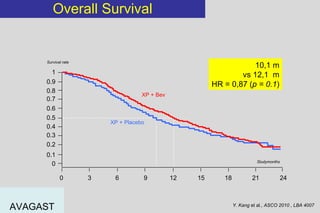
Overall Survival Y. Kang  et al ., ASCO 2010 , LBA 4007 10,1 m vs 12,1  m HR = 0,87 ( p = 0.1 ) AVAGAST Survival rate 0 0.1 0.2 0.3 0.4 0.5 0.6 0.7 0.8 0.9 1 0 3 6 9 12 15 18 21 24 XP + Bev XP + Placebo Studymonths
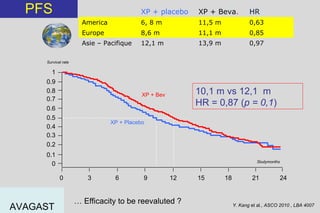
PFS Y. Kang  et al ., ASCO 2010 , LBA 4007 10,1 m vs 12,1  m HR = 0,87 ( p = 0,1 ) AVAGAST Survival rate 0 0.1 0.2 0.3 0.4 0.5 0.6 0.7 0.8 0.9 1 0 3 6 9 12 15 18 21 24 XP + Bev XP + Placebo Studymonths XP + placebo XP + Beva . HR  America 6, 8 m 11,5 m 0,63 Europe 8,6 m 11,1 m 0,85 Asie – Pacifique 12,1 m 13,9 m 0,97 …  Efficacity to be reevaluted ?
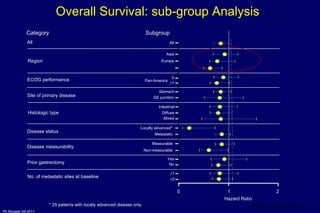
Overall Survival: sub-group Analysis Pan-America * 29 patients with locally advanced disease only Kang, et al. ASCO 2010  2 No Disease status ECOG performance Prior gastrectomy Region Site of primary disease No. of metastatic sites at baseline Disease measurability  Histologic type  All Locally advanced* Metastatic 0 Yes Europe All  1 Asia Stomach GE junction  1 Measurable Non-measurable Intestinal Diffuse Mixed Subgroup Category 2 Hazard Ratio 0 1
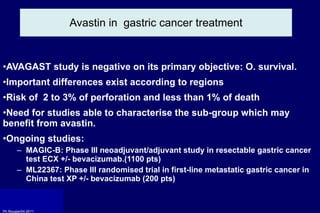
Avastin in  gastric cancer treatment AVAGAST study is negative on its primary objective: O. survival. Important differences exist according to regions Risk of  2 to 3% of perforation and less than 1% of death Need for studies able to characterise the sub-group which may benefit from avastin. Ongoing studies: MAGIC-B:  P hase III neoadjuvant/adjuvant study in resectable gastric cancer test ECX +/- bevacizumab.(1100 pts) ML22367:  P hase III randomised trial in first-line metastatic gastric cancer  in China test XP +/- bevacizumab (200 pts)
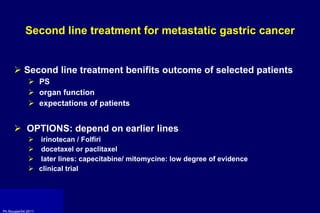
Second line treatment for metastatic gastric cancer Second line treatment benifits outcome of selected patients PS  organ function expectations of patients OPTIONS: depend on earlier lines irinotecan / Folfiri  docetaxel or paclitaxel later lines: capecitabine/ mitomycine: low degree of evidence clinical trial
GASTRIC CANCER – CONCLUSION 1  Major problem  Surgery remains the main curative treatment Results of surgical resection are poor with reccurrence rates ranging from 60 to 80% Perioperative (neoadjuvant +/- adjuvant) chemotherapy, even with old drugs, is a valid option in resectable GC. Relation between volume of the center and outcome after gastric cancer surgery has been established
GASTRIC CANCER – CONCLUSION 2  Chemotherapy improve survival in metastatic GC : oxaliplatine, taxoter and irinotecan combinations with 5FU are valid options Trastuzumab is the only  targeted therapy with a demonstrated activity in HER2 hyperexpression Multidisciplinary discussion and treatment in expert teams and centers Relation between volume of the center and outcome after gastric cancer surgery has been established

MON 2011 - Slide 20 - P. Rougier - Gastric and pancreatic cancers (part I)

  • 1.
    Gastric cancer: Currentstandards and next steps Philippe ROUGIER, Sce HGE-Oncologie Digestive HEGP, 75015 PARIS [email_address] UFR PIFO UVSQ Université Versailles-Saint Quentin en Yveline
  • 2.
    Gastric cancer: aglobal disease 4th most common malignant disease ~ 930,000 2nd most common cause of cancer-related death worldwide ~700,000 Falling incidence of distal gastric cancer Increasing incidence of proximal gastric cancer Wide geographical variation www.cancer.gov Kamangar F et al. J Clin Oncol 2006;24:2137–50  20 / 100 000 <10 / 100 000  10 -  20 / 100 000 Incidence (males)
  • 3.
    Gastric cancer: trendof age-adjusted mortality rate but GE-junction incidence is rising 14/04/11 *Standardized to world population Year 80 60 40 20 0 1955 1960 1965 1970 1975 1980 1985 1990 Japan Denmark US white Annual rates per 100,000
  • 4.
    Carcinogenesis of gastric cancers Pathological classification: Lauren: intestinal vs diffuse type Proximal Cancers : diffuse type ? Distal Cancers: mainly intestinal type: Intestinal: 85% role of atrophic gastritis & H pylori Diffuse: 12% Familial: 3% 14/04/11
  • 5.
    Coréa 1975 ( Lancet 1975;2:58-9) Carcinogenesis Superficial chronic Gastritis (corps gastrique, pangastrique++) atrophic Gastritis(50%) Intestinale Metaplasia (8%) Severe Dysplasia (1/100) Intestinal Type gastric Cancer 14/04/11 HP HP Virulence (CagA, VacA), Immunogenotype hote (IL1, TNF) environnement (Salt, low antioxydant nutrition, tobacco…)
  • 6.
    Primary staging procedures Evaluation of organ function Tumour markers: CEA and CA 19-9: recommended. Imaging: Gastroscopy with biopsies Spiral CT scan abdomen + contrast & chest Xray or CT thorax Endoscopic ultrasound (EUS): no complete consensus ; may be a role to take a decision for superficial disease or linitis High resolution CT scan: same information as EUS no systematic role for MRI FDG-PET: very selected patients, mainly GE Junction. Staging laparoscopy +/- peritoneal lavage: not done routinely because no clear therapeutic implications
  • 7.
    Gastric Cancers: TREATMENT SURGERY (NEO) ADJUVANT TREATMENTS TREATMENT OF ADVANCED CASES
  • 8.
    Multidisciplinary discussion andtreatment in expert teams and centers Relation between volume of the center and outcome after gastric cancer surgery has been established Expert discussion on gastric cancer Barcelona ESMO/WCGIC 2010 E Van Cutsem Ann Oncol 2011 2 types of Resections Distal - Total
  • 9.
    Type of surgical procedure in resectable gastric cancer Extend of resection Partial vs total: depending on location, margins (> 5 cm) and histology: diffuse type/signet cells Partial gastrectomy for distal cancer (antrum) Total gastrectomy for cancer from the upper part of the stomach Proximal gastrectomy increasingly performed Diffuse type/ signet cells: total gastrectomy GE junction tumours depending on extent of disease: esophago+prox.gastrectomy, esophago+total gastrectomy D2 LN dissection preferred: better long term outcome Splenectomy: not done, unless direct invasion laparoscopic resection: clinical trials Expert discussion on gastric cancer ESMO / WCGC June 30 – July 3, 2010, Barcelona
  • 10.
    P rognostic markersin resectable gastric cancer clinical: prognostic : PS , nutritional status , a ge biochemica l: evidence is weak prognostic: WBC, CEA, CA19-9, LFT, albumin pathological : prognostic: TNM stage including ratio of involved lymph nodes histology (Lauren); response on neoadjuvant treatment Molecular : MMP9, p53, MSI Expert discussion on gastric cancer ESMO / WCGC June 30 – July 3, 2010, Barcelona
  • 11.
    Kattan et al.J Clin Oncol 2003; 21:3647-3650 Lymph Nodes (LN) invasion play a major role in the prognosis and AJCC classification Poor prognosis even after resection for stage II, IIIA and IIIB (N1 1-6 metastatic LN (regional); N2 7-15 metastatic LN ; N3 >15 metastatic LN) Stade 0                   pTis N0 M0 Stade I A                pT1 N0 M0 Stade I B pT1N1; T2a/bN0M0 Stade II                pT1N2 ; T2a/b N1 pT3 N0 M0 Stade III  A              pT2 a/bN2 or pT3N1 or pT4N0M0 Stade III B               pT3 N2 M0 Stade IV                  pT4N1-3M0 ; pT1-3N3M0 all T all N M1 Disease Specific Survival
  • 12.
    complementary treatment ingastric cancer ? Ajuvant treatment Neoadjuvant / perioperative tt Chemotherapy (CT) ? Radio-chemotherapy (RT-CT)
  • 13.
    Adjuvant Chemotherapy: thefacts Gastric cancer Meta-Analysis of Randomized Trials Based on 15 phase III trials 3,514 pts Individual data Hazard Ratio: 0.82 R. Risk of Death: decreased -18% GASTRIC “ Global Advanced/Adjuvant stomach Tumor Research through International Collaboration”ASCO 2009
  • 14.
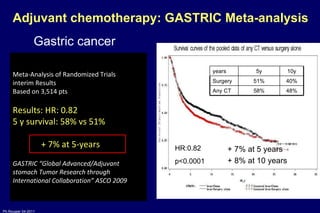
    Adjuvant chemotherapy: GASTRICMeta-analysis Gastric cancer HR:0.82 p<0.0001 + 7% at 5 years + 8% at 10 years years 5y 10y Surgery 51% 40% Any CT 58% 48% Meta-Analysis of Randomized Trials interim Results Based on 3,514 pts Results: HR: 0.82 5 y survival: 58% vs 51% + 7% at 5-years GASTRIC “Global Advanced/Adjuvant stomach Tumor Research through International Collaboration” ASCO 2009
  • 15.
    S1 compound inadjuvant (2007) Benefit on DFS & OS at 3 year (+ 12% and + 10.4%) Benefit non dependant on age or sexe… mainly stage II and IIIa tumors 100 50 0 2 3 4 5 1 Ans HR = 0,68 [0,52-0,87] p = 0,0024 Overall survival (n = 1 059) 100 50 0 2 3 4 5 1 Ans HR = 0,62 [0,50-0,77] p < 0,0001 Disease free Survival (n = 1 059) % % ASCO GI 2007 – D’après Sasako et al., Tokyo, Japon, abstr. 8 actualisé ; lancet 80,5 % 70,1 % Surgery + S-1 Surgery only 72,2 % 60,1 % Surgery + S-1 Surgery only
  • 16.
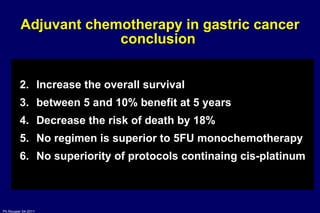
    Adjuvant chemotherapy ingastric cancer conclusion Increase the overall survival between 5 and 10% benefit at 5 years Decrease the risk of death by 18% No regimen is superior to 5FU monochemotherapy No superiority of protocols continaing cis-platinum
  • 17.
    Adjuvant treatment ingastric cancer ? Chemotherapy (CT) ? Radio-chemotherapy (RT-CT)
  • 18.
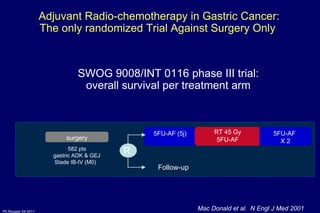
    582 pts gastricADK & GEJ Stade IB-IV (M0) 5FU-AF (5j) surgery RT 45 Gy 5FU-AF 5FU-AF X 2 Follow-up Mac Donald et al. N Engl J Med 2001 Adjuvant Radio-chemotherapy in Gastric Cancer: The only randomized Trial Against Surgery Only SWOG 9008/INT 0116 phase III trial: o verall survival per treatment arm R
  • 19.
    Updated Results (2009)of INT 0116 (SWOG 9008) trial with a 11 years follow-up Overall survival Recurrence free survival 0 20 40 60 80 100 % 0 24 48 72 96 120 144 168 192 Months after Registration 0 20 40 60 80 100 % 0 24 48 72 96 120 144 168 192 Months after Registration J.S. Mac Donald et al., ASCO 2009, A 4515 OS: HR = 1.35 (1,09-1,66) p=0,005 RFS: HR = 1.52 (1,23-1,86) p<0,001 BUT 54% of patients with surgery <D1 Grade 3/4 toxicity 41%/32%! 33% of inadequate RxTT planing 5-FU + leucovorin + RT Observation 282 277 213 239 27 19 N Events Median in Months P < .0001 5-FU + leucovorin + RT Observation 282 277 211 231 35 27 N Events Median in Months P = .0051
  • 20.
    Adjuvant radio-chemotherapy ingastric cancer conclusion Increase the overall survival About 10% benefit at 5 years Decrease the risk of death In patients with suboptimal surgery No comparison with chemotherapy Not feasible in all patients
  • 21.
    Discussion Adjuvant Tt in Gastric Cancer is not for all ! Surgery - Delayed surgical recovery - Poor food intake - Dumping syndrome etc. - Poor performance status - Treatment refusal ~50%? BUT : tolerance is often poor with - Treatment delays - Dose reductions - Early termination ~50% receive Adjuvant Treatment “ in the Real life”
  • 22.
    Adjuvant treatments inGastric Cancer: conclusion HR:0.82 ; p<0.0001 - < 10% absolute 5-year survival benefit - < 50% of the pts able to receive adjuvant tt Interest of peri-operative or neoadjuvant tts In resectable but infiltrating tumor
  • 23.
    Objectives of preoperative(radio)Chemotherapy Downstaging of the tumor Facilitation of surgery Decreases the risk of recurrence and distant M Increases overall survival Better tolerated & more efficient than adjuvant
  • 24.
    Gastric & EGJCancer : Perioperative Chemotherapy: the MAGIC and the French Trials Surgery alone R Stage ≥II “ locally advanced” Chemo Surgery Chemo MAGIC trial : ECF x 3  Surgery  ECF x 3 (503 pts) French trial : FP x 2  Surgery  FP x 4 (224 pts) E: farmorubicin, C: cisplatin, F: 5FU (fluorouracil) in continuous infusion
  • 25.
    MAGIC Trial gastriccancer: 2/3, low esophageal adenocarcinoma: 1/3 of pts D Cunningham et al. N Engl J Med 2006 ; 355: 11-20. CSC Perioperative CT S Benefit to CSC arm 2-y survival 50% 415 + 9% 5-y survival 36% 23% + 13% Medial survival 24 mo 20 mo + 4 mo
  • 26.
    ___ S___ CT + S years French trial: Gastric Cancer + cardia FNCLCC 94012 - FFCD 9703 results: Overall survival and resection rate At risk 5-year survival:S: 24% (16-33%) vs S+CT: 38% (28-47%) = +14% p=0.021 resection R0: S: 74% vs S+CT: 87% = +13% p=0.04 Logrank p = 0.021 Hazard Ratio = 0.69 (95% CI 0.50-0.95) Boige, V et al. ASCO 2007 # 4510 gastric cancer: 1/4, low esophageal adenocarcinoma: 3/4 of pts
  • 27.
    C Schuhmacher etal., ASCO 2009, A 4510 144 patients gastric ADK / cardia Loc avanced 5-FU 2000 mg/m²/24H/w AF 500 mg/m²/2H/w + CDDP 50 mg/m²/2 w (D1=D48) Surgery X 2 surgery Main Criteria : overall survival Needs: 360 pts : for an increase m OS from 17 -> 24 mths Arrest for too low accrual in 2008 after 144 pts randomized Intensive work-up (coelioscopy) EORTC Phase III trial : neoadjuvant CT in gastric cancer R
  • 28.
    R0 Resection RateNeoadjuvant chemotherapy improves The R0 resection rate in 2 out of 3 studies P = n.s. P = 0.04 P = 0.04 MAGIC (n=503) ACCORD (n=224) EORTC (n=114) CTX CHIR CTX CHIR CTX CHIR 69% 66% 87% 74% 82% 67%
  • 29.
    Survival Hazard RatiosNeoadjuvant chemotherapy improves the survival in stage 2 and 3 gastric cancer in 2 out of 3 studies MAGIC (n=503) ACCORD (n=224) EORTC (n=114) CTX CHIR CTX CHIR CTX CHIR 0.75 (0,.60; 0.93) 0.69 (0.50; 0.96) 0.84 (0.52; 1.35)
  • 30.
    Neoadjuvant Therapy eficacyis confirmed in a Meta-Analysis ASCO 2010 Ronellenfitsch, U. et al. ASCO 2010 #4022
  • 31.
    Perioperative chemotherapy ingastric cancer conclusion Favor the down staging in 4 studies Increase the R0 rection rate in 2 studies Increase the overall survival in 2 studies + 10 to 15% benefit in survival at 5 years in 2/3 studies Decrease the risk of recurrence Superiority over adjuvant chemotherapy ?
  • 32.
    Neo-adjuvant and adjuvanttherapy for gastric cancer: different strategies Post-operative Chemoradiotherapy (trend to perioperative CT in academic centers) Peri-operative Chemotherapy (ECF- 5FU/cisplatin) Post-operative Chemotherapy (S-1 or combination) Postoperative CT
  • 33.
    Treatment of metastaticgastric cancer ? chemotherapy Targetted therapy TT
  • 34.
    PALLIATIVE chemotherapy… improves survival and quality of life Efficacy : 11 m vs 4,3 m, p < 0,00001 Cochrane DatabaseSystRev. 2010 Mar 17;3:CD004064 in selected patients < 1 years Chemo BSC HR 95%CI Murad Cancer 1993 FAMTX 30 10 0,33 0,17 - 0,64 Pyrhonen BJC 1995 FEMTX 21 20 0,25 0,25 - 0,47 Scheithauer Ann Hematol 1996 ELF 52 51 0,49 0,33 - 0,74 total 103 81 0,39 0,28 - 0,52
  • 35.
    Pronostic Index: 4factors PS gr 2 or 3 Hepatic Metastases Peritoneal Carcinomatosis Alkaline Phosph > 100 UI Chau et al. J Clin Oncol 2004 ECF vs FAMTX ECF vs MCF Fuc vs FUcMMC 1080 patients 0 = « good » : 11.8 months 1 or 2 = intermediate: 7.4 months 3 or 4 = poor : 4.1 months
  • 36.
    old « modern » <1 year ? PALLIATIVE chemotherapy … multiple products and regimens DCF mDCF IF FOLFIRI EOX FOLFOX FLO regimens Taxane Oxaliplatine Oral 5FU Irinotecan 5FU / antimetabolite Anthracyclins CisPlatinum
  • 37.
    Méta-analyse US Polychemo>single drug Combination 5FU / CDDP / Anthra > 5FU / CDDP Combination 5FU / CDDP / Anthra > 5FU / Anthra Wagner A et al. J Clin Oncol 2006 Cochrane DatabaseSystRev. 2010 Mar 17;3:CD004064
  • 38.
    Méta-analyse GASTRIC (Donnéesindividuelles) GASTRIC metaanalyse group, ASCO 2009
  • 39.
    « anciens » Palliative Chemotherapy5FU / antimetabolite Anthracyclins CisPlatinum FAMTX (5FU + Doxorub + HD Metho.) FUP (5FU + Cisplatin) ECF (Epirubicin + Cisplatin + 5FU) ELF (Etoposide + Leucoverin + 5FU) EAP (Etoposide + Doxo. + Cisplatin) = LV5FU2 - P Cap - P Taieb J et al, Ann Oncol. 2002 Aug;13(8):1192-6. Kang et al, ASCO 2006
  • 40.
    SSP (objectifprincipal) : Non Inferiority : XP versus FP (étude ML17032) XP (n=160) FP (n=156) Médianes 5.6mois (95%IC : 4.8–6.9) 5.0mois (95% IC : 3.9–5.7) Mois 2 4 6 8 10 12 14 16 18 20 22 24 26 1.0 0.8 0.6 0.4 0.2 0.0 Kang et al, Ann Oncol; 20: 666–673, 2009 N = 316 Cisplatine : 80 mg/m2 à J1 + Xeloda : 2g/m2 J1 -14 Ou + 5FU : 800 mg/m2 J1 – 5 Toutes les 3 semaines 0 median overall survival(months) : 10,5 (9,3-11,2) 9,3 (7,4-10,6) Capecitabine ? (Xeloda®)
  • 41.
    Moiseyenko V etal, ASCO 2005 Van Cutsem E et al. JCO 2006; 24: 4991-7 Tax325 trial Docétaxel 75 mg/m 2 J1 CDDP 75 mg/m2 J1 5FU 750 mg/m2 PC J1 à J5 / 3 sem CDDP 100 mg/m2 J1 5FU 1000 mg/m2 PC J1 à J5 / 4 sem VS n OR TTP OS TCF CF 221/227 224/230 37% 0.01 25% 5.6 0.0004 3.7 9.2 0.02 8.6 Tox grade 3-4 Non hematol : 81% / hematol 82% 30% febrile neutropenia VS Non hematol : 75% Hematol : 56% 13% febrile neutropenia Docetaxel (taxoter ® ) ?
  • 42.
    Alternatives to DCF less toxic as efficients ? … P236 – JFHOD 2011 S. Pernot et al T-FOX (Tax 50mg/m 2 + FOLFOX4) N = 46
  • 43.
    E : Epirubicine50mg/m2 , C : Cisplatine60mg/m 2 , F : 5FUc 200mg/m 2 /j REAL 2 ECF E O F E O X EC X X : Xeloda 1000 mg/m 2 /j O : Eloxatin 130 mg/m 2 / 3 sem. 5 FU Vs X Cisplatin vs Oxaliplatine N Engl J Med 358;1 january 3, 2008 Non infériorité Primary objective =Survival N = 1002 Oxaliplatine ? (Eloxatine®)
  • 44.
    REAL-2 trialASCO 2006 - D. Cunningham et al., abstract 4017 actualisé
  • 45.
    Stratification : Mesurableor not PS WHO 0-1 or 2 Adj (R)CT or not Linitis or not Cardial or gastric Center FNLCC-GERCOR-FFCD 0307 FOLFIRI / ECX as first line CT : A: B: ECX until progression ; then FOLFIRI 2d line FOLFIRI until progression ; then ECX 2d line Delay between Randomisation & : 1/ Progression Or 2/ Arrest of tt Or 3/ Death Objective I : Time to TT failure in 1 rst line (TET) Objectives II : PFS, OS, (TTF 2 d line) Toxicity, Response, QoL* QLQC30 et STO-22 ECX : D1 = Epirubicin 50 mg/m² (15 min.), Cisplatin 60 mg/m² (1 h) ; D2 to 15 : Capecitabine 1 g/m² x 2/d. D1 = D21 Cumulated dose of Epirubicin < 900 mg/m² (max 18 cures) FOLFIRI : D1 = Irinotecan 180 mg/m² (90 min) + LV 400 mg/m² (2h), 5FU b 400 mg/m², 5FU c.i. 2400 mg/m² (46h). D 1 = D14 Guimbaud R et al ASCO 2010 Irinotecan ? (campto®)
  • 46.
    FNLCC-GERCOR-FFCD 0307 FOLFIRI/ ECX as first line CT : primary objective : Time to First line treatment Failure p (Log-rank) = 0.008 HR ( B vs A) = 0.77 [0.63;0.94] ECX 1 rst line : 4.24 m [3.48; 4.65] FOLFIRI 1 rst line : 5.09 m [4.53; 5.68] Overall Survival : ECX 1 ère ligne) : 9.49 m. [ 8.77; 11.14] FOLFIRI 1 ère ligne) : 9.72 m . [8.54; 11.27] p (Log-rank)= 0.95 HR (B vs A)= 1.01 [0.82; 1.24] less toxicity with FOLFIRI = Guimbaud R et al ASCO 2010 Bras A 209 108 33 8 4 2 1 1 1 Bras B 207 123 50 19 6 3 2 1 0 TTF 0.0 0.2 0.4 0.6 0.8 1.0 Time (months) 0 4 8 12 16 20 24 28 32
  • 47.
    « old » Palliative Chemotherapy:synthesis « modern » regimens => Many regimens available ; not a single protocol as standard DCF mDCF IF FOLFIRI EOX FOLFOX FLO FUP ECF (ECX) 5FU / antimetabolite Anthracyclins CisPlatinum Taxane Oxaliplatine Oral 5FU Irinotecan
  • 48.
    Targeted therapies ? Metastatic Potential Immortalisation Angiogenesis Independence From Growth factors => Loss ef ‘tumor Suppression’ Tt / Anti growth factors Apoptosis inhibition Inspiré de Hanahan & Weinberg, Cell 2000 et JC Soria 2009 Inhibiteurs de La transduction du Signal - Famille HER (HER2, EGFR…) Ac monoclonaux TK inhibiteurs HGF/Met (ALK4) RAS/RAF/MEK PI3K IGF1 (CP751, 871) Inhib. Farnesyl Transf. Inhib PDGF et C-kit Agents anti-invasion Inhib MMP (AG3340…) Chimiokines et leurs récepteurs (modulateurs) Inhib. Src (dasatinib, bosutinib…) Agents anti-angiogéèniques Inhib VEGF Anti corps anti VEGF (beva, VEGF-TRAP…) anti VEGF oraux (AZD2171, PTK/ZK, SU11248, BAY 43-9006, pazopanib, enzastaurine) VAD: AS104, AVE 8062 Agents proapoptotiques -anti Bcl2 (oblimersen) -MDM2 -ONYX-015 -Ad5CMV-p53 Antagonistes Survitin Anti-trai2 (AMG655)
  • 49.
    Gastric Cancer :targeted therapies 14/04/11 Targets Agent Randomised trials Phase Line Résults Métalloprotéase Marimastat Bramhall BJC 2002 III 2 Négative mTOR Okamoto et al. Jpn J Clin Oncol 2009 Everolimus GRANITE III 2-3 ongoing HER2 Lapatinib Trastuzumab ToGA III 1 Positive VEGF Shah MA et al. JCO 2006 Bevacizumab MRC-STO3 AVAGAST III III Périop 1 ongoing Négatif EGFR Cetuximab Panitumumab EXPAND REAL-3 MEGA III III IIR 1 Périop 1 ongoing ongoing ongoing HGF/c-Met GSK 089 AMG 102 MEGA IIR 1 ongoing Anti-VEGFR2 PXL108454 + taxol ImClone CP12-0922 IIR 2 ongoing
  • 50.
  • 51.
    Ac anti-HER2 :essai ToGA Bang YJ et al. Lancet 2010 Aug 28;376(9742):687-97. Phase III 1 rst line (M+ ou LA) ADK gastric or EGJ with HER2 surexpression IHC : HER2 3+ or FISH : + 22% (810 out of 3807 tumours ) : HER2 « + » 584 : 15% included in ToGA 33% Cardia vs 21% Stomach, p<0,001 32% Intestinal vs 6% Diffuse, p<0,001
  • 52.
    Patients’ Characteristics Highestrecruitment was from Korea, Japan, China and Russia F, fluoropyrimidine; C, cisplatin a n=287; b n=293 Characteristics F+C n=290 F+C + trastuzumab n=294 Sexe, % male / Female 75 / 25 77 / 23 Age, median (range) years 59.0 (21–82) 61.0 (23–83) weight, median (range) kg 60.3 (28–105) 61.5 (35–110) Région, n (%) Asia C/S America Europe other 166 (56) 26 (9) 95 (32) 9 (3) 158 (53) 27 (9) 99 (33) 14 (5) Type CG ( centralised) Intestinal Diffus Mixe 74.2 a 8.7 a 17.1 a 76.8 b 8.9 b 14.3 b Gastrectomy 21.4 24.1
  • 53.
    Months 0,2 0,40,6 0,8 1,0 0 2 4 6 8 10 12 14 16 18 20 22 24 26 28 30 32 34 36 FU/cap + cisplat n= 290 FU/cap + cisplat + trastuzumab n= 294 Événements RR = 0,74 (IC: 0,60-0,91) p = 0,0046 Van Cutsem E et al., ASCO 2009 13,8 m 11,1 m IHC3+ or 2+FISH+ : 11,8 m vs 16 m Primary objective : overall survival ( 10 m => 13 m) 5FU or cape-CDDP + trastuzumab vs 5FU or cape-CDDP phase III ToGA IHC 3+ et/ou FISH+ 0,0
  • 54.
    Efficacité (survie): analysede sous-groupe Risk ratio 0.2 1 2 5 0.4 0.6 3 4 All All 584 0.60, 0.91 0.74 GEJ Primary site 106 0.42, 1.08 0.67 Stomach 478 0.60, 0.96 0.76 Region Asia 319 0.61, 1.11 0.82 C/S America 52 0.21, 0.90 0.44 Europe 190 0.44, 0.89 0.63 Other 23 0.48, 3.08 1.22 0–1 ECOG PS 527 0.56, 0.89 0.71 2 57 0.51, 1.79 0.96 279 0.84 <60 Age group 0.62, 1.14 >60 305 0.49, 0.88 0.66 Fluoropyrimidine 5-FU 73 0.40, 1.23 0.70 Capecitabine 511 0.60, 0.95 0.75 Category Subgroup N 95% CI HR Diffuse GC type 51 0.56, 2.05 1.07 Intestinal 438 0.54, 0.88 0.69 Mixed 91 0.51, 1.46 0.86 1–2 No. metastatic sites 298 0.68, 1.26 0.93 >2 285 0.43, 0.77 0.57 No Yes Prior gastrectomy 451 133 0.72 0.81 0.57, 0.91 0.49, 1.34 Favours T Favours no T
  • 55.
    Efficacité (survie): selonle statut HER2 Subgroup Median OS (months) All 11.1 13.8 vs Pre-planned analysis IHC0/FISH+ IHC1+/FISH+ IHC2+/FISH+ IHC3+/FISH+ IHC3+/FISH- 7.2 10.2 10.8 12.3 17.7 10.6 8.7 12.3 17.9 17.5 Exploratory analysis IHC0 or 1+/FISH+ IHC2+/FISH+ or IHC3+ 8.7 11.8 10.0 16.0 vs vs vs vs vs vs vs 0.92 1.24 0.75 0.58 0.83 0.48, 1.76 0.70, 2.20 0.51, 1.11 0.41, 0.81 0.20, 3.38 Hazard ratio 95% CI 0.74 0.60, 0.91 1.07 0.65 0.70, 1.62 0.51, 0.83 Risk ratio Favours T Favours no T 584 61 70 159 256 15 131 446 N 0.2 0.4 0.6 1 2 3 4 5
  • 56.
    Algorythme for characterisationof HER2 in GC/JOG 0 FISH/SISH* + – Eligible for trastuzumab +1 +3 IHC Tumoral tissue +2 *cut off for FISH, SISH = HER2:CEP17 ratio ≥2
  • 57.
    Synthesis Trastuzumab reducethe risk of death by 26% when combined to “standard” chemotherapy using “5FU” + CDDP (HR 0,74) Increases the overall survival From 11.1 to 13.8 m; p=0,0046 in gastric cancer patients HER2-+ & from 11.8 months to 16.0 m ; HR 0,65 ) in gastric cancer patients with a high HER2 expression (IHC 2+/FISH+ or IHC 3+) PFS and RR are also ameliorated. Tolerance is acceptable with about 6% of EF diminution
  • 58.
    Anti HER1 (EGFR)Acanti-EGFR (Acanti-EGFR : Cmab, Pmab) TKI (erlotinib, gefitinib) Surexpression : > 50% Mutations Kras / Braf : rare.
  • 59.
    Anti-EGFR: phase IIin gastric cancer 14/04/11 Essai Phase Tumeur Stade Ligne nb Agent Chimiothérapie OR (%) PFS (m) SG (mois) Fahlke ASCO 2009 II E LA/M+ 1 30 Cetux Docetaxel, CDDP 27 ND ND Pinto Br J Cancer 2009 II E, C LA/M+ (96%) 1 72 Cetux (jà PD) Docetaxel, CDDP (x 6) 41 5.0* 9.0 Kanzler ASCO 2009 II E, C LA/M+ 1 49 Cetux FU, CPT11 42 8.5 16.6 Pinto Ann Oncol 2007 II E, C LA/M+ (87%) 1 38 Cetux (jà PD) FU, CPT11 (x 12) 44 8.0* 16.0 Zhang ASCO GI 2009 II E LA/M+ 1 52 Cetux Cape, CDDP 48 5.2* ND Han Br J Cancer 2009 II E M+/ récid. 1 40 Cetux (jà PD) FU, LOHP (x 12) 50 5.5* 9.9 Kim Invest New Drugs 2009 II E M+ / récid. 1 44 Cetux (jà PD) Cape, LOHP (x 8) 52 6.5 11.8 Woell ASCO 2009 II E LA/M+ 1 51 Cetux CPT11, LOHP 63 5.7* 8.7 Lordick Br J Cancer 2010 II E M+ 1 52 Cetux FU, LOHP 65 7.6* 9.5 Yeh ASCO 2009 II E LA/M+ 1 35 Cetux FU, CDDP 69 10.0 15.0 Tebbutt Br J Cancer 2010 IIR E, C, O M+ 2 38 Cetux Docetaxel 6 2.1 5.2
  • 60.
    Anti EGFR inphase III Anti-HER(Ac) Cetuximab(erbitux®) : EXPAND XP vs XP + cetuximab Clos, n = 870 (obj : SSP) Panitumumab(vectibix®) : REAL 3 EOX vs EOX + Pmab En cours EGFR
  • 61.
    Ab Anti-VEGF :AvaGast trial Y. Kang et al., ASCO 2010, LBA #4007 Phase III 1 ère ligne (M+ ou LA ) ADK gastriques ou JOG
  • 62.
    AVAGAST: Phase III in 1rst line tt gastric adenocarcinomas Xeloda*/cisplatin + placebo / 3 w Xeloda*/cisplatin + Avastin 7.5 mg/kg , / 3 w Gastric Cancers Locally advanced Metastatic (n=774) R Primary objective: Survival secondaries: PFS, RR & duration OR, tolerance, QoL Kang, et al. ASCO 2010 *5-FU also allowed if Xeloda contraindicated Xeloda 1 , 000 mg/m 2 bid , d1-21 cisplatin 80 mg/m 2 , d1 After a maximum of 6 cycles of cisplatin, patients can continue with Xeloda and Avastin • Asie Pacifique : 50% • Europe : 32% • Amérique : 19% 95% M+ • IP OMS 1-0 : 95% • Estomac : 87% / JOG 13% • Intestinal : ~40% / diffus : ~50% •
  • 63.
    Overall Survival Y.Kang et al ., ASCO 2010 , LBA 4007 10,1 m vs 12,1 m HR = 0,87 ( p = 0.1 ) AVAGAST Survival rate 0 0.1 0.2 0.3 0.4 0.5 0.6 0.7 0.8 0.9 1 0 3 6 9 12 15 18 21 24 XP + Bev XP + Placebo Studymonths
  • 64.
    PFS Y. Kang et al ., ASCO 2010 , LBA 4007 10,1 m vs 12,1 m HR = 0,87 ( p = 0,1 ) AVAGAST Survival rate 0 0.1 0.2 0.3 0.4 0.5 0.6 0.7 0.8 0.9 1 0 3 6 9 12 15 18 21 24 XP + Bev XP + Placebo Studymonths XP + placebo XP + Beva . HR America 6, 8 m 11,5 m 0,63 Europe 8,6 m 11,1 m 0,85 Asie – Pacifique 12,1 m 13,9 m 0,97 … Efficacity to be reevaluted ?
  • 65.
    Overall Survival: sub-groupAnalysis Pan-America * 29 patients with locally advanced disease only Kang, et al. ASCO 2010  2 No Disease status ECOG performance Prior gastrectomy Region Site of primary disease No. of metastatic sites at baseline Disease measurability Histologic type All Locally advanced* Metastatic 0 Yes Europe All  1 Asia Stomach GE junction  1 Measurable Non-measurable Intestinal Diffuse Mixed Subgroup Category 2 Hazard Ratio 0 1
  • 66.
    Avastin in gastric cancer treatment AVAGAST study is negative on its primary objective: O. survival. Important differences exist according to regions Risk of 2 to 3% of perforation and less than 1% of death Need for studies able to characterise the sub-group which may benefit from avastin. Ongoing studies: MAGIC-B: P hase III neoadjuvant/adjuvant study in resectable gastric cancer test ECX +/- bevacizumab.(1100 pts) ML22367: P hase III randomised trial in first-line metastatic gastric cancer in China test XP +/- bevacizumab (200 pts)
  • 67.
    Second line treatmentfor metastatic gastric cancer Second line treatment benifits outcome of selected patients PS organ function expectations of patients OPTIONS: depend on earlier lines irinotecan / Folfiri docetaxel or paclitaxel later lines: capecitabine/ mitomycine: low degree of evidence clinical trial
  • 68.
    GASTRIC CANCER –CONCLUSION 1 Major problem Surgery remains the main curative treatment Results of surgical resection are poor with reccurrence rates ranging from 60 to 80% Perioperative (neoadjuvant +/- adjuvant) chemotherapy, even with old drugs, is a valid option in resectable GC. Relation between volume of the center and outcome after gastric cancer surgery has been established
  • 69.
    GASTRIC CANCER –CONCLUSION 2 Chemotherapy improve survival in metastatic GC : oxaliplatine, taxoter and irinotecan combinations with 5FU are valid options Trastuzumab is the only targeted therapy with a demonstrated activity in HER2 hyperexpression Multidisciplinary discussion and treatment in expert teams and centers Relation between volume of the center and outcome after gastric cancer surgery has been established

Editor's Notes

  • #16 L’analyse définitive des résultats a été effectuée en novembre 2006. La compliance au traitement par S-1 a été de 87,4 % à 3 mois et de 65,8 % à 12 mois. Les effets indésirables de grade 3 ou 4 les plus fréquents ont été l’anorexie (6 %), les nausées (3,7 %) et la diarrhée (3,1 %). Les résultats en termes d’efficacité confirment après 3 ans de suivi les bénéfices sur la survie globale et la survie sans rechute déjà observés à 2 ans : le taux de survie globale à 3 ans était ainsi de 80,5 %, contre 70,1 % avec la chirurgie seule (risque relatif : 0,68 [p = 0,0024]). Ce bénéfice de survie globale à 3 ans était observé dans les stades II (90,7 % versus 82,1 % [p = 0,042]) et IIIA (77,4 % versus 62,0 % [p = 0,032]) mais non IIIB (64,3 % versus 56,6 % [p = 0,192]) (analyses sur la population éligible, n = 1 034). L’analyse par sous-groupes (sexe, âge, type histologique) montre que tous les patients bénéficiaient de la CT. La CT adjuvante par S-1 apparaît donc dans cette étude efficace (notamment dans les stades les plus précoces) et bien tolérée. Elle semble avoir sa place pour le traitement adjuvant des cancers gastriques de stade II/III après résection D2 à visée curative, compliquant encore le débat opposant les schémas MAGIC et McDonald.
  • #35 Randomized comparison between chemotherapy plus best supportive care with best supportive care in advanced gastric cancer. Glimelius B , Ekstr K , Hoffman K , Graf W , Sj 駭 PO , Haglund U , Svensson C , Enander LK , Linn � T , Sellstr H , Heuman R .Department of Oncology, University of Uppsala, Sweden.BACKGROUND: The extent to which chemotherapy may relieve tumour-related symptoms, improve quality of life and prolong survival in patients with gastric cancer is not known in spite of the extensive use of this treatment modality. The aim of this study was to estimate any gain in the quantity and quality of life produced by chemotherapy in these patients. PATIENTS AND METHODS: Between January 1991 and February 1995, 61 patients with gastric cancer were randomized to either chemotherapy in addition to best supportive care or to best supportive care. Chemotherapy was allowed in the latter group if the supportive measures did not lead to palliation. Chemotherapy was the ELF-regimen consisting of 5-fluorouracil, leucovorin and etoposide, or, in elderly patients with poor performance, a 5-fluorouracil/leucovorin regimen (FLv). Quality of life was evaluated with the EORTC-QLQ-C30 instrument. RESULTS: More patients in the chemotherapy group (45%, 14/31) had an improved or prolonged high quality of life for a minimum period of 4 months compared to those in the best supportive care group (20%, 6/30, P &lt; 0.05). A similar difference was seen in the treating physician&apos;s evaluation of whether the patient was subjectively improved or continued to do well for at least 4 months (17/31, 55% versus 6/30, 20%, P &lt; 0.01). Overall survival was longer in the chemotherapy group (median 8 vs. 5 months) although the difference was not statistically significant (P = 0.12). After corrections for imbalances in pretreatment characteristics, chemotherapy treatment was, however, associated with a survival benefit (P = 0.003). Also, the quality-adjusted survival time and time to disease progression were longer for patients randomized to chemotherapy (median 5 vs. 2 months, P = 0.03). CONCLUSIONS: The results show that chemotherapy can add to both quantity and quality of life in advanced gastric cancer. The number of patients who benefit from treatment is, however, still rather limited.
  • #37 Not a unique standard chemo. At egal efficacy options with good tolerability are needed
  • #38 La place de la polychimio, par rapport à la monochimio, a peut- être été sur-estimée car les nombreux essais les ayant comparés sont anciens et par toujours en ITT donc ont pu sous-estimer les pb de sur-toxicités liées aux polychimio. L’ ECF (Epirubicine, Cisplatine et 5-FU continu) reste le schéma de référence en dépit de son maniement difficile. Les taux de réponse sont compris entre 40 et 50% mais le bénéfice en terme de survie est faible comparé au FAMTX (9 versus 6 mois). L’association 5-FU et Cisplatine (sous sa forme classique sur 5 jours ou sous forme de l’association de LV5FU2-Cisplatine) est largement utilisée. Une étude comparative rétrospective semble suggérer une équivalence d’efficacité et une meilleure tolérance du LV5FU2-Cisplatine par rapport au schéma classique. L’ ELF (5-FU, Acide Folinique et Etoposide) est un protocole intéressant chez les malades présentant une contre-indication aux anthracyclines et au cisplatine. 5 FU continu - CDDP versus ELF ( VP16 - Ac Fol - 5FU) versus FAMTX ( 5FU - Adria - Métothrexate HD) ECF : 5FU 200 mg/m2 continu jusqu’à progression Epiadriamycine 50 mg/m2 / 3 semaines CDDP 60 mg/m2/ 3 semaines
  • #40 Not a unique standard chemo. At egal efficacy options with good tolerability are needed
  • #41 Trouverpublidéfinitive Progression-free survival (PFS) non-inferiority of XP vs. FP based on the intent-to-treat (ITT) population was also significant showing consistency with the PP analyses. The comparison of the actual hazard ratio (HR) upper limit equal to 1.03 with the limit of 1.25 shown here is a more rigorous test than that vs. the limit of 1.4, and shows a clear difference that is statistically significant (p=0.0004) based on the ITT unadjusted analysis for non-inferiority. The test for superiority should be based on the ITT population (all patients randomized) since it is the more rigorous test in this case. As shown here, there was a trend toward superior PFS with XP vs. FP based on the ITT population unadjusted analysis (p=0.0801). This studywasalsopowered for noninferiority. Progression-freesurvivalwas 5.6 months for XP versus 5.0 months for FP, (HR 0.81; 95% CI 0.63, 1.04; p = 0.08). Response rates were 41% (XP) versus 29% (FP) [p = 0.03]. Again, noninferioritywasshownbetween 5-FU and capecitabine, with a superiorresponse rate demonstrated for capecitab-ine. Medianoverallsurvivalwas 10.5 months for XP versus 9.3 months for FP (HR 0.85; 95% CI 0.64, 1.13; p-value not significant). cisplatin 80 mg/m2 as a 2-h i.v. infusion on day 1 withhyperhydration plus either oral capecitabine (XP) 1000 mg/m2 twicedaily on days 1–14 every 3 weeks or 5-FU (FP) 800 mg/ m2/day by continuous infusion on days 1–5 every 3 weeks
  • #47 Median Follow-up : Bras A: 20.99 [20.99;39.33] Bras B: Non atteinte [NA; NA]
  • #48 Not a unique standard chemo. At egal efficacy options with good tolerability are needed
  • #52 Dans littérature Surexpression : 6 à 35% M+ 97% et LA 3%
  • #54 Les résultats sont éloquents : - Objectif principal atteint : supériorité de la survie globale en faveur du bras avec trastuzumab (13,8 versus 11,1 mois), avec une réduction du risque de 26 % (HR = 0,74 ; IC 95 : 0,60-0,91 ; p = 0,0046). Chez les patients FISH+ ou IHC 2+/3+, la différence était encore plus marquée : 16 mois versus 11,8 mois (HR = 0,65 ; IC 95 : 0,51-0,83) ; - Objectifs secondaires : Augmentation de la survie sans progression : 6,7 mois versus 5,5 mois (HR : 0,71 ; IC 95 : 0,59-0,85 ; p = 0,0002) ; Augmentation du taux de réponse : 47,3 % versus 34,5 % (p = 0,0017) ; Pas d’augmentation significative de la toxicité, hormis une augmentation asymptomatique de la fraction d’éjection ventriculaire gauche chez les patients sous trastuzumab. Après le cancer du sein, il s’agit de la deuxième localisation tumorale pour laquelle le trastuzumab apporte un bénéfice significatif. C’est une incontestable ouverture vers de nouveaux défis, de nouveaux schémas d’associations, et de nouveaux espoirs pour améliorer le pronostic de nos patients atteints de cancer de l’estomac.
  • #59 HER2 largement impliqué dans un sous-groupe de K sein. Avait « révolutionné la sénologie » de part efficacité de l’AC anti_HER2. Hyperexpression sur lignée cellulaire de cellules gastriques connue depuis longtemps. Surexpression ensuite retrouvée dans 6 à 35% de K gastriques Etudes cliniques précoce
  • #62 M+ 95 et LA 5%
  • #63 Kang K-Y et al. AVAGAST: a randomized, double-blind placebo-controlled, phase III study of first-line capecitabine and cisplatin + bevacizumab or placebo in patients with advanced gastric cancer (AGC) . Abstract No. LBA4007, 2010 ASCO Annual Meeting
  • #66 Kang K-Y et al. AVAGAST: a randomized, double-blind placebo-controlled, phase III study of first-line capecitabine and cisplatin + bevacizumab or placebo in patients with advanced gastric cancer (AGC) . Abstract No. LBA4007, 2010 ASCO Annual Meeting