Recurrent Head & Neck Cancer and
Nasopharyngeal cancer
- Rec Nasopharynx with ONLY local recurrence need treatment with Surgery/ RT
- High precision RT do have benefit in terms of toxicity
- Small Vol disease, Persistent local disease, treated with high dose (>50Gy), rT1-2
disease have better prognosis
- Prognostication is possible for recurrent disease treated with RT
- In favorable group, SBRT in recurrent localized nasopharynx provide relative long
term LC & survival
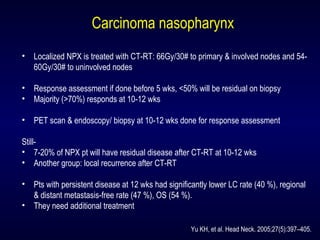
Carcinoma nasopharynx
• Localized NPX is treated with CT-RT: 66Gy/30# to primary & involved nodes and 54-
60Gy/30# to uninvolved nodes
• Response assessment if done before 5 wks, <50% will be residual on biopsy
• Majority (>70%) responds at 10-12 wks
• PET scan & endoscopy/ biopsy at 10-12 wks done for response assessment
Still-
• 7-20% of NPX pt will have residual disease after CT-RT at 10-12 wks
• Another group: local recurrence after CT-RT
• Pts with persistent disease at 12 wks had significantly lower LC rate (40 %), regional
& distant metastasis-free rate (47 %), OS (54 %).
• They need additional treatment
Yu KH, et al. Head Neck. 2005;27(5):397–405.
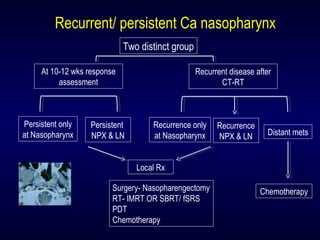
Recurrent/ persistent Ca nasopharynx
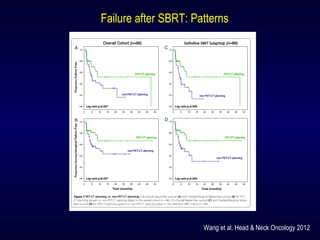
Two distinct group
At 10-12 wks response
assessment
Recurrent disease after
CT-RT
Persistent only
at Nasopharynx
Persistent
NPX & LN
Recurrence only
at Nasopharynx
Recurrence
NPX & LN Distant mets
Local Rx
Surgery- Nasopharengectomy
RT- IMRT OR SBRT/ fSRS
PDT
Chemotherapy
Chemotherapy
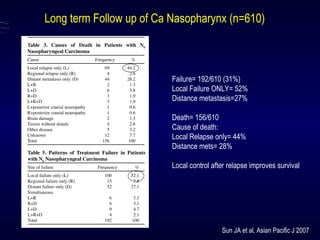
Long term Follow up of Ca Nasopharynx (n=610)
Failure= 192/610 (31%)
Local Failure ONLY= 52%
Distance metastasis=27%
Death= 156/610
Cause of death:
Local Relapse only= 44%
Distance mets= 28%
Local control after relapse improves survival
Sun JA et al, Asian Pacific J 2007
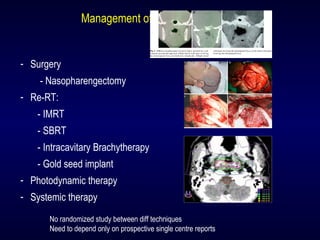
Management of ONLY local recurrence
- Surgery
- Nasopharengectomy
- Re-RT:
- IMRT
- SBRT
- Intracavitary Brachytherapy
- Gold seed implant
- Photodynamic therapy
- Systemic therapy
No randomized study between diff techniques
Need to depend only on prospective single centre reports
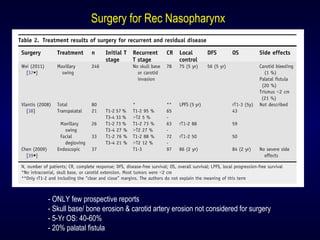
Surgery for Rec Nasopharynx
- ONLY few prospective reports
- Skull base/ bone erosion & carotid artery erosion not considered for surgery
- 5-Yr OS: 40-60%
- 20% palatal fistula
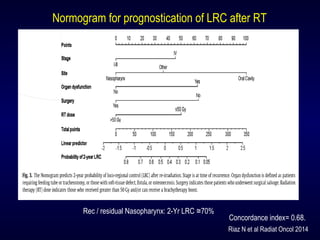
Riaz N et al Radiat Oncol 2014
Concordance index= 0.68.
Normogram for prognostication of LRC after RT
Rec / residual Nasopharynx: 2-Yr LRC ≅70%
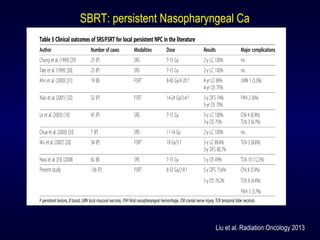
Liu et al. Radiation Oncology 2013
SBRT: persistent Nasopharyngeal Ca
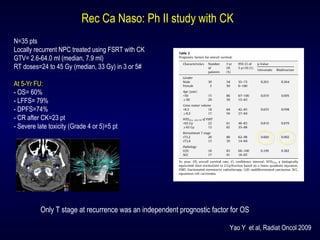
N=35 pts
Locally recurrent NPC treated using FSRT with CK
GTV= 2.6-64.0 ml (median, 7.9 ml)
RT doses=24 to 45 Gy (median, 33 Gy) in 3 or 5#
At 5-Yr FU:
- OS= 60%
- LFFS= 79%
- DPFS=74%
- CR after CK=23 pt
- Severe late toxicity (Grade 4 or 5)=5 pt
Only T stage at recurrence was an independent prognostic factor for OS
Yao Y et al, Radiat Oncol 2009
Rec Ca Naso: Ph II study with CK
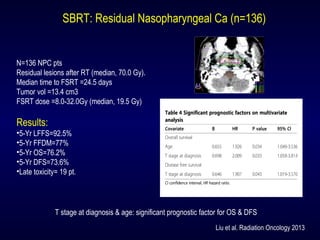
N=136 NPC pts
Residual lesions after RT (median, 70.0 Gy).
Median time to FSRT =24.5 days
Tumor vol =13.4 cm3
FSRT dose =8.0-32.0Gy (median, 19.5 Gy)
Results:
•5-Yr LFFS=92.5%
•5-Yr FFDM=77%
•5-Yr OS=76.2%
•5-Yr DFS=73.6%
•Late toxicity= 19 pt.
T stage at diagnosis & age: significant prognostic factor for OS & DFS
SBRT: Residual Nasopharyngeal Ca (n=136)
Liu et al. Radiation Oncology 2013
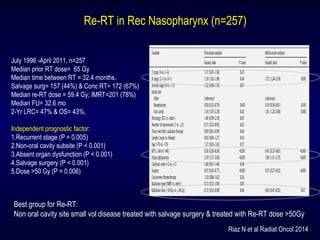
Riaz N et al Radiat Oncol 2014
July 1996 -April 2011, n=257
Median prior RT dose= 65 Gy
Median time between RT = 32.4 months.
Salvage surg= 157 (44%) & Conc RT= 172 (67%)
Median re-RT dose = 59.4 Gy; IMRT=201 (78%)
Median FU= 32.6 mo
2-Yr LRC= 47% & OS= 43%,
Independent prognostic factor:
1.Recurrent stage (P = 0.005)
2.Non-oral cavity subsite (P < 0.001)
3.Absent organ dysfunction (P < 0.001)
4.Salvage surgery (P < 0.001)
5.Dose >50 Gy (P = 0.006)
Re-RT in Rec Nasopharynx (n=257)
Best group for Re-RT:
Non oral cavity site small vol disease treated with salvage surgery & treated with Re-RT dose >50Gy
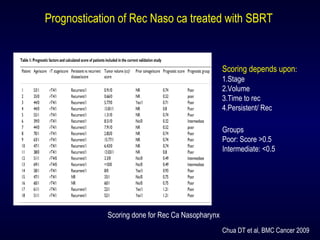
Scoring depends upon:
1.Stage
2.Volume
3.Time to rec
4.Persistent/ Rec
Groups
Poor: Score >0.5
Intermediate: <0.5
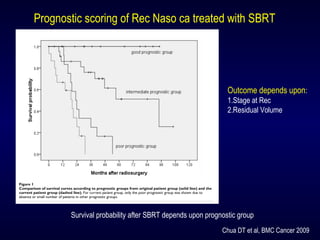
Prognostication of Rec Naso ca treated with SBRT
Scoring done for Rec Ca Nasopharynx
Chua DT et al, BMC Cancer 2009
Prognostic scoring of Rec Naso ca treated with SBRT
Survival probability after SBRT depends upon prognostic group
Chua DT et al, BMC Cancer 2009
Outcome depends upon:
1.Stage at Rec
2.Residual Volume
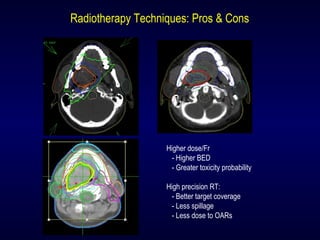
Radiotherapy Techniques: Pros & Cons
Higher dose/Fr
- Higher BED
- Greater toxicity probability
High precision RT:
- Better target coverage
- Less spillage
- Less dose to OARs
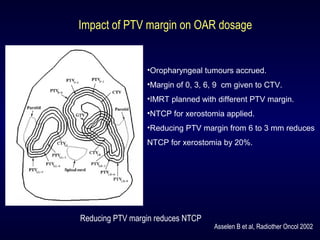
Impact of PTV margin on OAR dosage
Asselen B et al, Radiother Oncol 2002
•Oropharyngeal tumours accrued.
•Margin of 0, 3, 6, 9 cm given to CTV.
•IMRT planned with different PTV margin.
•NTCP for xerostomia applied.
•Reducing PTV margin from 6 to 3 mm reduces
NTCP for xerostomia by 20%.
Reducing PTV margin reduces NTCP
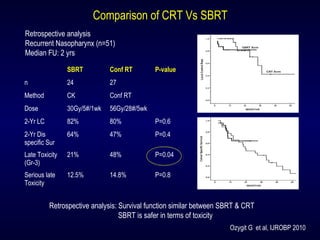
SBRT Conf RT P-value
n 24 27
Method CK Conf RT
Dose 30Gy/5#/1wk 56Gy/28#/5wk
2-Yr LC 82% 80% P=0.6
2-Yr Dis
specific Sur
64% 47% P=0.4
Late Toxicity
(Gr-3)
21% 48% P=0.04
Serious late
Toxicity
12.5% 14.8% P=0.8
Ozygit G et al, IJROBP 2010
Retrospective analysis: Survival function similar between SBRT & CRT
SBRT is safer in terms of toxicity
Retrospective analysis
Recurrent Nasopharynx (n=51)
Median FU: 2 yrs
Comparison of CRT Vs SBRT
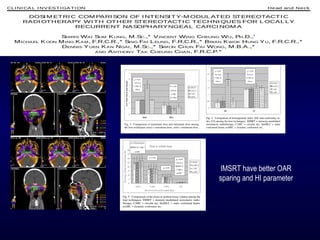
CLI NI CA L I NV ESTI GATI ON Head and Neck
DOSI M ETRI C COM PARI SON OF I NTENSI TY-M ODUL ATED STEREOTACTI C
RADI OTHERAPY WI TH OTHER STEREOTACTI C TECHNI QUES FOR L OCAL LY
RECURRENT NASOPHARYNGEAL CARCI NOM A
SHIRIS WAI SUM KUNG, M.SC.,* VINCENT WING CHEUNG WU, PH.D.,y
MICHAEL KOON MING KAM, F.R.C.R.,* SING FAI LEUNG, F.R.C.R.,* BRIAN KWOK HUNG YU, F.R.C.R.,*
DENNIS YUEN KAN NGAI, M.SC.,* SIMON CHUN FAI WONG, M.B.A.,*
AND ANTHONY TAK CHEUNG CHAN, F.R.C.P.*
* State Key Laboratory in Oncology in South China, Sir Y. K. Pao Centre for Cancer, Department of Clinical Oncology, Hong Kong
Cancer Institute, Prince of Wales Hospital, The Chinese University of Hong Kong, and the y
Department of Health Technology and
Informatics, Hong Kong Polytechnic University, Hong Kong, China
Pur pose: L ocally r ecur r ent nasophar yngeal car cinoma (NPC) patients can besalvaged by r eir r adiation with a sub-
stantial degr ee of r adiation-r elat ed complications. Ster eotactic r adiother apy (SRT) is widely used in this r egar d
because of its r apid dose falloff and high geometr ic pr ecision. The aim of this study was to examine whether the
newly developed intensity-modulated ster eotactic r adiother apy (I M SRT) has any dosimetr ic advantages over
thr ee other ster eotactic techniques, including cir cular ar c (CARC), static confor mal beam (SmM L C), and dynamic
confor mal ar c (mARC), in tr eating locally r ecur r ent NPC.
M ethods and M ater ials: Computed tomogr aphy images of 32 patients with locally r ecur r ent NPC, pr eviously
tr eated with SRT, wer e r etr ieved fr om the ster eotactic planning system for contour ing and computing tr eatment
plans. Tr eatment planning of each patient was per for med for the four tr eatment techniques: CARC, SmM L C,
mARC, and I M SRT. The confor mity index (CI ) and homogeneity index (HI ) of the planning tar get volume
(PTV) and doses to the or gans at r isk (OARs) and nor mal tissue wer e compar ed.
Results: All four techniques deliver ed adequate doses to the PTV. I M SRT, SmM L C, and mARC deliver ed r eason-
ably confor mal and homogenous dose to the PTV (CI <1.47, HI <0.53), but not for CARC (p < 0.05). I M SRT pr e-
sented with the smallest CI (1.37) and HI (0.40). Among the four techniques, I M SRT spar ed the gr eatest number of
OARs, namely br ainstem, tempor al lobes, optic chiasm, and optic ner ve, and had the smallest nor mal tissue
volume in the low-dose r egion.
Conclusion: Based on the dosimetr ic compar ison, I M SRT was optimal for locally r ecur r ent NPC by deliver ing
a confor mal and homogenous dose to the PTV while spar ing OARs. Ó 2011 Elsevier I nc.
I ntensity-modulated ster eotactic r adiother apy, L ocally r ecur r ent nasophar yngeal car cinoma, Dosimetr ic compar -
ison, Ster eotactic r adiother apy.
I NTRODUCTI ON
Radiotherapy isthemain component of curative treatment for
nasopharyngeal carcinoma (NPC) (1, 2). For the treatment of
local recurrence, reirradiation with a tumoricidal dose above
60 Gy is commonly used (2). This posesachallengeto oncol-
ogists because the nearby vital structures have already re-
ceived relatively high doses in previous treatments (3). The
detrimental effect of damage to organs at risk (OARs) from
any injudicious use of reirradiation may offset the benefit
of a second local remission (4).
Stereotactic radiosurgery has the characteristics of rapid
dose falloff and high geometric precision. It achieves high
dose conformity to a relativel y small target and spares
adjacent normal tissues (1, 3, 5). Stereotactic radiotherapy
(SRT), mainly linac-based, enjoys thebenefit of fractionation
for alargetarget with regard to normal tissuerepair. Evidence
has shown that both stereotactic radiosurgery and SRT im-
prove the local tumor control with acceptable complications
for locally recurrent NPC (1, 3, 6, 7).
For linac-based SRT, radiation beamscan beshaped by cir-
cular collimators of variable sizes, or micromultileaf collima-
tors (mMLC). With the circular collimator rotating along the
arcs around each isocenter, multiple isocenters are required
to conform to an irregular target. With the mMLC system,
focused radiation can be delivered to a single isocenter via
multiple static conformal beams that are shaped by very fine
Reprint requests to: Michael K. M. Kam, F.R.C.R., Department
of Clinical Oncology, Prince of Wales Hospital, Hong Kong, China.
Tel: (+852) 26322137; Fax: (+852) 26322170; E-mail: kamkm@
yahoo.com
Conflict of interest: none.
Received March 19, 2009, and in revised form Sept 14, 2009.
Accepted for publication Oct 25, 2009.
71
IMSRT have better OAR
sparing and HI parameter
Factors influencing outcome with SBRT
- Dose
- Volume
- T Stage at recurrence
- Time gap between recurrence
- Persistent vs recurrent disease
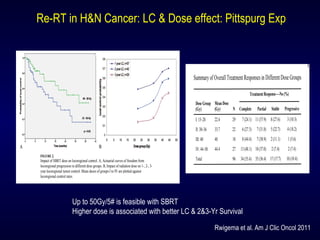
FIGURE 2.
Impact of SBRT dose on locoregional control. A, Actuarial curves of freedom from
locoregional progression in different dose groups. B, Impact of radiation dose on 1-, 2-, 3-
year locoregional tumor control. Mean doses of groups I to IV are plotted against
locoregional control rates.
Rwigema et al. Page 13
NIH-PAAuthorManuscriptNIH-PAAuthorManuscript
AuthorManuscriptNIH-PAAuthorManuscript
TABLE 3
SummaryofOverallTreatmentResponsesinDifferentDoseGroups
DoseGroup
(Gy)
MeanDose
(Gy) N
TreatmentResponse—-No(%)
Complete Partial Stable Progressive
I:15–28 22.4 29 7(24.1) 11(37.9) 8(27.6) 3(10.3)
II:30–36 33.7 22 6(27.3) 7(31.8) 5(22.7) 4(18.2)
III:40 40 18 8(44.4) 7(38.9) 2(11.1) 1(5.6)
IV:44–50 44.4 27 13(48.1) 10(37.0) 2(7.4) 2(7.4)
Total 96 34(35.4) 35(36.4) 17(17.7) 10(10.4)
AmJClinOncol.Authormanuscript;availableinPMC2011September
Re-RT in H&N Cancer: LC & Dose effect: Pittspurg Exp
Rwigema et al. Am J Clic Oncol 2011
Up to 50Gy/5# is feasible with SBRT
Higher dose is associated with better LC & 2&3-Yr Survival
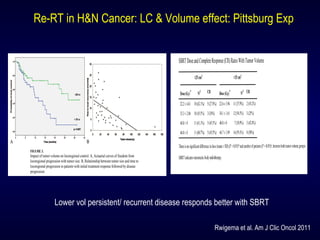
FIGURE 3.
Impact of tumor volume on locoregional control. A, Actuarial curves of freedom from
locoregional progression with tumor size. B, Relationship between tumor size and time to
locoregional progression in patients with initial treatment response followed by disease
progression.
Rwigema et al. Page 14
Re-RT in H&N Cancer: LC & Volume effect: Pittsburg Exp
Rwigema et al. Am J Clic Oncol 2011
Lower vol persistent/ recurrent disease responds better with SBRT
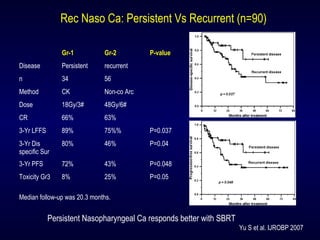
Median follow-up was 20.3 months.
Gr-1 Gr-2 P-value
Disease Persistent recurrent
n 34 56
Method CK Non-co Arc
Dose 18Gy/3# 48Gy/6#
CR 66% 63%
3-Yr LFFS 89% 75%% P=0.037
3-Yr Dis
specific Sur
80% 46% P=0.04
3-Yr PFS 72% 43% P=0.048
Toxicity Gr3 8% 25% P=0.05
Yu S et al. IJROBP 2007
Rec Naso Ca: Persistent Vs Recurrent (n=90)
Persistent Nasopharyngeal Ca responds better with SBRT
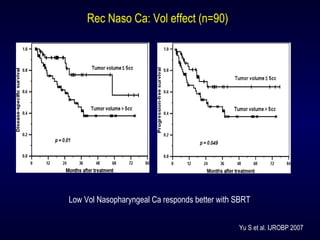
Yu S et al. IJROBP 2007
Rec Naso Ca: Vol effect (n=90)
Low Vol Nasopharyngeal Ca responds better with SBRT
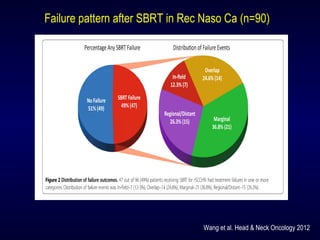
Failure pattern after SBRT in Rec Naso Ca (n=90)
Wang et al. Head & Neck Oncology 2012
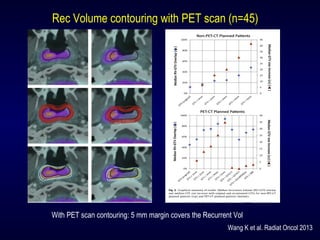
Rec Volume contouring with PET scan (n=45)
With PET scan contouring: 5 mm margin covers the Recurrent Vol
Wang K et al. Radiat Oncol 2013
Wang et al. Head & Neck Oncology 2012
Failure after SBRT: Patterns
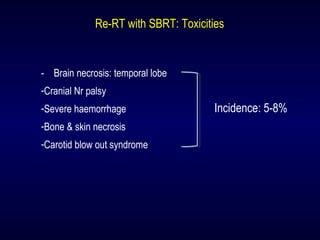
Re-RT with SBRT: Toxicities
- Brain necrosis: temporal lobe
-Cranial Nr palsy
-Severe haemorrhage
-Bone & skin necrosis
-Carotid blow out syndrome
Incidence: 5-8%
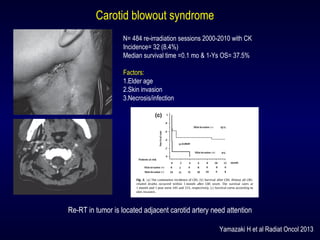
N= 484 re-irradiation sessions 2000-2010 with CK
Incidence= 32 (8.4%)
Median survival time =0.1 mo & 1-Ys OS= 37.5%
Factors:
1.Elder age
2.Skin invasion
3.Necrosis/infection
Carotid blowout syndrome
Re-RT in tumor is located adjacent carotid artery need attention
Yamazaki H et al Radiat Oncol 2013
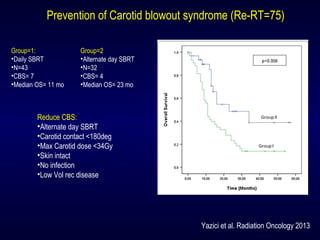
Group=1:
•Daily SBRT
•N=43
•CBS= 7
•Median OS= 11 mo
Prevention of Carotid blowout syndrome (Re-RT=75)
Reduce CBS:
•Alternate day SBRT
•Carotid contact <180deg
•Max Carotid dose <34Gy
•Skin intact
•No infection
•Low Vol rec disease
Group=2
•Alternate day SBRT
•N=32
•CBS= 4
•Median OS= 23 mo
Yazici et al. Radiation Oncology 2013
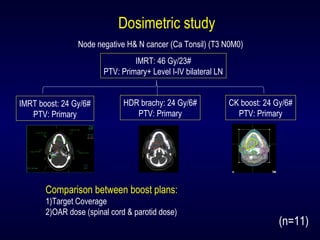
Dosimetric study
Node negative H& N cancer (Ca Tonsil) (T3 N0M0)
IMRT: 46 Gy/23#
PTV: Primary+ Level I-IV bilateral LN
IMRT boost: 24 Gy/6#
PTV: Primary
HDR brachy: 24 Gy/6#
PTV: Primary
CK boost: 24 Gy/6#
PTV: Primary
Comparison between boost plans:
1)Target Coverage
2)OAR dose (spinal cord & parotid dose)
(n=11)
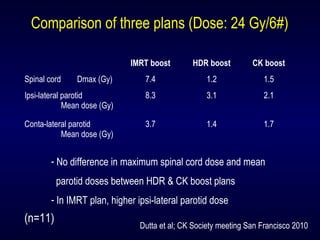
- No difference in maximum spinal cord dose and mean
parotid doses between HDR & CK boost plans
- In IMRT plan, higher ipsi-lateral parotid dose
Comparison of three plans (Dose: 24 Gy/6#)
IMRT boost HDR boost CK boost
Spinal cord Dmax (Gy) 7.4 1.2 1.5
Ipsi-lateral parotid
Mean dose (Gy)
8.3 3.1 2.1
Conta-lateral parotid
Mean dose (Gy)
3.7 1.4 1.7
(n=11)
Dutta et al; CK Society meeting San Francisco 2010
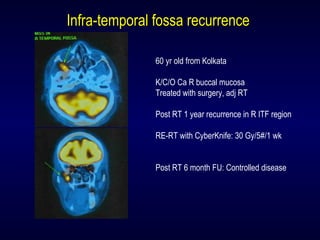
Infra-temporal fossa recurrenceInfra-temporal fossa recurrence
60 yr old from Kolkata
K/C/O Ca R buccal mucosa
Treated with surgery, adj RT
Post RT 1 year recurrence in R ITF region
RE-RT with CyberKnife: 30 Gy/5#/1 wk
Post RT 6 month FU: Controlled disease
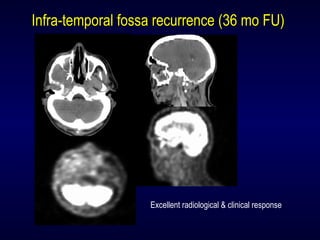
Excellent radiological & clinical response
Infra-temporal fossa recurrence (36 mo FU)Infra-temporal fossa recurrence (36 mo FU)
Take home message
- Rec Nasopharynx with ONLY local recurrence need treatment with Surgery/ RT
- High precision RT do have benefit in terms of toxicity
- Small Vol disease, Persistent local disease, treated with high dose (>50Gy), rT1-2
disease have better prognosis
- Prognostication is possible for recurrent disease treated with RT
- In favorable group, SBRT in recurrent localized nasopharynx provide relative long
term LC & survival
- However, distant metastasis may offset the impact of local treatment
- Need prospective randomized studies to ascertain role of different modalities
Thank you
duttadeb07@gmail.com

Head & neck cancer

  • 1.
    Recurrent Head &Neck Cancer and Nasopharyngeal cancer - Rec Nasopharynx with ONLY local recurrence need treatment with Surgery/ RT - High precision RT do have benefit in terms of toxicity - Small Vol disease, Persistent local disease, treated with high dose (>50Gy), rT1-2 disease have better prognosis - Prognostication is possible for recurrent disease treated with RT - In favorable group, SBRT in recurrent localized nasopharynx provide relative long term LC & survival
  • 2.
    Carcinoma nasopharynx • LocalizedNPX is treated with CT-RT: 66Gy/30# to primary & involved nodes and 54- 60Gy/30# to uninvolved nodes • Response assessment if done before 5 wks, <50% will be residual on biopsy • Majority (>70%) responds at 10-12 wks • PET scan & endoscopy/ biopsy at 10-12 wks done for response assessment Still- • 7-20% of NPX pt will have residual disease after CT-RT at 10-12 wks • Another group: local recurrence after CT-RT • Pts with persistent disease at 12 wks had significantly lower LC rate (40 %), regional & distant metastasis-free rate (47 %), OS (54 %). • They need additional treatment Yu KH, et al. Head Neck. 2005;27(5):397–405.
  • 3.
    Recurrent/ persistent Canasopharynx Two distinct group At 10-12 wks response assessment Recurrent disease after CT-RT Persistent only at Nasopharynx Persistent NPX & LN Recurrence only at Nasopharynx Recurrence NPX & LN Distant mets Local Rx Surgery- Nasopharengectomy RT- IMRT OR SBRT/ fSRS PDT Chemotherapy Chemotherapy
  • 4.
    Long term Followup of Ca Nasopharynx (n=610) Failure= 192/610 (31%) Local Failure ONLY= 52% Distance metastasis=27% Death= 156/610 Cause of death: Local Relapse only= 44% Distance mets= 28% Local control after relapse improves survival Sun JA et al, Asian Pacific J 2007
  • 5.
    Management of ONLYlocal recurrence - Surgery - Nasopharengectomy - Re-RT: - IMRT - SBRT - Intracavitary Brachytherapy - Gold seed implant - Photodynamic therapy - Systemic therapy No randomized study between diff techniques Need to depend only on prospective single centre reports
  • 6.
    Surgery for RecNasopharynx - ONLY few prospective reports - Skull base/ bone erosion & carotid artery erosion not considered for surgery - 5-Yr OS: 40-60% - 20% palatal fistula
  • 7.
    Riaz N etal Radiat Oncol 2014 Concordance index= 0.68. Normogram for prognostication of LRC after RT Rec / residual Nasopharynx: 2-Yr LRC ≅70%
  • 8.
    Liu et al.Radiation Oncology 2013 SBRT: persistent Nasopharyngeal Ca
  • 9.
    N=35 pts Locally recurrentNPC treated using FSRT with CK GTV= 2.6-64.0 ml (median, 7.9 ml) RT doses=24 to 45 Gy (median, 33 Gy) in 3 or 5# At 5-Yr FU: - OS= 60% - LFFS= 79% - DPFS=74% - CR after CK=23 pt - Severe late toxicity (Grade 4 or 5)=5 pt Only T stage at recurrence was an independent prognostic factor for OS Yao Y et al, Radiat Oncol 2009 Rec Ca Naso: Ph II study with CK
  • 10.
    N=136 NPC pts Residuallesions after RT (median, 70.0 Gy). Median time to FSRT =24.5 days Tumor vol =13.4 cm3 FSRT dose =8.0-32.0Gy (median, 19.5 Gy) Results: •5-Yr LFFS=92.5% •5-Yr FFDM=77% •5-Yr OS=76.2% •5-Yr DFS=73.6% •Late toxicity= 19 pt. T stage at diagnosis & age: significant prognostic factor for OS & DFS SBRT: Residual Nasopharyngeal Ca (n=136) Liu et al. Radiation Oncology 2013
  • 11.
    Riaz N etal Radiat Oncol 2014 July 1996 -April 2011, n=257 Median prior RT dose= 65 Gy Median time between RT = 32.4 months. Salvage surg= 157 (44%) & Conc RT= 172 (67%) Median re-RT dose = 59.4 Gy; IMRT=201 (78%) Median FU= 32.6 mo 2-Yr LRC= 47% & OS= 43%, Independent prognostic factor: 1.Recurrent stage (P = 0.005) 2.Non-oral cavity subsite (P < 0.001) 3.Absent organ dysfunction (P < 0.001) 4.Salvage surgery (P < 0.001) 5.Dose >50 Gy (P = 0.006) Re-RT in Rec Nasopharynx (n=257) Best group for Re-RT: Non oral cavity site small vol disease treated with salvage surgery & treated with Re-RT dose >50Gy
  • 12.
    Scoring depends upon: 1.Stage 2.Volume 3.Timeto rec 4.Persistent/ Rec Groups Poor: Score >0.5 Intermediate: <0.5 Prognostication of Rec Naso ca treated with SBRT Scoring done for Rec Ca Nasopharynx Chua DT et al, BMC Cancer 2009
  • 13.
    Prognostic scoring ofRec Naso ca treated with SBRT Survival probability after SBRT depends upon prognostic group Chua DT et al, BMC Cancer 2009 Outcome depends upon: 1.Stage at Rec 2.Residual Volume
  • 14.
    Radiotherapy Techniques: Pros& Cons Higher dose/Fr - Higher BED - Greater toxicity probability High precision RT: - Better target coverage - Less spillage - Less dose to OARs
  • 15.
    Impact of PTVmargin on OAR dosage Asselen B et al, Radiother Oncol 2002 •Oropharyngeal tumours accrued. •Margin of 0, 3, 6, 9 cm given to CTV. •IMRT planned with different PTV margin. •NTCP for xerostomia applied. •Reducing PTV margin from 6 to 3 mm reduces NTCP for xerostomia by 20%. Reducing PTV margin reduces NTCP
  • 16.
    SBRT Conf RTP-value n 24 27 Method CK Conf RT Dose 30Gy/5#/1wk 56Gy/28#/5wk 2-Yr LC 82% 80% P=0.6 2-Yr Dis specific Sur 64% 47% P=0.4 Late Toxicity (Gr-3) 21% 48% P=0.04 Serious late Toxicity 12.5% 14.8% P=0.8 Ozygit G et al, IJROBP 2010 Retrospective analysis: Survival function similar between SBRT & CRT SBRT is safer in terms of toxicity Retrospective analysis Recurrent Nasopharynx (n=51) Median FU: 2 yrs Comparison of CRT Vs SBRT
  • 17.
    CLI NI CAL I NV ESTI GATI ON Head and Neck DOSI M ETRI C COM PARI SON OF I NTENSI TY-M ODUL ATED STEREOTACTI C RADI OTHERAPY WI TH OTHER STEREOTACTI C TECHNI QUES FOR L OCAL LY RECURRENT NASOPHARYNGEAL CARCI NOM A SHIRIS WAI SUM KUNG, M.SC.,* VINCENT WING CHEUNG WU, PH.D.,y MICHAEL KOON MING KAM, F.R.C.R.,* SING FAI LEUNG, F.R.C.R.,* BRIAN KWOK HUNG YU, F.R.C.R.,* DENNIS YUEN KAN NGAI, M.SC.,* SIMON CHUN FAI WONG, M.B.A.,* AND ANTHONY TAK CHEUNG CHAN, F.R.C.P.* * State Key Laboratory in Oncology in South China, Sir Y. K. Pao Centre for Cancer, Department of Clinical Oncology, Hong Kong Cancer Institute, Prince of Wales Hospital, The Chinese University of Hong Kong, and the y Department of Health Technology and Informatics, Hong Kong Polytechnic University, Hong Kong, China Pur pose: L ocally r ecur r ent nasophar yngeal car cinoma (NPC) patients can besalvaged by r eir r adiation with a sub- stantial degr ee of r adiation-r elat ed complications. Ster eotactic r adiother apy (SRT) is widely used in this r egar d because of its r apid dose falloff and high geometr ic pr ecision. The aim of this study was to examine whether the newly developed intensity-modulated ster eotactic r adiother apy (I M SRT) has any dosimetr ic advantages over thr ee other ster eotactic techniques, including cir cular ar c (CARC), static confor mal beam (SmM L C), and dynamic confor mal ar c (mARC), in tr eating locally r ecur r ent NPC. M ethods and M ater ials: Computed tomogr aphy images of 32 patients with locally r ecur r ent NPC, pr eviously tr eated with SRT, wer e r etr ieved fr om the ster eotactic planning system for contour ing and computing tr eatment plans. Tr eatment planning of each patient was per for med for the four tr eatment techniques: CARC, SmM L C, mARC, and I M SRT. The confor mity index (CI ) and homogeneity index (HI ) of the planning tar get volume (PTV) and doses to the or gans at r isk (OARs) and nor mal tissue wer e compar ed. Results: All four techniques deliver ed adequate doses to the PTV. I M SRT, SmM L C, and mARC deliver ed r eason- ably confor mal and homogenous dose to the PTV (CI <1.47, HI <0.53), but not for CARC (p < 0.05). I M SRT pr e- sented with the smallest CI (1.37) and HI (0.40). Among the four techniques, I M SRT spar ed the gr eatest number of OARs, namely br ainstem, tempor al lobes, optic chiasm, and optic ner ve, and had the smallest nor mal tissue volume in the low-dose r egion. Conclusion: Based on the dosimetr ic compar ison, I M SRT was optimal for locally r ecur r ent NPC by deliver ing a confor mal and homogenous dose to the PTV while spar ing OARs. Ó 2011 Elsevier I nc. I ntensity-modulated ster eotactic r adiother apy, L ocally r ecur r ent nasophar yngeal car cinoma, Dosimetr ic compar - ison, Ster eotactic r adiother apy. I NTRODUCTI ON Radiotherapy isthemain component of curative treatment for nasopharyngeal carcinoma (NPC) (1, 2). For the treatment of local recurrence, reirradiation with a tumoricidal dose above 60 Gy is commonly used (2). This posesachallengeto oncol- ogists because the nearby vital structures have already re- ceived relatively high doses in previous treatments (3). The detrimental effect of damage to organs at risk (OARs) from any injudicious use of reirradiation may offset the benefit of a second local remission (4). Stereotactic radiosurgery has the characteristics of rapid dose falloff and high geometric precision. It achieves high dose conformity to a relativel y small target and spares adjacent normal tissues (1, 3, 5). Stereotactic radiotherapy (SRT), mainly linac-based, enjoys thebenefit of fractionation for alargetarget with regard to normal tissuerepair. Evidence has shown that both stereotactic radiosurgery and SRT im- prove the local tumor control with acceptable complications for locally recurrent NPC (1, 3, 6, 7). For linac-based SRT, radiation beamscan beshaped by cir- cular collimators of variable sizes, or micromultileaf collima- tors (mMLC). With the circular collimator rotating along the arcs around each isocenter, multiple isocenters are required to conform to an irregular target. With the mMLC system, focused radiation can be delivered to a single isocenter via multiple static conformal beams that are shaped by very fine Reprint requests to: Michael K. M. Kam, F.R.C.R., Department of Clinical Oncology, Prince of Wales Hospital, Hong Kong, China. Tel: (+852) 26322137; Fax: (+852) 26322170; E-mail: kamkm@ yahoo.com Conflict of interest: none. Received March 19, 2009, and in revised form Sept 14, 2009. Accepted for publication Oct 25, 2009. 71 IMSRT have better OAR sparing and HI parameter
  • 18.
    Factors influencing outcomewith SBRT - Dose - Volume - T Stage at recurrence - Time gap between recurrence - Persistent vs recurrent disease
  • 19.
    FIGURE 2. Impact ofSBRT dose on locoregional control. A, Actuarial curves of freedom from locoregional progression in different dose groups. B, Impact of radiation dose on 1-, 2-, 3- year locoregional tumor control. Mean doses of groups I to IV are plotted against locoregional control rates. Rwigema et al. Page 13 NIH-PAAuthorManuscriptNIH-PAAuthorManuscript AuthorManuscriptNIH-PAAuthorManuscript TABLE 3 SummaryofOverallTreatmentResponsesinDifferentDoseGroups DoseGroup (Gy) MeanDose (Gy) N TreatmentResponse—-No(%) Complete Partial Stable Progressive I:15–28 22.4 29 7(24.1) 11(37.9) 8(27.6) 3(10.3) II:30–36 33.7 22 6(27.3) 7(31.8) 5(22.7) 4(18.2) III:40 40 18 8(44.4) 7(38.9) 2(11.1) 1(5.6) IV:44–50 44.4 27 13(48.1) 10(37.0) 2(7.4) 2(7.4) Total 96 34(35.4) 35(36.4) 17(17.7) 10(10.4) AmJClinOncol.Authormanuscript;availableinPMC2011September Re-RT in H&N Cancer: LC & Dose effect: Pittspurg Exp Rwigema et al. Am J Clic Oncol 2011 Up to 50Gy/5# is feasible with SBRT Higher dose is associated with better LC & 2&3-Yr Survival
  • 20.
    FIGURE 3. Impact oftumor volume on locoregional control. A, Actuarial curves of freedom from locoregional progression with tumor size. B, Relationship between tumor size and time to locoregional progression in patients with initial treatment response followed by disease progression. Rwigema et al. Page 14 Re-RT in H&N Cancer: LC & Volume effect: Pittsburg Exp Rwigema et al. Am J Clic Oncol 2011 Lower vol persistent/ recurrent disease responds better with SBRT
  • 21.
    Median follow-up was20.3 months. Gr-1 Gr-2 P-value Disease Persistent recurrent n 34 56 Method CK Non-co Arc Dose 18Gy/3# 48Gy/6# CR 66% 63% 3-Yr LFFS 89% 75%% P=0.037 3-Yr Dis specific Sur 80% 46% P=0.04 3-Yr PFS 72% 43% P=0.048 Toxicity Gr3 8% 25% P=0.05 Yu S et al. IJROBP 2007 Rec Naso Ca: Persistent Vs Recurrent (n=90) Persistent Nasopharyngeal Ca responds better with SBRT
  • 22.
    Yu S etal. IJROBP 2007 Rec Naso Ca: Vol effect (n=90) Low Vol Nasopharyngeal Ca responds better with SBRT
  • 23.
    Failure pattern afterSBRT in Rec Naso Ca (n=90) Wang et al. Head & Neck Oncology 2012
  • 24.
    Rec Volume contouringwith PET scan (n=45) With PET scan contouring: 5 mm margin covers the Recurrent Vol Wang K et al. Radiat Oncol 2013
  • 25.
    Wang et al.Head & Neck Oncology 2012 Failure after SBRT: Patterns
  • 26.
    Re-RT with SBRT:Toxicities - Brain necrosis: temporal lobe -Cranial Nr palsy -Severe haemorrhage -Bone & skin necrosis -Carotid blow out syndrome Incidence: 5-8%
  • 27.
    N= 484 re-irradiationsessions 2000-2010 with CK Incidence= 32 (8.4%) Median survival time =0.1 mo & 1-Ys OS= 37.5% Factors: 1.Elder age 2.Skin invasion 3.Necrosis/infection Carotid blowout syndrome Re-RT in tumor is located adjacent carotid artery need attention Yamazaki H et al Radiat Oncol 2013
  • 28.
    Group=1: •Daily SBRT •N=43 •CBS= 7 •MedianOS= 11 mo Prevention of Carotid blowout syndrome (Re-RT=75) Reduce CBS: •Alternate day SBRT •Carotid contact <180deg •Max Carotid dose <34Gy •Skin intact •No infection •Low Vol rec disease Group=2 •Alternate day SBRT •N=32 •CBS= 4 •Median OS= 23 mo Yazici et al. Radiation Oncology 2013
  • 29.
    Dosimetric study Node negativeH& N cancer (Ca Tonsil) (T3 N0M0) IMRT: 46 Gy/23# PTV: Primary+ Level I-IV bilateral LN IMRT boost: 24 Gy/6# PTV: Primary HDR brachy: 24 Gy/6# PTV: Primary CK boost: 24 Gy/6# PTV: Primary Comparison between boost plans: 1)Target Coverage 2)OAR dose (spinal cord & parotid dose) (n=11)
  • 30.
    - No differencein maximum spinal cord dose and mean parotid doses between HDR & CK boost plans - In IMRT plan, higher ipsi-lateral parotid dose Comparison of three plans (Dose: 24 Gy/6#) IMRT boost HDR boost CK boost Spinal cord Dmax (Gy) 7.4 1.2 1.5 Ipsi-lateral parotid Mean dose (Gy) 8.3 3.1 2.1 Conta-lateral parotid Mean dose (Gy) 3.7 1.4 1.7 (n=11) Dutta et al; CK Society meeting San Francisco 2010
  • 31.
    Infra-temporal fossa recurrenceInfra-temporalfossa recurrence 60 yr old from Kolkata K/C/O Ca R buccal mucosa Treated with surgery, adj RT Post RT 1 year recurrence in R ITF region RE-RT with CyberKnife: 30 Gy/5#/1 wk Post RT 6 month FU: Controlled disease
  • 32.
    Excellent radiological &clinical response Infra-temporal fossa recurrence (36 mo FU)Infra-temporal fossa recurrence (36 mo FU)
  • 33.
    Take home message -Rec Nasopharynx with ONLY local recurrence need treatment with Surgery/ RT - High precision RT do have benefit in terms of toxicity - Small Vol disease, Persistent local disease, treated with high dose (>50Gy), rT1-2 disease have better prognosis - Prognostication is possible for recurrent disease treated with RT - In favorable group, SBRT in recurrent localized nasopharynx provide relative long term LC & survival - However, distant metastasis may offset the impact of local treatment - Need prospective randomized studies to ascertain role of different modalities
  • 34.