Innovative Systems Design and Engineering                                                     www.iiste.org
ISSN 2222-1727 (Paper) ISSN 2222-2871 (Online)
Vol 2, No 3


                   A new Approach to Compute Convex Hull

                                  Muhammad Sharif       (Corresponding author)
                 Department of Computer Science, COMSATS Institute of Information Technology
                                       PO box 47040, Wah Cantt, Pakistan
                        Tel: +92303-5188998 E-mail: muhammadsharifmalik@yahoo.com


                            Syeda Zilley Zahra Naqvi, Mudassar Raza, Waqas Haider
                 Department of Computer Science, COMSATS Institute of Information Technology
                                       PO box 47040, Wah Cantt, Pakistan
             E-mail: malihanaqvi@gmail.com, mudassarkazmi@yahoo.com, waqasbtn@gmail.com


Abstract
Virtual reality techniques have proved their importance in almost every field of knowledge, particularly in
medical and architecture. Convex hull is an application of virtual reality which is used to draw the
boundary of some object inside an image. In this paper a hybrid method is proposed to compute convex
hull. The method is based on two already existing      convex hull algorithms i.e. quick hull and grahams
Scan algorithm. The proposed technique is an attempt to remove the deficiencies in the two above
mentioned techniques of the convex hull.
Keywords: Boundary detection, Convexity, Orientation.
1. Introduction
Virtual reality provides an interactive capability to the user and makes it possible for the information to be
displayed as in a realistic environment. Since real objects do not have any deterministic shape, they can be
modeled easily by computing their convex hulls (Haubner etc 1997, Sofeman etc and Ja-Chen etc 1998 and
De Paolis etc 2007). With the help of computing, simulations have made it possible to study and examine
the organs or any structure of the human body closely and in the way which was not possible few years
back. Simulations are very helpful for the users, medical students and the beginners. Thus, they are an
important tool and the source to acquire valuable information for the students during their education. In this
paper simulation is conducted using new technique to compute convex hull and later on results are given,
which proved sufficient improvement then the existing approaches. The rest of the paper is organized as
follows: In Section 1 the answer to the question that what the convex hull is? Are briefed. Section 2
discusses some of the existing algorithms for computing convex hulls, section 3 deals with the new
technique for computation of convex hulls and results and finally in section 4 the concluded remarks are
given.
1.1 Covex Hull
Convex hull for a set S can also be defined as the set of points that can be expressed as convex
combinations of the points in that set S . Convex hulls have their applications in image processing, pattern
recognition and medical simulations (Dan 2009 and Dundar 2008). Convex hull is different for different
objects because it depends upon the feature point of every object. For the recognition of objects the
feature points are standardized so that convex hull of 40 points can be constructed. If the convex hull
cannot be constructed from the feature points specified it will lower the value by 1 from the total number of
points. It will continue to decrease the number by 1 until the appropriate convex hull can be made. The
convex hull can be defined for object of any kind with any number of dimensions.
Innovative Systems Design and Engineering                                                       www.iiste.org
ISSN 2222-1727 (Paper) ISSN 2222-2871 (Online)
Vol 2, No 3


2. Existing Approaches to compute Covex Hull
For finding convex hulls so many algorithms are used. In this section some of existing algorithms will be
discussed which are used in our proposed technique. Graham’s Scan Algorithm, Divide and Conquer
Algorithm (Xin etc 2008), Jarvis’s March or Gift wrapping Algorithm (Yaacoub etc 2006 and Choi 2007),
Quick hull Algorithm (Mucke 2009) and Chan’s Algorithm (Chan 2011).
Graham Scan computes the convex hull of any given set of points in O(nlogn). In graham scan first the
Algorithm starts by sorting the set of points by increasing order of x-axis. In its second step it checks the
orientation at each point with two most recently selected points. If the points form left-hand turn (positive
orientation) then the points are pushed to the stack but if the point is failed to form a positive orientation
with last two pushed points then the last two points are popped from the stack. Now the join the points
stored in the stack, the resultant will be the required hull. The next algorithm presented is the generalization
of the sorting procedure Quick sort, named as Quick hull. Quick hull operates in O(nlogn) time but in worst
case it can be O(n2). The basic idea behind quick hull is to discard the points as quickly as possible. In
quick hull the first the algorithm calculate the points with minimum and maximum x and y-coordinates and
by joining these points a bounding rectangle is defined, within which the hull is contained. Furthermore the
points within this quadrilateral are discarded for any further consideration. Now in the continuation of this
algorithm the remaining points are classified into four remaining corner triangles. On these corner points
now the next task is to find a point among the points on the hull, discard the points within the new triangle
and reconsider the two newly formed subsets. How should this point be selected? This point can be selected
by considering possible perpendicular distance from the edge.
3. Proposed Technique
The proposed technique is composed of two existing algorithms Quick Hull and Graham scan. To overcome
the draw backs of these two algorithms the proposed techniques works. As in Graham Scan , it works quite
slowly because it checks the orientation of all the points in the set, for smaller point set the algorithm will
definitely perform faster, but for a larger set the computational cost will be really unaffordable. To reduce
the set of point’s candidate to be on hull the quick hull’s initial step is applied as the useless points are
discarded at the very initial stage and no extra calculation is performed which will increase the speed of the
Graham’s method.As discussed earlier Graham Scan selects the points on the basis of their orientation. It
checks the orientation of the selected point with respect to the last two added points like Jarvis method it
works quite slowly. The other algorithm (Quick Hull) starts by calculating the points with minimum and the
maximum x-and y-coordinates.
Innovative Systems Design and Engineering                                                          www.iiste.org
ISSN 2222-1727 (Paper) ISSN 2222-2871 (Online)
Vol 2, No 3


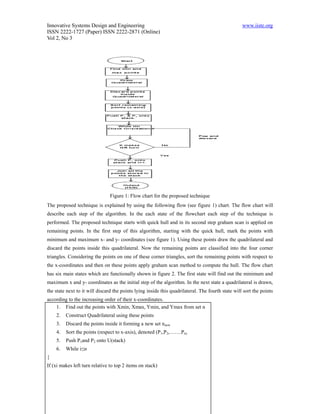
                                Figure 1: Flow chart for the proposed technique
The proposed technique is explained by using the following flow (see figure 1) chart. The flow chart will
describe each step of the algorithm. In the each state of the flowchart each step of the technique is
performed. The proposed technique starts with quick hull and in its second step graham scan is applied on
remaining points. In the first step of this algorithm, starting with the quick hull, mark the points with
minimum and maximum x- and y- coordinates (see figure 1). Using these points draw the quadrilateral and
discard the points inside this quadrilateral. Now the remaining points are classified into the four corner
triangles. Considering the points on one of these corner triangles, sort the remaining points with respect to
the x-coordinates and then on these points apply graham scan method to compute the hull. The flow chart
has six main states which are functionally shown in figure 2. The first state will find out the minimum and
maximum x and y- coordinates as the initial step of the algorithm. In the next state a quadrilateral is drawn,
the state next to it will discard the points lying inside this quadrilateral. The fourth state will sort the points
according to the increasing order of their x-coordinates.
    1. Find out the points with Xmin, Xmax, Ymin, and Ymax from set n
    2.   Construct Quadrilateral using these points
    3.   Discard the points inside it forming a new set nnew
    4.   Sort the points (respect to x-axis), denoted (P1,P2,…….Pn)
    5.   Push P1and P2 onto U(stack)
    6.   While i≤n
{
If (xi makes left turn relative to top 2 items on stack)
Innovative Systems Design and Engineering                                                      www.iiste.org
ISSN 2222-1727 (Paper) ISSN 2222-2871 (Online)
Vol 2, No 3


{
Push xi;
i++;
}
Else
{
Pop (last two added points);
Discard;
}}


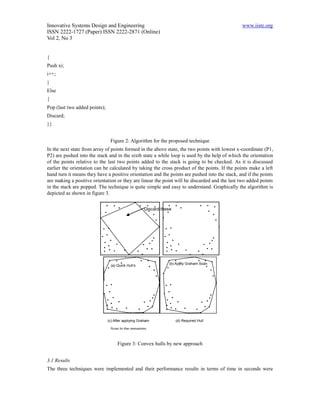
                                Figure 2: Algorithm for the proposed technique
In the next state from array of points formed in the above state, the two points with lowest x-coordinate (P1,
P2) are pushed into the stack and in the sixth state a while loop is used by the help of which the orientation
of the points relative to the last two points added to the stack is going to be checked. As it is discussed
earlier the orientation can be calculated by taking the cross product of the points. If the points make a left
hand turn it means they have a positive orientation and the points are pushed into the stack, and if the points
are making a positive orientation or they are linear the point will be discarded and the last two added points
in the stack are popped. The technique is quite simple and easy to understand. Graphically the algorithm is
depicted as shown in figure 3.


                                                       Discard these


                                                                   (b) Apply Graham Scan
                                (a) Quick Hull’s
                                                                  to these remaining points
                               initial quadrilateral


                               (c) After applying Graham               (d) Required Hull

                                Scan to the remaining

                                         points
                                     Figure 3: Convex hulls by new approach


3.1 Results
The three techniques were implemented and their performance results in terms of time in seconds were
Innovative Systems Design and Engineering                                                                         www.iiste.org
ISSN 2222-1727 (Paper) ISSN 2222-2871 (Online)
Vol 2, No 3


taken using different sets of randomly taken points as an input. The following results illustrates the
performance analysis of the proposed technique
Table 1: Comparison of processing time for points among the existing and proposed techniques

                                             Points          Graham                    Quick     New
                                                             Scan                      Hull      technique
                                                             (sec)                     (sec)     (sec)

                             1               5000            3.73                      1.26      0.86
                             2               10000           7.35                      2.64      1.63
                             3               15000           11.96                     4.68      2.65
                             4               20000           19.23                     6.95      3.96
                             5               25000           23.6                      7.99      5.86

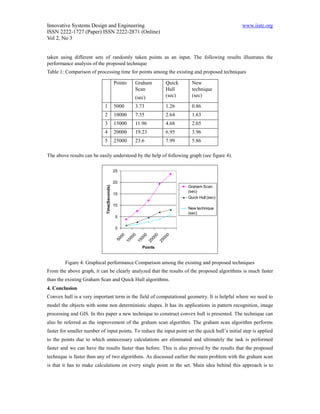
The above results can be easily understood by the help of following graph (see figure 4).

                                             25

                                             20
                             Time(Seconds)


                                                                                               Graham Scan
                                                                                               (sec)
                                             15
                                                                                               Quick Hull (sec)
                                             10
                                                                                               New technique
                                                                                               (sec)
                                              5

                                              0
                                                            0

                                                                     0

                                                                              0

                                                                                       0
                                                  00

                                                        00

                                                                 00

                                                                          00

                                                                                   00
                                              50

                                                       10

                                                                15

                                                                         20

                                                                                  25


                                                                     Points


         Figure 4: Graphical performance Comparison among the existing and proposed techniques
From the above graph, it can be clearly analyzed that the results of the proposed algorithms is much faster
than the existing Graham Scan and Quick Hull algorithms.
4. Conclusion
Convex hull is a very important term in the field of computational geometry. It is helpful where we need to
model the objects with some non deterministic shapes. It has its applications in pattern recognition, image
processing and GIS. In this paper a new technique to construct convex hull is presented. The technique can
also be referred as the improvement of the graham scan algorithm. The graham scan algorithm performs
faster for smaller number of input points. To reduce the input point set the quick hull’s initial step is applied
to the points due to which unnecessary calculations are eliminated and ultimately the task is performed
faster and we can have the results faster than before. This is also proved by the results that the proposed
technique is faster than any of two algorithms. As discussed earlier the main problem with the graham scan
is that it has to make calculations on every single point in the set. Main idea behind this approach is to
Innovative Systems Design and Engineering                                                      www.iiste.org
ISSN 2222-1727 (Paper) ISSN 2222-2871 (Online)
Vol 2, No 3


reduce the number of calculations, as more points are discarded in the initial step. Using quick hull, the
points in the input set can be reduced.
References
Haubner, M.; Krapichler, C.; Losch, A.; Englmeier, K.-H.; Van Eimeren, W, 1997.“Virtual reality in
medicine-computer graphics and interaction techniques”. IEEE Transactions on Information Technology in
Biomedicine, pp 61 – 72
Akay, M.; Marsh, A, 2001.” Virtual Reality in Medicine and Biology”. IEEE BOOK CHAPTER
Information Technologies in Medicine, Medical Simulation and Education, pp 1 – 31
De Paolis, L.T.; Blasi, E.; De Mauro, A.; Aloisio, G , 2001” A Force Feedback Virtual Simulator for
Education and Training”. IEEE Symposium on Virtual Environments, Human-Computer Interfaces and
Measurement Systems, VECIMS , pp 135 – 138.
Soferman, Z.; Blythe, D.; John, N.W, 1998” Advanced graphics behind medical virtual reality: evolution of
algorithms, hardware, and software interfaces”. Proceedings of the IEEE. 1998 , pp 531 – 554.
Ja-Chen Lin; Jenn-Yih Lin, 1998.” A 1 log N parallel algorithm for detecting convex hulls on image
boards” . IEEE Transactions on Image Processing, pp 922 – 925.
Lecture notes by David M. Mount, 2007. University of Maryland.                 CMSC 754 “Computational
Geometry”.
Herv’e Bronnimann, John Iacono, 2002. “ Convex Hull Algorithms”. Latin American Theoretical
Informatics citeseer.ist.psu.edu/612454. Html.
Dan Sunday,2009.”The Convex Hull of a 2D Point Set or Polygon” available online at
http://geometryalgorithms.com/Archive/algorithm_0109/algorithm_0109.htm
Preston, K., Jr.; Duff, M.J.B.; Levialdi, S.; Norgren, P.E.; Toriwaki, J, 1979.” Basics of cellular logic with
some applications in medical image processing”. Proceedings of the IEEE, pp 826 – 856.
Deglint, H.J.; Rangayyan, R.M, 2005.” Segmentation of neuroblastoma in CT images using deformable
contours, image reconstruction, and convex hulls”. The 3rd IEE International Seminar on Medical
Applications of Signal Processing, pp 29 – 34.
Dundar, M.M.; Fung, G.; Krishnapuram, B.; Rao, R.B, 2008.” Multiple-Instance Learning Algorithms for
Computer-Aided Detection”. IEEE Transactions on Biomedical Engineering, pp 1015 – 1021.
Xin-Jing Wang; Lei Zhang; Xirong Li; Wei-Ying Ma, 2008.” Annotating Images by Mining Image Search
Results”. IEEE Transactions on Pattern Analysis and Machine Intelligence, pp 1919 – 1932.
Yaacoub, F.; Haman, Y.; Abche, A.; Fares, C,2008.” Convex Hull in Medical Simulations: A New Hybrid
Approach”. 32nd Annual Conference on IEEE Industrial Electronics, IECON, pp 3308 – 3313.
Choi, Y.K, 2007.” Shrink-wrapping based isosurface reconstruction from cross-sectional images”. IET
Journals Electronics Letters, pp 620 – 621.
Mucke, E, 2009.” Computing Prescriptions: Quickhull: Computing Convex Hulls Quickly”. IEEE Journal
on Computing in Science & Engineering,Volume 11, issue 5 , pp 54 – 57.
Chan, S. H.; Nguyen, T. Q, 2011.” LCD Motion Blur: Modeling, Analysis, and Algorithm”. IEEE
Transactions on Image Processing, pp 2352 – 2365.
Innovative Systems Design and Engineering        www.iiste.org
ISSN 2222-1727 (Paper) ISSN 2222-2871 (Online)
Vol 2, No 3

20 convex hull last 7

  • 1.
    Innovative Systems Designand Engineering www.iiste.org ISSN 2222-1727 (Paper) ISSN 2222-2871 (Online) Vol 2, No 3 A new Approach to Compute Convex Hull Muhammad Sharif (Corresponding author) Department of Computer Science, COMSATS Institute of Information Technology PO box 47040, Wah Cantt, Pakistan Tel: +92303-5188998 E-mail: muhammadsharifmalik@yahoo.com Syeda Zilley Zahra Naqvi, Mudassar Raza, Waqas Haider Department of Computer Science, COMSATS Institute of Information Technology PO box 47040, Wah Cantt, Pakistan E-mail: malihanaqvi@gmail.com, mudassarkazmi@yahoo.com, waqasbtn@gmail.com Abstract Virtual reality techniques have proved their importance in almost every field of knowledge, particularly in medical and architecture. Convex hull is an application of virtual reality which is used to draw the boundary of some object inside an image. In this paper a hybrid method is proposed to compute convex hull. The method is based on two already existing convex hull algorithms i.e. quick hull and grahams Scan algorithm. The proposed technique is an attempt to remove the deficiencies in the two above mentioned techniques of the convex hull. Keywords: Boundary detection, Convexity, Orientation. 1. Introduction Virtual reality provides an interactive capability to the user and makes it possible for the information to be displayed as in a realistic environment. Since real objects do not have any deterministic shape, they can be modeled easily by computing their convex hulls (Haubner etc 1997, Sofeman etc and Ja-Chen etc 1998 and De Paolis etc 2007). With the help of computing, simulations have made it possible to study and examine the organs or any structure of the human body closely and in the way which was not possible few years back. Simulations are very helpful for the users, medical students and the beginners. Thus, they are an important tool and the source to acquire valuable information for the students during their education. In this paper simulation is conducted using new technique to compute convex hull and later on results are given, which proved sufficient improvement then the existing approaches. The rest of the paper is organized as follows: In Section 1 the answer to the question that what the convex hull is? Are briefed. Section 2 discusses some of the existing algorithms for computing convex hulls, section 3 deals with the new technique for computation of convex hulls and results and finally in section 4 the concluded remarks are given. 1.1 Covex Hull Convex hull for a set S can also be defined as the set of points that can be expressed as convex combinations of the points in that set S . Convex hulls have their applications in image processing, pattern recognition and medical simulations (Dan 2009 and Dundar 2008). Convex hull is different for different objects because it depends upon the feature point of every object. For the recognition of objects the feature points are standardized so that convex hull of 40 points can be constructed. If the convex hull cannot be constructed from the feature points specified it will lower the value by 1 from the total number of points. It will continue to decrease the number by 1 until the appropriate convex hull can be made. The convex hull can be defined for object of any kind with any number of dimensions.
  • 2.
    Innovative Systems Designand Engineering www.iiste.org ISSN 2222-1727 (Paper) ISSN 2222-2871 (Online) Vol 2, No 3 2. Existing Approaches to compute Covex Hull For finding convex hulls so many algorithms are used. In this section some of existing algorithms will be discussed which are used in our proposed technique. Graham’s Scan Algorithm, Divide and Conquer Algorithm (Xin etc 2008), Jarvis’s March or Gift wrapping Algorithm (Yaacoub etc 2006 and Choi 2007), Quick hull Algorithm (Mucke 2009) and Chan’s Algorithm (Chan 2011). Graham Scan computes the convex hull of any given set of points in O(nlogn). In graham scan first the Algorithm starts by sorting the set of points by increasing order of x-axis. In its second step it checks the orientation at each point with two most recently selected points. If the points form left-hand turn (positive orientation) then the points are pushed to the stack but if the point is failed to form a positive orientation with last two pushed points then the last two points are popped from the stack. Now the join the points stored in the stack, the resultant will be the required hull. The next algorithm presented is the generalization of the sorting procedure Quick sort, named as Quick hull. Quick hull operates in O(nlogn) time but in worst case it can be O(n2). The basic idea behind quick hull is to discard the points as quickly as possible. In quick hull the first the algorithm calculate the points with minimum and maximum x and y-coordinates and by joining these points a bounding rectangle is defined, within which the hull is contained. Furthermore the points within this quadrilateral are discarded for any further consideration. Now in the continuation of this algorithm the remaining points are classified into four remaining corner triangles. On these corner points now the next task is to find a point among the points on the hull, discard the points within the new triangle and reconsider the two newly formed subsets. How should this point be selected? This point can be selected by considering possible perpendicular distance from the edge. 3. Proposed Technique The proposed technique is composed of two existing algorithms Quick Hull and Graham scan. To overcome the draw backs of these two algorithms the proposed techniques works. As in Graham Scan , it works quite slowly because it checks the orientation of all the points in the set, for smaller point set the algorithm will definitely perform faster, but for a larger set the computational cost will be really unaffordable. To reduce the set of point’s candidate to be on hull the quick hull’s initial step is applied as the useless points are discarded at the very initial stage and no extra calculation is performed which will increase the speed of the Graham’s method.As discussed earlier Graham Scan selects the points on the basis of their orientation. It checks the orientation of the selected point with respect to the last two added points like Jarvis method it works quite slowly. The other algorithm (Quick Hull) starts by calculating the points with minimum and the maximum x-and y-coordinates.
  • 3.
    Innovative Systems Designand Engineering www.iiste.org ISSN 2222-1727 (Paper) ISSN 2222-2871 (Online) Vol 2, No 3 Figure 1: Flow chart for the proposed technique The proposed technique is explained by using the following flow (see figure 1) chart. The flow chart will describe each step of the algorithm. In the each state of the flowchart each step of the technique is performed. The proposed technique starts with quick hull and in its second step graham scan is applied on remaining points. In the first step of this algorithm, starting with the quick hull, mark the points with minimum and maximum x- and y- coordinates (see figure 1). Using these points draw the quadrilateral and discard the points inside this quadrilateral. Now the remaining points are classified into the four corner triangles. Considering the points on one of these corner triangles, sort the remaining points with respect to the x-coordinates and then on these points apply graham scan method to compute the hull. The flow chart has six main states which are functionally shown in figure 2. The first state will find out the minimum and maximum x and y- coordinates as the initial step of the algorithm. In the next state a quadrilateral is drawn, the state next to it will discard the points lying inside this quadrilateral. The fourth state will sort the points according to the increasing order of their x-coordinates. 1. Find out the points with Xmin, Xmax, Ymin, and Ymax from set n 2. Construct Quadrilateral using these points 3. Discard the points inside it forming a new set nnew 4. Sort the points (respect to x-axis), denoted (P1,P2,…….Pn) 5. Push P1and P2 onto U(stack) 6. While i≤n { If (xi makes left turn relative to top 2 items on stack)
  • 4.
    Innovative Systems Designand Engineering www.iiste.org ISSN 2222-1727 (Paper) ISSN 2222-2871 (Online) Vol 2, No 3 { Push xi; i++; } Else { Pop (last two added points); Discard; }} Figure 2: Algorithm for the proposed technique In the next state from array of points formed in the above state, the two points with lowest x-coordinate (P1, P2) are pushed into the stack and in the sixth state a while loop is used by the help of which the orientation of the points relative to the last two points added to the stack is going to be checked. As it is discussed earlier the orientation can be calculated by taking the cross product of the points. If the points make a left hand turn it means they have a positive orientation and the points are pushed into the stack, and if the points are making a positive orientation or they are linear the point will be discarded and the last two added points in the stack are popped. The technique is quite simple and easy to understand. Graphically the algorithm is depicted as shown in figure 3. Discard these (b) Apply Graham Scan (a) Quick Hull’s to these remaining points initial quadrilateral (c) After applying Graham (d) Required Hull Scan to the remaining points Figure 3: Convex hulls by new approach 3.1 Results The three techniques were implemented and their performance results in terms of time in seconds were
  • 5.
    Innovative Systems Designand Engineering www.iiste.org ISSN 2222-1727 (Paper) ISSN 2222-2871 (Online) Vol 2, No 3 taken using different sets of randomly taken points as an input. The following results illustrates the performance analysis of the proposed technique Table 1: Comparison of processing time for points among the existing and proposed techniques Points Graham Quick New Scan Hull technique (sec) (sec) (sec) 1 5000 3.73 1.26 0.86 2 10000 7.35 2.64 1.63 3 15000 11.96 4.68 2.65 4 20000 19.23 6.95 3.96 5 25000 23.6 7.99 5.86 The above results can be easily understood by the help of following graph (see figure 4). 25 20 Time(Seconds) Graham Scan (sec) 15 Quick Hull (sec) 10 New technique (sec) 5 0 0 0 0 0 00 00 00 00 00 50 10 15 20 25 Points Figure 4: Graphical performance Comparison among the existing and proposed techniques From the above graph, it can be clearly analyzed that the results of the proposed algorithms is much faster than the existing Graham Scan and Quick Hull algorithms. 4. Conclusion Convex hull is a very important term in the field of computational geometry. It is helpful where we need to model the objects with some non deterministic shapes. It has its applications in pattern recognition, image processing and GIS. In this paper a new technique to construct convex hull is presented. The technique can also be referred as the improvement of the graham scan algorithm. The graham scan algorithm performs faster for smaller number of input points. To reduce the input point set the quick hull’s initial step is applied to the points due to which unnecessary calculations are eliminated and ultimately the task is performed faster and we can have the results faster than before. This is also proved by the results that the proposed technique is faster than any of two algorithms. As discussed earlier the main problem with the graham scan is that it has to make calculations on every single point in the set. Main idea behind this approach is to
  • 6.
    Innovative Systems Designand Engineering www.iiste.org ISSN 2222-1727 (Paper) ISSN 2222-2871 (Online) Vol 2, No 3 reduce the number of calculations, as more points are discarded in the initial step. Using quick hull, the points in the input set can be reduced. References Haubner, M.; Krapichler, C.; Losch, A.; Englmeier, K.-H.; Van Eimeren, W, 1997.“Virtual reality in medicine-computer graphics and interaction techniques”. IEEE Transactions on Information Technology in Biomedicine, pp 61 – 72 Akay, M.; Marsh, A, 2001.” Virtual Reality in Medicine and Biology”. IEEE BOOK CHAPTER Information Technologies in Medicine, Medical Simulation and Education, pp 1 – 31 De Paolis, L.T.; Blasi, E.; De Mauro, A.; Aloisio, G , 2001” A Force Feedback Virtual Simulator for Education and Training”. IEEE Symposium on Virtual Environments, Human-Computer Interfaces and Measurement Systems, VECIMS , pp 135 – 138. Soferman, Z.; Blythe, D.; John, N.W, 1998” Advanced graphics behind medical virtual reality: evolution of algorithms, hardware, and software interfaces”. Proceedings of the IEEE. 1998 , pp 531 – 554. Ja-Chen Lin; Jenn-Yih Lin, 1998.” A 1 log N parallel algorithm for detecting convex hulls on image boards” . IEEE Transactions on Image Processing, pp 922 – 925. Lecture notes by David M. Mount, 2007. University of Maryland. CMSC 754 “Computational Geometry”. Herv’e Bronnimann, John Iacono, 2002. “ Convex Hull Algorithms”. Latin American Theoretical Informatics citeseer.ist.psu.edu/612454. Html. Dan Sunday,2009.”The Convex Hull of a 2D Point Set or Polygon” available online at http://geometryalgorithms.com/Archive/algorithm_0109/algorithm_0109.htm Preston, K., Jr.; Duff, M.J.B.; Levialdi, S.; Norgren, P.E.; Toriwaki, J, 1979.” Basics of cellular logic with some applications in medical image processing”. Proceedings of the IEEE, pp 826 – 856. Deglint, H.J.; Rangayyan, R.M, 2005.” Segmentation of neuroblastoma in CT images using deformable contours, image reconstruction, and convex hulls”. The 3rd IEE International Seminar on Medical Applications of Signal Processing, pp 29 – 34. Dundar, M.M.; Fung, G.; Krishnapuram, B.; Rao, R.B, 2008.” Multiple-Instance Learning Algorithms for Computer-Aided Detection”. IEEE Transactions on Biomedical Engineering, pp 1015 – 1021. Xin-Jing Wang; Lei Zhang; Xirong Li; Wei-Ying Ma, 2008.” Annotating Images by Mining Image Search Results”. IEEE Transactions on Pattern Analysis and Machine Intelligence, pp 1919 – 1932. Yaacoub, F.; Haman, Y.; Abche, A.; Fares, C,2008.” Convex Hull in Medical Simulations: A New Hybrid Approach”. 32nd Annual Conference on IEEE Industrial Electronics, IECON, pp 3308 – 3313. Choi, Y.K, 2007.” Shrink-wrapping based isosurface reconstruction from cross-sectional images”. IET Journals Electronics Letters, pp 620 – 621. Mucke, E, 2009.” Computing Prescriptions: Quickhull: Computing Convex Hulls Quickly”. IEEE Journal on Computing in Science & Engineering,Volume 11, issue 5 , pp 54 – 57. Chan, S. H.; Nguyen, T. Q, 2011.” LCD Motion Blur: Modeling, Analysis, and Algorithm”. IEEE Transactions on Image Processing, pp 2352 – 2365.
  • 7.
    Innovative Systems Designand Engineering www.iiste.org ISSN 2222-1727 (Paper) ISSN 2222-2871 (Online) Vol 2, No 3