AIR DISPERSION
MODELING HIGHLIGHTS
FROM 2012 ACE
Presentation for the A&WMA UMS Board Meeting
August 21, 2012
Sergio Guerra
Wenck Associates, Inc.
Outline
• Introduction
• EMVAP
• Distance limitation for AERMOD use
• Case studies
• North Dakota
• Gibson Station
Why do we use a model?
What is a model?
• A Model is a way of expressing the

relationship between the different variables
of a system in mathematical terms
What is an Air Quality Model
An

attempt to predict or simulate the ambient
concentrations of contaminants in an area of interest.

An Air Quality Model can be as simple as an algebraic

equation or more complex
AERMOD
• AERMOD is a steady-state plume model that incorporates

air dispersion based on planetary boundary layer
turbulence structure and scaling concepts, including
treatment of both surface and elevated sources, and both
simple and complex terrain.
• AERMOD replaced the Industrial Source Complex
(ISCST3) model as EPA’s regulatory model on December
9, 2006
• Preprocessors include:
AERMET,AERMINUTE,AERSURFACE,AERMAP,BPIP
What are the inputs of a dispersion
model?
• Source data
• Building data
• Receptor data
• Site data
• Meteorological data
• Terrain data
ACE 2012 Highlights
Emissions Variability Processor (EMVAP)
EMVAP an Emission Variability Processor for Modeling
Applications
Paper 2012-A-341-AWMA
Richard P. Hamel, Robert J. Paine, David W. Heinold (AECOM)
Naresh Kumar and Eladio Knipping (EPRI)
EMVAP
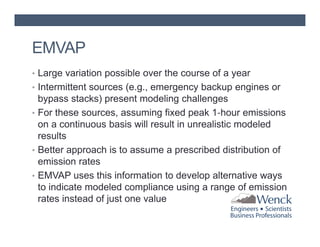
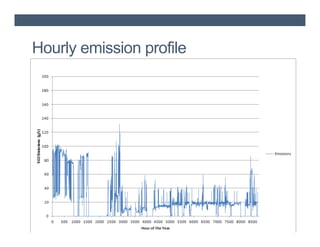
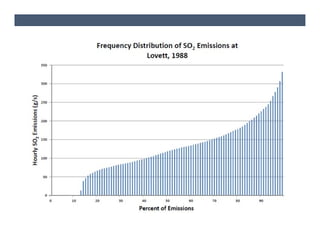
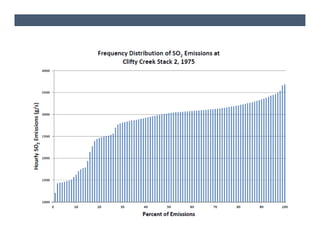
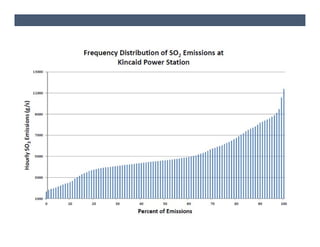
• Large variation possible over the course of a year
• Intermittent sources (e.g., emergency backup engines or

bypass stacks) present modeling challenges
• For these sources, assuming fixed peak 1‐hour emissions
on a continuous basis will result in unrealistic modeled
results
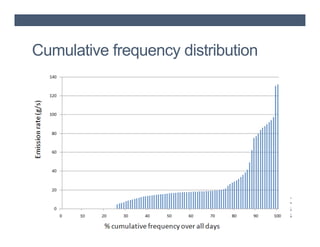
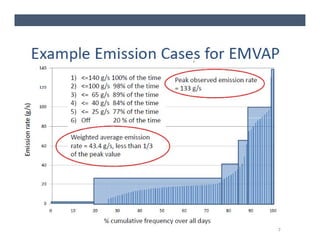
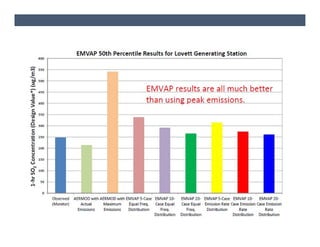
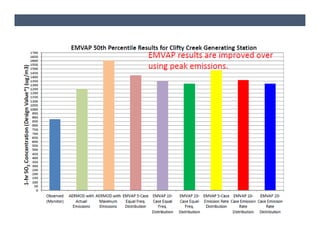
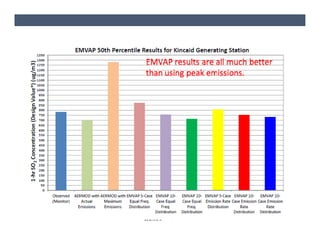
• Better approach is to assume a prescribed distribution of
emission rates
• EMVAP uses this information to develop alternative ways
to indicate modeled compliance using a range of emission
rates instead of just one value
Hourly emission profile
Cumulative frequency distribution
Distance limitations of AERMOD
Limitations of Steady-State Dispersion Models and
Possible Advanced Approaches
Paper 2012-500-AWMA
Gary Moore, Robert Paine, and David Heinold (AECOM)
Steve Hanna (Hanna Consultants)
Short range model distance applicability
• Plumes are assumed to travel to infinite distances within 1
•
•
•
•

hour (“lighthouse beam” effect)
Each hour, the previous hour’s emissions are replaced
and forgotten
Worst‐case conditions, especially associated with low
winds, result in impossible distances
Currently, though, US EPA considers these models to be
applicable to a rather arbitrary distance of 50 km
Equivalence between ISC and CALPUFF for 2 met data
locations:
• Salem, Oregon
• Evansville, Indiana
Short range model distance applicability
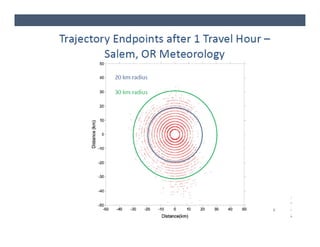
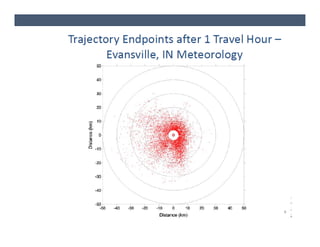
• 20‐30 km is the extent a single hour’s travel for most of

the hours
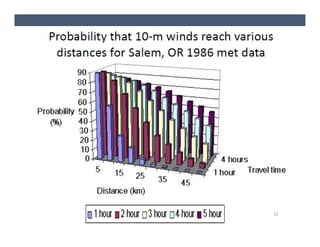
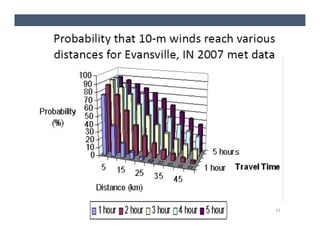
• Even after 4‐5 hours, more than half of air parcels
followed with a 10‐m wind are still on the 50‐km modeling
domain
• Results suggest that a 20‐km limit seems more
appropriate for steady‐state model (e.g., AERMOD)
applicability rather than the current limit of 50 km
Case Study 1- North Dakota
Comparison of AERMOD Modeled 1-hour SO2
Concentrations to Observations at Multiple Monitoring
Stations in North Dakota
Paper 2012-A-353-AWMA
Mary M. Kaplan, Robert Paine (AECOM)
Evaluation Opportunity in North Dakota
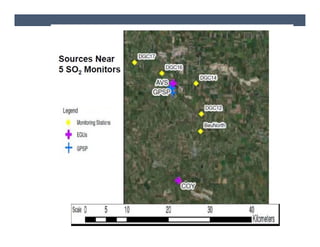
• Mercer County: Antelope Valley Station and Great Plains
•
•
•
•
•

Synfuels Plant
Electrical generating unit sources dominate SO2
emissions – hourly data available
Five SO2 monitors in area within about 10 km of two
nearby “central” sources
Site‐specific PSD quality meteorological data years
available (10‐m tower)
Major SO2 sources within 50 km were modeled
Five recent years of data were used
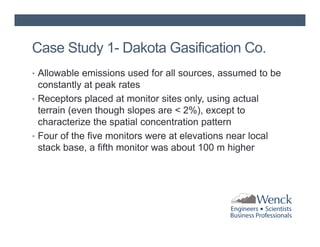
Case Study 1- Dakota Gasification Co.
• Allowable emissions used for all sources, assumed to be

constantly at peak rates
• Receptors placed at monitor sites only, using actual
terrain (even though slopes are < 2%), except to
characterize the spatial concentration pattern
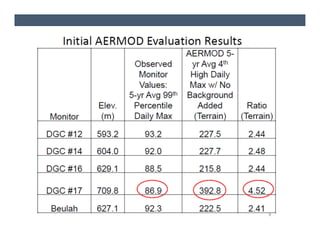
• Four of the five monitors were at elevations near local
stack base, a fifth monitor was about 100 m higher
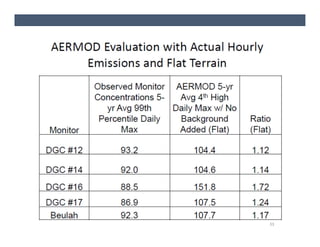
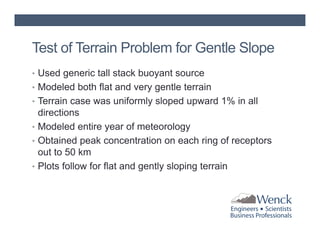
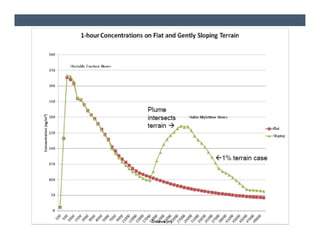
Test of Terrain Problem for Gentle Slope
• Used generic tall stack buoyant source
• Modeled both flat and very gentle terrain
• Terrain case was uniformly sloped upward 1% in all

directions
• Modeled entire year of meteorology
• Obtained peak concentration on each ring of receptors
out to 50 km
• Plots follow for flat and gently sloping terrain
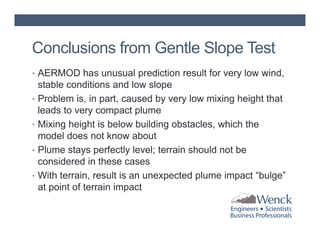
Conclusions from Gentle Slope Test
• AERMOD has unusual prediction result for very low wind,
•
•
•
•

stable conditions and low slope
Problem is, in part, caused by very low mixing height that
leads to very compact plume
Mixing height is below building obstacles, which the
model does not know about
Plume stays perfectly level; terrain should not be
considered in these cases
With terrain, result is an unexpected plume impact “bulge”
at point of terrain impact
Case Study 2-Gibson Generating Station
• Review of IDEM’s AERMOD Evaluation for the Gibson

Generating Station
• Robert Paine and Carlos Szembek (AECOM)
Case Study 2-Gibson Generating Station
• The Indiana Department of Environmental Management

(IDEM) conducted an evaluation of AERMOD
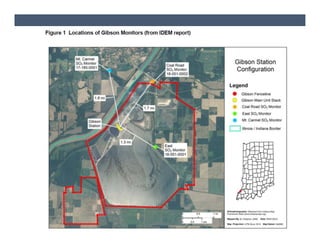
• Gibson is an isolated source with 4 stacks and 3 nearby
monitors
• On-site met data and hourly SO2 emission data for 2010
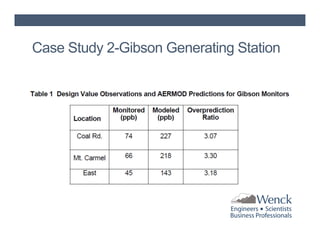
• Comparison of monitored versus predicted concentrations
Case Study 2-Gibson Generating Station
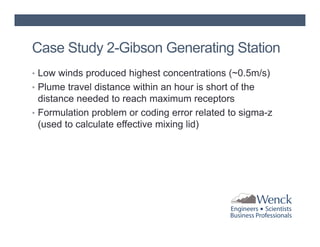
• Low winds produced highest concentrations (~0.5m/s)
• Plume travel distance within an hour is short of the

distance needed to reach maximum receptors
• Formulation problem or coding error related to sigma-z
(used to calculate effective mixing lid)
Questions?
Sergio A. Guerra
Environmental Engineer
Phone: (651) 395-5225
sguerra@wenck.com
AIR DISPERSION MODELING HIGHLIGHTS FROM 2012 ACE

AIR DISPERSION MODELING HIGHLIGHTS FROM 2012 ACE

  • 1.
    AIR DISPERSION MODELING HIGHLIGHTS FROM2012 ACE Presentation for the A&WMA UMS Board Meeting August 21, 2012 Sergio Guerra Wenck Associates, Inc.
  • 2.
    Outline • Introduction • EMVAP •Distance limitation for AERMOD use • Case studies • North Dakota • Gibson Station
  • 3.
    Why do weuse a model?
  • 4.
    What is amodel? • A Model is a way of expressing the relationship between the different variables of a system in mathematical terms
  • 5.
    What is anAir Quality Model An attempt to predict or simulate the ambient concentrations of contaminants in an area of interest. An Air Quality Model can be as simple as an algebraic equation or more complex
  • 6.
    AERMOD • AERMOD isa steady-state plume model that incorporates air dispersion based on planetary boundary layer turbulence structure and scaling concepts, including treatment of both surface and elevated sources, and both simple and complex terrain. • AERMOD replaced the Industrial Source Complex (ISCST3) model as EPA’s regulatory model on December 9, 2006 • Preprocessors include: AERMET,AERMINUTE,AERSURFACE,AERMAP,BPIP
  • 7.
    What are theinputs of a dispersion model? • Source data • Building data • Receptor data • Site data • Meteorological data • Terrain data
  • 8.
  • 9.
    Emissions Variability Processor(EMVAP) EMVAP an Emission Variability Processor for Modeling Applications Paper 2012-A-341-AWMA Richard P. Hamel, Robert J. Paine, David W. Heinold (AECOM) Naresh Kumar and Eladio Knipping (EPRI)
  • 10.
    EMVAP • Large variationpossible over the course of a year • Intermittent sources (e.g., emergency backup engines or bypass stacks) present modeling challenges • For these sources, assuming fixed peak 1‐hour emissions on a continuous basis will result in unrealistic modeled results • Better approach is to assume a prescribed distribution of emission rates • EMVAP uses this information to develop alternative ways to indicate modeled compliance using a range of emission rates instead of just one value
  • 11.
  • 12.
  • 20.
    Distance limitations ofAERMOD Limitations of Steady-State Dispersion Models and Possible Advanced Approaches Paper 2012-500-AWMA Gary Moore, Robert Paine, and David Heinold (AECOM) Steve Hanna (Hanna Consultants)
  • 21.
    Short range modeldistance applicability • Plumes are assumed to travel to infinite distances within 1 • • • • hour (“lighthouse beam” effect) Each hour, the previous hour’s emissions are replaced and forgotten Worst‐case conditions, especially associated with low winds, result in impossible distances Currently, though, US EPA considers these models to be applicable to a rather arbitrary distance of 50 km Equivalence between ISC and CALPUFF for 2 met data locations: • Salem, Oregon • Evansville, Indiana
  • 26.
    Short range modeldistance applicability • 20‐30 km is the extent a single hour’s travel for most of the hours • Even after 4‐5 hours, more than half of air parcels followed with a 10‐m wind are still on the 50‐km modeling domain • Results suggest that a 20‐km limit seems more appropriate for steady‐state model (e.g., AERMOD) applicability rather than the current limit of 50 km
  • 27.
    Case Study 1-North Dakota Comparison of AERMOD Modeled 1-hour SO2 Concentrations to Observations at Multiple Monitoring Stations in North Dakota Paper 2012-A-353-AWMA Mary M. Kaplan, Robert Paine (AECOM)
  • 28.
    Evaluation Opportunity inNorth Dakota • Mercer County: Antelope Valley Station and Great Plains • • • • • Synfuels Plant Electrical generating unit sources dominate SO2 emissions – hourly data available Five SO2 monitors in area within about 10 km of two nearby “central” sources Site‐specific PSD quality meteorological data years available (10‐m tower) Major SO2 sources within 50 km were modeled Five recent years of data were used
  • 30.
    Case Study 1-Dakota Gasification Co. • Allowable emissions used for all sources, assumed to be constantly at peak rates • Receptors placed at monitor sites only, using actual terrain (even though slopes are < 2%), except to characterize the spatial concentration pattern • Four of the five monitors were at elevations near local stack base, a fifth monitor was about 100 m higher
  • 33.
    Test of TerrainProblem for Gentle Slope • Used generic tall stack buoyant source • Modeled both flat and very gentle terrain • Terrain case was uniformly sloped upward 1% in all directions • Modeled entire year of meteorology • Obtained peak concentration on each ring of receptors out to 50 km • Plots follow for flat and gently sloping terrain
  • 35.
    Conclusions from GentleSlope Test • AERMOD has unusual prediction result for very low wind, • • • • stable conditions and low slope Problem is, in part, caused by very low mixing height that leads to very compact plume Mixing height is below building obstacles, which the model does not know about Plume stays perfectly level; terrain should not be considered in these cases With terrain, result is an unexpected plume impact “bulge” at point of terrain impact
  • 36.
    Case Study 2-GibsonGenerating Station • Review of IDEM’s AERMOD Evaluation for the Gibson Generating Station • Robert Paine and Carlos Szembek (AECOM)
  • 37.
    Case Study 2-GibsonGenerating Station • The Indiana Department of Environmental Management (IDEM) conducted an evaluation of AERMOD • Gibson is an isolated source with 4 stacks and 3 nearby monitors • On-site met data and hourly SO2 emission data for 2010 • Comparison of monitored versus predicted concentrations
  • 39.
    Case Study 2-GibsonGenerating Station
  • 40.
    Case Study 2-GibsonGenerating Station • Low winds produced highest concentrations (~0.5m/s) • Plume travel distance within an hour is short of the distance needed to reach maximum receptors • Formulation problem or coding error related to sigma-z (used to calculate effective mixing lid)
  • 41.
    Questions? Sergio A. Guerra EnvironmentalEngineer Phone: (651) 395-5225 sguerra@wenck.com