Sergio Guerra, PhD | GHD
Ron Petersen, PhD, CCM | Petersen Research and Consulting
James Paumier | Consultant
Extended Abstract: 616634
A&WMA’s 112th Annual Conference & Exhibition
Quebec City, Canada
June 27, 2019
PRIME2 Model Evaluation
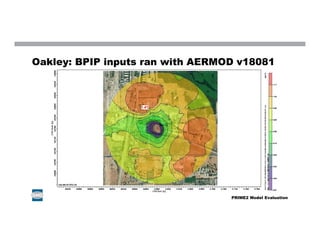
-AERMOD 18081
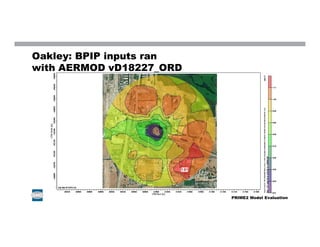
-AERMOD D18227_ORD
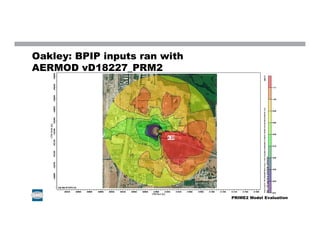
-AERMOD D18227_PRM2
Abstract
The Plume Rise Model Enhancements (PRIME) formulation in AERMOD has been updated based new equations developed from wind tunnel measurements taken downwind of
various solid and streamlined structures. These new equations, along with other building downwash improvements have been included as alpha options in the upcoming new
version of AERMOD.
The PRIME2 options include:
• PRIME2UTurb which enables enhanced calculations of turbulence and wind speed
• PRIME2Ueff which defines the height used to compute effective parameters Ueff, Sweff, Sveff and Tgeff at plume height and at 30 m
• Streamline defines the set of constants for modeling all structures as streamlined. If omitted, rectangular building constants are used.
The ORD Options include:
• PRIMEUeff which controls the heights for which the wind speed is calculated for the main plume concentrations.
• Average between plume height and receptor height recommended in ORD version
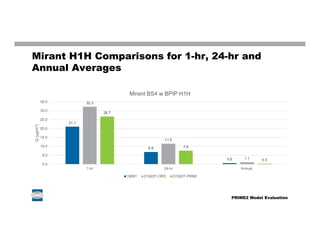
• Default is current method in AERMOD, stack height wind speed.
• PRIMETurb which adjusts the vertical turbulence intensity, wiz0 from 0.6 to 0.7.
• PRIMECav modifies the cavity calculations
These improvements aim to address important theoretical issues that significantly affect the accuracy of predicted concentrations subject to downwash effects. This research effort
was funded in part by the American Petroleum Institute, the Electric Power Research Institute, the Corn Refiners Association and the American Forest & Paper Association. As part
of it, the PRIME2 subcommittee under the A&WMA APM committee was formed to: (1) establish a mechanism to review, approve and implement new science into the model for this
and future improvements; and (2) provide a technical review forum to improve the PRIME building downwash algorithms. Collaboration and cooperation from the EPA Office of
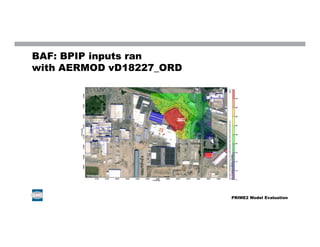
Research and Development (ORD) has been on-going during the research project resulting in new alpha options aimed at solving known issues with the treatment of building
downwash effects in AERMOD. The intent is that these experimental options will be tested by the user community to create enough justification to make these beta (approved on a
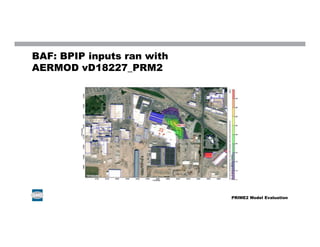
case-by-case basis) and eventually default options in AERMOD.
A preliminary evaluation for the following four cases will be presented:
• Arconic- Davenport, IA (formerly Alcoa)
• Mirant Potomac River Generating Station- Alexandria, VA
• Basic American Foods- Blackfoot, ID
• Oakley Generating Station- Oakley, CA
The evaluation includes comparing 1-hr, 24-hr and annual averages along with Q-Q plots and isopleths. A discussion related to the results obtained will also be presented.
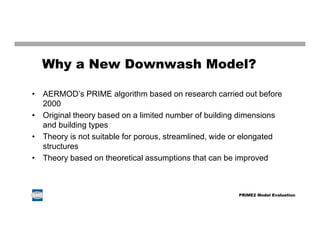
Why a New Downwash Model?
• AERMOD’s PRIME algorithm based on research carried out before
2000
• Original theory based on a limited number of building dimensions
and building types
• Theory is not suitable for porous, streamlined, wide or elongated
structures
• Theory based on theoretical assumptions that can be improved
PRIME2 Model Evaluation
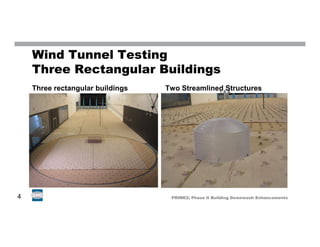
Wind Tunnel Testing
Three Rectangular Buildings
Three rectangular buildings Two Streamlined Structures
PRIME2; Phase II Building Downwash Enhancements4
1:4:4
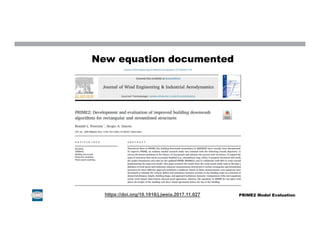
New equation documented
https://doi.org/10.1016/j.jweia.2017.11.027 PRIME2 Model Evaluation
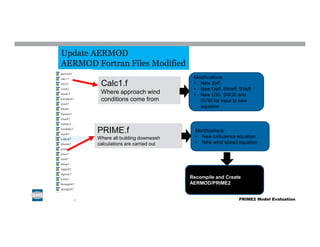
Update AERMOD
AERMOD Fortran Files Modified
PRIME.f
Where all building downwash
calculations are carried out
Calc1.f
Where approach wind
conditions come from
Modifications
• New Zeff
• New Ueff, SWeff, SVeff
• New U30, SW30 and
SV30 for input to new
equation
Modifications
• New turbulence equation
• New wind speed equation
Recompile and Create
AERMOD/PRIME2
6 PRIME2 Model Evaluation
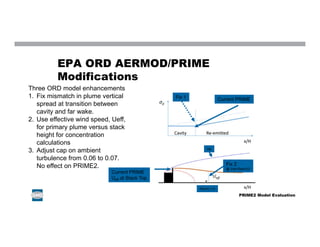
EPA ORD AERMOD/PRIME
Modifications
Current PRIME
Three ORD model enhancements
1. Fix mismatch in plume vertical
spread at transition between
cavity and far wake.
2. Use effective wind speed, Ueff,
for primary plume versus stack
height for concentration
calculations
3. Adjust cap on ambient
turbulence from 0.06 to 0.07.
No effect on PRIME2.
Fix 1
Current PRIME
Ueff at Stack Top
Fix 2
@ (Hp+RecH)/2
RecH) = 0
Hp
PRIME2 Model Evaluation
Field Evaluations
Presented on June 28, 2-18 at the A&WMA’s 11th Annual Conference &
Exhibition in Hartford, CT
PRIME2 Model Evaluation
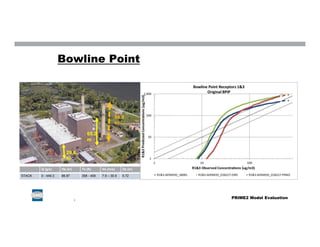
Bowline Point
9
29.6
m
65.2
m
86.9
m
Q (g/s) Hs (m) Ts (K) Vs (m/s) Ds (m)
STACK 0 - 449.3 86.87 358 - 409 7.9 – 30.9 5.72
9
PRIME2 Model Evaluation
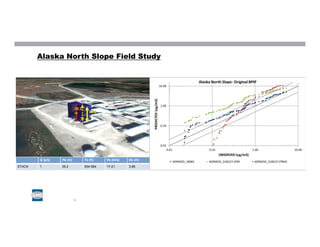
Q (g/s) Hs (m) Ts (K) Vs (m/s) Ds (m)
STACK 1 39.2 554-584 17-21 3.66
34.0
m
39.2
m
Alaska North Slope Field Study
10
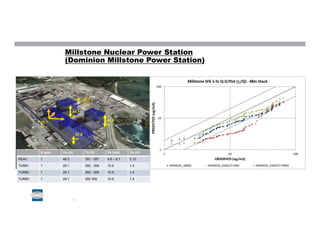
Millstone Nuclear Power Station
(Dominion Millstone Power Station)
Q (g/s) Hs (m) Ts (K) Vs (m/s) Ds (m)
REAC 1 48.3 291 - 297 4.6 – 8.7 2.12
TURB1 1 29.1 292 - 306 10.5 1.4
TURB2 1 29.1 292 - 306 10.5 1.4
TURB3 1 29.1 292 306 10.5 1.4
41.6
m
44.7
m
27.6
m
29.1
m
48.3
m
11
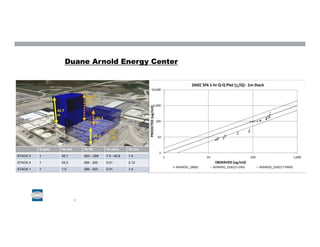
Duane Arnold Energy Center
23.5
m
42.7
m
1
m
23.5
m
45.7
m
Q (g/s) Hs (m) Ts (K) Vs (m/s) Ds (m)
STACK 5 1 45.7 293 – 299 7.4 - 40.8 1.4
STACK 4 1 23.5 294 - 300 0.01 2.12
STACK 1 1 1.0 299 - 303 0.01 1.4
12
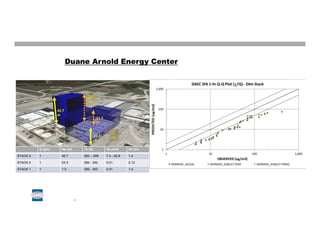
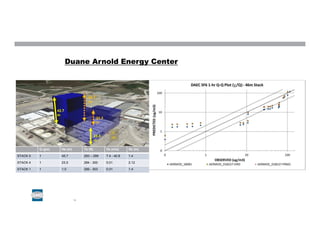
Duane Arnold Energy Center
23.5
m
42.7
m
1
m
23.5
m
45.7
m
Q (g/s) Hs (m) Ts (K) Vs (m/s) Ds (m)
STACK 5 1 45.7 293 – 299 7.4 - 40.8 1.4
STACK 4 1 23.5 294 - 300 0.01 2.12
STACK 1 1 1.0 299 - 303 0.01 1.4
13
Duane Arnold Energy Center
23.5
m
42.7
m
1
m
23.5
m
45.7
m
Q (g/s) Hs (m) Ts (K) Vs (m/s) Ds (m)
STACK 5 1 45.7 293 – 299 7.4 - 40.8 1.4
STACK 4 1 23.5 294 - 300 0.01 2.12
STACK 1 1 1.0 299 - 303 0.01 1.4
14
Case Study Evaluation
Conducted for the following four cases:
• Arconic (formerly Alcoa )- Davenport, IA
• Mirant Potomac River Generating Station- Alexandria, VA
• Basic American Foods- Blackfoot, ID
• Oakley Generating Station- Oakley, CA
The evaluation compares the following averages for each
case:
• 1-hour (H1H)
• 24-hr (H1H)
• Annual
PRIME2 Model Evaluation
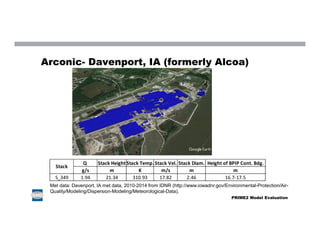
Arconic- Davenport, IA (formerly Alcoa)
PRIME2 Model Evaluation
Met data: Davenport, IA met data, 2010-2014 from IDNR (http://www.iowadnr.gov/Environmental-Protection/Air-
Quality/Modeling/Dispersion-Modeling/Meteorological-Data).
Q Stack Height Stack Temp. Stack Vel. Stack Diam. Height of BPIP Cont. Bdg.
g/s m K m/s m m
S_349 1.94 21.34 310.93 17.82 2.46 16.7-17.5
Stack
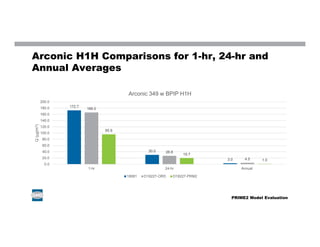
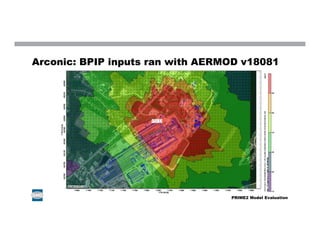
Arconic H1H Comparisons for 1-hr, 24-hr and
Annual Averages
172.7
30.0
3.0
166.0
26.8
4.5
95.9
19.7
1.0
0.0
20.0
40.0
60.0
80.0
100.0
120.0
140.0
160.0
180.0
200.0
1-hr 24-hr Annual
Q(µg/m3)
Arconic 349 w BPIP H1H
18081 D18227-ORD D18227-PRM2
PRIME2 Model Evaluation
Arconic: BPIP inputs ran with AERMOD v18081
PRIME2 Model Evaluation
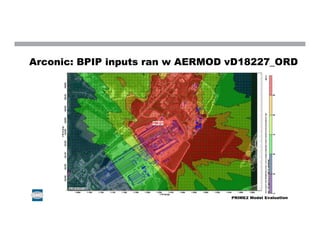
Arconic: BPIP inputs ran w AERMOD vD18227_ORD
PRIME2 Model Evaluation
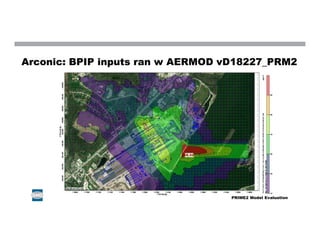
Arconic: BPIP inputs ran w AERMOD vD18227_PRM2
PRIME2 Model Evaluation
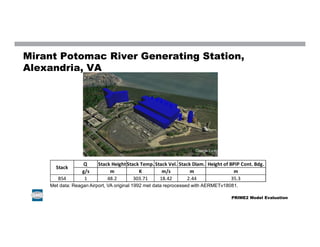
Mirant Potomac River Generating Station,
Alexandria, VA
PRIME2 Model Evaluation
Met data: Reagan Airport, VA original 1992 met data reprocessed with AERMETv18081.
Q Stack Height Stack Temp. Stack Vel. Stack Diam. Height of BPIP Cont. Bdg.
g/s m K m/s m m
BS4 1 48.2 303.71 18.42 2.44 35.3
Stack
Mirant H1H Comparisons for 1-hr, 24-hr and
Annual Averages
21.1
6.9
0.6
32.3
11.5
1.1
26.7
7.6
0.3
0.0
5.0
10.0
15.0
20.0
25.0
30.0
35.0
1-hr 24-hr Annual
Q(µg/m3)
Mirant BS4 w BPIP H1H
18081 D18227-ORD D18227-PRM2
PRIME2 Model Evaluation
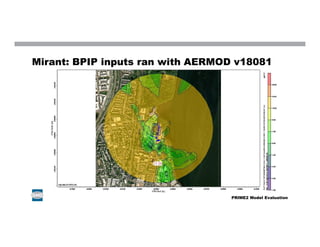
Mirant: BPIP inputs ran with AERMOD v18081
PRIME2 Model Evaluation
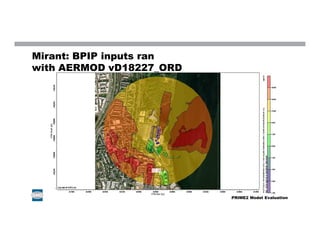
Mirant: BPIP inputs ran
with AERMOD vD18227_ORD
PRIME2 Model Evaluation
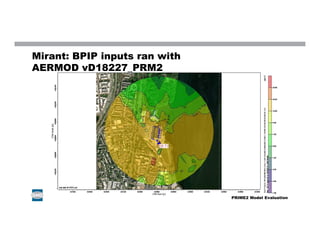
Mirant: BPIP inputs ran with
AERMOD vD18227_PRM2
PRIME2 Model Evaluation
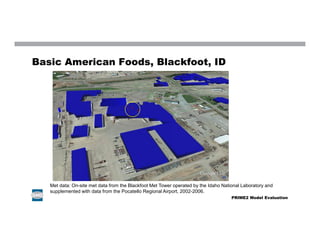
Basic American Foods, Blackfoot, ID
PRIME2 Model Evaluation
Met data: On-site met data from the Blackfoot Met Tower operated by the Idaho National Laboratory and
supplemented with data from the Pocatello Regional Airport, 2002-2006.
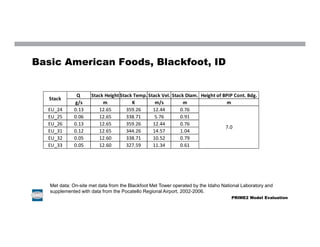
Basic American Foods, Blackfoot, ID
PRIME2 Model Evaluation
Met data: On-site met data from the Blackfoot Met Tower operated by the Idaho National Laboratory and
supplemented with data from the Pocatello Regional Airport, 2002-2006.
Q Stack Height Stack Temp. Stack Vel. Stack Diam. Height of BPIP Cont. Bdg.
g/s m K m/s m m
EU_24 0.13 12.65 359.26 12.44 0.76
EU_25 0.06 12.65 338.71 5.76 0.91
EU_26 0.13 12.65 359.26 12.44 0.76
EU_31 0.12 12.65 344.26 14.57 1.04
EU_32 0.05 12.60 338.71 10.52 0.79
EU_33 0.05 12.60 327.59 11.34 0.61
Stack
7.0
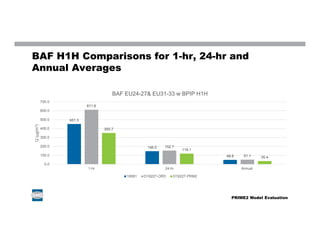
BAF H1H Comparisons for 1-hr, 24-hr and
Annual Averages
451.3
146.0
48.8
611.6
152.7
51.1
350.7
119.1
35.4
0.0
100.0
200.0
300.0
400.0
500.0
600.0
700.0
1-hr 24-hr Annual
Q(µg/m3)
BAF EU24-27& EU31-33 w BPIP H1H
18081 D18227-ORD D18227-PRM2
PRIME2 Model Evaluation
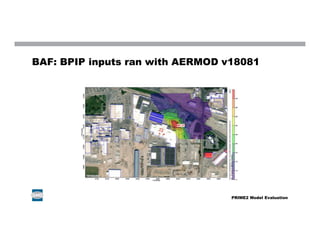
BAF: BPIP inputs ran with AERMOD v18081
PRIME2 Model Evaluation
BAF: BPIP inputs ran
with AERMOD vD18227_ORD
PRIME2 Model Evaluation
BAF: BPIP inputs ran with
AERMOD vD18227_PRM2
PRIME2 Model Evaluation
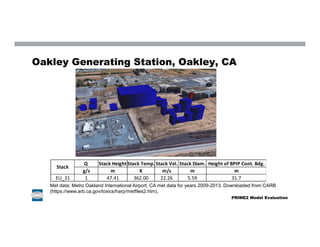
Oakley Generating Station, Oakley, CA
PRIME2 Model Evaluation
Met data: Metro Oakland International Airport, CA met data for years 2009-2013. Downloaded from CARB
(https://www.arb.ca.gov/toxics/harp/metfiles2.htm).
Q Stack Height Stack Temp. Stack Vel. Stack Diam. Height of BPIP Cont. Bdg.
g/s m K m/s m m
EU_31 1 47.41 362.00 22.26 5.59 31.7
Stack
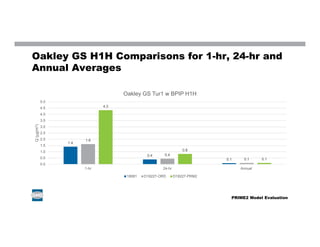
Oakley GS H1H Comparisons for 1-hr, 24-hr and
Annual Averages
1.4
0.4
0.1
1.6
0.4
0.1
4.3
0.8
0.1
0.0
0.5
1.0
1.5
2.0
2.5
3.0
3.5
4.0
4.5
5.0
1-hr 24-hr Annual
Q(µg/m3)
Oakley GS Tur1 w BPIP H1H
18081 D18227-ORD D18227-PRM2
PRIME2 Model Evaluation
Oakley: BPIP inputs ran with AERMOD v18081
PRIME2 Model Evaluation
Oakley: BPIP inputs ran
with AERMOD vD18227_ORD
PRIME2 Model Evaluation
Oakley: BPIP inputs ran with
AERMOD vD18227_PRM2
PRIME2 Model Evaluation
Results
• Performance of version D18227-PRM2 is inconsistent
• Predicted values are lower than the base case for Arconic and BAF with
small differences for Mirant (except for annual which has PRIME2
significantly lower).
• The base case predictions are lower than the ones from the D18227-
ORD and D18227-PRM2 versions for the Oakley case.
PRIME2 Model Evaluation
Results
• In general, version D18227-ORD produces higher concentrations
than AERMOD 18081.
• The primary reason for this is that the ORD version uses the wind speed
at the average between plume centerline height and receptor height to
calculate concentrations versus stack height in AERMOD.
• PRIME2’s theory does not depend on the wake height but rather the
building height, width, length and position relative to the stack.
PRIME2 Model Evaluation
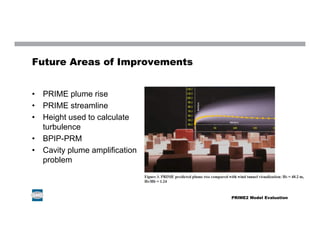
Future Areas of Improvements
• PRIME plume rise
• PRIME streamline
• Height used to calculate
turbulence
• BPIP-PRM
• Cavity plume amplification
problem
PRIME2 Model Evaluation
Conclusions
• PRIME2 includes a superior theory to account for building
downwash effects for rectangular and streamlined structures.
• Inconsistencies may be due to other parts of the model
• Work from EPA ORD complements the work performed by PRIME2.
• Plan is to continue EPA collaboration to address model
improvements to AERMOD related to building downwash.
PRIME2 Model Evaluation
Sergio A. Guerra, PhD Ron Petersen, PhD, CCM
sergio.guerra@ghd.com rpetersen@petersenresearch.com
Office: + 720 974 0935 Mobile:+1 970 690 1344
PRIME2 Model Evaluation
www.ghd.com
PRIME2 Model Evaluation
Objectives
PRIME2 Subcommittee was
formed to:
• Establish a mechanism to review,
approve and implement new science
into the model for this and future
improvements
• Provide a technical review forum to
improve the PRIME building
downwash algorithms
PRIME2 Model Evaluation
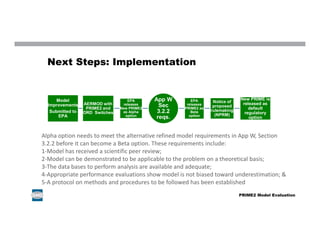
Next Steps: Implementation
Model
Improvements
Submitted to
EPA
AERMOD with
PRIME2 and
ORD Switches
EPA
releases
New PRIME2
as Alpha
option
App W
Sec
3.2.2
reqs.
EPA
releases
PRIME2 as
Beta
option
Notice of
proposed
rulemaking
(NPRM)
New PRIME is
released as
default
regulatory
option
Alpha option needs to meet the alternative refined model requirements in App W, Section
3.2.2 before it can become a Beta option. These requirements include:
1-Model has received a scientific peer review;
2-Model can be demonstrated to be applicable to the problem on a theoretical basis;
3-The data bases to perform analysis are available and adequate;
4-Appropriate performance evaluations show model is not biased toward underestimation; &
5-A protocol on methods and procedures to be followed has been established
PRIME2 Model Evaluation

PRIME2 Model Evaluation

  • 1.
    Sergio Guerra, PhD| GHD Ron Petersen, PhD, CCM | Petersen Research and Consulting James Paumier | Consultant Extended Abstract: 616634 A&WMA’s 112th Annual Conference & Exhibition Quebec City, Canada June 27, 2019 PRIME2 Model Evaluation -AERMOD 18081 -AERMOD D18227_ORD -AERMOD D18227_PRM2
  • 2.
    Abstract The Plume RiseModel Enhancements (PRIME) formulation in AERMOD has been updated based new equations developed from wind tunnel measurements taken downwind of various solid and streamlined structures. These new equations, along with other building downwash improvements have been included as alpha options in the upcoming new version of AERMOD. The PRIME2 options include: • PRIME2UTurb which enables enhanced calculations of turbulence and wind speed • PRIME2Ueff which defines the height used to compute effective parameters Ueff, Sweff, Sveff and Tgeff at plume height and at 30 m • Streamline defines the set of constants for modeling all structures as streamlined. If omitted, rectangular building constants are used. The ORD Options include: • PRIMEUeff which controls the heights for which the wind speed is calculated for the main plume concentrations. • Average between plume height and receptor height recommended in ORD version • Default is current method in AERMOD, stack height wind speed. • PRIMETurb which adjusts the vertical turbulence intensity, wiz0 from 0.6 to 0.7. • PRIMECav modifies the cavity calculations These improvements aim to address important theoretical issues that significantly affect the accuracy of predicted concentrations subject to downwash effects. This research effort was funded in part by the American Petroleum Institute, the Electric Power Research Institute, the Corn Refiners Association and the American Forest & Paper Association. As part of it, the PRIME2 subcommittee under the A&WMA APM committee was formed to: (1) establish a mechanism to review, approve and implement new science into the model for this and future improvements; and (2) provide a technical review forum to improve the PRIME building downwash algorithms. Collaboration and cooperation from the EPA Office of Research and Development (ORD) has been on-going during the research project resulting in new alpha options aimed at solving known issues with the treatment of building downwash effects in AERMOD. The intent is that these experimental options will be tested by the user community to create enough justification to make these beta (approved on a case-by-case basis) and eventually default options in AERMOD. A preliminary evaluation for the following four cases will be presented: • Arconic- Davenport, IA (formerly Alcoa) • Mirant Potomac River Generating Station- Alexandria, VA • Basic American Foods- Blackfoot, ID • Oakley Generating Station- Oakley, CA The evaluation includes comparing 1-hr, 24-hr and annual averages along with Q-Q plots and isopleths. A discussion related to the results obtained will also be presented.
  • 3.
    Why a NewDownwash Model? • AERMOD’s PRIME algorithm based on research carried out before 2000 • Original theory based on a limited number of building dimensions and building types • Theory is not suitable for porous, streamlined, wide or elongated structures • Theory based on theoretical assumptions that can be improved PRIME2 Model Evaluation
  • 4.
    Wind Tunnel Testing ThreeRectangular Buildings Three rectangular buildings Two Streamlined Structures PRIME2; Phase II Building Downwash Enhancements4 1:4:4
  • 5.
  • 6.
    Update AERMOD AERMOD FortranFiles Modified PRIME.f Where all building downwash calculations are carried out Calc1.f Where approach wind conditions come from Modifications • New Zeff • New Ueff, SWeff, SVeff • New U30, SW30 and SV30 for input to new equation Modifications • New turbulence equation • New wind speed equation Recompile and Create AERMOD/PRIME2 6 PRIME2 Model Evaluation
  • 7.
    EPA ORD AERMOD/PRIME Modifications CurrentPRIME Three ORD model enhancements 1. Fix mismatch in plume vertical spread at transition between cavity and far wake. 2. Use effective wind speed, Ueff, for primary plume versus stack height for concentration calculations 3. Adjust cap on ambient turbulence from 0.06 to 0.07. No effect on PRIME2. Fix 1 Current PRIME Ueff at Stack Top Fix 2 @ (Hp+RecH)/2 RecH) = 0 Hp PRIME2 Model Evaluation
  • 8.
    Field Evaluations Presented onJune 28, 2-18 at the A&WMA’s 11th Annual Conference & Exhibition in Hartford, CT PRIME2 Model Evaluation
  • 9.
    Bowline Point 9 29.6 m 65.2 m 86.9 m Q (g/s)Hs (m) Ts (K) Vs (m/s) Ds (m) STACK 0 - 449.3 86.87 358 - 409 7.9 – 30.9 5.72 9 PRIME2 Model Evaluation
  • 10.
    Q (g/s) Hs(m) Ts (K) Vs (m/s) Ds (m) STACK 1 39.2 554-584 17-21 3.66 34.0 m 39.2 m Alaska North Slope Field Study 10
  • 11.
    Millstone Nuclear PowerStation (Dominion Millstone Power Station) Q (g/s) Hs (m) Ts (K) Vs (m/s) Ds (m) REAC 1 48.3 291 - 297 4.6 – 8.7 2.12 TURB1 1 29.1 292 - 306 10.5 1.4 TURB2 1 29.1 292 - 306 10.5 1.4 TURB3 1 29.1 292 306 10.5 1.4 41.6 m 44.7 m 27.6 m 29.1 m 48.3 m 11
  • 12.
    Duane Arnold EnergyCenter 23.5 m 42.7 m 1 m 23.5 m 45.7 m Q (g/s) Hs (m) Ts (K) Vs (m/s) Ds (m) STACK 5 1 45.7 293 – 299 7.4 - 40.8 1.4 STACK 4 1 23.5 294 - 300 0.01 2.12 STACK 1 1 1.0 299 - 303 0.01 1.4 12
  • 13.
    Duane Arnold EnergyCenter 23.5 m 42.7 m 1 m 23.5 m 45.7 m Q (g/s) Hs (m) Ts (K) Vs (m/s) Ds (m) STACK 5 1 45.7 293 – 299 7.4 - 40.8 1.4 STACK 4 1 23.5 294 - 300 0.01 2.12 STACK 1 1 1.0 299 - 303 0.01 1.4 13
  • 14.
    Duane Arnold EnergyCenter 23.5 m 42.7 m 1 m 23.5 m 45.7 m Q (g/s) Hs (m) Ts (K) Vs (m/s) Ds (m) STACK 5 1 45.7 293 – 299 7.4 - 40.8 1.4 STACK 4 1 23.5 294 - 300 0.01 2.12 STACK 1 1 1.0 299 - 303 0.01 1.4 14
  • 15.
    Case Study Evaluation Conductedfor the following four cases: • Arconic (formerly Alcoa )- Davenport, IA • Mirant Potomac River Generating Station- Alexandria, VA • Basic American Foods- Blackfoot, ID • Oakley Generating Station- Oakley, CA The evaluation compares the following averages for each case: • 1-hour (H1H) • 24-hr (H1H) • Annual PRIME2 Model Evaluation
  • 16.
    Arconic- Davenport, IA(formerly Alcoa) PRIME2 Model Evaluation Met data: Davenport, IA met data, 2010-2014 from IDNR (http://www.iowadnr.gov/Environmental-Protection/Air- Quality/Modeling/Dispersion-Modeling/Meteorological-Data). Q Stack Height Stack Temp. Stack Vel. Stack Diam. Height of BPIP Cont. Bdg. g/s m K m/s m m S_349 1.94 21.34 310.93 17.82 2.46 16.7-17.5 Stack
  • 17.
    Arconic H1H Comparisonsfor 1-hr, 24-hr and Annual Averages 172.7 30.0 3.0 166.0 26.8 4.5 95.9 19.7 1.0 0.0 20.0 40.0 60.0 80.0 100.0 120.0 140.0 160.0 180.0 200.0 1-hr 24-hr Annual Q(µg/m3) Arconic 349 w BPIP H1H 18081 D18227-ORD D18227-PRM2 PRIME2 Model Evaluation
  • 18.
    Arconic: BPIP inputsran with AERMOD v18081 PRIME2 Model Evaluation
  • 19.
    Arconic: BPIP inputsran w AERMOD vD18227_ORD PRIME2 Model Evaluation
  • 20.
    Arconic: BPIP inputsran w AERMOD vD18227_PRM2 PRIME2 Model Evaluation
  • 21.
    Mirant Potomac RiverGenerating Station, Alexandria, VA PRIME2 Model Evaluation Met data: Reagan Airport, VA original 1992 met data reprocessed with AERMETv18081. Q Stack Height Stack Temp. Stack Vel. Stack Diam. Height of BPIP Cont. Bdg. g/s m K m/s m m BS4 1 48.2 303.71 18.42 2.44 35.3 Stack
  • 22.
    Mirant H1H Comparisonsfor 1-hr, 24-hr and Annual Averages 21.1 6.9 0.6 32.3 11.5 1.1 26.7 7.6 0.3 0.0 5.0 10.0 15.0 20.0 25.0 30.0 35.0 1-hr 24-hr Annual Q(µg/m3) Mirant BS4 w BPIP H1H 18081 D18227-ORD D18227-PRM2 PRIME2 Model Evaluation
  • 23.
    Mirant: BPIP inputsran with AERMOD v18081 PRIME2 Model Evaluation
  • 24.
    Mirant: BPIP inputsran with AERMOD vD18227_ORD PRIME2 Model Evaluation
  • 25.
    Mirant: BPIP inputsran with AERMOD vD18227_PRM2 PRIME2 Model Evaluation
  • 26.
    Basic American Foods,Blackfoot, ID PRIME2 Model Evaluation Met data: On-site met data from the Blackfoot Met Tower operated by the Idaho National Laboratory and supplemented with data from the Pocatello Regional Airport, 2002-2006.
  • 27.
    Basic American Foods,Blackfoot, ID PRIME2 Model Evaluation Met data: On-site met data from the Blackfoot Met Tower operated by the Idaho National Laboratory and supplemented with data from the Pocatello Regional Airport, 2002-2006. Q Stack Height Stack Temp. Stack Vel. Stack Diam. Height of BPIP Cont. Bdg. g/s m K m/s m m EU_24 0.13 12.65 359.26 12.44 0.76 EU_25 0.06 12.65 338.71 5.76 0.91 EU_26 0.13 12.65 359.26 12.44 0.76 EU_31 0.12 12.65 344.26 14.57 1.04 EU_32 0.05 12.60 338.71 10.52 0.79 EU_33 0.05 12.60 327.59 11.34 0.61 Stack 7.0
  • 28.
    BAF H1H Comparisonsfor 1-hr, 24-hr and Annual Averages 451.3 146.0 48.8 611.6 152.7 51.1 350.7 119.1 35.4 0.0 100.0 200.0 300.0 400.0 500.0 600.0 700.0 1-hr 24-hr Annual Q(µg/m3) BAF EU24-27& EU31-33 w BPIP H1H 18081 D18227-ORD D18227-PRM2 PRIME2 Model Evaluation
  • 29.
    BAF: BPIP inputsran with AERMOD v18081 PRIME2 Model Evaluation
  • 30.
    BAF: BPIP inputsran with AERMOD vD18227_ORD PRIME2 Model Evaluation
  • 31.
    BAF: BPIP inputsran with AERMOD vD18227_PRM2 PRIME2 Model Evaluation
  • 32.
    Oakley Generating Station,Oakley, CA PRIME2 Model Evaluation Met data: Metro Oakland International Airport, CA met data for years 2009-2013. Downloaded from CARB (https://www.arb.ca.gov/toxics/harp/metfiles2.htm). Q Stack Height Stack Temp. Stack Vel. Stack Diam. Height of BPIP Cont. Bdg. g/s m K m/s m m EU_31 1 47.41 362.00 22.26 5.59 31.7 Stack
  • 33.
    Oakley GS H1HComparisons for 1-hr, 24-hr and Annual Averages 1.4 0.4 0.1 1.6 0.4 0.1 4.3 0.8 0.1 0.0 0.5 1.0 1.5 2.0 2.5 3.0 3.5 4.0 4.5 5.0 1-hr 24-hr Annual Q(µg/m3) Oakley GS Tur1 w BPIP H1H 18081 D18227-ORD D18227-PRM2 PRIME2 Model Evaluation
  • 34.
    Oakley: BPIP inputsran with AERMOD v18081 PRIME2 Model Evaluation
  • 35.
    Oakley: BPIP inputsran with AERMOD vD18227_ORD PRIME2 Model Evaluation
  • 36.
    Oakley: BPIP inputsran with AERMOD vD18227_PRM2 PRIME2 Model Evaluation
  • 37.
    Results • Performance ofversion D18227-PRM2 is inconsistent • Predicted values are lower than the base case for Arconic and BAF with small differences for Mirant (except for annual which has PRIME2 significantly lower). • The base case predictions are lower than the ones from the D18227- ORD and D18227-PRM2 versions for the Oakley case. PRIME2 Model Evaluation
  • 38.
    Results • In general,version D18227-ORD produces higher concentrations than AERMOD 18081. • The primary reason for this is that the ORD version uses the wind speed at the average between plume centerline height and receptor height to calculate concentrations versus stack height in AERMOD. • PRIME2’s theory does not depend on the wake height but rather the building height, width, length and position relative to the stack. PRIME2 Model Evaluation
  • 39.
    Future Areas ofImprovements • PRIME plume rise • PRIME streamline • Height used to calculate turbulence • BPIP-PRM • Cavity plume amplification problem PRIME2 Model Evaluation
  • 40.
    Conclusions • PRIME2 includesa superior theory to account for building downwash effects for rectangular and streamlined structures. • Inconsistencies may be due to other parts of the model • Work from EPA ORD complements the work performed by PRIME2. • Plan is to continue EPA collaboration to address model improvements to AERMOD related to building downwash. PRIME2 Model Evaluation
  • 41.
    Sergio A. Guerra,PhD Ron Petersen, PhD, CCM sergio.guerra@ghd.com rpetersen@petersenresearch.com Office: + 720 974 0935 Mobile:+1 970 690 1344 PRIME2 Model Evaluation
  • 42.
  • 43.
    Objectives PRIME2 Subcommittee was formedto: • Establish a mechanism to review, approve and implement new science into the model for this and future improvements • Provide a technical review forum to improve the PRIME building downwash algorithms PRIME2 Model Evaluation
  • 44.
    Next Steps: Implementation Model Improvements Submittedto EPA AERMOD with PRIME2 and ORD Switches EPA releases New PRIME2 as Alpha option App W Sec 3.2.2 reqs. EPA releases PRIME2 as Beta option Notice of proposed rulemaking (NPRM) New PRIME is released as default regulatory option Alpha option needs to meet the alternative refined model requirements in App W, Section 3.2.2 before it can become a Beta option. These requirements include: 1-Model has received a scientific peer review; 2-Model can be demonstrated to be applicable to the problem on a theoretical basis; 3-The data bases to perform analysis are available and adequate; 4-Appropriate performance evaluations show model is not biased toward underestimation; & 5-A protocol on methods and procedures to be followed has been established PRIME2 Model Evaluation