www.cppwind.comwww.cppwind.com
Using Physical Modeling to
Refine Downwash Inputs to
AERMOD
Rocky Mountain States Section –
Air & Waste Management Association
Denver, CO
Sergio A. Guerra, PhD
Ron Petersen, PhD, CCM
April 13, 2017
Outline
1. Building Downwash in AERMOD
2. Equivalent Building Dimensions Method
3. Potential Benefits
Using Physical Modeling to Refine Downwash Inputs to AERMOD2
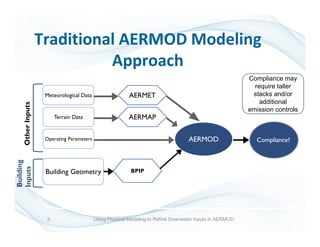
3
Compliance?Compliance?
BPIPBuilding Geometry
Meteorological Data
Terrain Data
AERMET
AERMAP
Operating Parameters AERMOD
OtherInputs
Building
Inputs
Traditional AERMOD Modeling
Approach
Compliance may
require taller
stacks and/or
additional
emission controls
Using Physical Modeling to Refine Downwash Inputs to AERMOD
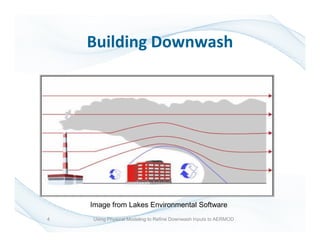
Building Downwash
4 Using Physical Modeling to Refine Downwash Inputs to AERMOD
Image from Lakes Environmental Software
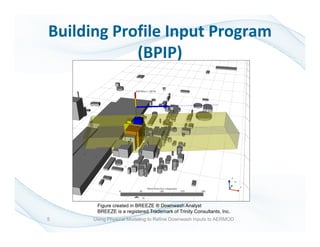
Building Profile Input Program
(BPIP)
Figure created in BREEZE ® Downwash Analyst
BREEZE is a registered Trademark of Trinity Consultants, Inc.
5 Using Physical Modeling to Refine Downwash Inputs to AERMOD
6
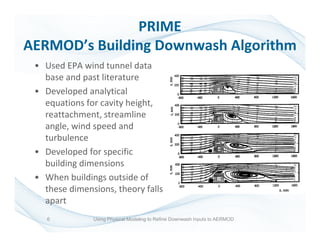
PRIME
AERMOD’s Building Downwash Algorithm
• Used EPA wind tunnel data
base and past literature
• Developed analytical
equations for cavity height,
reattachment, streamline
angle, wind speed and
turbulence
• Developed for specific
building dimensions
• When buildings outside of
these dimensions, theory falls
apart
Using Physical Modeling to Refine Downwash Inputs to AERMOD
7
Overprediction due to Building
Downwash
Using Physical Modeling to Refine Downwash Inputs to AERMOD
8
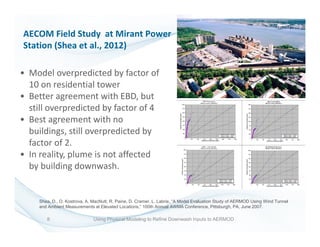
AECOM Field Study at Mirant Power
Station (Shea et al., 2012)
Shea, D., O. Kostrova, A. MacNutt, R. Paine, D. Cramer, L. Labrie, “A Model Evaluation Study of AERMOD Using Wind Tunnel
and Ambient Measurements at Elevated Locations,” 100th Annual AWMA Conference, Pittsburgh, PA, June 2007.
• Model overpredicted by factor of
10 on residential tower
• Better agreement with EBD, but
still overpredicted by factor of 4
• Best agreement with no
buildings, still overpredicted by
factor of 2.
• In reality, plume is not affected
by building downwash.
Using Physical Modeling to Refine Downwash Inputs to AERMOD
What’s Causing These
Problems?
9 Using Physical Modeling to Refine Downwash Inputs to AERMOD
Petersen, R., Guerra, S., Bova, A., ”Critical Review of the Building Downwash Algorithms in
AERMOD”, Journal of the Air & Waste Management Association. Accepted author version:
http://www.tandfonline.com/doi/full/10.1080/10962247.2017.1279088
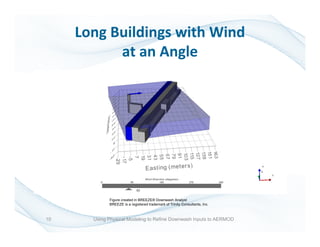
Long Buildings with Wind
at an Angle
Figure created in BREEZE® Downwash Analyst
BREEZE is a registered trademark of Trinity Consultants, Inc.
10 Using Physical Modeling to Refine Downwash Inputs to AERMOD
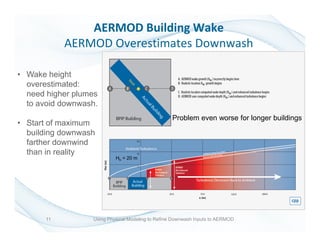
AERMOD Building Wake
AERMOD Overestimates Downwash
Hb = 20 m
Problem even worse for longer buildings
• Wake height
overestimated:
need higher plumes
to avoid downwash.
• Start of maximum
building downwash
farther downwind
than in reality
11 Using Physical Modeling to Refine Downwash Inputs to AERMOD
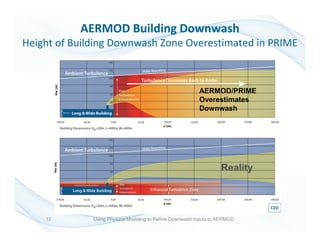
AERMOD/PRIME
Overestimates
Downwash
Reality
AERMOD Building Downwash
Height of Building Downwash Zone Overestimated in PRIME
12 Using Physical Modeling to Refine Downwash Inputs to AERMOD
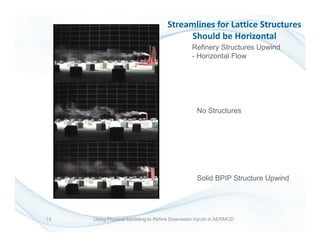
Refinery Structures Upwind
- Horizontal Flow
Solid BPIP Structure Upwind
No Structures
Streamlines for Lattice Structures
Should be Horizontal
13 Using Physical Modeling to Refine Downwash Inputs to AERMOD
How to Minimize the Effect from
these Errors?
14 Using Physical Modeling to Refine Downwash Inputs to AERMOD
Solutions to Downwash Overpredictions
– Refine building dimensions with a wind tunnel
study
– Equivalent Building Dimensions (EBDs) are the
dimensions (height, width, length and location)
that are input into AERMOD in place of BPIP
dimensions to more accurately predict building
wake effects
– Guerra, S., Petersen, R. “Using Physical Modeling
to Refine Downwash Inputs to AERMOD”, EM
Magazine, October 2016
http://www.cppwind.com/wp-content/uploads/2016/10/Using-Physical-Modeling-to-
Refine-Downwash-Inputs-to-AERMOD_EMMag-Oct-16_PetersenGuerra.pdf
15 Using Physical Modeling to Refine Downwash Inputs to AERMOD
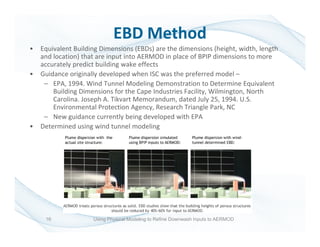
• Equivalent Building Dimensions (EBDs) are the dimensions (height, width, length
and location) that are input into AERMOD in place of BPIP dimensions to more
accurately predict building wake effects
• Guidance originally developed when ISC was the preferred model –
– EPA, 1994. Wind Tunnel Modeling Demonstration to Determine Equivalent
Building Dimensions for the Cape Industries Facility, Wilmington, North
Carolina. Joseph A. Tikvart Memorandum, dated July 25, 1994. U.S.
Environmental Protection Agency, Research Triangle Park, NC
– New guidance currently being developed with EPA
• Determined using wind tunnel modeling
EBD Method
16 Using Physical Modeling to Refine Downwash Inputs to AERMOD
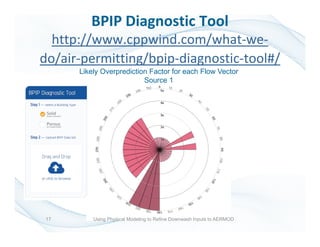
BPIP Diagnostic Tool
http://www.cppwind.com/what-we-
do/air-permitting/bpip-diagnostic-tool#/
Likely Overprediction Factor for each Flow Vector
Source 1
17 Using Physical Modeling to Refine Downwash Inputs to AERMOD
18
ComplianceCompliance
CPP’s EBDCPP’s EBD
BPIP Diagnostic
ToolBuilding Geometry
Meteorological Data
Terrain Data
AERMET
AERMAP
Operating Parameters
AERMOD
OtherInputs
Building
Inputs
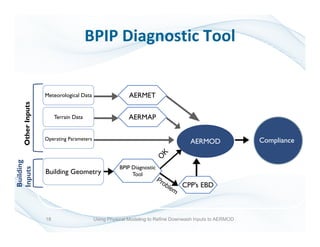
BPIP Diagnostic Tool
Using Physical Modeling to Refine Downwash Inputs to AERMOD
19
Summary of Approved Projects
• Studies conducted and approved using original guidance for ISC
applications
– Amoco Whiting Refinery, Region 5, 1990
– Public Service Electric & Gas, Region 2, 1993
– Cape Industries, Region 4, 1993
– Cambridge Electric Plant, Region 1, 1993
– District Energy, Region 5, 1993
– Hoechst Celanese Celco Plant, Region 3, 1994
– Pleasants Power, Region 3, 2002
• Studies conducted using original guidance for AERMOD/PRIME
applications
– Hawaiian Electric (Approved), Region 9, 1998
– Mirant Power Station (Approved), Region 3, 2006
– Cheswick Power Plant (Approved), Region 3, 2006
– Radback Energy (Protocol Approved), Region IX, 2010
– Chevron 1 (Study Approved), Region 4, 2012
– Chevron 2 (Study Approved), Region 4, 2013
– On going confidential study in Region X
Using Physical Modeling to Refine Downwash Inputs to AERMOD
20 Using Physical Modeling to Refine Downwash Inputs to AERMOD
How to Use EBD for Regulatory Purposes?
Step 1: Develop a protocol outlining the EBD study
Step 2: Submit EBD protocol for approval to regulatory agency. Also need to
involve Model Clearinghouse
Step 3: Perform wind tunnel testing
Step 4: Use building geometry from EBD study in AERMOD to show compliance
Step 5: Submit final report for agency review and approval
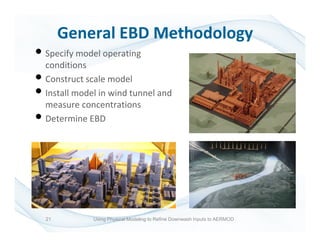
General EBD Methodology
• Specify model operating
conditions
• Construct scale model
• Install model in wind tunnel and
measure concentrations
• Determine EBD
21 Using Physical Modeling to Refine Downwash Inputs to AERMOD
22
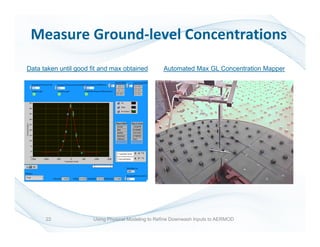
Measure Ground-level Concentrations
Data taken until good fit and max obtained Automated Max GL Concentration Mapper
Using Physical Modeling to Refine Downwash Inputs to AERMOD
23
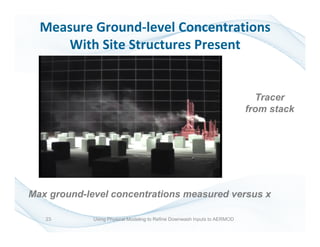
Measure Ground-level Concentrations
With Site Structures Present
Tracer
from stack
Max ground-level concentrations measured versus x
Using Physical Modeling to Refine Downwash Inputs to AERMOD
24
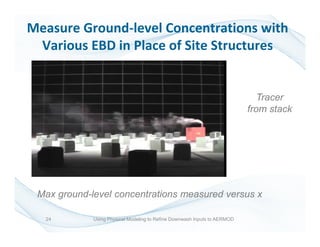
Measure Ground-level Concentrations with
Various EBD in Place of Site Structures
Tracer
from stack
Max ground-level concentrations measured versus x
Using Physical Modeling to Refine Downwash Inputs to AERMOD
25
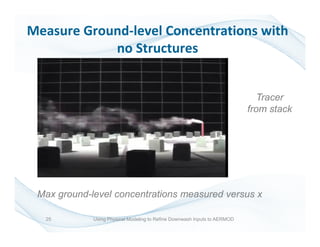
Measure Ground-level Concentrations with
no Structures
Tracer
from stack
Max ground-level concentrations measured versus x
Using Physical Modeling to Refine Downwash Inputs to AERMOD
26
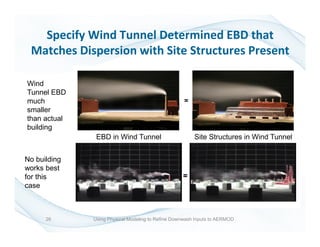
Specify Wind Tunnel Determined EBD that
Matches Dispersion with Site Structures Present
Wind
Tunnel EBD
much
smaller
than actual
building
No building
works best
for this
case
Site Structures in Wind TunnelEBD in Wind Tunnel
Using Physical Modeling to Refine Downwash Inputs to AERMOD
27
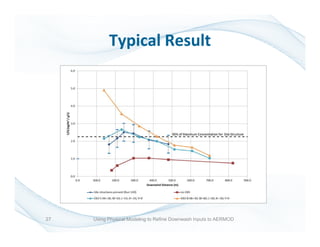
Typical Result
Wind Tunnel EBD
Using Physical Modeling to Refine Downwash Inputs to AERMOD
28
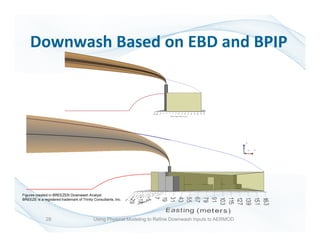
Downwash Based on EBD and BPIP
Figures created in BREEZE® Downwash Analyst
BREEZE is a registered trademark of Trinity Consultants, Inc.
Using Physical Modeling to Refine Downwash Inputs to AERMOD
29 Using Physical Modeling to Refine Downwash Inputs to AERMOD
Potential Benefits from use of EBD
30 Using Physical Modeling to Refine Downwash Inputs to AERMOD
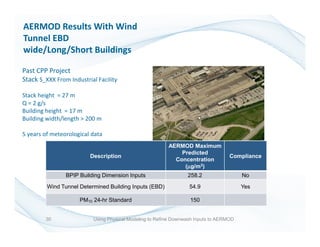
Past CPP Project
Stack S_XXX From Industrial Facility
Stack height = 27 m
Q = 2 g/s
Building height = 17 m
Building width/length > 200 m
5 years of meteorological data
AERMOD Results With Wind
Tunnel EBD
wide/Long/Short Buildings
Description
AERMOD Maximum
Predicted
Concentration
(µg/m3)
Compliance
BPIP Building Dimension Inputs 258.2 No
Wind Tunnel Determined Building Inputs (EBD) 54.9 Yes
PM10 24-hr Standard 150
31 Using Physical Modeling to Refine Downwash Inputs to AERMOD
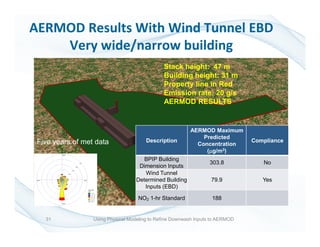
AERMOD Results With Wind Tunnel EBD
Very wide/narrow building
Stack height: 47 m
Building height: 31 m
Property line in Red
Emission rate: 20 g/s
AERMOD RESULTS
Five years of met data Description
AERMOD Maximum
Predicted
Concentration
(µg/m3)
Compliance
BPIP Building
Dimension Inputs
303.8 No
Wind Tunnel
Determined Building
Inputs (EBD)
79.9 Yes
NO2 1-hr Standard 188
Sergio A. Guerra, PhD Ron Petersen, PhD, CCM
sguerra@cppwind.com rpetersen@cppwind.com
Mobile: + 612 584 9595 Mobile:+1 970 690 1344
CPP, Inc.
2400 Midpoint Drive, Suite 190
Fort Collins, CO 80525
+ 970 221 3371
www.cppwind.com @CPPWindExperts
Questions?
32 Using Physical Modeling to Refine Downwash Inputs to AERMOD

Using Physical Modeling to Refine Downwash Inputs to AERMOD

  • 1.
    www.cppwind.comwww.cppwind.com Using Physical Modelingto Refine Downwash Inputs to AERMOD Rocky Mountain States Section – Air & Waste Management Association Denver, CO Sergio A. Guerra, PhD Ron Petersen, PhD, CCM April 13, 2017
  • 2.
    Outline 1. Building Downwashin AERMOD 2. Equivalent Building Dimensions Method 3. Potential Benefits Using Physical Modeling to Refine Downwash Inputs to AERMOD2
  • 3.
    3 Compliance?Compliance? BPIPBuilding Geometry Meteorological Data TerrainData AERMET AERMAP Operating Parameters AERMOD OtherInputs Building Inputs Traditional AERMOD Modeling Approach Compliance may require taller stacks and/or additional emission controls Using Physical Modeling to Refine Downwash Inputs to AERMOD
  • 4.
    Building Downwash 4 UsingPhysical Modeling to Refine Downwash Inputs to AERMOD Image from Lakes Environmental Software
  • 5.
    Building Profile InputProgram (BPIP) Figure created in BREEZE ® Downwash Analyst BREEZE is a registered Trademark of Trinity Consultants, Inc. 5 Using Physical Modeling to Refine Downwash Inputs to AERMOD
  • 6.
    6 PRIME AERMOD’s Building DownwashAlgorithm • Used EPA wind tunnel data base and past literature • Developed analytical equations for cavity height, reattachment, streamline angle, wind speed and turbulence • Developed for specific building dimensions • When buildings outside of these dimensions, theory falls apart Using Physical Modeling to Refine Downwash Inputs to AERMOD
  • 7.
    7 Overprediction due toBuilding Downwash Using Physical Modeling to Refine Downwash Inputs to AERMOD
  • 8.
    8 AECOM Field Studyat Mirant Power Station (Shea et al., 2012) Shea, D., O. Kostrova, A. MacNutt, R. Paine, D. Cramer, L. Labrie, “A Model Evaluation Study of AERMOD Using Wind Tunnel and Ambient Measurements at Elevated Locations,” 100th Annual AWMA Conference, Pittsburgh, PA, June 2007. • Model overpredicted by factor of 10 on residential tower • Better agreement with EBD, but still overpredicted by factor of 4 • Best agreement with no buildings, still overpredicted by factor of 2. • In reality, plume is not affected by building downwash. Using Physical Modeling to Refine Downwash Inputs to AERMOD
  • 9.
    What’s Causing These Problems? 9Using Physical Modeling to Refine Downwash Inputs to AERMOD Petersen, R., Guerra, S., Bova, A., ”Critical Review of the Building Downwash Algorithms in AERMOD”, Journal of the Air & Waste Management Association. Accepted author version: http://www.tandfonline.com/doi/full/10.1080/10962247.2017.1279088
  • 10.
    Long Buildings withWind at an Angle Figure created in BREEZE® Downwash Analyst BREEZE is a registered trademark of Trinity Consultants, Inc. 10 Using Physical Modeling to Refine Downwash Inputs to AERMOD
  • 11.
    AERMOD Building Wake AERMODOverestimates Downwash Hb = 20 m Problem even worse for longer buildings • Wake height overestimated: need higher plumes to avoid downwash. • Start of maximum building downwash farther downwind than in reality 11 Using Physical Modeling to Refine Downwash Inputs to AERMOD
  • 12.
    AERMOD/PRIME Overestimates Downwash Reality AERMOD Building Downwash Heightof Building Downwash Zone Overestimated in PRIME 12 Using Physical Modeling to Refine Downwash Inputs to AERMOD
  • 13.
    Refinery Structures Upwind -Horizontal Flow Solid BPIP Structure Upwind No Structures Streamlines for Lattice Structures Should be Horizontal 13 Using Physical Modeling to Refine Downwash Inputs to AERMOD
  • 14.
    How to Minimizethe Effect from these Errors? 14 Using Physical Modeling to Refine Downwash Inputs to AERMOD
  • 15.
    Solutions to DownwashOverpredictions – Refine building dimensions with a wind tunnel study – Equivalent Building Dimensions (EBDs) are the dimensions (height, width, length and location) that are input into AERMOD in place of BPIP dimensions to more accurately predict building wake effects – Guerra, S., Petersen, R. “Using Physical Modeling to Refine Downwash Inputs to AERMOD”, EM Magazine, October 2016 http://www.cppwind.com/wp-content/uploads/2016/10/Using-Physical-Modeling-to- Refine-Downwash-Inputs-to-AERMOD_EMMag-Oct-16_PetersenGuerra.pdf 15 Using Physical Modeling to Refine Downwash Inputs to AERMOD
  • 16.
    • Equivalent BuildingDimensions (EBDs) are the dimensions (height, width, length and location) that are input into AERMOD in place of BPIP dimensions to more accurately predict building wake effects • Guidance originally developed when ISC was the preferred model – – EPA, 1994. Wind Tunnel Modeling Demonstration to Determine Equivalent Building Dimensions for the Cape Industries Facility, Wilmington, North Carolina. Joseph A. Tikvart Memorandum, dated July 25, 1994. U.S. Environmental Protection Agency, Research Triangle Park, NC – New guidance currently being developed with EPA • Determined using wind tunnel modeling EBD Method 16 Using Physical Modeling to Refine Downwash Inputs to AERMOD
  • 17.
    BPIP Diagnostic Tool http://www.cppwind.com/what-we- do/air-permitting/bpip-diagnostic-tool#/ LikelyOverprediction Factor for each Flow Vector Source 1 17 Using Physical Modeling to Refine Downwash Inputs to AERMOD
  • 18.
    18 ComplianceCompliance CPP’s EBDCPP’s EBD BPIPDiagnostic ToolBuilding Geometry Meteorological Data Terrain Data AERMET AERMAP Operating Parameters AERMOD OtherInputs Building Inputs BPIP Diagnostic Tool Using Physical Modeling to Refine Downwash Inputs to AERMOD
  • 19.
    19 Summary of ApprovedProjects • Studies conducted and approved using original guidance for ISC applications – Amoco Whiting Refinery, Region 5, 1990 – Public Service Electric & Gas, Region 2, 1993 – Cape Industries, Region 4, 1993 – Cambridge Electric Plant, Region 1, 1993 – District Energy, Region 5, 1993 – Hoechst Celanese Celco Plant, Region 3, 1994 – Pleasants Power, Region 3, 2002 • Studies conducted using original guidance for AERMOD/PRIME applications – Hawaiian Electric (Approved), Region 9, 1998 – Mirant Power Station (Approved), Region 3, 2006 – Cheswick Power Plant (Approved), Region 3, 2006 – Radback Energy (Protocol Approved), Region IX, 2010 – Chevron 1 (Study Approved), Region 4, 2012 – Chevron 2 (Study Approved), Region 4, 2013 – On going confidential study in Region X – On going confidential study in Region X Using Physical Modeling to Refine Downwash Inputs to AERMOD
  • 20.
    20 Using PhysicalModeling to Refine Downwash Inputs to AERMOD How to Use EBD for Regulatory Purposes? Step 1: Develop a protocol outlining the EBD study Step 2: Submit EBD protocol for approval to regulatory agency. Also need to involve Model Clearinghouse Step 3: Perform wind tunnel testing Step 4: Use building geometry from EBD study in AERMOD to show compliance Step 5: Submit final report for agency review and approval
  • 21.
    General EBD Methodology •Specify model operating conditions • Construct scale model • Install model in wind tunnel and measure concentrations • Determine EBD 21 Using Physical Modeling to Refine Downwash Inputs to AERMOD
  • 22.
    22 Measure Ground-level Concentrations Datataken until good fit and max obtained Automated Max GL Concentration Mapper Using Physical Modeling to Refine Downwash Inputs to AERMOD
  • 23.
    23 Measure Ground-level Concentrations WithSite Structures Present Tracer from stack Max ground-level concentrations measured versus x Using Physical Modeling to Refine Downwash Inputs to AERMOD
  • 24.
    24 Measure Ground-level Concentrationswith Various EBD in Place of Site Structures Tracer from stack Max ground-level concentrations measured versus x Using Physical Modeling to Refine Downwash Inputs to AERMOD
  • 25.
    25 Measure Ground-level Concentrationswith no Structures Tracer from stack Max ground-level concentrations measured versus x Using Physical Modeling to Refine Downwash Inputs to AERMOD
  • 26.
    26 Specify Wind TunnelDetermined EBD that Matches Dispersion with Site Structures Present Wind Tunnel EBD much smaller than actual building No building works best for this case Site Structures in Wind TunnelEBD in Wind Tunnel Using Physical Modeling to Refine Downwash Inputs to AERMOD
  • 27.
    27 Typical Result Wind TunnelEBD Using Physical Modeling to Refine Downwash Inputs to AERMOD
  • 28.
    28 Downwash Based onEBD and BPIP Figures created in BREEZE® Downwash Analyst BREEZE is a registered trademark of Trinity Consultants, Inc. Using Physical Modeling to Refine Downwash Inputs to AERMOD
  • 29.
    29 Using PhysicalModeling to Refine Downwash Inputs to AERMOD Potential Benefits from use of EBD
  • 30.
    30 Using PhysicalModeling to Refine Downwash Inputs to AERMOD Past CPP Project Stack S_XXX From Industrial Facility Stack height = 27 m Q = 2 g/s Building height = 17 m Building width/length > 200 m 5 years of meteorological data AERMOD Results With Wind Tunnel EBD wide/Long/Short Buildings Description AERMOD Maximum Predicted Concentration (µg/m3) Compliance BPIP Building Dimension Inputs 258.2 No Wind Tunnel Determined Building Inputs (EBD) 54.9 Yes PM10 24-hr Standard 150
  • 31.
    31 Using PhysicalModeling to Refine Downwash Inputs to AERMOD AERMOD Results With Wind Tunnel EBD Very wide/narrow building Stack height: 47 m Building height: 31 m Property line in Red Emission rate: 20 g/s AERMOD RESULTS Five years of met data Description AERMOD Maximum Predicted Concentration (µg/m3) Compliance BPIP Building Dimension Inputs 303.8 No Wind Tunnel Determined Building Inputs (EBD) 79.9 Yes NO2 1-hr Standard 188
  • 32.
    Sergio A. Guerra,PhD Ron Petersen, PhD, CCM sguerra@cppwind.com rpetersen@cppwind.com Mobile: + 612 584 9595 Mobile:+1 970 690 1344 CPP, Inc. 2400 Midpoint Drive, Suite 190 Fort Collins, CO 80525 + 970 221 3371 www.cppwind.com @CPPWindExperts Questions? 32 Using Physical Modeling to Refine Downwash Inputs to AERMOD