The Age of Enlightenment
Monarchy restored, but power
weakened- Britain becomes more
democratic
King rules by the consent of the
people
Beginnings of the Industrial
Revolution
Great Advances in the Sciences
Celebrated the scientific method –
believed Man could perfect himself
and society
Literature of the time very orderly and
formed (rhymed couplets, etc)
Emulated Classic styles
Frequent references to classics
(myths, gods, and heroes)
Tried to look at the world
objectively
Use of Aphorisms (One liners—the
equivalent of the “sound byte”)
Very fond of Satire
 Age of Dryden
 Named for John Dryden
 Celebrates Human Achievement
 Age of Pope and Swift
 Heavy Neoclassic style characterized by
Alexander Pope and Jonathan Swift
 Age of Johnson
 Beginnings of a shift toward Romanticism
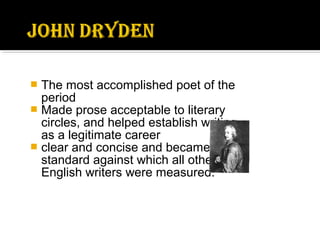
 The most accomplished poet of the
period
 Made prose acceptable to literary
circles, and helped establish writing
as a legitimate career
 clear and concise and became the
standard against which all other
English writers were measured.
His work was a response to the
excesses and political upheaval
of the restoration.
Praised the virtues of order,
balance & harmony
Poet laureate in 1668
 A single, unified strain of exalted lyrical verse
 Deals with ONE theme and praises its
value/virtues
 Elaborate, dignified and imaginative
 Born into a working class family
 Considered the ministry but instead
decided on becoming a crappy
businessman
 Didn’t start writing the novels that made
him famous until into his sixties
 Was pilloried for political writing
 Wrote two very popular novels (a new
form at the time)
 Robinson Crusoe and Moll Flanders
(both purported to be nonfiction)
 Crusoe started a genre
 Also wrote a real non fiction account—
Journal of the Plague Year
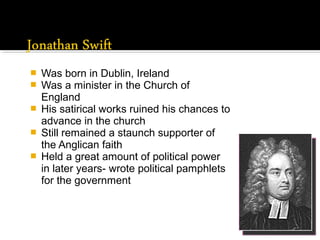
 Was born in Dublin, Ireland
 Was a minister in the Church of
England
 His satirical works ruined his chances to
advance in the church
 Still remained a staunch supporter of
the Anglican faith
 Held a great amount of political power
in later years- wrote political pamphlets
for the government
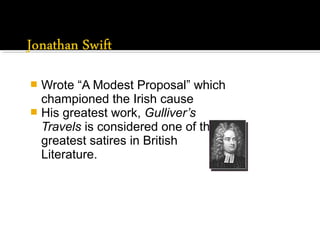
 Wrote “A Modest Proposal” which
championed the Irish cause
 His greatest work, Gulliver’s
Travels is considered one of the
greatest satires in British
Literature.
 A work that blends humor and wit for the
improvement of human institutions or
humanity
 Satire is not intended to “tear down” as much
as to “inspire remodeling”
 Does not attack an individual- it will “pass
over a single foe to charge whole armies.”
 Satire is subtle enough that the reader must
make the inference to what or who is being
mocked
 The first English poet to support himself solely
by his writing
 Being Catholic prevented him from holding
public office or getting a wealthy patron
 First major work was An Essay on Criticism,
which brought him to the attention of the leading
literary figures of the time.
 Very frail in health- was less than five feet
tall. Was a sharp wit and was a sought
after guest
 A brilliant satirist-one of his best know
works is The Rape of the Lock, one of the
greatest Mock Epics in English
 Iambic Pentameter in rhymed pairs
 Became a fixed for with Pope and
dominated English verse for decades

2 restoration literature

  • 1.
    The Age ofEnlightenment
  • 2.
    Monarchy restored, butpower weakened- Britain becomes more democratic King rules by the consent of the people Beginnings of the Industrial Revolution
  • 3.
    Great Advances inthe Sciences Celebrated the scientific method – believed Man could perfect himself and society Literature of the time very orderly and formed (rhymed couplets, etc)
  • 4.
    Emulated Classic styles Frequentreferences to classics (myths, gods, and heroes) Tried to look at the world objectively Use of Aphorisms (One liners—the equivalent of the “sound byte”) Very fond of Satire
  • 5.
     Age ofDryden  Named for John Dryden  Celebrates Human Achievement  Age of Pope and Swift  Heavy Neoclassic style characterized by Alexander Pope and Jonathan Swift  Age of Johnson  Beginnings of a shift toward Romanticism
  • 6.
     The mostaccomplished poet of the period  Made prose acceptable to literary circles, and helped establish writing as a legitimate career  clear and concise and became the standard against which all other English writers were measured.
  • 7.
    His work wasa response to the excesses and political upheaval of the restoration. Praised the virtues of order, balance & harmony Poet laureate in 1668
  • 8.
     A single,unified strain of exalted lyrical verse  Deals with ONE theme and praises its value/virtues  Elaborate, dignified and imaginative
  • 9.
     Born intoa working class family  Considered the ministry but instead decided on becoming a crappy businessman  Didn’t start writing the novels that made him famous until into his sixties  Was pilloried for political writing
  • 10.
     Wrote twovery popular novels (a new form at the time)  Robinson Crusoe and Moll Flanders (both purported to be nonfiction)  Crusoe started a genre  Also wrote a real non fiction account— Journal of the Plague Year
  • 11.
     Was bornin Dublin, Ireland  Was a minister in the Church of England  His satirical works ruined his chances to advance in the church  Still remained a staunch supporter of the Anglican faith  Held a great amount of political power in later years- wrote political pamphlets for the government
  • 12.
     Wrote “AModest Proposal” which championed the Irish cause  His greatest work, Gulliver’s Travels is considered one of the greatest satires in British Literature.
  • 13.
     A workthat blends humor and wit for the improvement of human institutions or humanity  Satire is not intended to “tear down” as much as to “inspire remodeling”  Does not attack an individual- it will “pass over a single foe to charge whole armies.”  Satire is subtle enough that the reader must make the inference to what or who is being mocked
  • 14.
     The firstEnglish poet to support himself solely by his writing  Being Catholic prevented him from holding public office or getting a wealthy patron  First major work was An Essay on Criticism, which brought him to the attention of the leading literary figures of the time.
  • 15.
     Very frailin health- was less than five feet tall. Was a sharp wit and was a sought after guest  A brilliant satirist-one of his best know works is The Rape of the Lock, one of the greatest Mock Epics in English
  • 16.
     Iambic Pentameterin rhymed pairs  Became a fixed for with Pope and dominated English verse for decades