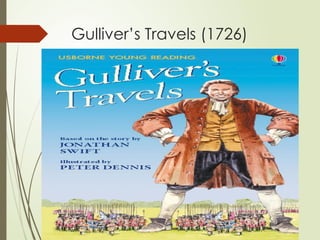
give the brief information about neoclassical period. it discusses the main concepts, ideas of this perios and also discusses about the great writer Jonathan Swift and his masterpiece Guliver`s travel
The Neoclassical Age(1660–1745)
THE NEOCLASSICAL AGE
(1660–1745)
Historical Background
The Neoclassical Age began in 1660, when King
Charles II returned to England after years of
exile(ссылка). His return marked the end of the
Puritan Commonwealth and the beginning of a new
era called the Restoration. Under the Puritan
government, life in England had been strict, serious,
and controlled. Theatres were closed, festivals were
forbidden, and art was limited to religious
2.
However, withthe Restoration, the mood of the nation changed. People
welcomed music, theatre, entertainment, conversation, and social
elegance. London became the center of social activity. Coffee-houses
opened and became places for political discussion and intellectual debate.
Newspapers and magazines began to appear, spreading ideas among
educated citizens.
At the same time, Europe experienced scientific development. Thinkers
like Isaac Newton and philosophers such as John Locke encouraged
people to believe in reason, logic, and observation. The idea grew that
human behavior could be guided by rational thinking rather than by
emotion or intuition.
Because of this intellectual atmosphere, writers turned away from the
emotional and imaginative literature of earlier times. They admired the
works of ancient Greek and Roman authors, believing that classical
literature represented balance, harmony, order, and self-control. For this
reason, the literature of this period is called “Neoclassical”, meaning “a
new imitation of the classical style.”
3.
The Spirit andPhilosophy of the
Neoclassical Age
The Neoclassical Age believed that reason is the true guide of
human life. Writers of this period thought that human emotions can
mislead, but reason leads to truth and good judgment. Therefore,
literature should not simply express personal feelings. It should teach,
guide, and correct human behavior.
Unlike the Renaissance (which celebrated imagination) and the
Puritan Age (which emphasized faith), the Neoclassical art should
follow rules. They valued structure, style, and polished expression
more than emotional depth.
Because writers observed society neoclassical Age focused on
moderation, clarity, and rational order. Writers believed , they saw
many weaknesses: pride, corruption, vanity(achievements),
foolishness, and hypocrisy. To show these faults, they developed
satire — a style that criticizes human behavior through humor, irony,
and clever expression. Instead of openly attacking people, satirists
revealed the truth through subtle ridicule(making fun of someone in
4.
Main Features ofthe Neoclassical Age
Reason over Emotion
Literature is based on logic, clarity, and thoughtful expression, not feelings or
imagination.
Imitation of Classical Models
Writers respected the style and structure of ancient Greek and Roman
literature.
Clarity, Balance, and Order in Language
Sentences are carefully shaped; expression is elegant and controlled.
Rules and Form in Poetry
Poetry often uses the heroic couplet (two lines of iambic pentameter with a
rhyme).
Satire as a Dominant Form
Writers used satire to criticize society and human behavior.
Focus on Society Rather Than the Individual
The literature reflects public life, politics, social behavior, and manners.
Urban and Intellectual Tone
Most works are set in London, involving educated and social classes.
5.
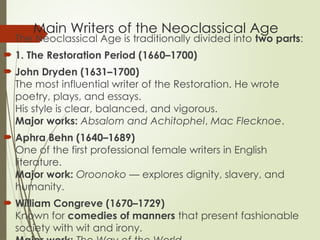
Main Writers ofthe Neoclassical Age
The Neoclassical Age is traditionally divided into two parts:
1. The Restoration Period (1660–1700)
John Dryden (1631–1700)
The most influential writer of the Restoration. He wrote
poetry, plays, and essays.
His style is clear, balanced, and vigorous.
Major works: Absalom and Achitophel, Mac Flecknoe.
Aphra Behn (1640–1689)
One of the first professional female writers in English
literature.
Major work: Oroonoko — explores dignity, slavery, and
humanity.
William Congreve (1670–1729)
Known for comedies of manners that present fashionable
society with wit and irony.
6.
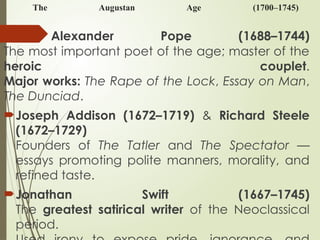
The Augustan Age(1700–1745)
Alexander Pope (1688–1744)
The most important poet of the age; master of the
heroic couplet.
Major works: The Rape of the Lock, Essay on Man,
The Dunciad.
Joseph Addison (1672–1719) & Richard Steele
(1672–1729)
Founders of The Tatler and The Spectator —
essays promoting polite manners, morality, and
refined taste.
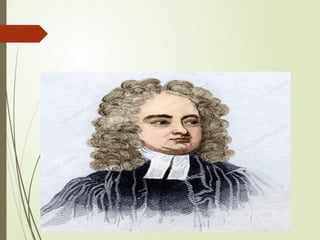
Jonathan Swift (1667–1745)
The greatest satirical writer of the Neoclassical
period.
7.
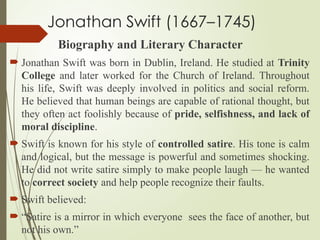
Jonathan Swift (1667–1745)
Biographyand Literary Character
Jonathan Swift was born in Dublin, Ireland. He studied at Trinity
College and later worked for the Church of Ireland. Throughout
his life, Swift was deeply involved in politics and social reform.
He believed that human beings are capable of rational thought, but
they often act foolishly because of pride, selfishness, and lack of
moral discipline.
Swift is known for his style of controlled satire. His tone is calm
and logical, but the message is powerful and sometimes shocking.
He did not write satire simply to make people laugh — he wanted
to correct society and help people recognize their faults.
Swift believed:
“Satire is a mirror in which everyone sees the face of another, but
not his own.”
Gulliver’s Travels isSwift’s
greatest work. It appears to be a
travel story, but it is actually a
deep satire that criticizes human
nature and society. The novel is
divided into four voyages, each
representing a different moral
lesson.
11.
1. Lilliput— Tiny people, petty politics
The small size of the Lilliputians represents the smallness
of human pride and silly political arguments.
2. Brobdingnag — Land of giants
Human actions appear ridiculous and ugly when seen
from a larger, more honest perspective.
3. Laputa — Island of scientists lost in theory
Shows the danger of intelligence without wisdom.
4. Houyhnhnms and Yahoos — Rational horses and
degraded humans
This part expresses Swift’s disappointment in human
nature.
Humans are shown as greedy, violent, and irrational,
while the horses are calm and wise.
12.
Meaning and Messageof the Novel
Swift teaches that:
Human beings often behave irrationally.
Pride leads to corruption and suffering.
Reason and self-control are necessary for
moral life.
Improvement begins with seeing one’s
own mistakes.
Gulliver’s Travels is not a fantasy
adventure — it is a mirror held up to
society.
13.
Conclusion
The Neoclassical Agevalued
clarity, balance, and rational
judgment.
Its writers shaped modern English
prose, satire, and critical thought.
Swift and Pope remain central
voices of this intellectual era.