STAGE 2
RESEARCH +
EXPERIMENTS
Daniel Thompson
 You MUST conduct a questionnaire/survey/interview or a combination of all three.
Summarise this and add in any other primary research you feel is appropriate
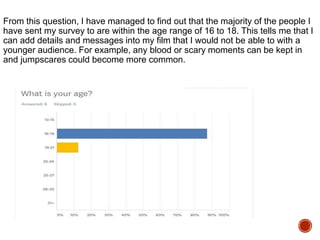
From this question, I have managed to find out that the majority of the people I
have sent my survey to are within the age range of 16 to 18. This tells me that I
can add details and messages into my film that I would not be able to with a
younger audience. For example, any blood or scary moments can be kept in
and jumpscares could become more common.
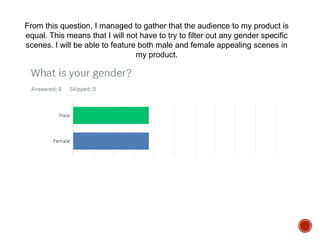
From this question, I managed to gather that the audience to my product is
equal. This means that I will not have to try to filter out any gender specific
scenes. I will be able to feature both male and female appealing scenes in
my product.
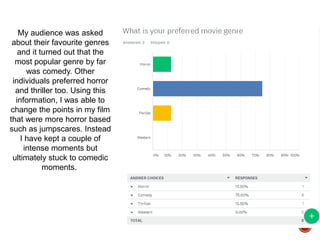
My audience was asked
about their favourite genres
and it turned out that the
most popular genre by far
was comedy. Other
individuals preferred horror
and thriller too. Using this
information, I was able to
change the points in my film
that were more horror based
such as jumpscares. Instead
I have kept a couple of
intense moments but
ultimately stuck to comedic
moments.
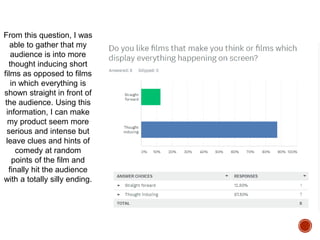
From this question, I was
able to gather that my
audience is into more
thought inducing short
films as opposed to films
in which everything is
shown straight in front of
the audience. Using this
information, I can make
my product seem more
serious and intense but
leave clues and hints of
comedy at random
points of the film and
finally hit the audience
with a totally silly ending.
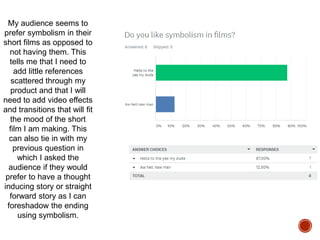
My audience seems to
prefer symbolism in their
short films as opposed to
not having them. This
tells me that I need to
add little references
scattered through my
product and that I will
need to add video effects
and transitions that will fit
the mood of the short
film I am making. This
can also tie in with my
previous question in
which I asked the
audience if they would
prefer to have a thought
inducing story or straight
forward story as I can
foreshadow the ending
using symbolism.
 Research viewing figures, sales figures, demographic and psychographic info.
Look up article, features or stories related to your potential audience
Lights Out (2013): 13.5 million views on YouTube, Horror fan audience.
 For this you should summarise your primary and secondary research, through this you
should then be able to produce an audience outline that you intend to target. For this
you could also produce an audience profile.
After plenty of both primary and secondary research into short films, existing films and
even my own questionnaire answers, I now know what type of audience I am hoping to
achieve the approval of. My product will mostly appeal to male audiences. In my
questionnaire, I managed to find out that my audience amounts to an equal divide of male
and female but due to myself being a male, I thought it would be easier to come up with
ideas and features that would interest men and boys alike. My audience's age will vary
vastly but none will be over 15/16 years old and will most likely end around the 45 year
mark.. This allows me to keep in any potentially scary or tense scenes that may disturb
any younger audiences (this does not necessarily mean that I will be creating a horror
based product). The sexuality of my audience will not matter as I am not including any
sexual references or scenes in my product. My product will be most relatable to younger,
working class audiences in the D to C2 NRS grade marking as they are most likely to find
this kind of humour funny. Upper class people and upper middle class people may not like
silly humour such as what I have planned. Lastly, my audience may use my product for
entertainment purposes as it is there to make them laugh and smile.
 Given your idea generation and your audience research, what sort of content
would you define as the appropriate. Consider issues of taste, certification [BBFC
might be a good starting point for this], etc. Look at what you’d like to include and
what you are allowed to include.
After taking a look at my idea generation and audience research, I figured that my
audience rating could potentially be a 12. I originally could have made a 15 rated
film but after planning and research I realize that I would not be adding any scenes
of violence or drug abuse, etc. At the very most, my film will include threats to the
character and the lowest rating allowing to use threats is a 12.
 Research potential production techniques you might want to use
or feel would be most appropriate – these can be related to
camera, editing, story, sound, etc
 You should look at a minimum of 3 related products in your
research.
 You should collect clips/still images/how to guides/etc that might
help you. When watching scenes from films, etc you could also
ask potential target audience what they think.
 You will need to add extra slides!
 With each technique you should assess whether you can use it or
how you might employ or why you may want to disregard it
completely
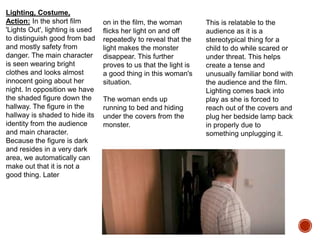
Lighting, Costume,
Action: In the short film
'Lights Out', lighting is used
to distinguish good from bad
and mostly safety from
danger. The main character
is seen wearing bright
clothes and looks almost
innocent going about her
night. In opposition we have
the shaded figure down the
hallway. The figure in the
hallway is shaded to hide its
identity from the audience
and main character.
Because the figure is dark
and resides in a very dark
area, we automatically can
make out that it is not a
good thing. Later
on in the film, the woman
flicks her light on and off
repeatedly to reveal that the
light makes the monster
disappear. This further
proves to us that the light is
a good thing in this woman's
situation.
The woman ends up
running to bed and hiding
under the covers from the
monster.
This is relatable to the
audience as it is a
stereotypical thing for a
child to do while scared or
under threat. This helps
create a tense and
unusually familiar bond with
the audience and the film.
Lighting comes back into
play as she is forced to
reach out of the covers and
plug her bedside lamp back
in properly due to
something unplugging it.
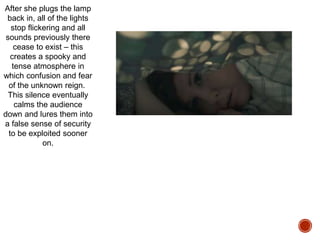
After she plugs the lamp
back in, all of the lights
stop flickering and all
sounds previously there
cease to exist – this
creates a spooky and
tense atmosphere in
which confusion and fear
of the unknown reign.
This silence eventually
calms the audience
down and lures them into
a false sense of security
to be exploited sooner
on.
EXPERIMENTS
Camera/Editing/Audio Experiments
Be prepared to add extra slides
 What elements of your experiments will you include in your final
product?
 What elements of your experiments will you include in your final
product?
 What elements of your experiments will you include in your final
product?
 List all the potential constraints that might affect or limit your production, you
should consider issues from each of these categories:
 Time/Personnel/Cost/Technical/Location/Organisational

2. research sf 2017

  • 1.
  • 2.
     You MUSTconduct a questionnaire/survey/interview or a combination of all three. Summarise this and add in any other primary research you feel is appropriate
  • 3.
    From this question,I have managed to find out that the majority of the people I have sent my survey to are within the age range of 16 to 18. This tells me that I can add details and messages into my film that I would not be able to with a younger audience. For example, any blood or scary moments can be kept in and jumpscares could become more common.
  • 4.
    From this question,I managed to gather that the audience to my product is equal. This means that I will not have to try to filter out any gender specific scenes. I will be able to feature both male and female appealing scenes in my product.
  • 5.
    My audience wasasked about their favourite genres and it turned out that the most popular genre by far was comedy. Other individuals preferred horror and thriller too. Using this information, I was able to change the points in my film that were more horror based such as jumpscares. Instead I have kept a couple of intense moments but ultimately stuck to comedic moments.
  • 6.
    From this question,I was able to gather that my audience is into more thought inducing short films as opposed to films in which everything is shown straight in front of the audience. Using this information, I can make my product seem more serious and intense but leave clues and hints of comedy at random points of the film and finally hit the audience with a totally silly ending.
  • 7.
    My audience seemsto prefer symbolism in their short films as opposed to not having them. This tells me that I need to add little references scattered through my product and that I will need to add video effects and transitions that will fit the mood of the short film I am making. This can also tie in with my previous question in which I asked the audience if they would prefer to have a thought inducing story or straight forward story as I can foreshadow the ending using symbolism.
  • 8.
     Research viewingfigures, sales figures, demographic and psychographic info. Look up article, features or stories related to your potential audience Lights Out (2013): 13.5 million views on YouTube, Horror fan audience.
  • 9.
     For thisyou should summarise your primary and secondary research, through this you should then be able to produce an audience outline that you intend to target. For this you could also produce an audience profile. After plenty of both primary and secondary research into short films, existing films and even my own questionnaire answers, I now know what type of audience I am hoping to achieve the approval of. My product will mostly appeal to male audiences. In my questionnaire, I managed to find out that my audience amounts to an equal divide of male and female but due to myself being a male, I thought it would be easier to come up with ideas and features that would interest men and boys alike. My audience's age will vary vastly but none will be over 15/16 years old and will most likely end around the 45 year mark.. This allows me to keep in any potentially scary or tense scenes that may disturb any younger audiences (this does not necessarily mean that I will be creating a horror based product). The sexuality of my audience will not matter as I am not including any sexual references or scenes in my product. My product will be most relatable to younger, working class audiences in the D to C2 NRS grade marking as they are most likely to find this kind of humour funny. Upper class people and upper middle class people may not like silly humour such as what I have planned. Lastly, my audience may use my product for entertainment purposes as it is there to make them laugh and smile.
  • 10.
     Given youridea generation and your audience research, what sort of content would you define as the appropriate. Consider issues of taste, certification [BBFC might be a good starting point for this], etc. Look at what you’d like to include and what you are allowed to include. After taking a look at my idea generation and audience research, I figured that my audience rating could potentially be a 12. I originally could have made a 15 rated film but after planning and research I realize that I would not be adding any scenes of violence or drug abuse, etc. At the very most, my film will include threats to the character and the lowest rating allowing to use threats is a 12.
  • 11.
     Research potentialproduction techniques you might want to use or feel would be most appropriate – these can be related to camera, editing, story, sound, etc  You should look at a minimum of 3 related products in your research.  You should collect clips/still images/how to guides/etc that might help you. When watching scenes from films, etc you could also ask potential target audience what they think.  You will need to add extra slides!  With each technique you should assess whether you can use it or how you might employ or why you may want to disregard it completely
  • 12.
    Lighting, Costume, Action: Inthe short film 'Lights Out', lighting is used to distinguish good from bad and mostly safety from danger. The main character is seen wearing bright clothes and looks almost innocent going about her night. In opposition we have the shaded figure down the hallway. The figure in the hallway is shaded to hide its identity from the audience and main character. Because the figure is dark and resides in a very dark area, we automatically can make out that it is not a good thing. Later on in the film, the woman flicks her light on and off repeatedly to reveal that the light makes the monster disappear. This further proves to us that the light is a good thing in this woman's situation. The woman ends up running to bed and hiding under the covers from the monster. This is relatable to the audience as it is a stereotypical thing for a child to do while scared or under threat. This helps create a tense and unusually familiar bond with the audience and the film. Lighting comes back into play as she is forced to reach out of the covers and plug her bedside lamp back in properly due to something unplugging it.
  • 13.
    After she plugsthe lamp back in, all of the lights stop flickering and all sounds previously there cease to exist – this creates a spooky and tense atmosphere in which confusion and fear of the unknown reign. This silence eventually calms the audience down and lures them into a false sense of security to be exploited sooner on.
  • 16.
  • 18.
     What elementsof your experiments will you include in your final product?
  • 20.
     What elementsof your experiments will you include in your final product?
  • 22.
     What elementsof your experiments will you include in your final product?
  • 23.
     List allthe potential constraints that might affect or limit your production, you should consider issues from each of these categories:  Time/Personnel/Cost/Technical/Location/Organisational

Editor's Notes

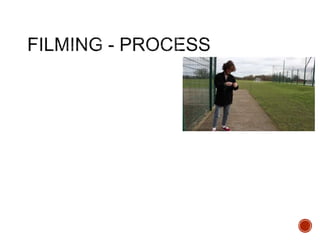
  • #18 Discuss the and tools processes used in your experiments – use screenshots to illustrate your process
  • #20 Discuss the tools and processes used in your experiments – use screenshots to illustrate your process
  • #22 Discuss the tools and processes used in your experiments – use screenshots to illustrate your process