STAGE 2
RESEARCH +
EXPERIMENTS
Your name here
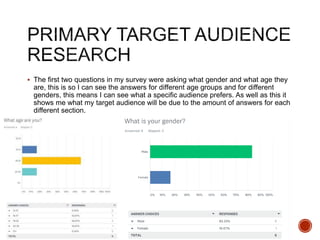
 The first two questions in my survey were asking what gender and what age they
are, this is so I can see the answers for different age groups and for different
genders, this means I can see what a specific audience prefers. As well as this it
shows me what my target audience will be due to the amount of answers for each
different section.
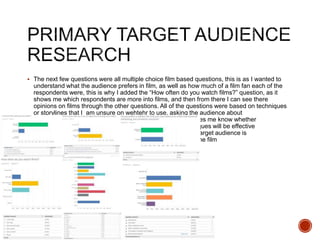
 The next few questions were all multiple choice film based questions, this is as I wanted to
understand what the audience prefers in film, as well as how much of a film fan each of the
respondents were, this is why I added the “How often do you watch films?” question, as it
shows me which respondents are more into films, and then from there I can see there
opinions on films through the other questions. All of the questions were based on techniques
or storylines that I am unsure on wehtehr to use, asking the audience about
t these makes me know whether
the techniques will be effective
when the target audience is
watching the film
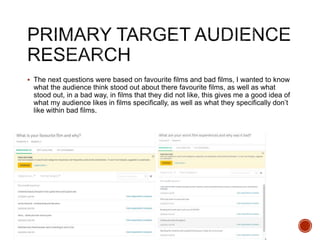
 The next questions were based on favourite films and bad films, I wanted to know
what the audience think stood out about there favourite films, as well as what
stood out, in a bad way, in films that they did not like, this gives me a good idea of
what my audience likes in films specifically, as well as what they specifically don’t
like within bad films.
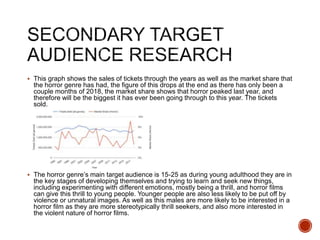
 This graph shows the sales of tickets through the years as well as the market share that
the horror genre has had, the figure of this drops at the end as there has only been a
couple months of 2018, the market share shows that horror peaked last year, and
therefore will be the biggest it has ever been going through to this year. The tickets
sold.
 The horror genre’s main target audience is 15-25 as during young adulthood they are in
the key stages of developing themselves and trying to learn and seek new things,
including experimenting with different emotions, mostly being a thrill, and horror films
can give this thrill to young people. Younger people are also less likely to be put off by
violence or unnatural images. As well as this males are more likely to be interested in a
horror film as they are more stereotypically thrill seekers, and also more interested in
the violent nature of horror films.
 After my audience research I believe the main target audience is younger people,
this being of the ages 16-24, this is as they are more interested in the thrill
seeking and violent nature that is included in most horror films. The gender of my
target audience is both, as males may seem to be more interested in horror films
but I believe there is a narrow gap between the amount that each gender is
interested, therefore I should target both in order to widen my target audience as
well as not make people disinterested. The social status of my target audience
would mainly be C1C2DE as these are typically more interested in the horror
genre due to the nature of the films, as these films may put off people in the
higher classes, A & B. The psychographic I will aim at is emulator/wanna be’s as
these will be interested in the story of over coming an enemy and a problem.
 I think my film classification would be a 15, as it may include strong violence,
possible injury detail and threat, which are both reasons in which a lot of other
films have been given a 15 classification rating. This limits the nudity and sex, as
you cannot show either in a non-educational way in this rating, violence that
dwells on the infliction of pain or injury, as well as sadistic and sexual violence not
being allowed, also you cannot have any imitable behaviour in a 15 rating, this
includes hanging, suicide, and self-harm, all of this should not affect my short film
as none of this was planned to be included.
 Research potential production techniques you might want to use
or feel would be most appropriate – these can be related to
camera, editing, story, sound, etc
 You should look at a minimum of 3 related products in your
research.
 You should collect clips/still images/how to guides/etc that might
help you. When watching scenes from films, etc you could also
ask potential target audience what they think.
 You will need to add extra slides!
 With each technique you should assess whether you can use it or
how you might employ or why you may want to disregard it
completely
 “Tuck Me In” – A short film – 2014.
 I have chosen to research this as I believe I could use some of the techniques that
are used in this short film.
 First of all there is an unexpected twist, which leaves viewers confused and
wanting more information, this is when the father character checks under his sons
bed, to find his son underneath, where he states that there is someone in his bed,
this leaves viewers confused as they think they have already seen the child, Alex,
in his bed, this leaves viewers wanting more information. I may use this in a few
ways, my first thoughts on this technique are to use it towards the end of my film,
just as the good character finds an escape from the torment, the bad character
returns to do more damage.
 The next technique I liked that was used was the use of the cliff-hanger at the
end, this being that the short film stops once the father see’s this other child and
realises that there seems to be two Alex’s, this is a good technique to use as it
leaves the reader wanting more, and therefore waiting for any further information
you may release on the subject, it leaves them wanting more from the film. This
could be used in my film through a sudden finish once the character escapes, and
is confronted once again by the film’s bad character.
 Lights Out – A short film - 2013.
 I have chosen to research this film as I believe the storyline was good and
also they used many techniques and a slow build which worked well.
 Firstly the way they introduced the bad character was good, an original jump
scare that was then turned into a conflict in the main characters mind, does
she leave the lights on or go and find out more about what is happening, this
also sets up the rest of the story well as it shows the bad character appears
to only be around in the dark, which creates a tense build from when the
outside light is mysteriously turned off.
 As well as this I like the shots they use, originally they used a shot which
shows where the location of the place is, it shows it is an ordinary house,
making the location relatable and then inside the house they have a couple
of long shots inside, and then include close ups too show the emotion of the
main character, which is effective.
 Also the sound is recorded after the film has been made, this works well as it
can build up the tension for the bad character, as you can hear the little
creaks eventually turn into heavy footsteps, as well as making you know
what is happening without necessarily seeing it.
 Polaroid – Short Film – 2017.
 I am researching this as the story and tension build up as well as other
techniques used were good and I think I could be inspired by this when doing
my work.
 Firstly the story is introduced with a shot coming from darkness into the light
part of the room, which could be seen as foreshadowing what happens later
in the story, where the main character is dragged into darkness by the bad
character.
 Also the first minute of this story seems innocent, with a man appearing to
have moved into a new home checking all of his possessions, finding his
polaroid camera, and then using it, this is where the build up and tension
begins, as once he uses the camera the story changes, as he discovers
something on the camera that isn’t in the real life view that we are shown, I
think this builds tension well as it doesn’t give the viewers a clear view of
what is going on with the bad character, it leaves viewers in the dark and
therefore builds tension as they don’t know what could happen next.
EXPERIMENTS
Camera/Editing/Audio Experiments
Be prepared to add extra slides
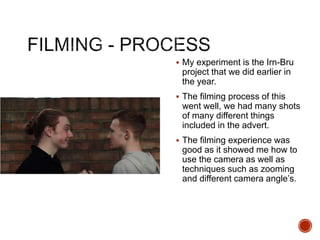
 My experiment is the Irn-Bru
project that we did earlier in
the year.
 The filming process of this
went well, we had many shots
of many different things
included in the advert.
 The filming experience was
good as it showed me how to
use the camera as well as
techniques such as zooming
and different camera angle’s.
 What elements of your experiments will you include in your final
product?
 I will include a lot of similar looking shots, obviously in a different kind
of way, as this is meant to be a horror film but the experiment was
more of a comedy one.
 As well as this the experience of being behind the camera really
helped.
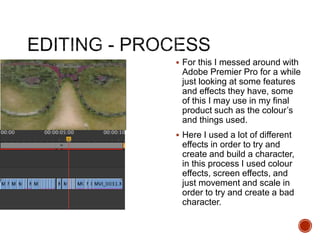
 For this I messed around with
Adobe Premier Pro for a while
just looking at some features
and effects they have, some
of this I may use in my final
product such as the colour’s
and things used.
 Here I used a lot of different
effects in order to try and
create and build a character,
in this process I used colour
effects, screen effects, and
just movement and scale in
order to try and create a bad
character.
 What elements of your experiments will you include in your final
product?
 I will use some of this editing as I believe it created the character well,
as well as made the character seem mysterious, it built a mystery due
to the strange scene.
 I will use the colour effects as I liked the way these looked and the
way that they made the character seem.
 For the audio experiment I did a
Foley sound experiment, for this I
used a scene in “Sean of the Dead”
and went out to record audio for
this, then once this had been done I
had to edit it all to make the scene
come together and make the scene
feel real with the sounds I had
recorded.
 What elements of your experiments will you include in your final
product?
 I will use most of the elements of the experiments as it worked well
and is how I will be using sound in my final product, this includes all
the sound of surroundings that were included as it makes the film
seem more real.
 List all the potential constraints that might affect or limit your production, you
should consider issues from each of these categories:
 Time/Personnel/Cost/Technical/Location/Organisational
 People may not be able to film at times I can.
 Any equipment, such as cameras and audio recorders could break orget damaged.
 The cost of getting back from my house to someone’s house may effect the decision on
being in the film.
 The location may not be as god as expected, or on that day may have something go wrong
with it, for example electrics.
 Organisation could be ruined by one small thing, for example a person pulling out of
filming.
 Personnel issues could make someone unavailable on the day.
 Weather could stop from filming outside.

Video - Research

  • 1.
  • 2.
     The firsttwo questions in my survey were asking what gender and what age they are, this is so I can see the answers for different age groups and for different genders, this means I can see what a specific audience prefers. As well as this it shows me what my target audience will be due to the amount of answers for each different section.
  • 3.
     The nextfew questions were all multiple choice film based questions, this is as I wanted to understand what the audience prefers in film, as well as how much of a film fan each of the respondents were, this is why I added the “How often do you watch films?” question, as it shows me which respondents are more into films, and then from there I can see there opinions on films through the other questions. All of the questions were based on techniques or storylines that I am unsure on wehtehr to use, asking the audience about t these makes me know whether the techniques will be effective when the target audience is watching the film
  • 4.
     The nextquestions were based on favourite films and bad films, I wanted to know what the audience think stood out about there favourite films, as well as what stood out, in a bad way, in films that they did not like, this gives me a good idea of what my audience likes in films specifically, as well as what they specifically don’t like within bad films.
  • 5.
     This graphshows the sales of tickets through the years as well as the market share that the horror genre has had, the figure of this drops at the end as there has only been a couple months of 2018, the market share shows that horror peaked last year, and therefore will be the biggest it has ever been going through to this year. The tickets sold.  The horror genre’s main target audience is 15-25 as during young adulthood they are in the key stages of developing themselves and trying to learn and seek new things, including experimenting with different emotions, mostly being a thrill, and horror films can give this thrill to young people. Younger people are also less likely to be put off by violence or unnatural images. As well as this males are more likely to be interested in a horror film as they are more stereotypically thrill seekers, and also more interested in the violent nature of horror films.
  • 6.
     After myaudience research I believe the main target audience is younger people, this being of the ages 16-24, this is as they are more interested in the thrill seeking and violent nature that is included in most horror films. The gender of my target audience is both, as males may seem to be more interested in horror films but I believe there is a narrow gap between the amount that each gender is interested, therefore I should target both in order to widen my target audience as well as not make people disinterested. The social status of my target audience would mainly be C1C2DE as these are typically more interested in the horror genre due to the nature of the films, as these films may put off people in the higher classes, A & B. The psychographic I will aim at is emulator/wanna be’s as these will be interested in the story of over coming an enemy and a problem.
  • 7.
     I thinkmy film classification would be a 15, as it may include strong violence, possible injury detail and threat, which are both reasons in which a lot of other films have been given a 15 classification rating. This limits the nudity and sex, as you cannot show either in a non-educational way in this rating, violence that dwells on the infliction of pain or injury, as well as sadistic and sexual violence not being allowed, also you cannot have any imitable behaviour in a 15 rating, this includes hanging, suicide, and self-harm, all of this should not affect my short film as none of this was planned to be included.
  • 8.
     Research potentialproduction techniques you might want to use or feel would be most appropriate – these can be related to camera, editing, story, sound, etc  You should look at a minimum of 3 related products in your research.  You should collect clips/still images/how to guides/etc that might help you. When watching scenes from films, etc you could also ask potential target audience what they think.  You will need to add extra slides!  With each technique you should assess whether you can use it or how you might employ or why you may want to disregard it completely
  • 9.
     “Tuck MeIn” – A short film – 2014.  I have chosen to research this as I believe I could use some of the techniques that are used in this short film.  First of all there is an unexpected twist, which leaves viewers confused and wanting more information, this is when the father character checks under his sons bed, to find his son underneath, where he states that there is someone in his bed, this leaves viewers confused as they think they have already seen the child, Alex, in his bed, this leaves viewers wanting more information. I may use this in a few ways, my first thoughts on this technique are to use it towards the end of my film, just as the good character finds an escape from the torment, the bad character returns to do more damage.  The next technique I liked that was used was the use of the cliff-hanger at the end, this being that the short film stops once the father see’s this other child and realises that there seems to be two Alex’s, this is a good technique to use as it leaves the reader wanting more, and therefore waiting for any further information you may release on the subject, it leaves them wanting more from the film. This could be used in my film through a sudden finish once the character escapes, and is confronted once again by the film’s bad character.
  • 10.
     Lights Out– A short film - 2013.  I have chosen to research this film as I believe the storyline was good and also they used many techniques and a slow build which worked well.  Firstly the way they introduced the bad character was good, an original jump scare that was then turned into a conflict in the main characters mind, does she leave the lights on or go and find out more about what is happening, this also sets up the rest of the story well as it shows the bad character appears to only be around in the dark, which creates a tense build from when the outside light is mysteriously turned off.  As well as this I like the shots they use, originally they used a shot which shows where the location of the place is, it shows it is an ordinary house, making the location relatable and then inside the house they have a couple of long shots inside, and then include close ups too show the emotion of the main character, which is effective.  Also the sound is recorded after the film has been made, this works well as it can build up the tension for the bad character, as you can hear the little creaks eventually turn into heavy footsteps, as well as making you know what is happening without necessarily seeing it.
  • 11.
     Polaroid –Short Film – 2017.  I am researching this as the story and tension build up as well as other techniques used were good and I think I could be inspired by this when doing my work.  Firstly the story is introduced with a shot coming from darkness into the light part of the room, which could be seen as foreshadowing what happens later in the story, where the main character is dragged into darkness by the bad character.  Also the first minute of this story seems innocent, with a man appearing to have moved into a new home checking all of his possessions, finding his polaroid camera, and then using it, this is where the build up and tension begins, as once he uses the camera the story changes, as he discovers something on the camera that isn’t in the real life view that we are shown, I think this builds tension well as it doesn’t give the viewers a clear view of what is going on with the bad character, it leaves viewers in the dark and therefore builds tension as they don’t know what could happen next.
  • 12.
  • 13.
     My experimentis the Irn-Bru project that we did earlier in the year.  The filming process of this went well, we had many shots of many different things included in the advert.  The filming experience was good as it showed me how to use the camera as well as techniques such as zooming and different camera angle’s.
  • 14.
     What elementsof your experiments will you include in your final product?  I will include a lot of similar looking shots, obviously in a different kind of way, as this is meant to be a horror film but the experiment was more of a comedy one.  As well as this the experience of being behind the camera really helped.
  • 15.
     For thisI messed around with Adobe Premier Pro for a while just looking at some features and effects they have, some of this I may use in my final product such as the colour’s and things used.  Here I used a lot of different effects in order to try and create and build a character, in this process I used colour effects, screen effects, and just movement and scale in order to try and create a bad character.
  • 16.
     What elementsof your experiments will you include in your final product?  I will use some of this editing as I believe it created the character well, as well as made the character seem mysterious, it built a mystery due to the strange scene.  I will use the colour effects as I liked the way these looked and the way that they made the character seem.
  • 17.
     For theaudio experiment I did a Foley sound experiment, for this I used a scene in “Sean of the Dead” and went out to record audio for this, then once this had been done I had to edit it all to make the scene come together and make the scene feel real with the sounds I had recorded.
  • 18.
     What elementsof your experiments will you include in your final product?  I will use most of the elements of the experiments as it worked well and is how I will be using sound in my final product, this includes all the sound of surroundings that were included as it makes the film seem more real.
  • 19.
     List allthe potential constraints that might affect or limit your production, you should consider issues from each of these categories:  Time/Personnel/Cost/Technical/Location/Organisational  People may not be able to film at times I can.  Any equipment, such as cameras and audio recorders could break orget damaged.  The cost of getting back from my house to someone’s house may effect the decision on being in the film.  The location may not be as god as expected, or on that day may have something go wrong with it, for example electrics.  Organisation could be ruined by one small thing, for example a person pulling out of filming.  Personnel issues could make someone unavailable on the day.  Weather could stop from filming outside.

Editor's Notes

  • #14 Discuss the tools and processes used in your experiments – use screenshots to illustrate your process
  • #16 Discuss the tools and processes used in your experiments – use screenshots to illustrate your process
  • #18 Discuss the tools and processes used in your experiments – use screenshots to illustrate your process