Habtamu Biazin (BSc, MSc)
AAU ,CHS, SoM
Department of MIP
7/11/20191
Prokaryotes and Eukaryotes cell
Prokaryotic and Eukaryotic cell
7/11/20192
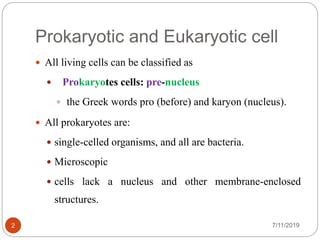
 All living cells can be classified as
 Prokaryotes cells: pre-nucleus
 the Greek words pro (before) and karyon (nucleus).
 All prokaryotes are:
 single-celled organisms, and all are bacteria.
 Microscopic
 cells lack a nucleus and other membrane-enclosed
structures.
Cell types …
7/11/20193
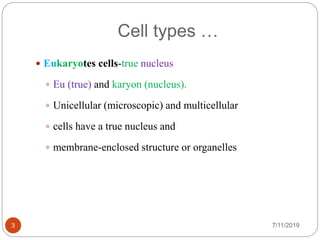
 Eukaryotes cells-true nucleus
 Eu (true) and karyon (nucleus).
 Unicellular (microscopic) and multicellular
 cells have a true nucleus and
 membrane-enclosed structure or organelles
Cell types…
7/11/20194
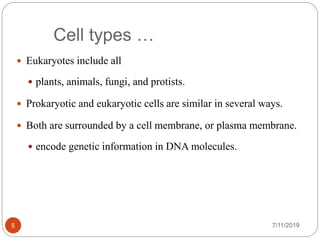
Viruses: acellular, parasitic particles composed of
a nucleic acid and proteins.
Cell types …
 Eukaryotes include all
 plants, animals, fungi, and protists.
 Prokaryotic and eukaryotic cells are similar in several ways.
 Both are surrounded by a cell membrane, or plasma membrane.
 encode genetic information in DNA molecules.
7/11/20195
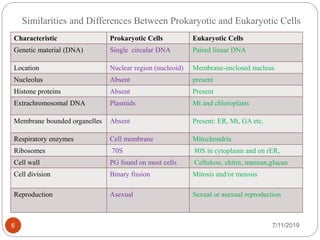
Similarities and Differences Between Prokaryotic and Eukaryotic Cells
Characteristic Prokaryotic Cells Eukaryotic Cells
Genetic material (DNA) Single circular DNA Paired linear DNA
Location Nuclear region (nucleoid) Membrane-enclosed nucleus
Nucleolus Absent present
Histone proteins Absent Present
Extrachromosomal DNA Plasmids Mt and chloroplasts
Membrane bounded organelles Absent Present: ER, Mt, GA etc.
Respiratory enzymes Cell membrane Mitochondria
Ribosomes 70S 80S in cytoplasm and on rER,
Cell wall PG found on most cells Cellulose, chitin, mannan,glucan
Cell division Binary fission Mitosis and/or meiosis
Reproduction Asexual Sexual or asexual reproduction
7/11/20196
Prokaryotes cells…
 Bacteria are prokaryotic, single-celled microorganisms.
Have a complex cell wall and
Have a single, Ds ,circular DNA
lack a nuclear membrane
Reproduce by Binary fission
Metabolically they are active and mostly independent
7/11/20197
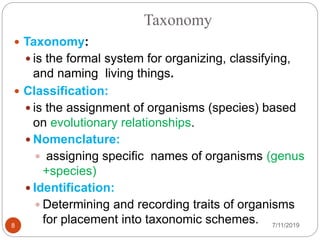
Taxonomy
 Taxonomy:
 is the formal system for organizing, classifying,
and naming living things.
 Classification:
 is the assignment of organisms (species) based
on evolutionary relationships.
 Nomenclature:
 assigning specific names of organisms (genus
+species)
 Identification:
 Determining and recording traits of organisms
for placement into taxonomic schemes. 7/11/20198
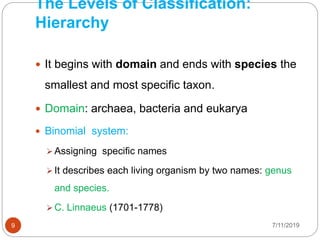
The Levels of Classification:
Hierarchy
7/11/20199
 It begins with domain and ends with species the
smallest and most specific taxon.
 Domain: archaea, bacteria and eukarya
 Binomial system:
 Assigning specific names
 It describes each living organism by two names: genus
and species.
 C. Linnaeus (1701-1778)
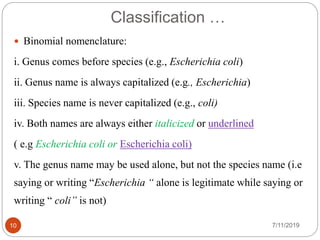
Classification …
 Binomial nomenclature:
i. Genus comes before species (e.g., Escherichia coli)
ii. Genus name is always capitalized (e.g., Escherichia)
iii. Species name is never capitalized (e.g., coli)
iv. Both names are always either italicized or underlined
( e.g Escherichia coli or Escherichia coli)
v. The genus name may be used alone, but not the species name (i.e
saying or writing “Escherichia “ alone is legitimate while saying or
writing “ coli” is not)
7/11/201910
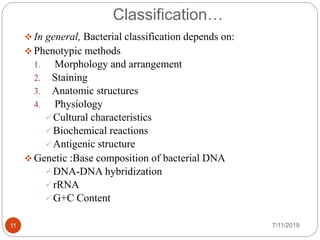
Classification…
 In general, Bacterial classification depends on:
 Phenotypic methods
1. Morphology and arrangement
2. Staining
3. Anatomic structures
4. Physiology
Cultural characteristics
Biochemical reactions
Antigenic structure
 Genetic :Base composition of bacterial DNA
DNA-DNA hybridization
rRNA
G+C Content
7/11/201911
Morphology of Bacteria
Size
Prokaryotes are among the smallest of all organisms.
Most prokaryotes range from 0.5 to 2.0 um in
diameter.
With some exception
cyanobacteria are 60 um long
Bacillus anthrax measures 10um
7/11/201912
Morphology of Bacteria
Shape
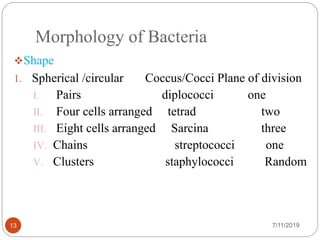
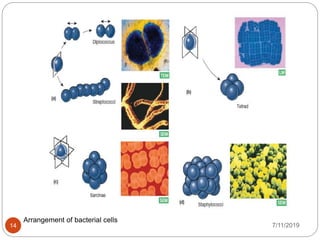
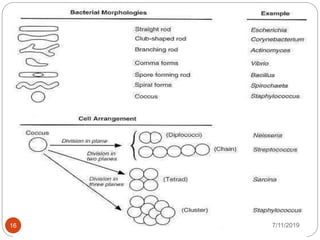
1. Spherical /circular Coccus/Cocci Plane of division
I. Pairs diplococci one
II. Four cells arranged tetrad two
III. Eight cells arranged Sarcina three
IV. Chains streptococci one
V. Clusters staphylococci Random
7/11/201913
 Arrangement of bacterial cells
7/11/201914
Morphology of Bacteria
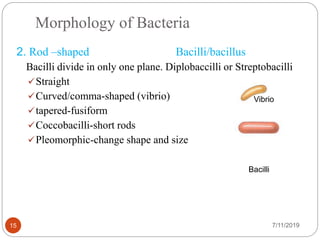
2. Rod –shaped Bacilli/bacillus
Bacilli divide in only one plane. Diplobaccilli or Streptobacilli
Straight
Curved/comma-shaped (vibrio)
tapered-fusiform
Coccobacilli-short rods
Pleomorphic-change shape and size
Vibrio
7/11/201915
Bacilli
7/11/201916
Morphology of Bacteria
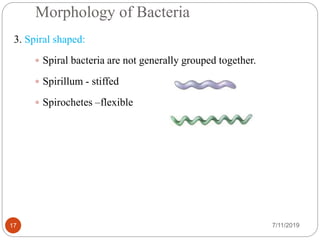
3. Spiral shaped:
 Spiral bacteria are not generally grouped together.
 Spirillum - stiffed
 Spirochetes –flexible
7/11/201917
Staining characteristics
7/11/201918
 Color
 Bacteria are colorless, transparent(similar refractive
index with surrounding environment).
 Staining preparation needed to see them under the
microscope
 Gram positive vs. gram negative bacteria
 Acid fast positive vs. negative bacteria
7/11/201919
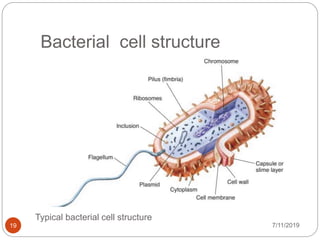
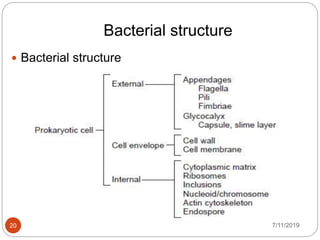
Typical bacterial cell structure
Bacterial cell structure
Bacterial structure
 Bacterial structure
7/11/201920
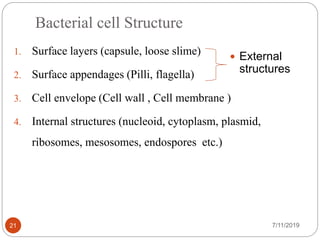
Bacterial cell Structure
1. Surface layers (capsule, loose slime)
2. Surface appendages (Pilli, flagella)
3. Cell envelope (Cell wall , Cell membrane )
4. Internal structures (nucleoid, cytoplasm, plasmid,
ribosomes, mesosomes, endospores etc.)
7/11/201921
 External
structures
1. Surface appendages (Pilli, flagella)
 Are surface structures originated outside the CM
 Sometimes being attached to it, and
 Extended into the environment
 Two types of surface appendage are found on certain
bacterial species:
7/11/201922
Surface appendages…
7/11/201923
I. Flagella :
Are thread/whip like structures
Free at one end and attached to a cell at the other end
made of protein flagellin.
are organs of locomotion
 occur on both Gram-+ve and Gram-ve bacteria.
 Their presence can be useful in identification.
 Flagellar antigen-H antigen
Flagella…
7/11/201924
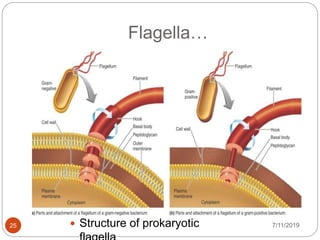
 The flagella has 3 basic parts
 The filament-the long outermost region.
-Consists of flagellin a Globular protein.
The hook-where the filament is attached
-wider and consists of different proteins.
The basal body-which anchors the flagellum to the CW
and CM.
-composed of a small central rod inserted
into a series of rings.
-in GNB, it contains two rings
-the outer pair of ring is anchored to the
CW.
-the inner pair of rings is anchored to the
CM
-In GPB, only the inner pairs of rings are
Flagella…
7/11/201925  Structure of prokaryotic
Surface appendages…
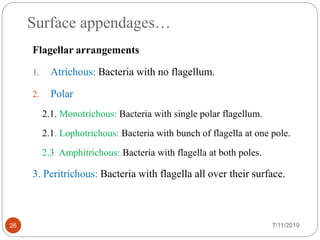
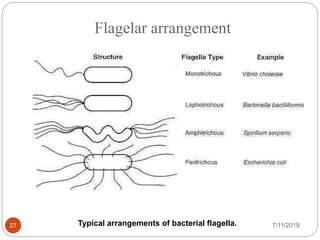
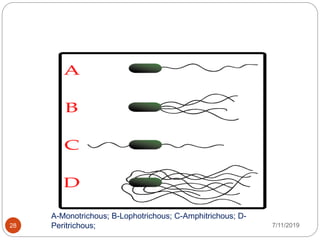
Flagellar arrangements
1. Atrichous: Bacteria with no flagellum.
2. Polar
2.1. Monotrichous: Bacteria with single polar flagellum.
2.1. Lophotrichous: Bacteria with bunch of flagella at one pole.
2.3 Amphitrichous: Bacteria with flagella at both poles.
3. Peritrichous: Bacteria with flagella all over their surface.
7/11/201926
Flagelar arrangement
Typical arrangements of bacterial flagella. 7/11/201927
7/11/201928
A-Monotrichous; B-Lophotrichous; C-Amphitrichous; D-
Peritrichous;
Flagella…
 Function
Locomotion/movement (motile vs. non-motile)
Colonization/attachment
Antigenic-flagellar antigen “H” antigen
Serogrouping/serotyping
7/11/201929
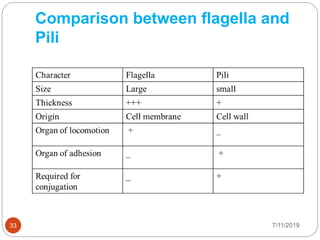
ii. Fimbriae and Pili
 Hairlike appendages common in GNB.
 Are shorter, straighter and thinner than flagella.
 Used for attachment and transfer of DNA.
 composed of protein called pilin.
 pili occur almost exclusively on Gram-negative bacteria.
 found on only a few GPB(e.g., Corynebacterium renale).
 Pili (Latin hairs), fimbriae (Latin fringes).
7/11/201930
Pili and Fimbriae…
 Two types (Based on function)
 Common pili(Fimbriae):
 A few to several hundreds per cell.
 Have the tendency to adhere to each other and
to the surface.
 The structure for adherence to cell to cell
surface.
 They involved in biofilm formation.
 Help bacteria to adhere epithelial cells
7/11/201931
Pili and Fimbriae..
7/11/201932
 Sex pili:
 Are usually longer than fimbriae
 Only 1 or 2 in numbers per cell.
 Involved in motility and transfer of genetic
material during the process of conjugation.
 Twitching and gliding motility
Comparison between flagella and
Pili
7/11/201933
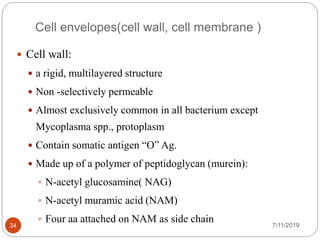
Cell envelopes(cell wall, cell membrane )
 Cell wall:
 a rigid, multilayered structure
 Non -selectively permeable
 Almost exclusively common in all bacterium except
Mycoplasma spp., protoplasm
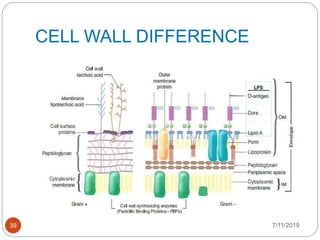
 Contain somatic antigen “O” Ag.
 Made up of a polymer of peptidoglycan (murein):
 N-acetyl glucosamine( NAG)
 N-acetyl muramic acid (NAM)
 Four aa attached on NAM as side chain 7/11/201934
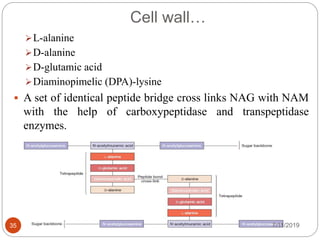
Cell wall…
L-alanine
D-alanine
D-glutamic acid
Diaminopimelic (DPA)-lysine
 A set of identical peptide bridge cross links NAG with NAM
with the help of carboxypeptidase and transpeptidase
enzymes.
7/11/201935
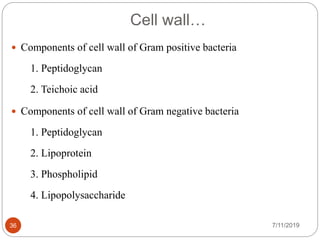
Cell wall…
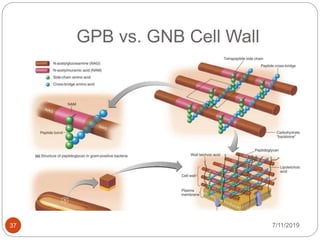
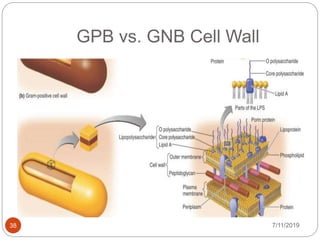
 Components of cell wall of Gram positive bacteria
1. Peptidoglycan
2. Teichoic acid
 Components of cell wall of Gram negative bacteria
1. Peptidoglycan
2. Lipoprotein
3. Phospholipid
4. Lipopolysaccharide
7/11/201936
GPB vs. GNB Cell Wall
7/11/201937
GPB vs. GNB Cell Wall
7/11/201938
CELL WALL DIFFERENCE
7/11/201939
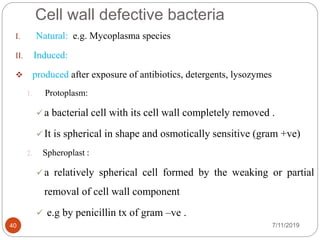
Cell wall defective bacteria
I. Natural: e.g. Mycoplasma species
II. Induced:
 produced after exposure of antibiotics, detergents, lysozymes
1. Protoplasm:
 a bacterial cell with its cell wall completely removed .
 It is spherical in shape and osmotically sensitive (gram +ve)
2. Spheroplast :
 a relatively spherical cell formed by the weaking or partial
removal of cell wall component
 e.g by penicillin tx of gram –ve .
7/11/201940
Cell wall defective bacteria
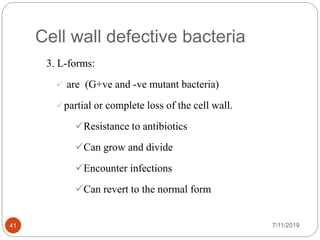
3. L-forms:
 are (G+ve and -ve mutant bacteria)
partial or complete loss of the cell wall.
Resistance to antibiotics
Can grow and divide
Encounter infections
Can revert to the normal form
7/11/201941
Functions of cell wall
1. Provides shape to the bacterium
2. Gives rigidity to the organism
3. Protects from environment
4. Provides staining characteristics to the bacterium
5. Contains receptor sites for phages/complements
6. Site of action of antibody, antibiotics and colicin
7. Contains toxic components to host-endotoxic
7/11/201942
Cell /plasma membrane
 Phospholipid by layer +protein
 It accounts for 30% of the dry weight of bacterial cell.
 It is composed of
 60% protein
 20-30% lipids and
 10-20% CHO
Function of cell membrane
1. Selective permeable/barrier
2.Transport of molecules(passive, active)
3. Energy generation: Respiration –ATP
4. Synthesize biosynthetic enzymes
7/11/201943
Surface layers
7/11/201944
 Glycocalyx :
 Secreted substance on the surface of many
prokaryotic cells.
 A.k.a the pericellular matrix- substances that
surround cells
 Glycocalyx (meaning sugar coat)
 It is a viscous (sticky), gelatinous polymer
 It is composed of polysaccharide, polypeptide, or
surface layers
 Capsule:
 Glycocalyx which is organized and is firmly attached to the cell
wall
the outer most layer of bacteria cell.
 made of polymers of polysaccharide +polyalcohols+aminosugars
except in B.anthracis (polymers of D-glutamic acid).
capsulated bacteria produced smooth, mucoid colonies.
Non-capsulated bacteria produced rough non-mucoid colonies.
Capsular antigens, K,Vi
e.g. Hameophilus influnzae ,S.pneumoniae, N.meningitis
7/11/201945
function of capsule
 Anti-phagocytic Activity
 Antigenicity
 Attachment/adherence/colonization
 Resistance to drying
 Serotyping bacteria
7/11/201946
Surface layer…
7/11/201947
 Slime layer
Glycocalyx substance is unorganized and only
loosely attached to the cell wall.
The Glycocalyx is a very important component of
biofilms.
Mesosomes
 Infoldings/invagination of the plasma membrane in which
bacterial chromosomes attached to it.
 Often found near dividing line in bacteria
 Involved in segregation of newly replicated chromosomes
following DNA replication.
7/11/201948
Internal structures
7/11/201949
 Ribosomes
 DNA(Nucleoid)
 Granules
 Plasmid
 Endospores
Polyamine
Cytoplasmic constituents
Inclusion bodies /granules
 Aggregates of various compounds used as foods storage /reserves
Poly-beta hydroxyalkanoate (PHA):
is a derivative of poly-hydroxybutyrate (PHB): source of
carbon and energy
Metachromic granules (volutin): inorganic sulphate, Sulfur
granules
Polysaccharide granules : usually glycogen or starch
Lipid inclusions
7/11/201950
Endospores
 Small round, highly resistant, resting structures produced with the
cell during starvation/accumulation of toxic wastes.
 Little or no metabolism inside the spore
 Spores are resistant to heat, radiation, chemicals and desiccation
 Spores are cable of detecting their environment and under favorable
environmental conditions.
 they germinate and retuning to the vegetative state
 Spore formation (sporulation)-process of forming spores
7/11/201951
Layers of endospore
Core: the core is dehydrated cytoplasm; containing DNA,
ribosomes ,enzymes ,calcium dipocolinate (5-15% of dry
weight).
Cortex: the cortex is a modified cell wall/PG layer.
Coat: keratin-like proteins layers that are impermeable to
most chemicals
7/11/201952
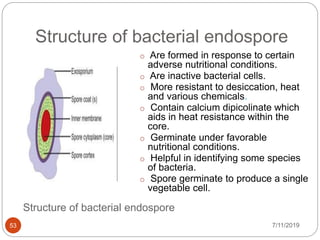
Structure of bacterial endospore
7/11/201953
Structure of bacterial endospore
o Are formed in response to certain
adverse nutritional conditions.
o Are inactive bacterial cells.
o More resistant to desiccation, heat
and various chemicals.
o Contain calcium dipicolinate which
aids in heat resistance within the
core.
o Germinate under favorable
nutritional conditions.
o Helpful in identifying some species
of bacteria.
o Spore germinate to produce a single
vegetable cell.
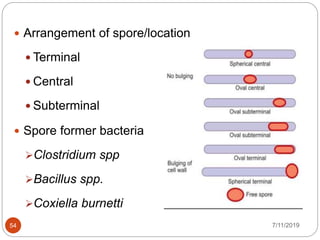
 Arrangement of spore/location
 Terminal
 Central
 Subterminal
 Spore former bacteria
Clostridium spp
Bacillus spp.
Coxiella burnetti
7/11/201954
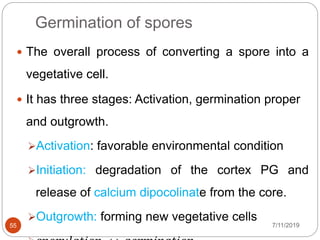
Germination of spores
 The overall process of converting a spore into a
vegetative cell.
 It has three stages: Activation, germination proper
and outgrowth.
Activation: favorable environmental condition
Initiation: degradation of the cortex PG and
release of calcium dipocolinate from the core.
Outgrowth: forming new vegetative cells
7/11/201955
7/11/201956
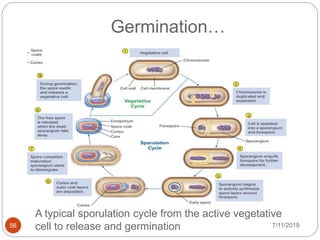
Germination…
A typical sporulation cycle from the active vegetative
cell to release and germination
Bacterial Nutrition and Growth
 Bacterial nutrition:
 Bacteria, like all cells, require nutrients for the
maintenance of
their metabolism and for cell division.
 Bacterial structural components and the
macromolecules for the metabolism are synthesized
from the elements.
 The four most important elements of bacteria are C,
H2, O2 and N2.
 Minerals: sulfur and phosphorus, trace elements
7/11/201957
7/11/201958
Carbon
 Organisms require a source of carbon for the synthesis
of numerous organic compounds that comprise
protoplast.
 Depending on their requirements, bacteria can be
classified as
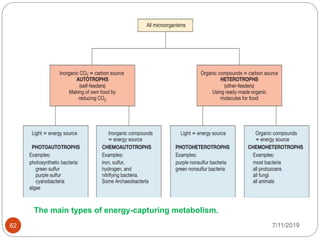
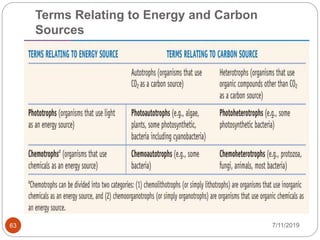
1. Autotrophs: Free-living, non-parasitic bacteria
 use carbon dioxide as carbon source.
 The energy needed for their metabolism can be
obtained from: 7/11/201959
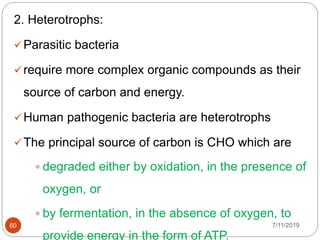
2. Heterotrophs:
Parasitic bacteria
require more complex organic compounds as their
source of carbon and energy.
Human pathogenic bacteria are heterotrophs
The principal source of carbon is CHO which are
 degraded either by oxidation, in the presence of
oxygen, or
 by fermentation, in the absence of oxygen, to
provide energy in the form of ATP.
7/11/201960
7/11/201961
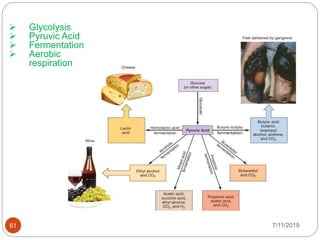
 Glycolysis
 Pyruvic Acid
 Fermentation
 Aerobic
respiration
7/11/201962
The main types of energy-capturing metabolism.
Terms Relating to Energy and Carbon
Sources
7/11/201963
Bacterial Nutrition…
 Hydrogen and oxygen
 Obtained from water.
 Essential for the growth and maintenance of cell.
 Nitrogen
Constitutes 10% of dry weight of bacterial cell.
Obtained from organic molecules like proteins and
inorganic molecules like ammonium salts and nitrates.
7/11/201964
Growth factors
 Growth factors
are organic compounds
Required in small amounts
the cell can not synthesize from other carbon
source.
 These are aminoacids, purines and pyrimidines, and
vitamins.
 Prototrophs: Wild-type bacteria with normal growth
requirements.
 Auxotrophs: Mutant bacteria, which require an
7/11/201965
BACTERIAL GROWTH
 It is an orderly increase in all the components of an
organism.
 It is an increment in biomass.
 It is synchronous with bacterial cell reproduction.
Generation time: is the time taken for the size of a
bacterial population to be double.
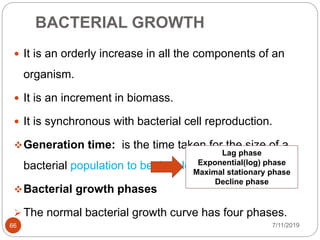
Bacterial growth phases
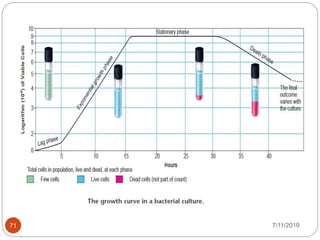
 The normal bacterial growth curve has four phases.
Lag phase
Exponential(log) phase
Maximal stationary phase
Decline phase
7/11/201966
1. Lag phase
 The period of adaptation
 active macro molecular synthesis like DNA, RNA,
various enzymes and other structural components.
 It is the preparation time for reproduction; no increase
in cell number.
7/11/201967
2. Exponential(log) phase
7/11/201968
 The period of active multiplication of cells.
 Cell division precedes at a logarithmic rate.
determined by the medium and condition of the
culture.
3. Maximal stationary phase
 The period when the bacteria have achieved their
maximal cell density or yield.
 There is no further increase in viable bacterial cell
number.
 The growth rate is exactly equal to the death rate.
A bacterial population may reach stationary growth when
one of the
following conditions occur:
 The required nutrients are exhausted
 Inhibitory end products are accumulated
7/11/201969
4. Decline phase
 The period at which the rate of death of bacterial cells
exceeds the rate of new cell formation.
 There is drastic decline in viable cells.
 Few organisms may persist for so long time at this
period at the
expense of nutrients released from dying micro-
organisms.
7/11/201970
7/11/201971
Factors influencing bacterial
growth
 Rates of bacterial growth are influenced by the
following environmental parameters.
I. Nutrition
II. Temperature
III. Oxygen
IV. PH
V. Salinity
7/11/201972
1. Nutrition
 Macromolecules (source of C,H,O,N)
 Minerals: sulfur and phosphorus, trace elements
 Growth factors: amino acids, purines, pyrimidines and
vitamins.
7/11/201973
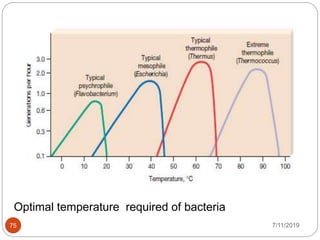
2. Temperature
 Optimal growth range of temperature:
The temperature at which the maximum growth rate
occurs; and results in the shortest generation time of
bacteria.
Optimal growth temperature
Psychrophilic bacteria:15-20 ° c; grow best at low T°
range
Mesophilic bacteria:30-37 °c; grow best at middle T°
range
7/11/201974
Optimal temperature required of bacteria
7/11/201975
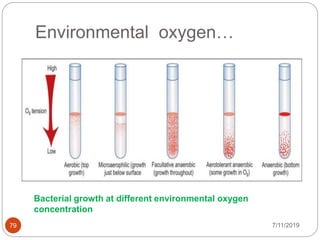
 Base on oxygen requirements and tolerance,
bacteria are classified as:
1. Obligate aerobes
2. Microaerophilic
3. Obligate anaerobes
4. Facultative anaerobes
5. Aerotolerent anaerobes
6. Capnophilic
3. Oxygen
7/11/201976
 Obligate aerobic bacteria grow only when free oxygen is
available to support their respiratory metabolism.
 They obtain ATP by using oxygen as a final electron
acceptor in respiration.
 Obligate anaerobic bacteria grow in the absence of oxygen;
exposure to oxygen kills anaerobes.
 FA bacteria: grow in the presence or absence of O².
 They obtain ATP by fermentation or anaerobic respiration.
7/11/201977
Environmental oxygen…
7/11/201978
 Microaerophilic bacteria grow best at reduced
oxygen tension; high oxygen tension is toxic to
them.
 Aerotolerant anaerobes do not utilize oxygen
but can survive in its presence.
 are not killed by oxygen, because they possess
alternative mechanisms for breaking down
peroxides and superoxide.
 Capnophilic bacteria grow best at a higher
Environmental oxygen…
7/11/201979
Bacterial growth at different environmental oxygen
concentration
4.Hydrogen ion concentration
 Neutrophilic bacteria grow best at near neutral PH
value.
 Acidophilic bacteria prefer to grow at low PH value
(acidic medium).
 Alkalophilic bacteria prefer to grow at high PH value
(alkaline medium).
 Most pathogenic bacteria grow best at PH of 6-8.
7/11/201980
5. Salinity
 Salt content of the medium affects bacterial growth.
 Halophile bacteria grow best at high salt
concentration.
 Moderate halophiles: require 3% salt concentration.
 Extreme halophiles require 15% salt concentration.
 Most bacteria can not tolerate high salt concentration.
7/11/201981
7/11/201982
6. Osmotic pressure
7. Sun light
7/11/201983

2. Prokaryotic and eukaryotic cell structure

  • 1.
    Habtamu Biazin (BSc,MSc) AAU ,CHS, SoM Department of MIP 7/11/20191 Prokaryotes and Eukaryotes cell
  • 2.
    Prokaryotic and Eukaryoticcell 7/11/20192  All living cells can be classified as  Prokaryotes cells: pre-nucleus  the Greek words pro (before) and karyon (nucleus).  All prokaryotes are:  single-celled organisms, and all are bacteria.  Microscopic  cells lack a nucleus and other membrane-enclosed structures.
  • 3.
    Cell types … 7/11/20193 Eukaryotes cells-true nucleus  Eu (true) and karyon (nucleus).  Unicellular (microscopic) and multicellular  cells have a true nucleus and  membrane-enclosed structure or organelles
  • 4.
    Cell types… 7/11/20194 Viruses: acellular,parasitic particles composed of a nucleic acid and proteins.
  • 5.
    Cell types … Eukaryotes include all  plants, animals, fungi, and protists.  Prokaryotic and eukaryotic cells are similar in several ways.  Both are surrounded by a cell membrane, or plasma membrane.  encode genetic information in DNA molecules. 7/11/20195
  • 6.
    Similarities and DifferencesBetween Prokaryotic and Eukaryotic Cells Characteristic Prokaryotic Cells Eukaryotic Cells Genetic material (DNA) Single circular DNA Paired linear DNA Location Nuclear region (nucleoid) Membrane-enclosed nucleus Nucleolus Absent present Histone proteins Absent Present Extrachromosomal DNA Plasmids Mt and chloroplasts Membrane bounded organelles Absent Present: ER, Mt, GA etc. Respiratory enzymes Cell membrane Mitochondria Ribosomes 70S 80S in cytoplasm and on rER, Cell wall PG found on most cells Cellulose, chitin, mannan,glucan Cell division Binary fission Mitosis and/or meiosis Reproduction Asexual Sexual or asexual reproduction 7/11/20196
  • 7.
    Prokaryotes cells…  Bacteriaare prokaryotic, single-celled microorganisms. Have a complex cell wall and Have a single, Ds ,circular DNA lack a nuclear membrane Reproduce by Binary fission Metabolically they are active and mostly independent 7/11/20197
  • 8.
    Taxonomy  Taxonomy:  isthe formal system for organizing, classifying, and naming living things.  Classification:  is the assignment of organisms (species) based on evolutionary relationships.  Nomenclature:  assigning specific names of organisms (genus +species)  Identification:  Determining and recording traits of organisms for placement into taxonomic schemes. 7/11/20198
  • 9.
    The Levels ofClassification: Hierarchy 7/11/20199  It begins with domain and ends with species the smallest and most specific taxon.  Domain: archaea, bacteria and eukarya  Binomial system:  Assigning specific names  It describes each living organism by two names: genus and species.  C. Linnaeus (1701-1778)
  • 10.
    Classification …  Binomialnomenclature: i. Genus comes before species (e.g., Escherichia coli) ii. Genus name is always capitalized (e.g., Escherichia) iii. Species name is never capitalized (e.g., coli) iv. Both names are always either italicized or underlined ( e.g Escherichia coli or Escherichia coli) v. The genus name may be used alone, but not the species name (i.e saying or writing “Escherichia “ alone is legitimate while saying or writing “ coli” is not) 7/11/201910
  • 11.
    Classification…  In general,Bacterial classification depends on:  Phenotypic methods 1. Morphology and arrangement 2. Staining 3. Anatomic structures 4. Physiology Cultural characteristics Biochemical reactions Antigenic structure  Genetic :Base composition of bacterial DNA DNA-DNA hybridization rRNA G+C Content 7/11/201911
  • 12.
    Morphology of Bacteria Size Prokaryotesare among the smallest of all organisms. Most prokaryotes range from 0.5 to 2.0 um in diameter. With some exception cyanobacteria are 60 um long Bacillus anthrax measures 10um 7/11/201912
  • 13.
    Morphology of Bacteria Shape 1.Spherical /circular Coccus/Cocci Plane of division I. Pairs diplococci one II. Four cells arranged tetrad two III. Eight cells arranged Sarcina three IV. Chains streptococci one V. Clusters staphylococci Random 7/11/201913
  • 14.
     Arrangement ofbacterial cells 7/11/201914
  • 15.
    Morphology of Bacteria 2.Rod –shaped Bacilli/bacillus Bacilli divide in only one plane. Diplobaccilli or Streptobacilli Straight Curved/comma-shaped (vibrio) tapered-fusiform Coccobacilli-short rods Pleomorphic-change shape and size Vibrio 7/11/201915 Bacilli
  • 16.
  • 17.
    Morphology of Bacteria 3.Spiral shaped:  Spiral bacteria are not generally grouped together.  Spirillum - stiffed  Spirochetes –flexible 7/11/201917
  • 18.
    Staining characteristics 7/11/201918  Color Bacteria are colorless, transparent(similar refractive index with surrounding environment).  Staining preparation needed to see them under the microscope  Gram positive vs. gram negative bacteria  Acid fast positive vs. negative bacteria
  • 19.
    7/11/201919 Typical bacterial cellstructure Bacterial cell structure
  • 20.
    Bacterial structure  Bacterialstructure 7/11/201920
  • 21.
    Bacterial cell Structure 1.Surface layers (capsule, loose slime) 2. Surface appendages (Pilli, flagella) 3. Cell envelope (Cell wall , Cell membrane ) 4. Internal structures (nucleoid, cytoplasm, plasmid, ribosomes, mesosomes, endospores etc.) 7/11/201921  External structures
  • 22.
    1. Surface appendages(Pilli, flagella)  Are surface structures originated outside the CM  Sometimes being attached to it, and  Extended into the environment  Two types of surface appendage are found on certain bacterial species: 7/11/201922
  • 23.
    Surface appendages… 7/11/201923 I. Flagella: Are thread/whip like structures Free at one end and attached to a cell at the other end made of protein flagellin. are organs of locomotion  occur on both Gram-+ve and Gram-ve bacteria.  Their presence can be useful in identification.  Flagellar antigen-H antigen
  • 24.
    Flagella… 7/11/201924  The flagellahas 3 basic parts  The filament-the long outermost region. -Consists of flagellin a Globular protein. The hook-where the filament is attached -wider and consists of different proteins. The basal body-which anchors the flagellum to the CW and CM. -composed of a small central rod inserted into a series of rings. -in GNB, it contains two rings -the outer pair of ring is anchored to the CW. -the inner pair of rings is anchored to the CM -In GPB, only the inner pairs of rings are
  • 25.
  • 26.
    Surface appendages… Flagellar arrangements 1.Atrichous: Bacteria with no flagellum. 2. Polar 2.1. Monotrichous: Bacteria with single polar flagellum. 2.1. Lophotrichous: Bacteria with bunch of flagella at one pole. 2.3 Amphitrichous: Bacteria with flagella at both poles. 3. Peritrichous: Bacteria with flagella all over their surface. 7/11/201926
  • 27.
    Flagelar arrangement Typical arrangementsof bacterial flagella. 7/11/201927
  • 28.
  • 29.
    Flagella…  Function Locomotion/movement (motilevs. non-motile) Colonization/attachment Antigenic-flagellar antigen “H” antigen Serogrouping/serotyping 7/11/201929
  • 30.
    ii. Fimbriae andPili  Hairlike appendages common in GNB.  Are shorter, straighter and thinner than flagella.  Used for attachment and transfer of DNA.  composed of protein called pilin.  pili occur almost exclusively on Gram-negative bacteria.  found on only a few GPB(e.g., Corynebacterium renale).  Pili (Latin hairs), fimbriae (Latin fringes). 7/11/201930
  • 31.
    Pili and Fimbriae… Two types (Based on function)  Common pili(Fimbriae):  A few to several hundreds per cell.  Have the tendency to adhere to each other and to the surface.  The structure for adherence to cell to cell surface.  They involved in biofilm formation.  Help bacteria to adhere epithelial cells 7/11/201931
  • 32.
    Pili and Fimbriae.. 7/11/201932 Sex pili:  Are usually longer than fimbriae  Only 1 or 2 in numbers per cell.  Involved in motility and transfer of genetic material during the process of conjugation.  Twitching and gliding motility
  • 33.
    Comparison between flagellaand Pili 7/11/201933
  • 34.
    Cell envelopes(cell wall,cell membrane )  Cell wall:  a rigid, multilayered structure  Non -selectively permeable  Almost exclusively common in all bacterium except Mycoplasma spp., protoplasm  Contain somatic antigen “O” Ag.  Made up of a polymer of peptidoglycan (murein):  N-acetyl glucosamine( NAG)  N-acetyl muramic acid (NAM)  Four aa attached on NAM as side chain 7/11/201934
  • 35.
    Cell wall… L-alanine D-alanine D-glutamic acid Diaminopimelic(DPA)-lysine  A set of identical peptide bridge cross links NAG with NAM with the help of carboxypeptidase and transpeptidase enzymes. 7/11/201935
  • 36.
    Cell wall…  Componentsof cell wall of Gram positive bacteria 1. Peptidoglycan 2. Teichoic acid  Components of cell wall of Gram negative bacteria 1. Peptidoglycan 2. Lipoprotein 3. Phospholipid 4. Lipopolysaccharide 7/11/201936
  • 37.
    GPB vs. GNBCell Wall 7/11/201937
  • 38.
    GPB vs. GNBCell Wall 7/11/201938
  • 39.
  • 40.
    Cell wall defectivebacteria I. Natural: e.g. Mycoplasma species II. Induced:  produced after exposure of antibiotics, detergents, lysozymes 1. Protoplasm:  a bacterial cell with its cell wall completely removed .  It is spherical in shape and osmotically sensitive (gram +ve) 2. Spheroplast :  a relatively spherical cell formed by the weaking or partial removal of cell wall component  e.g by penicillin tx of gram –ve . 7/11/201940
  • 41.
    Cell wall defectivebacteria 3. L-forms:  are (G+ve and -ve mutant bacteria) partial or complete loss of the cell wall. Resistance to antibiotics Can grow and divide Encounter infections Can revert to the normal form 7/11/201941
  • 42.
    Functions of cellwall 1. Provides shape to the bacterium 2. Gives rigidity to the organism 3. Protects from environment 4. Provides staining characteristics to the bacterium 5. Contains receptor sites for phages/complements 6. Site of action of antibody, antibiotics and colicin 7. Contains toxic components to host-endotoxic 7/11/201942
  • 43.
    Cell /plasma membrane Phospholipid by layer +protein  It accounts for 30% of the dry weight of bacterial cell.  It is composed of  60% protein  20-30% lipids and  10-20% CHO Function of cell membrane 1. Selective permeable/barrier 2.Transport of molecules(passive, active) 3. Energy generation: Respiration –ATP 4. Synthesize biosynthetic enzymes 7/11/201943
  • 44.
    Surface layers 7/11/201944  Glycocalyx:  Secreted substance on the surface of many prokaryotic cells.  A.k.a the pericellular matrix- substances that surround cells  Glycocalyx (meaning sugar coat)  It is a viscous (sticky), gelatinous polymer  It is composed of polysaccharide, polypeptide, or
  • 45.
    surface layers  Capsule: Glycocalyx which is organized and is firmly attached to the cell wall the outer most layer of bacteria cell.  made of polymers of polysaccharide +polyalcohols+aminosugars except in B.anthracis (polymers of D-glutamic acid). capsulated bacteria produced smooth, mucoid colonies. Non-capsulated bacteria produced rough non-mucoid colonies. Capsular antigens, K,Vi e.g. Hameophilus influnzae ,S.pneumoniae, N.meningitis 7/11/201945
  • 46.
    function of capsule Anti-phagocytic Activity  Antigenicity  Attachment/adherence/colonization  Resistance to drying  Serotyping bacteria 7/11/201946
  • 47.
    Surface layer… 7/11/201947  Slimelayer Glycocalyx substance is unorganized and only loosely attached to the cell wall. The Glycocalyx is a very important component of biofilms.
  • 48.
    Mesosomes  Infoldings/invagination ofthe plasma membrane in which bacterial chromosomes attached to it.  Often found near dividing line in bacteria  Involved in segregation of newly replicated chromosomes following DNA replication. 7/11/201948
  • 49.
    Internal structures 7/11/201949  Ribosomes DNA(Nucleoid)  Granules  Plasmid  Endospores Polyamine Cytoplasmic constituents
  • 50.
    Inclusion bodies /granules Aggregates of various compounds used as foods storage /reserves Poly-beta hydroxyalkanoate (PHA): is a derivative of poly-hydroxybutyrate (PHB): source of carbon and energy Metachromic granules (volutin): inorganic sulphate, Sulfur granules Polysaccharide granules : usually glycogen or starch Lipid inclusions 7/11/201950
  • 51.
    Endospores  Small round,highly resistant, resting structures produced with the cell during starvation/accumulation of toxic wastes.  Little or no metabolism inside the spore  Spores are resistant to heat, radiation, chemicals and desiccation  Spores are cable of detecting their environment and under favorable environmental conditions.  they germinate and retuning to the vegetative state  Spore formation (sporulation)-process of forming spores 7/11/201951
  • 52.
    Layers of endospore Core:the core is dehydrated cytoplasm; containing DNA, ribosomes ,enzymes ,calcium dipocolinate (5-15% of dry weight). Cortex: the cortex is a modified cell wall/PG layer. Coat: keratin-like proteins layers that are impermeable to most chemicals 7/11/201952
  • 53.
    Structure of bacterialendospore 7/11/201953 Structure of bacterial endospore o Are formed in response to certain adverse nutritional conditions. o Are inactive bacterial cells. o More resistant to desiccation, heat and various chemicals. o Contain calcium dipicolinate which aids in heat resistance within the core. o Germinate under favorable nutritional conditions. o Helpful in identifying some species of bacteria. o Spore germinate to produce a single vegetable cell.
  • 54.
     Arrangement ofspore/location  Terminal  Central  Subterminal  Spore former bacteria Clostridium spp Bacillus spp. Coxiella burnetti 7/11/201954
  • 55.
    Germination of spores The overall process of converting a spore into a vegetative cell.  It has three stages: Activation, germination proper and outgrowth. Activation: favorable environmental condition Initiation: degradation of the cortex PG and release of calcium dipocolinate from the core. Outgrowth: forming new vegetative cells 7/11/201955
  • 56.
    7/11/201956 Germination… A typical sporulationcycle from the active vegetative cell to release and germination
  • 57.
    Bacterial Nutrition andGrowth  Bacterial nutrition:  Bacteria, like all cells, require nutrients for the maintenance of their metabolism and for cell division.  Bacterial structural components and the macromolecules for the metabolism are synthesized from the elements.  The four most important elements of bacteria are C, H2, O2 and N2.  Minerals: sulfur and phosphorus, trace elements 7/11/201957
  • 58.
  • 59.
    Carbon  Organisms requirea source of carbon for the synthesis of numerous organic compounds that comprise protoplast.  Depending on their requirements, bacteria can be classified as 1. Autotrophs: Free-living, non-parasitic bacteria  use carbon dioxide as carbon source.  The energy needed for their metabolism can be obtained from: 7/11/201959
  • 60.
    2. Heterotrophs: Parasitic bacteria requiremore complex organic compounds as their source of carbon and energy. Human pathogenic bacteria are heterotrophs The principal source of carbon is CHO which are  degraded either by oxidation, in the presence of oxygen, or  by fermentation, in the absence of oxygen, to provide energy in the form of ATP. 7/11/201960
  • 61.
    7/11/201961  Glycolysis  PyruvicAcid  Fermentation  Aerobic respiration
  • 62.
    7/11/201962 The main typesof energy-capturing metabolism.
  • 63.
    Terms Relating toEnergy and Carbon Sources 7/11/201963
  • 64.
    Bacterial Nutrition…  Hydrogenand oxygen  Obtained from water.  Essential for the growth and maintenance of cell.  Nitrogen Constitutes 10% of dry weight of bacterial cell. Obtained from organic molecules like proteins and inorganic molecules like ammonium salts and nitrates. 7/11/201964
  • 65.
    Growth factors  Growthfactors are organic compounds Required in small amounts the cell can not synthesize from other carbon source.  These are aminoacids, purines and pyrimidines, and vitamins.  Prototrophs: Wild-type bacteria with normal growth requirements.  Auxotrophs: Mutant bacteria, which require an 7/11/201965
  • 66.
    BACTERIAL GROWTH  Itis an orderly increase in all the components of an organism.  It is an increment in biomass.  It is synchronous with bacterial cell reproduction. Generation time: is the time taken for the size of a bacterial population to be double. Bacterial growth phases  The normal bacterial growth curve has four phases. Lag phase Exponential(log) phase Maximal stationary phase Decline phase 7/11/201966
  • 67.
    1. Lag phase The period of adaptation  active macro molecular synthesis like DNA, RNA, various enzymes and other structural components.  It is the preparation time for reproduction; no increase in cell number. 7/11/201967
  • 68.
    2. Exponential(log) phase 7/11/201968 The period of active multiplication of cells.  Cell division precedes at a logarithmic rate. determined by the medium and condition of the culture.
  • 69.
    3. Maximal stationaryphase  The period when the bacteria have achieved their maximal cell density or yield.  There is no further increase in viable bacterial cell number.  The growth rate is exactly equal to the death rate. A bacterial population may reach stationary growth when one of the following conditions occur:  The required nutrients are exhausted  Inhibitory end products are accumulated 7/11/201969
  • 70.
    4. Decline phase The period at which the rate of death of bacterial cells exceeds the rate of new cell formation.  There is drastic decline in viable cells.  Few organisms may persist for so long time at this period at the expense of nutrients released from dying micro- organisms. 7/11/201970
  • 71.
  • 72.
    Factors influencing bacterial growth Rates of bacterial growth are influenced by the following environmental parameters. I. Nutrition II. Temperature III. Oxygen IV. PH V. Salinity 7/11/201972
  • 73.
    1. Nutrition  Macromolecules(source of C,H,O,N)  Minerals: sulfur and phosphorus, trace elements  Growth factors: amino acids, purines, pyrimidines and vitamins. 7/11/201973
  • 74.
    2. Temperature  Optimalgrowth range of temperature: The temperature at which the maximum growth rate occurs; and results in the shortest generation time of bacteria. Optimal growth temperature Psychrophilic bacteria:15-20 ° c; grow best at low T° range Mesophilic bacteria:30-37 °c; grow best at middle T° range 7/11/201974
  • 75.
    Optimal temperature requiredof bacteria 7/11/201975
  • 76.
     Base onoxygen requirements and tolerance, bacteria are classified as: 1. Obligate aerobes 2. Microaerophilic 3. Obligate anaerobes 4. Facultative anaerobes 5. Aerotolerent anaerobes 6. Capnophilic 3. Oxygen 7/11/201976
  • 77.
     Obligate aerobicbacteria grow only when free oxygen is available to support their respiratory metabolism.  They obtain ATP by using oxygen as a final electron acceptor in respiration.  Obligate anaerobic bacteria grow in the absence of oxygen; exposure to oxygen kills anaerobes.  FA bacteria: grow in the presence or absence of O².  They obtain ATP by fermentation or anaerobic respiration. 7/11/201977
  • 78.
    Environmental oxygen… 7/11/201978  Microaerophilicbacteria grow best at reduced oxygen tension; high oxygen tension is toxic to them.  Aerotolerant anaerobes do not utilize oxygen but can survive in its presence.  are not killed by oxygen, because they possess alternative mechanisms for breaking down peroxides and superoxide.  Capnophilic bacteria grow best at a higher
  • 79.
    Environmental oxygen… 7/11/201979 Bacterial growthat different environmental oxygen concentration
  • 80.
    4.Hydrogen ion concentration Neutrophilic bacteria grow best at near neutral PH value.  Acidophilic bacteria prefer to grow at low PH value (acidic medium).  Alkalophilic bacteria prefer to grow at high PH value (alkaline medium).  Most pathogenic bacteria grow best at PH of 6-8. 7/11/201980
  • 81.
    5. Salinity  Saltcontent of the medium affects bacterial growth.  Halophile bacteria grow best at high salt concentration.  Moderate halophiles: require 3% salt concentration.  Extreme halophiles require 15% salt concentration.  Most bacteria can not tolerate high salt concentration. 7/11/201981
  • 82.
  • 83.