Prof. Vaishali P. Argade
Lecturer in PRES, Institute of Pharmacy, Loni
Email:vaishali.argade@pravara.in
Mobile:9158813767
1
By-Ms. Argade V. P.
Learning Outcomes
After completion of this chapter, you will be able to:
1. Understand the concept of posology
2. Understand the various factors influencing dose of drugs
3. Calculate the dose of drugs
2
By-Ms. Argade V. P.
Definition
• The term posology derived from the Greek word “Posos” means how much
and “Logos” means science.
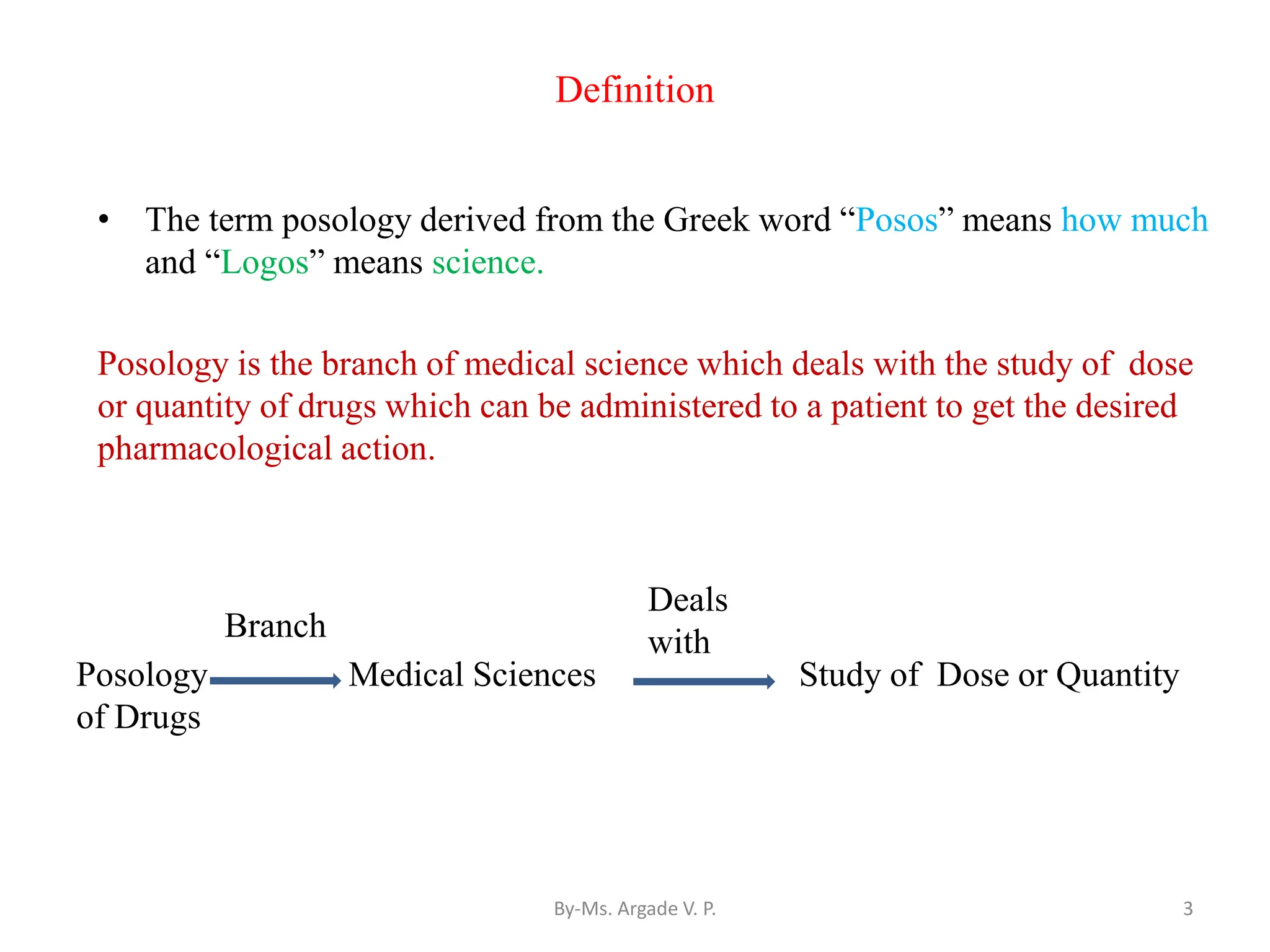
Posology is the branch of medical science which deals with the study of dose
or quantity of drugs which can be administered to a patient to get the desired
pharmacological action.
3
Posology Medical Sciences Study of Dose or Quantity
of Drugs
Branch
Deals
with
By-Ms. Argade V. P.
Factors Influencing Dose of Drugs
Factors Influencing Dose of Drugs are given bellow:
1. Age
2. Sex
3. Body weight
4. Route of administration
5. Time of administration
6. Environmental factor
7. Emotional factor
8. Presence of disease
9. Accumulation
10. Additive effect
11. Synergism
12. Antagonism
13. Idiosyncrasy
14. Tolerance
15. Tachyphylaxis
16. Metabolic disturbance
4
By-Ms. Argade V. P.
Factors Influencing Dose
1. Age:
• The pharmacokinetics of many drugs changes with age so, the age of a patients has
great significance.
• Children and old people need laser amount of drug than normal adult dose, because
their excretion capacity are less than the adults.
2. Sex:
• Woman do not always respond to the action of drug in the same manner as it is
done in men.
• Morphine, Alcohols, Narcotics and barbiturate should be avoided in pregnancy
• During lactation antihistamines like morphine and tetracycline drugs are restricted.
5
By-Ms. Argade V. P.
3. Body weight:
• The dose of drug are calculated for children or obese patient according to
there body weight.
4. Route of administration:
• IV dose is lesser than Oral dose because, the drugs administered
directly into the systemic circulation.
• For immediate action and special case Intravenous drugs are given.
Ex. Ergotamine
IV (0.25mg), IM (1mg), Oral (2-5mg)
6
By-Ms. Argade V. P.
5. Time of administration:
• A small dose of drug may be more effective if given empty stomach rather
than given after meals. Eg: Calcium
• The irritating drugs like Iron, arsenic are better tolerated if administered
after meals.
• Hypnotics are more effective at night instead given in the morning.
6. Environmental factor:
• Daylight is stimulant, enhancing the effect of stimulating drugs.
• Darkness is sedative, hypnotics are shows more effect at night.
7
By-Ms. Argade V. P.
7. Emotional factor:
• The females are more emotional than the males and require less dose of
certain drugs.
• The placebos are effective in angina pectoris & bronchial asthma patient.
8. Presence of disease:
• Streptomycin is excreted mainly by the kidney so it gives toxic effects to
the patient having kidney problems.
• During fever a patient can tolerate high does antipyretics than a normal
person.
8
By-Ms. Argade V. P.
9. Accumulation:
The drug which are slowly excreted may built up a sufficient high concentration in
the body and produce toxic symptoms if it is repeatedly administered for a long
time.
Eg: Digitalis, heavy metals, Emetine
10. Additive effect:
When two or more drug administered together the total pharmacological action is
equivalent to the sum of there individual pharmacological action.
Eg: Ephedrine & Aminophylline in the treatment of Bronchial ashtma.
( 1 + 1 = 2 )
1st drug 2nd drugs Total Pharmacological Action
9
By-Ms. Argade V. P.
11. Synergism: (1 + 1 = 3)
When two or more drugs are administered together their Pharmacological
action is increased this phenomenon is known as Synergism.
Eg: Procaine & Adrenaline combination, increase the duration of action of
Procaine.
( 1 + 1 = 3 )
1st drug 2nd drugs Total Pharmacological Action is
increased
10
By-Ms. Argade V. P.
12. Antagonism:
When two or more drugs are administered together, the action of one drug is
opposed by other drug on the same physiological system is known as
antagonism.
Eg: Adrenaline & Acetylcholine are given together they neutralize the effect of
each other due to antagonism
( 1 + 1 = 0 )
1st drug 2nd drugs No Pharmacological Action
11
By-Ms. Argade V. P.
13. Idiosyncrasy:
An extraordinary response to a drug which is different from its characteristic
pharmacological action is called idiosyncrasy.
Eg: Small quantity of aspirin may cause gastric haemorrhage.
14. Tolerance:
When an unusual large does of a drug is required to give an affect that produced by
the normal therapeutic dose the phenomenon is termed as Tolerance.
Eg: Smokers can tolerate Nicotine, Alcoholic can tolerate large quantity of
alcohols.
12
By-Ms. Argade V. P.
15.Tachyphylaxis/ Acute Tolerance :
When certain drugs are administrated repeatedly at short intervals, the cell receptor
get blocked and pharmacological response to that particular drug is decreased. The
decreased response can not be reverse by increasing the dose. This phenomenon is
called Tachyphylaxis /acute tolerance.
E.g. Ephedrine given repeated dose at short intervals in the treatment of bronchial
asthma may produce very less response due to Tachyphylaxis.
16. Metabolic disorder:
Changes in water electrolyte balance and body temperature and other
physiological factor may modify the effect of drug.
E.g. Salicylates reduce body temperature in only in case an individual has rise in
body temperature.
13
By-Ms. Argade V. P.
Important Questions
1. What is posology?
2. Describe the different factors which influence the dose?
3. Why the quantity of drug which is given by intravenous route is less than oral route.
4. Write short notes on: idiosyncrasy, Tolerance,Tachyphylaxis, Additive effect,
Antagonism.
5. Enlist the different factors Influencing dose of drugs.
14
By-Ms. Argade V. P.
References
1. Pharmaceutics II
By R. M. Mehata,
Vallabh Prakashan,
Third edition, 2010.
2. Pharmaceutics-2 (Dispensing Pharmacy)
By Dr. G.K.Jani,
B.S.shah Prakashan,
10th edition, 2011-2012.
3. Introduction to Pharmaceutics-II
By A.K.Gupta & S.S. Bajaj,
CBS Publishers & Distributors,
4th edition,2000.
4. MSBTE board Annual question paper,
https://msbte.org.in
15
By- Ms. Argade V.P.
Thank You.....
16
By-Ms. Argade V. P.

2. Posology - Copy.pptx -Pharmaceutics II

  • 1.
    Prof. Vaishali P.Argade Lecturer in PRES, Institute of Pharmacy, Loni Email:vaishali.argade@pravara.in Mobile:9158813767 1 By-Ms. Argade V. P.
  • 2.
    Learning Outcomes After completionof this chapter, you will be able to: 1. Understand the concept of posology 2. Understand the various factors influencing dose of drugs 3. Calculate the dose of drugs 2 By-Ms. Argade V. P.
  • 3.
    Definition • The termposology derived from the Greek word “Posos” means how much and “Logos” means science. Posology is the branch of medical science which deals with the study of dose or quantity of drugs which can be administered to a patient to get the desired pharmacological action. 3 Posology Medical Sciences Study of Dose or Quantity of Drugs Branch Deals with By-Ms. Argade V. P.
  • 4.
    Factors Influencing Doseof Drugs Factors Influencing Dose of Drugs are given bellow: 1. Age 2. Sex 3. Body weight 4. Route of administration 5. Time of administration 6. Environmental factor 7. Emotional factor 8. Presence of disease 9. Accumulation 10. Additive effect 11. Synergism 12. Antagonism 13. Idiosyncrasy 14. Tolerance 15. Tachyphylaxis 16. Metabolic disturbance 4 By-Ms. Argade V. P.
  • 5.
    Factors Influencing Dose 1.Age: • The pharmacokinetics of many drugs changes with age so, the age of a patients has great significance. • Children and old people need laser amount of drug than normal adult dose, because their excretion capacity are less than the adults. 2. Sex: • Woman do not always respond to the action of drug in the same manner as it is done in men. • Morphine, Alcohols, Narcotics and barbiturate should be avoided in pregnancy • During lactation antihistamines like morphine and tetracycline drugs are restricted. 5 By-Ms. Argade V. P.
  • 6.
    3. Body weight: •The dose of drug are calculated for children or obese patient according to there body weight. 4. Route of administration: • IV dose is lesser than Oral dose because, the drugs administered directly into the systemic circulation. • For immediate action and special case Intravenous drugs are given. Ex. Ergotamine IV (0.25mg), IM (1mg), Oral (2-5mg) 6 By-Ms. Argade V. P.
  • 7.
    5. Time ofadministration: • A small dose of drug may be more effective if given empty stomach rather than given after meals. Eg: Calcium • The irritating drugs like Iron, arsenic are better tolerated if administered after meals. • Hypnotics are more effective at night instead given in the morning. 6. Environmental factor: • Daylight is stimulant, enhancing the effect of stimulating drugs. • Darkness is sedative, hypnotics are shows more effect at night. 7 By-Ms. Argade V. P.
  • 8.
    7. Emotional factor: •The females are more emotional than the males and require less dose of certain drugs. • The placebos are effective in angina pectoris & bronchial asthma patient. 8. Presence of disease: • Streptomycin is excreted mainly by the kidney so it gives toxic effects to the patient having kidney problems. • During fever a patient can tolerate high does antipyretics than a normal person. 8 By-Ms. Argade V. P.
  • 9.
    9. Accumulation: The drugwhich are slowly excreted may built up a sufficient high concentration in the body and produce toxic symptoms if it is repeatedly administered for a long time. Eg: Digitalis, heavy metals, Emetine 10. Additive effect: When two or more drug administered together the total pharmacological action is equivalent to the sum of there individual pharmacological action. Eg: Ephedrine & Aminophylline in the treatment of Bronchial ashtma. ( 1 + 1 = 2 ) 1st drug 2nd drugs Total Pharmacological Action 9 By-Ms. Argade V. P.
  • 10.
    11. Synergism: (1+ 1 = 3) When two or more drugs are administered together their Pharmacological action is increased this phenomenon is known as Synergism. Eg: Procaine & Adrenaline combination, increase the duration of action of Procaine. ( 1 + 1 = 3 ) 1st drug 2nd drugs Total Pharmacological Action is increased 10 By-Ms. Argade V. P.
  • 11.
    12. Antagonism: When twoor more drugs are administered together, the action of one drug is opposed by other drug on the same physiological system is known as antagonism. Eg: Adrenaline & Acetylcholine are given together they neutralize the effect of each other due to antagonism ( 1 + 1 = 0 ) 1st drug 2nd drugs No Pharmacological Action 11 By-Ms. Argade V. P.
  • 12.
    13. Idiosyncrasy: An extraordinaryresponse to a drug which is different from its characteristic pharmacological action is called idiosyncrasy. Eg: Small quantity of aspirin may cause gastric haemorrhage. 14. Tolerance: When an unusual large does of a drug is required to give an affect that produced by the normal therapeutic dose the phenomenon is termed as Tolerance. Eg: Smokers can tolerate Nicotine, Alcoholic can tolerate large quantity of alcohols. 12 By-Ms. Argade V. P.
  • 13.
    15.Tachyphylaxis/ Acute Tolerance: When certain drugs are administrated repeatedly at short intervals, the cell receptor get blocked and pharmacological response to that particular drug is decreased. The decreased response can not be reverse by increasing the dose. This phenomenon is called Tachyphylaxis /acute tolerance. E.g. Ephedrine given repeated dose at short intervals in the treatment of bronchial asthma may produce very less response due to Tachyphylaxis. 16. Metabolic disorder: Changes in water electrolyte balance and body temperature and other physiological factor may modify the effect of drug. E.g. Salicylates reduce body temperature in only in case an individual has rise in body temperature. 13 By-Ms. Argade V. P.
  • 14.
    Important Questions 1. Whatis posology? 2. Describe the different factors which influence the dose? 3. Why the quantity of drug which is given by intravenous route is less than oral route. 4. Write short notes on: idiosyncrasy, Tolerance,Tachyphylaxis, Additive effect, Antagonism. 5. Enlist the different factors Influencing dose of drugs. 14 By-Ms. Argade V. P.
  • 15.
    References 1. Pharmaceutics II ByR. M. Mehata, Vallabh Prakashan, Third edition, 2010. 2. Pharmaceutics-2 (Dispensing Pharmacy) By Dr. G.K.Jani, B.S.shah Prakashan, 10th edition, 2011-2012. 3. Introduction to Pharmaceutics-II By A.K.Gupta & S.S. Bajaj, CBS Publishers & Distributors, 4th edition,2000. 4. MSBTE board Annual question paper, https://msbte.org.in 15 By- Ms. Argade V.P.
  • 16.