Frenki Imanto, S.Si.T, Sistem Kontrol 
Bourdon's tube pressure gauge 
The majority of pressure gauges in use have a Bourdon-tube 
as a measuring element. The Bourdon tube is a device that 
senses pressure and converts the pressure to displacement. 
Since the Bourdon-tube displacement is a function of the 
pressure applied, it may be mechanically amplified and 
indicated by apointer. 
Thus, the pointer position indirectly indicates pressure. 
The Bourdon-tube gauge is available in various tube shapes: 
curved or C-shaped, helical, and spiral. The size, shape, and 
material of the tube depend on the pressure range and the type 
of gauge desired. 
Low-pressure Bourdon tubes (pressures up to 2000 psi) 
are often made of phosphor bronze. High-pressure Bourdon 
tubes (pressures above 2000 psi) are made of stainless steel or 
other high-strength materials. 
High- pressure Bourdon tubes tend to have more 
circular cross sections than their lower-range counterparts, 
which tend to have oval cross sections. The Bourdon tube most 
commonly used is the C-shaped metal tube that is sealed at one 
end and open at the other gauge. 
Bourdon-tube gauges are now commonly available to 
measure a wide range of gauge, absolute, sealed, and
Frenki Imanto, S.Si.T, Sistem Kontrol 
differential pressures, plus vacuum. They are manufactured to 
an accuracy as high as 0.1% of span and in dial diameters from 
1 1/2 to 16 in. A variety of accessories can extend their 
performance and usefulness. Snubbers and gauge isolators can 
be installed to protect the sensitive internal workings from 
pressure spikes. 
Three types of elastic chambers are commonly used in 
gauges : 
 C-shaped 
Gauges using C-shaped Bourdon tubes as the elastic 
chamber, as shown above left, are by far the most common. 
Pressurized fluid enters the stem at the bottom (which is 
sometimes entrancement instead) and passes into the 
Bourdon tube. The tube has a flattened cross section and is 
sealed at its tip. Any pressure in the tube in excess of the 
external pressure (usually atmospheric) causes the Bourdon 
tube to elastically change its shape to a more circular cross 
section. 
This change in shape of the cross section tends to 
straighten the C-shape of the Bourdon tube. With the bottom 
stem end fixed, the straightening causes the tip at the 
opposite end to move a short distance — 1/16 to 1/2 in., 
depending on the size of the tube. A mechanical movement 
then transmits this tip motion to a gear train that rotates an
Frenki Imanto, S.Si.T, Sistem Kontrol 
indicating pointer over a graduated scale to display the 
applied pressure. Often, a movement is incorporated to 
provide mechanical advantage to multiply the relatively 
short movement of the tube tip. 
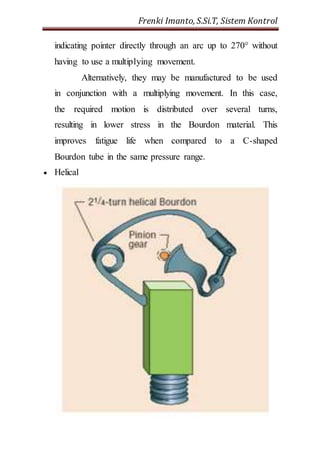
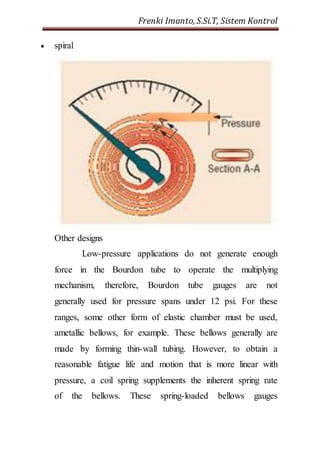
Bourdon tubes also may be made in the form of a 
spiral or a helix. Each uses a long length of flattened tubing 
to provide increased tip travel. This does not change the 
operating principle of the Bourdon tube, but produces tip 
motion equal to the sum of the individual motions that 
would result from each part of the spiral or helix considered 
as a C-shape. Small-diameter spirals and helices can be 
manufactured to provide enough motion to drive the
Frenki Imanto, S.Si.T, Sistem Kontrol 
indicating pointer directly through an arc up to 270° without 
having to use a multiplying movement. 
Alternatively, they may be manufactured to be used 
in conjunction with a multiplying movement. In this case, 
the required motion is distributed over several turns, 
resulting in lower stress in the Bourdon material. This 
improves fatigue life when compared to a C-shaped 
Bourdon tube in the same pressure range. 
 Helical
Frenki Imanto, S.Si.T, Sistem Kontrol 
 spiral 
Other designs 
Low-pressure applications do not generate enough 
force in the Bourdon tube to operate the multiplying 
mechanism, therefore, Bourdon tube gauges are not 
generally used for pressure spans under 12 psi. For these 
ranges, some other form of elastic chamber must be used, 
ametallic bellows, for example. These bellows generally are 
made by forming thin-wall tubing. However, to obtain a 
reasonable fatigue life and motion that is more linear with 
pressure, a coil spring supplements the inherent spring rate 
of the bellows. These spring-loaded bellows gauges
Frenki Imanto, S.Si.T, Sistem Kontrol 
generally are used in pressure ranges having spans to 100 
psi and to 1 in.Hg.

2. materi bourdon (oke)

  • 1.
    Frenki Imanto, S.Si.T,Sistem Kontrol Bourdon's tube pressure gauge The majority of pressure gauges in use have a Bourdon-tube as a measuring element. The Bourdon tube is a device that senses pressure and converts the pressure to displacement. Since the Bourdon-tube displacement is a function of the pressure applied, it may be mechanically amplified and indicated by apointer. Thus, the pointer position indirectly indicates pressure. The Bourdon-tube gauge is available in various tube shapes: curved or C-shaped, helical, and spiral. The size, shape, and material of the tube depend on the pressure range and the type of gauge desired. Low-pressure Bourdon tubes (pressures up to 2000 psi) are often made of phosphor bronze. High-pressure Bourdon tubes (pressures above 2000 psi) are made of stainless steel or other high-strength materials. High- pressure Bourdon tubes tend to have more circular cross sections than their lower-range counterparts, which tend to have oval cross sections. The Bourdon tube most commonly used is the C-shaped metal tube that is sealed at one end and open at the other gauge. Bourdon-tube gauges are now commonly available to measure a wide range of gauge, absolute, sealed, and
  • 2.
    Frenki Imanto, S.Si.T,Sistem Kontrol differential pressures, plus vacuum. They are manufactured to an accuracy as high as 0.1% of span and in dial diameters from 1 1/2 to 16 in. A variety of accessories can extend their performance and usefulness. Snubbers and gauge isolators can be installed to protect the sensitive internal workings from pressure spikes. Three types of elastic chambers are commonly used in gauges :  C-shaped Gauges using C-shaped Bourdon tubes as the elastic chamber, as shown above left, are by far the most common. Pressurized fluid enters the stem at the bottom (which is sometimes entrancement instead) and passes into the Bourdon tube. The tube has a flattened cross section and is sealed at its tip. Any pressure in the tube in excess of the external pressure (usually atmospheric) causes the Bourdon tube to elastically change its shape to a more circular cross section. This change in shape of the cross section tends to straighten the C-shape of the Bourdon tube. With the bottom stem end fixed, the straightening causes the tip at the opposite end to move a short distance — 1/16 to 1/2 in., depending on the size of the tube. A mechanical movement then transmits this tip motion to a gear train that rotates an
  • 3.
    Frenki Imanto, S.Si.T,Sistem Kontrol indicating pointer over a graduated scale to display the applied pressure. Often, a movement is incorporated to provide mechanical advantage to multiply the relatively short movement of the tube tip. Bourdon tubes also may be made in the form of a spiral or a helix. Each uses a long length of flattened tubing to provide increased tip travel. This does not change the operating principle of the Bourdon tube, but produces tip motion equal to the sum of the individual motions that would result from each part of the spiral or helix considered as a C-shape. Small-diameter spirals and helices can be manufactured to provide enough motion to drive the
  • 4.
    Frenki Imanto, S.Si.T,Sistem Kontrol indicating pointer directly through an arc up to 270° without having to use a multiplying movement. Alternatively, they may be manufactured to be used in conjunction with a multiplying movement. In this case, the required motion is distributed over several turns, resulting in lower stress in the Bourdon material. This improves fatigue life when compared to a C-shaped Bourdon tube in the same pressure range.  Helical
  • 5.
    Frenki Imanto, S.Si.T,Sistem Kontrol  spiral Other designs Low-pressure applications do not generate enough force in the Bourdon tube to operate the multiplying mechanism, therefore, Bourdon tube gauges are not generally used for pressure spans under 12 psi. For these ranges, some other form of elastic chamber must be used, ametallic bellows, for example. These bellows generally are made by forming thin-wall tubing. However, to obtain a reasonable fatigue life and motion that is more linear with pressure, a coil spring supplements the inherent spring rate of the bellows. These spring-loaded bellows gauges
  • 6.
    Frenki Imanto, S.Si.T,Sistem Kontrol generally are used in pressure ranges having spans to 100 psi and to 1 in.Hg.