FORMATION OF LIMESTONE
Structure of limestone
• Carboniferous limestone is a hard grey
sedimentary rock which was laid in layers on
the sea-bed
• The horizontal junctions between the layers
are called bedding planes
• Joints are lines of weakness at right angles to
the bedding planes
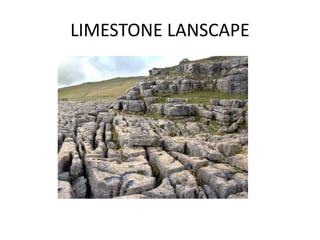
LIMESTONE LANSCAPE
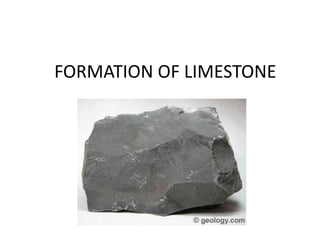
FORMATION OF LIMESTONE
• Limestone is a sedimentary rock composed
primarily of calcium carbonate (CaCO3) in the
form of the mineral calcite.
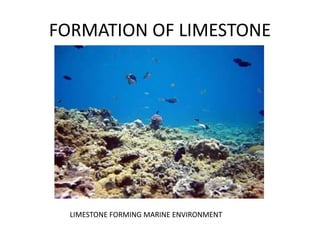
• It most commonly forms in clear, warm, shallow
marine waters. It is usually an organic
sedimentary rock that forms from the
accumulation of shell, coral, algal and fecal
debris.
• It can also be a chemical sedimentary rock
formed by the precipitation of calcium
carbonate from lake or ocean water.
FORMATION OF LIMESTONE
LIMESTONE FORMING MARINE ENVIRONMENT
FORMATION OF LIMESTONE
• Most limestones form in shallow, calm, warm
marine waters.
• When organisms capable of forming calcium
carbonate die their shell and skeletal debris
accumulate as a sediment that might be
lithified* into limestone.
• Limestones formed from this type of
sediment are biological sedimentary rocks.
• Their biological origin is often revealed in the
rock by the presence of fossils.
*Lithify- transform (a sediment or other material) into stone.
FORMATION OF LIMESTONE
• Limestone can also form through evaporation
• In a cave, droplets of water seeping down from
above enter the cave through fractures or
other pore spaces in the cave ceiling
• There they might evaporate before falling to
the cave floor.
• When the water evaporates, any calcium
carbonate that was dissolved in the water will
be deposited on the cave ceiling.
FORMATION OF LIMESTONE
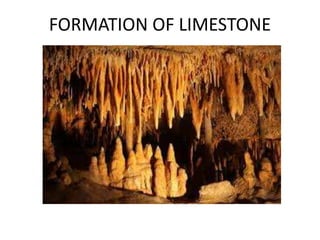
• This evaporative process can result in an
accumulation of icicle-shaped calcium
carbonate on the cave ceiling.
• These deposits are known as stalactites
• If the droplet falls to the floor and evaporates
there a stalagmite could grow upwards from
the cave floor.
• The limestone that makes up these cave
formations is known as "travertine" and is a
chemical sedimentary rock.

2 formation of limestone

  • 1.
  • 2.
    Structure of limestone •Carboniferous limestone is a hard grey sedimentary rock which was laid in layers on the sea-bed • The horizontal junctions between the layers are called bedding planes • Joints are lines of weakness at right angles to the bedding planes
  • 3.
  • 4.
    FORMATION OF LIMESTONE •Limestone is a sedimentary rock composed primarily of calcium carbonate (CaCO3) in the form of the mineral calcite. • It most commonly forms in clear, warm, shallow marine waters. It is usually an organic sedimentary rock that forms from the accumulation of shell, coral, algal and fecal debris. • It can also be a chemical sedimentary rock formed by the precipitation of calcium carbonate from lake or ocean water.
  • 5.
    FORMATION OF LIMESTONE LIMESTONEFORMING MARINE ENVIRONMENT
  • 6.
    FORMATION OF LIMESTONE •Most limestones form in shallow, calm, warm marine waters. • When organisms capable of forming calcium carbonate die their shell and skeletal debris accumulate as a sediment that might be lithified* into limestone. • Limestones formed from this type of sediment are biological sedimentary rocks. • Their biological origin is often revealed in the rock by the presence of fossils. *Lithify- transform (a sediment or other material) into stone.
  • 7.
  • 8.
    FORMATION OF LIMESTONE •Limestone can also form through evaporation • In a cave, droplets of water seeping down from above enter the cave through fractures or other pore spaces in the cave ceiling • There they might evaporate before falling to the cave floor. • When the water evaporates, any calcium carbonate that was dissolved in the water will be deposited on the cave ceiling.
  • 9.
    FORMATION OF LIMESTONE •This evaporative process can result in an accumulation of icicle-shaped calcium carbonate on the cave ceiling. • These deposits are known as stalactites • If the droplet falls to the floor and evaporates there a stalagmite could grow upwards from the cave floor. • The limestone that makes up these cave formations is known as "travertine" and is a chemical sedimentary rock.