Preparedby:SharifOmarSalem–ssalemg@gmail.com
Prepared by: Sharif Omar Salem – ssalemg@gmail.com
0
Preparedby:SharifOmarSalem–ssalemg@gmail.com
Historical View
Set Theory
 Symbolic Logic
 Truth Tables
1
Preparedby:SharifOmarSalem–ssalemg@gmail.com
Philosophical Logic
 500 BC (Before Christ) to 19th Century
Symbolic Logic
 Mid to late 19th Century
Mathematical Logic
 Late 19th to mid 20th Century
Logic in Computer Science
2
Preparedby:SharifOmarSalem–ssalemg@gmail.com
500 B.C – 19th Century
Logic dealt with arguments in the natural language used
by humans.
Example
 All men are moral.
 Socrates is a man
 Therefore, Socrates is moral.
3
Preparedby:SharifOmarSalem–ssalemg@gmail.com
Natural language is very ambiguous.
 Eric does not believe that Mary can pass any test.
 I only borrowed your car.
 Tom hates Jim and he likes Mary.
It led to many paradoxes.
 “This sentence is a lie.” (The Liar’s Paradox)
4
Preparedby:SharifOmarSalem–ssalemg@gmail.com
Mid to late 19th Century.
Attempted to formulate logic in terms of a mathematical
language
Rules of inference were modeled after various laws for
manipulating algebraic expressions.
5
Preparedby:SharifOmarSalem–ssalemg@gmail.com
Late 19th to mid 20th Century
Frege proposed logic as a language for mathematics in
1879.
With the rigor of this new foundation, Cantor was able to
analyze the notion of infinity in ways that were previously
impossible. (2N is strictly larger than N)
Russell’s Paradox
T = { S | S ∉ S}
6
Preparedby:SharifOmarSalem–ssalemg@gmail.com
In computer science, we design and study systems
through the use of formal languages that can
themselves be interpreted by a formal system.
 Boolean circuits
 Programming languages
 Design Validation and verification
 AI, Security. Etc.
7
Preparedby:SharifOmarSalem–ssalemg@gmail.com
Propositional Logic
First Order Logic
Higher Order Logic
Theory of Construction
Real-time Logic, Temporal Logic
Process Algebras
Linear Logic
8
Preparedby:SharifOmarSalem–ssalemg@gmail.com
Understanding set theory helps people to …
 see things in terms of systems
 organize things into groups
 begin to understand logic
9
Preparedby:SharifOmarSalem–ssalemg@gmail.com
These mathematicians influenced the development of set
theory and logic:
 Georg Cantor
 John Venn
 George Boole
 Augustus DeMorgan
10
Preparedby:SharifOmarSalem–ssalemg@gmail.com
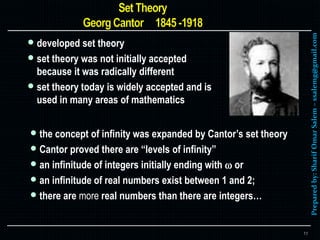
 developed set theory
 set theory was not initially accepted
because it was radically different
 set theory today is widely accepted and is
used in many areas of mathematics
11
 the concept of infinity was expanded by Cantor’s set theory
 Cantor proved there are “levels of infinity”
 an infinitude of integers initially ending with  or
 an infinitude of real numbers exist between 1 and 2;
 there are more real numbers than there are integers…
Preparedby:SharifOmarSalem–ssalemg@gmail.com
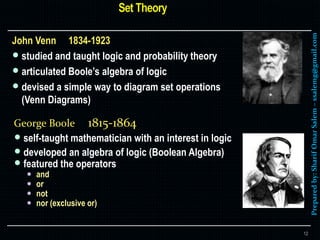
John Venn 1834-1923
 studied and taught logic and probability theory
 articulated Boole’s algebra of logic
 devised a simple way to diagram set operations
(Venn Diagrams)
12
George Boole 1815-1864
 self-taught mathematician with an interest in logic
 developed an algebra of logic (Boolean Algebra)
 featured the operators
 and
 or
 not
 nor (exclusive or)
Preparedby:SharifOmarSalem–ssalemg@gmail.com
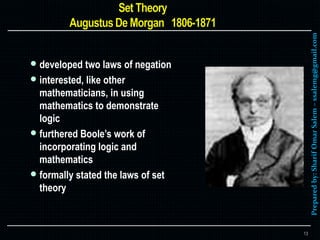
 developed two laws of negation
 interested, like other
mathematicians, in using
mathematics to demonstrate
logic
 furthered Boole’s work of
incorporating logic and
mathematics
 formally stated the laws of set
theory
13
Preparedby:SharifOmarSalem–ssalemg@gmail.com
 A set is a collection of elements
 An element is an object contained in a set
 If every element of Set A is also contained in Set B, then Set A is a
subset of Set B
 A is a proper subset of B if B has more elements than A does
 The universal set contains all of the elements relevant to a given
discussion
14
Preparedby:SharifOmarSalem–ssalemg@gmail.com
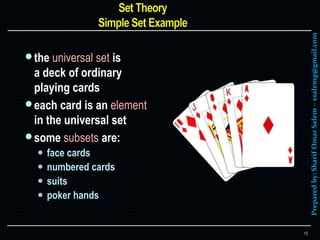
the universal set is
a deck of ordinary
playing cards
each card is an element
in the universal set
some subsets are:
 face cards
 numbered cards
 suits
 poker hands
15
Preparedby:SharifOmarSalem–ssalemg@gmail.com
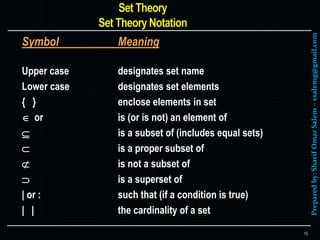
Symbol Meaning
Upper case designates set name
Lower case designates set elements
{ } enclose elements in set
 or is (or is not) an element of
 is a subset of (includes equal sets)
 is a proper subset of
 is not a subset of
 is a superset of
| or : such that (if a condition is true)
| | the cardinality of a set
16

Preparedby:SharifOmarSalem–ssalemg@gmail.com
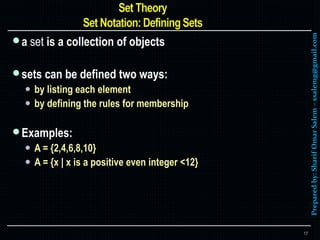
a set is a collection of objects
sets can be defined two ways:
 by listing each element
 by defining the rules for membership
Examples:
 A = {2,4,6,8,10}
 A = {x | x is a positive even integer <12}
17
Preparedby:SharifOmarSalem–ssalemg@gmail.com
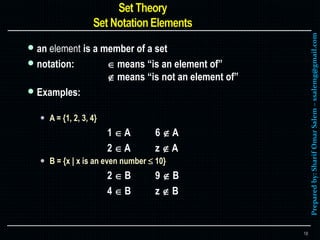
 an element is a member of a set
 notation:  means “is an element of”
 means “is not an element of”
 Examples:
 A = {1, 2, 3, 4}
1  A 6  A
2  A z  A
 B = {x | x is an even number  10}
2  B 9  B
4  B z  B
18
Preparedby:SharifOmarSalem–ssalemg@gmail.com
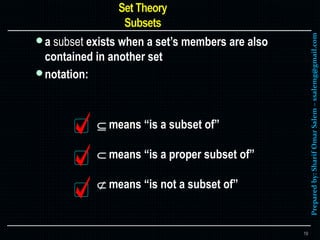
a subset exists when a set’s members are also
contained in another set
notation:
 means “is a subset of”
 means “is a proper subset of”
 means “is not a subset of”
19
Preparedby:SharifOmarSalem–ssalemg@gmail.com
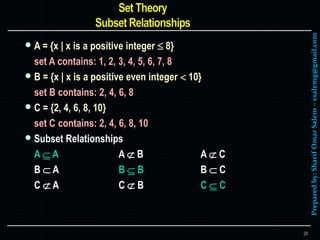
 A = {x | x is a positive integer  8}
set A contains: 1, 2, 3, 4, 5, 6, 7, 8
 B = {x | x is a positive even integer  10}
set B contains: 2, 4, 6, 8
 C = {2, 4, 6, 8, 10}
set C contains: 2, 4, 6, 8, 10
 Subset Relationships
A  A A  B A  C
B  A B  B B  C
C  A C  B C  C
20
Preparedby:SharifOmarSalem–ssalemg@gmail.com
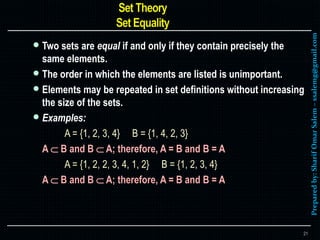
 Two sets are equal if and only if they contain precisely the
same elements.
 The order in which the elements are listed is unimportant.
 Elements may be repeated in set definitions without increasing
the size of the sets.
 Examples:
A = {1, 2, 3, 4} B = {1, 4, 2, 3}
A  B and B  A; therefore, A = B and B = A
A = {1, 2, 2, 3, 4, 1, 2} B = {1, 2, 3, 4}
A  B and B  A; therefore, A = B and B = A
21
Preparedby:SharifOmarSalem–ssalemg@gmail.com
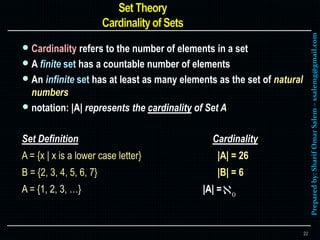
 Cardinality refers to the number of elements in a set
 A finite set has a countable number of elements
 An infinite set has at least as many elements as the set of natural
numbers
 notation: |A| represents the cardinality of Set A
Set Definition Cardinality
A = {x | x is a lower case letter} |A| = 26
B = {2, 3, 4, 5, 6, 7} |B| = 6
A = {1, 2, 3, …} |A| =
22
Preparedby:SharifOmarSalem–ssalemg@gmail.com
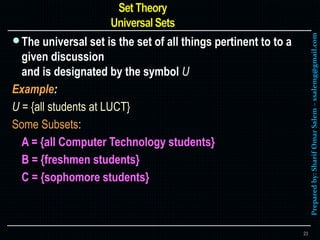
The universal set is the set of all things pertinent to to a
given discussion
and is designated by the symbol U
Example:
U = {all students at LUCT}
Some Subsets:
A = {all Computer Technology students}
B = {freshmen students}
C = {sophomore students}
23
Preparedby:SharifOmarSalem–ssalemg@gmail.com
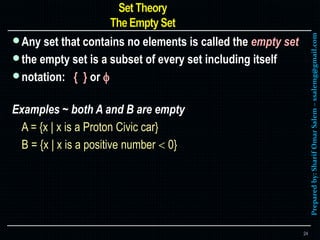
Any set that contains no elements is called the empty set
the empty set is a subset of every set including itself
notation: { } or 
Examples ~ both A and B are empty
A = {x | x is a Proton Civic car}
B = {x | x is a positive number  0}
24
Preparedby:SharifOmarSalem–ssalemg@gmail.com
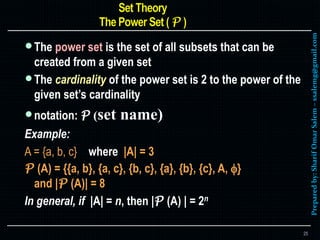
The power set is the set of all subsets that can be
created from a given set
The cardinality of the power set is 2 to the power of the
given set’s cardinality
notation: P (set name)
Example:
A = {a, b, c} where |A| = 3
P (A) = {{a, b}, {a, c}, {b, c}, {a}, {b}, {c}, A, }
and |P (A)| = 8
In general, if |A| = n, then |P (A) | = 2n
25
Preparedby:SharifOmarSalem–ssalemg@gmail.com
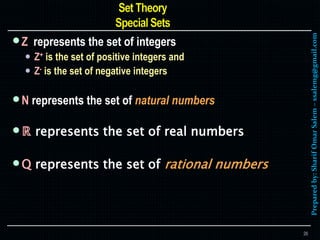
Z represents the set of integers
 Z+ is the set of positive integers and
 Z- is the set of negative integers
N represents the set of natural numbers
ℝ represents the set of real numbers
Q represents the set of rational numbers
26
Preparedby:SharifOmarSalem–ssalemg@gmail.com
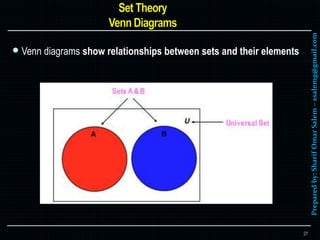
 Venn diagrams show relationships between sets and their elements
27
Preparedby:SharifOmarSalem–ssalemg@gmail.com
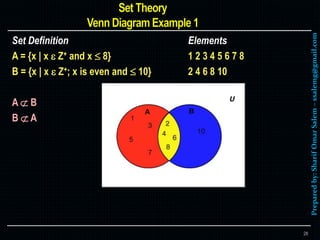
Set Definition Elements
A = {x | x  Z+ and x  8} 1 2 3 4 5 6 7 8
B = {x | x  Z+; x is even and  10} 2 4 6 8 10
A  B
B  A
28
Preparedby:SharifOmarSalem–ssalemg@gmail.com
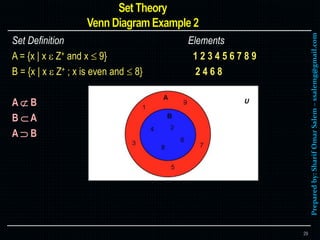
Set Definition Elements
A = {x | x  Z+ and x  9} 1 2 3 4 5 6 7 8 9
B = {x | x  Z+ ; x is even and  8} 2 4 6 8
A  B
B  A
A  B
29
Preparedby:SharifOmarSalem–ssalemg@gmail.com
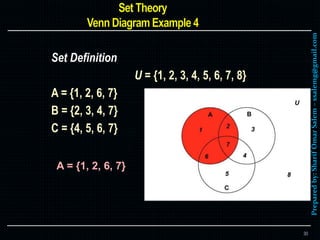
Set Definition
U = {1, 2, 3, 4, 5, 6, 7, 8}
A = {1, 2, 6, 7}
B = {2, 3, 4, 7}
C = {4, 5, 6, 7}
30
A = {1, 2, 6, 7}
Preparedby:SharifOmarSalem–ssalemg@gmail.com

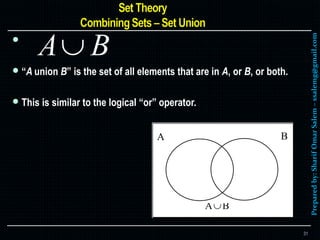
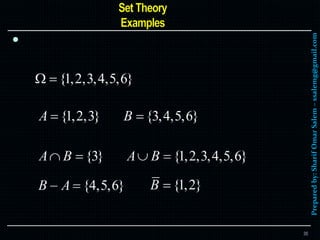
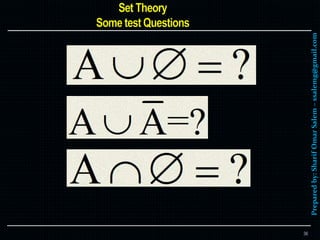
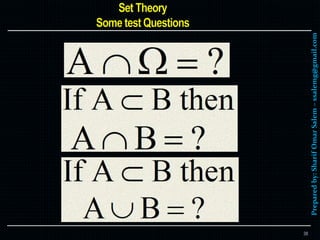
 “A union B” is the set of all elements that are in A, or B, or both.
 This is similar to the logical “or” operator.
A B
A BÈ
31
Preparedby:SharifOmarSalem–ssalemg@gmail.com

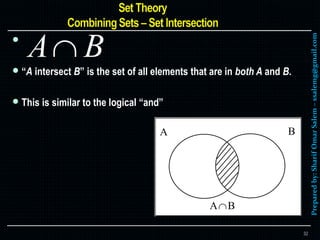
 “A intersect B” is the set of all elements that are in both A and B.
 This is similar to the logical “and”
A B
A BÇ
32
Preparedby:SharifOmarSalem–ssalemg@gmail.com

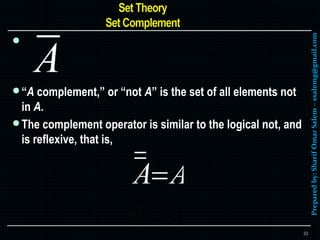
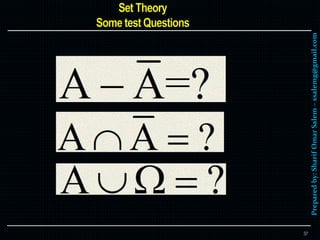
“A complement,” or “not A” is the set of all elements not
in A.
The complement operator is similar to the logical not, and
is reflexive, that is,
A A
33
Preparedby:SharifOmarSalem–ssalemg@gmail.com

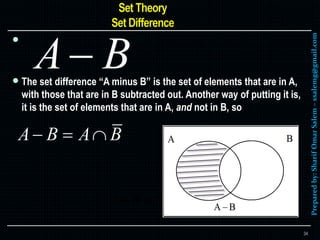
 The set difference “A minus B” is the set of elements that are in A,
with those that are in B subtracted out. Another way of putting it is,
it is the set of elements that are in A, and not in B, so
A B A B  Ç
34
Preparedby:SharifOmarSalem–ssalemg@gmail.com

35
Preparedby:SharifOmarSalem–ssalemg@gmail.com
36
Preparedby:SharifOmarSalem–ssalemg@gmail.com
37
Preparedby:SharifOmarSalem–ssalemg@gmail.com
38
Preparedby:SharifOmarSalem–ssalemg@gmail.com
Symbolic logic is
 a collection of languages that use symbols to represent facts,
events, and actions,
 and provide rules to symbolize reasoning.
Given the specification of a system and a collection of
desirable properties, both written in logic formulas, we can
attempt to prove that these desirable properties are logical
consequences of the specification.
39
Preparedby:SharifOmarSalem–ssalemg@gmail.com
 Definition of a statement:
A statement, also called a proposition, is a sentence that is either
true or false, but not both.
 Hence the truth value of a statement is T (1) or F (0)
 Examples: Which ones are statements?
 All mathematicians wear sandals.
 5 is greater than –2.
 Where do you live?
 You are a cool person.
 Anyone who wears sandals is an algebraist.
40
Preparedby:SharifOmarSalem–ssalemg@gmail.com
 An example to illustrate how logic really helps us (3 statements
written below):
 All LUCT staff wear Black.
 Anyone who wears black is an employee.
 Therefore, all LUCT staff are employees.
 Logic is of no help in determining the individual truth of these
statements.
 Logic helps in concluding fact from another facts (reasoning)
 However, if the first two statements are true, logic assures the truth of
the third statement.
 Logical methods are used in mathematics to prove theorems and in
computer science to prove that programs do what they are
supposed to do.
41
Preparedby:SharifOmarSalem–ssalemg@gmail.com
 Usually, letters like A, B, C, D, etc. are used to represent statements.
 Logical connectives are symbols such as
 Λ , V ,  ,  , ’
Λ represents and, V represents or,  represents equivalence,
 represents implication, ‘ represents negation.
 A statement form or propositional form is an expression made up
of statement variables (such as A, B, and C) and logical connectives
(such as Λ, V, , )
 Example: (A V B)  (B Λ C)
42
Preparedby:SharifOmarSalem–ssalemg@gmail.com
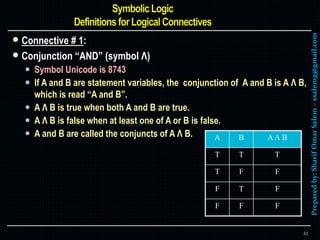
 Connective # 1:
 Conjunction “AND” (symbol Λ)
 Symbol Unicode is 8743
 If A and B are statement variables, the conjunction of A and B is A Λ B,
which is read “A and B”.
 A Λ B is true when both A and B are true.
 A Λ B is false when at least one of A or B is false.
 A and B are called the conjuncts of A Λ B.
43
A B AΛ B
T T T
T F F
F T F
F F F
Preparedby:SharifOmarSalem–ssalemg@gmail.com
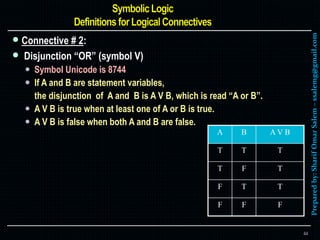
 Connective # 2:
 Disjunction “OR” (symbol V)
 Symbol Unicode is 8744
 If A and B are statement variables,
the disjunction of A and B is A V B, which is read “A or B”.
 A V B is true when at least one of A or B is true.
 A V B is false when both A and B are false.
44
A B A V B
T T T
T F T
F T T
F F F
Preparedby:SharifOmarSalem–ssalemg@gmail.com
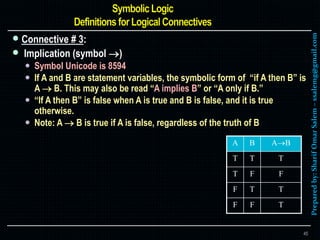
 Connective # 3:
 Implication (symbol )
 Symbol Unicode is 8594
 If A and B are statement variables, the symbolic form of “if A then B” is
A  B. This may also be read “A implies B” or “A only if B.”
 “If A then B” is false when A is true and B is false, and it is true
otherwise.
 Note: A  B is true if A is false, regardless of the truth of B
45
A B AB
T T T
T F F
F T T
F F T
Preparedby:SharifOmarSalem–ssalemg@gmail.com
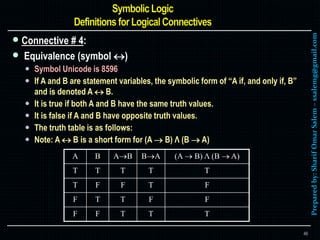
 Connective # 4:
 Equivalence (symbol )
 Symbol Unicode is 8596
 If A and B are statement variables, the symbolic form of “A if, and only if, B”
and is denoted A  B.
 It is true if both A and B have the same truth values.
 It is false if A and B have opposite truth values.
 The truth table is as follows:
 Note: A  B is a short form for (A  B) Λ (B  A)
46
A B AB BA (A  B) Λ (B  A)
T T T T T
T F F T F
F T T F F
F F T T T
Preparedby:SharifOmarSalem–ssalemg@gmail.com
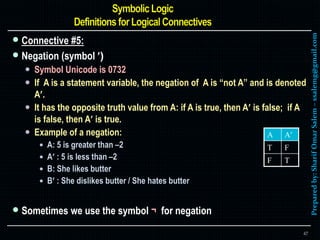
 Connective #5:
 Negation (symbol )
 Symbol Unicode is 0732
 If A is a statement variable, the negation of A is “not A” and is denoted
A.
 It has the opposite truth value from A: if A is true, then A is false; if A
is false, then A is true.
 Example of a negation:
 A: 5 is greater than –2
 A : 5 is less than –2
 B: She likes butter
 B : She dislikes butter / She hates butter
 Sometimes we use the symbol ¬ for negation
47
A A
T F
F T
Preparedby:SharifOmarSalem–ssalemg@gmail.com
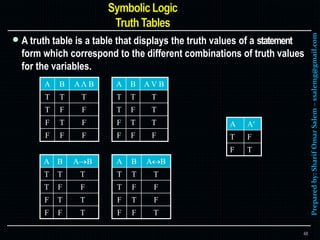
 A truth table is a table that displays the truth values of a statement
form which correspond to the different combinations of truth values
for the variables.
48
A A
T F
F T
A B AΛ B
T T T
T F F
F T F
F F F
A B A V B
T T T
T F T
F T T
F F F
A B AB
T T T
T F F
F T T
F F T
A B AB
T T T
T F F
F T F
F F T
Preparedby:SharifOmarSalem–ssalemg@gmail.com
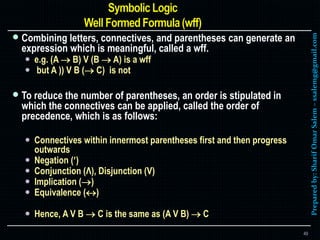
 Combining letters, connectives, and parentheses can generate an
expression which is meaningful, called a wff.
 e.g. (A  B) V (B  A) is a wff
 but A )) V B ( C) is not
 To reduce the number of parentheses, an order is stipulated in
which the connectives can be applied, called the order of
precedence, which is as follows:
 Connectives within innermost parentheses first and then progress
outwards
 Negation ()
 Conjunction (Λ), Disjunction (V)
 Implication ()
 Equivalence ()
 Hence, A V B  C is the same as (A V B)  C
49
Preparedby:SharifOmarSalem–ssalemg@gmail.com
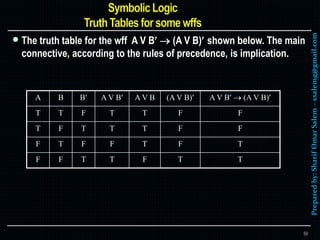
 The truth table for the wff A V B  (A V B) shown below. The main
connective, according to the rules of precedence, is implication.
50
A B B A V B A V B (A V B) A V B  (A V B)
T T F T T F F
T F T T T F F
F T F F T F T
F F T T F T T
Preparedby:SharifOmarSalem–ssalemg@gmail.com
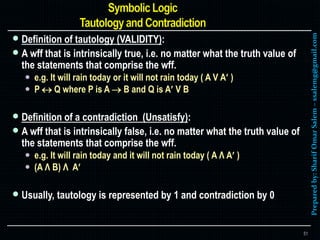
 Definition of tautology (VALIDITY):
 A wff that is intrinsically true, i.e. no matter what the truth value of
the statements that comprise the wff.
 e.g. It will rain today or it will not rain today ( A V A )
 P  Q where P is A  B and Q is A V B
 Definition of a contradiction (Unsatisfy):
 A wff that is intrinsically false, i.e. no matter what the truth value of
the statements that comprise the wff.
 e.g. It will rain today and it will not rain today ( A Λ A )
 (A Λ B) Λ A
 Usually, tautology is represented by 1 and contradiction by 0
51
Preparedby:SharifOmarSalem–ssalemg@gmail.com
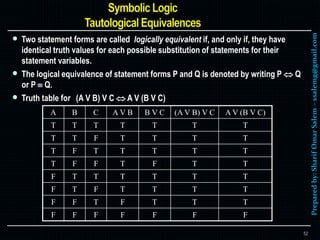
 Two statement forms are called logically equivalent if, and only if, they have
identical truth values for each possible substitution of statements for their
statement variables.
 The logical equivalence of statement forms P and Q is denoted by writing P  Q
or P  Q.
 Truth table for (A V B) V C  A V (B V C)
52
A B C A V B B V C (A V B) V C A V (B V C)
T T T T T T T
T T F T T T T
T F T T T T T
T F F T F T T
F T T T T T T
F T F T T T T
F F T F T T T
F F F F F F F
Preparedby:SharifOmarSalem–ssalemg@gmail.com
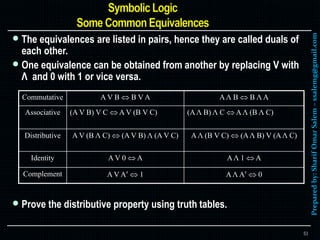
 The equivalences are listed in pairs, hence they are called duals of
each other.
 One equivalence can be obtained from another by replacing V with
Λ and 0 with 1 or vice versa.
 Prove the distributive property using truth tables.
53
Commutative A V B  B V A AΛ B  B Λ A
Associative (A V B) V C  A V (B V C) (AΛ B) Λ C  AΛ (B Λ C)
Distributive A V (B Λ C)  (A V B) Λ (A V C) AΛ (B V C)  (AΛ B) V (AΛ C)
Identity A V 0  A AΛ 1  A
Complement A V A  1 AΛ A  0
Preparedby:SharifOmarSalem–ssalemg@gmail.com
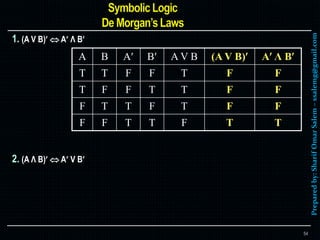
1. (A V B)  A Λ B
2. (A Λ B)  A V B
54
A B A B A V B (A V B) A Λ B
T T F F T F F
T F F T T F F
F T T F T F F
F F T T F T T
Preparedby:SharifOmarSalem–ssalemg@gmail.com
Prepared by: Sharif Omar Salem – ssalemg@gmail.com
55
Preparedby:SharifOmarSalem–ssalemg@gmail.com
Prepared by: Sharif Omar Salem – ssalemg@gmail.com
56

#2 formal methods – principles of logic